December 19: BTC, ETH, SOL, RTX, ZKP Market Analysis

金色财经Опубликовано 2025-12-19Обновлено 2025-12-19

Введение

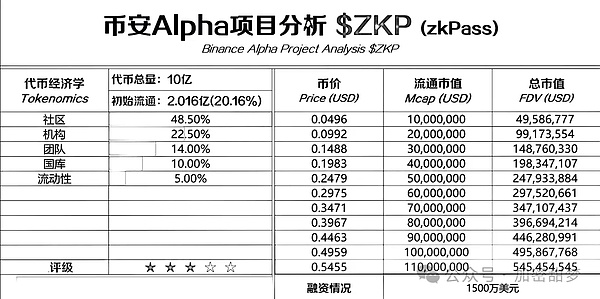
On December 19, analysis of BTC, ETH, SOL, RTX, and ZKP market trends was provided. BTC experienced volatility following favorable CPI data, briefly rising above $89,000 before dropping to around $84,000, resulting in $450 million in liquidations. A whale deposited 5,152 BTC ($445 million) into Binance. The 4-hour chart suggests a potential falling wedge pattern, indicating a possible reversal if it breaks above the $89,000–$90,000 resistance. ETH showed a strong rebound, possibly due to large-scale accumulation after recent negative news. It remains in a downtrend channel but may break out soon. Key resistance levels are $3,030 and $3,150, with support at $2,860, $2,750, and $2,650. SOL has been underperforming, falling below $120. It failed multiple times to break the $145 resistance. A rebound above $123 could target $132–$135. RTX has a total supply of 100 million tokens with an initial circulation of 16.66%. Pre-market price is $1.30. The project having mixed factors—moderate trading volume and unclear advantages. ZKP has a total supply of 1 billion tokens, with an initial circulation of 20.16% priced at $0.175. Significant airdrop supply may cause selling pressure. A Binance contract listing is anticipated. The overall outlook suggests potential recovery after recent declines, with specific entry and exit levels provided for each asset.

Last night's CPI data was favorable for risk assets. After the data was released, Bitcoin briefly surged above 89,000 but quickly dropped to around 84,000. The futures market saw liquidations as high as $450 million.

BTC OG whales deposited 5,152 BTC (approximately $445 million) into Binance. Currently, there are no signs of a halt in the decline or stabilization from the market perspective. However, after the Bank of Japan's interest rate hike was implemented, market panic sentiment is expected to improve.

BTC

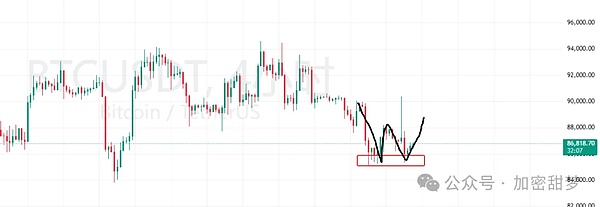
From the 4-hour chart, this decline appears to be a falling wedge pattern, likely the final leg of the drop. It's uncertain whether this pattern will fully form, as the overall trend remains bearish. However, considering the short-term rebound potential, I'm temporarily holding off on short positions and will keep my long positions for now.

Watch the 89,000-90,000 range. If it breaks and stabilizes above this level with strong upward momentum, it's highly likely to confirm the falling wedge pattern, indicating a potential trend reversal.

The current rebound isn't over yet. Keep an eye on the upper resistance line for further analysis.

ETH

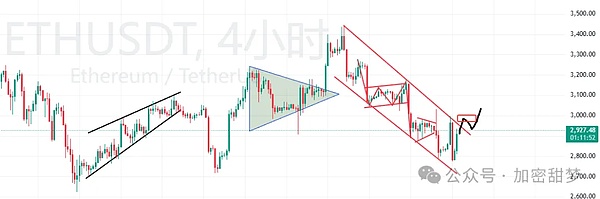
ETH's rebound has been quite strong, possibly due to the resolution of negative news, prompting large funds to start buying in batches. This led to a rapid price rebound. Although it's still within a descending channel, the 4-hour chart shows consecutive golden crosses at low levels, suggesting a likely breakout in the short term.

Key resistance levels to watch are 3030 and 3150. Consider shorting around these levels.

Support levels are at 2860, 2750, and 2650. For medium-term short, target 2500.

SOL

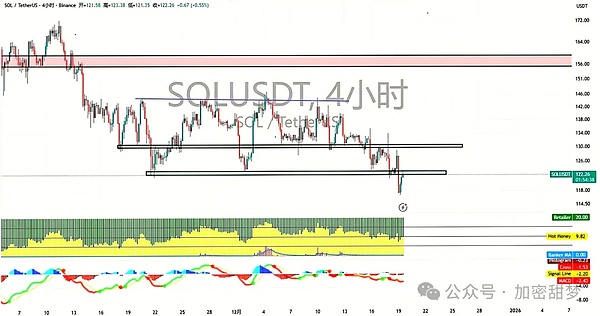
Recently, SOL has been relatively sluggish. Last night, it broke below the 120 mark. During this phase, SOL's performance has been quite weak, failing to break above the 145 resistance three times. The support at 122 was directly broken, indicating selling pressure for some time. If it stabilizes above 123, consider buying long with targets at 132-135.

RTX

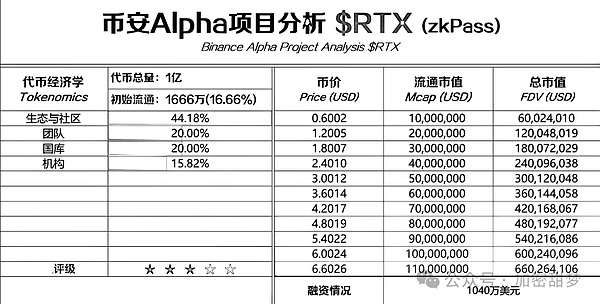
Total supply: 100 million. Initial circulation: 16.66%. Pre-market price: 1.3. Pool price: 1.2.

Pros: 1. Second Aster USD1 trading pair. 2. Community anti-sybil measures, though not as high as 1.33%.

Cons: 1. On-chain TVL is 44 million. 2. The fundraising timing is questionable, with no clear justification for the November fundraising. TVL performance hasn't been strong enough to support the token launch.

The project seems average, with mediocre trading volume and no significant advantages. The pre-market valuation is neither high nor low. Keep an eye on it after launch.

ZKP

Total token supply: 1 billion. Initial circulation: 201.6 million (20.16%). Pre-market and pool price: 0.175U. Corresponding circulating market cap: $35 million. FDV: $175 million.

Kaito presale: 2%, with half unlocked at TGE. Claims open on the Ethereum network at 20:00. Aspecta key presale: 0.2% of tokens available for exchange within 2 hours of TGE. Additional community airdrops, Kaito sybil airdrops, and Binance BOOSTER 10 million tokens mean there are quite a few scattered tokens outside.

However, the project team hasn't clarified the airdrop quantity, which is quite sneaky. Price maintenance and Binance contract listings shouldn't be an issue. After various airdrops are sold off, consider whether to take a position for a contract listing.

If you find our content helpful, share our public account with your friends! Welcome to follow and stay updated with the latest crypto news! After every crash comes vast opportunities. If you're unsure about future market strategies, follow Tianmeng and contact: RFGH8689

Связанные с этим вопросы

QWhat was the market reaction to the CPI data release according to the article?

AThe CPI data was favorable for risk assets, causing Bitcoin to rise above $89,000 initially, but it was quickly sold off, dropping to around $84,000, with $450 million in contracts liquidated.

QWhat pattern is BTC疑似 forming on the 4-hour chart, and what would confirm it?

ABTC is疑似 forming a falling wedge pattern on the 4-hour chart. It would be confirmed if the price breaks and stabilizes above the $89,000-$90,000 range with strong upward momentum, indicating a potential trend reversal.

QWhat are the key resistance and support levels mentioned for ETH?

AThe key resistance levels for ETH are $3,030 and $3,150, where shorting is suggested. Support levels are $2,860, $2,750, and $2,650, with a bearish target of $2,500 for a波段空 (swing short).

QWhy does the article describe SOL's recent performance as '拉胯' (underwhelming)?

ASOL's performance is described as underwhelming because it failed to break above the $145 resistance three times and recently fell below the $120 support level, indicating sustained selling pressure.

QWhat are the initial circulating supply and FDV (fully diluted valuation) for ZKP?

AZKP has an initial circulating supply of 201.6 million tokens (20.16% of total supply) and an FDV of $175 million based on a pre-listing and pool price of $0.175 per token.

Похожее

Super-Rich Hoarded Record Cash in February, Stock Market Hit New Highs Four Months Later: Who's Getting Fooled?

In February, the total assets in US money market funds reached a record high of approximately $8.25 trillion, a trend highlighted by high-net-worth individuals increasing their cash holdings. Notably, Warren Buffett's Berkshire Hathaway amassed a $381.7 billion cash pile ahead of his 2025 retirement, while other prominent figures like Peter Thiel sold tech stocks, fueling narratives of wealthy investors seeking safety. However, by June, the trend reversed. Money market fund assets fell to around $7.87 trillion, indicating a flow of capital back into equities. Concurrently, the S&P 500 and Nasdaq reached all-time highs, with the S&P 500 surpassing 7600 points. This market surge occurred despite the earlier defensive moves, highlighting a potential opportunity cost for those who retreated to cash. Analysis shows that since early 2022, the S&P 500's total return significantly outpaced that of prime money market funds. The capital shifted from equities appears to have been partly reallocated into alternative investments like real estate, art, and private credit, especially among ultra-high-net-worth individuals. Meanwhile, major investment banks like Goldman Sachs and Morgan Stanley have raised their year-end targets for the S&P 500, citing AI-driven earnings growth, while also cautioning about risks including market concentration and economic fragility beneath the surface rally.

marsbit11 мин. назад

Super-Rich Hoarded Record Cash in February, Stock Market Hit New Highs Four Months Later: Who's Getting Fooled?

marsbit11 мин. назад

Robot Vacuums Have Been Competing for 20 Years, So Why Are 90% of Chinese Households Still Hesitant?

The article explores why over 90% of Chinese households are still hesitant to adopt robotic vacuum cleaners despite two decades of industry development, identifying a core "trust gap" as the primary barrier. The central issue is not a lack of need, but user concerns about reliability in dynamic, real-world home environments. Common anxieties include the robot dragging pet waste, colliding with transparent objects, tangling in cords, scattering cat litter, getting stuck on thresholds, missing corners under furniture, and requiring high-maintenance bases that develop odors. The industry's past focus on competing on technical specs (suction power, mopping functions) has not adequately addressed these practical usability and trust problems. The piece then examines DJI's entry into the market with its ROMO 2 model as a potential new approach. Leveraging its expertise in spatial perception and obstacle avoidance from drones, DJI's solution emphasizes "less intervention" through three key principles: less manual re-cleaning, less user rescue missions, and less maintenance. Specific ROMO 2 features highlighted include advanced obstacle recognition (handling transparent objects and small items), adaptive leg mechanisms for climbing thresholds (up to 8.5cm), an extendable arm for reaching under furniture, AI for identifying and appropriately handling different mess types (e.g., avoiding scattering dry debris), and a self-cleaning base designed to minimize user upkeep. The article argues the next phase of competition should shift from a "parameter race" to a "trust race." It draws a parallel to the iPhone's simplification of the smartphone, suggesting that focusing on a reliable, low-hassle user experience—where people feel confident leaving their floors to the machine—is what's needed to finally convince the vast majority of观望ing families. The ultimate test for products like the ROMO 2 will be long-term user adoption, retention, and口碑, not just technical specifications.

marsbit11 мин. назад

Robot Vacuums Have Been Competing for 20 Years, So Why Are 90% of Chinese Households Still Hesitant?

marsbit11 мин. назад

The Unclear American Economy: Resilient or Cooling Down?

**U.S. Economic Outlook: Resilient or Cooling Down?** This analysis examines whether the U.S. economy is heading towards a recession. While still growing, the economy shows significant signs of strain. Key data points include Q1 2026 GDP growth of 1.6% and Q1 PCE inflation at 4.5% (annualized), more than double the Fed's target. The labor market remains resilient but is softening, with unemployment at 4.3%. Critical recession indicators present a mixed picture: the yield curve has normalized after a prolonged inversion (historically a late-cycle signal), and the Conference Board's Leading Economic Index has been declining. Current recession probability for 2026 is estimated at 19%, but rises to 41% for 2027, indicating heightened delayed risks. Major pressures are building: a wall of corporate debt refinancing at higher rates, depleted consumer savings, a contracting housing sector, and an energy price shock. The economy exhibits stagflationary characteristics—high inflation alongside slowing growth—which constrains the Federal Reserve's policy options. Historical patterns show recessions are often preceded by Fed tightening and yield curve inversions. If a recession occurs, it is expected to be mild, similar to 2001 rather than 2008. For investors, a defensive portfolio shift toward staples, healthcare, and short-term high-quality bonds may be prudent, while maintaining a long-term, diversified perspective. Key developments to monitor include upcoming GDP, employment, and inflation data, as well as policy signals from the new Fed Chair.

marsbit18 мин. назад

The Unclear American Economy: Resilient or Cooling Down?

marsbit18 мин. назад

The Most Advanced Large Models Are Now Subject to Export Controls Like Enriched Uranium

In an unprecedented move mirroring the control of enriched uranium, the US Commerce Department has imposed an export control ban on Anthropic's advanced AI models, Fable 5 and Mythos 5, forcing their global shutdown. This marks the first time a purely digital entity—a set of neural network weights—has been subjected to such hardware-like strategic export restrictions, based not on physical scarcity but on its concentrated "capability density." The article draws a direct parallel to the historical control of nuclear technology, arguing that just as uranium ore becomes a controlled substance only when enriched to a critical threshold, AI capabilities become subject to regulation when compressed into a single, potent, and easily accessible interface. This "enriched AI" is seen as crossing a threshold where its aggregated power poses a potential threat. The author predicts three major consequences over the next decade. First, capability auditing will become institutionalized, with governments setting compliance checklists and thresholds for model power, triggering automatic export controls. Second, jurisdictional boundaries will blur as US export controls extend their reach globally, governing any user of American AI services regardless of location, forcing non-US entities to reconsider their AI supply chain dependencies. Third, a technological bifurcation will occur, splitting the AI landscape into a restricted, high-risk track of advanced US proprietary models and a more reliable track of open-source or locally developed alternatives, where guaranteed access may outweigh raw performance. The core crisis exposed is the lack of a legal property rights framework for AI "intelligence." While companies invest heavily in integrating these models into their production systems, legally they only purchase a service that can be revoked at any time, leaving them with no recourse for their sunk investments. The conclusion warns of a permanently fractured digital world where the most capable models may not be the most usable, and clear, unassailable ownership of technology will become paramount.

marsbit31 мин. назад

The Most Advanced Large Models Are Now Subject to Export Controls Like Enriched Uranium

marsbit31 мин. назад

Торговля

Спот
Фьючерсы

Популярные статьи

Тест по Bitcoin Биткоина

HTX Learn: Изучите Bitcoin halving и Заработаете Токены USDT

3.1k просмотров всегоОпубликовано 2024.04.16Обновлено 2024.04.16

Тест по Bitcoin  Биткоина

Что такое $BITCOIN

ЦИФРОВОЕ ЗОЛОТО ($BITCOIN): Комплексный анализ Введение в ЦИФРОВОЕ ЗОЛОТО ($BITCOIN) ЦИФРОВОЕ ЗОЛОТО ($BITCOIN) — это проект на основе блокчейна, работающий в сети Solana, который стремится объединить характеристики традиционных драгоценных металлов с инновациями децентрализованных технологий. Хотя он носит имя Биткойн, часто называемого “цифровым золотом” из-за его восприятия как средства хранения ценности, ЦИФРОВОЕ ЗОЛОТО является отдельным токеном, предназначенным для создания уникальной экосистемы в ландшафте Web3. Его цель — позиционировать себя как жизнеспособный альтернативный цифровой актив, хотя детали его применения и функциональности все еще развиваются. Что такое ЦИФРОВОЕ ЗОЛОТО ($BITCOIN)? ЦИФРОВОЕ ЗОЛОТО ($BITCOIN) — это токен криптовалюты, специально разработанный для использования в блокчейне Solana. В отличие от Биткойна, который выполняет широко признанную роль хранения ценности, этот токен, похоже, сосредоточен на более широких приложениях и характеристиках. Примечательные аспекты включают: Инфраструктура блокчейна: Токен построен на блокчейне Solana, известном своей способностью обрабатывать высокоскоростные и недорогие транзакции. Динамика предложения: ЦИФРОВОЕ ЗОЛОТО имеет максимальное предложение, ограниченное 100 квадриллионами токенов (100P $BITCOIN), хотя детали о его обращающемся предложении в настоящее время не раскрыты. Утилита: Хотя точные функциональные возможности не описаны, есть указания на то, что токен может быть использован для различных приложений, потенциально связанных с децентрализованными приложениями (dApps) или стратегиями токенизации активов. Кто создатель ЦИФРОВОГО ЗОЛОТА ($BITCOIN)? На данный момент личность создателей и команды разработчиков, стоящих за ЦИФРОВЫМ ЗОЛОТОМ ($BITCOIN), остается неизвестной. Эта ситуация типична для многих инновационных проектов в области блокчейна, особенно тех, которые связаны с децентрализованными финансами и феноменом мем-криптовалют. Хотя такая анонимность может способствовать культуре, ориентированной на сообщество, она усиливает опасения по поводу управления и ответственности. Кто инвесторы ЦИФРОВОГО ЗОЛОТА ($BITCOIN)? Доступная информация указывает на то, что у ЦИФРОВОГО ЗОЛОТА ($BITCOIN) нет известных институциональных спонсоров или значительных венчурных капиталовложений. Проект, похоже, функционирует по модели пирингового взаимодействия, сосредоточенной на поддержке и принятии сообществом, а не на традиционных путях финансирования. Его активность и ликвидность в основном сосредоточены на децентрализованных биржах (DEX), таких как PumpSwap, а не на устоявшихся централизованных торговых платформах, что еще больше подчеркивает его подход, ориентированный на grassroots. Как работает ЦИФРОВОЕ ЗОЛОТО ($BITCOIN) Операционные механизмы ЦИФРОВОГО ЗОЛОТА ($BITCOIN) можно подробно описать на основе его дизайна блокчейна и характеристик сети: Механизм консенсуса: Используя уникальный механизм доказательства истории (PoH) Solana в сочетании с моделью доказательства доли (PoS), проект обеспечивает эффективную валидацию транзакций, что способствует высокой производительности сети. Токеномика: Хотя конкретные дефляционные механизмы не были подробно описаны, большое максимальное предложение токенов подразумевает, что оно может быть предназначено для микротранзакций или нишевых случаев использования, которые еще предстоит определить. Интероперабельность: Существует потенциал для интеграции с более широкой экосистемой Solana, включая различные платформы децентрализованных финансов (DeFi). Однако детали относительно конкретных интеграций остаются неуточненными. Хронология ключевых событий Вот хронология, которая подчеркивает значимые вехи, касающиеся ЦИФРОВОГО ЗОЛОТА ($BITCOIN): 2023: Первоначальное развертывание токена происходит в блокчейне Solana, отмеченное его адресом контракта. 2024: ЦИФРОВОЕ ЗОЛОТО приобретает видимость, когда оно становится доступным для торговли на децентрализованных биржах, таких как PumpSwap, позволяя пользователям обменивать его на SOL. 2025: Проект наблюдает спорадическую торговую активность и потенциальный интерес к инициативам, возглавляемым сообществом, хотя на данный момент не зафиксировано никаких значительных партнерств или технических достижений. Критический анализ Сильные стороны Масштабируемость: Основная инфраструктура Solana поддерживает высокие объемы транзакций, что может повысить полезность $BITCOIN в различных сценариях транзакций. Доступность: Потенциально низкая цена торговли за токен может привлечь розничных инвесторов, способствуя более широкому участию благодаря возможностям дробного владения. Риски Отсутствие прозрачности: Отсутствие публично известных спонсоров, разработчиков или процесса аудита может вызвать скептицизм относительно устойчивости и надежности проекта. Волатильность рынка: Торговая активность сильно зависит от спекулятивного поведения, что может привести к значительной волатильности цен и неопределенности для инвесторов. Заключение ЦИФРОВОЕ ЗОЛОТО ($BITCOIN) является интригующим, но неоднозначным проектом в быстро развивающейся экосистеме Solana. Хотя он пытается использовать нарратив “цифрового золота”, его отход от установленной роли Биткойна как средства хранения ценности подчеркивает необходимость более четкого различения его предполагаемой утилиты и структуры управления. Будущее принятие и усвоение, вероятно, будут зависеть от решения текущей непрозрачности и более четкого определения его операционных и экономических стратегий. Примечание: Этот отчет охватывает синтезированную информацию, доступную на октябрь 2023 года, и с тех пор могут произойти события.

99 просмотров всегоОпубликовано 2025.05.13Обновлено 2025.05.13

Что такое $BITCOIN

Fractal Bitcoin: масштабирование Биткоина с помощью рекурсивной системы

Fractal Bitcoin — масштабное Layer-1-решнение, созданное на базе кода Биткоина, позволяющего достигать бесконечного масштабирования с помощью рекурсивного подхода.

2.3k просмотров всегоОпубликовано 2025.06.30Обновлено 2025.06.30

Fractal Bitcoin: масштабирование Биткоина с помощью рекурсивной системы

Обсуждения

Добро пожаловать в Сообщество HTX. Здесь вы сможете быть в курсе последних новостей о развитии платформы и получить доступ к профессиональной аналитической информации о рынке. Мнения пользователей о цене на BTC (BTC) представлены ниже.

活动图片