‘USD debasement risk’ – Will Taiwan adopt a Bitcoin reserve now?

ambcryptoОпубликовано 2026-04-02Обновлено 2026-04-02

Введение

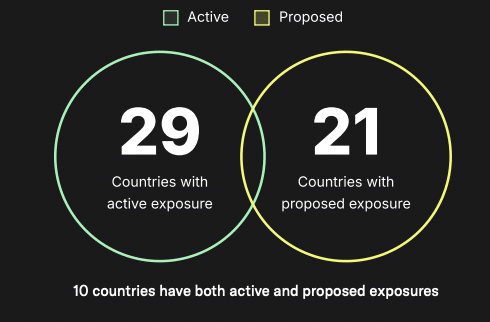
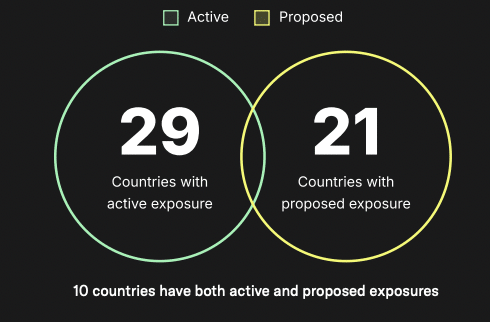
Taiwan is reconsidering the adoption of a Bitcoin Reserve, a significant shift after initially rejecting the idea in 2025 due to concerns over Bitcoin's volatility, liquidity, and security risks. A research paper by a U.S. Department of Defense civil servant suggests Taiwan could join 29 other countries with Bitcoin exposure by 2026, driven by the U.S. Strategic Bitcoin Reserve executive order. With over 80% of its foreign reserves held in USD assets and a $157 billion trade surplus, Taiwan is increasingly significant exposure to potential USD debasement risks from growing U.S. debt and monetary expansion. Bitcoin is seen as a potential hedge against geopolitical tensions and economic instability. Currently, Taiwan holds 210 BTC, a small fraction compared to the U.S. (328,372 BTC) and China (190,000 BTC). Concurrently, U.S. lawmakers are proposing the "Mined in America Act" to strengthen domestic cryptocurrency mining and establish a Strategic Bitcoin Reserve.

The Bitcoin Reserve race is not just limited to the U.S. Competitors and crypto critics are now showing interest in the idea of Bitcoin Reserve.

In a recent update, Taiwan, officially the Republic of China, is planning to reconsider the idea of a Bitcoin Reserve. For those unaware, this isn’t the first time the country has thought on these lines.

In fact, the first time the idea was proposed, it got ruled out in December, 2025.

Now, coming up with a fresh perspective, in a research paper authored by Jacob Langenkamp, a civil servant for the U.S. Department of Defense, said,

Taiwan would join 29 countries that have gained bitcoin exposure as of January 2026, a trend accelerated by the U.S. Strategic Bitcoin Reserve executive order.

Source: Bitcoin Policy Institute/Research Paper

Why had Taiwan rejected the Bitcoin Reserve in 2025?

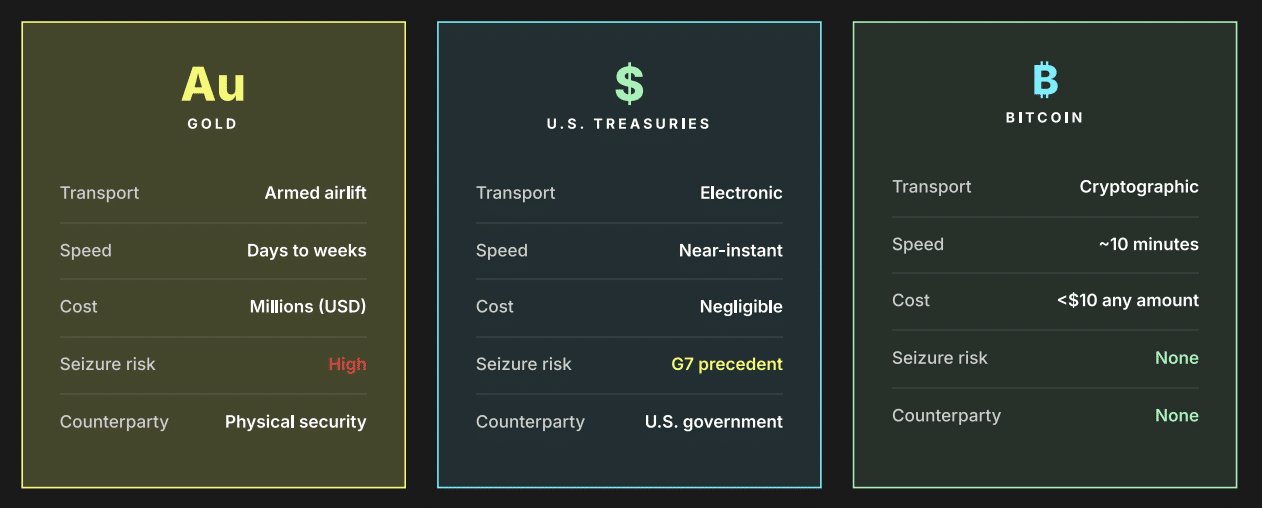
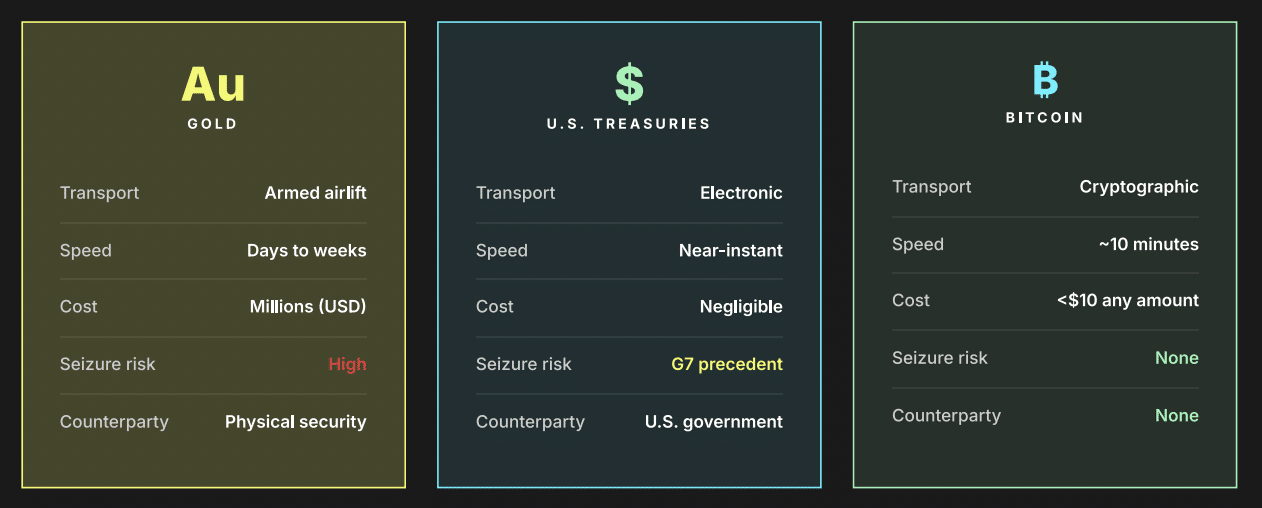
That said, if we look back in 2025, Taiwan had stepped back because of Bitcoin’s high volatility and low liquidity compared to traditional assets like U.S. dollars or gold.

Source: Bitcoin Institute Policy/Research Paper

Additionally, operational and security risks, including potential vulnerabilities in storage, and compliance with anti-money laundering (AML), were other reasons behind saying ‘NO’ back then.

However, with a huge $157 billion trade surplus, these concerns seem invalid, now. In fact, with over 80% of its foreign reserves held in USD, the perspective required some alteration.

Now, with the growing U.S. debt, the Fed’s monetary base expansion, and the worries around AI bubble bursts, Taiwan is leaning towards Bitcoin [BTC].

Langenkamp believes that Bitcoin can act as a hedge against geopolitical tensions and support Taiwan’s economy in times of war.

Expressing fears about the ongoing turmoil, Langenkamp added,

For Taiwan specifically, the American debt and deficit situation is nuanced. While Taiwan is not fully dollarized, 85-90% of its exports are estimated to be priced in USD, and more than 80% of the CBC reserves are in U.S. Treasuries. The country is heavily exposed to potential USD debasement.

Taiwan vs U.S and China’s Bitcoin holdings

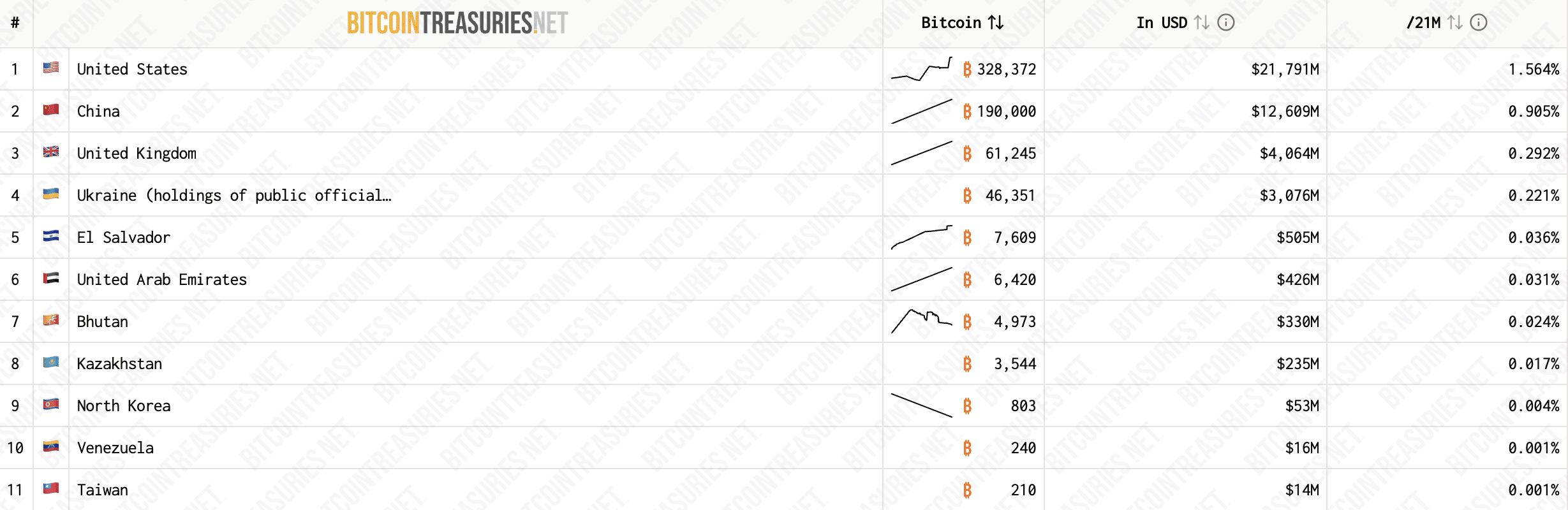
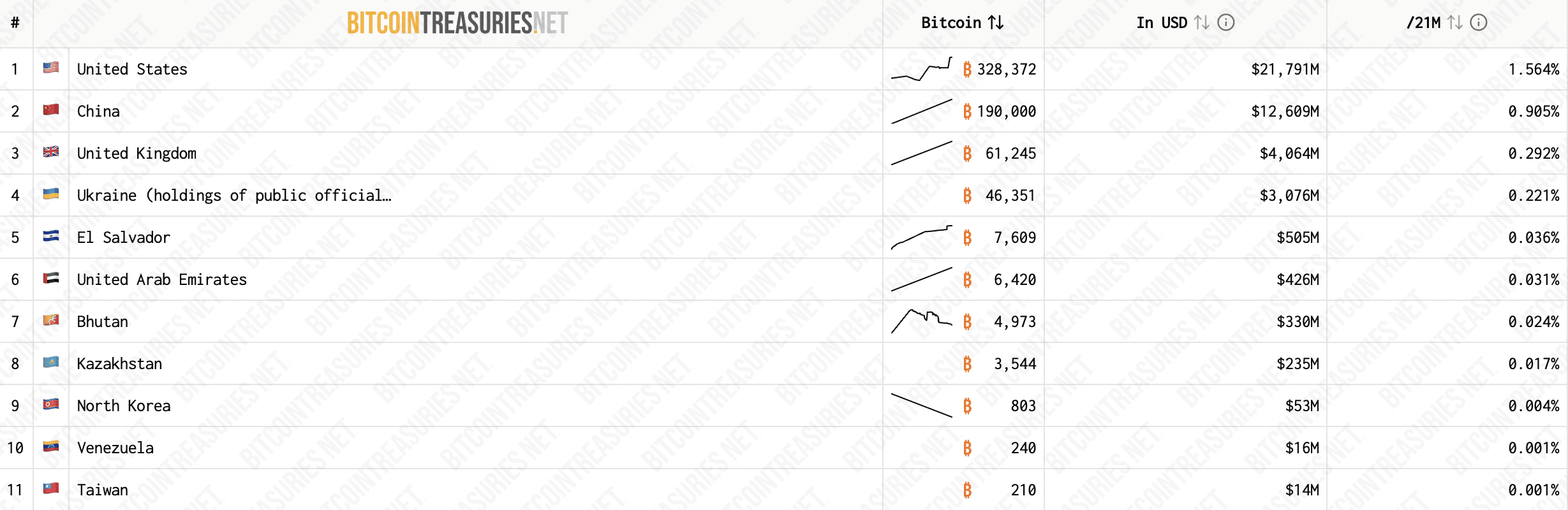
This comes as Taiwan’s Bitcoin stash stands at 210 BTC worth $14M, just 0.001% of the total Bitcoin supply as per BitcoinTreasuries.Net. Meanwhile, the U.S holds 328,372 BTC worth $21,822 million.

Whereas China holds 190,000 BTC worth $12,619 million.

Source: BitcoinTreasuries.Net

Bitcoin traded at $66,420.97 at press time, after falling 3.12% in the past 24 hours. However, with Bitcoin dominance at 58.58%, BTC appears focused on longer-term positioning rather than short-term volatility.

Additional developments in the U.S

Amidst all these developments, two U.S. lawyers have proposed the “Mined in America Act,” introduced by Bill Cassidy and Cynthia Lummis.

The bill is meant to widen the scope of U.S.-based cryptocurrency mining while also reducing dependence on foreign supply chains. This new bill also codifies a Strategic Bitcoin Reserve, very much in line with earlier executive actions signed in 2025.


Final Summary

  • In just 3 months, Taiwan, which once rejected Bitcoin Reserve, is now shifting its stance.
  • With over 80% of foreign reserves held in USD assets and the growing concerns of USD debasements, Taiwan bends down to Bitcoin.

Связанные с этим вопросы

QWhy did Taiwan initially reject the idea of a Bitcoin Reserve in 2025?

ATaiwan rejected the Bitcoin Reserve in 2025 due to Bitcoin's high volatility, low liquidity compared to traditional assets, and concerns over operational and security risks, including vulnerabilities in storage and compliance with anti-money laundering (AML) regulations.

QWhat has changed that is making Taiwan reconsider adopting a Bitcoin Reserve now?

ATaiwan is reconsidering due to its huge $157 billion trade surplus, over 80% of its foreign reserves being held in USD assets, and growing concerns about U.S. debt, the Fed's monetary expansion, and potential USD debasement, making Bitcoin an attractive hedge.

QAccording to the research paper, how many countries had gained bitcoin exposure by January 2026?

AAccording to the research paper authored by Jacob Langenkamp, 29 countries had gained bitcoin exposure as of January 2026.

QHow much Bitcoin does Taiwan currently hold, and how does this compare to the U.S. and China?

ATaiwan's Bitcoin stash stands at 210 BTC worth $14 million. In comparison, the U.S. holds 328,372 BTC worth $21,822 million, and China holds 190,000 BTC worth $12,619 million.

QWhat is the name of the purpose of the new bill proposed by U.S. lawyers Bill Cassidy and Cynthia Lummis?

AThe new bill is called the 'Mined in America Act.' Its purpose is to widen the scope of U.S.-based cryptocurrency mining, reduce dependence on foreign supply chains, and codify a Strategic Bitcoin Reserve.

Похожее

Retail Ecology Dwindles, ZKsync Bets on Bank Pilots for a Breakthrough

Amidst declining retail activity, ZKsync is pivoting to target institutional banking as its primary growth strategy. The article explores this shift, contrasting it with the competitive "survival of the fittest" narrative by highlighting a cooperative model inspired by naturalist Peter Kropotkin. ZKsync is developing infrastructure like its private, permissioned Prividium suite for banks (e.g., Deutsche Bank's use case via Memento), enabling private transactions with public verifiability via zero-knowledge proofs. This appeals to institutions needing privacy, compliance, and Ethereum-based settlement security, unlike fully private chains (e.g., JPMorgan's Kinaxis) or consortium models (e.g., R3 Corda). However, this strategic focus has coincided with a steep decline in its public DeFi ecosystem, evidenced by plunging TVL and the departure of major protocols like Aave due to low fees. The network's future now hinges on banking adoption, with upcoming pilots like the Cari Network involving regional banks holding over $600 billion in deposits. A significant challenge is balancing this institutional focus with ZKsync's decentralized governance. Banks must operate on a network where rules and fees (denominated in the volatile ZK token) can be changed via community vote, and where a Security Council holds emergency control—a stark contrast to the predictable, contract-bound environments of traditional finance. The coming 18 months will test whether ZKsync can successfully onboard traditional banks onto a dynamically governed public chain or if institutions will ultimately revert to proprietary solutions.

Foresight News38 мин. назад

Retail Ecology Dwindles, ZKsync Bets on Bank Pilots for a Breakthrough

Foresight News38 мин. назад

The Recursive AI Anthropic Warned About: Tian Yuandong's New Company Has Just Taken the "First Step"

Anthropic recently highlighted the rapid progress toward "recursive self-improvement," where AI systems autonomously design and train their successors. In response, Recursive Superintelligence, a new company co-founded by former Meta researcher Tian Yuan Dong, has publicly demonstrated its first step toward automating AI research. The company released a system designed to autonomously execute the full AI research cycle: generating ideas, implementing code, running experiments, and learning from results. It validated this approach by achieving state-of-the-art results on three diverse benchmarks: 1. **NanoChat Autoresearch:** Optimizing a small language model's validation loss under a fixed 5-minute GPU budget, improving upon the community's best result. 2. **NanoGPT Speedrun:** Reducing the time to train a GPT model to a specific loss on 8 H100 GPUs from 79.7 seconds to 77.5 seconds, beating a highly optimized, human-driven community effort. 3. **SOL-ExecBench:** Improving the overall score on NVIDIA's suite of 235 GPU kernel optimization tasks by 18%, closing the gap to the hardware limit. The system discovered novel optimizations in this highly specialized domain without direct human expertise. Recursive's system operates as a general framework, capable of parallel exploration and cross-task knowledge transfer while incorporating safeguards against reward hacking. The company, backed by $650M in funding and a star-studded team including Richard Socher and Alexey Dosovitskiy, aims to create AI that recursively enhances its own research capabilities. This development represents an early but concrete move toward a new paradigm where AI accelerates its own advancement. It occurs alongside Anthropic's warnings about the need for industry coordination and potential pauses when recursive self-improvement thresholds are reached, highlighting the dual trajectory of rapid technical progress and growing calls for careful stewardship.

marsbit45 мин. назад

The Recursive AI Anthropic Warned About: Tian Yuandong's New Company Has Just Taken the "First Step"

marsbit45 мин. назад

The Gold Buy-on-the-Dip Guide: Watch Interest Rates, Not Just War

"Gold Buying Guide: Focus on Interest Rates, Not Just War" Four months ago, gold buyers likely didn't anticipate buying at a peak that even a war couldn't sustain. After hitting a record high of $5,596 on January 29, gold entered a bear market just 91 days later, its fastest decline since 2008. A key trigger was the Fed's hawkish shift, highlighting that monetary policy, not geopolitics, is the primary driver. The article argues that the traditional "buy gold in turmoil" script has changed. While the US-Iran conflict initially boosted prices, the sustained rally in oil prices heightened inflation fears, forcing central banks to maintain or consider tighter policy. Since gold yields no interest, higher rates increase its opportunity cost, eroding its appeal. This dynamic was evident when gold fell sharply on May 18 despite positive peace talks, as lower oil prices eased inflation and thus rate hike pressures. The recent sell-off is also part of a broader market deleveraging. Correlations between gold, Nasdaq, and Bitcoin spiked as leveraged investors sold liquid assets to cover losses, creating a synchronized downturn. Historically, gold bottoms align with policy shifts, not conflict resolutions. The 2008 and 2022 bear markets ended with shifts to extreme easing and peak inflation expectations, respectively. For potential buyers, the author suggests monitoring three signals: 1) Peak interest rate hike expectations, 2) Reopening of the Strait of Hormuz (to ease oil/inflation pressure), and 3) A return to net inflows for Gold ETFs, indicating the end of forced selling. While predicting the exact bottom is impossible, the author's personal strategy involves scaling into a position across price levels like $4000, $3700, and $3500, committing no more than 30% of the intended total allocation initially, and adding the remainder only if key signals emerge. The core conclusion: In turbulent times, watching interest rates is more crucial than watching wars.

marsbit52 мин. назад

The Gold Buy-on-the-Dip Guide: Watch Interest Rates, Not Just War

marsbit52 мин. назад

Recent On-Chain Review: No Clear Narrative Under U.S. Stock Market Pressure, Just Hype

This article analyzes the current state of the Solana meme coin and community token ecosystem, highlighting a market caught between two dominant forces: attention-based PvP and a gradual return to community-centric projects. The first part explores the "Attention PvP" dynamic, where success is driven by celebrity endorsements, viral events, and speed. Examples include $JOTCHUA, which surged after its meme creator's social media activity, and $WORLDCUP, which outperformed a similar Base chain project ($PITCH) largely due to influencer support. The recent "pump.fun GO" feature, allowing bounty tasks for token promotion, is critiqued for fostering sensationalist and often negative stunts—like people getting token tickers tattooed on their bodies for rewards—reminiscent of old internet shock content. In contrast, the article points to a resurgence of organic, community-driven tokens that survive market volatility through strong holder bases and shared ideology, not just hype. Influencer Ansem is cited, arguing that durable meme coins rely on communities willing to endure losses and promote their core message daily. Examples given are older tokens like $neet (anti-work ethos), $troll, $buttcoin, and $triplet, which have maintained relative price stability. A prime example of this community-build model is the new project $KINS, the token for the browser-based MMORPG Kintara. Its success stems not from advanced graphics but from consistently delivering updates, fostering player trust, and creating genuine engagement (e.g., in-game economies, events, property auctions). It has attracted a growing player base and even notable KOLs as participants, demonstrating that sustainable growth can come from building trust rather than orchestrating pumps. The article concludes by questioning whether the market is ultimately a game of mutual trust or mutual deception, expressing hope that such reflection might lead to a healthier ecosystem.

marsbit52 мин. назад

Recent On-Chain Review: No Clear Narrative Under U.S. Stock Market Pressure, Just Hype

marsbit52 мин. назад

Торговля

Спот
Фьючерсы

Популярные статьи

Тест по Bitcoin Биткоина

HTX Learn: Изучите Bitcoin halving и Заработаете Токены USDT

3.1k просмотров всегоОпубликовано 2024.04.16Обновлено 2024.04.16

Тест по Bitcoin  Биткоина

Что такое $BITCOIN

ЦИФРОВОЕ ЗОЛОТО ($BITCOIN): Комплексный анализ Введение в ЦИФРОВОЕ ЗОЛОТО ($BITCOIN) ЦИФРОВОЕ ЗОЛОТО ($BITCOIN) — это проект на основе блокчейна, работающий в сети Solana, который стремится объединить характеристики традиционных драгоценных металлов с инновациями децентрализованных технологий. Хотя он носит имя Биткойн, часто называемого “цифровым золотом” из-за его восприятия как средства хранения ценности, ЦИФРОВОЕ ЗОЛОТО является отдельным токеном, предназначенным для создания уникальной экосистемы в ландшафте Web3. Его цель — позиционировать себя как жизнеспособный альтернативный цифровой актив, хотя детали его применения и функциональности все еще развиваются. Что такое ЦИФРОВОЕ ЗОЛОТО ($BITCOIN)? ЦИФРОВОЕ ЗОЛОТО ($BITCOIN) — это токен криптовалюты, специально разработанный для использования в блокчейне Solana. В отличие от Биткойна, который выполняет широко признанную роль хранения ценности, этот токен, похоже, сосредоточен на более широких приложениях и характеристиках. Примечательные аспекты включают: Инфраструктура блокчейна: Токен построен на блокчейне Solana, известном своей способностью обрабатывать высокоскоростные и недорогие транзакции. Динамика предложения: ЦИФРОВОЕ ЗОЛОТО имеет максимальное предложение, ограниченное 100 квадриллионами токенов (100P $BITCOIN), хотя детали о его обращающемся предложении в настоящее время не раскрыты. Утилита: Хотя точные функциональные возможности не описаны, есть указания на то, что токен может быть использован для различных приложений, потенциально связанных с децентрализованными приложениями (dApps) или стратегиями токенизации активов. Кто создатель ЦИФРОВОГО ЗОЛОТА ($BITCOIN)? На данный момент личность создателей и команды разработчиков, стоящих за ЦИФРОВЫМ ЗОЛОТОМ ($BITCOIN), остается неизвестной. Эта ситуация типична для многих инновационных проектов в области блокчейна, особенно тех, которые связаны с децентрализованными финансами и феноменом мем-криптовалют. Хотя такая анонимность может способствовать культуре, ориентированной на сообщество, она усиливает опасения по поводу управления и ответственности. Кто инвесторы ЦИФРОВОГО ЗОЛОТА ($BITCOIN)? Доступная информация указывает на то, что у ЦИФРОВОГО ЗОЛОТА ($BITCOIN) нет известных институциональных спонсоров или значительных венчурных капиталовложений. Проект, похоже, функционирует по модели пирингового взаимодействия, сосредоточенной на поддержке и принятии сообществом, а не на традиционных путях финансирования. Его активность и ликвидность в основном сосредоточены на децентрализованных биржах (DEX), таких как PumpSwap, а не на устоявшихся централизованных торговых платформах, что еще больше подчеркивает его подход, ориентированный на grassroots. Как работает ЦИФРОВОЕ ЗОЛОТО ($BITCOIN) Операционные механизмы ЦИФРОВОГО ЗОЛОТА ($BITCOIN) можно подробно описать на основе его дизайна блокчейна и характеристик сети: Механизм консенсуса: Используя уникальный механизм доказательства истории (PoH) Solana в сочетании с моделью доказательства доли (PoS), проект обеспечивает эффективную валидацию транзакций, что способствует высокой производительности сети. Токеномика: Хотя конкретные дефляционные механизмы не были подробно описаны, большое максимальное предложение токенов подразумевает, что оно может быть предназначено для микротранзакций или нишевых случаев использования, которые еще предстоит определить. Интероперабельность: Существует потенциал для интеграции с более широкой экосистемой Solana, включая различные платформы децентрализованных финансов (DeFi). Однако детали относительно конкретных интеграций остаются неуточненными. Хронология ключевых событий Вот хронология, которая подчеркивает значимые вехи, касающиеся ЦИФРОВОГО ЗОЛОТА ($BITCOIN): 2023: Первоначальное развертывание токена происходит в блокчейне Solana, отмеченное его адресом контракта. 2024: ЦИФРОВОЕ ЗОЛОТО приобретает видимость, когда оно становится доступным для торговли на децентрализованных биржах, таких как PumpSwap, позволяя пользователям обменивать его на SOL. 2025: Проект наблюдает спорадическую торговую активность и потенциальный интерес к инициативам, возглавляемым сообществом, хотя на данный момент не зафиксировано никаких значительных партнерств или технических достижений. Критический анализ Сильные стороны Масштабируемость: Основная инфраструктура Solana поддерживает высокие объемы транзакций, что может повысить полезность $BITCOIN в различных сценариях транзакций. Доступность: Потенциально низкая цена торговли за токен может привлечь розничных инвесторов, способствуя более широкому участию благодаря возможностям дробного владения. Риски Отсутствие прозрачности: Отсутствие публично известных спонсоров, разработчиков или процесса аудита может вызвать скептицизм относительно устойчивости и надежности проекта. Волатильность рынка: Торговая активность сильно зависит от спекулятивного поведения, что может привести к значительной волатильности цен и неопределенности для инвесторов. Заключение ЦИФРОВОЕ ЗОЛОТО ($BITCOIN) является интригующим, но неоднозначным проектом в быстро развивающейся экосистеме Solana. Хотя он пытается использовать нарратив “цифрового золота”, его отход от установленной роли Биткойна как средства хранения ценности подчеркивает необходимость более четкого различения его предполагаемой утилиты и структуры управления. Будущее принятие и усвоение, вероятно, будут зависеть от решения текущей непрозрачности и более четкого определения его операционных и экономических стратегий. Примечание: Этот отчет охватывает синтезированную информацию, доступную на октябрь 2023 года, и с тех пор могут произойти события.

99 просмотров всегоОпубликовано 2025.05.13Обновлено 2025.05.13

Что такое $BITCOIN

Fractal Bitcoin: масштабирование Биткоина с помощью рекурсивной системы

Fractal Bitcoin — масштабное Layer-1-решнение, созданное на базе кода Биткоина, позволяющего достигать бесконечного масштабирования с помощью рекурсивного подхода.

2.3k просмотров всегоОпубликовано 2025.06.30Обновлено 2025.06.30

Fractal Bitcoin: масштабирование Биткоина с помощью рекурсивной системы

Обсуждения

Добро пожаловать в Сообщество HTX. Здесь вы сможете быть в курсе последних новостей о развитии платформы и получить доступ к профессиональной аналитической информации о рынке. Мнения пользователей о цене на BTC (BTC) представлены ниже.

活动图片