Bitcoin, Ethereum : Deux trajectoires possibles, rebond technique ou retournement ? Altcoins à trader en range : SOL, LIQUID, PIPPIN, AAVE

金色财经Опубликовано 2025-12-23Обновлено 2025-12-23

Введение

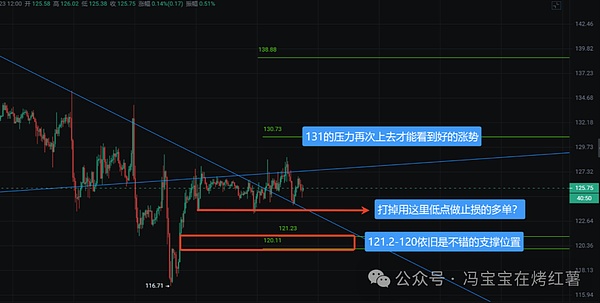
Résumé de l'analyse crypto : Le marché reste en phase de consolidation. Le Bitcoin (BTC) a échoué à franchir la résistance clé de 88 800 $, une clé à mèche supérieure indiquant une forte vente. Un vrai breakout pourrait cibler 92 000-95 000 $, mais un rejet entraînerait une correction vers 87 700 $. L'Ethereum (ETH) suit une dynamique similaire, avec un niveau pivot à 3 010 $. La stratégie recommandée est de trader en range (acheter les dips, vendre les pics) et d'éviter les positions lourdes tant qu'il n'y a pas de breakout clair. Les altcoins présentent des opportunités sélectives : - **SOL** : Support à 120-121$, résistance à 131$. - **PIPPIN** : A atteint l'objectif de 0,26$. - **AAVE** : Projet fondamentalement solide, une baisse est une opportunité d'achat. - **ASTER** : Rebond technique possible, mais le projet est considéré comme faible à long terme. - **LIQUID** : Mécanisme innovant d'ajout automatique de liquidités. - **GUA** : Projet AI, semble en phase de accumulation. Méfiance générale : le marché américain devrait corriger, ce qui pourrait impacter BTC et ETH. Prudence face aux mouvements brusques (wicks).

Point clé : ne soyez pas trop investis ! Le marché actuel en range se prête au trading range (acheter bas, vendre haut), évitez les mouvements brusques avant une vraie breakout. Une mauvaise décision peut facilement mener à être fortement coincé. Surveillez attentivement la situation de breakout des résistances du BTC et de l'ETH. Un correctif US est inévitable, le BTC et l'ETH ne pourront y échapper, méfiez-vous des wicks qui ramènent les prix à leur point de départ. N'achetez pas au prix actuel, concentrez-vous sur les opportunités à court terme lors des mouvements brusques à la baisse ou à la hausse.

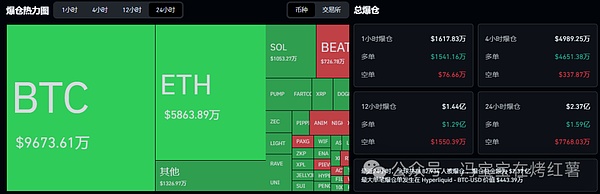
Sur les dernières 24 heures, 82 934 personnes ont été liquidées sur l'ensemble des plateformes, pour un montant total de 237 millions de dollars. Liquidations long : 159 millions USD, liquidations short : 77.6899 millions USD.
BTC

D'après la récente évolution, le prix du Bitcoin a tenté de franchir une zone de résistance clé, mais a finalement clôturé sur une bougie avec une longue mèche supérieure et un volume élevé, indiquant que la pression vendeuse reste forte. Cette bougie est apparue au niveau où la ligne de tendance baissière et la zone d'offre coïncident, le signal technique est très clair. Le marché n'est pas dépourvu de force haussière, mais la structure globale reste sous la pression des vendeurs.
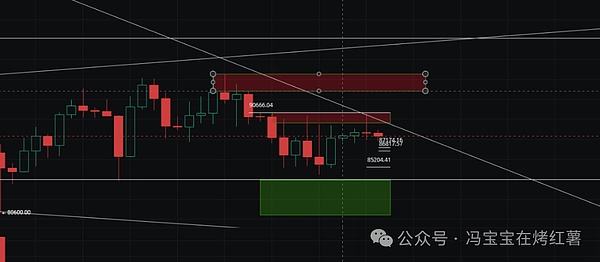
Si une breakout réelle de la zone de résistance à 88 800 $ intervient par la suite, le prix pourrait viser l'intervalle 92 000 - 95 000 $. Surveillez les résistances aux alentours de 89 600 - 90 585 - 91 355 $.

Chaque poussée haussière pourrait être un test. Si aujourd'hui le prix est rejeté et ne parvient pas à se maintenir au-dessus de 88 800 $, le rebond sur le timeframe inférieur sera considéré comme faible, et un retest des supports autour de 87 720 - 86 650 - 85 220 $ est à prévoir.

ETH

L'évolution de l'Ethereum reste essentiellement corrélée à celle du Bitcoin. Même en cas de breakout locale de la ligne de tendance baissière, tant que la logique de cycle plus large n'a pas changé, la signification de ce type de breakout reste limitée. Globalement, pour le moyen terme jusqu'au premier semestre de l'année prochaine, nous maintenons un jugement prudent, voire plutôt baissier.
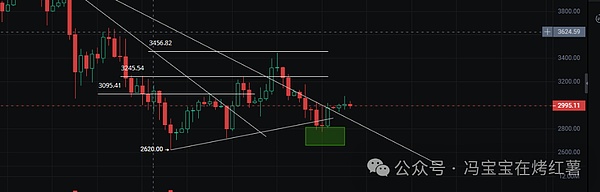
Aujourd'hui, surveillez le niveau de 3 010 $. Ce n'est qu'en se maintenant fermement au-dessus de ce niveau que ce correctif de timeframe 4H sera considéré comme terminé et que la tendance haussière pourra reprendre. Les résistances supérieures se situent autour de 3 043 - 3 078 - 3 115 $. Si la clôture aujourd'hui n'a pas au-dessus de 3 010 $, cela indiquera que le rebond sur le timeframe inférieur est faible, et un retest des supports autour de 2 970 - 2 943 - 2 906 $ est à prévoir.

Altcoins

Le marché ne fonctionne jamais selon la volonté de qui que ce soit. Un trader vraiment mature ne se mesure pas au nombre de fois où il a correctement prédit le marché, mais à sa capacité à avoir anticipé un plan d'action pour différents scénarios. À court terme, prévoir range et mouvements baissiers ; à moyen terme, attendre une structure plus optimale ; à long terme, respecter le cycle. C'est la logique centrale pour traverser les marchés haussiers et baissiers.

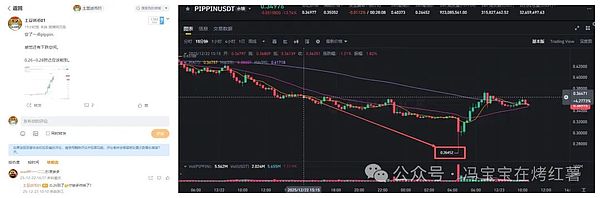
$PIPPIN

PIPPIN a directement touché l'objectif de 0,26 $. Ce n'est pas de la chance, c'est le respect de la tendance, la conviction dans le chartisme. Quand tout le monde achetait la hausse, j'ai attendu le repli ; pendant les ventes de panique, je suis resté serein. La prochaine fois, douterez-vous encore ?
$SOL

Le support pour Solana se situe toujours entre 121,2 et 120 $. Il faut surveiller une éventuelle descente vers ces niveaux pour capturer de la liquidité. La résistance supérieure à 131 $ devra être franç à nouveau pour envisager une bonne hausse.
$AAVE

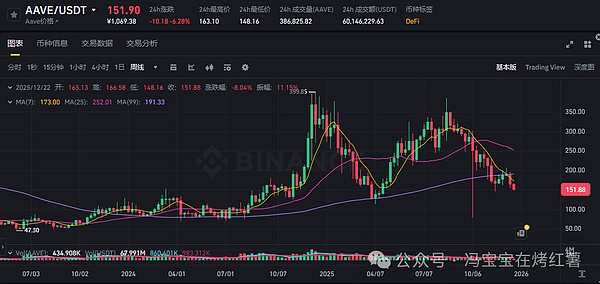
Bien que l'équipe commence à avoir des dissensions internes, d'un point de vue fondamental, AAVE reste un excellent projet de prêt/emprunt defi. La baisse me semble plutôt être une opportunité, j'attends qu'il baisse encore un peu pour tenter d'acheter, il y a peu de chances de se faire piéger.
$ASTER

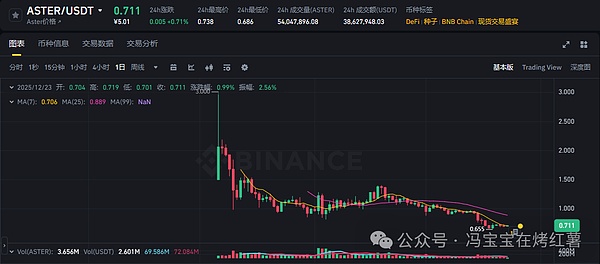
La baisse à court terme devrait toucher à sa fin : surachat technique, pression de vente réduite, un rebond à court terme est très probable. Mais fondamentalement, cela reste un projet médiocre : une activité quotidienne sur la chaîne de seulement quelques centaines d'utilisateurs pour une capitalisation de plusieurs milliards, c'est totalement déraisonnable ! Le secteur perpdex a déjà un leader absolu, HYPE. ASTER est né dans l'imitation et non l'innovation. Après le rebond à court terme, la baisse devrait donc se poursuivre.
$Hakimi

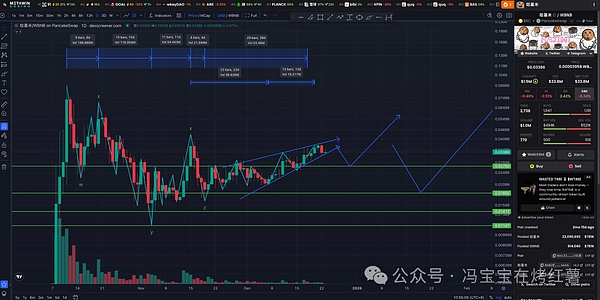
Hakimi : la formation en wedge arrive à son terme, le choix de direction est imminent, à surveiller de près pour du court terme. C'est bientôt Noël, si un bug apparaît avec le chinois, les ingénieurs seront en vacances et personne ne pourra le corriger. Donc, les nodes spot en chinois pourraient être meilleurs après le Nouvel An, nouveau départ pour la nouvelle année. S'il n'y a pas de situation imprévue, un correctif d'abord, puis peut-être un énorme pump.
$LIQUID

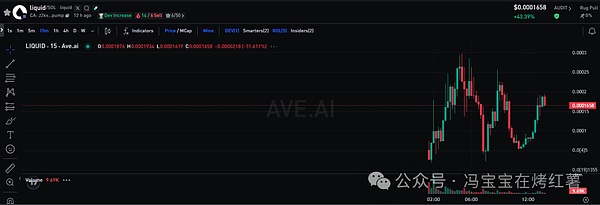
Ce jeton ajoute automatiquement des LP, c'est un projet de DEV leyten. Les amis intéressés par les mécanismes innovants peuvent aller jeter un œil.
$GUA

Projet de divination par IA, venant juste de lancer ses contrats, capitalisation de 100 millions, pas trop cher. Le "dog Zhuang" (gros poisson) maintient très activement le coût à 0,1$. Sur les 26 jours depuis le lancement sur Alpha, le coût à six chiffres pour maintenir le prix a été réellement dépensé. Cela semble former un bottom, l'espace pour le stop-loss est assez étroit, on peut en prendre un peu.


Похожее

Cursor, Why Boarded Musk's Starship?

SpaceX announced its acquisition of AI programming startup Cursor's parent company, Anysphere, for $60 billion in an all-stock deal, just days after its record-breaking IPO. The move sent SpaceX's stock soaring, briefly making it the most valuable U.S. company. Cursor, founded in 2022 by MIT graduate Michael Truell and his classmates, is a popular AI coding assistant that allows developers to switch between models from OpenAI, Anthropic, and others. It saw explosive revenue growth, reaching a $4 billion annualized run rate in early 2026. However, its market share was eroded by the launch of competitor Claude Code from its key AI supplier, Anthropic. This dependence prompted Cursor to develop its own AI model, Composer, in early 2026. To scale Composer, Cursor needed immense computing power. In April 2026, it struck a deal with SpaceX, granting the latter an option to acquire it post-IPO. SpaceX exercised this option, offering Cursor access to its Colossus supercomputer, powered by hundreds of thousands of top-tier Nvidia AI chips. For SpaceX, the acquisition is a strategic move to bolster its AI capabilities, particularly for its xAI division, and advance its broader ambition of building orbital, solar-powered data centers. While the deal surprised some employees and investors given Truell's earlier stance on independence, it represents a high-stakes partnership. SpaceX CEO Elon Musk has projected the company could reach $1 trillion in revenue by 2030. For Truell, joining forces with SpaceX is a monumental gamble on an unprecedented scale in the race for AI dominance.

链捕手4 мин. назад

Cursor, Why Boarded Musk's Starship?

链捕手4 мин. назад

The More It Rises, the More Dangerous? The Systemic Risks Behind SpaceX's Soaring Valuation

Summary: The article raises concerns about the systemic risks posed by SpaceX's skyrocketing valuation, arguing that modern market mechanics, rather than fundamentals, are driving its price discovery. Following SpaceX's market capitalization surpassing $3 trillion in after-hours trading, the author contends that the market is no longer functioning properly. The core issue is not SpaceX's business prospects but the unhealthy market structure surrounding it. With limited float and the imminent launch of options trading, the stage is set for a potential "gamma squeeze"—a feedback loop where market makers hedging call options are forced to buy shares, pushing the price higher and attracting more speculative momentum traders. This mechanism, seen previously with Tesla and meme stocks, can decouple valuation from financial reality. The danger escalates as extreme valuations force passive funds, ETFs, pensions, and major indices to hold the stock. If SpaceX grows large enough—hypothetically reaching $5 or even $10 trillion—its performance would increasingly dictate broader market indices, embedding systemic risk. The author warns that when price appreciation itself becomes the primary bullish thesis, the market transforms from a capital allocation mechanism into a self-reinforcing speculative machine, endangering the retirement savings of ordinary investors tied to passive strategies. The piece questions whether such a system can still perform its fundamental role of price discovery.

marsbit9 мин. назад

The More It Rises, the More Dangerous? The Systemic Risks Behind SpaceX's Soaring Valuation

marsbit9 мин. назад

How Much of the Subscription Fee You Pay to Claude Can Optical Module Companies Get?

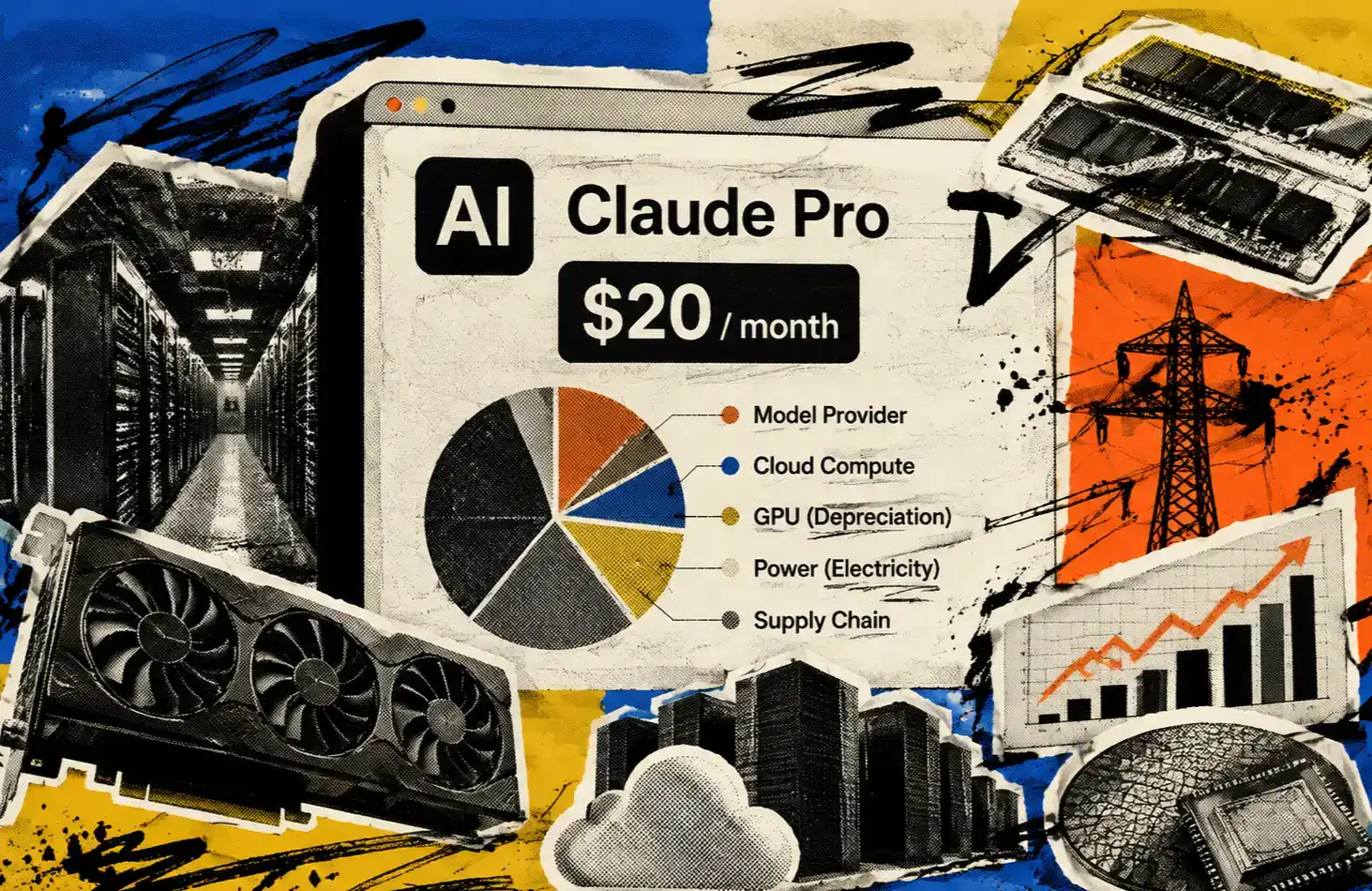
How much of your $20 Claude Pro subscription actually goes to AI model companies like Anthropic? A viral breakdown image highlights the fundamental valuation challenge for AI applications versus traditional SaaS. Unlike SaaS with high software margins, AI subscriptions face variable "inference costs": every user query consumes GPU time, power, and cloud resources. This creates a tension between fixed subscription fees and usage-driven expenses. While the specific dollar splits are illustrative, the core question is whether AI revenue can achieve SaaS-like margins as usage scales. Currently, infrastructure providers (cloud platforms, GPU makers like Nvidia, HBM suppliers, power/data centers) capture more certain revenue from growing AI usage. Their financials reflect pricing power and faster earnings validation. The bullish case hinges on efficiency improvements: model optimization, caching, smaller models, and custom chips could lower per-token costs over time. The key debate is whether cost declines can outpace increases in user workload complexity and volume. Ultimately, for AI companies to command high SaaS-like valuations, they must demonstrate not just user growth but also improving gross margins after accounting for inference costs. Investors will scrutinize not just subscriber numbers, but usage patterns, enterprise pricing tiers, and real efficiency gains.

marsbit19 мин. назад

How Much of the Subscription Fee You Pay to Claude Can Optical Module Companies Get?

marsbit19 мин. назад

OpenAI's Hyperliquid Pre-IPO Pricing Venture: Why Did It Last Only Half a Year?

The article discusses the rise and fall of Pre-IPO pricing markets on the Hyperliquid blockchain. Trade.xyz, an anonymous team, successfully built the largest pre-market for SpaceX (SPCX) by launching a contract with a clear anchor: the eventual Nasdaq listing price. This provided inherent price stability and validation. In contrast, Ventuals, a team backed by Paradigm, failed despite holding exclusive contracts for highly sought-after companies like OpenAI and Anthropic. Its key mistake was its pricing mechanism. For companies with no near-term IPO date, Ventuals' oracle relied partly on opaque private market transactions and, critically, partly on its own contract's moving average price. This created a self-referential feedback loop where prices were artificially propped up and detached from genuine supply and demand, leading to illiquid markets. Ventuals shut down after nine months, settling positions at final prices of $1,341.80 for OpenAI and $1,618.90 for Anthropic. Ironically, some employees and late-stage investors of these very companies reportedly used these flawed Ventuals prices for valuation reference, highlighting the acute demand for any price signal in illiquid private markets. The article concludes that while demand for pre-IPO trading is real and growing, with players like Coinbase now entering the space, the fundamental challenge remains: without a public listing to provide a definitive price anchor, these markets struggle to establish truly accurate and liquid pricing. The need for a transparent, self-correcting market is the critical lesson from Ventuals' failure.

marsbit35 мин. назад

OpenAI's Hyperliquid Pre-IPO Pricing Venture: Why Did It Last Only Half a Year?

marsbit35 мин. назад

Торговля

Спот
Фьючерсы

Популярные статьи

Тест по Bitcoin Биткоина

HTX Learn: Изучите Bitcoin halving и Заработаете Токены USDT

3.1k просмотров всегоОпубликовано 2024.04.16Обновлено 2024.04.16

Тест по Bitcoin  Биткоина

Что такое $BITCOIN

ЦИФРОВОЕ ЗОЛОТО ($BITCOIN): Комплексный анализ Введение в ЦИФРОВОЕ ЗОЛОТО ($BITCOIN) ЦИФРОВОЕ ЗОЛОТО ($BITCOIN) — это проект на основе блокчейна, работающий в сети Solana, который стремится объединить характеристики традиционных драгоценных металлов с инновациями децентрализованных технологий. Хотя он носит имя Биткойн, часто называемого “цифровым золотом” из-за его восприятия как средства хранения ценности, ЦИФРОВОЕ ЗОЛОТО является отдельным токеном, предназначенным для создания уникальной экосистемы в ландшафте Web3. Его цель — позиционировать себя как жизнеспособный альтернативный цифровой актив, хотя детали его применения и функциональности все еще развиваются. Что такое ЦИФРОВОЕ ЗОЛОТО ($BITCOIN)? ЦИФРОВОЕ ЗОЛОТО ($BITCOIN) — это токен криптовалюты, специально разработанный для использования в блокчейне Solana. В отличие от Биткойна, который выполняет широко признанную роль хранения ценности, этот токен, похоже, сосредоточен на более широких приложениях и характеристиках. Примечательные аспекты включают: Инфраструктура блокчейна: Токен построен на блокчейне Solana, известном своей способностью обрабатывать высокоскоростные и недорогие транзакции. Динамика предложения: ЦИФРОВОЕ ЗОЛОТО имеет максимальное предложение, ограниченное 100 квадриллионами токенов (100P $BITCOIN), хотя детали о его обращающемся предложении в настоящее время не раскрыты. Утилита: Хотя точные функциональные возможности не описаны, есть указания на то, что токен может быть использован для различных приложений, потенциально связанных с децентрализованными приложениями (dApps) или стратегиями токенизации активов. Кто создатель ЦИФРОВОГО ЗОЛОТА ($BITCOIN)? На данный момент личность создателей и команды разработчиков, стоящих за ЦИФРОВЫМ ЗОЛОТОМ ($BITCOIN), остается неизвестной. Эта ситуация типична для многих инновационных проектов в области блокчейна, особенно тех, которые связаны с децентрализованными финансами и феноменом мем-криптовалют. Хотя такая анонимность может способствовать культуре, ориентированной на сообщество, она усиливает опасения по поводу управления и ответственности. Кто инвесторы ЦИФРОВОГО ЗОЛОТА ($BITCOIN)? Доступная информация указывает на то, что у ЦИФРОВОГО ЗОЛОТА ($BITCOIN) нет известных институциональных спонсоров или значительных венчурных капиталовложений. Проект, похоже, функционирует по модели пирингового взаимодействия, сосредоточенной на поддержке и принятии сообществом, а не на традиционных путях финансирования. Его активность и ликвидность в основном сосредоточены на децентрализованных биржах (DEX), таких как PumpSwap, а не на устоявшихся централизованных торговых платформах, что еще больше подчеркивает его подход, ориентированный на grassroots. Как работает ЦИФРОВОЕ ЗОЛОТО ($BITCOIN) Операционные механизмы ЦИФРОВОГО ЗОЛОТА ($BITCOIN) можно подробно описать на основе его дизайна блокчейна и характеристик сети: Механизм консенсуса: Используя уникальный механизм доказательства истории (PoH) Solana в сочетании с моделью доказательства доли (PoS), проект обеспечивает эффективную валидацию транзакций, что способствует высокой производительности сети. Токеномика: Хотя конкретные дефляционные механизмы не были подробно описаны, большое максимальное предложение токенов подразумевает, что оно может быть предназначено для микротранзакций или нишевых случаев использования, которые еще предстоит определить. Интероперабельность: Существует потенциал для интеграции с более широкой экосистемой Solana, включая различные платформы децентрализованных финансов (DeFi). Однако детали относительно конкретных интеграций остаются неуточненными. Хронология ключевых событий Вот хронология, которая подчеркивает значимые вехи, касающиеся ЦИФРОВОГО ЗОЛОТА ($BITCOIN): 2023: Первоначальное развертывание токена происходит в блокчейне Solana, отмеченное его адресом контракта. 2024: ЦИФРОВОЕ ЗОЛОТО приобретает видимость, когда оно становится доступным для торговли на децентрализованных биржах, таких как PumpSwap, позволяя пользователям обменивать его на SOL. 2025: Проект наблюдает спорадическую торговую активность и потенциальный интерес к инициативам, возглавляемым сообществом, хотя на данный момент не зафиксировано никаких значительных партнерств или технических достижений. Критический анализ Сильные стороны Масштабируемость: Основная инфраструктура Solana поддерживает высокие объемы транзакций, что может повысить полезность $BITCOIN в различных сценариях транзакций. Доступность: Потенциально низкая цена торговли за токен может привлечь розничных инвесторов, способствуя более широкому участию благодаря возможностям дробного владения. Риски Отсутствие прозрачности: Отсутствие публично известных спонсоров, разработчиков или процесса аудита может вызвать скептицизм относительно устойчивости и надежности проекта. Волатильность рынка: Торговая активность сильно зависит от спекулятивного поведения, что может привести к значительной волатильности цен и неопределенности для инвесторов. Заключение ЦИФРОВОЕ ЗОЛОТО ($BITCOIN) является интригующим, но неоднозначным проектом в быстро развивающейся экосистеме Solana. Хотя он пытается использовать нарратив “цифрового золота”, его отход от установленной роли Биткойна как средства хранения ценности подчеркивает необходимость более четкого различения его предполагаемой утилиты и структуры управления. Будущее принятие и усвоение, вероятно, будут зависеть от решения текущей непрозрачности и более четкого определения его операционных и экономических стратегий. Примечание: Этот отчет охватывает синтезированную информацию, доступную на октябрь 2023 года, и с тех пор могут произойти события.

104 просмотров всегоОпубликовано 2025.05.13Обновлено 2025.05.13

Что такое $BITCOIN

Fractal Bitcoin: масштабирование Биткоина с помощью рекурсивной системы

Fractal Bitcoin — масштабное Layer-1-решнение, созданное на базе кода Биткоина, позволяющего достигать бесконечного масштабирования с помощью рекурсивного подхода.

2.3k просмотров всегоОпубликовано 2025.06.30Обновлено 2025.06.30

Fractal Bitcoin: масштабирование Биткоина с помощью рекурсивной системы

Обсуждения

Добро пожаловать в Сообщество HTX. Здесь вы сможете быть в курсе последних новостей о развитии платформы и получить доступ к профессиональной аналитической информации о рынке. Мнения пользователей о цене на BTC (BTC) представлены ниже.

活动图片