The year is 2027. It’s a time of great innovation and technological advancement, but also a time of chaos. What will the crypto market look like in 2027? (For those unfamiliar, that's a line from the 2011 video game, Deus Ex.)
Long-term predictions are notoriously difficult to make, but they are good thought experiments. One year is too short a period for fundamental changes, but five years is just enough for everything to change.
Here are the most unexpected and outrageous events that could happen over the next five years.
1. The metaverse will not rise
The metaverse is a hot topic, but most people do not have even the slightest idea of what it actually comprises. The metaverse is a holistic virtual world that exists on an ongoing basis (without pauses or resets), works in real-time, accommodates any number of users, has its own economy, is created by the participants themselves, and is characterized by unprecedented interoperability. A variety of applications could (in theory) be integrated into the metaverse, including games, video-conferencing applications, services for issuing driver’s licenses — anything.
This definition makes it clear the metaverse is not such a novel phenomenon. Games and social networks that include most of the features stated above have been around for quite some time. Granted, interoperability is a problem that needs to be addressed seriously. It would have been a very useful feature to be able to easily transfer digital assets between games — or a digital identity — without being tethered to a specific platform.
But the metaverse will never be able to cater to every need. There is no reason to include some services in the metaverse at all. Some services will remain isolated due to the unwillingness of their operators to surrender control over them.
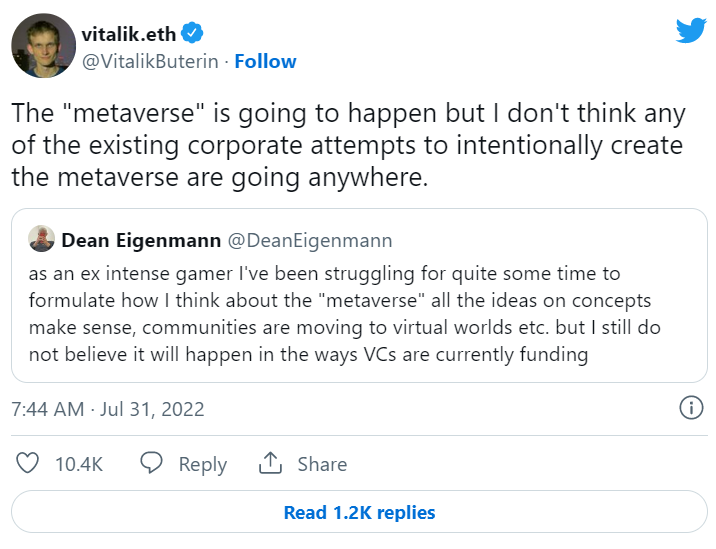
And there is also the technical aspect to take into account. The cyberpunk culture of the 1980s and 90s postulated that the metaverse meant total immersion. Such immersion is now conceived as possible only with the use of virtual reality glasses. VR hardware is getting better every year, but it’s not what we expected. VR remains a niche phenomenon even among hardcore gamers. The vast majority of ordinary people will never put on such glasses for the sake of calling their grandmother or selling some crypto on an exchange.
True immersion requires a technological breakthrough like smart contact lenses or Neuralink. It is highly unlikely those technologies will be widely used five years from now.
2. Wallets will become “super apps”
An active decentralized finance (DeFi) user is forced to deal with dozens of protocols these days. Wallets, interfaces, exchanges, bridges, loan protocols — there are hundreds of them, and they are growing daily. Having to live with such an array of technologies is inconvenient even for advanced users. As for the prospects of mass adoption, such a state of affairs is all the more unacceptable.
For the ordinary user, it is ideal when a maximum number of services can be accessed through a limited number of universal applications. The optimal choice is when they are integrated right into their wallet. Storing, exchanging, transferring to other networks, staking — why bother visiting dozens of different sites for accessing such services if all the necessary operations can be carried out using a single interface?
Users don’t care which exchange or bridge they use. They are only concerned about security, speed and low fees. A significant number of DeFi protocols will eventually turn into back-ends that cater to popular wallets and interfaces.
3. Bitcoin will become a unit of account on par with the U.S. dollar or Euro
Money has three main roles — acting as a means of payment, as a store of value and as a unit of account. Many cryptocurrencies, primarily stablecoins, are used as a means of payment. Bitcoin (BTC) and — to a much lesser extent — Ether (ETH) are used as stores of value among cryptocurrencies. But the United States dollar remains the main unit of account in the world. Everything is valued in dollars, including Bitcoin.
The real victory for sound money will be heralded when cryptocurrencies take over the role of a unit of account. Bitcoin is currently the main candidate for this role. Such a victory will signify a major mental shift.

What needs to happen in the next five years to make this a possibility?
A sharp drop in the confidence vested in the U.S. dollar and euro is a prerequisite for cryptocurrencies to take on the role of a basic unit of account. Western authorities have already done a lot to undermine said confidence by printing trillions of dollars in fiat money, allowing abnormally high inflation to spiral, freezing hundreds of billions of a sovereign country’s reserves, and so on. This may be just the beginning.
What if actual inflation becomes much worse than projected? What if the economic crisis is protracted? What if a new epidemic breaks out? What if the conflict in Ukraine spills into neighboring countries? All of these are feasible scenarios. Some are extreme, of course — but they are possible.
4. At least half of the top 50 cryptocurrencies will see their standing decline
There is a high probability that the list of top cryptocurrencies will radically change. Outright zombies such as Ethereum Classic (ETC) will be ousted from the list, and projects that now seem to hold unshakable positions will not only be de-throned but may also vanish altogether.
Some stablecoins will surely sink. New ones will take their place. Cardano (ADA) will slide down the list to officially become a living corpse. The project is moving agonizingly slowly. Developers not only fail to see this as problematic but even seem to view it as a benefit.
5. The crypto market will fragment along geographic lines
Cryptocurrencies are global by default, but they are not invulnerable to the influence of individual states. The state always has an edge and an extra trick up its sleeve. A number of territories (the U.S., the European Union, China, India, Russia, etc.) have already introduced or are threatening to introduce strict regulation of cryptocurrencies.
The factor of international competition is superimposed onto internal state motivations. When Russia was heavily sanctioned, some crypto projects started restricting Russian users from accessing their services or even blocking their funds. This scenario may play out again in the future with respect to China.
It is not difficult to imagine a future in which parts of the crypto market will work in favor of some countries while closing to others. We are living in such a future already, at least to some degree.