Why Has Bitcoin Risen Against the Trend Amid Turmoil?

marsbitОпубликовано 2026-04-15Обновлено 2026-04-15

Введение

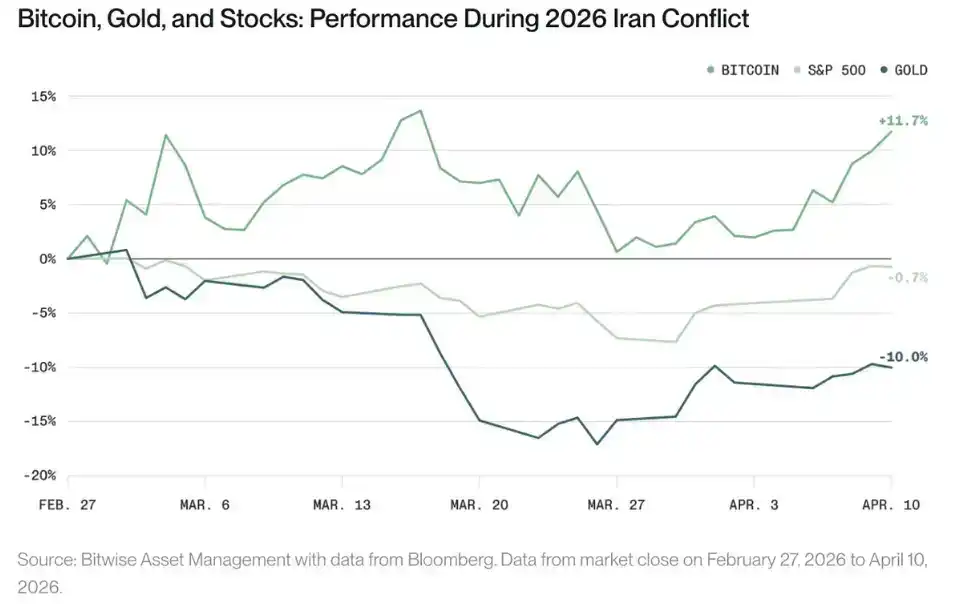
Title: Why Bitcoin Defies Market Turmoil and Rises Against the Odds? Amidst the recent Iran conflict, Bitcoin demonstrated unexpected strength, rising 12% while traditional risk assets like the S&P 500 fell 1% and gold dropped 10%. This challenges the conventional view of Bitcoin is a risk-on asset. Matt Hougan, Bitwise CIO, argues that Bitcoin’s surge is not due to ignorance of geopolitical tensions or long-term money printing expectations, but is directly driven by the conflict itself. Hougan proposes a dual-investment thesis for Bitcoin: it acts both as a "digital gold" competing in the $38 trillion store-of-value market, and as a speculative bet on becoming a genuine global currency. While the first narrative has dominated the past five years, the second—once a distant possibility—is gaining relevance as global financial systems become increasingly weaponized. The 2022 SWIFT sanctions against Russia marked a turning point, prompting nations to explore alternative financial networks. Iran’s recent move to demand Bitcoin payments for shipping tolls in the Strait of Hormuz exemplifies this shift. Such developments increase the probability of Bitcoin being used as a neutral, apolitical settlement medium and amplify global monetary system volatility. This dual role suggests Bitcoin’s potential market extends beyond gold’s $38 trillion valuation. Its pricing is now influenced not only by liquidity or tech stock trends but also by growing uncertainties in the international f...

Editor's Note: While the market has grown accustomed to categorizing Bitcoin as a "risk asset," the recent market movement triggered by the Iran conflict has delivered a clear signal that deviates from the consensus: against a backdrop of falling traditional assets and failing safe-haven assets, Bitcoin has instead strengthened.

Author Matt Hougan (current Bitwise CIO, co-founder of Future Proof, former CEO of ETF.com) argues that Bitcoin's rise is not "ignoring the war," nor is it solely the result of "money printing expectations," but is directly driven by the geopolitical conflict itself.

Hougan proposes a more explanatory framework—Bitcoin is not a single asset, but a "stacked bet": on one hand, it is competing with gold for the status of a "store of value"; on the other hand, it is also making a bet, albeit with low probability but high elasticity, on becoming a true global currency.

In the past, this second layer of logic was more of a distant imagination. However, as the financial system is gradually "weaponized," this hypothesis is beginning to move from the fringe to reality. From SWIFT sanctions to the rise of parallel settlement networks, to Iran's attempt to collect shipping passage fees in Bitcoin, Bitcoin is no longer just a tool against inflation; it is also being incorporated into the borderlands of national-level games.

Against this backdrop, Bitcoin's pricing logic has also changed. It is no longer driven solely by liquidity, tech stocks, or risk appetite, but has begun to price in the "uncertainty of the global monetary system." When conflicts increase the probability of its "monetary attributes" being realized while amplifying the volatility of the global financial system, the upside potential of this asset is also reopened.

If the narrative of Bitcoin over the past five years has focused on "digital gold," what is emerging now is a more complex dual role: both a store of value and a potential depoliticized settlement medium. And once this structure is established, its market boundaries may no longer be limited to the $38 trillion corresponding to gold.

Below is the original text:

Bitcoin has performed relatively strongly since the outbreak of the Iran conflict. Since the U.S. and Israel began airstrikes against Iran on February 28, Bitcoin has risen by 12%, while the S&P 500 index has fallen by 1%, and gold has dropped by 10%.

This has surprised many. Bitcoin has long been viewed as a risk asset, and many originally believed it should fall during the "risk-off" sentiment triggered by geopolitical conflict. Consequently, various explanations have emerged: some argue that geopolitics is irrelevant to Bitcoin; others point out that wars often lead to money printing, which in the long run benefits Bitcoin.

Neither explanation is accurate. Bitcoin's strong performance during this crisis stems precisely from the conflict itself. Understanding this is important.

One Investment, Two Bets

Buying Bitcoin is essentially betting on two things simultaneously.

First, you are betting that Bitcoin will become "digital gold" and compete with physical gold in the $38 trillion "store of value" market. This is Bitcoin's primary use case currently and a bet I find very attractive. As I have explained before, simply capturing about 17% of this market over the next decade could potentially drive Bitcoin's price to $1 million.

But when you buy Bitcoin, you are actually making a second bet—that one day, perhaps, Bitcoin will function like a traditional currency.

In the past, I have always viewed this as an "out-of-the-money call option": a speculative bet on a future that is unlikely to materialize. After all, for most of Bitcoin's existence, this possibility seemed extremely remote to most people. Until a few years ago, the global financial system was almost entirely built on the U.S. dollar track, and using a volatile, early-stage "cryptocurrency" for international trade sounded more like a fantasy at the time.

The turning point came in 2022, when the U.S. kicked Russia out of the dollar-centric SWIFT system. The French finance minister called it a "financial nuclear bomb" at the time, and countries became alert. China quickly built a parallel financial system, and other countries also took action. Russia moved 99% of its financial activities to these new systems, and other countries began to experiment.

At the time, I pondered that weaponizing SWIFT might open up space for Bitcoin: if countries gradually become reluctant to rely on the dollar system, it seems logical that at some stage they might turn to a "depoliticized" alternative.

And in this Iran conflict, we are seeing an early (and unsettling) manifestation of this trend: Iran stated in an interview with the Financial Times that it would begin charging all ships passing through the Strait of Hormuz a "toll" of $1 per barrel (approximately $20 million per day), to be settled in Bitcoin.

Obviously, this move raises important concerns about sanctions evasion and money laundering. Although in a sense it might be preferable to the status quo—for years, Iran has been evading U.S. sanctions through China's financial systems, which are harder to track than cryptocurrencies—it also brings new risks.

At the same time, it reveals a reality beyond the current conflict: in a world where countries are weaponizing financial systems, Bitcoin is gradually becoming a depoliticized alternative.

Option Pricing Logic

This is also why I analogize Bitcoin's potential as a currency to an "out-of-the-money call option."

The value of an option typically stems from two points: either the probability of reaching the target price increases, or the volatility of the underlying market rises.

In this Iran conflict, both occurred: first, the probability of Bitcoin being used as a "currency" rose; second, the uncertainty and volatility of the global monetary system increased.

This analytical framework can help us understand two important things. First, in future geopolitical conflicts, Bitcoin is likely to continue rising—especially in regions caught between the U.S. and Chinese systems. Second, Bitcoin's potential market size may far exceed the $38 trillion gold market.

Over the past five years, we have almost exclusively viewed Bitcoin as a "store of value." But if it begins to play a dual role as both a "store of value" (like gold) and a "payment currency" (like the dollar), then we may need to readjust our expectations for its long-term potential upward.

Связанные с этим вопросы

QWhy did Bitcoin's price rise during the Iran conflict, contrary to its typical classification as a risk asset?

ABitcoin's rise was driven by the geopolitical conflict itself, as it began to function as a potential 'depoliticized' alternative in global finance, especially after Iran announced it would accept Bitcoin for shipping fees, increasing its perceived utility as a currency.

QWhat are the two simultaneous bets an investor makes when buying Bitcoin, according to Matt Hougan?

AFirst, a bet that Bitcoin will become 'digital gold' and compete in the $38 trillion store-of-value market. Second, a speculative bet that Bitcoin might eventually function as a traditional global currency, though this was historically seen as unlikely.

QHow did the weaponization of financial systems (e.g., SWIFT sanctions against Russia) create an opportunity for Bitcoin?

AThe exclusion of Russia from SWIFT alerted nations to the risks of relying on dollar-centric systems, prompting some to explore alternatives. This increased the probability of Bitcoin being adopted as a neutral, decentralized settlement option in international trade.

QWhat analogy does Hougan use to describe Bitcoin's potential as a global currency, and why did its value increase during the Iran crisis?

AHougan compares it to an 'out-of-the-money call option.' Its value rose during the Iran conflict because both the probability of Bitcoin becoming a currency increased (e.g., Iran's adoption) and global monetary system volatility grew, enhancing the option's potential payoff.

QHow might Bitcoin's dual role as both a store of value and a payment currency affect its long-term market potential?

AIf Bitcoin serves both roles, its market size could exceed the $38 trillion gold market, as it would not only compete with gold but also potentially replace or supplement traditional fiat currencies in cross-border settlements, expanding its addressable market significantly.

Похожее

Торговля

Спот
Фьючерсы

Популярные статьи

Тест по Bitcoin Биткоина

HTX Learn: Изучите Bitcoin halving и Заработаете Токены USDT

3.0k просмотров всегоОпубликовано 2024.04.16Обновлено 2024.04.16

Тест по Bitcoin  Биткоина

Что такое $BITCOIN

ЦИФРОВОЕ ЗОЛОТО ($BITCOIN): Комплексный анализ Введение в ЦИФРОВОЕ ЗОЛОТО ($BITCOIN) ЦИФРОВОЕ ЗОЛОТО ($BITCOIN) — это проект на основе блокчейна, работающий в сети Solana, который стремится объединить характеристики традиционных драгоценных металлов с инновациями децентрализованных технологий. Хотя он носит имя Биткойн, часто называемого “цифровым золотом” из-за его восприятия как средства хранения ценности, ЦИФРОВОЕ ЗОЛОТО является отдельным токеном, предназначенным для создания уникальной экосистемы в ландшафте Web3. Его цель — позиционировать себя как жизнеспособный альтернативный цифровой актив, хотя детали его применения и функциональности все еще развиваются. Что такое ЦИФРОВОЕ ЗОЛОТО ($BITCOIN)? ЦИФРОВОЕ ЗОЛОТО ($BITCOIN) — это токен криптовалюты, специально разработанный для использования в блокчейне Solana. В отличие от Биткойна, который выполняет широко признанную роль хранения ценности, этот токен, похоже, сосредоточен на более широких приложениях и характеристиках. Примечательные аспекты включают: Инфраструктура блокчейна: Токен построен на блокчейне Solana, известном своей способностью обрабатывать высокоскоростные и недорогие транзакции. Динамика предложения: ЦИФРОВОЕ ЗОЛОТО имеет максимальное предложение, ограниченное 100 квадриллионами токенов (100P $BITCOIN), хотя детали о его обращающемся предложении в настоящее время не раскрыты. Утилита: Хотя точные функциональные возможности не описаны, есть указания на то, что токен может быть использован для различных приложений, потенциально связанных с децентрализованными приложениями (dApps) или стратегиями токенизации активов. Кто создатель ЦИФРОВОГО ЗОЛОТА ($BITCOIN)? На данный момент личность создателей и команды разработчиков, стоящих за ЦИФРОВЫМ ЗОЛОТОМ ($BITCOIN), остается неизвестной. Эта ситуация типична для многих инновационных проектов в области блокчейна, особенно тех, которые связаны с децентрализованными финансами и феноменом мем-криптовалют. Хотя такая анонимность может способствовать культуре, ориентированной на сообщество, она усиливает опасения по поводу управления и ответственности. Кто инвесторы ЦИФРОВОГО ЗОЛОТА ($BITCOIN)? Доступная информация указывает на то, что у ЦИФРОВОГО ЗОЛОТА ($BITCOIN) нет известных институциональных спонсоров или значительных венчурных капиталовложений. Проект, похоже, функционирует по модели пирингового взаимодействия, сосредоточенной на поддержке и принятии сообществом, а не на традиционных путях финансирования. Его активность и ликвидность в основном сосредоточены на децентрализованных биржах (DEX), таких как PumpSwap, а не на устоявшихся централизованных торговых платформах, что еще больше подчеркивает его подход, ориентированный на grassroots. Как работает ЦИФРОВОЕ ЗОЛОТО ($BITCOIN) Операционные механизмы ЦИФРОВОГО ЗОЛОТА ($BITCOIN) можно подробно описать на основе его дизайна блокчейна и характеристик сети: Механизм консенсуса: Используя уникальный механизм доказательства истории (PoH) Solana в сочетании с моделью доказательства доли (PoS), проект обеспечивает эффективную валидацию транзакций, что способствует высокой производительности сети. Токеномика: Хотя конкретные дефляционные механизмы не были подробно описаны, большое максимальное предложение токенов подразумевает, что оно может быть предназначено для микротранзакций или нишевых случаев использования, которые еще предстоит определить. Интероперабельность: Существует потенциал для интеграции с более широкой экосистемой Solana, включая различные платформы децентрализованных финансов (DeFi). Однако детали относительно конкретных интеграций остаются неуточненными. Хронология ключевых событий Вот хронология, которая подчеркивает значимые вехи, касающиеся ЦИФРОВОГО ЗОЛОТА ($BITCOIN): 2023: Первоначальное развертывание токена происходит в блокчейне Solana, отмеченное его адресом контракта. 2024: ЦИФРОВОЕ ЗОЛОТО приобретает видимость, когда оно становится доступным для торговли на децентрализованных биржах, таких как PumpSwap, позволяя пользователям обменивать его на SOL. 2025: Проект наблюдает спорадическую торговую активность и потенциальный интерес к инициативам, возглавляемым сообществом, хотя на данный момент не зафиксировано никаких значительных партнерств или технических достижений. Критический анализ Сильные стороны Масштабируемость: Основная инфраструктура Solana поддерживает высокие объемы транзакций, что может повысить полезность $BITCOIN в различных сценариях транзакций. Доступность: Потенциально низкая цена торговли за токен может привлечь розничных инвесторов, способствуя более широкому участию благодаря возможностям дробного владения. Риски Отсутствие прозрачности: Отсутствие публично известных спонсоров, разработчиков или процесса аудита может вызвать скептицизм относительно устойчивости и надежности проекта. Волатильность рынка: Торговая активность сильно зависит от спекулятивного поведения, что может привести к значительной волатильности цен и неопределенности для инвесторов. Заключение ЦИФРОВОЕ ЗОЛОТО ($BITCOIN) является интригующим, но неоднозначным проектом в быстро развивающейся экосистеме Solana. Хотя он пытается использовать нарратив “цифрового золота”, его отход от установленной роли Биткойна как средства хранения ценности подчеркивает необходимость более четкого различения его предполагаемой утилиты и структуры управления. Будущее принятие и усвоение, вероятно, будут зависеть от решения текущей непрозрачности и более четкого определения его операционных и экономических стратегий. Примечание: Этот отчет охватывает синтезированную информацию, доступную на октябрь 2023 года, и с тех пор могут произойти события.

99 просмотров всегоОпубликовано 2025.05.13Обновлено 2025.05.13

Что такое $BITCOIN

Fractal Bitcoin: масштабирование Биткоина с помощью рекурсивной системы

Fractal Bitcoin — масштабное Layer-1-решнение, созданное на базе кода Биткоина, позволяющего достигать бесконечного масштабирования с помощью рекурсивного подхода.

2.2k просмотров всегоОпубликовано 2025.06.30Обновлено 2025.06.30

Fractal Bitcoin: масштабирование Биткоина с помощью рекурсивной системы

Обсуждения

Добро пожаловать в Сообщество HTX. Здесь вы сможете быть в курсе последних новостей о развитии платформы и получить доступ к профессиональной аналитической информации о рынке. Мнения пользователей о цене на BTC (BTC) представлены ниже.

活动图片