Newbie Bitcoin Whales Took $1.77 Billion In Loss During Price Crash: Data

bitcoinistОпубликовано 2026-06-09Обновлено 2026-06-09

Введение

New Bitcoin whales, defined as holders of over 1,000 BTC acquired within the last 155 days, realized approximately $1.77 billion in losses during the recent price crash, according to on-chain data. These short-term holder whales, considered the market's "weak-minded" side, panic-sold as Bitcoin's price dropped to around $59,000. In contrast, long-term holder whales minimized their loss-taking. Analyst Maartunn notes Bitcoin's price has yet to fall below its current Realized Price of $53,630 this cycle, a level historically seen as a buying opportunity. At publication, Bitcoin trades near $63,300, down over 13% for the week.

On-chain data shows the new Bitcoin whales realized a massive amount of loss during the past week as BTC has gone through its drawdown.

New Bitcoin Whales Have Harvested Massive Losses Recently

As pointed out by CryptoQuant analyst Maartunn in a new post on X, New Whales on the Bitcoin blockchain have been participating in loss-taking recently. “Whales” are broadly defined as investors holding more than 1,000 BTC in their wallets, excluding entities such as miners and exchanges.

Whales can be divided into two cohorts on the basis of holding time: New Whales and Old Whales. The former, also known as Short-Term Holder (STH) Whales, include all whale-sized addresses that purchased their coins within the past 155 days. Similarly, the Old or Long-Term Holder (LTH) Whales are made up of the large investors who have held past the five-month cutoff.

Statistically, the longer an investor holds onto their coins, the less likely they are to sell them in the future. As such, the New Whales with their relatively short holding time are considered to represent the weak-minded side of the market, while the Old Whales represent the resolute side.

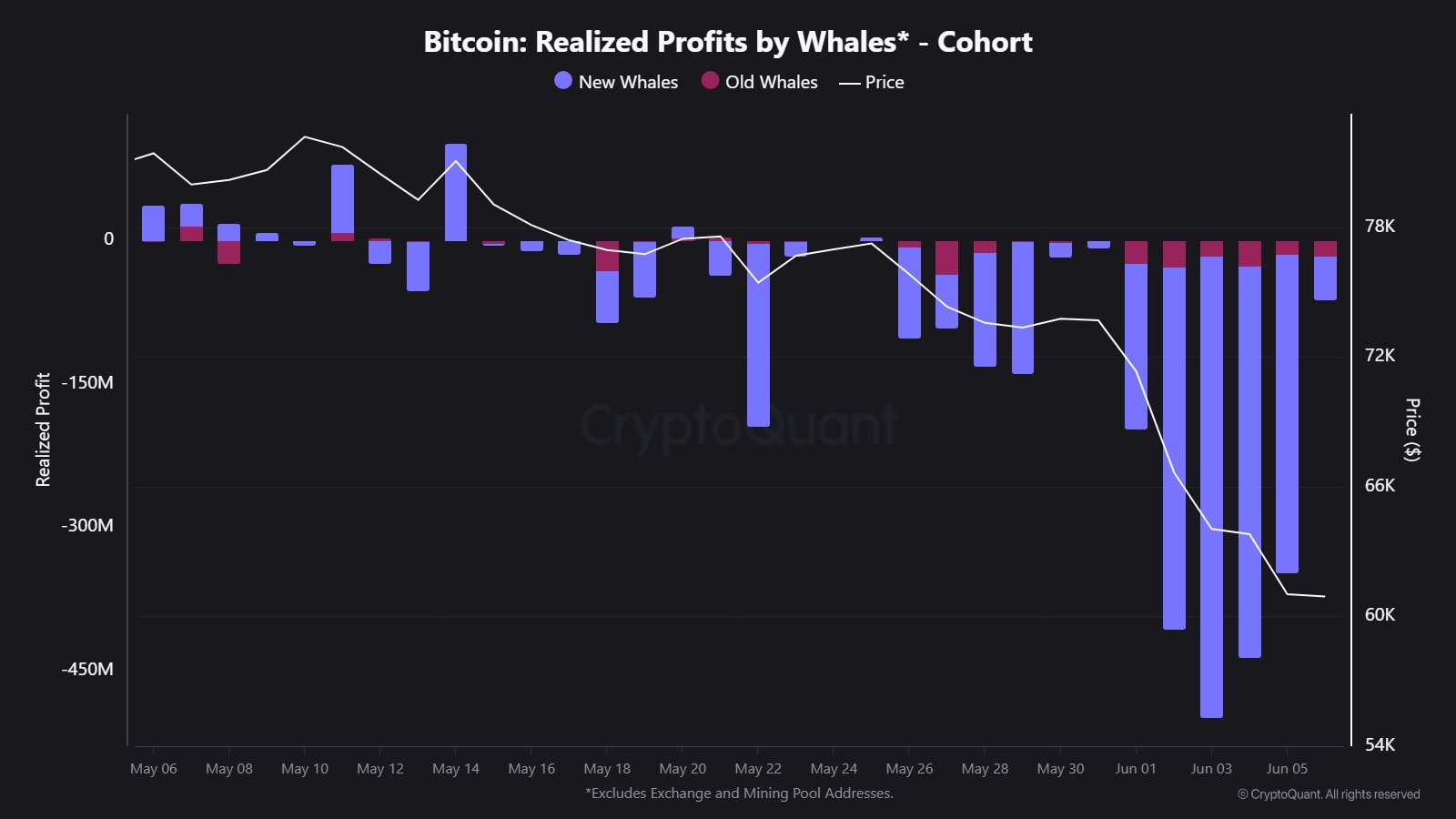
The behavior of these investors has been in line with their reputation during the recent price plunge, as the chart for the Bitcoin realized profit/loss shared by Maartunn shows.

The value of the metric appears to have been negative in recent days | Source: @JA_Maartun on X

From the graph, it’s apparent that the whales as a whole have realized a significant amount of losses in response to the bearish price action. The distribution of the realized loss, however, has heavily skewed toward the New Whales (shaded in blue in the chart).

In total, the STH Whales took $1.77 billion in losses during the past week. This is a notable amount and suggests that the big-money investors who entered the market recently have panic-capitulated in the crash. Meanwhile, the LTH Whales have kept their loss-taking contained, at least for now.

It only remains to be seen how the Bitcoin price will develop in the near future and how these whales will react to it. The price drawdown so far took the cryptocurrency to a low of $59,000, which isn’t at too much of a distance from the Realized Price, a metric tracking the cost basis of the average investor on the network.

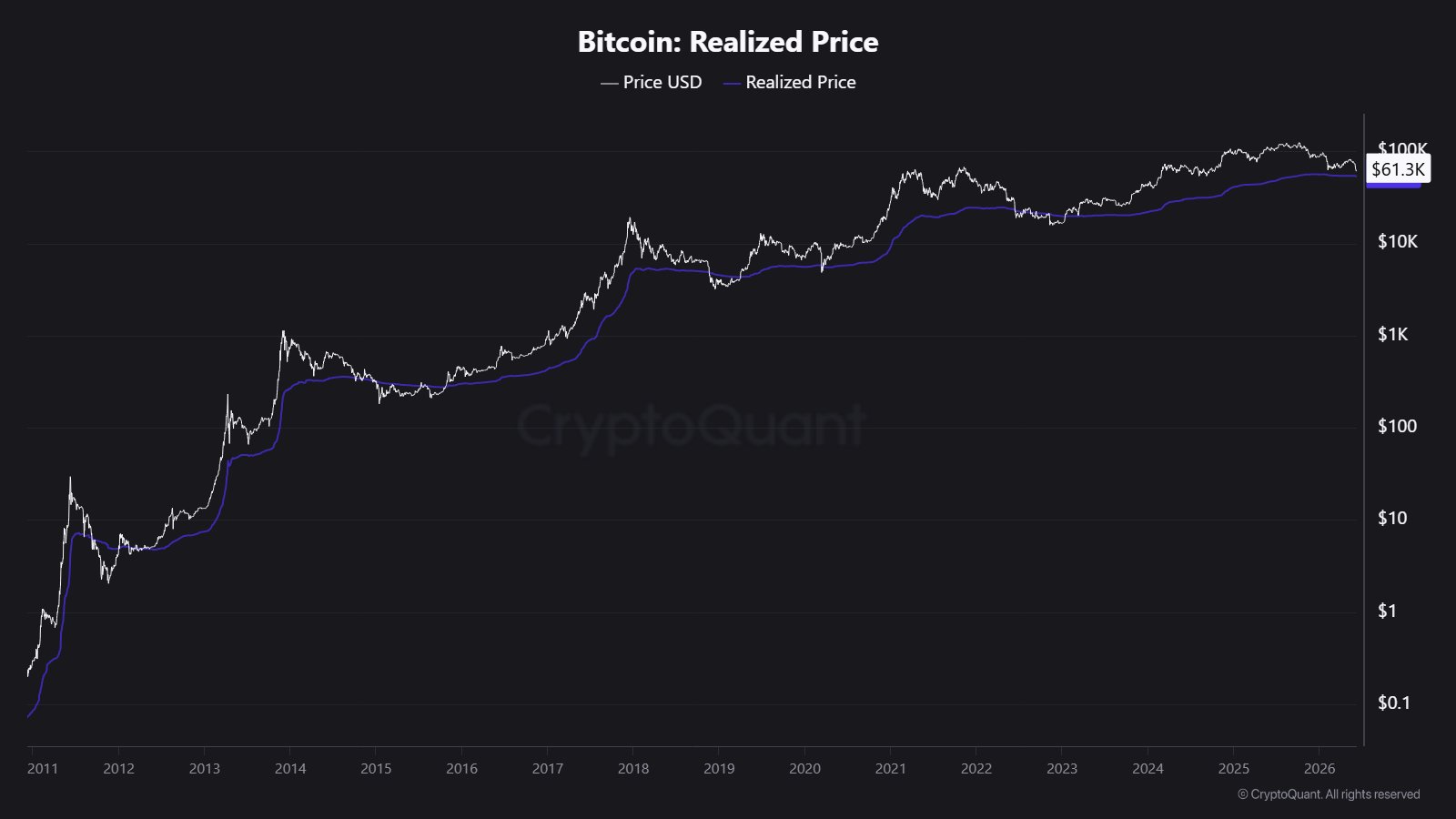
As the analyst pointed out in another X post, BTC’s Realized Price is currently located at $53,630.

The trend in the Realized Price over the history of the asset | Source: @JA_Maartun on X

Bitcoin hasn’t gone below the Realized Price in this cycle even once, but it’s possible that if the current bearish trajectory continues, a retest could occur. “Every dip below that level has historically been a no-brainer DCA zone for long-term investors,” noted Maartunn.

BTC Price

At the time of writing, Bitcoin is trading around $63,300, down more than 13% over the past week.

Looks like the price of the coin has been moving sideways recently | Source: BTCUSDT on TradingView

Связанные с этим вопросы

QWhat is the main finding from the on-chain data regarding new Bitcoin whales?

AThe main finding is that new Bitcoin whales (Short-Term Holder Whales) realized massive losses totaling $1.77 billion during the past week's price crash, indicating panic capitulation.

QHow are 'New Whales' and 'Old Whales' defined in the context of this article?

ANew Whales, or Short-Term Holder (STH) Whales, are addresses holding over 1,000 BTC that acquired them within the last 155 days. Old Whales, or Long-Term Holder (LTH) Whales, are those who have held their coins for longer than that five-month cutoff.

QAccording to the analyst, what is the current level of Bitcoin's Realized Price and its significance?

AThe current Bitcoin Realized Price is $53,630. The analyst notes that historically, dips below this level have been a 'no-brainer DCA zone' for long-term investors, as it represents the average cost basis across the network.

QWhat was the lowest price Bitcoin reached during the recent drawdown mentioned in the article?

ADuring the recent drawdown, Bitcoin reached a low of $59,000.

QWhat does the behavior of the New Whales during the crash suggest about their mindset, according to the article?

ATheir behavior suggests they represent the 'weak-minded side of the market,' as they engaged in significant panic selling and realized heavy losses shortly after entering the market.

Похожее

Michael Saylor's Latest Long Read: Who Defines the Soul of Bitcoin?

Michael Saylor's essay outlines four key ideological factions within the Bitcoin community, each shaping its future. **Bitcoin Maximalists** view Bitcoin as the dominant monetary network—a breakthrough offering superior property rights and sound money. They focus on its moral imperative and resist dilution. **Bitcoin Capitalists** believe Bitcoin's full potential is unlocked through deep integration with the global economy—into capital markets, corporate treasuries, and financial instruments. Their risk is excessive financialization. **Bitcoin Technologists** advocate for ongoing protocol improvements in scalability, privacy, and security to meet evolving demands and threats. Their core risk is destabilizing changes to the foundational layer. **Bitcoin Fundamentalists** prioritize protecting Bitcoin's core principles: self-custody, running nodes, decentralization, and its use as money. They guard against corruption, capture, and compromise. The essay argues that Bitcoin's success requires a balanced synthesis of these perspectives: maintaining its sacred core (Fundamentalists), recognizing its dominance (Maximalists), enabling global integration (Capitalists), and allowing carefully considered innovation (Technologists). The goal is disciplined expansion where most innovation occurs in higher layers, preserving the integrity of the base protocol while making Bitcoin useful for all.

marsbit38 мин. назад

Michael Saylor's Latest Long Read: Who Defines the Soul of Bitcoin?

marsbit38 мин. назад

SpaceX's Blazingly Hot IPO Breaks Records; The Previous Record Holder Was a Chinese Company

SpaceX's upcoming IPO has ignited a feverish market response, poised to break records as the largest in US and global history with a targeted valuation of $1.77 trillion and fundraising of $75 billion. Elon Musk's assertive stance, rewriting IPO rules by allocating 30% of new shares to retail investors—far exceeding the typical 5-10%—and slashing underwriting fees below 0.75%, has fueled the frenzy. This event surpasses the previous US IPO fundraising record set by Chinese e-commerce giant Alibaba in 2014. Alibaba's landmark 2014 NYSE listing raised over $25 billion, crowning it the world's fourth-largest tech company. It symbolized China's rising consumer class and digital economy, ushering in a golden era for US-listed Chinese tech firms and even prompting Hong Kong's exchange to reform its listing rules. However, Alibaba's fortunes shifted post-2020 peak. It faced a record antitrust fine for "choosing one from two" practices, internal cultural crises, and strategic missteps. A focus on premium consumption eroded its core e-commerce market share to around 30%, while costly expansions into new retail and media incurred massive losses. In late 2023, its market value was overtaken by PDD (Pinduoduo). Now, Alibaba is pivoting to AI as a new growth engine. Its Tongyi Qianwen model boasts high user engagement, and Alibaba Cloud remains China's leading public cloud provider, with AI-related revenue growing significantly. The company is integrating AI across its ecosystem. Yet challenges persist, including strong competition from ByteDance's Doubao model, talent retention issues, and an unclear strategic focus between consumer and enterprise AI. Alibaba's journey—from its record-setting IPO peak, through periods of regulatory scrutiny and strategic overreach, to its current AI-driven recalibration—highlights the cyclical fate of tech giants and underscores the critical role of core technological innovation in navigating industry shifts.

marsbit44 мин. назад

SpaceX's Blazingly Hot IPO Breaks Records; The Previous Record Holder Was a Chinese Company

marsbit44 мин. назад

Why Does Ethereum Still Need Kohaku? Privacy Concerns Aren't Just in Transactions

The article "Why Ethereum Still Needs Kohaku: Privacy Issues Extend Beyond Transactions" explains the Kohaku initiative as a suite of privacy-first tools designed to improve user privacy on the Ethereum network. It addresses the problem that while Ethereum's transparency enables innovation, it also exposes users' financial activities, asset holdings, and social connections when they reuse a single address. Kohaku aims to bridge the gap between existing privacy protocols (like Railgun, Privacy Pools) and practical user experience by integrating privacy features into wallets, developer tools, and daily interactions. Key focuses include: enabling wallets to manage multiple accounts for different purposes ("many accounts, many you"), facilitating controlled visibility for transactions instead of full transparency, protecting user data during RPC queries and network activity, and providing developers with easier ways to integrate privacy. The article clarifies that Kohaku is not a single product but an ongoing effort to make privacy a default, usable component of the ecosystem, moving beyond complex protocols to practical application. It counters common misconceptions, arguing that privacy is a fundamental user right for normal activities, not just for anonymity, and that it can coexist with compliance through selective disclosure. Ultimately, Kohaku represents an essential step for Ethereum's maturation, ensuring users can participate in the open network while maintaining control over their personal information boundaries.

marsbit44 мин. назад

Why Does Ethereum Still Need Kohaku? Privacy Concerns Aren't Just in Transactions

marsbit44 мин. назад

AI Kills India's Most Profitable Business: 2 Trillion

The article discusses the significant impact of AI on India's IT outsourcing industry, a sector that has been the backbone of the country's economic growth for three decades. On June 3, India's IT stock index plunged 5.8%, with major firms like TCS, Infosys, and Wipro seeing sharp declines. The panic stems from the realization that AI tools capable of coding, testing, documentation, and customer service directly threaten India's core business model of selling programmer hours. The industry, which generated approximately $282 billion in revenue in the 2025 fiscal year with nearly 80% from exports, faces an existential challenge. The traditional growth logic—more projects requiring more engineers—is being dismantled. Estimates suggest AI could reduce development teams from 100 people to just 2-3 for certain tasks, slashing project costs and company profit margins. Consequently, leading firms have begun reducing headcounts, a reversal of a decades-long trend, and entry-level job openings have plummeted. The risk is profound as IT services account for over 7% of India's GDP and support millions of jobs. With high youth unemployment, the AI-driven reduction in low-to-mid-level engineering roles poses a severe socio-economic threat. However, India also shows potential to adapt and lead in the AI era. Reports indicate it has the world's highest rates of AI tool adoption among employees and managers. Major IT firms are rapidly deploying enterprise AI solutions like Microsoft Copilot. The new opportunity may lie not in competing to build foundational AI models but in becoming the world's premier center for AI implementation, deployment, and productivity enhancement—exporting AI-powered services and expertise instead of just manual coding labor.

marsbit50 мин. назад

AI Kills India's Most Profitable Business: 2 Trillion

marsbit50 мин. назад

Fei-Fei Li's Manifesto for World Models

"Feifei Li's World Model Manifesto" draws a crucial distinction between current AI's linguistic prowess and its lack of understanding of the physical world. Citing Wittgenstein, Li argues that true intelligence requires moving beyond text statistics to comprehend physical laws like optics, inertia, and collision. The article diagnoses the current confusion around "world models" and proposes a clear taxonomy based on the Partially Observable Markov Decision Process (POMDP) framework. Li identifies three core, interdependent pillars for building such models: 1) The **Renderer**, which masters visual plausibility and pixel generation (e.g., Sora, image models) but lacks structural integrity. 2) The **Simulator**, which prioritizes strict adherence to physical laws (mass, friction, collision) and is essential for robotics and real-world application, though it is computationally demanding and data-hungry. 3) The **Planner**, which connects perception to action, enabling decision-making in complex, unstructured environments. Li posits the **Simulator as the critical nexus** linking rendering and planning, highlighting NVIDIA's Omniverse as a leading example. Mastering physical simulation is key to industrial AI applications. Despite challenges like scarce annotated 3D data and "physics-unrealistic" generative outputs, a convergent trend is emerging. The future lies in a **unified foundational model** that seamlessly integrates rendering, simulation, and planning into a dynamic, interactive system. Ultimately, this pursuit of "world models" represents the next evolutionary step for AI: developing **spatial intelligence** to interact with the physical world. It's not merely an algorithmic challenge but a redefinition of digital-physical standards on the path to AGI. However, as noted by Yann LeCun, achieving even rudimentary physical understanding akin to a dog's intelligence may still be years away.

marsbit51 мин. назад

Fei-Fei Li's Manifesto for World Models

marsbit51 мин. назад

Торговля

Спот
Фьючерсы

Популярные статьи

Тест по Bitcoin Биткоина

HTX Learn: Изучите Bitcoin halving и Заработаете Токены USDT

3.1k просмотров всегоОпубликовано 2024.04.16Обновлено 2024.04.16

Тест по Bitcoin  Биткоина

Что такое $BITCOIN

ЦИФРОВОЕ ЗОЛОТО ($BITCOIN): Комплексный анализ Введение в ЦИФРОВОЕ ЗОЛОТО ($BITCOIN) ЦИФРОВОЕ ЗОЛОТО ($BITCOIN) — это проект на основе блокчейна, работающий в сети Solana, который стремится объединить характеристики традиционных драгоценных металлов с инновациями децентрализованных технологий. Хотя он носит имя Биткойн, часто называемого “цифровым золотом” из-за его восприятия как средства хранения ценности, ЦИФРОВОЕ ЗОЛОТО является отдельным токеном, предназначенным для создания уникальной экосистемы в ландшафте Web3. Его цель — позиционировать себя как жизнеспособный альтернативный цифровой актив, хотя детали его применения и функциональности все еще развиваются. Что такое ЦИФРОВОЕ ЗОЛОТО ($BITCOIN)? ЦИФРОВОЕ ЗОЛОТО ($BITCOIN) — это токен криптовалюты, специально разработанный для использования в блокчейне Solana. В отличие от Биткойна, который выполняет широко признанную роль хранения ценности, этот токен, похоже, сосредоточен на более широких приложениях и характеристиках. Примечательные аспекты включают: Инфраструктура блокчейна: Токен построен на блокчейне Solana, известном своей способностью обрабатывать высокоскоростные и недорогие транзакции. Динамика предложения: ЦИФРОВОЕ ЗОЛОТО имеет максимальное предложение, ограниченное 100 квадриллионами токенов (100P $BITCOIN), хотя детали о его обращающемся предложении в настоящее время не раскрыты. Утилита: Хотя точные функциональные возможности не описаны, есть указания на то, что токен может быть использован для различных приложений, потенциально связанных с децентрализованными приложениями (dApps) или стратегиями токенизации активов. Кто создатель ЦИФРОВОГО ЗОЛОТА ($BITCOIN)? На данный момент личность создателей и команды разработчиков, стоящих за ЦИФРОВЫМ ЗОЛОТОМ ($BITCOIN), остается неизвестной. Эта ситуация типична для многих инновационных проектов в области блокчейна, особенно тех, которые связаны с децентрализованными финансами и феноменом мем-криптовалют. Хотя такая анонимность может способствовать культуре, ориентированной на сообщество, она усиливает опасения по поводу управления и ответственности. Кто инвесторы ЦИФРОВОГО ЗОЛОТА ($BITCOIN)? Доступная информация указывает на то, что у ЦИФРОВОГО ЗОЛОТА ($BITCOIN) нет известных институциональных спонсоров или значительных венчурных капиталовложений. Проект, похоже, функционирует по модели пирингового взаимодействия, сосредоточенной на поддержке и принятии сообществом, а не на традиционных путях финансирования. Его активность и ликвидность в основном сосредоточены на децентрализованных биржах (DEX), таких как PumpSwap, а не на устоявшихся централизованных торговых платформах, что еще больше подчеркивает его подход, ориентированный на grassroots. Как работает ЦИФРОВОЕ ЗОЛОТО ($BITCOIN) Операционные механизмы ЦИФРОВОГО ЗОЛОТА ($BITCOIN) можно подробно описать на основе его дизайна блокчейна и характеристик сети: Механизм консенсуса: Используя уникальный механизм доказательства истории (PoH) Solana в сочетании с моделью доказательства доли (PoS), проект обеспечивает эффективную валидацию транзакций, что способствует высокой производительности сети. Токеномика: Хотя конкретные дефляционные механизмы не были подробно описаны, большое максимальное предложение токенов подразумевает, что оно может быть предназначено для микротранзакций или нишевых случаев использования, которые еще предстоит определить. Интероперабельность: Существует потенциал для интеграции с более широкой экосистемой Solana, включая различные платформы децентрализованных финансов (DeFi). Однако детали относительно конкретных интеграций остаются неуточненными. Хронология ключевых событий Вот хронология, которая подчеркивает значимые вехи, касающиеся ЦИФРОВОГО ЗОЛОТА ($BITCOIN): 2023: Первоначальное развертывание токена происходит в блокчейне Solana, отмеченное его адресом контракта. 2024: ЦИФРОВОЕ ЗОЛОТО приобретает видимость, когда оно становится доступным для торговли на децентрализованных биржах, таких как PumpSwap, позволяя пользователям обменивать его на SOL. 2025: Проект наблюдает спорадическую торговую активность и потенциальный интерес к инициативам, возглавляемым сообществом, хотя на данный момент не зафиксировано никаких значительных партнерств или технических достижений. Критический анализ Сильные стороны Масштабируемость: Основная инфраструктура Solana поддерживает высокие объемы транзакций, что может повысить полезность $BITCOIN в различных сценариях транзакций. Доступность: Потенциально низкая цена торговли за токен может привлечь розничных инвесторов, способствуя более широкому участию благодаря возможностям дробного владения. Риски Отсутствие прозрачности: Отсутствие публично известных спонсоров, разработчиков или процесса аудита может вызвать скептицизм относительно устойчивости и надежности проекта. Волатильность рынка: Торговая активность сильно зависит от спекулятивного поведения, что может привести к значительной волатильности цен и неопределенности для инвесторов. Заключение ЦИФРОВОЕ ЗОЛОТО ($BITCOIN) является интригующим, но неоднозначным проектом в быстро развивающейся экосистеме Solana. Хотя он пытается использовать нарратив “цифрового золота”, его отход от установленной роли Биткойна как средства хранения ценности подчеркивает необходимость более четкого различения его предполагаемой утилиты и структуры управления. Будущее принятие и усвоение, вероятно, будут зависеть от решения текущей непрозрачности и более четкого определения его операционных и экономических стратегий. Примечание: Этот отчет охватывает синтезированную информацию, доступную на октябрь 2023 года, и с тех пор могут произойти события.

99 просмотров всегоОпубликовано 2025.05.13Обновлено 2025.05.13

Что такое $BITCOIN

Fractal Bitcoin: масштабирование Биткоина с помощью рекурсивной системы

Fractal Bitcoin — масштабное Layer-1-решнение, созданное на базе кода Биткоина, позволяющего достигать бесконечного масштабирования с помощью рекурсивного подхода.

2.3k просмотров всегоОпубликовано 2025.06.30Обновлено 2025.06.30

Fractal Bitcoin: масштабирование Биткоина с помощью рекурсивной системы

Обсуждения

Добро пожаловать в Сообщество HTX. Здесь вы сможете быть в курсе последних новостей о развитии платформы и получить доступ к профессиональной аналитической информации о рынке. Мнения пользователей о цене на BTC (BTC) представлены ниже.

活动图片