Michael Saylor claims, ‘Bitcoin has won’ – But the market is yet to decide

ambcryptoОпубликовано 2026-04-05Обновлено 2026-04-05

Введение

Michael Saylor's claim that "Bitcoin has won" is being tested as the market faces significant macro volatility. While he argues that Bitcoin is evolving from a speculative asset into a digital credit instrument within institutional financial systems, recent market behavior suggests otherwise. The 2024 halving did not produce the expected post-halving rally, and Bitcoin's price has fallen nearly 32% from its yearly peak, showing it remains sensitive to external risk factors. On-chain data reveals declining transaction fees—the lowest since 2011—indicating reduced network activity and demand. Additionally, persistent institutional selling pressure and distribution by short-term holders further challenge the idea that Bitcoin has matured into a resilient digital credit system. Despite growing institutional adoption, Bitcoin continues to behave like a risk asset, putting Saylor’s bullish thesis under scrutiny.

Michael Saylor’s latest bullish thesis is now facing its real test.

From a macro perspective, though, his view on Bitcoin [BTC] doesn’t seem far-fetched. The idea that BTC’s traditional four-year cycle is “dead” actually holds some weight.

Technically speaking, the 2024 halving didn’t deliver the kind of post-halving rally seen in previous cycles, disrupting the usual supply narrative.

That naturally brings us to the digital credit angle. Michael Saylor argued in his post that Bitcoin’s credibility increasingly depends on DeFi as TradFi institutions integrate BTC as a digital asset and shape its future evolution.

Put simply, rather than functioning as a speculative asset, Bitcoin is gradually positioning itself as a credit instrument within institutional financial systems.

Source: X

The timing of the tweet is also notable. On the macro side, volatility is still firmly in play. U.S. President Donald Trump’s warning to Iran to open the Strait of Hormuz is set to expire on Monday at 10:05 a.m. ET.

More importantly, that’s about 35 minutes after U.S. markets reopen following the three-day weekend.

In fact, analysts are now calling for a highly eventful session, with geopolitical uncertainty likely to drive sharp moves across risk assets, including Bitcoin.

Against this backdrop, Michael Saylor’s post starts to make more sense, especially as he argues that institutional adoption will drive Bitcoin’s next phase. That naturally raises the bigger question: Will Saylor’s “Bitcoin has won” thesis actually play out?

Has Bitcoin matured into DeFi?

For Bitcoin to truly mature into digital credit, it needs to show resilience against macro FUD. However, recent price action suggests the market hasn’t fully reached that stage yet.

Macro uncertainty has already dragged BTC nearly 32% down from its yearly $97k peak, reinforcing how strongly external liquidity conditions still shape price behavior. More importantly, this trend is now visible on-chain as well.

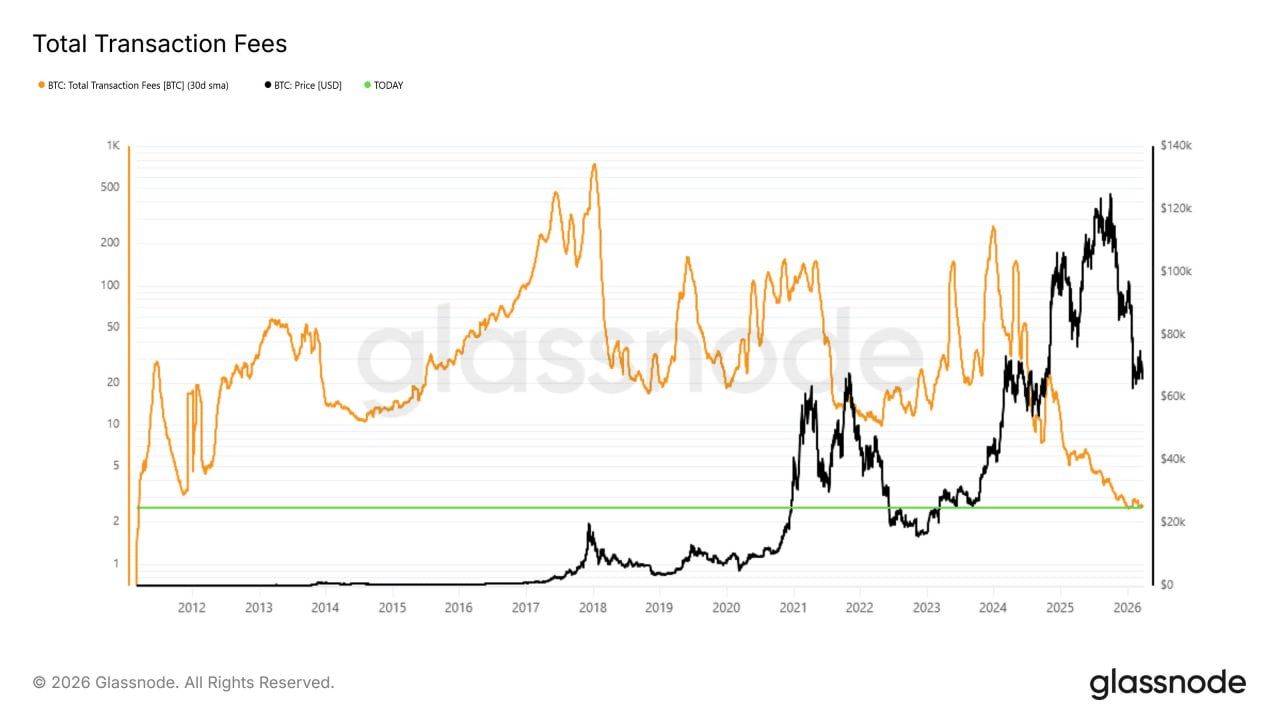
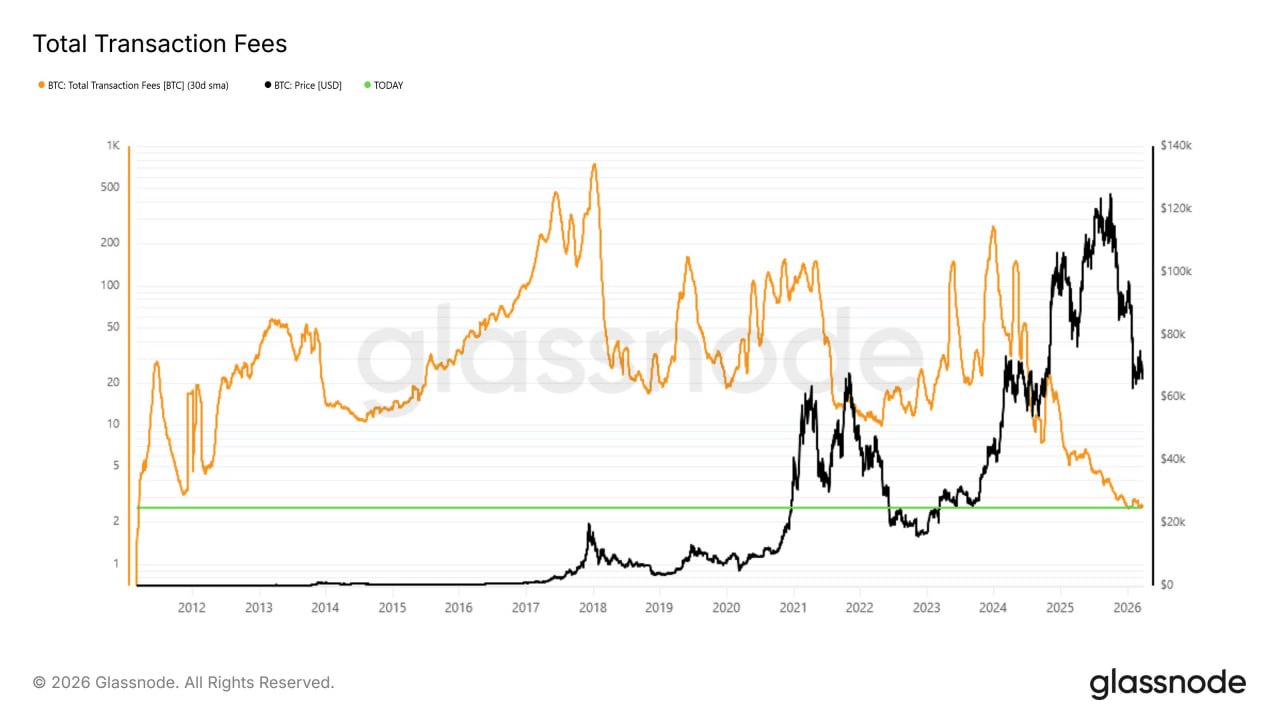
At the micro level, Bitcoin’s transaction fees have dropped to 2.5 BTC per day, the lowest since 2011.

Since fees act as a direct signal of network activity, declining fees point to softer demand, lower transaction pressure, and reduced participation. Meanwhile, conviction off-chain doesn’t look much stronger either.

Source: Glassnode

According to CryptoQuant data, institutional selling pressure continues to linger as the Coinbase Premium Index (CPI) remains in negative territory, signaling persistent selling from U.S.-based institutional flows.

In fact, the only brief relief in this pressure appeared when Bitcoin retested the $75,000 level.

Meanwhile, Short-Term Holder Net Position Change (both on daily readings and across the 90-day trend) shows distribution, indicating STHs are still rotating Bitcoin back into the market rather than accumulating.

Taken together, falling fees, weak accumulation, and ongoing capitulation, alongside Bitcoin’s 22% correction in Q1 and an additional 2.04% drop so far in April, show that BTC hasn’t been fully insulated from macro risk.

That, in turn, puts Michael Saylor’s broader thesis under real market scrutiny.


Final Summary

  • Bitcoin’s institutional narrative is gaining traction, but macro volatility continues to dominate price action.
  • Weak on-chain activity and ongoing distribution suggest BTC still behaves like a risk asset rather than a fully matured digital credit system, challenging Saylor’s “Bitcoin has won” thesis.

Связанные с этим вопросы

QWhat is Michael Saylor's main argument about Bitcoin in the article?

AMichael Saylor argues that 'Bitcoin has won' and is gradually positioning itself as a credit instrument within institutional financial systems, rather than functioning as a speculative asset, with its future evolution being shaped by TradFi institutions integrating it as a digital asset.

QAccording to the article, why is the traditional four-year Bitcoin cycle considered 'dead'?

AThe traditional four-year Bitcoin cycle is considered 'dead' because the 2024 halving did not deliver the kind of post-halving rally seen in previous cycles, thereby disrupting the usual supply narrative.

QWhat on-chain metric indicates weak network activity and demand for Bitcoin?

ABitcoin's transaction fees have dropped to 2.5 BTC per day, the lowest since 2011, which signals softer demand, lower transaction pressure, and reduced participation on the network.

QWhat does the negative Coinbase Premium Index (CPI) signify for Bitcoin?

AA negative Coinbase Premium Index (CPI) signifies persistent selling pressure from U.S.-based institutional flows, indicating that institutional investors are continuing to sell Bitcoin.

QHow has macro uncertainty affected Bitcoin's price according to the analysis?

AMacro uncertainty has dragged Bitcoin nearly 32% down from its yearly peak of $97k, causing a 22% correction in Q1 and an additional 2.04% drop in April, showing that BTC's price action is still strongly influenced by external liquidity conditions and geopolitical events.

Похожее

Saylor's Purchase of 1550 Bitcoin Is a Bad Trade

**Title: Saylor's Purchase of 1,550 Bitcoins Was a Bad Trade** The article critically analyzes Strategy's recent move of selling 32 bitcoins followed by a much larger purchase of 1,550 bitcoins. While appearing bullish, the author argues this trade is detrimental to MSTR shareholders. The core argument revolves around the concept of "breakeven modified Net Asset Value (mNAV)," a key metric for Strategy. To increase Bitcoin per share (BPS) for MSTR holders, Strategy must issue new shares at a premium high enough that the funds raised can buy more bitcoin than the bitcoin backing each existing share. Currently, this breakeven mNAV is estimated at 1.30. The recent trade failed on two counts: 1. The shares for the $181 million raise were issued at an mNAV *below* the 1.30 breakeven point. Selling "cheap" shares to buy bitcoin actually *reduces* BPS. 2. Only $101.3 million of the raised funds were used to buy bitcoin; the rest went to boost the company's dollar reserves. The breakeven mNAV calculation assumes *100%* of proceeds are used for bitcoin purchases. Diverting funds, even if mNAV were high, dilutes BPS. The result is an estimated 0.19% decrease in Bitcoin per share for MSTR holders. In exchange, Strategy merely extended its operational runway for its dollar reserves from ~6.3 months to 7 months. The author interprets this as Strategy prioritizing the survival and development of its STRC business over its stated core goal of increasing MSTR's BPS. This constitutes a gamble: if sacrificing MSTR value leads to improved market sentiment and a recovery in STRC's price (and thus mNAV), the whole system could work. If not, Strategy may be forced into a cycle of further diluting MSTR to stay afloat, potentially leading to deferred STRC dividends or corporate decline. The article concludes with a hope for price recovery for Bitcoin, MSTR, and STRC.

Foresight News14 мин. назад

Saylor's Purchase of 1550 Bitcoin Is a Bad Trade

Foresight News14 мин. назад

The AI Bear Market Lasting Two Days Is Over; Why Did Funds Buy Back Storage Stocks First?

After a severe two-day selloff in early June that erased over $1 trillion from U.S. chip stock market value, capital is flowing back first to the memory sector. The correction was not driven by a collapse in AI demand but rather a market reassessment of high expectations. Stocks like Broadcom faced selling pressure despite strong AI revenue guidance, signaling a shift in focus from who has an "AI story" to who can most rapidly translate AI demand into verifiable profits and earnings per share (EPS). Memory companies, such as Micron and SK Hynix, are leading the recovery because their EPS growth is more immediately verifiable. The AI server boom directly increases demand for high-bandwidth memory (HBM) and high-capacity server DRAM, tightening supply and driving up contract prices for conventional DRAM and NAND Flash. This price increase, coupled with a shift to higher-margin products, flows directly into near-term revenue and profitability, as evidenced in recent earnings reports. In contrast, other AI semiconductor segments like GPUs, ASICs, and optical modules, while central to the long-term AI infrastructure story, face longer and less certain paths to EPS validation. Their growth depends more on future product cycles, customer adoption timelines, and capital expenditure plans. The rebound in memory stocks highlights a market preference for assets with shorter, more transparent EPS conversion cycles following the recent de-risking phase. However, this does not negate the potential of other AI hardware segments should they provide clearer near-term order visibility. The episode has raised the validation bar for all AI-related investments.

marsbit14 мин. назад

The AI Bear Market Lasting Two Days Is Over; Why Did Funds Buy Back Storage Stocks First?

marsbit14 мин. назад

Monera Digital|Crypto Market May Report: Four Major Reasons Behind the Accelerated Decline

Monera Digital Crypto Market May Report: Four Key Reasons Behind the Accelerated Decline The crypto market experienced a significant downturn in May, driven by an internal liquidity crisis rather than external macro factors. Bitcoin fell from around $82,850 to $73,674, even as traditional markets rallied in the final week, highlighting a clear "liquidity transmission failure" specific to crypto. Four primary internal factors caused the accelerated sell-off: 1. **Major ETF Outflows:** U.S. spot Bitcoin ETFs saw a net outflow of $2.425 billion for the month, the third-largest monthly withdrawal since their launch. Ethereum ETFs also reversed to net outflows. This turned a key pillar of the bull run into a source of selling pressure. 2. **Holder Capitulation:** On-chain data showed textbook "surrender" patterns. The Short-Term Holder MVRV ratio fell below 1.0, indicating this cohort is now in aggregate loss. The Net Unrealized Profit/Loss (NUPL) metric also deteriorated significantly. 3. **Contagious Negative Sentiment:** The Coinbase Premium Index, which shows U.S. institutional buying/selling pressure, turned deeply negative for most of the month. This confirmed the ETF outflows and reflected a strategic shift away from crypto toward assets like U.S. Treasuries. 4. **Leverage Unwinding and Psychological Breaks:** Despite the downturn, futures open interest initially grew, signaling leveraged positioning. This culminated in a sharp deleveraging event with $307 million in long liquidations. Furthermore, the price broke below the critical $75K-$76K support zone, which is both a key gamma option level and the approximate average cost basis for major public companies holding Bitcoin, turning them from potential buyers into potential sellers. The report concludes that the market's pricing power has shifted from macro narratives to internal liquidation. While Bitcoin's 200-week moving average quantile has entered a historical "value zone" at 10.2%, this indicates a deep bear market reset is underway, not an immediate reversal. A sustainable recovery will require both a genuine improvement in the macro liquidity environment and clear signs of renewed on-chain demand, such as ETF inflows resuming and the Coinbase Premium turning positive. Until then, discipline and capital preservation are paramount.

marsbit25 мин. назад

Monera Digital|Crypto Market May Report: Four Major Reasons Behind the Accelerated Decline

marsbit25 мин. назад

Торговля

Спот
Фьючерсы

Популярные статьи

Тест по Bitcoin Биткоина

HTX Learn: Изучите Bitcoin halving и Заработаете Токены USDT

3.1k просмотров всегоОпубликовано 2024.04.16Обновлено 2024.04.16

Тест по Bitcoin  Биткоина

Что такое $BITCOIN

ЦИФРОВОЕ ЗОЛОТО ($BITCOIN): Комплексный анализ Введение в ЦИФРОВОЕ ЗОЛОТО ($BITCOIN) ЦИФРОВОЕ ЗОЛОТО ($BITCOIN) — это проект на основе блокчейна, работающий в сети Solana, который стремится объединить характеристики традиционных драгоценных металлов с инновациями децентрализованных технологий. Хотя он носит имя Биткойн, часто называемого “цифровым золотом” из-за его восприятия как средства хранения ценности, ЦИФРОВОЕ ЗОЛОТО является отдельным токеном, предназначенным для создания уникальной экосистемы в ландшафте Web3. Его цель — позиционировать себя как жизнеспособный альтернативный цифровой актив, хотя детали его применения и функциональности все еще развиваются. Что такое ЦИФРОВОЕ ЗОЛОТО ($BITCOIN)? ЦИФРОВОЕ ЗОЛОТО ($BITCOIN) — это токен криптовалюты, специально разработанный для использования в блокчейне Solana. В отличие от Биткойна, который выполняет широко признанную роль хранения ценности, этот токен, похоже, сосредоточен на более широких приложениях и характеристиках. Примечательные аспекты включают: Инфраструктура блокчейна: Токен построен на блокчейне Solana, известном своей способностью обрабатывать высокоскоростные и недорогие транзакции. Динамика предложения: ЦИФРОВОЕ ЗОЛОТО имеет максимальное предложение, ограниченное 100 квадриллионами токенов (100P $BITCOIN), хотя детали о его обращающемся предложении в настоящее время не раскрыты. Утилита: Хотя точные функциональные возможности не описаны, есть указания на то, что токен может быть использован для различных приложений, потенциально связанных с децентрализованными приложениями (dApps) или стратегиями токенизации активов. Кто создатель ЦИФРОВОГО ЗОЛОТА ($BITCOIN)? На данный момент личность создателей и команды разработчиков, стоящих за ЦИФРОВЫМ ЗОЛОТОМ ($BITCOIN), остается неизвестной. Эта ситуация типична для многих инновационных проектов в области блокчейна, особенно тех, которые связаны с децентрализованными финансами и феноменом мем-криптовалют. Хотя такая анонимность может способствовать культуре, ориентированной на сообщество, она усиливает опасения по поводу управления и ответственности. Кто инвесторы ЦИФРОВОГО ЗОЛОТА ($BITCOIN)? Доступная информация указывает на то, что у ЦИФРОВОГО ЗОЛОТА ($BITCOIN) нет известных институциональных спонсоров или значительных венчурных капиталовложений. Проект, похоже, функционирует по модели пирингового взаимодействия, сосредоточенной на поддержке и принятии сообществом, а не на традиционных путях финансирования. Его активность и ликвидность в основном сосредоточены на децентрализованных биржах (DEX), таких как PumpSwap, а не на устоявшихся централизованных торговых платформах, что еще больше подчеркивает его подход, ориентированный на grassroots. Как работает ЦИФРОВОЕ ЗОЛОТО ($BITCOIN) Операционные механизмы ЦИФРОВОГО ЗОЛОТА ($BITCOIN) можно подробно описать на основе его дизайна блокчейна и характеристик сети: Механизм консенсуса: Используя уникальный механизм доказательства истории (PoH) Solana в сочетании с моделью доказательства доли (PoS), проект обеспечивает эффективную валидацию транзакций, что способствует высокой производительности сети. Токеномика: Хотя конкретные дефляционные механизмы не были подробно описаны, большое максимальное предложение токенов подразумевает, что оно может быть предназначено для микротранзакций или нишевых случаев использования, которые еще предстоит определить. Интероперабельность: Существует потенциал для интеграции с более широкой экосистемой Solana, включая различные платформы децентрализованных финансов (DeFi). Однако детали относительно конкретных интеграций остаются неуточненными. Хронология ключевых событий Вот хронология, которая подчеркивает значимые вехи, касающиеся ЦИФРОВОГО ЗОЛОТА ($BITCOIN): 2023: Первоначальное развертывание токена происходит в блокчейне Solana, отмеченное его адресом контракта. 2024: ЦИФРОВОЕ ЗОЛОТО приобретает видимость, когда оно становится доступным для торговли на децентрализованных биржах, таких как PumpSwap, позволяя пользователям обменивать его на SOL. 2025: Проект наблюдает спорадическую торговую активность и потенциальный интерес к инициативам, возглавляемым сообществом, хотя на данный момент не зафиксировано никаких значительных партнерств или технических достижений. Критический анализ Сильные стороны Масштабируемость: Основная инфраструктура Solana поддерживает высокие объемы транзакций, что может повысить полезность $BITCOIN в различных сценариях транзакций. Доступность: Потенциально низкая цена торговли за токен может привлечь розничных инвесторов, способствуя более широкому участию благодаря возможностям дробного владения. Риски Отсутствие прозрачности: Отсутствие публично известных спонсоров, разработчиков или процесса аудита может вызвать скептицизм относительно устойчивости и надежности проекта. Волатильность рынка: Торговая активность сильно зависит от спекулятивного поведения, что может привести к значительной волатильности цен и неопределенности для инвесторов. Заключение ЦИФРОВОЕ ЗОЛОТО ($BITCOIN) является интригующим, но неоднозначным проектом в быстро развивающейся экосистеме Solana. Хотя он пытается использовать нарратив “цифрового золота”, его отход от установленной роли Биткойна как средства хранения ценности подчеркивает необходимость более четкого различения его предполагаемой утилиты и структуры управления. Будущее принятие и усвоение, вероятно, будут зависеть от решения текущей непрозрачности и более четкого определения его операционных и экономических стратегий. Примечание: Этот отчет охватывает синтезированную информацию, доступную на октябрь 2023 года, и с тех пор могут произойти события.

99 просмотров всегоОпубликовано 2025.05.13Обновлено 2025.05.13

Что такое $BITCOIN

Fractal Bitcoin: масштабирование Биткоина с помощью рекурсивной системы

Fractal Bitcoin — масштабное Layer-1-решнение, созданное на базе кода Биткоина, позволяющего достигать бесконечного масштабирования с помощью рекурсивного подхода.

2.3k просмотров всегоОпубликовано 2025.06.30Обновлено 2025.06.30

Fractal Bitcoin: масштабирование Биткоина с помощью рекурсивной системы

Обсуждения

Добро пожаловать в Сообщество HTX. Здесь вы сможете быть в курсе последних новостей о развитии платформы и получить доступ к профессиональной аналитической информации о рынке. Мнения пользователей о цене на BTC (BTC) представлены ниже.

活动图片