From Geopolitical Tensions to Liquidity Tightening: BTC Dragged into Uncontrolled Market Conditions

marsbitОпубликовано 2026-01-30Обновлено 2026-01-30

Введение

"Bitcoin experienced a sharp decline, dropping from around $88,000 to below $81,200, with a 24-hour loss exceeding 7%. The sell-off was driven by multiple factors converging simultaneously. Escalating geopolitical tensions in the Middle East, particularly involving the U.S. and Iran, increased market uncertainty and risk aversion. Meanwhile, the Federal Reserve's latest FOMC meeting maintained interest rates and dashed hopes for near-term rate cuts, leading to a repricing of liquidity expectations. The downturn was not isolated to crypto; U.S. equities and precious metals like gold and silver also fell, indicating a market-wide reduction in risk exposure. Additionally, Bitcoin ETFs saw sustained outflows, with over $1 billion in net withdrawals in just one week, reducing market liquidity and amplifying downward pressure. This collective 'de-risking' event forced a breakdown of key technical levels, including the 100-week moving average, triggering leveraged liquidations. Market stability now depends on reclaiming these technical supports and the return of risk capital."

Author | Asher(@Asher_ 0210)

"The big crash" has happened again.

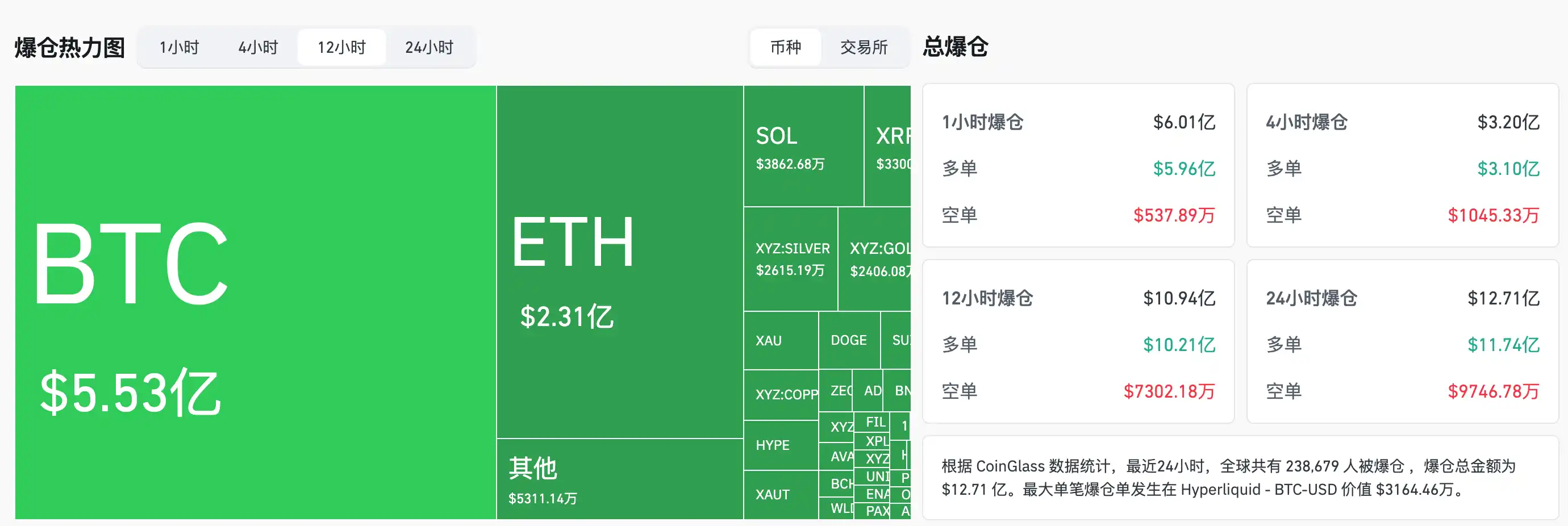
OKX market data shows that from last night to this morning Beijing time, BTC quickly fell from around $88,000, once dropping below $81,200, with a 24-hour decline of over 7%; ETH fell from $2,940 to a low of $2,690, with a 24-hour decline of nearly 10%; SOL dropped from $123 to around $112, with a 24-hour decline of over 8%. Coinglass data shows that in the past 12 hours, the market saw liquidations of $1.094 billion, with long positions accounting for as much as $1.021 billion; nearly 240,000 people were liquidated in 24 hours.

This decline was not triggered by a single negative factor, but rather the result of multiple factors being released simultaneously at the same point in time.

Middle East tensions suddenly escalate, geopolitical risks re-emerge in the market

The sudden escalation of geopolitical risk is one of the earliest important background factors factored into last night's market decline.

Latest news shows that the US aircraft carrier USS Abraham Lincoln and its strike group have entered a state of "lights out" and communication blackout. This move is usually seen as a standard operating procedure before major military actions, leading the market to speculate that actions related to Iran are entering a highly sensitive phase.

At the same time, statements from Iran have also clearly shifted to a posture of readiness for combat. Iran's First Vice President Aref, speaking about the regional situation, stated that Iran has maintained a state of combat readiness since the current administration took office, will not initiate war, but if conflict is provoked, it will defend itself with a firm stance, emphasizing that "the outcome of the war will not be decided by the enemy." He pointed out that it is currently necessary to prepare for a state of war.

Although the situation has not yet evolved into substantive conflict, this state of being "highly opaque, unverifiable, and difficult to predict" is itself enough to influence market behavior. Against a backdrop of already tight liquidity and receding risk appetite, geopolitical uncertainty was quickly priced in, prompting funds to倾向于 reduce directional exposure rather than continue betting on high-volatility assets.

FOMC "hawkish landing," liquidity expectations repriced

The decline in cryptocurrency prices still cannot be separated from the Federal Reserve.

At the January FOMC meeting, the Fed kept the benchmark interest rate unchanged in the range of 3.50% to 3.75%, and emphasized in its statement that the unemployment rate has stabilized and inflation remains at a relatively high level. The stance itself did not significantly exceed market expectations, but it emotionally completed an "expectation finale"—the market's vague幻想 of a near-term rate cut, or even a policy pivot, was officially compressed or even eliminated.

For risk assets, such moments often do not appear in the form of "new negatives," but rather as a realization that "positive factors can no longer be further透支." Since 2025, Bitcoin has seen pullbacks multiple times after FOMC meetings, which is a repeated演绎 of this mechanism: it's not that policy suddenly turned hawkish, but that the market had to admit that liquidity would not arrive as early as anticipated.

When positions are already built up and leverage is already high, this kind of "confirmation" itself is enough to trigger risk release—it is not the first push that topples the dominoes, but rather what causes all the already precarious structures to simultaneously lose their support.

Not just the crypto market falling, US stocks and precious metals also "turn sour" simultaneously

More alarmingly, this decline is not a "solo performance" by the crypto market.

In US stocks, the decline in stock indices became an important signal of weakening market risk appetite. The Nasdaq 100 index fell about 1.6%, the S&P 500 index fell about 0.75%, and the Dow Jones Industrial Average also fell about 0.2%. The three major indices were generally under pressure, with the technology sector performing particularly weakly, dragging down overall market risk appetite.

At the same time, precious metals market, originally seen as "safe-haven assets," also experienced剧烈波动. After a recent strong rally, gold prices saw a sharp short-term pullback last night, with significant profit-taking emerging in the market; silver also retreated rapidly from its highs, with a notable decline. This indicates that funds are not simply switching from risk assets to safe-haven assets, but are rather reducing risk exposure across the board in a high-volatility environment.

When stocks fall, crypto assets are under pressure, and precious metals also pull back simultaneously, the signal sent by the market is quite clear. Funds are simultaneously reducing exposure across multiple asset classes, with overall risk appetite contracting rapidly.

In such an environment, Bitcoin naturally finds it difficult to remain unscathed. It is not truly regarded by the market as a safe-haven asset, and due to its own high volatility, it often becomes one of the first to be sold when sentiment turns risk-averse.

Sustained ETF outflows significantly reduce the crypto market's capacity to absorb selling

Changes in the capital flow provided the final piece of the puzzle for this decline.

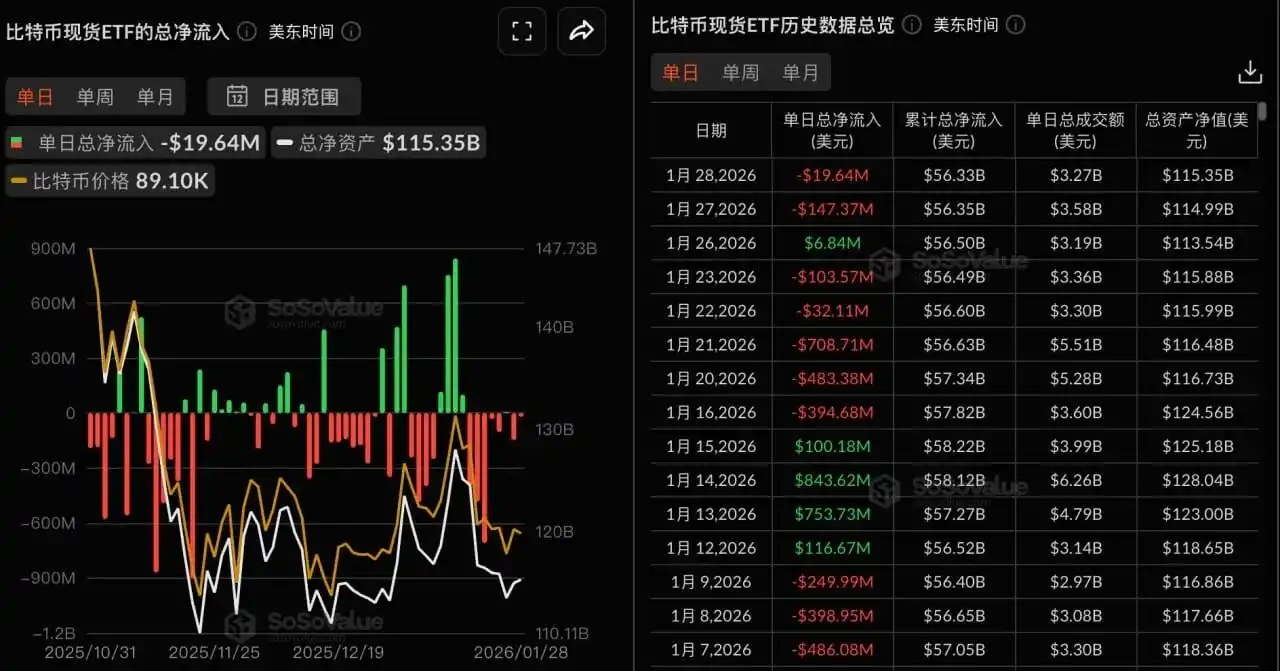
Looking at the data for Bitcoin spot ETFs, funds are continuously withdrawing. Data shows that in the past week alone, BTC spot ETFs saw sustained net outflows, with multiple days recording outflows of over $100 million per day, with the cumulative net outflow scale reaching over $1 billion.

More importantly, the withdrawal of ETF funds is not a one-time宣泄, but rather a continuous, multi-day, trend-driven reduction in positions. This means that institutional funds are not choosing to "buy the dip and provide support" during the pullback, but are more inclined to reduce overall risk exposure and wait for clearer macro and market signals.

In such a capital environment, the market does not have a "buffer." When prices fall, ETFs do not provide sustained buying power; the market relies more on existing funds to消化 selling pressure on their own. Once key price levels are broken, selling behavior quickly dominates, while buying interest明显 lags, forcing prices to rapidly探 lower to find a new balance.

Not a black swan, but a concentrated release of "forced de-risking"

The essence of BTC's current decline is not caused by a single突发 negative factor alone, but is the result of the market's repricing of risk assets overall under the叠加 of multiple risk factors. Geopolitical uncertainty intensified, macro liquidity expectations were修正, and against the backdrop of sustained net outflows from ETFs, the crypto market lacked stable structural support, ultimately triggering the market's主动 "braking" behavior.

When long-term funds and passive buying are absent, the market often completes the first stage of risk clearing by having prices break through key trend levels downward, forcing trend-following strategies and leveraged funds to exit被动, thereby completing the first stage of risk clearing. In this process, Bitcoin broke below the highly watched 100-week moving average (around $85,000), a level that has acted as a "safety net"多次 during adjustments since last year and is also the default defense line for many trend models and leveraged positions.

Judging from the outcome, the market has now completed the first round of rapid deleveraging and emotional clearing, but true stabilization still depends on two conditions: first, whether key technical levels can be recaptured and held firmly, and second, whether risk capital is willing to return to the market to participate in pricing. Before that, high volatility and low confidence may still be the阶段性主旋律.

Связанные с этим вопросы

QWhat were the main factors that led to the sharp decline in Bitcoin and other cryptocurrencies as described in the article?

AThe decline was triggered by a combination of factors including escalating geopolitical tensions in the Middle East, a hawkish stance from the Federal Reserve's FOMC meeting leading to repricing of liquidity expectations, and continuous outflows from Bitcoin ETFs which reduced market support.

QHow did geopolitical tensions contribute to the cryptocurrency market downturn?

AGeopolitical risks, particularly the heightened tensions between the US and Iran with military preparations and Iran's readiness for conflict, created uncertainty. This led to reduced risk appetite, prompting investors to lower exposure to high-volatility assets like cryptocurrencies.

QWhat was the Federal Reserve's FOMC meeting's impact on market expectations and crypto prices?

AThe FOMC maintained interest rates and emphasized stable unemployment and high inflation, dashing market hopes for near-term rate cuts or policy easing. This 'hawkish landing' forced a repricing of liquidity expectations, triggering risk-off sentiment and selling pressure on cryptocurrencies.

QWhy did the article mention that the decline was not limited to cryptocurrencies?

AThe downturn was broad-based, affecting not only cryptocurrencies but also US stock indices (like Nasdaq and S&P 500) and precious metals (gold and silver). This indicated a widespread reduction in risk exposure across multiple asset classes, not a isolated crypto market event.

QHow did Bitcoin ETF flows affect the market's ability to handle the sell-off?

ABitcoin ETFs experienced sustained outflows, with over $1 billion in net outflows in a week, indicating institutional investors were reducing risk exposure rather than buying the dip. This lack of buying support weakened market resilience, leading to steeper price declines as sell orders overwhelmed limited demand.

Похожее

Торговля

Спот
Фьючерсы

Популярные статьи

Тест по Bitcoin Биткоина

HTX Learn: Изучите Bitcoin halving и Заработаете Токены USDT

3.0k просмотров всегоОпубликовано 2024.04.16Обновлено 2024.04.16

Тест по Bitcoin  Биткоина

Что такое $BITCOIN

ЦИФРОВОЕ ЗОЛОТО ($BITCOIN): Комплексный анализ Введение в ЦИФРОВОЕ ЗОЛОТО ($BITCOIN) ЦИФРОВОЕ ЗОЛОТО ($BITCOIN) — это проект на основе блокчейна, работающий в сети Solana, который стремится объединить характеристики традиционных драгоценных металлов с инновациями децентрализованных технологий. Хотя он носит имя Биткойн, часто называемого “цифровым золотом” из-за его восприятия как средства хранения ценности, ЦИФРОВОЕ ЗОЛОТО является отдельным токеном, предназначенным для создания уникальной экосистемы в ландшафте Web3. Его цель — позиционировать себя как жизнеспособный альтернативный цифровой актив, хотя детали его применения и функциональности все еще развиваются. Что такое ЦИФРОВОЕ ЗОЛОТО ($BITCOIN)? ЦИФРОВОЕ ЗОЛОТО ($BITCOIN) — это токен криптовалюты, специально разработанный для использования в блокчейне Solana. В отличие от Биткойна, который выполняет широко признанную роль хранения ценности, этот токен, похоже, сосредоточен на более широких приложениях и характеристиках. Примечательные аспекты включают: Инфраструктура блокчейна: Токен построен на блокчейне Solana, известном своей способностью обрабатывать высокоскоростные и недорогие транзакции. Динамика предложения: ЦИФРОВОЕ ЗОЛОТО имеет максимальное предложение, ограниченное 100 квадриллионами токенов (100P $BITCOIN), хотя детали о его обращающемся предложении в настоящее время не раскрыты. Утилита: Хотя точные функциональные возможности не описаны, есть указания на то, что токен может быть использован для различных приложений, потенциально связанных с децентрализованными приложениями (dApps) или стратегиями токенизации активов. Кто создатель ЦИФРОВОГО ЗОЛОТА ($BITCOIN)? На данный момент личность создателей и команды разработчиков, стоящих за ЦИФРОВЫМ ЗОЛОТОМ ($BITCOIN), остается неизвестной. Эта ситуация типична для многих инновационных проектов в области блокчейна, особенно тех, которые связаны с децентрализованными финансами и феноменом мем-криптовалют. Хотя такая анонимность может способствовать культуре, ориентированной на сообщество, она усиливает опасения по поводу управления и ответственности. Кто инвесторы ЦИФРОВОГО ЗОЛОТА ($BITCOIN)? Доступная информация указывает на то, что у ЦИФРОВОГО ЗОЛОТА ($BITCOIN) нет известных институциональных спонсоров или значительных венчурных капиталовложений. Проект, похоже, функционирует по модели пирингового взаимодействия, сосредоточенной на поддержке и принятии сообществом, а не на традиционных путях финансирования. Его активность и ликвидность в основном сосредоточены на децентрализованных биржах (DEX), таких как PumpSwap, а не на устоявшихся централизованных торговых платформах, что еще больше подчеркивает его подход, ориентированный на grassroots. Как работает ЦИФРОВОЕ ЗОЛОТО ($BITCOIN) Операционные механизмы ЦИФРОВОГО ЗОЛОТА ($BITCOIN) можно подробно описать на основе его дизайна блокчейна и характеристик сети: Механизм консенсуса: Используя уникальный механизм доказательства истории (PoH) Solana в сочетании с моделью доказательства доли (PoS), проект обеспечивает эффективную валидацию транзакций, что способствует высокой производительности сети. Токеномика: Хотя конкретные дефляционные механизмы не были подробно описаны, большое максимальное предложение токенов подразумевает, что оно может быть предназначено для микротранзакций или нишевых случаев использования, которые еще предстоит определить. Интероперабельность: Существует потенциал для интеграции с более широкой экосистемой Solana, включая различные платформы децентрализованных финансов (DeFi). Однако детали относительно конкретных интеграций остаются неуточненными. Хронология ключевых событий Вот хронология, которая подчеркивает значимые вехи, касающиеся ЦИФРОВОГО ЗОЛОТА ($BITCOIN): 2023: Первоначальное развертывание токена происходит в блокчейне Solana, отмеченное его адресом контракта. 2024: ЦИФРОВОЕ ЗОЛОТО приобретает видимость, когда оно становится доступным для торговли на децентрализованных биржах, таких как PumpSwap, позволяя пользователям обменивать его на SOL. 2025: Проект наблюдает спорадическую торговую активность и потенциальный интерес к инициативам, возглавляемым сообществом, хотя на данный момент не зафиксировано никаких значительных партнерств или технических достижений. Критический анализ Сильные стороны Масштабируемость: Основная инфраструктура Solana поддерживает высокие объемы транзакций, что может повысить полезность $BITCOIN в различных сценариях транзакций. Доступность: Потенциально низкая цена торговли за токен может привлечь розничных инвесторов, способствуя более широкому участию благодаря возможностям дробного владения. Риски Отсутствие прозрачности: Отсутствие публично известных спонсоров, разработчиков или процесса аудита может вызвать скептицизм относительно устойчивости и надежности проекта. Волатильность рынка: Торговая активность сильно зависит от спекулятивного поведения, что может привести к значительной волатильности цен и неопределенности для инвесторов. Заключение ЦИФРОВОЕ ЗОЛОТО ($BITCOIN) является интригующим, но неоднозначным проектом в быстро развивающейся экосистеме Solana. Хотя он пытается использовать нарратив “цифрового золота”, его отход от установленной роли Биткойна как средства хранения ценности подчеркивает необходимость более четкого различения его предполагаемой утилиты и структуры управления. Будущее принятие и усвоение, вероятно, будут зависеть от решения текущей непрозрачности и более четкого определения его операционных и экономических стратегий. Примечание: Этот отчет охватывает синтезированную информацию, доступную на октябрь 2023 года, и с тех пор могут произойти события.

99 просмотров всегоОпубликовано 2025.05.13Обновлено 2025.05.13

Что такое $BITCOIN

Fractal Bitcoin: масштабирование Биткоина с помощью рекурсивной системы

Fractal Bitcoin — масштабное Layer-1-решнение, созданное на базе кода Биткоина, позволяющего достигать бесконечного масштабирования с помощью рекурсивного подхода.

2.2k просмотров всегоОпубликовано 2025.06.30Обновлено 2025.06.30

Fractal Bitcoin: масштабирование Биткоина с помощью рекурсивной системы

Обсуждения

Добро пожаловать в Сообщество HTX. Здесь вы сможете быть в курсе последних новостей о развитии платформы и получить доступ к профессиональной аналитической информации о рынке. Мнения пользователей о цене на BTC (BTC) представлены ниже.

活动图片