Bitcoin’s Current Volatility Pushes Supply Held In Profit Below Historic Bull Thresholds

bitcoinistОпубликовано 2026-05-26Обновлено 2026-05-26

Введение

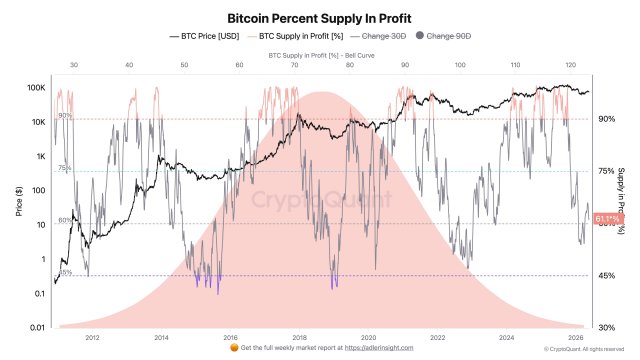
Bitcoin's current price decline below $77,000 has pushed the percentage of BTC supply held in profit down to approximately 61%. This level is notably below the typical 75%+ seen during historic bull markets, signaling a shift in market dynamics and weakening investor confidence. Analyst Darkfost notes that while this is not the extreme loss dominance of a bear market, the reduction in profitable supply creates a negative environment and reflects ongoing volatility. The key resistance level remains at $80,000, which aligns with the Short-Term Holders' Cost Basis and has consistently rejected price advances since late last year, increasing pressure on short-term investors and the potential for selling activity.

After a period of downside pressure, Bitcoin’s market dynamics are starting to experience a crucial shift that could play a role in shaping its next price trajectory. With BTC’s price experiencing a decline, the supply in profit is beginning to drop, creating a highly negative environment for investors.

Percentage Of Bitcoin Supply In Profit Continues To Shrink

The Bitcoin price is now struggling within the $77,000 threshold following a recent pullback, which is now hindering its market dynamics. One of the outcomes includes the percentage of BTC supply currently held in profit falling below key levels seen during previous bull market phases.

In his analysis shared on the X platform, Darkfost, a market decoder and verified CryptoQuant author, highlighted that the Bitcoin supply being held in profit has fallen to around 61%, indicating the growing impact of ongoing market volatility. A growing number of investors are either holding unrealized losses or are getting closer to their cost basis after BTC’s downside action.

While the level may appear relatively high after first glance, the expert stated that it remains fairly low in reality. In the past, the share of supply held in profit has often stayed above 75% during bull market phases, indicating a crucial change in market dynamics. The decline in profitable supply reflects ongoing weakening confidence in the market as it moves into a phase of uncertainty.

Source: Chart from Darkfost on X

Meanwhile, bear market periods have been linked to a significantly greater domination of losses, with about 45% of the supply being retained at a loss. When BTC dropped below the $60,000 price level, the market drew close to reaching a balance between profits and losses. During this period, only 51.1% of the BTC supply was left in profit.

For investors to remain more inclined to hold their BTC, Darkfost stated that it is vital for the market to maintain a sufficiently high level of unrealized profits. Naturally, the market becomes overheated and more susceptible to short-term corrections when extremes are reached, particularly when almost all of the supply is held in profit.

Why The $80,000 Level Remains A Key Resistance

After examining Bitcoin’s price action, Darkfost has revealed that the next crucial resistance level to break is the $80,000 mark. According to the expert, this level, which represents the Short-Term Holders’ Cost Basis, has continued to act as a major resistance range since early October last year. This implies that short-term investors are still under pressure, increasing the likelihood of cautious sentiment and more selling activity in the market.

Related Reading: Bitcoin Opens New Opportunities As The MVRV Ratio Falls Below A Key Threshold

As seen on the chart, BTC was once again rejected from this crucial resistance level as it attempted to break above the $82,000 mark. However, for now, short-term holders are likely to exit the market and reduce their losses rather than continue to hold strong to their coins.

BTC trading at $77,360 on the 1D chart | Source: BTCUSDT on Tradingview.com

Связанные с этим вопросы

QAccording to the article, what is the current percentage of Bitcoin supply held in profit, and how does it compare to typical bull market levels?

AThe current percentage of Bitcoin supply held in profit is around 61%. This is considered relatively low, as during bull market phases, this share has often stayed above 75%.

QWho provided the analysis on Bitcoin's supply in profit mentioned in the article, and on which platform was it shared?

AThe analysis was provided by Darkfost, a market decoder and verified CryptoQuant author, and it was shared on the X platform.

QWhat key price level does the article identify as the next crucial resistance for Bitcoin, and why is it significant?

AThe $80,000 mark is identified as the next crucial resistance. It is significant because it represents the Short-Term Holders' Cost Basis and has acted as a major resistance range since early October of the previous year, indicating pressure on short-term investors.

QWhat happened to the Bitcoin market when the price dropped below the $60,000 level, according to the article?

AWhen Bitcoin's price dropped below $60,000, the market neared a balance between profits and losses, with only 51.1% of the BTC supply remaining in profit.

QWhy does the expert, Darkfost, believe it's vital for the market to maintain a sufficiently high level of unrealized profits?

ADarkfost believes it is vital for the market to maintain a sufficiently high level of unrealized profits to keep investors more inclined to hold their BTC. Conversely, when almost all supply is held in profit, the market becomes overheated and more susceptible to short-term corrections.

Похожее

SEC Slams the Brakes at the Last Minute, Halting "Tokenized U.S. Stocks"

On May 22, the U.S. SEC postponed the release of a key "innovation exemption" draft that would have permitted crypto-native platforms to issue and trade tokenized U.S. stocks on decentralized venues without full traditional exchange compliance. This would have legalized a "third-party token" model used overseas, where platforms issue tokens tracking stock prices without the underlying company's involvement, raising unresolved questions about shareholder rights, dividends, and sanctions enforcement. Meanwhile, the SEC had already approved a different, compliant path for tokenization led by Nasdaq and NYSE. Their model integrates tokenized stocks into existing settlement systems (like DTCC), preserving all shareholder rights. This creates a fundamental conflict: crypto platforms seek a permissionless, 24/7 on-chain parallel market, while traditional exchanges advocate for an upgraded, regulated version of the current system. Intense lobbying from traditional exchange groups like the World Federation of Exchanges argued the exemption would create an unfair regulatory advantage and dilute investor protection. Even some compliant crypto firms favored delay. Internally, SEC commissioners were divided on the scope and pace of the exemption. The delay highlights a critical policy crossroads. With significant trading volume already occurring overseas, the SEC's decision will determine whether the U.S. embraces a dual-track system for tokenized equities or sidelines itself from an emerging global infrastructure. The core unresolved question remains the legal status and rights of holders of third-party tokenized stocks. The SEC paused because the draft framework risked creating a major new asset class with profound, unanswered legal implications.

marsbit8 мин. назад

SEC Slams the Brakes at the Last Minute, Halting "Tokenized U.S. Stocks"

marsbit8 мин. назад

Is a Super IPO Wave Coming? Will It Drain and Crash the U.S. Stock Market?

The article discusses concerns about a potential "super IPO wave" hitting the U.S. stock market, with major companies like SpaceX, OpenAI, and Anthropic preparing to go public. While these large IPOs could collectively raise hundreds of billions, raising fears of a market "blood drain," analysis suggests the impact may be limited. Key points include: * Historical data shows IPO waves often coincide with strong market returns, as they typically occur during periods of high investor demand. * Model estimates suggest even the largest IPOs might only cause a market dip of around 1%. They are more likely to trigger a routine market pullback rather than end a bull market. * The current demand side remains supportive due to high household cash balances, strong corporate earnings growth, continued stock fund inflows, and robust share buyback announcements. * The main risk lies in concentrated investor positions, particularly in large-cap tech stocks, which are at elevated levels. A shift in funds towards new issuances could pressure these crowded sectors. * Recent fund flows show strength concentrated in U.S. and tech stocks, while other regions like Europe and Japan are experiencing outflows. The conclusion is that the IPO wave itself is unlikely to crash the market unless it coincides with a weakening in underlying demand factors like earnings or fund inflows into U.S. equities. The focus should be on whether demand can continue to absorb the new supply.

marsbit14 мин. назад

Is a Super IPO Wave Coming? Will It Drain and Crash the U.S. Stock Market?

marsbit14 мин. назад

Vitalik is Personally 'Dismantling' the Ethereum Foundation

Vitalik Buterin recently published an extensive article addressing core concerns about Ethereum's future direction and the role of the Ethereum Foundation (EF). He clarifies that the EF is not his personal domain nor the central authority of Ethereum; it operates as just one node within the broader ecosystem. The board makes collective decisions, with significant operational work led by Aya Miyaguchi, allowing Vitalik to focus on technical matters. The article critiques the perception that the EF should act like a conventional, fast-moving tech company. Buterin warns that merely chasing higher TPS, lower latency, or better marketing—like other chains—risks diluting Ethereum's foundational values. He draws a parallel to Google's evolution away from its "Don't be evil" ethos. Instead, the EF's renewed mandate is to focus on preserving and strengthening Ethereum's core principles, summarized as CROPS: **C**ensorship-resistance, **R**esistance to capture, **O**pen source, **P**rivacy, and **S**ecurity. The foundation will concentrate its limited resources (holding only ~0.16% of ETH) on these long-term, non-commercializable fundamentals, while ecosystem growth, applications, and market-facing activities should be driven by external teams and capital. Buterin outlines key technical priorities aligned with this vision: 1) Advancing formal verification to mathematically prove the absence of bugs; 2) Enhancing consensus security to maintain operation without reliance on social coordination during outages; and 3) Reducing dependency on intermediaries (like RPCs) to strengthen user sovereignty and privacy. He acknowledges ETH as Ethereum's most valuable asset, crucial for security, but stresses that promoting its value is a task for the wider ecosystem, not the EF. Ultimately, Buterin's message is a strategic refocus: the EF will become a smaller, more focused entity guarding Ethereum's essential, harder-to-achieve properties, ensuring it remains distinct not just in performance but in its commitment to decentralization, resistance, and security.

marsbit18 мин. назад

Vitalik is Personally 'Dismantling' the Ethereum Foundation

marsbit18 мин. назад

After Futu Securities Was Banned, Will Buying Stocks On-Chain Be a New Solution?

After Chinese regulators announced crackdowns on cross-border securities platforms like Futu Securities, some investors are exploring whether blockchain-based stock trading could offer an alternative. However, this article argues that "on-chain stocks" are not a legal loophole for mainland Chinese investors to bypass securities, foreign exchange, and cryptocurrency regulations. Instead, it represents an infrastructure experiment in tokenizing traditional assets like U.S. stocks and ETFs for a global audience. The appeal of on-chain stocks lies in offering a more seamless, 24/7 trading experience using crypto wallets and stablecoins, particularly for non-U.S. investors and crypto natives. Projects typically issue tokens that track the price of underlying assets, but these are often financial instruments or structured products, not direct equity ownership conferring voting rights. For investors, key risks include unclear legal rights, redemption mechanisms, regional access restrictions, and the misalignment between on-chain token trading hours and the actual stock market. Using stablecoins to purchase these tokens does not legitimize otherwise restricted capital outflows for Chinese residents. For entrepreneurs, the opportunity lies not in creating new retail channels to circumvent regulations, but in building B2B infrastructure—such as compliance, custody, identity verification, and reporting tools—for licensed institutions exploring asset tokenization. In conclusion, while on-chain stocks represent a significant trend in bridging traditional finance with blockchain, they are not a regulatory workaround. Their long-term viability depends on robust compliance, clear legal structures, and serving legitimate global demand, rather than facilitating unauthorized cross-border investment.

marsbit18 мин. назад

After Futu Securities Was Banned, Will Buying Stocks On-Chain Be a New Solution?

marsbit18 мин. назад

Торговля

Спот
Фьючерсы

Популярные статьи

Тест по Bitcoin Биткоина

HTX Learn: Изучите Bitcoin halving и Заработаете Токены USDT

3.0k просмотров всегоОпубликовано 2024.04.16Обновлено 2024.04.16

Тест по Bitcoin  Биткоина

Что такое $BITCOIN

ЦИФРОВОЕ ЗОЛОТО ($BITCOIN): Комплексный анализ Введение в ЦИФРОВОЕ ЗОЛОТО ($BITCOIN) ЦИФРОВОЕ ЗОЛОТО ($BITCOIN) — это проект на основе блокчейна, работающий в сети Solana, который стремится объединить характеристики традиционных драгоценных металлов с инновациями децентрализованных технологий. Хотя он носит имя Биткойн, часто называемого “цифровым золотом” из-за его восприятия как средства хранения ценности, ЦИФРОВОЕ ЗОЛОТО является отдельным токеном, предназначенным для создания уникальной экосистемы в ландшафте Web3. Его цель — позиционировать себя как жизнеспособный альтернативный цифровой актив, хотя детали его применения и функциональности все еще развиваются. Что такое ЦИФРОВОЕ ЗОЛОТО ($BITCOIN)? ЦИФРОВОЕ ЗОЛОТО ($BITCOIN) — это токен криптовалюты, специально разработанный для использования в блокчейне Solana. В отличие от Биткойна, который выполняет широко признанную роль хранения ценности, этот токен, похоже, сосредоточен на более широких приложениях и характеристиках. Примечательные аспекты включают: Инфраструктура блокчейна: Токен построен на блокчейне Solana, известном своей способностью обрабатывать высокоскоростные и недорогие транзакции. Динамика предложения: ЦИФРОВОЕ ЗОЛОТО имеет максимальное предложение, ограниченное 100 квадриллионами токенов (100P $BITCOIN), хотя детали о его обращающемся предложении в настоящее время не раскрыты. Утилита: Хотя точные функциональные возможности не описаны, есть указания на то, что токен может быть использован для различных приложений, потенциально связанных с децентрализованными приложениями (dApps) или стратегиями токенизации активов. Кто создатель ЦИФРОВОГО ЗОЛОТА ($BITCOIN)? На данный момент личность создателей и команды разработчиков, стоящих за ЦИФРОВЫМ ЗОЛОТОМ ($BITCOIN), остается неизвестной. Эта ситуация типична для многих инновационных проектов в области блокчейна, особенно тех, которые связаны с децентрализованными финансами и феноменом мем-криптовалют. Хотя такая анонимность может способствовать культуре, ориентированной на сообщество, она усиливает опасения по поводу управления и ответственности. Кто инвесторы ЦИФРОВОГО ЗОЛОТА ($BITCOIN)? Доступная информация указывает на то, что у ЦИФРОВОГО ЗОЛОТА ($BITCOIN) нет известных институциональных спонсоров или значительных венчурных капиталовложений. Проект, похоже, функционирует по модели пирингового взаимодействия, сосредоточенной на поддержке и принятии сообществом, а не на традиционных путях финансирования. Его активность и ликвидность в основном сосредоточены на децентрализованных биржах (DEX), таких как PumpSwap, а не на устоявшихся централизованных торговых платформах, что еще больше подчеркивает его подход, ориентированный на grassroots. Как работает ЦИФРОВОЕ ЗОЛОТО ($BITCOIN) Операционные механизмы ЦИФРОВОГО ЗОЛОТА ($BITCOIN) можно подробно описать на основе его дизайна блокчейна и характеристик сети: Механизм консенсуса: Используя уникальный механизм доказательства истории (PoH) Solana в сочетании с моделью доказательства доли (PoS), проект обеспечивает эффективную валидацию транзакций, что способствует высокой производительности сети. Токеномика: Хотя конкретные дефляционные механизмы не были подробно описаны, большое максимальное предложение токенов подразумевает, что оно может быть предназначено для микротранзакций или нишевых случаев использования, которые еще предстоит определить. Интероперабельность: Существует потенциал для интеграции с более широкой экосистемой Solana, включая различные платформы децентрализованных финансов (DeFi). Однако детали относительно конкретных интеграций остаются неуточненными. Хронология ключевых событий Вот хронология, которая подчеркивает значимые вехи, касающиеся ЦИФРОВОГО ЗОЛОТА ($BITCOIN): 2023: Первоначальное развертывание токена происходит в блокчейне Solana, отмеченное его адресом контракта. 2024: ЦИФРОВОЕ ЗОЛОТО приобретает видимость, когда оно становится доступным для торговли на децентрализованных биржах, таких как PumpSwap, позволяя пользователям обменивать его на SOL. 2025: Проект наблюдает спорадическую торговую активность и потенциальный интерес к инициативам, возглавляемым сообществом, хотя на данный момент не зафиксировано никаких значительных партнерств или технических достижений. Критический анализ Сильные стороны Масштабируемость: Основная инфраструктура Solana поддерживает высокие объемы транзакций, что может повысить полезность $BITCOIN в различных сценариях транзакций. Доступность: Потенциально низкая цена торговли за токен может привлечь розничных инвесторов, способствуя более широкому участию благодаря возможностям дробного владения. Риски Отсутствие прозрачности: Отсутствие публично известных спонсоров, разработчиков или процесса аудита может вызвать скептицизм относительно устойчивости и надежности проекта. Волатильность рынка: Торговая активность сильно зависит от спекулятивного поведения, что может привести к значительной волатильности цен и неопределенности для инвесторов. Заключение ЦИФРОВОЕ ЗОЛОТО ($BITCOIN) является интригующим, но неоднозначным проектом в быстро развивающейся экосистеме Solana. Хотя он пытается использовать нарратив “цифрового золота”, его отход от установленной роли Биткойна как средства хранения ценности подчеркивает необходимость более четкого различения его предполагаемой утилиты и структуры управления. Будущее принятие и усвоение, вероятно, будут зависеть от решения текущей непрозрачности и более четкого определения его операционных и экономических стратегий. Примечание: Этот отчет охватывает синтезированную информацию, доступную на октябрь 2023 года, и с тех пор могут произойти события.

99 просмотров всегоОпубликовано 2025.05.13Обновлено 2025.05.13

Что такое $BITCOIN

Fractal Bitcoin: масштабирование Биткоина с помощью рекурсивной системы

Fractal Bitcoin — масштабное Layer-1-решнение, созданное на базе кода Биткоина, позволяющего достигать бесконечного масштабирования с помощью рекурсивного подхода.

2.3k просмотров всегоОпубликовано 2025.06.30Обновлено 2025.06.30

Fractal Bitcoin: масштабирование Биткоина с помощью рекурсивной системы

Обсуждения

Добро пожаловать в Сообщество HTX. Здесь вы сможете быть в курсе последних новостей о развитии платформы и получить доступ к профессиональной аналитической информации о рынке. Мнения пользователей о цене на BTC (BTC) представлены ниже.

活动图片