Bitcoin Needs Only 2 Steps To Become Quantum-Resistant, Core Dev Says

bitcoinistОпубликовано 2026-02-23Обновлено 2026-02-23

Введение

Bitcoin core developer Matt Corallo refutes claims that developers are ignoring quantum threats, proposing a two-step roadmap for quantum resistance. First, enable post-quantum key commitments using hash-based signatures, a step with growing consensus. Second, decide later when to disable vulnerable legacy spend paths, a more politically challenging move. Corallo argues most wallets already have quantum-safe features at the derivation layer, reducing migration complexity. He emphasizes ongoing work is active, citing research at Blockstream and Chaincode Labs, and disputes the narrative that quantum risk is being neglected. The goal is a low-cost upgrade path that prepares Bitcoin without immediate fee increases.

Bitcoin open-source engineer Matt Corallo pushed back on claims that Bitcoin developers are “sleepwalking” on quantum risk, arguing instead that a practical post-quantum roadmap is already taking shape and may be simpler than critics suggest. Speaking on the Unchained podcast episode published Feb. 22, Corallo said the key work can be framed in two main steps: enable post-quantum key commitments first, then decide later when to disable vulnerable legacy spend paths.

Corallo’s appearance was a direct response to criticism popularized by Castle Island Ventures’ Nick Carter, who has argued Bitcoin developers are not treating the quantum threat with sufficient urgency. Corallo said that characterization misses both the amount of ongoing work and an important technical point about how many Bitcoin wallets already function.

He argued that most wallets using seed phrases already have a quantum-safe anchor at the wallet-derivation layer, even if the on-chain public key and signature scheme remain vulnerable to a future cryptographically relevant quantum computer. In his telling, that meaningfully changes the migration problem and could reduce how much disruption is required if the threat becomes urgent.

Corallo’s 2-Step Roadmap For Bitcoin

Corallo repeatedly returned to what he called the core sequence for Bitcoin’s quantum preparation. “There are only two steps,” he said. “The first relevant step is just adding the ability to commit to a postquantum public key. I think that should be done soon.”

He added that this first phase is increasingly converging around hash-based signatures, with current discussion focused less on whether to do it and more on exact implementation details. Corallo said he sees “pretty strong consensus” around hash-based approaches and pointed to work tied to BIP 360, while also noting debate continues on the precise format.

The second step, in his framing, is the politically harder one: deciding when legacy, quantum-vulnerable spend paths should no longer be accepted. That is the point where old coins that have not migrated — including lost or abandoned coins — become part of a market-driven fork decision, in his view.

Corallo’s argument for moving early on the first step but delaying the enforcement switch rests on cost and wallet behavior. He said wallets can start committing to post-quantum public keys now without immediately paying the size and fee overhead of using large post-quantum signatures on-chain.

“You really want an upgrade path that is free for now,” Corallo said. “The wallets know how to spend it. They know how to build these keys, how to sign with these keys. They just don’t have to use it yet.”

He argued this avoids a scenario where wallets postpone upgrades because post-quantum transactions are larger and more expensive, while still preparing the system for a future enforcement moment.

The ‘Nobody Is Working On It’ Narrative

Corallo also disputed the idea that Bitcoin development circles are ignoring the issue. He pointed to research and engineering work at organizations including Blockstream Research and Chaincode Labs, cited Ethan Heilman and co-authors working on BIP 360, and said post-quantum discussion on the Bitcoin developer mailing list has grown steadily.

At one point, he said mailing-list discussion has risen to “30 or 40%” of posts, describing that as evidence of sustained attention rather than neglect.

Corallo did not argue the problem is trivial. He acknowledged migration of active wallets could take years and said critics are right that the social and market consequences of disabling insecure spend paths would be contentious. But his central claim was narrower: Bitcoin does not need a fully finalized end-state today to begin meaningful preparation now.

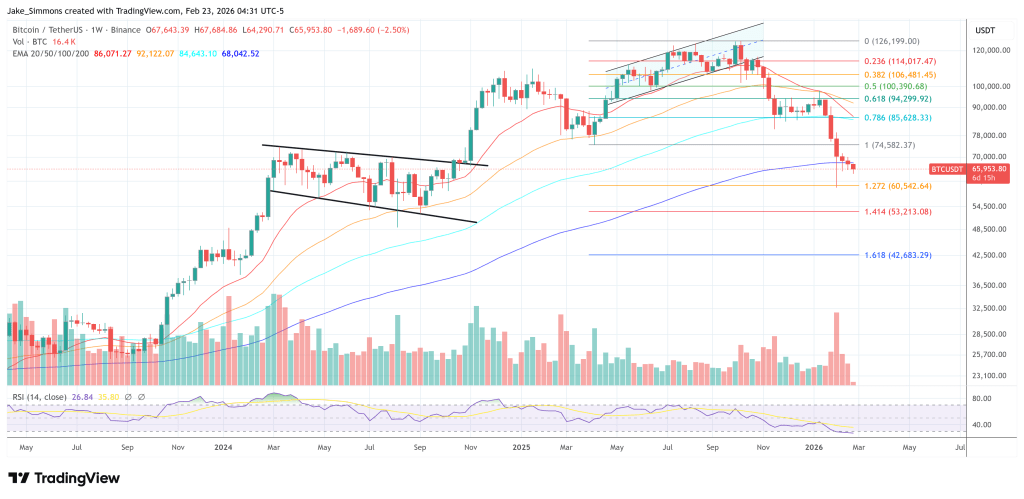
At press time, BTC traded at $65,953.

Bitcoin must reclaim the 200-week EMA, 1-week chart | Source: BTCUSDT on TradingView.com

Связанные с этим вопросы

QWhat are the two main steps in Matt Corallo's roadmap to make Bitcoin quantum-resistant?

AThe two main steps are: 1. Enable post-quantum key commitments, and 2. Decide when to disable vulnerable legacy spend paths.

QAccording to Corallo, why is the second step of disabling legacy spend paths considered politically harder?

AIt is politically harder because it involves a contentious decision on when to stop accepting old, quantum-vulnerable transactions, which would affect un-migrated coins and create a market-driven fork.

QWhat type of post-quantum signature scheme is gaining consensus among Bitcoin developers, as mentioned by Corallo?

AThere is 'pretty strong consensus' around hash-based signature schemes, with ongoing work related to BIP 360.

QHow does Corallo counter the narrative that Bitcoin developers are ignoring the quantum threat?

AHe points to increased discussion on the Bitcoin developer mailing list (up to '30 or 40%' of posts) and research work at organizations like Blockstream Research and Chaincode Labs, including efforts on BIP 360.

QWhat practical advantage does Corallo see in enabling post-quantum key commitments first, without immediately using large signatures?

AIt provides a 'free for now' upgrade path, allowing wallets to prepare for the future without incurring the immediate cost and size overhead of large post-quantum signatures, thus avoiding upgrade delays.

Похожее

iQiyi Is Too Impatient

The article "iQiyi Is Too Impatient" discusses the controversy surrounding the Chinese streaming platform IQiyi's recent announcement of an "AI Actor Library" during its 2026 World Conference. IQiyi claimed over 100 actors, including well-known names like Zhang Ruoyun and Yu Hewei, had joined the initiative. CEO Gong Yu suggested AI could enable actors to "star in 14 dramas a year instead of 4" and that "live-action filming might become a world cultural heritage." The announcement quickly sparked backlash. Multiple actors named in the list issued urgent statements denying they had signed any AI-related authorization agreements. This forced IQiyi to clarify that inclusion in the library only indicated a willingness to *consider* AI projects, with separate negotiations required for any specific role. The incident, which trended on social media with hashtags like "IQiyi is crazy," is presented as a sign of the company's growing desperation. Facing intense competition from short-video platforms like Douyin and Kuaishou, as well as Bilibili and Xiaohongshu, IQiyi's financial performance has weakened, with revenues declining for two consecutive years. The author argues that IQiyi is "too impatient" to tell a compelling AI story to reassure the market, especially as it pursues a listing on the Hong Kong stock exchange. The piece concludes by outlining three key "AI questions" IQiyi must answer: defining its role as a tool provider versus a content creator, balancing the "coldness" of AI with the human element audiences desire, and properly managing the interests of platforms, actors, and viewers. The core dilemma is that while AI can reduce costs and increase efficiency, it risks creating homogenized, formulaic content and devaluing human performers.

marsbit27 мин. назад

iQiyi Is Too Impatient

marsbit27 мин. назад

Торговля

Спот
Фьючерсы

Популярные статьи

Тест по Bitcoin Биткоина

HTX Learn: Изучите Bitcoin halving и Заработаете Токены USDT

3.0k просмотров всегоОпубликовано 2024.04.16Обновлено 2024.04.16

Тест по Bitcoin  Биткоина

Что такое $BITCOIN

ЦИФРОВОЕ ЗОЛОТО ($BITCOIN): Комплексный анализ Введение в ЦИФРОВОЕ ЗОЛОТО ($BITCOIN) ЦИФРОВОЕ ЗОЛОТО ($BITCOIN) — это проект на основе блокчейна, работающий в сети Solana, который стремится объединить характеристики традиционных драгоценных металлов с инновациями децентрализованных технологий. Хотя он носит имя Биткойн, часто называемого “цифровым золотом” из-за его восприятия как средства хранения ценности, ЦИФРОВОЕ ЗОЛОТО является отдельным токеном, предназначенным для создания уникальной экосистемы в ландшафте Web3. Его цель — позиционировать себя как жизнеспособный альтернативный цифровой актив, хотя детали его применения и функциональности все еще развиваются. Что такое ЦИФРОВОЕ ЗОЛОТО ($BITCOIN)? ЦИФРОВОЕ ЗОЛОТО ($BITCOIN) — это токен криптовалюты, специально разработанный для использования в блокчейне Solana. В отличие от Биткойна, который выполняет широко признанную роль хранения ценности, этот токен, похоже, сосредоточен на более широких приложениях и характеристиках. Примечательные аспекты включают: Инфраструктура блокчейна: Токен построен на блокчейне Solana, известном своей способностью обрабатывать высокоскоростные и недорогие транзакции. Динамика предложения: ЦИФРОВОЕ ЗОЛОТО имеет максимальное предложение, ограниченное 100 квадриллионами токенов (100P $BITCOIN), хотя детали о его обращающемся предложении в настоящее время не раскрыты. Утилита: Хотя точные функциональные возможности не описаны, есть указания на то, что токен может быть использован для различных приложений, потенциально связанных с децентрализованными приложениями (dApps) или стратегиями токенизации активов. Кто создатель ЦИФРОВОГО ЗОЛОТА ($BITCOIN)? На данный момент личность создателей и команды разработчиков, стоящих за ЦИФРОВЫМ ЗОЛОТОМ ($BITCOIN), остается неизвестной. Эта ситуация типична для многих инновационных проектов в области блокчейна, особенно тех, которые связаны с децентрализованными финансами и феноменом мем-криптовалют. Хотя такая анонимность может способствовать культуре, ориентированной на сообщество, она усиливает опасения по поводу управления и ответственности. Кто инвесторы ЦИФРОВОГО ЗОЛОТА ($BITCOIN)? Доступная информация указывает на то, что у ЦИФРОВОГО ЗОЛОТА ($BITCOIN) нет известных институциональных спонсоров или значительных венчурных капиталовложений. Проект, похоже, функционирует по модели пирингового взаимодействия, сосредоточенной на поддержке и принятии сообществом, а не на традиционных путях финансирования. Его активность и ликвидность в основном сосредоточены на децентрализованных биржах (DEX), таких как PumpSwap, а не на устоявшихся централизованных торговых платформах, что еще больше подчеркивает его подход, ориентированный на grassroots. Как работает ЦИФРОВОЕ ЗОЛОТО ($BITCOIN) Операционные механизмы ЦИФРОВОГО ЗОЛОТА ($BITCOIN) можно подробно описать на основе его дизайна блокчейна и характеристик сети: Механизм консенсуса: Используя уникальный механизм доказательства истории (PoH) Solana в сочетании с моделью доказательства доли (PoS), проект обеспечивает эффективную валидацию транзакций, что способствует высокой производительности сети. Токеномика: Хотя конкретные дефляционные механизмы не были подробно описаны, большое максимальное предложение токенов подразумевает, что оно может быть предназначено для микротранзакций или нишевых случаев использования, которые еще предстоит определить. Интероперабельность: Существует потенциал для интеграции с более широкой экосистемой Solana, включая различные платформы децентрализованных финансов (DeFi). Однако детали относительно конкретных интеграций остаются неуточненными. Хронология ключевых событий Вот хронология, которая подчеркивает значимые вехи, касающиеся ЦИФРОВОГО ЗОЛОТА ($BITCOIN): 2023: Первоначальное развертывание токена происходит в блокчейне Solana, отмеченное его адресом контракта. 2024: ЦИФРОВОЕ ЗОЛОТО приобретает видимость, когда оно становится доступным для торговли на децентрализованных биржах, таких как PumpSwap, позволяя пользователям обменивать его на SOL. 2025: Проект наблюдает спорадическую торговую активность и потенциальный интерес к инициативам, возглавляемым сообществом, хотя на данный момент не зафиксировано никаких значительных партнерств или технических достижений. Критический анализ Сильные стороны Масштабируемость: Основная инфраструктура Solana поддерживает высокие объемы транзакций, что может повысить полезность $BITCOIN в различных сценариях транзакций. Доступность: Потенциально низкая цена торговли за токен может привлечь розничных инвесторов, способствуя более широкому участию благодаря возможностям дробного владения. Риски Отсутствие прозрачности: Отсутствие публично известных спонсоров, разработчиков или процесса аудита может вызвать скептицизм относительно устойчивости и надежности проекта. Волатильность рынка: Торговая активность сильно зависит от спекулятивного поведения, что может привести к значительной волатильности цен и неопределенности для инвесторов. Заключение ЦИФРОВОЕ ЗОЛОТО ($BITCOIN) является интригующим, но неоднозначным проектом в быстро развивающейся экосистеме Solana. Хотя он пытается использовать нарратив “цифрового золота”, его отход от установленной роли Биткойна как средства хранения ценности подчеркивает необходимость более четкого различения его предполагаемой утилиты и структуры управления. Будущее принятие и усвоение, вероятно, будут зависеть от решения текущей непрозрачности и более четкого определения его операционных и экономических стратегий. Примечание: Этот отчет охватывает синтезированную информацию, доступную на октябрь 2023 года, и с тех пор могут произойти события.

99 просмотров всегоОпубликовано 2025.05.13Обновлено 2025.05.13

Что такое $BITCOIN

Fractal Bitcoin: масштабирование Биткоина с помощью рекурсивной системы

Fractal Bitcoin — масштабное Layer-1-решнение, созданное на базе кода Биткоина, позволяющего достигать бесконечного масштабирования с помощью рекурсивного подхода.

2.2k просмотров всегоОпубликовано 2025.06.30Обновлено 2025.06.30

Fractal Bitcoin: масштабирование Биткоина с помощью рекурсивной системы

Обсуждения

Добро пожаловать в Сообщество HTX. Здесь вы сможете быть в курсе последних новостей о развитии платформы и получить доступ к профессиональной аналитической информации о рынке. Мнения пользователей о цене на BTC (BTC) представлены ниже.

活动图片