Справочный обменный курс предназначен только для справки и не является фиксированным. Окончательный курс определяется на основе фактической цены исполнения.
Текущая статистика CORE
Реальлная цена CORE (CORE) сейчас составляет $0.02 USD и текущая рыночная капитализация составляет $-- USD.
Получайте обновления по CORE/USD в реальном времени на HTX. Оставайтесь в курсе последних данных и тенденций рынка, чтобы принимать разумные торговые решения. HTX – ваш надежный источник точной информации о ценах на криптовалюты.
Основные данные по CORE
Объем за 24ч (USD)
$--
Изменение цены сегодня
--
Оборотное предложение (CORE)
1.24B
Зарегистрируйтесь и торгуйте, чтобы выиграть вознаграждения на сумму до 1,500 USDT.Участвовать
Динамика цены CORE
Отслеживайте движение цены CORE, просматривая графики за периоды в 1 день, 30 дней, 60 дней, 90 дней, 1 год и за весь период с момента листинга на HTX.Просматривайте еще больше данных о ценах CORE
Время
Изменение
Изменение в %
Самая высокая цена
Самая низкая цена
No data
Рыночная информация по CORE
Получайте последнюю информацию о цене CORE на HTX: ценовые максимумы и минимумы за 24 часа, исторический максимум (ATH), и ежедневный процент изменения цены.
24ч Мин
$0
24ч Макс
$0
Исторический максимум
$0
Рыночная капитализация
$0.00
Объем за 24ч (USD)
$--
Объем в обращении
--
Что такое CORE?
Core — это блокчейн первого уровня, который обеспечивает компонуемость цепочки EVM с децентрализацией и безопасностью Биткоина. CORE — это нативный токен сети Core
Для получения более подробной информации, пожалуйста, прочтите: Что такое CORE?
Как купить CORE
Купить CORE на HTX очень просто. Нажмите здесь, чтобы ознакомиться с полным руководством по покупке CORE.
Рынки CORE в реальном времени
Обзор цен CORE в реальном времени на спотовых рынках HTX. Переключайтесь между спотовым и фьючерсным рынками, чтобы мгновенно сравнивать текущие цены и изменения цен за 24 часа.
Основываясь на исторических показателях CORE, наш инструмент прогнозирования предполагает, что цена CORE (CORE) может достигнуть -- к -- году.
Прогноз цены CORE за -- год
Наш самый последний прогноз говорит о том, что цена CORE (CORE) вырастет до -- к -- году, а изменение цены составит --% и совокупный ROI составит приблизительно --%.
Купите свои первые CORE на HTXРегистрация
Часто задаваемые вопросы о CORE
Какая сегодня цена CORE (CORE)?
Текущая цена CORE (CORE) составляет $0.02 USD.
Какая рыночная капитализация CORE (CORE)?
Текущая рыночная капитализация CORE (CORE) составляет $0.00 USD, рассчитанная путем умножения его оборотного предложения на текущую цену.
Каково оборотное предложение CORE (CORE)?
Текущее оборотное предложение CORE (CORE) составляет -- CORE.
Каким был исторический максимум CORE (CORE)?
На 2026-08-20, исторический максимум CORE (CORE) составляет $0 USD.
Каков 24-часовой объем торгов CORE (CORE)?
24-часовой объем торгов CORE (CORE) на HTX составляет -- USD.
Могу ли я купить CORE (CORE) на HTX?
Да, HTX предлагает лучшие в отрасли торговые комиссии и высокую ликвидность, обеспечивая бесперебойную и безопасную торговлю CORE (CORE).
In 2020, AI researcher Giambattista Parascandolo presented his vision for neural network reasoning at an MIT faculty interview, only to have the committee dismiss the direction as "nonsense." He later posted the details online. His talk centered on enabling artificial neural networks to generalize and plan beyond their training data, closer to human capabilities.
Parascandolo proposed three key research directions. First was "open-ended reasoning," where models could dedicate more computation time to harder problems, continuously refining answers—a precursor to today's compute-adaptive reasoning models. He noted that simply adding steps (e.g., in RNNs) wasn't enough without learning to use them effectively. Second, he advocated using language as a medium for reasoning within reinforcement learning. By leveraging the world knowledge in models like GPT, agents could better describe environments, decompose tasks, and plan—foreshadowing concepts like chain-of-thought and agent workflows. His third direction involved giving AI systems the ability to manipulate their own learning process: resetting to past states, creating counterfactual scenarios, and even editing their own activations or weights to facilitate deliberate practice.
Parascandolo, who earned his PhD focusing on out-of-distribution generalization and had internships at Google X and DeepMind, joined OpenAI in 2021. He contributed to GPT-4 and later became integral to the foundational research behind the reasoning models o1 and o3. His early, criticized ideas remarkably charted a course for advanced AI reasoning systems developed years later.
Anthropic's recent blog post urges developers using Claude Code to stop wasting money on tokens. The core issue is inefficient usage that inflates costs, often unbeknownst to users. The article outlines six key optimization strategies: 1) Use `/clear` after completing a task to prevent irrelevant previous context from bloating future interactions. 2) Set the model and reasoning effort level at the start of a session; changing them mid-conversation invalidates the prompt cache, forcing a full-price recomputation of the entire history. 3) Attach files with `@` instead of typing paths manually to avoid unnecessary tool calls and exploratory file reads that add to the context. 4) Add quiet flags to noisy commands (e.g., in `CLAUDE.md`) to minimize lengthy output that fills the context window. 5) Use `/compact` before a break while the cache is still hot, as it costs only one-tenth of compressing after the cache expires. 6) Offload large-output tasks to sub-agents, which run in isolated contexts and only return conclusions, keeping the main conversation lean.
The cost structure is explained: output tokens are 5x more expensive than input tokens due to serial "decoding." Pricing depends on the model (Opus, Sonnet, Haiku) and reasoning effort level. The most powerful cost-saving tool is the **prompt cache**, which allows reusing previously computed prefixes at 10% of the input cost. However, the cache is fragile and invalidated by switching models, changing effort levels, toggling Fast mode, using `/compact`, session timeout, or resuming old sessions.
A critical problem is **context bloat (O(n²) growth)**, where each interaction accumulates files read and command outputs, making every subsequent round more expensive. Strategies to combat this include using `@` for files, quiet flags for commands, employing sub-agents, and using `/clear` or `/compact`. The `/rewind` command is also noted for trimming recent off-track turns without breaking the cache.
The post frames efficient token management as a new essential skill for developers in the AI era, crucial for maximizing productivity within a budget.
In this article, Uniswap founder Hayden Adams argues that Automated Market Makers (AMMs) have the potential to become the core engine of future financial markets, drawing parallels to the disruptive rise of index funds 50 years ago.
He posits that asset tokenization is more than just an infrastructure upgrade; it enables programmable markets and changes who can provide liquidity. AMMs like Uniswap have already found product-market fit in long-tail crypto assets and stablecoin pairs, where passive strategies can outcompete traditional market makers due to lower capital costs.
The traditional market-making model is vertically integrated, creating high barriers to entry. Blockchain technology dismantles this by decoupling execution, custody, and settlement into competitive, open layers. In this new landscape, capital is the scarcest resource, and advantage goes to those with the lowest cost of holding assets—such as asset issuers or long-term holders who naturally have exposure.
A key emerging pattern is "correlated pairs" (e.g., an asset trading against a related index like SPY instead of USD). When two assets are correlated, passive AMM strategies perform much closer to active ones, and liquidity providers bear less risk. This structure naturally organizes markets for efficiency, with passive AMMs dominating correlated pairs and active players competing on the fewer, high-volatility "bridging pairs" (like SPY/USD).
Early examples already exist, such as tokenized stocks trading directly against SPY on Uniswap. Adams concludes that, much like passive index funds eventually outperformed most active managers, passive liquidity provision via AMMs is on a path to win by dramatically lowering the cost and complexity of creating and accessing markets.
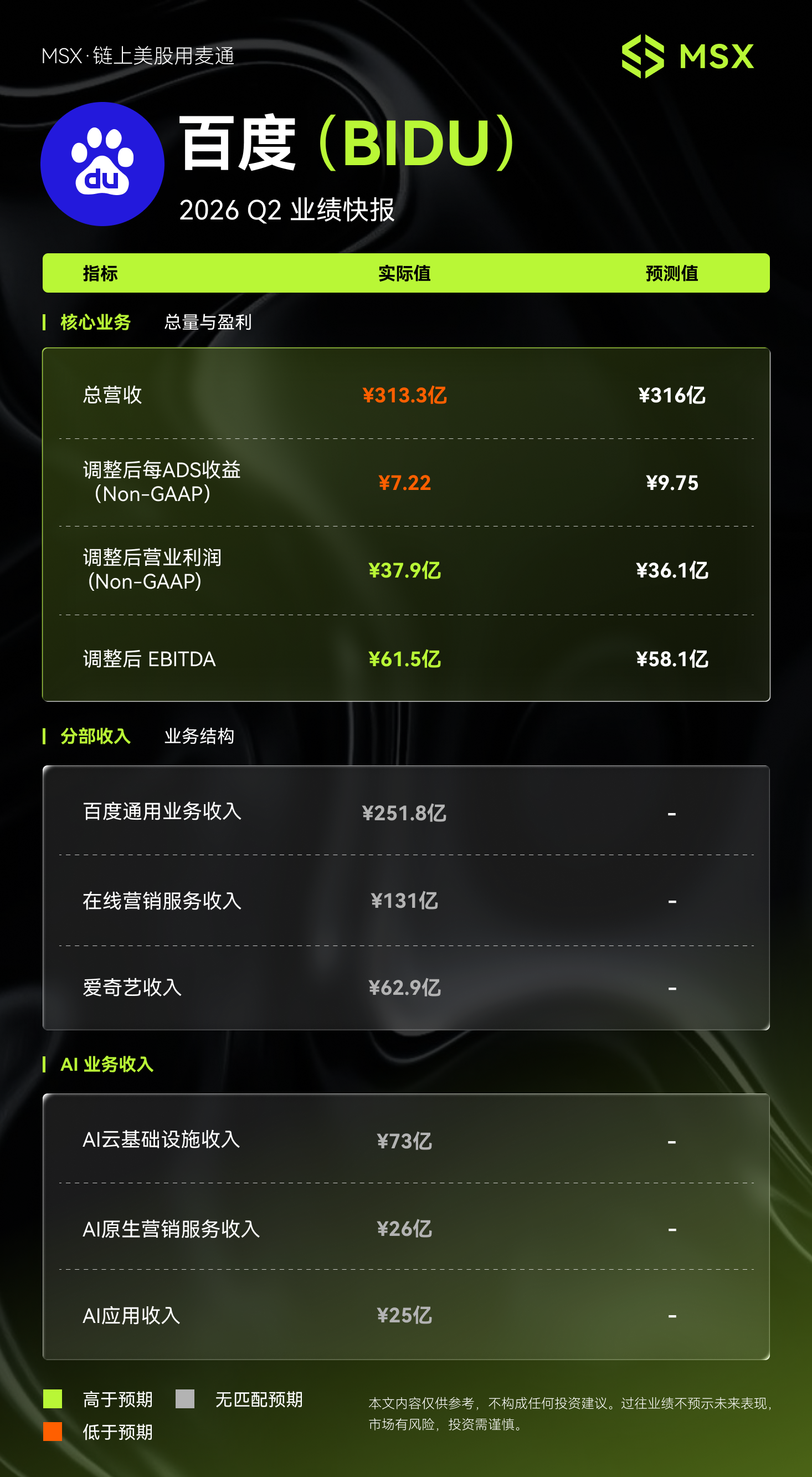
**MSX Daily US Stock Observation: Baidu 2026 Q2 Earnings Report**
Baidu's Q2 2026 earnings present a clear picture of a company in transition. Total revenue declined slightly to RMB 313.25 billion, missing market expectations. This was driven by a continued double-digit contraction (-19%) in its core online marketing (advertising) business.
The key highlight is the structural shift within the company's operations. AI-related revenue reached RMB 125 billion, accounting for approximately half of Baidu's core business income for the second consecutive quarter. Within AI, growth is heavily skewed towards infrastructure: AI cloud infrastructure revenue grew 50% year-over-year to RMB 73 billion, with GPU cloud revenue surging 283%. In contrast, AI application and AI-native marketing services revenue grew only 3% and remained flat, respectively, indicating slower commercialization on the application side.
Profitability metrics were mixed. While adjusted operating profit and EBITDA exceeded expectations, demonstrating cost control, adjusted earnings per ADS of RMB 7.22 fell short by about 26%. This gap is largely attributed to depreciation and amortization costs linked to significant AI infrastructure investments, which continue to pressure bottom-line profit realization.
The company holds a substantial cash position of RMB 2831 billion, providing runway for continued investment. The critical challenge ahead is translating the explosive growth in AI infrastructure (like GPU cloud) into stronger monetization from AI applications to bridge the gap between operational profit and per-share earnings.
The U.S. Treasury announced on August 19th an expansion of its liquidity support repurchase operations for long-term bonds. The single-operation limit for older, off-the-run nominal coupon securities in the 10-20 year and 20-30 year maturities will be increased from $2 billion to at least $4 billion, effective from September 9th until the end of the current quarterly refunding on November 4th.
The market reacted positively to the news, with yields on 10-year and 30-year Treasury notes falling. This action is seen as a key relief for assets like tech stocks, long-term bonds, gold, and cryptocurrencies, as a lower long-end yield reduces discount rate pressure on valuations. However, analysts caution against interpreting this as a form of quantitative easing (QE). The operation specifically targets less liquid older bonds to improve market functioning, unlike QE which involves the Federal Reserve expanding its balance sheet.
The move is viewed primarily as a signal that the Treasury is unwilling to let liquidity deteriorate in the long-end of the bond market, prompting short-covering and a relief rally. Its impact is constrained by the scale (a potential maximum of around $14 billion in additional repurchases this quarter), funding sources that may shift pressure to other maturities, and overarching macro factors like inflation and Fed policy.
The sustainability of the resulting market rebound will be tested by the Treasury's November quarterly refunding statement. If it includes sustained repurchases and a slowdown in long-term net issuance, the valuation support for long-duration assets could persist. If not, the operation may prove to be merely a tactical measure to reduce short-term volatility without altering the long-term pressures from deficits and inflation.
marsbit6小时前
Треды
Приветствуем вас в Сообществе HTX. Здесь вы можете быть в курсе последних новостей платформы и получите доступ к профессиональной рыночной аналитике. Мнения пользователей о цене CORE (CORE) представлены ниже.