Bitcoin near $76K – LTHs hold tight, BTC ETFs add almost $1B: What changed?

ambcryptoОпубликовано 2026-03-17Обновлено 2026-03-17

Введение

Bitcoin briefly reclaimed $76,000, supported by strengthening fundamentals. A key driver is the behavior of long-term holders (LTHs), who are holding tightly, as shown by low Coin Days Destroyed (CDD) and are at a four-year inactivity extreme. This significantly reduces structural sell pressure. Despite a slight rise in the Exchange Supply Ratio (ESR), total exchange reserves continue to decline, limiting downside risk. On the demand side, spot Bitcoin ETFs recorded six consecutive days of net inflows, totaling nearly $1 billion, marking the longest accumulation streak in 2025 and indicating renewed institutional confidence. These combined supply and demand dynamics support a continued upward price trend.

Bitcoin’s underlying structure continues to strengthen. In the early hours of Tuesday, the asset briefly reclaimed $76,000, a level last seen on the 4th of February, extending its recovery momentum.

At the core of this move is a shift in supply dynamics. On-chain data shows a sustained slowdown in Bitcoin inflows to centralized exchanges—key venues where sell pressure typically materializes. This trend points to reduced intent to sell across the market.

Long-term holders tighten supply at key levels

Long-term holders have emerged as the dominant force behind Bitcoin’s [BTC] improving fundamentals.

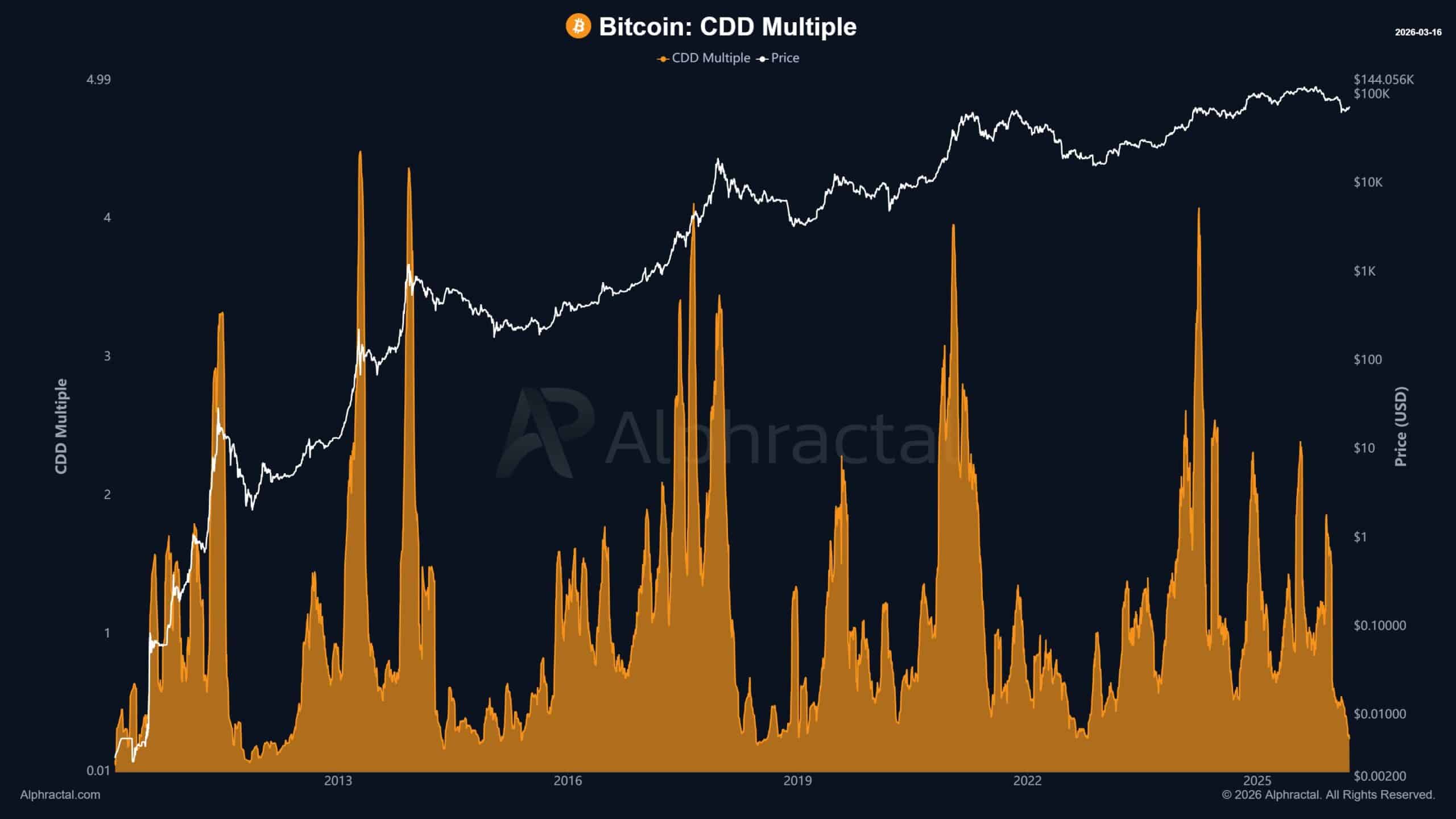
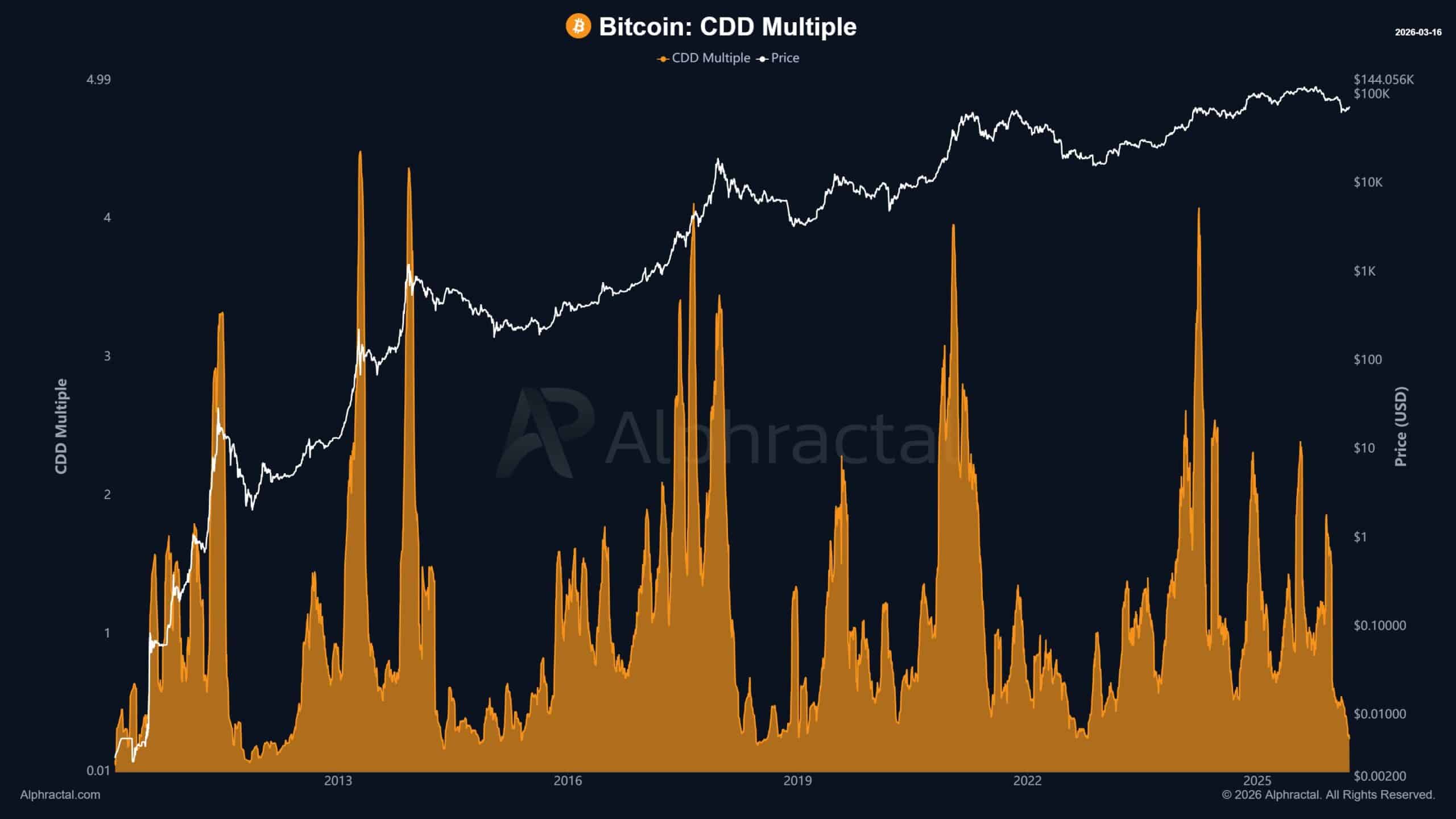
Data from Alphractal tracking Coin Days Destroyed (CDD)—a metric used to measure whether older coins are being spent—shows that long-term holders have remained largely inactive. In effect, older supply is staying off the market.

More notably, this inactivity has pushed holding behavior to a four-year extreme, last observed in 2022, a period that preceded a strong bullish phase.

Source: Alphractal

This reflects a clear shift in conviction: investors are opting to hold rather than distribute, typically a signal that expected returns outweigh current selling incentives.

The Binary CDD, a supply-adjusted variant of the metric, confirms this trend. It continues to show minimal distribution from long-term holders, reinforcing the view that structural sell pressure remains limited.

This tightening supply backdrop has coincided with a 12.84% price increase since the 9th of March, supporting the broader upward trend.

Supply conditions remain supportive despite ESR rise

From a supply standpoint, market conditions remain constructive, though not without nuance. The Exchange Supply Ratio (ESR) has risen to 0.13 after trending upward over the past two days.

Under normal conditions, a rising ESR—indicating a higher proportion of Bitcoin held on exchanges—would suggest increasing sell pressure. However, current price action tells a different story.

Bitcoin’s price has continued to climb alongside the ESR, creating a divergence from typical behavior. Rather than signaling distribution, this suggests that exchange inflows may not be translating into immediate selling, pointing instead to a more complex repositioning of supply.

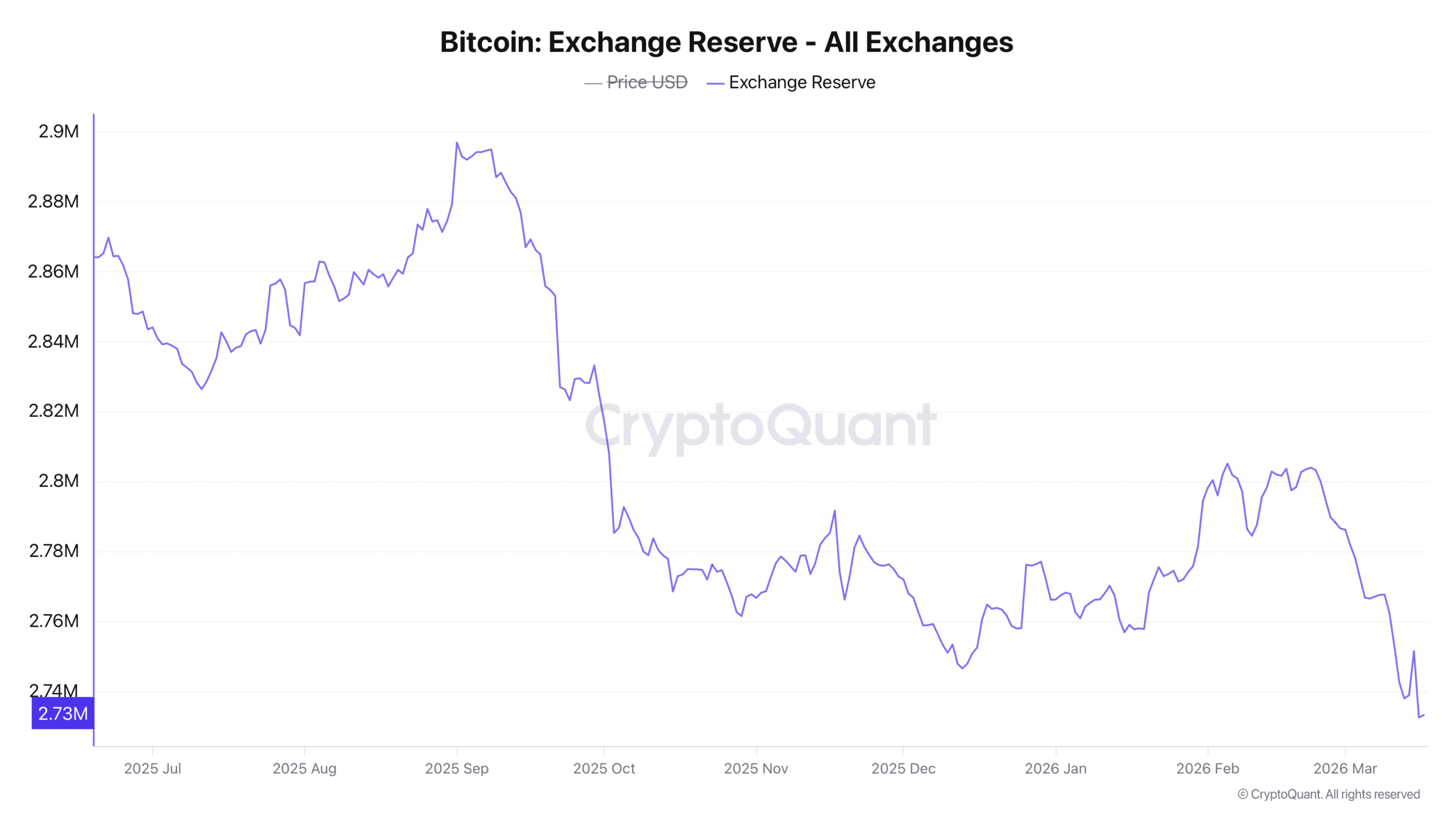
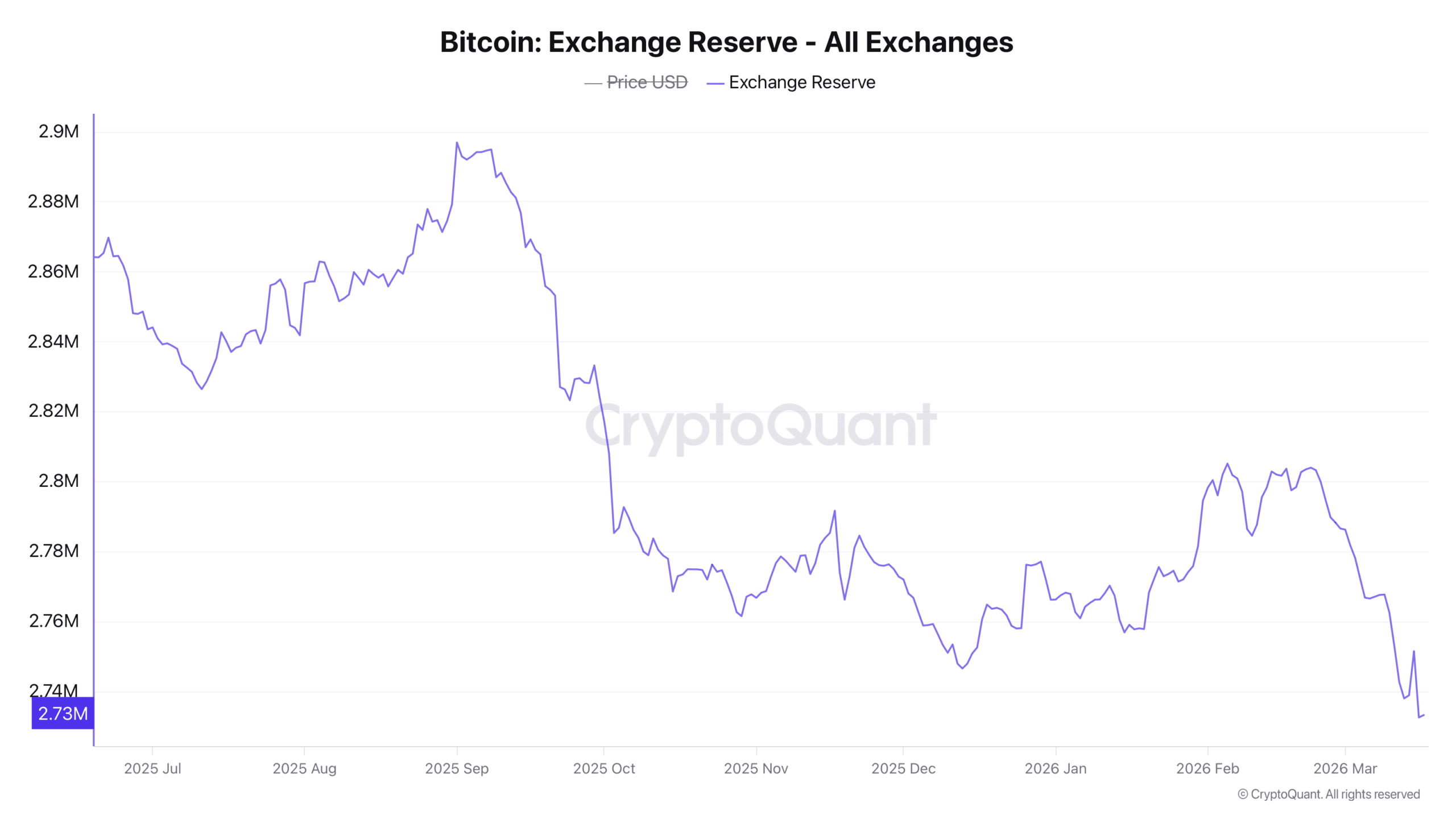
Source: CryptoQuant

A closer look at exchange reserves provides further clarity. Total Bitcoin held on exchanges continues to decline, indicating that the broader trend still favors supply contraction.

This dynamic limits the amount of readily available liquidity for sell-offs, reducing downside risk even if short-term sentiment shifts.

Demand shows early signs of strength

While supply continues to tighten, sustained upside depends on the demand keeping pace.

Institutional flows offer a key signal. According to SosoValue, spot Bitcoin ETFs have recorded six straight days of net inflows since the 9th of March, aligning with the start of the current rally.

These inflows total approximately $968.94 million, marking the longest accumulation streak recorded so far in 2025. This shift suggests renewed institutional participation and a stronger conviction at current price levels.

Although this demand has yet to trigger a decisive breakout, continued inflows could provide the necessary momentum to clear the $75,000 resistance zone and establish a stronger upward trend.


Final Summary

  • Long-term Bitcoin holders are increasing their conviction, signaling confidence in near-term upside.
  • Spot Bitcoin ETFs have recorded six consecutive days of inflows, marking their longest buying streak in over a year.

Связанные с этим вопросы

QWhat key price level did Bitcoin briefly reclaim in the early hours of Tuesday, and when was it last seen?

ABitcoin briefly reclaimed $76,000, a level last seen on the 4th of February.

QWhat on-chain metric shows that long-term holders (LTHs) have remained largely inactive, and what does this signify?

AThe Coin Days Destroyed (CDD) metric shows that long-term holders have remained largely inactive, signifying that older supply is staying off the market and reducing structural sell pressure.

QHow much have spot Bitcoin ETFs accumulated in net inflows over the six consecutive days of buying mentioned in the article?

ASpot Bitcoin ETFs have accumulated approximately $968.94 million in net inflows over the six consecutive days.

QDespite a rising Exchange Supply Ratio (ESR), why is it not necessarily signaling increased sell pressure according to the article?

AThe rising ESR is not signaling sell pressure because Bitcoin's price has continued to climb alongside it, suggesting that exchange inflows may not be translating into immediate selling but rather a more complex repositioning of supply, and total exchange reserves continue to decline.

QWhat does the holding behavior of long-term holders reaching a four-year extreme suggest about market expectations?

AThis holding behavior, last observed in 2022 which preceded a strong bullish phase, reflects a shift in conviction where investors' expected returns outweigh current selling incentives, signaling confidence in near-term upside.

Похожее

What's the Connection Between Pinduoduo's Huang Zheng and Blockchain?

This text explores the unexpected connection between Pinduoduo founder Colin Huang and blockchain, as suggested in his article *Turning Capitalism Upside Down*. Huang argues Pinduoduo's core business is about managing "uncertainty." He posits that wealth flows to the rich because they absorb life's uncertainties (e.g., illness, job loss) that devastate the poor, who pay a premium for certainty through insurance or stable prices. Pinduoduo's model attempts a "reverse insurance": by aggregating consumer demand via group-buying and flash sales, it creates a large, predictable order for manufacturers. This certainty allows factories to remove risk premiums, passing savings back as lower prices, thus partially reversing the wealth flow. The key obstacle, Huang notes, is that an individual's buying intent is an unreliable promise. He then asks if blockchain is the natural solution for this "reverse insurance." The text elaborates that blockchain, through smart contracts with binding deposits, could transform casual intent into a costly-to-break, enforceable commitment. This replaces interpersonal trust with coded rules, making promises credible, pricable, and resistant to fraud. Finally, the author draws a parallel to Bitcoin, framing two paths to creating certainty: the "Pinduoduo path" of aggregating decentralized will into scale, and the "Bitcoin path" of locking rules into immutable code. Both sacrifice something—personal freedom or system flexibility—to manufacture trust and predictability.

链捕手15 мин. назад

What's the Connection Between Pinduoduo's Huang Zheng and Blockchain?

链捕手15 мин. назад

The Storage Magnate Who Conquered a Trillion-Dollar Kingdom, Yet Ultimately Could Not Become the Richest

**Summary:** "The Memory Magnate Who Built a Trillion-Dollar Empire, Yet Never Became the Richest" explores the journey of Zhu Yiming, founder of GigaDevice (603986) and co-founder of the soon-to-IPO ChangXin Memory Technologies (CXMT). The article positions GigaDevice, a fabless chip designer now valued at ~¥340 billion, as a prequel to the massive IDM (Integrated Device Manufacturer) venture, CXMT. Starting in 2005 with minimal capital, Zhu strategically "picked up the pieces" by focusing on niche markets like NOR Flash and microcontrollers (MCUs), areas major players were exiting. This allowed GigaDevice to grow into a diversified semiconductor company, maintaining robust profitability even during industry downturns by controlling costs. However, the piece argues that in the highly cyclical and capital-intensive memory chip industry, the fabless model has limits. True resilience and scale require the ability for "counter-cyclical expansion" – investing heavily during downturns – a tactic only possible for IDMs like Samsung or SK Hynix. This insight led Zhu to partner with the Hefei city government in 2016 to establish CXMT, an IDM focused on DRAM. Zhu's symbolic moves, like forfeiting salary and diluting his equity, were crucial in securing the massive state and bank funding needed. CXMT's equipment base is now valued even higher than that of BYD's vast auto manufacturing empire. Despite the potential for CXMT to reach a market cap of ¥1-2 trillion upon its IPO, Zhu's indirect stake in both companies is estimated below 3%, placing his personal wealth far below that of China's top billionaires. The article concludes that his strategic vision built a trillion-yuan memory landscape, but the capital structure necessary to achieve it precluded a personal fortune of similar scale.

marsbit22 мин. назад

The Storage Magnate Who Conquered a Trillion-Dollar Kingdom, Yet Ultimately Could Not Become the Richest

marsbit22 мин. назад

XRP Ledger Daily Fees Drop Below $400 As Network Activity Question Returns

The XRP Ledger is drawing attention as daily network fees have fallen below $400. While low fees align with XRPL's design for affordable transactions and are often seen as a strength, the metric can also serve as an indicator of network demand and paid transaction volume. This data point of around $3,100 in weekly fee burn highlights the stark contrast with higher-fee chains like Ethereum and Bitcoin. The development fuels an ongoing debate. Proponents view low fees as a sign of efficiency and accessibility, while critics may question if the network is generating sufficient high-value activity relative to its market cap and payments-focused narrative. The article cautions against overstating the finding, noting a single low-fee day does not signify network failure. It instead adds context to discussions about XRPL's usage, especially alongside Ripple's broader initiatives in stablecoins (RLUSD), AI payments, and enterprise infrastructure. The report recommends monitoring for a fee rebound, checking transaction counts for a fuller picture, and confirming the trend via native explorers like Bithomp. It frames the story within a larger market shift where on-chain data, protocol updates, and infrastructure developments are becoming crucial alongside price action. The editorial stance is to present the verified data, explain its significance for assessing network activity, and avoid hype, positioning it as part of the daily crypto conversation.

bitcoinist4 ч. назад

XRP Ledger Daily Fees Drop Below $400 As Network Activity Question Returns

bitcoinist4 ч. назад

Торговля

Спот
Фьючерсы

Популярные статьи

Тест по Bitcoin Биткоина

HTX Learn: Изучите Bitcoin halving и Заработаете Токены USDT

3.1k просмотров всегоОпубликовано 2024.04.16Обновлено 2024.04.16

Тест по Bitcoin  Биткоина

Что такое $BITCOIN

ЦИФРОВОЕ ЗОЛОТО ($BITCOIN): Комплексный анализ Введение в ЦИФРОВОЕ ЗОЛОТО ($BITCOIN) ЦИФРОВОЕ ЗОЛОТО ($BITCOIN) — это проект на основе блокчейна, работающий в сети Solana, который стремится объединить характеристики традиционных драгоценных металлов с инновациями децентрализованных технологий. Хотя он носит имя Биткойн, часто называемого “цифровым золотом” из-за его восприятия как средства хранения ценности, ЦИФРОВОЕ ЗОЛОТО является отдельным токеном, предназначенным для создания уникальной экосистемы в ландшафте Web3. Его цель — позиционировать себя как жизнеспособный альтернативный цифровой актив, хотя детали его применения и функциональности все еще развиваются. Что такое ЦИФРОВОЕ ЗОЛОТО ($BITCOIN)? ЦИФРОВОЕ ЗОЛОТО ($BITCOIN) — это токен криптовалюты, специально разработанный для использования в блокчейне Solana. В отличие от Биткойна, который выполняет широко признанную роль хранения ценности, этот токен, похоже, сосредоточен на более широких приложениях и характеристиках. Примечательные аспекты включают: Инфраструктура блокчейна: Токен построен на блокчейне Solana, известном своей способностью обрабатывать высокоскоростные и недорогие транзакции. Динамика предложения: ЦИФРОВОЕ ЗОЛОТО имеет максимальное предложение, ограниченное 100 квадриллионами токенов (100P $BITCOIN), хотя детали о его обращающемся предложении в настоящее время не раскрыты. Утилита: Хотя точные функциональные возможности не описаны, есть указания на то, что токен может быть использован для различных приложений, потенциально связанных с децентрализованными приложениями (dApps) или стратегиями токенизации активов. Кто создатель ЦИФРОВОГО ЗОЛОТА ($BITCOIN)? На данный момент личность создателей и команды разработчиков, стоящих за ЦИФРОВЫМ ЗОЛОТОМ ($BITCOIN), остается неизвестной. Эта ситуация типична для многих инновационных проектов в области блокчейна, особенно тех, которые связаны с децентрализованными финансами и феноменом мем-криптовалют. Хотя такая анонимность может способствовать культуре, ориентированной на сообщество, она усиливает опасения по поводу управления и ответственности. Кто инвесторы ЦИФРОВОГО ЗОЛОТА ($BITCOIN)? Доступная информация указывает на то, что у ЦИФРОВОГО ЗОЛОТА ($BITCOIN) нет известных институциональных спонсоров или значительных венчурных капиталовложений. Проект, похоже, функционирует по модели пирингового взаимодействия, сосредоточенной на поддержке и принятии сообществом, а не на традиционных путях финансирования. Его активность и ликвидность в основном сосредоточены на децентрализованных биржах (DEX), таких как PumpSwap, а не на устоявшихся централизованных торговых платформах, что еще больше подчеркивает его подход, ориентированный на grassroots. Как работает ЦИФРОВОЕ ЗОЛОТО ($BITCOIN) Операционные механизмы ЦИФРОВОГО ЗОЛОТА ($BITCOIN) можно подробно описать на основе его дизайна блокчейна и характеристик сети: Механизм консенсуса: Используя уникальный механизм доказательства истории (PoH) Solana в сочетании с моделью доказательства доли (PoS), проект обеспечивает эффективную валидацию транзакций, что способствует высокой производительности сети. Токеномика: Хотя конкретные дефляционные механизмы не были подробно описаны, большое максимальное предложение токенов подразумевает, что оно может быть предназначено для микротранзакций или нишевых случаев использования, которые еще предстоит определить. Интероперабельность: Существует потенциал для интеграции с более широкой экосистемой Solana, включая различные платформы децентрализованных финансов (DeFi). Однако детали относительно конкретных интеграций остаются неуточненными. Хронология ключевых событий Вот хронология, которая подчеркивает значимые вехи, касающиеся ЦИФРОВОГО ЗОЛОТА ($BITCOIN): 2023: Первоначальное развертывание токена происходит в блокчейне Solana, отмеченное его адресом контракта. 2024: ЦИФРОВОЕ ЗОЛОТО приобретает видимость, когда оно становится доступным для торговли на децентрализованных биржах, таких как PumpSwap, позволяя пользователям обменивать его на SOL. 2025: Проект наблюдает спорадическую торговую активность и потенциальный интерес к инициативам, возглавляемым сообществом, хотя на данный момент не зафиксировано никаких значительных партнерств или технических достижений. Критический анализ Сильные стороны Масштабируемость: Основная инфраструктура Solana поддерживает высокие объемы транзакций, что может повысить полезность $BITCOIN в различных сценариях транзакций. Доступность: Потенциально низкая цена торговли за токен может привлечь розничных инвесторов, способствуя более широкому участию благодаря возможностям дробного владения. Риски Отсутствие прозрачности: Отсутствие публично известных спонсоров, разработчиков или процесса аудита может вызвать скептицизм относительно устойчивости и надежности проекта. Волатильность рынка: Торговая активность сильно зависит от спекулятивного поведения, что может привести к значительной волатильности цен и неопределенности для инвесторов. Заключение ЦИФРОВОЕ ЗОЛОТО ($BITCOIN) является интригующим, но неоднозначным проектом в быстро развивающейся экосистеме Solana. Хотя он пытается использовать нарратив “цифрового золота”, его отход от установленной роли Биткойна как средства хранения ценности подчеркивает необходимость более четкого различения его предполагаемой утилиты и структуры управления. Будущее принятие и усвоение, вероятно, будут зависеть от решения текущей непрозрачности и более четкого определения его операционных и экономических стратегий. Примечание: Этот отчет охватывает синтезированную информацию, доступную на октябрь 2023 года, и с тех пор могут произойти события.

99 просмотров всегоОпубликовано 2025.05.13Обновлено 2025.05.13

Что такое $BITCOIN

Fractal Bitcoin: масштабирование Биткоина с помощью рекурсивной системы

Fractal Bitcoin — масштабное Layer-1-решнение, созданное на базе кода Биткоина, позволяющего достигать бесконечного масштабирования с помощью рекурсивного подхода.

2.3k просмотров всегоОпубликовано 2025.06.30Обновлено 2025.06.30

Fractal Bitcoin: масштабирование Биткоина с помощью рекурсивной системы

Обсуждения

Добро пожаловать в Сообщество HTX. Здесь вы сможете быть в курсе последних новостей о развитии платформы и получить доступ к профессиональной аналитической информации о рынке. Мнения пользователей о цене на BTC (BTC) представлены ниже.

活动图片