Bitcoin Market At Uncertain Phase As Stagflation Fears In The US Rises — Details

bitcoinistОпубликовано 2026-03-07Обновлено 2026-03-07

Введение

Bitcoin's near-term trajectory faces uncertainty as rising US stagflation fears create a complex market environment. According to XWIN Research Japan, recent data shows a 4% unemployment rate increase alongside heightened inflation risks from surging oil prices due to geopolitical tensions. Historically, stagflation's early phases negatively impact risk assets like Bitcoin, as seen in 2022's high inflation period. However, if stagflation triggers financial instability (similar to the 2023 banking crisis), Bitcoin could attract capital inflows due to its perceived safe-haven attributes and fixed supply mechanism through halving events. Currently trading around $68,225, Bitcoin has declined over 4% daily, with mid-term movements heavily dependent on how US economic conditions evolve.

In their latest post on CryptoQuant, XWIN Research Japan explores how developing affairs in the United States could affect the trajectory of Bitcoin and other risk assets in the near-term. According to the education institute, concerns of a potential stagflation period have begun to come up, which could potentially boost or mar Bitcoin’s growth.

Unemployment Rate Rises To 4% As Inflation Builds Up

For context, stagflation is a rare economic condition that combines two concerning events at the same time: high inflation and high unemployment. In their QuickTake post on CryptoQuant, XWIN Research Japan reveals that the number of people who are employed in the United States declined by 92,000 in February, indicating a 4% rise in unemployment rates.

This was followed by a rising state of tension in the United States, owing to the geopolitical strife caused by a combined US-Israeli attack on Iran. This conflict has resulted in heightened oil prices, leading energy sources to become even more expensive. According to XWIN Research Japan, this increase in energy costs could also significantly trigger inflation, thereby completing the stagflation equation.

Notably, a shared historical example of stagflation occurred in the United States during the period of oil shocks in the 1970s; there was a surge of inflation into double digits, with unemployment rates following in such a destructive path. According to XWIN Research, the inflation was eventually subdued by the Federal Reserve Chairman Paul Volcker, who raised interest rates to nearly 20%, with a severe recession as the ensuing consequence.

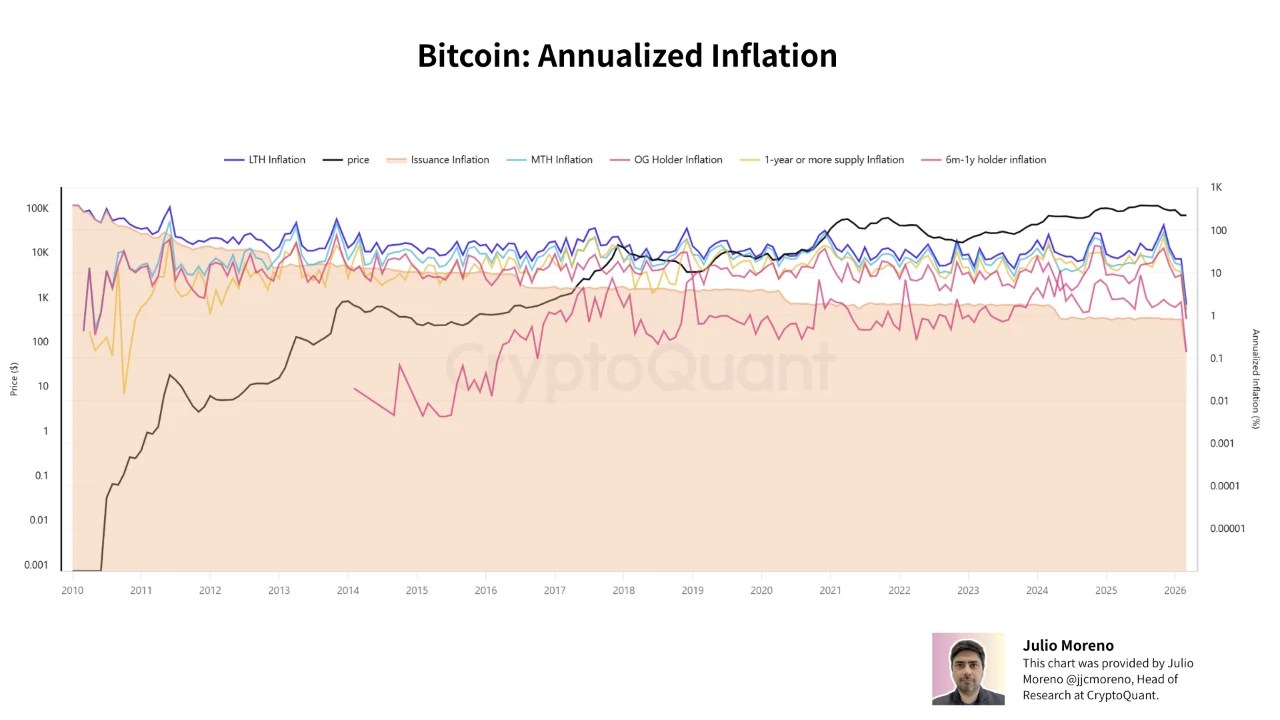
Source: @jjcmoreno

How Bitcoin Has Fit Into Past Stagflation Periods

XWIN Research Japan further notes that the Bitcoin relationship with US stagflation is a complicated one, rather than a linear, straightforward relationship.

The analysts explain that the early phases of stagflation are marked by headwinds to risk assets. When inflation heightens sharply (as was seen in 2022), both the NASDAQ and the Bitcoin price would decline sharply, indicating that Bitcoin has attained a high-beta asset title.

However, the dynamic could see a quick turnaround in cases where stagflation triggers financial instability, as was the case in the 2023 US banking crisis. In this scenario, capital moved into high-risk assets like Bitcoin, causing a more than 80% bullish rally. Also, Bitcoin’s unique supply structure has to be considered while predictions are being made.

Unlike fiat currencies, the issuance of Bitcoin is in line with a fixed algorithm where periodic halving events reduce the rate of new supply entering circulation. This means that Bitcoin’s inflation rate continues to fall, thereby potentially increasing its appeal in a market where traditional currencies are suffering the effects of inflation.

If this scenario holds now, the Bitcoin market could witness a significant amount of inflows in the mid term. As of this writing, Bitcoin trades for $68,225, recording a more than 4% loss since the past day.

BTC trading at $67,703 on the daily chart | Source: BTCUSDT chart on Tradingview.com

Связанные с этим вопросы

QWhat is stagflation and why is it a concern for the U.S. economy according to the article?

AStagflation is a rare economic condition characterized by the simultaneous occurrence of high inflation and high unemployment. It is a concern because the article notes a rise in the U.S. unemployment rate to 4% and points to geopolitical conflicts driving up energy prices, which could trigger significant inflation, creating a destructive economic environment similar to the 1970s.

QHow did the early phases of stagflation historically affect risk assets like Bitcoin and the NASDAQ?

AIn the early phases of stagflation, risk assets typically face headwinds. The article states that when inflation rises, as seen in 2022, both the NASDAQ and Bitcoin's value decline sharply, indicating that Bitcoin behaves as a high-beta asset during such periods.

QUnder what specific condition did Bitcoin experience a bullish rally during a period of financial instability, as mentioned in the article?

ABitcoin experienced a bullish rally of over 80% during the 2023 U.S. banking crisis. The article explains that stagflation can trigger financial instability, which in that instance caused capital to move into high-risk assets like Bitcoin.

QWhat key feature of Bitcoin's supply structure makes it potentially appealing during times of high traditional currency inflation?

ABitcoin's issuance is governed by a fixed algorithm that includes periodic halving events, which reduce the rate of new supply entering circulation. This causes Bitcoin's own inflation rate to continually fall, potentially increasing its appeal as a hedge when traditional fiat currencies are losing value due to inflation.

QWhat was the price of Bitcoin and its 24-hour performance at the time the article was written?

AAs of the writing of the article, Bitcoin was trading at $68,225, recording a loss of more than 4% over the previous 24 hours.

Похожее

The 2026 Landscape of Decentralized AI: Why Blockchain is the Inevitable 'Antidote' for AI?

Decentralized AI 2026 Landscape: Why Blockchain is AI's Essential "Antidote" Centralized AI faces structural bottlenecks—expensive compute, concentrated control, unverifiable outputs, and difficult data access—that cannot be solved by capital or code alone. Blockchain offers a path to make intelligence open, verifiable, and economically accessible. The decentralized AI stack comprises: * **Infrastructure:** The foundation with compute, verifiable inference, distributed training, data/storage, and privacy/verification layers. Projects like Akash, Render, and Filecoin provide cheaper, decentralized alternatives for raw resources. * **Middleware:** The coordination layer for agent discovery, identity, and commerce. Key players include Bittensor (a network of specialized AI subnets), Virtuals (an agent economy OS), and frameworks providing agent identity and tooling. * **Applications & Services:** Dominated by Agentic Finance (AI agents executing on-chain actions based on natural language) and Agentic Payments (machine-to-machine transactions using blockchain as a settlement layer). Projects like Giza, Infinit Labs, and x402 are enabling these use cases. Key trends for 2026-2027 show AI demand outgrowing infrastructure, compute becoming an asset class, and tokenomics emerging as a structural advantage for coordinating capital, compute, and data. While still early—with adoption uneven and revenue often trailing token incentives—projects like Bittensor, NEAR, and Venice demonstrate decentralized AI is evolving from a narrative into a new model for coordinating intelligence.

Foresight News14 мин. назад

The 2026 Landscape of Decentralized AI: Why Blockchain is the Inevitable 'Antidote' for AI?

Foresight News14 мин. назад

Торговля

Спот
Фьючерсы

Популярные статьи

Тест по Bitcoin Биткоина

HTX Learn: Изучите Bitcoin halving и Заработаете Токены USDT

3.1k просмотров всегоОпубликовано 2024.04.16Обновлено 2024.04.16

Тест по Bitcoin  Биткоина

Что такое $BITCOIN

ЦИФРОВОЕ ЗОЛОТО ($BITCOIN): Комплексный анализ Введение в ЦИФРОВОЕ ЗОЛОТО ($BITCOIN) ЦИФРОВОЕ ЗОЛОТО ($BITCOIN) — это проект на основе блокчейна, работающий в сети Solana, который стремится объединить характеристики традиционных драгоценных металлов с инновациями децентрализованных технологий. Хотя он носит имя Биткойн, часто называемого “цифровым золотом” из-за его восприятия как средства хранения ценности, ЦИФРОВОЕ ЗОЛОТО является отдельным токеном, предназначенным для создания уникальной экосистемы в ландшафте Web3. Его цель — позиционировать себя как жизнеспособный альтернативный цифровой актив, хотя детали его применения и функциональности все еще развиваются. Что такое ЦИФРОВОЕ ЗОЛОТО ($BITCOIN)? ЦИФРОВОЕ ЗОЛОТО ($BITCOIN) — это токен криптовалюты, специально разработанный для использования в блокчейне Solana. В отличие от Биткойна, который выполняет широко признанную роль хранения ценности, этот токен, похоже, сосредоточен на более широких приложениях и характеристиках. Примечательные аспекты включают: Инфраструктура блокчейна: Токен построен на блокчейне Solana, известном своей способностью обрабатывать высокоскоростные и недорогие транзакции. Динамика предложения: ЦИФРОВОЕ ЗОЛОТО имеет максимальное предложение, ограниченное 100 квадриллионами токенов (100P $BITCOIN), хотя детали о его обращающемся предложении в настоящее время не раскрыты. Утилита: Хотя точные функциональные возможности не описаны, есть указания на то, что токен может быть использован для различных приложений, потенциально связанных с децентрализованными приложениями (dApps) или стратегиями токенизации активов. Кто создатель ЦИФРОВОГО ЗОЛОТА ($BITCOIN)? На данный момент личность создателей и команды разработчиков, стоящих за ЦИФРОВЫМ ЗОЛОТОМ ($BITCOIN), остается неизвестной. Эта ситуация типична для многих инновационных проектов в области блокчейна, особенно тех, которые связаны с децентрализованными финансами и феноменом мем-криптовалют. Хотя такая анонимность может способствовать культуре, ориентированной на сообщество, она усиливает опасения по поводу управления и ответственности. Кто инвесторы ЦИФРОВОГО ЗОЛОТА ($BITCOIN)? Доступная информация указывает на то, что у ЦИФРОВОГО ЗОЛОТА ($BITCOIN) нет известных институциональных спонсоров или значительных венчурных капиталовложений. Проект, похоже, функционирует по модели пирингового взаимодействия, сосредоточенной на поддержке и принятии сообществом, а не на традиционных путях финансирования. Его активность и ликвидность в основном сосредоточены на децентрализованных биржах (DEX), таких как PumpSwap, а не на устоявшихся централизованных торговых платформах, что еще больше подчеркивает его подход, ориентированный на grassroots. Как работает ЦИФРОВОЕ ЗОЛОТО ($BITCOIN) Операционные механизмы ЦИФРОВОГО ЗОЛОТА ($BITCOIN) можно подробно описать на основе его дизайна блокчейна и характеристик сети: Механизм консенсуса: Используя уникальный механизм доказательства истории (PoH) Solana в сочетании с моделью доказательства доли (PoS), проект обеспечивает эффективную валидацию транзакций, что способствует высокой производительности сети. Токеномика: Хотя конкретные дефляционные механизмы не были подробно описаны, большое максимальное предложение токенов подразумевает, что оно может быть предназначено для микротранзакций или нишевых случаев использования, которые еще предстоит определить. Интероперабельность: Существует потенциал для интеграции с более широкой экосистемой Solana, включая различные платформы децентрализованных финансов (DeFi). Однако детали относительно конкретных интеграций остаются неуточненными. Хронология ключевых событий Вот хронология, которая подчеркивает значимые вехи, касающиеся ЦИФРОВОГО ЗОЛОТА ($BITCOIN): 2023: Первоначальное развертывание токена происходит в блокчейне Solana, отмеченное его адресом контракта. 2024: ЦИФРОВОЕ ЗОЛОТО приобретает видимость, когда оно становится доступным для торговли на децентрализованных биржах, таких как PumpSwap, позволяя пользователям обменивать его на SOL. 2025: Проект наблюдает спорадическую торговую активность и потенциальный интерес к инициативам, возглавляемым сообществом, хотя на данный момент не зафиксировано никаких значительных партнерств или технических достижений. Критический анализ Сильные стороны Масштабируемость: Основная инфраструктура Solana поддерживает высокие объемы транзакций, что может повысить полезность $BITCOIN в различных сценариях транзакций. Доступность: Потенциально низкая цена торговли за токен может привлечь розничных инвесторов, способствуя более широкому участию благодаря возможностям дробного владения. Риски Отсутствие прозрачности: Отсутствие публично известных спонсоров, разработчиков или процесса аудита может вызвать скептицизм относительно устойчивости и надежности проекта. Волатильность рынка: Торговая активность сильно зависит от спекулятивного поведения, что может привести к значительной волатильности цен и неопределенности для инвесторов. Заключение ЦИФРОВОЕ ЗОЛОТО ($BITCOIN) является интригующим, но неоднозначным проектом в быстро развивающейся экосистеме Solana. Хотя он пытается использовать нарратив “цифрового золота”, его отход от установленной роли Биткойна как средства хранения ценности подчеркивает необходимость более четкого различения его предполагаемой утилиты и структуры управления. Будущее принятие и усвоение, вероятно, будут зависеть от решения текущей непрозрачности и более четкого определения его операционных и экономических стратегий. Примечание: Этот отчет охватывает синтезированную информацию, доступную на октябрь 2023 года, и с тех пор могут произойти события.

99 просмотров всегоОпубликовано 2025.05.13Обновлено 2025.05.13

Что такое $BITCOIN

Fractal Bitcoin: масштабирование Биткоина с помощью рекурсивной системы

Fractal Bitcoin — масштабное Layer-1-решнение, созданное на базе кода Биткоина, позволяющего достигать бесконечного масштабирования с помощью рекурсивного подхода.

2.3k просмотров всегоОпубликовано 2025.06.30Обновлено 2025.06.30

Fractal Bitcoin: масштабирование Биткоина с помощью рекурсивной системы

Обсуждения

Добро пожаловать в Сообщество HTX. Здесь вы сможете быть в курсе последних новостей о развитии платформы и получить доступ к профессиональной аналитической информации о рынке. Мнения пользователей о цене на BTC (BTC) представлены ниже.

活动图片