Bitcoin Hashrate Slides: US Cold Wave Knocks Mining Rigs Offline

bitcoinistОпубликовано 2026-01-28Обновлено 2026-01-28

Введение

Bitcoin's price remains under pressure below $88,000 amid weak market sentiment. A sharp, unusual drop in hashrate—from 1.133 ZH/s to 690 EH/s in two days—has raised concerns. Analyst Darkfost attributes this not to miner capitulation, but to a severe US ice storm, particularly impacting Texas-based mining operations like MARA and Foundry Digital. The weather forced widespread shutdowns due to power grid stress and high electricity costs. This may lead to longer block times and a projected -4.54% difficulty adjustment. If prolonged, miners might sell BTC to cover costs, adding further selling pressure. Technically, BTC is testing key support near $86K–$88K; a break below could target the low-$80K range.

Bitcoin is struggling to regain momentum below the $88,000 level as fear and uncertainty continue to weigh on market sentiment. After a volatile selloff, price action remains compressed near key support, with buyers hesitant to step in aggressively and sellers pressing rallies at lower levels. While attention has largely focused on derivatives pressure and macro risk, on-chain signals are now adding another layer of concern to the current setup.

Top analyst Darkfost points to a critical indicator of Bitcoin’s underlying network health: the hashrate, which measures the total computing power securing the network and reflects overall mining activity. Under normal conditions, a sharp decline in hashrate suggests that miners are voluntarily shutting down machines, often due to unprofitability or stress—typically associated with miner capitulation phases near market lows.

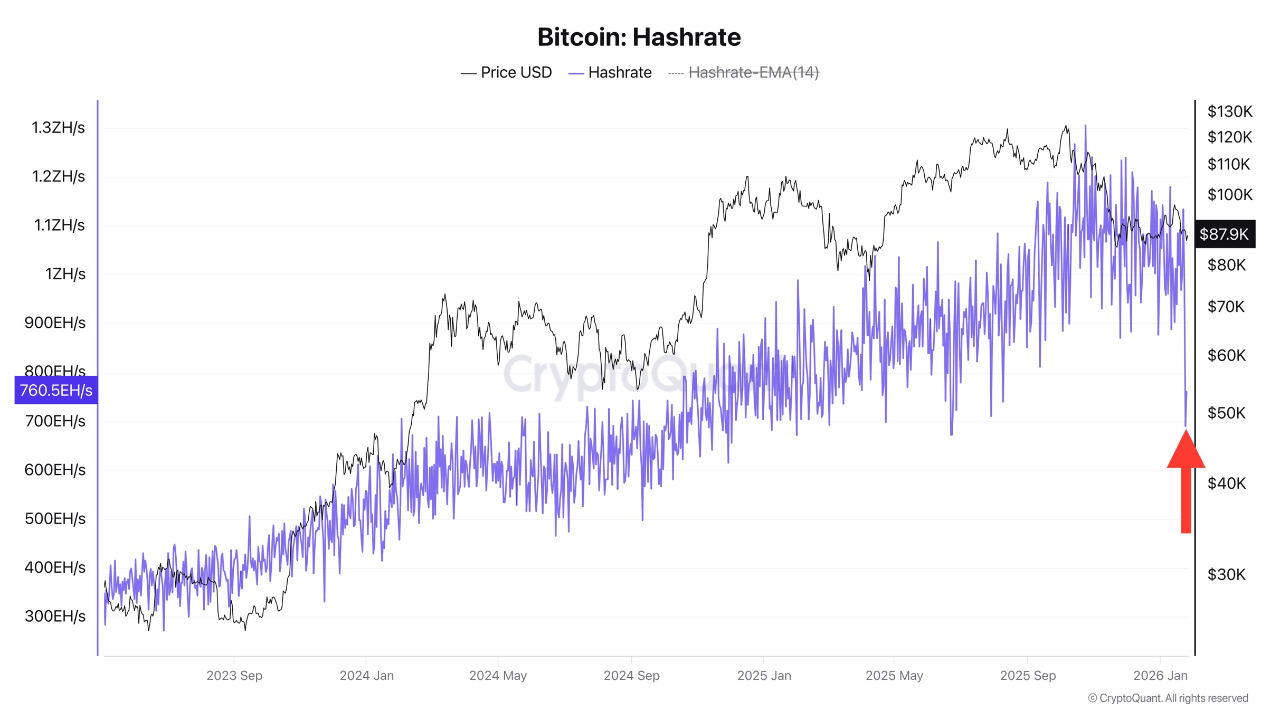
That is exactly the type of move unfolding now. Over just two days, Bitcoin’s hashrate has dropped dramatically, falling from 1.133 ZH/s to 690 EH/s. Such a rapid contraction is highly unusual and immediately raises questions about its cause. Importantly, Darkfost notes that this episode does not fit the classic miner capitulation narrative driven by collapsing prices or shrinking margins.

Bitcoin Hashrate | Source: CryptoQuant

Instead, the decline appears to be linked to external disruptions rather than economic pressure within the mining sector itself. This distinction matters. While price remains under pressure below $88K, the hashrate shock introduces a new variable—one that could influence short-term dynamics, miner behavior, and market psychology as conditions evolve.

Hashrate Shock Linked To US Ice Storm, Not Miner Capitulation

According to Darkfost, the sharp drop in Bitcoin’s hashrate appears to be driven by external disruptions, not by economic stress within the mining sector. A large number of ASIC machines have been shut down during the past few days, coinciding with a severe ice storm hitting the United States, a country that accounts for roughly one-third of global Bitcoin hashrate. The timing strongly suggests a weather-related shock rather than voluntary miner capitulation.

The cold wave has been especially disruptive in Texas, a key hub for industrial-scale mining operations. Major players such as MARA and Foundry Digital are heavily exposed to the region’s power grid. Darkfost highlights that MARA’s hashrate has fallen by roughly a factor of four over the last three days compared to its monthly average, underscoring how abrupt and severe the disruption has been.

Extreme cold places stress on power infrastructure, forcing grid operators to curtail non-essential loads, while electricity prices spike as demand surges. For miners, this combination makes continued operation temporarily unviable, leading to widespread shutdowns.

As a consequence, block times are likely to lengthen, and mining difficulty is expected to adjust lower, with the next adjustment already estimated near -4.54%. If the storm persists, Darkfost warns that some miners could be forced to sell BTC to cover fixed operating costs, adding another short-term pressure point for the market.

Bitcoin Medium-Term Structure Remains Under Pressure

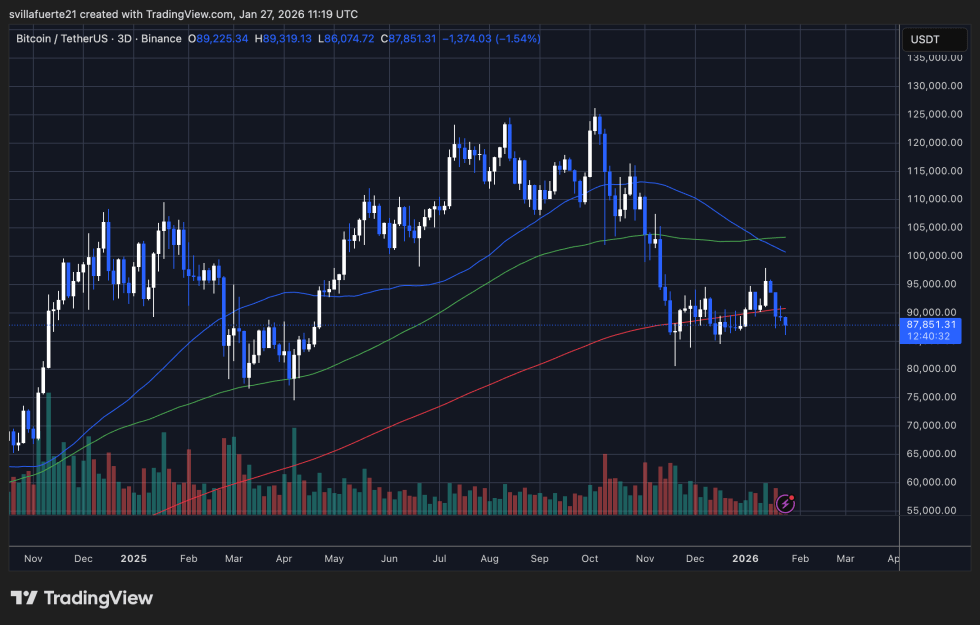
Bitcoin is trading around $87,850 on the 3-day chart, sitting at a critical inflection zone after a prolonged corrective phase. The broader structure shows that BTC peaked near the $125K area in late 2025 before entering a sustained downtrend, marked by sharp selloffs and increasingly weaker rebound attempts. While price has managed to stabilize above the mid-$80K region, momentum remains fragile and conviction on the buy side is limited.

BTC testing critical support | Source: BTCUSDT chart on TradingView

From a trend perspective, the moving averages outline the current market regime clearly. Bitcoin is trading below the 50-period moving average (blue), which has rolled over and is now acting as dynamic resistance near the low-$90K area.

The 100-period moving average (green) is flattening and beginning to turn lower, signaling a loss of medium-term trend strength and confirming that prior upside momentum has broken. Meanwhile, the 200-period moving average (red) continues to slope upward well below price, near the low-$90K to high-$80K region, acting as the last major long-term support reference.

Price action over recent candles suggests compression rather than capitulation. Volatility has contracted, and volume has declined compared to the November selloff, indicating reduced urgency from sellers. For bulls, holding the $86K–$88K zone is essential to avoid a deeper breakdown.

A decisive move back above $90K–$92K would be required to shift structure and signal early recovery, while failure here keeps downside risk open toward the low-$80K range.

Featured image from ChatGPT, chart from TradingView.com

Связанные с этим вопросы

QWhat is the primary reason for the recent sharp decline in Bitcoin's hashrate according to the article?

AThe sharp decline in Bitcoin's hashrate is primarily attributed to a severe ice storm in the United States, which forced the shutdown of mining operations, particularly in Texas, due to power grid stress and spiking electricity prices, rather than economic stress or miner capitulation.

QWhich major mining companies were specifically mentioned as being heavily affected by the US cold wave?

AThe article specifically mentions major mining companies MARA and Foundry Digital as being heavily exposed to the power grid disruptions in Texas.

QWhat critical price level is Bitcoin struggling to regain, and what is its current trading area as mentioned in the article?

ABitcoin is struggling to regain momentum below the $88,000 level and is currently trading around $87,850, sitting at a critical inflection zone.

QWhat are the potential consequences of the hashrate drop on Bitcoin's network mechanics?

AThe consequences of the hashrate drop include likely longer block times and an expected downward adjustment in mining difficulty, with the next adjustment estimated to be near -4.54%.

QWhat does the article suggest is the importance of Bitcoin holding the $86K–$88K price zone?

AHolding the $86K–$88K zone is essential for bulls to avoid a deeper breakdown in price. A failure to hold this support keeps downside risk open toward the low-$80K range.

Похожее

Fu Peng's First Public Speech in 2026: What Exactly Are Crypto Assets? Why Did I Join the Crypto Asset Industry?

Fu Peng, a renowned macroeconomist and now Chief Economist at New火 Group, delivered his first public speech of 2026 at the Hong Kong Web3 Festival. He explained his perspective on crypto assets and why he joined the industry, framing it within the context of macroeconomic trends and financial evolution. Fu emphasized that crypto assets are transitioning from an early, belief-driven phase to a mature, institutionally integrated asset class. He drew parallels to the 1970s-80s, when technological advances (like computing) revolutionized traditional finance, leading to the rise of FICC (Fixed Income, Currencies, and Commodities). Similarly, current advancements in AI, data, and blockchain are reshaping finance, with crypto assets becoming part of a new "FICC + C" (C for Crypto) framework. He noted that institutional capital, including traditional hedge funds, avoided early crypto due to its speculative nature but are now engaging as regulatory clarity emerges (e.g., stablecoin laws, CFTC classifying crypto as a commodity). Fu predicted that 2025-2026 marks a turning point where crypto becomes a standardized, financially viable asset for diversified portfolios, akin to commodities or derivatives in traditional finance. Fu defined Bitcoin not as "digital gold" in a simplistic sense but as a value-preserving, financially tradable asset. He highlighted that crypto's future lies in regulated, institutional adoption, moving away from retail-dominated trading. His entry into crypto signals this maturation, where traditional finance integrates crypto into mainstream asset management.

marsbit32 мин. назад

Fu Peng's First Public Speech in 2026: What Exactly Are Crypto Assets? Why Did I Join the Crypto Asset Industry?

marsbit32 мин. назад

Justin Sun Sues Trump Family: What $75 Million Bought Was Only a Blacklist

Justin Sun, founder of Tron, has filed a lawsuit in federal court against World Liberty Financial (WLF), alleging he was made the "primary target of a fraudulent scheme" after investing $75 million. Sun claims the investment secured him an advisor title and WLFI tokens, which were later frozen by WLF, causing "hundreds of millions in losses." The dispute began in late 2024 when Sun's investment helped revive WLF's struggling token sale, which ultimately raised $550 million. Shortly after, the SEC dropped its lawsuit against Sun following Donald Trump's inauguration. However, relations soured when Sun refused WLF's demands for additional funding. In August 2025, WLF added a "blacklist" function to its smart contract, allowing it to unilaterally freeze tokens. Sun's holdings, worth approximately $107 million, were frozen, and he was threatened with token destruction. The lawsuit highlights WLF's structure, which directs 75% of token sale profits to the Trump family, who had earned $1 billion by December 2025. WLF's CEO is Zach Witkoff, son of U.S. Middle East envoy Steve Witkoff. The project faces scrutiny for opaque operations, including a controversial loan arrangement on the Dolomite platform, co-founded by a WLF advisor. Despite Sun's history with the SEC, the case underscores centralization risks within DeFi, as WLF controls governance and holds powers to freeze assets arbitrarily. Sun's tokens remain frozen as legal proceedings begin.

marsbit40 мин. назад

Justin Sun Sues Trump Family: What $75 Million Bought Was Only a Blacklist

marsbit40 мин. назад

$500 to Buy OpenAI Stock: Silicon Valley's Most Respectable Liquidity Invitation

Silicon Valley's largest venture capital platform, AngelList, has launched a new fund called USVC, allowing U.S. retail investors to buy into high-profile AI companies like OpenAI, Anthropic, and xAI with a minimum investment of $500—no accredited investor status required. Promoted by AngelList co-founder Naval Ravikant, the fund is framed as an opportunity for ordinary people to access high-growth private tech investments traditionally reserved for VCs. However, critics argue it functions more like an exit vehicle for early insiders. USVC acquires shares not through primary rounds but largely via secondary transactions—purchasing stakes from early investors, VC funds, and employees looking to cash out at peak valuations. With companies like xAI heavily weighted in the portfolio, the fund effectively channels retail money into providing liquidity for insiders who entered at much lower valuations. The fund’s structure raises concerns: shares are illiquid, with no secondary market, and buybacks are limited and discretionary. The actual annual fee reaches 3.61%, far above the advertised 1% management fee. This model parallels the "low float, high fully diluted valuation" strategy seen in crypto, where early investors profit by selling to latecomers at inflated prices. The timing—alongside similar moves by platforms like Robinhood—suggests that Silicon Valley’s sudden interest in retail inclusion may be less about democratizing access and more about securing exits for insiders.

marsbit1 ч. назад

$500 to Buy OpenAI Stock: Silicon Valley's Most Respectable Liquidity Invitation

marsbit1 ч. назад

Торговля

Спот
Фьючерсы

Популярные статьи

Тест по Bitcoin Биткоина

HTX Learn: Изучите Bitcoin halving и Заработаете Токены USDT

3.0k просмотров всегоОпубликовано 2024.04.16Обновлено 2024.04.16

Тест по Bitcoin  Биткоина

Что такое $BITCOIN

ЦИФРОВОЕ ЗОЛОТО ($BITCOIN): Комплексный анализ Введение в ЦИФРОВОЕ ЗОЛОТО ($BITCOIN) ЦИФРОВОЕ ЗОЛОТО ($BITCOIN) — это проект на основе блокчейна, работающий в сети Solana, который стремится объединить характеристики традиционных драгоценных металлов с инновациями децентрализованных технологий. Хотя он носит имя Биткойн, часто называемого “цифровым золотом” из-за его восприятия как средства хранения ценности, ЦИФРОВОЕ ЗОЛОТО является отдельным токеном, предназначенным для создания уникальной экосистемы в ландшафте Web3. Его цель — позиционировать себя как жизнеспособный альтернативный цифровой актив, хотя детали его применения и функциональности все еще развиваются. Что такое ЦИФРОВОЕ ЗОЛОТО ($BITCOIN)? ЦИФРОВОЕ ЗОЛОТО ($BITCOIN) — это токен криптовалюты, специально разработанный для использования в блокчейне Solana. В отличие от Биткойна, который выполняет широко признанную роль хранения ценности, этот токен, похоже, сосредоточен на более широких приложениях и характеристиках. Примечательные аспекты включают: Инфраструктура блокчейна: Токен построен на блокчейне Solana, известном своей способностью обрабатывать высокоскоростные и недорогие транзакции. Динамика предложения: ЦИФРОВОЕ ЗОЛОТО имеет максимальное предложение, ограниченное 100 квадриллионами токенов (100P $BITCOIN), хотя детали о его обращающемся предложении в настоящее время не раскрыты. Утилита: Хотя точные функциональные возможности не описаны, есть указания на то, что токен может быть использован для различных приложений, потенциально связанных с децентрализованными приложениями (dApps) или стратегиями токенизации активов. Кто создатель ЦИФРОВОГО ЗОЛОТА ($BITCOIN)? На данный момент личность создателей и команды разработчиков, стоящих за ЦИФРОВЫМ ЗОЛОТОМ ($BITCOIN), остается неизвестной. Эта ситуация типична для многих инновационных проектов в области блокчейна, особенно тех, которые связаны с децентрализованными финансами и феноменом мем-криптовалют. Хотя такая анонимность может способствовать культуре, ориентированной на сообщество, она усиливает опасения по поводу управления и ответственности. Кто инвесторы ЦИФРОВОГО ЗОЛОТА ($BITCOIN)? Доступная информация указывает на то, что у ЦИФРОВОГО ЗОЛОТА ($BITCOIN) нет известных институциональных спонсоров или значительных венчурных капиталовложений. Проект, похоже, функционирует по модели пирингового взаимодействия, сосредоточенной на поддержке и принятии сообществом, а не на традиционных путях финансирования. Его активность и ликвидность в основном сосредоточены на децентрализованных биржах (DEX), таких как PumpSwap, а не на устоявшихся централизованных торговых платформах, что еще больше подчеркивает его подход, ориентированный на grassroots. Как работает ЦИФРОВОЕ ЗОЛОТО ($BITCOIN) Операционные механизмы ЦИФРОВОГО ЗОЛОТА ($BITCOIN) можно подробно описать на основе его дизайна блокчейна и характеристик сети: Механизм консенсуса: Используя уникальный механизм доказательства истории (PoH) Solana в сочетании с моделью доказательства доли (PoS), проект обеспечивает эффективную валидацию транзакций, что способствует высокой производительности сети. Токеномика: Хотя конкретные дефляционные механизмы не были подробно описаны, большое максимальное предложение токенов подразумевает, что оно может быть предназначено для микротранзакций или нишевых случаев использования, которые еще предстоит определить. Интероперабельность: Существует потенциал для интеграции с более широкой экосистемой Solana, включая различные платформы децентрализованных финансов (DeFi). Однако детали относительно конкретных интеграций остаются неуточненными. Хронология ключевых событий Вот хронология, которая подчеркивает значимые вехи, касающиеся ЦИФРОВОГО ЗОЛОТА ($BITCOIN): 2023: Первоначальное развертывание токена происходит в блокчейне Solana, отмеченное его адресом контракта. 2024: ЦИФРОВОЕ ЗОЛОТО приобретает видимость, когда оно становится доступным для торговли на децентрализованных биржах, таких как PumpSwap, позволяя пользователям обменивать его на SOL. 2025: Проект наблюдает спорадическую торговую активность и потенциальный интерес к инициативам, возглавляемым сообществом, хотя на данный момент не зафиксировано никаких значительных партнерств или технических достижений. Критический анализ Сильные стороны Масштабируемость: Основная инфраструктура Solana поддерживает высокие объемы транзакций, что может повысить полезность $BITCOIN в различных сценариях транзакций. Доступность: Потенциально низкая цена торговли за токен может привлечь розничных инвесторов, способствуя более широкому участию благодаря возможностям дробного владения. Риски Отсутствие прозрачности: Отсутствие публично известных спонсоров, разработчиков или процесса аудита может вызвать скептицизм относительно устойчивости и надежности проекта. Волатильность рынка: Торговая активность сильно зависит от спекулятивного поведения, что может привести к значительной волатильности цен и неопределенности для инвесторов. Заключение ЦИФРОВОЕ ЗОЛОТО ($BITCOIN) является интригующим, но неоднозначным проектом в быстро развивающейся экосистеме Solana. Хотя он пытается использовать нарратив “цифрового золота”, его отход от установленной роли Биткойна как средства хранения ценности подчеркивает необходимость более четкого различения его предполагаемой утилиты и структуры управления. Будущее принятие и усвоение, вероятно, будут зависеть от решения текущей непрозрачности и более четкого определения его операционных и экономических стратегий. Примечание: Этот отчет охватывает синтезированную информацию, доступную на октябрь 2023 года, и с тех пор могут произойти события.

99 просмотров всегоОпубликовано 2025.05.13Обновлено 2025.05.13

Что такое $BITCOIN

Fractal Bitcoin: масштабирование Биткоина с помощью рекурсивной системы

Fractal Bitcoin — масштабное Layer-1-решнение, созданное на базе кода Биткоина, позволяющего достигать бесконечного масштабирования с помощью рекурсивного подхода.

2.2k просмотров всегоОпубликовано 2025.06.30Обновлено 2025.06.30

Fractal Bitcoin: масштабирование Биткоина с помощью рекурсивной системы

Обсуждения

Добро пожаловать в Сообщество HTX. Здесь вы сможете быть в курсе последних новостей о развитии платформы и получить доступ к профессиональной аналитической информации о рынке. Мнения пользователей о цене на BTC (BTC) представлены ниже.

活动图片