Bitcoin Briefly Falls Below $72,000: How Much Faith Remains in the Crypto World?

华尔街日报Опубликовано 2026-02-05Обновлено 2026-02-05

Введение

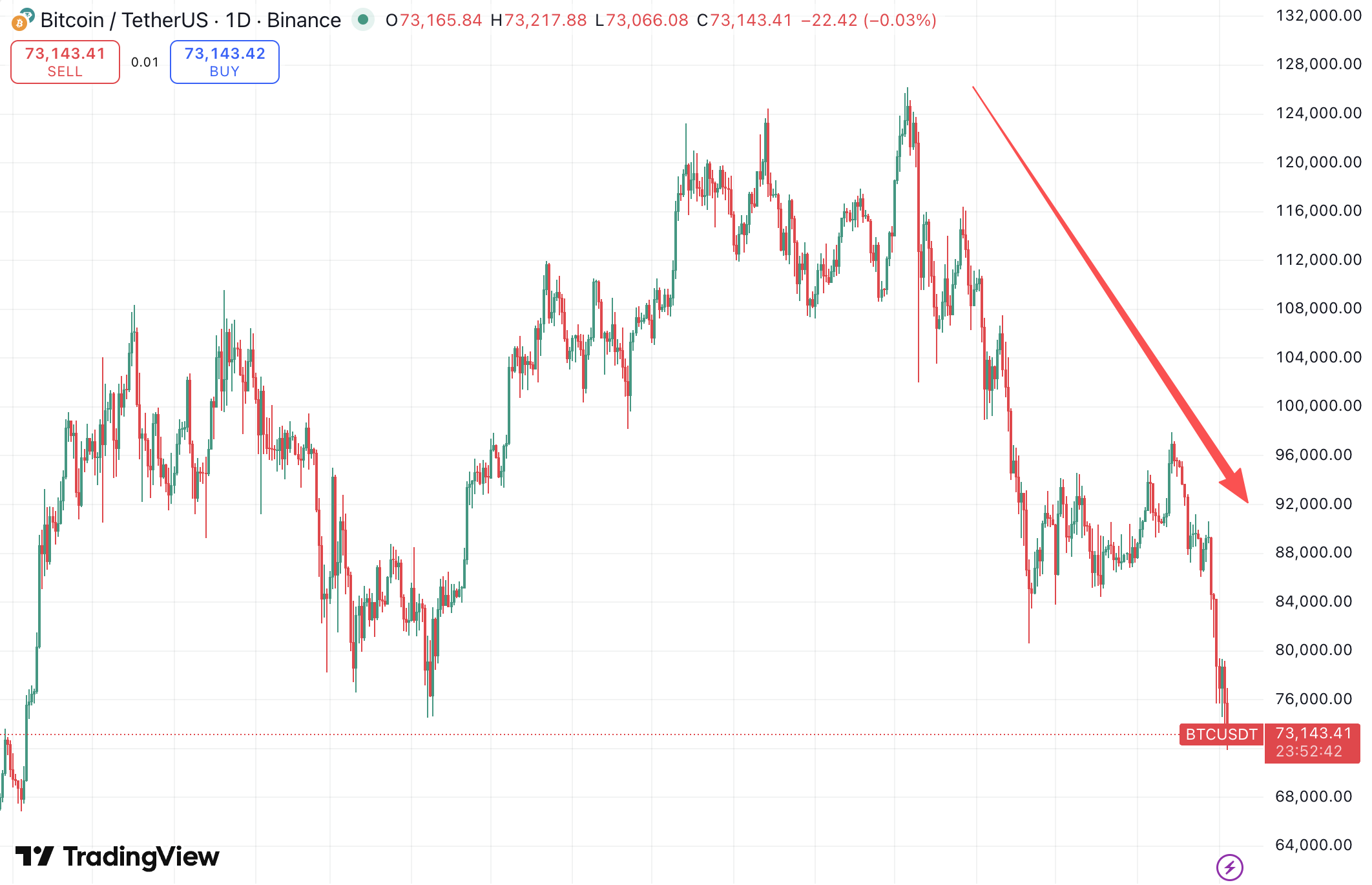
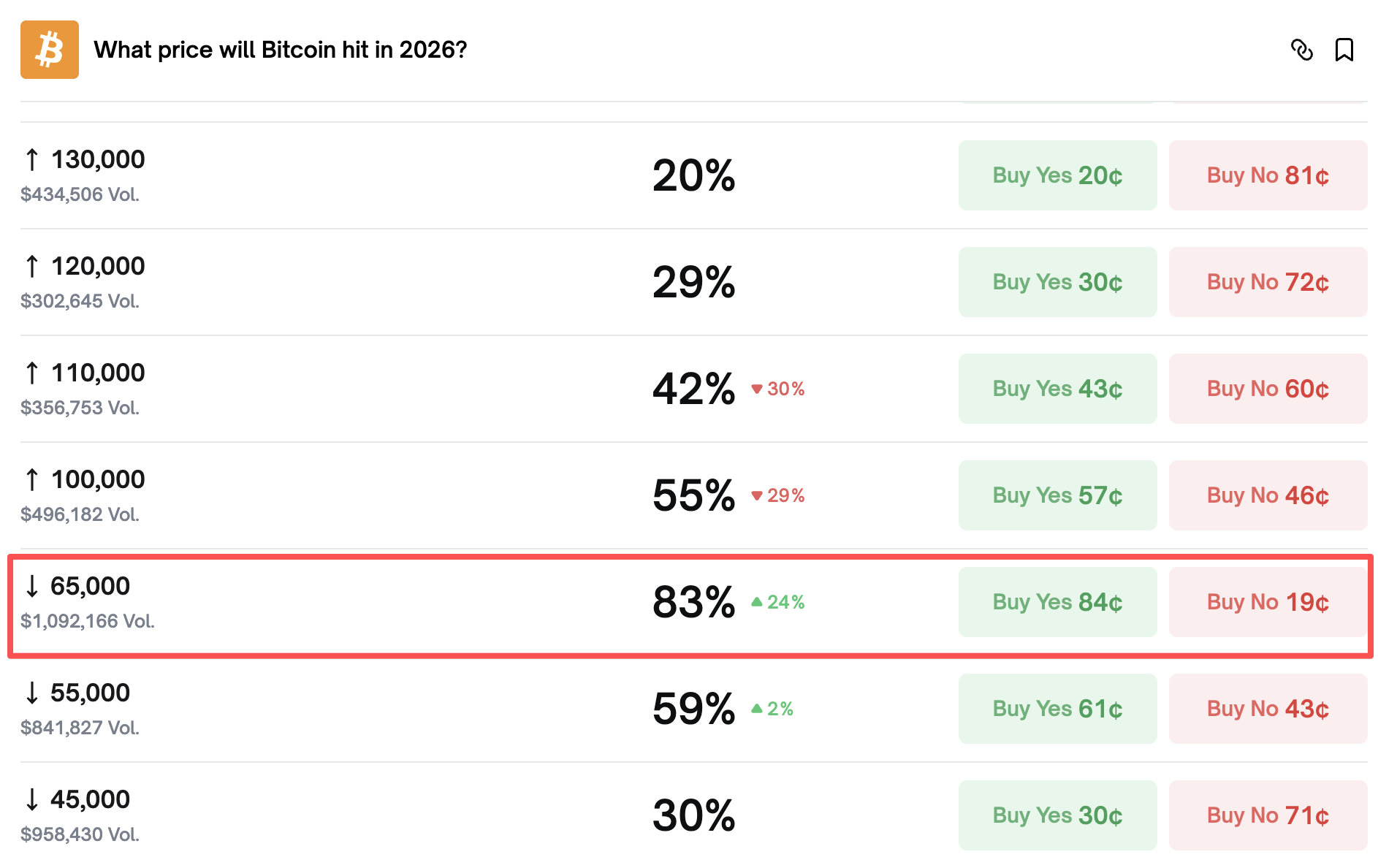
Bitcoin fell below the $72,000 mark, hitting its lowest level since November 2024 and deepening concerns over a "crisis of faith" in the cryptocurrency market. The decline, which saw Bitcoin drop over 42% from its October peak, is now driven by broader cross-asset selling pressure rather than just crypto-specific deleveraging. Global risk aversion intensified as the Nasdaq 100 fell more than 2%, with Bitcoin down in tandem—challenging its narrative as a safe-haven asset. Market sentiment has turned to "extreme fear," and analysts warn that if $72,000 fails to hold, Bitcoin could test $68,000 or even lower levels seen in early 2024. According to prediction markets, there is an 83% chance Bitcoin falls to $65,000 this year, and a 59% probability it drops below $55,000. ETF flows have been volatile, with inflows quickly reversing to outflows, reflecting unstable institutional interest. The crypto market has lost $1.7 trillion in value since its peak, raising questions about Bitcoin’s role during periods of market stress.

Bitcoin's drop below the $72,000 mark has brought the issue of 'faith' in the crypto market to the forefront. Against the backdrop of a sharp decline in global risk appetite, investors are reassessing Bitcoin's role during market turbulence, questioning the safe-haven narrative of crypto assets.

According to Bloomberg, Bitcoin fell to $71,739 at the close of trading in New York on Wednesday, marking the first time it dropped below $72,000 in about 15 months. Compared to its peak last October, Bitcoin has retreated by over 42%, with a year-to-date decline of approximately 17%, reaching its lowest level since November 6, 2024.

This round of selling is no longer just a continuation of internal deleveraging in the crypto market but is driven by broader cross-asset pressures. Global markets experienced synchronized selling on Wednesday, with the Nasdaq 100 Index falling over 2%. Sectors more sensitive to interest rates, such as software and chips, were under pressure, and Bitcoin weakened accordingly.

On the sentiment front, a 'crisis of faith' is emerging. Shiliang Tang, Managing Partner at Monarq Asset Management, stated that the market is experiencing a 'crisis of faith.'

Andrew Tu, Head of Business Development at Efficient Frontier, added that crypto market sentiment is now in 'extreme fear.' If the $72,000 level is breached, Bitcoin could fall to $68,000 or even return to the low range seen before the initial rebound in early 2024.

According to Polymarket, there is an 83% probability that Bitcoin will fall to $65,000 this year, while the probability of dropping below $55,000 has climbed to about 59%.

According to Bloomberg, the selling pressure on Bitcoin on Wednesday was related to broader cross-asset tensions rather than being solely driven by internal crypto asset liquidations. This sends a clear message to investors: during synchronized selling phases, Bitcoin has not demonstrated resilience independent of risk assets but instead behaves more like a high-volatility, long-tail risk asset.

The Nasdaq 100 Index fell over 2% on the same day, with losses spreading to sectors such as software and chips. Bitcoin's breach of a key psychological level during the same trading session reinforced its perception as moving in tandem with risk appetite.

Price declines are quickly transmitting through market capitalization contraction. According to CoinGecko data, the total market capitalization of crypto assets has shrunk by approximately $1.7 trillion since the peak last October. In the past week alone, the crypto market lost over $460 billion in value.

As the largest cryptocurrency, the extent and speed of Bitcoin's decline have an 'anchoring effect' on market sentiment. When Bitcoin's year-to-date losses widen to around 17%, risk control, margin management, and fund redemption pressures often rise simultaneously, exacerbating overall volatility.

Statements from market participants indicate that sentiment shifts are becoming a core variable. The 'crisis of faith' mentioned by Shiliang Tang points to investors' simultaneous wavering in both the long-term narrative of crypto assets and their short-term pricing mechanisms.

More critically, the driver of the decline has changed. According to Bloomberg, previous downturns were more driven by crypto-specific liquidations, whereas Wednesday's pressure stemmed from broader cross-market tensions.

This means that even if internal leverage unwinding in the crypto market concludes, Bitcoin may still lack catalysts for an independent rebound as long as external risk assets remain under pressure.

Several traders view the $72,000 level as a key short-term price point. Andrew Tu noted that if this level cannot be held, Bitcoin is 'very likely' to test $68,000 and could potentially return to the low range seen before the initial rebound in early 2024.

According to Polymarket, there is an 83% probability that Bitcoin will fall to $65,000 this year, while the probability of dropping below $55,000 has climbed to about 59%.

Fund flows are also sending mixed signals. According to data compiled by Bloomberg, U.S.-listed spot Bitcoin ETFs recorded approximately $562 million in net inflows on Monday but switched to $272 million in net outflows on Tuesday, indicating unstable incremental capital.

Amid the price decline and fluctuating fund flows, market skepticism about Bitcoin's role as a 'safe-haven asset during stress periods' is growing.

Связанные с этим вопросы

QWhat key psychological factor is emerging in the cryptocurrency market according to the article, and who commented on it?

AA 'crisis of faith' is emerging, as commented by Shiliang Tang, managing partner at Monarq Asset Management.

QWhat was the specific price level that Bitcoin fell below, and what is its significance as a potential support level?

ABitcoin fell below the $72,000 level, which is considered a critical short-term support. If it fails to hold, it could drop further to $68,000 or even lower.

QAccording to Polymarket data, what is the probability that Bitcoin will fall to $65,000 this year?

AAccording to Polymarket, there is an 83% probability that Bitcoin will fall to $65,000 this year.

QHow does the article describe the nature of the recent selling pressure on Bitcoin compared to previous downturns?

AThe recent selling pressure is described as being driven by broader cross-asset market tensions and a synchronous global sell-off, rather than being solely driven by internal crypto market liquidations as in previous downturns.

QWhat does the data from U.S. spot Bitcoin ETFs indicate about investor inflows during this period?

AThe data shows unstable investor inflows. The ETFs recorded a net inflow of approximately $562 million on Monday but switched to a net outflow of $272 million on Tuesday.

Похожее

Public Version of Mythos Officially Launched: Analyzing the Advantages and Limitations of AI Smart Contract Auditing

Publicly available Mythos, Anthropic's AI model, has officially launched, demonstrating both significant potential and limitations in smart contract security auditing. The article analyzes its capabilities through real-world cases. AI excels in identifying subtle, low-level vulnerabilities through pattern recognition and large-scale code screening. A key example is detecting a storage slot collision between a custom rewards mapping and a third-party library's ReentrancyGuard, a vulnerability easily missed in manual audits. In the recent Zcash incident, AI also rapidly discovered a critical soundness bug that had remained hidden for years. However, AI currently struggles with complex, interconnected scenarios. When tested on the Curve LlamaLend sDOLA exploit, which involved manipulating prices across multiple protocols (Curve pools, lending markets) to trigger liquidations, Fable 5 failed to identify the core cross-protocol attack vector. These scenarios require a deep understanding of DeFi economic models and multi-contract interactions. In conclusion, while AI tools like Mythos significantly boost efficiency in finding standardized, syntactic vulnerabilities, they cannot yet replace expert analysis for complex, business-logic, and cross-protocol attacks. An effective audit workflow combines AI's speed for initial screening with human expertise for in-depth, holistic analysis.

marsbit3 мин. назад

Public Version of Mythos Officially Launched: Analyzing the Advantages and Limitations of AI Smart Contract Auditing

marsbit3 мин. назад

Trade.xyz's Rebase Refusal Sparks Controversy, On-Chain Pre-IPO Market Faces Major Pricing Test

The debate surrounding Trade.xyz's refusal to adjust its SPCX (SpaceX pre-IPO) perpetual contract pricing amid updated share count revelations highlights a key challenge for on-chain pre-IPO markets. While several centralized exchanges (CEXs) paused and repriced their contracts after SpaceX's filing showed a ~10% increase in total shares, Trade.xyz maintained its market-driven pricing logic, which tracks expected per-share price sentiment rather than fundamental valuation metrics like market cap. This discrepancy triggered cross-platform arbitrage and caused leveraged long positions on Trade.xyz to suffer significant losses, as the platform's HIP-3 architecture lacks a native "Rebase" mechanism to neutrally adjust all user positions following such corporate actions. The incident underscores the difficulty for decentralized perpetual exchanges (Perp DEXs) to implement Rebase—a process CEXs handle by centrally pausing markets and adjusting ledger data. On-chain, this requires complex smart contract modifications, increasing gas costs, complexity, and potential attack surfaces. While some DEXs have managed similar adjustments, Trade.xyz's current design does not natively support it, though the team is reportedly exploring solutions for future events like stock splits. Ultimately, the controversy serves as a critical case study for the nascent on-chain pre-IPO sector, raising questions about price discovery reliability, transparent rule disclosure, and the readiness of DeFi infrastructures to handle traditional corporate actions as real-world assets (RWAs) gain traction.

marsbit11 мин. назад

Trade.xyz's Rebase Refusal Sparks Controversy, On-Chain Pre-IPO Market Faces Major Pricing Test

marsbit11 мин. назад

The 'Middle Eastern Prince' Swindles a Wealthy Woman: Renting Planes and Rolls-Royces, Scamming 120 Million Over Three Years

Two brothers who posed as "Middle Eastern princes" have been sentenced in the United States to 24 and 23 years in prison, respectively, and ordered to pay over $21.2 million in restitution and back taxes. Over three years, they fraudulently obtained approximately $21 million, primarily by promoting fictitious investment projects, including a non-existent cryptocurrency mining operation in a former General Electric industrial park in East Cleveland. The brothers, aged 42 and 33, created elaborate personas: one claimed to be a wealthy royal family heir and the city's "International Economic Advisor," while the other posed as a hedge fund manager with expertise from watching the TV show *Billions*. They bolstered their image by renting luxury cars and private jets and cultivating a relationship with a local mayor's chief of staff, who provided official-looking documents and government event access. A significant portion of the victims' funds, about $18 million, came from a single Chinese investor, a woman from Sichuan with experience in Bitcoin mining. The brothers also defrauded several women, including one former girlfriend. Their scheme unraveled when the primary investor discovered her $6 million worth of mining equipment had been sold off. The case highlights a trend of impostors using fabricated "Middle Eastern royal" identities to target wealthy individuals. Similar incidents include a "Dubai prince" who recently promoted a $500 million family office in Hong Kong and a Colombian man who impersonated a Saudi prince for decades in the US before being caught and sentenced in 2019.

marsbit26 мин. назад

The 'Middle Eastern Prince' Swindles a Wealthy Woman: Renting Planes and Rolls-Royces, Scamming 120 Million Over Three Years

marsbit26 мин. назад

a16z Partner: Being in the Flow of Capital Is the True Moat

A16z Partner: Standing in the Cash Flow is the True Moat Historically, many of the strongest companies built their moats by positioning themselves within "cash flows"—facilitating value creation and transfer in a network and taking a cut. The more value flows, the larger they grow. Crypto is the first modern technology natively built for this. With open ledgers, programmable settlement, and stablecoins enabling internet-speed global value transfer, it allows startups to inherit network effects from day one. Well-designed tokens align users, developers, and the protocol towards network growth, distributing value to contributors. This model isn't new (e.g., railroads, Visa, Google, AWS) but Crypto democratizes it. It lets entrepreneurs target areas with high inefficiency and profit extraction—like traditional finance's payments, custody, FX, and settlement—to compress costs, increase speed, and redistribute value by standing in the new flow. The opportunity extends beyond finance to emerging markets like GPU/compute, AI training data, energy, and space, where new, programmable infrastructure can be built without legacy constraints. Key questions for founders: Are you already in the cash flow? Does your revenue scale 10x with network activity? Where is profit extraction highest relative to value created in your market? The strategy is clear: compress the old cost structure, position yourself in the new value stream, and let the network compound.

marsbit53 мин. назад

a16z Partner: Being in the Flow of Capital Is the True Moat

marsbit53 мин. назад

Торговля

Спот
Фьючерсы

Популярные статьи

Тест по Bitcoin Биткоина

HTX Learn: Изучите Bitcoin halving и Заработаете Токены USDT

3.1k просмотров всегоОпубликовано 2024.04.16Обновлено 2024.04.16

Тест по Bitcoin  Биткоина

Что такое $BITCOIN

ЦИФРОВОЕ ЗОЛОТО ($BITCOIN): Комплексный анализ Введение в ЦИФРОВОЕ ЗОЛОТО ($BITCOIN) ЦИФРОВОЕ ЗОЛОТО ($BITCOIN) — это проект на основе блокчейна, работающий в сети Solana, который стремится объединить характеристики традиционных драгоценных металлов с инновациями децентрализованных технологий. Хотя он носит имя Биткойн, часто называемого “цифровым золотом” из-за его восприятия как средства хранения ценности, ЦИФРОВОЕ ЗОЛОТО является отдельным токеном, предназначенным для создания уникальной экосистемы в ландшафте Web3. Его цель — позиционировать себя как жизнеспособный альтернативный цифровой актив, хотя детали его применения и функциональности все еще развиваются. Что такое ЦИФРОВОЕ ЗОЛОТО ($BITCOIN)? ЦИФРОВОЕ ЗОЛОТО ($BITCOIN) — это токен криптовалюты, специально разработанный для использования в блокчейне Solana. В отличие от Биткойна, который выполняет широко признанную роль хранения ценности, этот токен, похоже, сосредоточен на более широких приложениях и характеристиках. Примечательные аспекты включают: Инфраструктура блокчейна: Токен построен на блокчейне Solana, известном своей способностью обрабатывать высокоскоростные и недорогие транзакции. Динамика предложения: ЦИФРОВОЕ ЗОЛОТО имеет максимальное предложение, ограниченное 100 квадриллионами токенов (100P $BITCOIN), хотя детали о его обращающемся предложении в настоящее время не раскрыты. Утилита: Хотя точные функциональные возможности не описаны, есть указания на то, что токен может быть использован для различных приложений, потенциально связанных с децентрализованными приложениями (dApps) или стратегиями токенизации активов. Кто создатель ЦИФРОВОГО ЗОЛОТА ($BITCOIN)? На данный момент личность создателей и команды разработчиков, стоящих за ЦИФРОВЫМ ЗОЛОТОМ ($BITCOIN), остается неизвестной. Эта ситуация типична для многих инновационных проектов в области блокчейна, особенно тех, которые связаны с децентрализованными финансами и феноменом мем-криптовалют. Хотя такая анонимность может способствовать культуре, ориентированной на сообщество, она усиливает опасения по поводу управления и ответственности. Кто инвесторы ЦИФРОВОГО ЗОЛОТА ($BITCOIN)? Доступная информация указывает на то, что у ЦИФРОВОГО ЗОЛОТА ($BITCOIN) нет известных институциональных спонсоров или значительных венчурных капиталовложений. Проект, похоже, функционирует по модели пирингового взаимодействия, сосредоточенной на поддержке и принятии сообществом, а не на традиционных путях финансирования. Его активность и ликвидность в основном сосредоточены на децентрализованных биржах (DEX), таких как PumpSwap, а не на устоявшихся централизованных торговых платформах, что еще больше подчеркивает его подход, ориентированный на grassroots. Как работает ЦИФРОВОЕ ЗОЛОТО ($BITCOIN) Операционные механизмы ЦИФРОВОГО ЗОЛОТА ($BITCOIN) можно подробно описать на основе его дизайна блокчейна и характеристик сети: Механизм консенсуса: Используя уникальный механизм доказательства истории (PoH) Solana в сочетании с моделью доказательства доли (PoS), проект обеспечивает эффективную валидацию транзакций, что способствует высокой производительности сети. Токеномика: Хотя конкретные дефляционные механизмы не были подробно описаны, большое максимальное предложение токенов подразумевает, что оно может быть предназначено для микротранзакций или нишевых случаев использования, которые еще предстоит определить. Интероперабельность: Существует потенциал для интеграции с более широкой экосистемой Solana, включая различные платформы децентрализованных финансов (DeFi). Однако детали относительно конкретных интеграций остаются неуточненными. Хронология ключевых событий Вот хронология, которая подчеркивает значимые вехи, касающиеся ЦИФРОВОГО ЗОЛОТА ($BITCOIN): 2023: Первоначальное развертывание токена происходит в блокчейне Solana, отмеченное его адресом контракта. 2024: ЦИФРОВОЕ ЗОЛОТО приобретает видимость, когда оно становится доступным для торговли на децентрализованных биржах, таких как PumpSwap, позволяя пользователям обменивать его на SOL. 2025: Проект наблюдает спорадическую торговую активность и потенциальный интерес к инициативам, возглавляемым сообществом, хотя на данный момент не зафиксировано никаких значительных партнерств или технических достижений. Критический анализ Сильные стороны Масштабируемость: Основная инфраструктура Solana поддерживает высокие объемы транзакций, что может повысить полезность $BITCOIN в различных сценариях транзакций. Доступность: Потенциально низкая цена торговли за токен может привлечь розничных инвесторов, способствуя более широкому участию благодаря возможностям дробного владения. Риски Отсутствие прозрачности: Отсутствие публично известных спонсоров, разработчиков или процесса аудита может вызвать скептицизм относительно устойчивости и надежности проекта. Волатильность рынка: Торговая активность сильно зависит от спекулятивного поведения, что может привести к значительной волатильности цен и неопределенности для инвесторов. Заключение ЦИФРОВОЕ ЗОЛОТО ($BITCOIN) является интригующим, но неоднозначным проектом в быстро развивающейся экосистеме Solana. Хотя он пытается использовать нарратив “цифрового золота”, его отход от установленной роли Биткойна как средства хранения ценности подчеркивает необходимость более четкого различения его предполагаемой утилиты и структуры управления. Будущее принятие и усвоение, вероятно, будут зависеть от решения текущей непрозрачности и более четкого определения его операционных и экономических стратегий. Примечание: Этот отчет охватывает синтезированную информацию, доступную на октябрь 2023 года, и с тех пор могут произойти события.

99 просмотров всегоОпубликовано 2025.05.13Обновлено 2025.05.13

Что такое $BITCOIN

Fractal Bitcoin: масштабирование Биткоина с помощью рекурсивной системы

Fractal Bitcoin — масштабное Layer-1-решнение, созданное на базе кода Биткоина, позволяющего достигать бесконечного масштабирования с помощью рекурсивного подхода.

2.3k просмотров всегоОпубликовано 2025.06.30Обновлено 2025.06.30

Fractal Bitcoin: масштабирование Биткоина с помощью рекурсивной системы

Обсуждения

Добро пожаловать в Сообщество HTX. Здесь вы сможете быть в курсе последних новостей о развитии платформы и получить доступ к профессиональной аналитической информации о рынке. Мнения пользователей о цене на BTC (BTC) представлены ниже.

活动图片