Rented Conviction: How Much Real Money Is Behind the Bitcoin ETF Flows

marsbitОпубликовано 2026-06-22Обновлено 2026-06-22

Введение

Borrowed Belief: How much of Bitcoin ETF flows are real money? Weekly Bitcoin ETF flows, often interpreted as a measure of institutional conviction, are heavily influenced by a hidden arbitrage trade rather than genuine directional buying. A cash-and-carry arbitrage, where traders buy the ETF while simultaneously shorting Bitcoin futures on the CME to lock in a basis spread (the price difference between futures and spot), drives roughly half of the week-to-week flow volatility. This delta-neutral activity appears as ETF inflows but is unrelated to price views. Data shows a strong correlation (0.70) between weekly ETF inflows and increases in hedge fund short positions on CME futures, while Bitcoin’s weekly price returns have almost no explanatory power. However, this arbitrage activity dominates short-term *fluctuations*, not the cumulative *stock* of investments. Of the total ~$55 billion in net ETF inflows since launch, only about $1 billion currently represents net arbitrage exposure. The vast majority consists of steady, directional buying averaging around $400 million per week. The arbitrage trade has been unwinding for two years, with hedge fund short positions peaking near $14 billion in late 2024 and declining to ~$4.5 billion. Recent ETF outflows partly reflect this ongoing unwind as the basis compresses, not a loss of faith in Bitcoin. Thus, ETF flows overstate the *volatility* of belief, not its *level*. The headline number is more a gauge of arbitrage ...

Author: Darko, IOSG

ETF fund flows are often viewed as a "thermometer" of institutional big money's confidence in Bitcoin. But viewed week by week, they measure something else more: a hidden interest rate trade being turned on and off repeatedly. This article explains how to identify it, how large this trade really is, and why it is quietly unwinding.

TL;DR

  1. Week to week, ETF flows are driven primarily by a hidden arbitrage trade, not conviction. Cash-and-carry arbitrageurs buy ETFs while simultaneously shorting futures on the CME, hedging away price risk, but appear indistinguishable from genuine bulls in the data. About half of the weekly flow volatility can be explained by the single variable of new hedge fund futures shorts, with a correlation of 0.70.

  2. Bitcoin's weekly price change explains almost none of the flows. Using price returns to predict ETF flows yields a result statistically indistinguishable from zero. Weekly flows are not chasing price performance; they move in sync with a hedged interest rate trade.

  3. Arbitrage dominates the weekly "volatility," but never the bulk of the "stock." Of the roughly $55 billion cumulatively flowed into ETFs, the arbitrage trade currently represents a net balance of only about $1 billion; the rest is stable, directional buying, averaging about $400 million per week, which compounded over two years constitutes nearly the entire "mountain."

  4. The correct statement is: ETF flows overstate the "volatility" of conviction, not its "level." The weekly ups and downs are mostly "rented"—arbitrage capital coming and going; while the assets that truly settle are mostly "owned."

  5. This trade is unwinding, and has been for two years. Leveraged funds' short positions grew from about $3 billion at launch to about $14 billion by late 2024, before steadily retreating to about $4.5 billion. Once the basis compresses to unprofitability, inflows and shorts retreat together—don't mistake the resulting outflows as the market passing judgment on Bitcoin.

I. That Number Everyone Watches

Every week, Bitcoin ETF ETF flows—how much money comes in or goes out—are published, and this number is often treated as a verdict. Large inflows mean institutions are piling in; outflows signal shaken confidence. Flow data has quietly become the market's headline metric for measuring faith.

The problem is, not everyone buying an ETF is betting on Bitcoin. Some of the biggest buyers don't care which way the price goes—and once you account for them, the weekly flow number measures their activity more than anyone's belief. To understand why, you first need to meet a completely different kind of buyer.
A Buyer Who Doesn't Care About Price

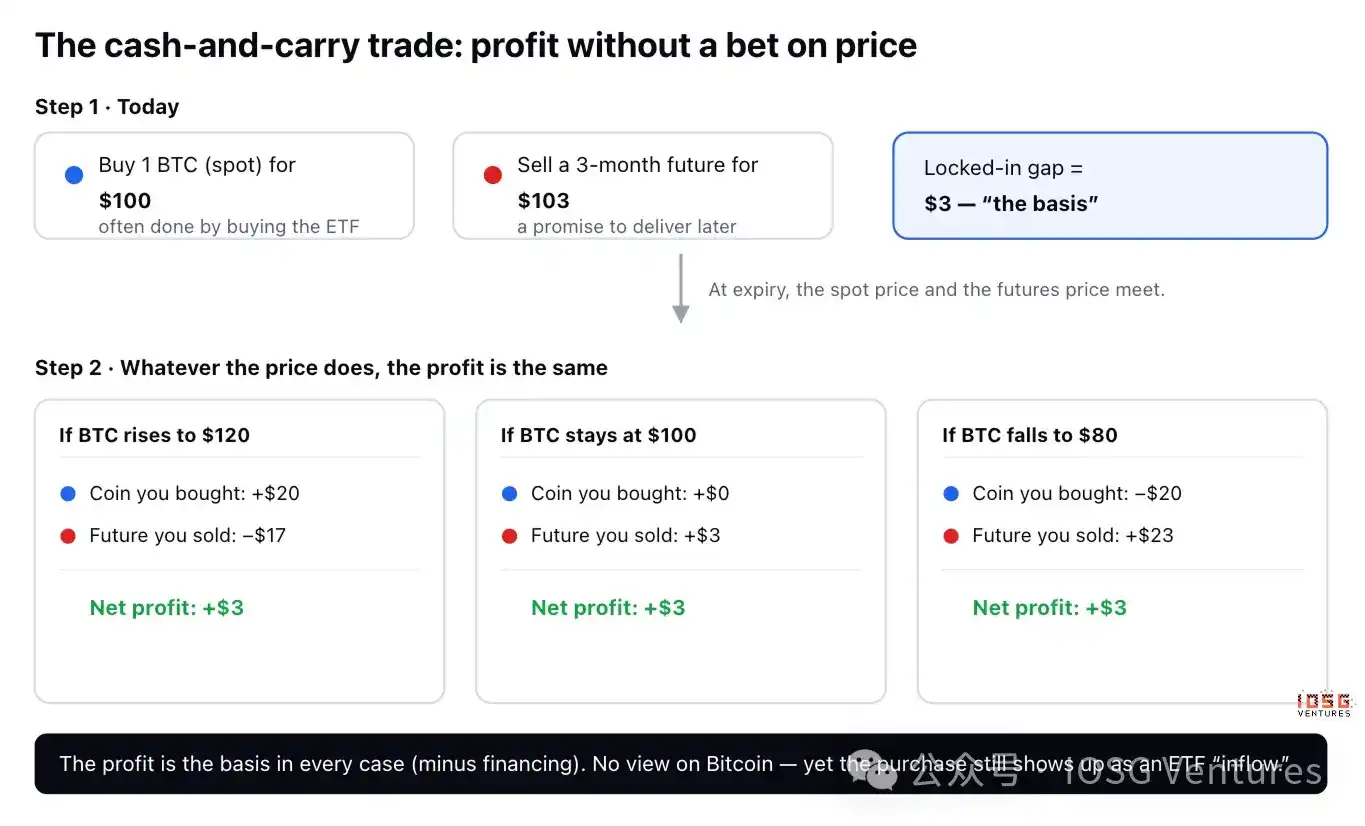
There is a classic, boring trade called cash-and-carry arbitrage. A Bitcoin "futures" contract is just an agreement to buy or sell Bitcoin at a set price on a future date, and most of the time, the futures price trades a bit above the current spot price—say Bitcoin is $100 now, but a contract expiring in three months sells for $103.

A trader can pocket that $3 difference without having any view on price:

  • Buy 1 Bitcoin today for $100 (often done by buying the ETF).

  • Sell a futures contract for $103, promising to deliver in three months.

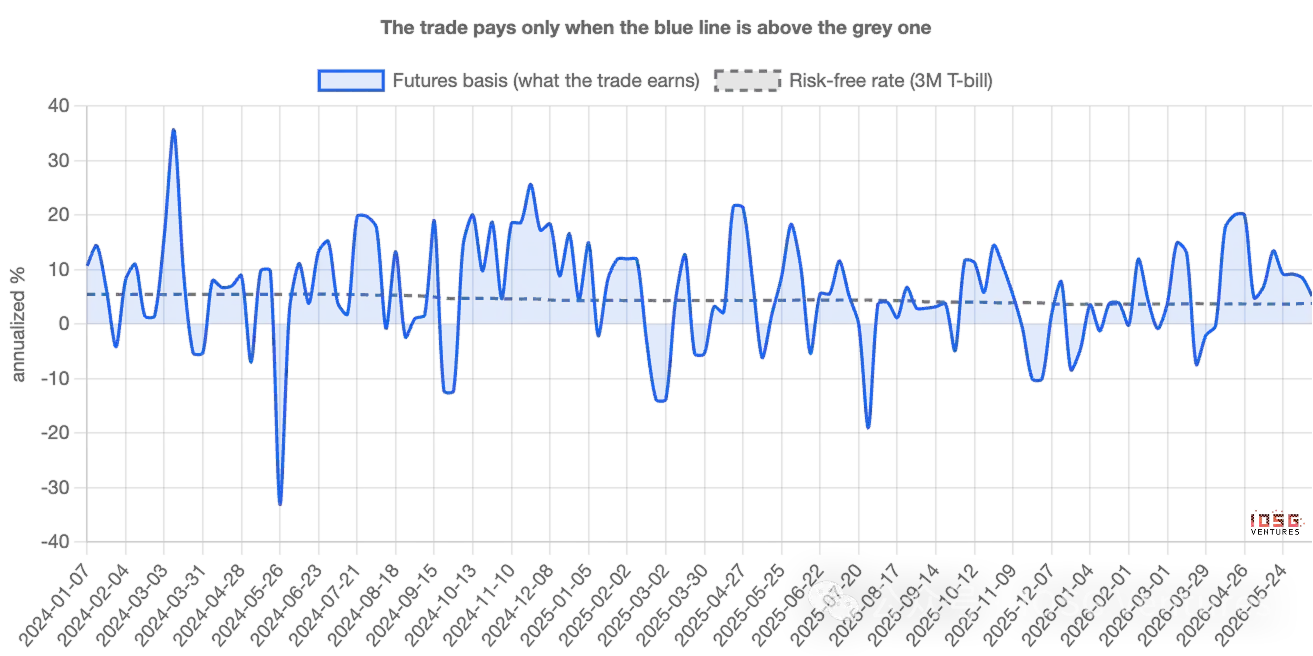
See what happens at expiration. If Bitcoin surges to $120, the trader makes $20 on the coin but loses $17 on the contract—a net gain of $3. If it crashes to $80, they lose $20 on the coin but make $23 on the contract—still a net gain of $3. If it stays flat, still $3. In every scenario, the profit is the same. The direction is hedged away; traders call this "delta neutral." This $3 price difference, expressed as an annualized rate, is the basis—essentially an interest rate earned for parking capital in this trade; it's worth doing as long as it exceeds the risk-free return one could get putting money in US Treasury bills (T-bills).
Why This Pollutes the Headline Number

The key is here. The first leg—buying 1 Bitcoin—is very commonly done by buying the ETF. Therefore, a trader with no view on Bitcoin, running delta neutral, appears in the data as an ETF inflow, indistinguishable on the surface from a true believer.

When lots of cash-and-carry is being set up, inflows look robust, and the narrative of "institutions are loading up" writes itself—even though these funds are hedged and will reverse the moment the trade ceases to be profitable. In other words, the flow number measures not just faith; it measures the activity of arbitrage desks. The challenge is separating the two—and how big each actually is.

How to Tell Them Apart

Cash-and-carry traders leave a second footprint. For every $1 of Bitcoin they buy, they short $1 of futures on the CME (the regulated US exchange where institutions trade Bitcoin futures). True believers leave only the first footprint; arbitrageurs leave both.

And the second footprint is public. The US derivatives regulator publishes a weekly report disclosing the size of long and short positions held by various trader types on the CME. One category—leveraged funds, essentially hedge funds—is precisely where the cash-and-carry crowd congregates. So you can take, week by week, the money flowing into ETFs and line it up against the new short positions these funds establish. If "demand" were truly conviction, the two shouldn't be closely linked; if a big chunk is that hidden trade, they should move together.

II. What the Data Says: Week to Week, Flows Follow Futures,Not Price

They move tightly together. Every single week since the ETFs launched, the weeks that saw more new futures shorting also saw more ETF inflows—almost one for one. About half of all weekly flow volatility can be explained by this single thing: how much shorting funds did. The correlation is 0.70, the kind of strength you see between two things that are clearly related, not coincidental.
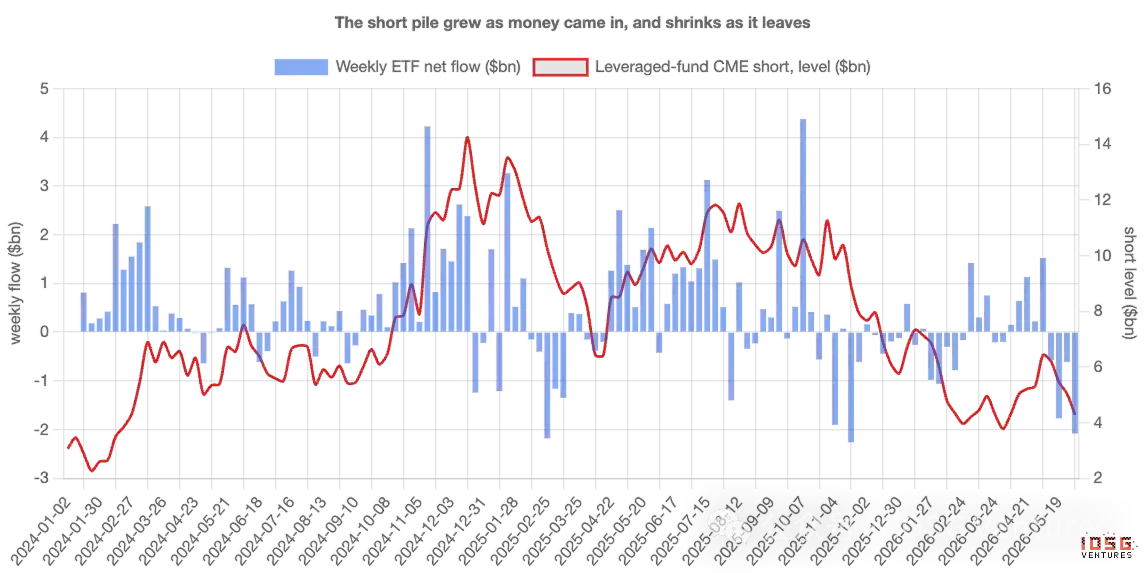
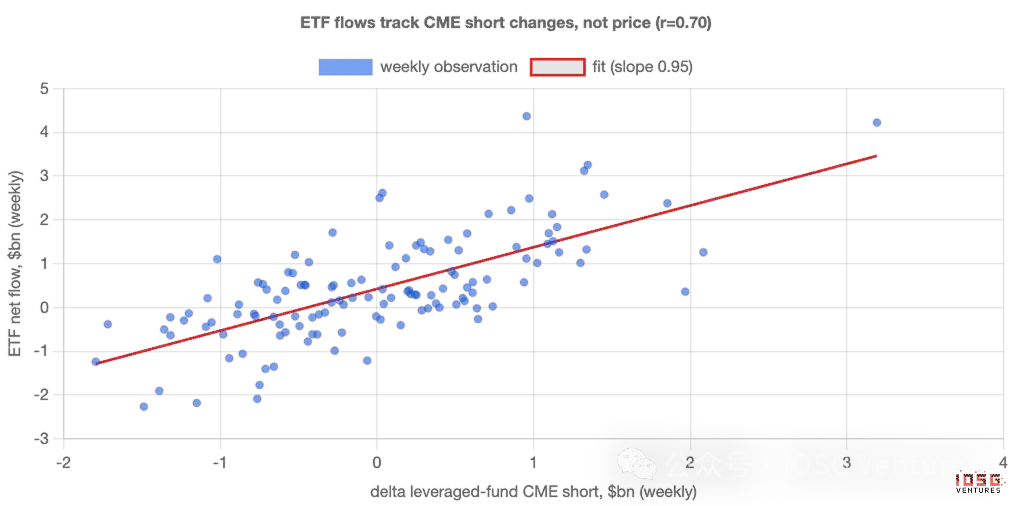
The point that should most unsettle believers: price itself explains almost nothing. Testing whether weekly Bitcoin returns predict ETF flows yields an answer statistically indistinguishable from zero. Weekly money is not chasing performance; it moves in lockstep with a hedged interest rate trade.

So, as a weekly signal, ETF "demand" is mostly arbitrage. The flow number is a poor thermometer for faith because its gyrations are the result of a basis trade being switched on and off, not anyone changing their mind about Bitcoin.

But How Much of the Money Is This Trade?

This is where the simplistic narrative—"it's all fake"—falls apart, and the real story gets more interesting. The basis trade dominates weekly volatility, but it never was the bulk of the stock of money.

Breaking weekly inflows into the part explained by futures shorts (hedged) and the rest (directional), and accumulating since launch: of the roughly $55 billion cumulatively flowed into ETFs, the basis trade currently represents a net balance of only about $1 billion—the rest is stable, directional buying. This buying averages about $400 million per week, week after week, regardless of basis or price, and compounded over two years, it is nearly the entire mountain.
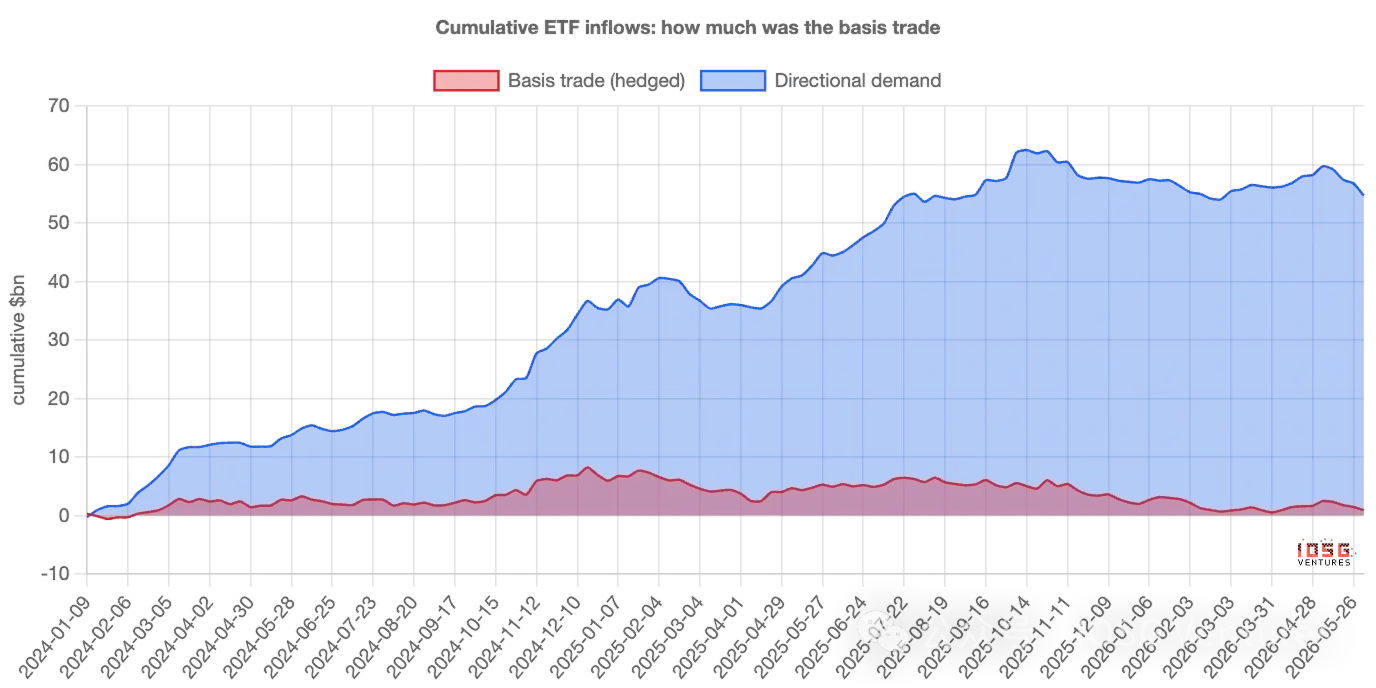
Looking at asset share rather than flows, the picture is the same: the hedged portion once neared 14% of ETF assets in 2024, and is now about 4%-5%. At its peak, it was a non-negligible minority; now it's a sliver.
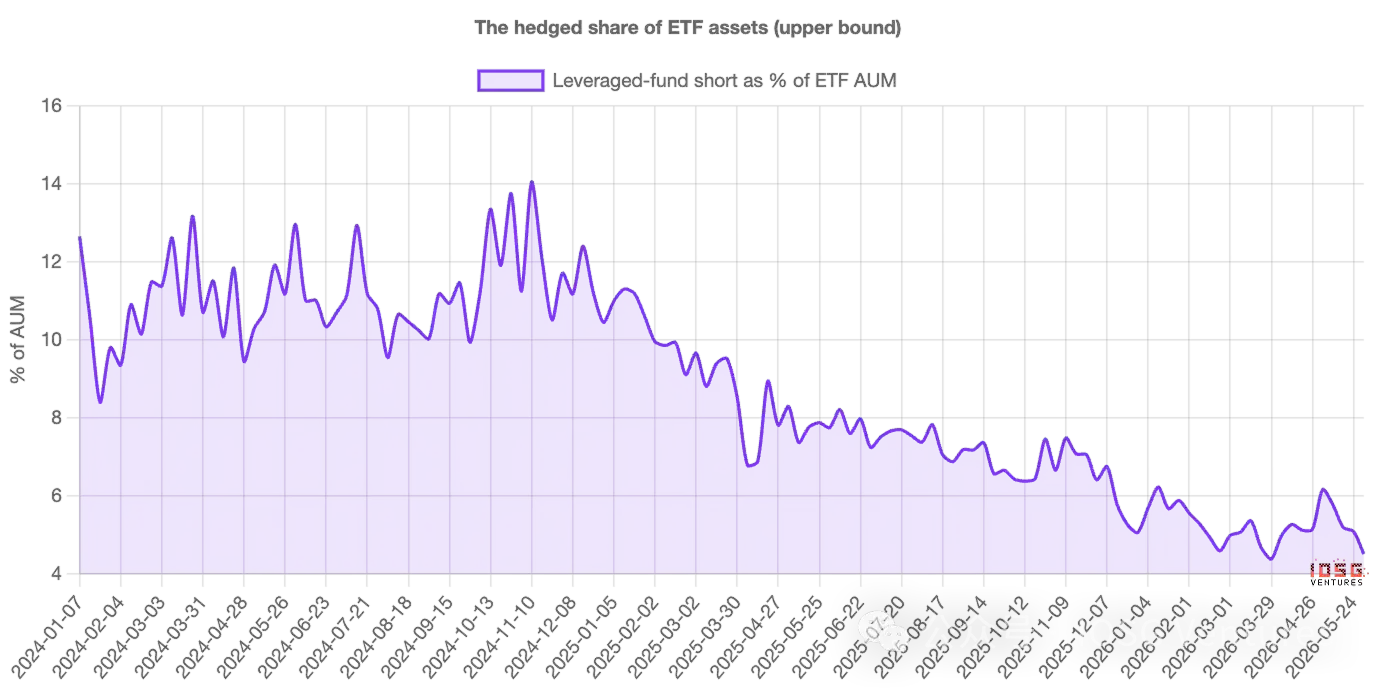
So, the more precise statement is: ETF flows overstate the volatility of conviction, not its level. The weekly ups and downs are mostly "rented"—arbitrage capital coming and going; but the assets that truly settle are mostly "owned." This trade churns through the flow data but was never the bulk of the balance.

And This Trade Is Unwinding

The hedged portion hasn't just always been small—it has been shrinking for two years. Leveraged funds' short positions grew from about $3 billion at launch to about $14 billion by late 2024, before steadily retreating to about $4.5 billion. This arbitrage trade has been unwinding across the entire period, not just recently.

This matters for reading the present. Entering June, hedged positions roughly halved again—funds' shorts fell from about $6.4 billion to $4.3 billion—while ETFs saw daily outflows of $300-$500 million. On the surface alone, that looks like panic capitulation. But paired with the futures data, it's just the routine cleanup of an interest rate trade that's no longer profitable. The same outflow number, two very different stories.

When the Basis Compresses, Demand Fades

The cleanest proof is what happens when the trade becomes unprofitable. When that $3 price difference narrows to approach what traders could earn risk-free, the trade isn't worth doing. If a big chunk of weekly demand really is this trade, then weekly demand should weaken precisely when the basis compresses—and it does. Stripping trend from each series and looking at moments around a compression: ETF inflows break below their usual rhythm, and funds simultaneously cover shorts, both moving in sync. Demand breathes with the trade.
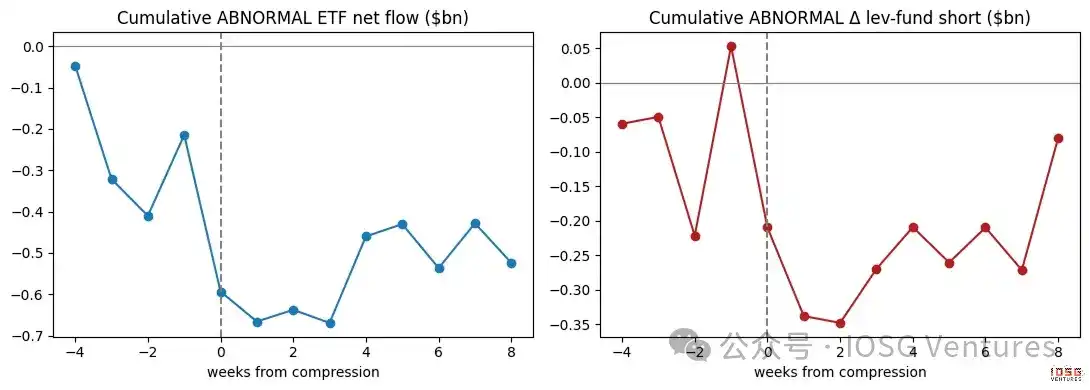
True believers wouldn't care about futures basis. And this weekly "demand" clearly does.

III. Which Comes First, and Who's Really Operating

First, the relationship is contemporaneous—strongest within the same week, with no clear lead or lag; and the slight directional evidence actually points the opposite way: it's ETF flows that seem to drive shorts, not the other way around. This fits the logic of a paired trade: buy the ETF first, and the futures hedge follows, rather than shorting magically "creating" an inflow. Second, the arbitrage crowd isn't the only driver. Flows follow leveraged funds' shorts most tightly, but they also resonate with directional institutional positions—both types of buyers are active. This article's claim is not that every inflow is hedged; rather, the hedged trade is the tightest, most reliable driver of week-to-week volatility.

Ethereum: The Same Trade, But the Math Hardly Works

Applying the same test to Ethereum ETFs reveals the signature, but weaker—a looser link to futures shorting, and that underlying stable directional buy flow is almost nonexistent. The reason is clear. Holding spot Ethereum instead of futures means forgoing the staking yield Ethereum offers, about 3%–4% annually. After netting this out, Ethereum's basis is often negative—the arbitrage trade often can't even clear its hurdle rate. So Ethereum ETFs have neither strong conviction buying nor robust arbitrage positioning to support them; they are just smaller, noisier cousins of Bitcoin's.

IV. How to Read ETF Flows From Now On

The point is not a call on price, but a method for reading flows. When the basis is rich, expect "institutional demand" to look strong, and largely hedged—don't mistake that strength for faith. When the basis compresses, expect inflows and shorts to retreat together—don't mistake the resulting outflows as the market passing judgment on Bitcoin. The two numbers worth watching are: the level of annualized basis returns relative to T-bill rates, and the net short position of leveraged funds in the weekly CME report. They'll tell you how much of the next "demand" headline is real.

How We Measured It

A few honest limitations. The basis is built from the nearest-month CME futures contract versus spot, excluding the final days before each expiry (where its extremely short tenor turns rounding errors into artificial spikes); building series contract by contract sharpens exact numbers but doesn't change conclusions. The link between flows and shorts is a strong contemporaneous relationship, not proof one causes the other—the key is they are two halves of the same trade. The futures short number is an upper bound on the proportion of ETF buying that is hedged, because some shorting hedges coins held elsewhere.

None of this changes the main story. Week to week, Bitcoin ETF "demand" is primarily a hidden interest rate trade, not faith—flows measure the activity of those arbitraging far more accurately than they measure belief. And that real buy flow is real, patient, and now the vast majority of what remains, because the "rented" part has been going home for two years.


Трендовые криптовалюты

Связанные с этим вопросы

QWhat does the article argue is the primary driver of week-to-week Bitcoin ETF flow fluctuations, rather than genuine conviction?

AThe article argues that week-to-week Bitcoin ETF flow fluctuations are primarily driven by a cash-and-carry arbitrage trade, not genuine investor conviction. This trade involves buying the ETF while simultaneously shorting Bitcoin futures to lock in a spread, creating delta-neutral inflows that are indistinguishable from directional buys in the data. About half of the weekly flow volatility is explained by changes in hedge fund short futures positions.

QWhat two key data points does the author suggest investors should watch to better interpret the 'true' demand behind Bitcoin ETF flow headlines?

AThe author suggests investors should watch two key data points: 1) The level of the annualized basis (the futures premium) relative to the U.S. Treasury bill (T-bill) rate, and 2) The net short positions of leveraged funds reported weekly by the CFTC in its Commitments of Traders report for CME Bitcoin futures.

QHow does the article characterize the role of cash-and-carry trades in the *cumulative* amount of money that has flowed into Bitcoin ETFs since launch?

AThe article states that while cash-and-carry trades drive week-to-week *volatility* in flows, they have never been the main component of the cumulative *stock* of money. Out of the total cumulative inflow of approximately $55 billion, the net amount from arbitrage trades is only about $1 billion. The vast majority is stable, directional buying, averaging about $400 million per week, which has compounded over two years to form almost the entire 'mountain' of assets.

QWhat is the key difference in the dynamics of Ethereum ETF flows compared to Bitcoin ETF flows, according to the article?

AThe key difference is that the same arbitrage dynamic is much weaker for Ethereum ETFs. The correlation with futures shorts is looser, and the underlying steady directional buy flow is almost non-existent. This is because holding spot Ethereum (via an ETF) means forgoing staking rewards (approx. 3-4% annually), which often makes the effective basis negative, rendering the cash-and-carry trade unprofitable from the start.

QWhen the basis (futures premium) compresses towards the risk-free rate, what does the article predict will happen to ETF flows and futures short positions, and how should this be interpreted?

AThe article predicts that when the basis compresses to a level no longer profitable relative to the risk-free rate, ETF inflows will weaken and leveraged funds will simultaneously cover (reduce) their short futures positions. This should not be interpreted as a loss of conviction or a market judgment on Bitcoin, but rather as the routine unwinding of a hedged interest rate trade that is no longer worthwhile.

Похожее

AI охватывает весь мир, почему же Crypto + AI находятся в состоянии полного провала?

Искусственный интеллект (ИИ) стремительно развивается, однако сектор Crypto + AI остается в стороне от этого бума. Основная проблема заключается в серьезном несоответствии спроса и предложения, а не в противоречивой логике объединения двух технологий. Анализ выявляет четыре ключевых направления и их специфические проблемы: 1. **Децентрализованные вычисления и хранение:** Несмотря на логические преимущества (суверенитет данных, стоимость), они пока не предлагают решающего технологического превосходства, чтобы оправдать для компаний риски перехода от традиционных облачных провайдеров. 2. **Верификация моделей и защита конфиденциальности:** Такие решения, как ZKML, решают важные, но не срочные для бизнеса задачи. Их массовое внедрение, вероятно, последует за появлением нормативных требований (как в законе ЕС об ИИ). 3. **Инфраструктура для AI-агентов:** Разработка блокчейн-решений для автономных агентов опережает рыночный спрос. Сейчас компании сосредоточены на внутренней автоматизации процессов, а не на межсетевом взаимодействии агентов. 4. **Платежи для AI-агентов:** Это единственная ниша, где блокчейн находится на равных с традиционными финансами, поскольку ни одна сторона еще не решила проблему микроплатежей и расчетов между машинами в реальном времени. Главные препятствия для роста сектора: отсутствие прорывных технологических преимуществ перед централизованными аналогами, структурное нежелание бизнеса мириться с потенциальной нестабильностью децентрализованных сетей, незрелость рынка для передовых сценариев и, как следствие, отсутствие убедительных кейсов массового внедрения. Тем не менее, долгосрочная ценность комбинации блокчейна и ИИ сохраняется. Ее будущее зависит от выбора стратегии: либо адаптация к текущим приоритетам индустрии ИИ (производительность, стоимость), либо продолжение развития инфраструктуры для будущей экономики автономных агентов. Рост регулирования может стать катализатором для внедрения решений, обеспечивающих проверяемость и конфиденциальность.

Foresight News3 мин. назад

AI охватывает весь мир, почему же Crypto + AI находятся в состоянии полного провала?

Foresight News3 мин. назад

ETF демонстрируют устойчивый чистый отток — институциональные инвесторы выходят из рынка?

В последние шесть недель наблюдался чистый отток средств из американских биткойн-ETF, сумма которого достигла около 6 миллиардов долларов. Это самый длительный период оттока с момента запуска продуктов в 2024 году. Основной объем продаж связан с IBIT от BlackRock. Анализ данных показывает, что долгосрочные держатели биткойнов сохраняют свои активы, в то время как основная продажа происходит от инвесторов, использующих ETF. Причины оттока включают макроэкономические факторы: рост инфляции, ужесточение политики ФРС и переток спекулятивного капитала в другие активы, такие как инфраструктура ИИ и предстоящие IPO. Хотя интенсивность оттока в июне замедлилась, структурная проблема сохраняется: крупные ETF, такие как IBIT, сами становятся источником давления на рынок при значительных выходах средств. На рынке наблюдается нехватка новых покупателей, что усугубляет волатильность. Ближайшие несколько торговых сессий могут определить дальнейшую динамику. Если отток из IBIT замедлится, а цена биткойна стабилизируется выше 60 000 долларов, текущую коррекцию можно будет считать перераспределением. Однако дальнейшие масштабные продажи и падение ниже 58 000 долларов могут указывать на более глубокую структурную перестройку, в ходе которой не-ETF инвесторы будут вынуждены самостоятельно абсорбировать давление от ухода институциональных игроков.

marsbit45 мин. назад

ETF демонстрируют устойчивый чистый отток — институциональные инвесторы выходят из рынка?

marsbit45 мин. назад

«Явно возводят дорогу, а тайно переправляются через Чэнцан»: Вош прокладывает путь для снижения ставок в сентябре?

Автор: Чжао Ин Источник: Wall Street News По мнению аналитика Academy Securities Питера Чира, несмотря на то что рынок оценивает вероятность повышения ставки ФРС в сентябре в 75% и ожидает суммарно 1,25 повышения до конца года, может существовать реальный путь к *снижению* ставки в сентябре. Чир предполагает, что председатель ФРС Кевин Уорш своим ястребиным настроем может сознательно создавать "дымовую завесу". Его аргументация строится на политико-экономической логике: администрация Трампа исторически заинтересована в низких ставках. Уорш, будучи назначенцем Трампа, мог договориться о стратегии: сначала жесткая риторика для сдерживания долгосрочных доходностей и поддержания видимости независимости ФРС, а затем поворот к смягчению при появлении "подходящих" данных, с возложением ответственности за инфляцию на предшественников. Ключевым элементом является потенциальное переопределение инфляционных данных. Чир указывает, что Уорш может отдать предпочтение не индексу PCE, а альтернативным показателям, таким как индекс арендной платы для новых арендаторов (NTRR) от ФРБ Кливленда или ежедневный индекс Truflation, который показывает уровень базовой инфляции около 1,45%. Смещение акцента на такие данные может технически оправдать снижение ставки. Кроме того, аналитик затрагивает тему нейтральной процентной ставки (r*), утверждая, что новая руководящая команда ФРС может заявить, что предыдущая оценка была завышенной, что также создаст пространство для смягчения. Чир критикует представление об инфляционном влиянии ИИ, отмечая, что рост расходов на центры обработки данных — это иная категория, не реагирующая на повышение ставок, которое вместо этого бьет по обычным заемщикам. На основе этого он прогнозирует переоценку рыночных ожиданий и видит возможности в покупке краткосрочных гособлигаций в ожидании снижения доходности на коротком конце кривой.

marsbit1 ч. назад

«Явно возводят дорогу, а тайно переправляются через Чэнцан»: Вош прокладывает путь для снижения ставок в сентябре?

marsbit1 ч. назад

IBIT за неделю вывел 13 миллиардов долларов. Крупнейший ETF на биткоин превращается в стену продаж, которую быки должны преодолеть

Активность инвесторов в биткоин-ETF столкнулась с резким поворотом: фонд iShares Bitcoin Trust (IBIT) от BlackRock, крупнейший в США по биткоинам, стал источником значительного оттока средств. За неделю с 22 по 26 июня общий чистый отток из спотовых биткоин-ETF составил около 1,79 млрд долларов, причем на долю IBIT пришлось примерно 1,3 млрд долларов, или около 73% от общего объема. В последний торговый день недели весь чистый отток в 444,5 млн долларов также был обеспечен IBIT. Этот концентрированный отток меняет рыночный контекст для биткоина, который в это время торговался около ключевого уровня в 60 000 долларов. Ранее ETF, особенно IBIT, рассматривались как основной канал для притока институциональных инвестиций, сокращающий доступное предложение и поддерживающий нарратив о растущем спросе. Теперь же крупнейший ETF демонстрирует, что этот же канал может работать и в обратном направлении, становясь источником структурного давления со стороны продавцов. Объемы IBIT (активы под управлением около 44,87 млрд долларов) означают, что его отток оказывает существенное влияние на рынок. Если он продолжится, биткоину для восстановления потребуется преодолеть не только общее давление продаж, но и дополнительное давление от вывода средств из основного ETF. Механизм выкупа ETF может подразумевать как денежные расчеты, так и физическую продажу биткоинов, создавая риски для рынка. Сценарии развития различны. Если отток из IBIT замедлится, а биткоин укрепится выше 59 000–62 000 долларов, текущую неделю можно будет считать этапом очистки рынка. Если же крупный отток продолжится и биткоин не сможет закрепиться выше 60 000 долларов, это укрепит новый нарратив: самый заметный инструмент для инвестиций в биткоин превратился в "стену продаж", и для дальнейшего роста потребуется активный спрос за пределами ETF-экосистемы. Следующие несколько торговых дней станут решающим тестом для этого сюжета.

marsbit2 ч. назад

IBIT за неделю вывел 13 миллиардов долларов. Крупнейший ETF на биткоин превращается в стену продаж, которую быки должны преодолеть

marsbit2 ч. назад

Токен Pump.fun вырос на 12% при рекордном числе держателей — 2 метрики могут ограничить рост

Токен Pump.fun (PUMP) вырос на 12%, достигнув рекордного числа держателей — 122 440, при этом розничные инвесторы составляют около 38%. Общая заблокированная стоимость (TVL) протокола также значительно увеличилась, достигнув 217,7 млн долларов, что указывает на приток нового капитала. Однако основные показатели активности протокола остаются слабыми. Объем запускаемых мемкоинов и комиссии платформы упали на 86,7% и 35,6% соответственно, а доход протокола снизился на 23%. Это указывает на снижение пользовательской активности и полезности платформы. Несмотря на позитивные сигналы рынка, такие как рост цены и числа держателей, устойчивость восстановления зависит от улучшения фундаментальных показателей протокола. Без восстановления активности оптимизм инвесторов может оказаться уязвимым.

ambcrypto2 ч. назад

Токен Pump.fun вырос на 12% при рекордном числе держателей — 2 метрики могут ограничить рост

ambcrypto2 ч. назад

Торговля

Спот

Популярные статьи

Тест по Bitcoin Биткоина

HTX Learn: Изучите Bitcoin halving и Заработаете Токены USDT

3.1k просмотров всегоОпубликовано 2024.04.16Обновлено 2024.04.16

Тест по Bitcoin  Биткоина

Что такое $BITCOIN

ЦИФРОВОЕ ЗОЛОТО ($BITCOIN): Комплексный анализ Введение в ЦИФРОВОЕ ЗОЛОТО ($BITCOIN) ЦИФРОВОЕ ЗОЛОТО ($BITCOIN) — это проект на основе блокчейна, работающий в сети Solana, который стремится объединить характеристики традиционных драгоценных металлов с инновациями децентрализованных технологий. Хотя он носит имя Биткойн, часто называемого “цифровым золотом” из-за его восприятия как средства хранения ценности, ЦИФРОВОЕ ЗОЛОТО является отдельным токеном, предназначенным для создания уникальной экосистемы в ландшафте Web3. Его цель — позиционировать себя как жизнеспособный альтернативный цифровой актив, хотя детали его применения и функциональности все еще развиваются. Что такое ЦИФРОВОЕ ЗОЛОТО ($BITCOIN)? ЦИФРОВОЕ ЗОЛОТО ($BITCOIN) — это токен криптовалюты, специально разработанный для использования в блокчейне Solana. В отличие от Биткойна, который выполняет широко признанную роль хранения ценности, этот токен, похоже, сосредоточен на более широких приложениях и характеристиках. Примечательные аспекты включают: Инфраструктура блокчейна: Токен построен на блокчейне Solana, известном своей способностью обрабатывать высокоскоростные и недорогие транзакции. Динамика предложения: ЦИФРОВОЕ ЗОЛОТО имеет максимальное предложение, ограниченное 100 квадриллионами токенов (100P $BITCOIN), хотя детали о его обращающемся предложении в настоящее время не раскрыты. Утилита: Хотя точные функциональные возможности не описаны, есть указания на то, что токен может быть использован для различных приложений, потенциально связанных с децентрализованными приложениями (dApps) или стратегиями токенизации активов. Кто создатель ЦИФРОВОГО ЗОЛОТА ($BITCOIN)? На данный момент личность создателей и команды разработчиков, стоящих за ЦИФРОВЫМ ЗОЛОТОМ ($BITCOIN), остается неизвестной. Эта ситуация типична для многих инновационных проектов в области блокчейна, особенно тех, которые связаны с децентрализованными финансами и феноменом мем-криптовалют. Хотя такая анонимность может способствовать культуре, ориентированной на сообщество, она усиливает опасения по поводу управления и ответственности. Кто инвесторы ЦИФРОВОГО ЗОЛОТА ($BITCOIN)? Доступная информация указывает на то, что у ЦИФРОВОГО ЗОЛОТА ($BITCOIN) нет известных институциональных спонсоров или значительных венчурных капиталовложений. Проект, похоже, функционирует по модели пирингового взаимодействия, сосредоточенной на поддержке и принятии сообществом, а не на традиционных путях финансирования. Его активность и ликвидность в основном сосредоточены на децентрализованных биржах (DEX), таких как PumpSwap, а не на устоявшихся централизованных торговых платформах, что еще больше подчеркивает его подход, ориентированный на grassroots. Как работает ЦИФРОВОЕ ЗОЛОТО ($BITCOIN) Операционные механизмы ЦИФРОВОГО ЗОЛОТА ($BITCOIN) можно подробно описать на основе его дизайна блокчейна и характеристик сети: Механизм консенсуса: Используя уникальный механизм доказательства истории (PoH) Solana в сочетании с моделью доказательства доли (PoS), проект обеспечивает эффективную валидацию транзакций, что способствует высокой производительности сети. Токеномика: Хотя конкретные дефляционные механизмы не были подробно описаны, большое максимальное предложение токенов подразумевает, что оно может быть предназначено для микротранзакций или нишевых случаев использования, которые еще предстоит определить. Интероперабельность: Существует потенциал для интеграции с более широкой экосистемой Solana, включая различные платформы децентрализованных финансов (DeFi). Однако детали относительно конкретных интеграций остаются неуточненными. Хронология ключевых событий Вот хронология, которая подчеркивает значимые вехи, касающиеся ЦИФРОВОГО ЗОЛОТА ($BITCOIN): 2023: Первоначальное развертывание токена происходит в блокчейне Solana, отмеченное его адресом контракта. 2024: ЦИФРОВОЕ ЗОЛОТО приобретает видимость, когда оно становится доступным для торговли на децентрализованных биржах, таких как PumpSwap, позволяя пользователям обменивать его на SOL. 2025: Проект наблюдает спорадическую торговую активность и потенциальный интерес к инициативам, возглавляемым сообществом, хотя на данный момент не зафиксировано никаких значительных партнерств или технических достижений. Критический анализ Сильные стороны Масштабируемость: Основная инфраструктура Solana поддерживает высокие объемы транзакций, что может повысить полезность $BITCOIN в различных сценариях транзакций. Доступность: Потенциально низкая цена торговли за токен может привлечь розничных инвесторов, способствуя более широкому участию благодаря возможностям дробного владения. Риски Отсутствие прозрачности: Отсутствие публично известных спонсоров, разработчиков или процесса аудита может вызвать скептицизм относительно устойчивости и надежности проекта. Волатильность рынка: Торговая активность сильно зависит от спекулятивного поведения, что может привести к значительной волатильности цен и неопределенности для инвесторов. Заключение ЦИФРОВОЕ ЗОЛОТО ($BITCOIN) является интригующим, но неоднозначным проектом в быстро развивающейся экосистеме Solana. Хотя он пытается использовать нарратив “цифрового золота”, его отход от установленной роли Биткойна как средства хранения ценности подчеркивает необходимость более четкого различения его предполагаемой утилиты и структуры управления. Будущее принятие и усвоение, вероятно, будут зависеть от решения текущей непрозрачности и более четкого определения его операционных и экономических стратегий. Примечание: Этот отчет охватывает синтезированную информацию, доступную на октябрь 2023 года, и с тех пор могут произойти события.

150 просмотров всегоОпубликовано 2025.05.13Обновлено 2025.05.13

Что такое $BITCOIN

Fractal Bitcoin: масштабирование Биткоина с помощью рекурсивной системы

Fractal Bitcoin — масштабное Layer-1-решнение, созданное на базе кода Биткоина, позволяющего достигать бесконечного масштабирования с помощью рекурсивного подхода.

2.3k просмотров всегоОпубликовано 2025.06.30Обновлено 2025.06.30

Fractal Bitcoin: масштабирование Биткоина с помощью рекурсивной системы

Обсуждения

Добро пожаловать в Сообщество HTX. Здесь вы сможете быть в курсе последних новостей о развитии платформы и получить доступ к профессиональной аналитической информации о рынке. Мнения пользователей о цене на BTC (BTC) представлены ниже.

活动图片