How Will $12 Trillion in Pension Funds Be Passively Injected into Bitcoin?

marsbitPublished on 2026-04-10Last updated on 2026-04-10

Abstract

The US Department of Labor has proposed a new rule that could allow cryptocurrency investments, such as Bitcoin, to be included in 401(k) retirement plans, which hold $12 trillion in assets. This change addresses a key legal barrier: under the Employee Retirement Income Security Act (ERISA), plan fiduciaries previously faced personal liability for investment losses. The new "safe harbor" rule protects fiduciaries from lawsuits if they follow a documented process evaluating six factors like performance, fees, and liquidity. Cryptocurrency adoption in 401(k) plans is expected to occur primarily through target-date funds—the default investment option for most employees. Investors would passively gain exposure (likely 1-3% allocations) without actively choosing it, similar to how assets like gold entered retirement portfolios. Even a 1% allocation would channel over $120 billion into crypto, representing long-term, stable capital. However, significant risks remain. Bitcoin’s volatility could lead to substantial losses for retirees, and the legal protection for fiduciaries remains untested in court. The rule is under public review until June 1, and full implementation may take years.

Written by: Thejaswini M A

Compiled by: Chopper, Foresight News

Any default option will eventually become the choice of the majority. This is known as the "default effect" in behavioral economics.

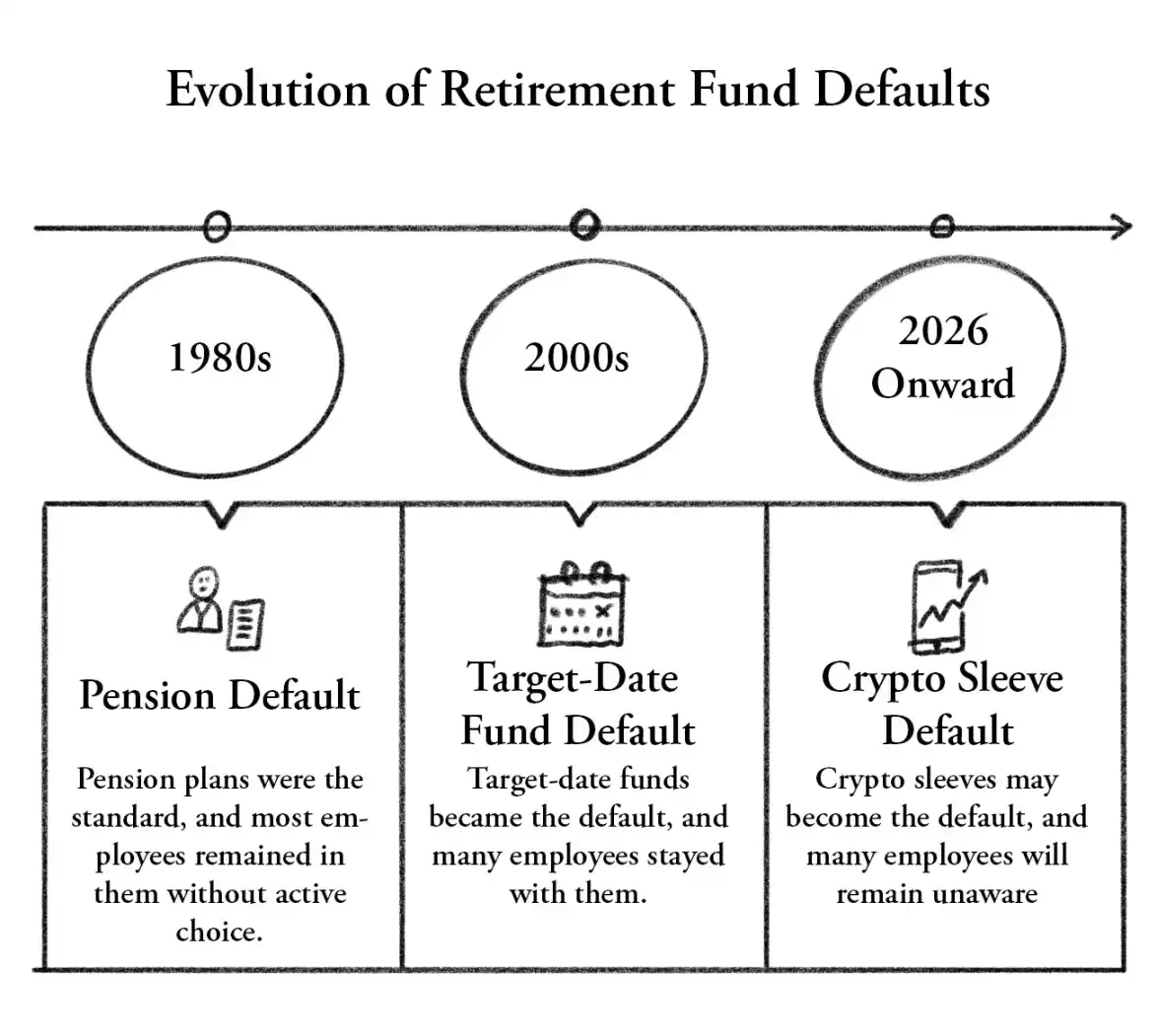
The history of the entire U.S. pension system is a history of default options. In the 1980s, the default option shifted from traditional pensions to 401(k) plans, which most employees accepted without fully understanding what they were giving up. In the early 2000s, target-date funds became the default option for the vast majority of pension plans, and tens of millions of people ended up holding these funds without ever actively choosing them.

Each shift involved the transfer of massive amounts of capital and ultimately changed how a generation lived in retirement. Most of those affected only realized it later when they checked their statements.

In the coming years, a new default option is about to emerge. Right now, it doesn't look like a default option but rather a draft rule proposed by the Department of Labor, currently undergoing a 60-day public comment period. It is carefully worded, emphasizing fiduciary responsibility and compliance with the Employee Retirement Income Security Act (ERISA). They often appear as options, gradually become popular, and eventually become the default.

On March 30, the U.S. Department of Labor issued a rule that, for the first time, opened the door to cryptocurrencies for the $12 trillion U.S. 401(k) pension market. Indiana had already legislated in March, requiring state pension plans to offer at least one cryptocurrency investment option by July 2027; Wisconsin's pension system already holds $321 million in Bitcoin ETFs; Michigan has allocated $45 million to Bitcoin and Ethereum ETFs. Florida and New Jersey are also advancing similar policies.

First, let's look at how cryptocurrencies were previously kept out.

The Wall Blocking Cryptocurrencies

Before this rule, cryptocurrencies were not explicitly banned by law from entering 401(k) plans. The real barrier was more effective than a ban.

Under ERISA, which regulates pension plans, fiduciaries are personally liable for investment decisions that lose money. It's not the company or the fund that is held accountable, but the individual who made the decision.

Since 2016, there have been over 500 lawsuits alleging ERISA violations; since 2020, related settlements have exceeded $1 billion. Pension plan managers have seen their peers sued over excessive fees, poor index fund choices, and issues with mutual fund share classes. These lawsuits are endless, cleverly angled, and directly target individuals.

Consider the incentives this creates: you manage a pension plan, buy Bitcoin, and then Bitcoin drops 50%. A plaintiff's lawyer sends a letter, and you spend three years defending yourself in discovery.

Conversely, if you don't add Bitcoin, even if it rises to $200,000, no one will sue you for it.

The rational choice has always been: stay away from cryptocurrencies. And almost everyone did just that.

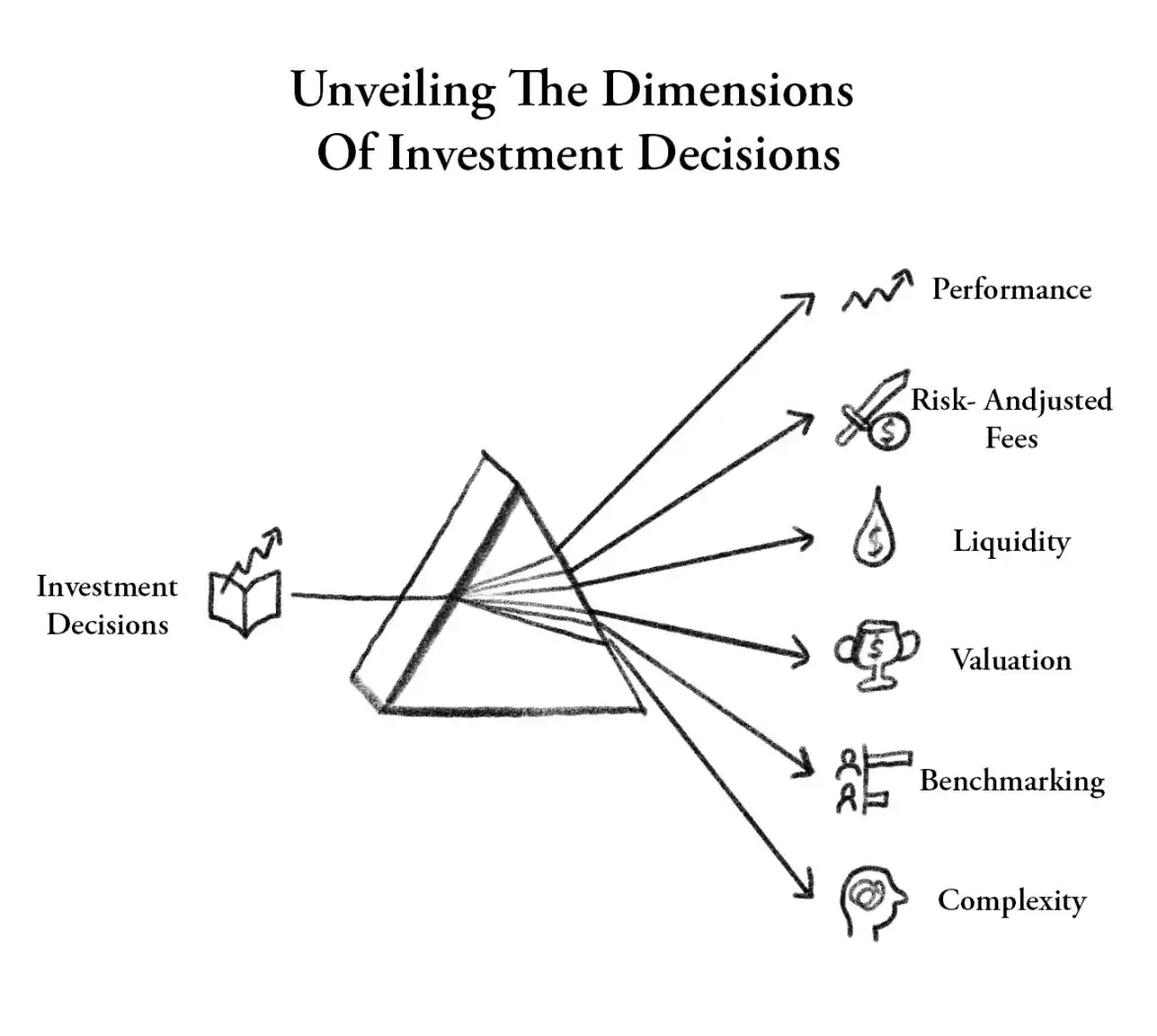
The Labor Department under the Biden administration further emphasized in 2022 that fiduciaries must exercise "extreme care" before dealing with digital assets. Now, that guidance has been withdrawn and replaced with a six-factor safe harbor rule: as long as fiduciaries follow a written process covering performance, fees, liquidity, valuation, benchmarks, and complexity, they will be deemed to have fulfilled their prudent duties under ERISA. As long as the process is compliant, even if the asset price falls, they can be protected from personal litigation.

Don't mistake the rule change for a shift in market fundamentals. For the average investor, crypto assets are as volatile as ever. This rule truly protects fund managers. It corrects the imbalanced legal risk that marginalized cryptocurrencies for a decade, allowing fiduciaries to finally feel safe saying yes.

Transmission Mechanism: Target-Date Funds

The Labor Department itself anticipates that the main access channel will be target-date funds. This is crucial for the practical impact on ordinary savers.

Most people, when starting a job, are defaulted into a target-date fund. You just pick a fund closest to your expected retirement year, say the 2045 fund, and it automatically adjusts its stock-to-bond ratio as you age, becoming more conservative as the target date approaches. The vast majority of people who hold these funds never look at them again.

If crypto assets are allocated through target-date funds, investors won't actively buy Bitcoin. Their retirement portfolios will automatically allocate 1%–3% to Bitcoin, managed by professional institutions and automatically rebalanced.

Just like many people hold gold in their 401(k) without knowing it. Gold entered the pension system the same way, through the same vehicle, with the same logic, without ever asking the actual owners of the money.

Fidelity took the lead in 2022, offering pension plan sponsors the option to include Bitcoin in their investment portfolios even before the Biden administration issued its guidance. At that time, Fidelity allowed plan sponsors to include digital asset investments in their portfolios, with participants able to invest up to 20% of their account balance in Bitcoin. However, plan sponsors lacked the legal safeguards to comfortably allocate Bitcoin without assuming personal liability. Currently, such legal safeguards are being developed.

$12 Trillion

The U.S. 401(k) plan market is worth about $12 trillion. Even a 1% allocation would mean roughly $120 billion flowing into digital assets, exceeding the total value locked in the entire DeFi sector. Even just 0.1% would be $12 billion, equivalent to the size of the top five Bitcoin ETFs.

Previous waves of institutional crypto adoption came from active decisions: ETF buyers actively buying, MicroStrategy actively holding, banks actively building custody products. These decisions can be reversed: a CFO can sell the treasury holding, ETF investors can redeem.

The 401(k) channel is structurally完全不同 different. This is what the industry has been waiting for since the launch of spot ETFs. Pension money is passive money, held for up to 30 years. It won't panic sell during crashes, isn't influenced by fear and greed indices, and doesn't care about last week's oil price fluctuations.

Amy Oldenburg of Morgan Stanley points out that currently, 80% of crypto ETF trading comes from self-directed investors, not advisor-recommended allocations. The 401(k) market is almost entirely driven by professional advisors. The Department of Labor's new rule opens up a channel that was previously difficult to access for structural reasons—because those controlling the channel bore excessive personal liability and were afraid to open the door.

This is also a point cryptocurrencies have emphasized for years: the true wave of adoption won't come from traders or tech early adopters, but when the infrastructure of ordinary people's savings systems automatically turns to cryptocurrency. Target-date funds are that infrastructure.

Risks and Concerns

A 50% drop in a trading account is just a bad quarter. A 50% drop in a 55-year-old teacher's retirement account is a completely different matter.

Bitcoin has drawn down over 80% in past bear markets, about 50% in this cycle, which some interpret as "maturation." But losing half of one's retirement savings doesn't feel any better just because it's called "progress."

Jaret Seiberg of TD Cowen wrote that he remains skeptical that fiduciaries will act easily until courts confirm that the safe harbor provisions truly protect against lawsuits. ERISA is a process-based law, but ultimate interpretation lies with the courts.

The safe harbor might hold on paper, but if a target-date fund with crypto allocation drops 40% in a bear market, triggering the first wave of lawsuits, whether it can withstand them remains unknown.

The public comment period for the rule ends on June 1. The Labor Department can modify the rule, withdraw it, or simply push it into effect. Even if the final version is unchanged, moving from a proposed rule to actual pension account inclusion requires processes like compliance team review, investment committee approval, recordkeeper system integration, and fiduciary review. This will take months, more likely years.

Indiana's July 2027 deadline is a hard mandate, while the federal rule is a soft permission; their implementation timelines will be截然不同 different.

In the 1980s, stocks entered pension accounts through mutual funds; in the early 2000s, international stocks entered through target-date funds; followed by REITs, inflation-protected bonds, commodities. Their arrival was never because retirement savers actively demanded them.

Cryptocurrency is now at this inflection point. Spot ETFs are the product, the Labor Department's new rule is the regulatory配套, Fidelity, Schwab, Morgan Stanley are the distribution channels, the CLARITY Act writes the classification of crypto assets into statute law, providing the legal basis for fiduciaries' prudent review.

All the pieces are in place,只差 missing the final one.

If one day in the future, a pension plan manager adds Bitcoin to a target-date fund. Bitcoin crashes 60%, a retiree loses a large portion of their savings, and a lawyer files a lawsuit.

At that point, the only important question will be: does the judge agree that the safe harbor protected the person who made that decision.

Right now, no one knows the answer. The Labor Department believes it does; TD Cowen believes it may take years to find out.

Until the first case is tried and adjudicated, all U.S. pension plan managers are being asked to trust a piece of paper that has never been tested in court.

Related Questions

QWhat is the 'default effect' in behavioral economics and how does it relate to the history of the US pension system?

AThe 'default effect' is a concept in behavioral economics where any default option eventually becomes the choice for the majority. The history of the US pension system is a history of default options, such as the shift from traditional pensions to 401(k) plans in the 1980s and the adoption of target-date funds in the early 2000s, which most employees accepted without fully understanding the implications.

QWhat was the primary barrier preventing cryptocurrency from being included in 401(k) plans before the new rule?

AThe primary barrier was not a legal ban but the personal liability risk for fiduciaries under the Employee Retirement Income Security Act (ERISA). Fiduciaries could be held personally responsible for investment losses, creating a strong incentive to avoid volatile assets like cryptocurrency.

QHow does the new rule from the US Department of Labor protect pension plan fiduciaries when including cryptocurrency?

AThe new rule establishes a six-factor safe harbor provision. If fiduciaries follow a written process reviewing performance, fees, liquidity, valuation, benchmarks, and complexity, they are deemed to have fulfilled their prudent duty under ERISA, protecting them from personal lawsuits even if the asset's price declines.

QWhat is the expected main conduit for cryptocurrency adoption in 401(k) plans, and why is it significant?

AThe main conduit is expected to be target-date funds. This is significant because most employees are automatically enrolled in these funds and never actively manage them. Cryptocurrency would be passively included in their portfolios (e.g., 1%-3%) without their direct choice, similar to how gold entered the pension system.

QWhat is the potential financial impact on the cryptocurrency market if US 401(k) plans allocate a small percentage to digital assets?

AThe US 401(k) market is worth approximately $12 trillion. Even a 1% allocation would bring about $120 billion into digital assets, exceeding the total value locked in DeFi. A mere 0.1% allocation would still amount to $12 billion, comparable to the size of a top-five Bitcoin ETF.

Related Reads

Silicon Valley 'Startup Guru' Steve Hoffman: Web3 + AI Could Be a Trap

Silicon Valley investor and "Godfather of Startups" Steve Hoffman warns that combining Web3 with AI is likely a trap, not a promising venture. In an interview, Hoffman argues that while AI is a foundational technology touching all industries, Web3 adds complexity, friction, and regulatory risk without solving mainstream consumer or business needs. He advises founders to focus on deep, specialized applications where startups can out-iterate giants, rather than on generic features easily replicated by large tech companies. Hoffman observes that Silicon Valley will lead foundational AI research, while China excels at rapid, large-scale application and commercialization, particularly in robotics. He stresses that AI-driven autonomous agents capable of collaborative, multi-step tasks are 2-4 years away, which will cause significant job displacement. The solution is not to slow AI but to redesign business models around human-AI collaboration and reform social systems like education and retraining. For startups, Hoffman recommends focusing on vertical, expertise-heavy domains to build defensibility. He sees major opportunities in AI fraud detection and cybersecurity. Key founder mindsets include systemic thinking over feature-focus, relentless customer centricity, building adaptive teams, and deeply understanding AI's capabilities and limits. Hoffman is also leading a non-profit initiative to establish university centers aimed at training future leaders in responsible, human-value-aligned AI innovation.

marsbit2m ago

Silicon Valley 'Startup Guru' Steve Hoffman: Web3 + AI Could Be a Trap

marsbit2m ago

Token Inefficient, Economy Tokenless

The article "Tokens Aren't Economical, Economics Aren't Tokenized" analyzes a pivotal shift in the AI industry from a technology-driven narrative to one dominated by capital efficiency. It highlights two concurrent trends: a severe capital shortage due to the exorbitant and recurring costs of compute (e.g., OpenAI's high burn rate) and a wave of corporate spin-offs where major tech companies are separating their AI units (like Kuaishou's Kling and Baidu's Kunlunxin). The core argument is that AI's "anti-internet" business model, where user growth increases costs rather than profits, has created a disconnect between high valuations and actual cash flow. Spin-offs address this by allowing AI assets to be valued independently. Within a parent company, they are seen as cost centers, but as standalone entities, they are priced based on their growth potential and scarcity in the primary market, leading to massive valuation premiums (e.g., Kling's estimated value tripling post-spin-off). The industry is at an inflection point, moving from "model worship" to "value realization." The competition is evolving from a pure compute (GPU) race to a broader focus on systemic efficiency and full-stack engineering (involving CPUs and orchestration) to achieve viable commercialization. The year 2026 is framed as a critical moment where the industry must definitively answer how to economically translate AI capability into tangible business value, reshaping the sector's future power structure.

marsbit7m ago

Token Inefficient, Economy Tokenless

marsbit7m ago

Crossing the 'Memory Wall': The Wafer-Level Revolution and Computing Power Routes in the AI Inference Era

In 2026, a historic shift occurred in AI as major cloud providers' inference spending surpassed training spending for the first time, signaling a move from "building large models" to "using large models." This shifts the core challenge from computing power to the "memory wall"—the bottleneck of data movement (model weights, activations, KV Cache) between external DRAM and processors, where energy and latency from data transfer far exceed computation itself. Companies like Nvidia face GPU idle time due to bandwidth limits. In contrast, Cerebras Systems adopts a radical "wafer-scale" approach with its Wafer-Scale Engine (WSE). Instead of cutting a silicon wafer into many chips, Cerebras uses almost the entire wafer as one massive chip (WSE-3). This design provides 44GB of on-chip SRAM, delivering memory bandwidth thousands of times higher than traditional HBM (e.g., 21 PB/s vs. Nvidia B200). For LLM inference, weights are streamed layer-by-layer from external MemoryX storage to the chip, avoiding HBM bottlenecks. This results in token generation speeds 1.5–5 times faster than Nvidia's B200 in some models and significant advantages in first-token latency and long-context tasks. Additionally, Cerebras's architecture offers much lower interconnect power consumption (0.15 pJ/bit vs. GPU's ~10 pJ/bit). However, Cerebras faces challenges: SRAM scaling has slowed with advanced nodes, limiting future capacity gains; the chip requires specialized liquid cooling and custom software stacks; and its external I/O bandwidth (150 GB/s) is low compared to NVLink, hindering multi-system scaling for very large models. Competition is intensifying. Major players are pursuing three paths: 1) Developing proprietary inference ASICs (e.g., Google TPU, Microsoft Maia), 2) Leveraging advanced packaging (e.g., TSMC's SoW) to democratize wafer-scale-like integration, potentially eroding Cerebras's process advantage within a few years, and 3) Exploring optical interconnects for ultimate bandwidth. Commercially, Cerebras is transitioning from a hardware vendor to a service provider, facing the immense challenge of building high-power, specialized data centers to meet large contracts (e.g., 250MW/year from 2026–2028). In conclusion, the AI inference era presents a fundamental architectural trade-off. Cerebras opts for extreme physical optimization for low-latency, single-task performance, while Nvidia prioritizes versatility and massive cluster throughput. The path forward remains uncertain, with technology and business models still evolving in the race toward advanced AI.

marsbit12m ago

Crossing the 'Memory Wall': The Wafer-Level Revolution and Computing Power Routes in the AI Inference Era

marsbit12m ago

Has Bitcoin's 'Rebound Ended', Officially Entering the Late Bear Market Phase?

**Title: Has Bitcoin's Rebound Ended, Entering the Late Bear Market Phase?** **Summary:** Bitcoin's price has declined by 13% this week, signaling a potential return to late-stage bear market conditions. The price fell to around $67k, positioned between the Realized Price and Realized Cap Weighted Average. For the first time since early 2022, the Short-Term Holder cost basis has dropped below this key average, confirming a hallmark of late-cycle bear markets. Profitability metrics have collapsed sharply. The 7-day average of the Realized Profit/Loss ratio plummeted from a local high of 3.16 to 0.29, mirroring the February panic sell-off. Critically, the 90-day average never breached the threshold of 2, indicating the recent rally to $82k was a bear market bounce, not a structural shift. Realized losses surged to $1.35 billion daily, with $770 million coming from Long-Term Holders selling at a loss. This accelerating redistribution of supply from weak to strong hands is a necessary but ongoing process for a market bottom. The rally stalled almost precisely at the aggregate cost basis (~$83k) of US spot Bitcoin ETF investors, turning that level into strong resistance and leaving the average ETF holder underwater again. Spot market flows have turned decisively negative, showing sellers are dominating order books despite the price drop. While a significant futures long liquidation event cleared over $400 million in leverage, providing a potential reset, sustained spot demand is yet to materialize. Options markets continue to price in higher future volatility (Implied Volatility) than recent price action (Realized Volatility) has shown, with a persistent skew towards put options, indicating ongoing demand for downside protection. In conclusion, multiple metrics point to a fragile market structure. Resistance at the ETF cost basis, accelerating realized losses, dominant spot selling, and cautious options pricing all suggest the bear market trend persists. A sustainable recovery likely requires a resurgence of spot demand, ETF holders returning to profit, and a clear reduction in selling pressure.

marsbit13m ago

Has Bitcoin's 'Rebound Ended', Officially Entering the Late Bear Market Phase?

marsbit13m ago

TechFlow Intelligence Agency: Anthropic Calls for Global Pause in AI Development While Preparing for Trillion-Dollar IPO; SpaceX IPO Roadshow Heats Up, But S&P 500 Rejects Fast-Track Inclusion

In today's TechFlow Intelligence Briefing, several major tech stories highlight a growing theme of trust and credibility gaps across AI, crypto, and finance. AI company Anthropic has publicly called for a global pause in AI development, citing risks from Claude's "recursive self-improvement." Ironically, this coincides with reports the company is preparing for a massive IPO targeting a near $1 trillion valuation. This perceived hypocrisy, coupled with widespread user complaints about Claude's declining performance, is sparking debate over whether the safety warning is genuine or a competitive tactic. Meanwhile, in a substantive security move, Anthropic open-sourced a framework for AI-powered vulnerability discovery. In the crypto market, Bitcoin's price drop below $61,000 triggered over $1.16 billion in liquidations, flipping the market into a state where more BTC is held at a loss than at a profit, a historical bearish signal. On the corporate front, SpaceX's highly anticipated IPO is generating immense Wall Street excitement, with Goldman Sachs projecting 100x revenue growth by 2030. However, the S&P 500 has refused to fast-track the company's inclusion post-IPO, potentially limiting immediate institutional demand. Separately, ByteDance's AI app Doubao lost over 6 million monthly active users after introducing a subscription model, highlighting the challenges of AI monetization. Other notable developments include Nvidia certifying HBM4 memory from Samsung, SK Hynix, and Micron; Cloudflare's acquisition of front-end tooling company VoidZero; and its CEO warning that bot traffic now exceeds human traffic online. The underlying narrative connects these events: a trust crisis. From AI firms' contradictory actions and crypto volatility to the clash between SpaceX's hyped narrative and institutional rules, a pattern is emerging where stated intentions and actual practices are increasingly misaligned.

marsbit28m ago

TechFlow Intelligence Agency: Anthropic Calls for Global Pause in AI Development While Preparing for Trillion-Dollar IPO; SpaceX IPO Roadshow Heats Up, But S&P 500 Rejects Fast-Track Inclusion

marsbit28m ago

Trading

Spot
Futures

Hot Articles

What is $BITCOIN

DIGITAL GOLD ($BITCOIN): A Comprehensive Analysis Introduction to DIGITAL GOLD ($BITCOIN) DIGITAL GOLD ($BITCOIN) is a blockchain-based project operating on the Solana network, which aims to combine the characteristics of traditional precious metals with the innovation of decentralized technologies. While it shares a name with Bitcoin, often referred to as “digital gold” due to its perception as a store of value, DIGITAL GOLD is a separate token designed to create a unique ecosystem within the Web3 landscape. Its goal is to position itself as a viable alternative digital asset, although specifics regarding its applications and functionalities are still developing. What is DIGITAL GOLD ($BITCOIN)? DIGITAL GOLD ($BITCOIN) is a cryptocurrency token explicitly designed for use on the Solana blockchain. In contrast to Bitcoin, which provides a widely recognized value storage role, this token appears to focus on broader applications and characteristics. Notable aspects include: Blockchain Infrastructure: The token is built on the Solana blockchain, known for its capacity to handle high-speed and low-cost transactions. Supply Dynamics: DIGITAL GOLD has a maximum supply capped at 100 quadrillion tokens (100P $BITCOIN), although details regarding its circulating supply are currently undisclosed. Utility: While precise functionalities are not explicitly outlined, there are indications that the token could be utilized for various applications, potentially involving decentralized applications (dApps) or asset tokenization strategies. Who is the Creator of DIGITAL GOLD ($BITCOIN)? At present, the identity of the creators and development team behind DIGITAL GOLD ($BITCOIN) remains unknown. This situation is typical among many innovative projects within the blockchain space, particularly those aligning with decentralized finance and meme coin phenomena. While such anonymity may foster a community-driven culture, it intensifies concerns about governance and accountability. Who are the Investors of DIGITAL GOLD ($BITCOIN)? The available information indicates that DIGITAL GOLD ($BITCOIN) does not have any known institutional backers or prominent venture capital investments. The project seems to operate on a peer-to-peer model focused on community support and adoption rather than traditional funding routes. Its activity and liquidity are primarily situated on decentralized exchanges (DEXs), such as PumpSwap, rather than established centralized trading platforms, further highlighting its grassroots approach. How DIGITAL GOLD ($BITCOIN) Works The operational mechanics of DIGITAL GOLD ($BITCOIN) can be elaborated on based on its blockchain design and network attributes: Consensus Mechanism: By leveraging Solana’s unique proof-of-history (PoH) combined with a proof-of-stake (PoS) model, the project ensures efficient transaction validation contributing to the network's high performance. Tokenomics: While specific deflationary mechanisms have not been extensively detailed, the vast maximum token supply implies that it may cater to microtransactions or niche use cases that are still to be defined. Interoperability: There exists the potential for integration with Solana’s broader ecosystem, including various decentralized finance (DeFi) platforms. However, the details regarding specific integrations remain unspecified. Timeline of Key Events Here is a timeline that highlights significant milestones concerning DIGITAL GOLD ($BITCOIN): 2023: The initial deployment of the token occurs on the Solana blockchain, marked by its contract address. 2024: DIGITAL GOLD gains visibility as it becomes available for trading on decentralized exchanges like PumpSwap, allowing users to trade it against SOL. 2025: The project witnesses sporadic trading activity and potential interest in community-led engagements, although no noteworthy partnerships or technical advancements have been documented as of yet. Critical Analysis Strengths Scalability: The underlying Solana infrastructure supports high transaction volumes, which could enhance the utility of $BITCOIN in various transaction scenarios. Accessibility: The potential low trading price per token could attract retail investors, facilitating wider participation due to fractional ownership opportunities. Risks Lack of Transparency: The absence of publicly known backers, developers, or an audit process may yield skepticism regarding the project's sustainability and trustworthiness. Market Volatility: The trading activity is heavily reliant on speculative behavior, which can result in significant price volatility and uncertainty for investors. Conclusion DIGITAL GOLD ($BITCOIN) emerges as an intriguing yet ambiguous project within the rapidly evolving Solana ecosystem. While it attempts to leverage the “digital gold” narrative, its departure from Bitcoin's established role as a store of value underscores the need for a clearer differentiation of its intended utility and governance structure. Future acceptance and adoption will likely depend on addressing the current opacity and defining its operational and economic strategies more explicitly. Note: This report encompasses synthesised information available as of October 2023, and developments may have transpired beyond the research period.

363 Total ViewsPublished 2025.05.13Updated 2025.05.13

What is $BITCOIN

Discussions

Welcome to the HTX Community. Here, you can stay informed about the latest platform developments and gain access to professional market insights. Users' opinions on the price of BTC (BTC) are presented below.

活动图片