XRP Ledger Adds Military-Grade Security Via Payments Engine Standard

bitcoinistОпубликовано 2025-12-18Обновлено 2025-12-18

Введение

Ripple has published the first formal specification for the XRP Ledger’s Payment Engine, developed with formal methods firm Common Prefix. This document aims to provide a canonical reference for payment behavior and cross-asset transfers on the ledger, moving beyond empirical success to mathematical certainty. The initiative addresses the limitations of relying solely on the C++ codebase as the source of truth, which makes it difficult to distinguish intentional design from historical behavior. As the ledger prepares for more complex features—like lending, batch transactions, and decentralized exchange upgrades—this specification ensures clarity and safety. The specification focuses on the Payment Engine and plans to extend to the Consensus Protocol, described as non-negotiable for network safety. Ripple aims to create both human-readable reference and machine-verifiable models to enable formal verification by 2026. The goal is to shift from "code-as-truth" to "mathematics-as-truth," enhancing security and enabling advanced features. The XRP community has welcomed the announcement as a major step toward military-grade security and protocol reliability.

Ripple has published the first formal specification of the XRP Ledger’s Payment Engine, positioning it as a foundational upgrade for protocol safety as XRPL moves into a more feature-dense era. The document was released in partnership with formal methods firm Common Prefix and is intended to become a canonical reference for how payments and cross-asset value transfer behave on-ledger.

The motivation is straightforward, and Ripple does not sugarcoat it. XRPL has operated for more than a decade without downtime, but the team argues that a long track record is still not the same as provable correctness. In the DEV Community post published Dec. 17 under the RippleX Developers banner, the authors write that “to prepare the ledger for the next generation of complex features, we must move beyond empirical success to mathematical certainty.”

A Turning Point For XRP Ledger Security

That is the tone throughout: less victory lap, more engineering debt disclosure. For much of XRPL’s life, the C++ implementation (xrpld) has effectively acted as the only definitive source of truth for core behavior. Ripple’s post calls out a practical problem with that model: “The code tells us, in very precise C++ terms, what it does. It does not always tell us why.” In other words, when code is the spec, it becomes difficult to separate intentional design choices from historical behavior that simply persisted because nothing broke.

That gap starts to matter more as new amendments arrive. Ripple points directly to a pipeline of complex features — including lending, DEX-related work tied to Multi-Purpose Tokens (MPTs), batch transactions, and permissioned DEX concepts — and warns that the number of possible system states expands quickly as new modules “weave into the decades-old logic of the ledger.”

The published specification is hosted on GitHub and labeled as work in progress, but it is already framed as a serious technical artifact: “a technical specification document intended for developers implementing or verifying XRPL payment system behavior.” It also spells out the heart of the system in plain language: the Payment Engine is what “figures out how value should travel and then carries out those moves,” enabling payments to draw across “trust lines, MPTs, order books, AMMs, and direct XRP.”

The deeper point, though, is what this enables next. Ripple’s post lays out a two-part target. First, a human-readable specification that reduces ambiguity and becomes the canonical reference for builders and researchers. Second, a machine-verifiable model — a mathematical representation of the spec — that can support mechanical proofs about system properties and whether proposed changes violate core safety guarantees.

It is also explicit about scope discipline. Ripple argues that specifying the entire ledger in one shot is not realistic: “It would be prohibitively expensive and time-consuming to specify the entire system at once.” So the work focuses on what it describes as the two most critical and complex components: the Payment Engine and the Consensus Protocol.

Consensus, in particular, is framed as non-negotiable infrastructure. Ripple describes it as “the heart of the ledger,” adding: “Its correctness is non-negotiable and underpins the safety and liveness of the entire network.”

The stated objective is to formally model the mechanism to prove properties such as liveness, safety, and finality. On timing, Ripple is clear that this is the starting line, not the finish. After publishing the Payment Engine specification, the team says it intends to begin formal verification work on the Payment Engine and the Consensus Protocol in 2026.

The closing line captures the direction of travel: “The shift from code-as-truth to mathematics-as-truth is underway.”

In the XRP community, the announcement landed with predictable euphoria. “Absolute freaking game changer! ... Aerospace & military grade security incoming,” wrote XRPL validator and community member Vet, adding: “The XRP Ledger is receiving its first formal specification for the payments engine. By mathematically specifying key protocol components [...] Basically, this is the enabler for the endboss of audits AND for other things like complex features or client diversity.”

At press time, XRP traded at $1.83.
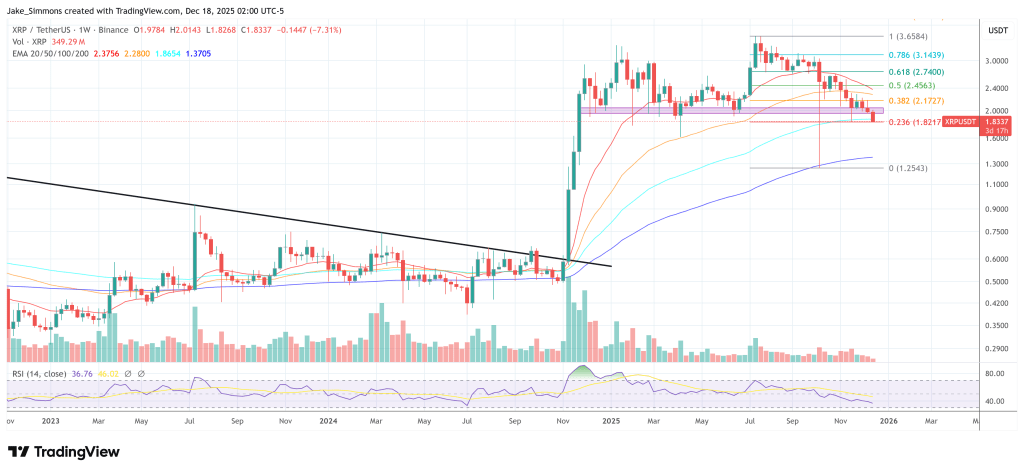
XRP falls below support zone, 1-week chart | Source: XRPUSDT on TradingView.com

Связанные с этим вопросы

QWhat is the main purpose of Ripple publishing the first formal specification of the XRP Ledger's Payment Engine?

AThe main purpose is to provide a foundational upgrade for protocol safety, moving beyond empirical success to mathematical certainty, and to serve as a canonical reference for how payments and cross-asset value transfer behave on-ledger as the XRPL introduces more complex features.

QWhich two critical components does Ripple's specification work focus on, and why?

AThe work focuses on the Payment Engine and the Consensus Protocol because specifying the entire ledger at once would be prohibitively expensive and time-consuming. These are described as the two most critical and complex components, with consensus being non-negotiable infrastructure that underpins the entire network's safety and liveness.

QWhat practical problem does Ripple identify with having the C++ code (xrpld) as the only definitive source of truth?

AThe code precisely tells what it does in C++ terms but does not always explain why, making it difficult to separate intentional design choices from historical behavior that simply because nothing broke, which becomes a greater issue as new amendments and complex features are added.

QWhat are the two parts of Ripple's target for the XRP Ledger specification?

AFirst, a human-readable specification that reduces ambiguity and becomes the canonical reference for builders and researchers. Second, a machine-verifiable model—a mathematical representation—that can support mechanical proofs about system properties and whether proposed changes violate core safety guarantees.

QWhen does Ripple intend to begin formal verification work on the Payment Engine and Consensus Protocol?

ARipple intends to begin the formal verification work on the Payment Engine and the Consensus Protocol in 2026.

Похожее

How Risky is the "Death Spiral" of MSTR and STRC?

Summary: This article explores the perceived "death spiral" risk between MicroStrategy (MSTR), its Bitcoin holdings, and its perpetual preferred stock (STRC), drawing comparisons to the LUNA-UST collapse. While both systems feature price anchors, high yields for holders, and potential feedback loops, their core mechanisms differ fundamentally. The MSTR-STRC structure relies on continuous financing to sustain its high dividend payouts, primarily through stock ATM offerings. A negative feedback cycle could occur: falling MSTR stock price makes raising equity capital harder, increasing pressure to sell Bitcoin, which undermines STRC confidence and further depresses MSTR. However, unlike LUNA-UST's automated, direct linkage, the MSTR-STRC loop is weaker and has brakes: STRC dividends can be deferred or rates lowered, and STRC holders have a $100/share liquidation preference in bankruptcy, providing a price floor. The company's sustainability hinges on its ability to continue financing. Its current ~$900 million USD reserves cover only about 6.3 months of its ~$1.71 billion annual interest/dividend burden. The next six months are critical, aligning with both the potential bottom in Bitcoin's four-year cycle and the depletion timeline of its reserves. While a LUNA-style catastrophic collapse is deemed highly unlikely due to structural differences, the key question is whether MicroStrategy can navigate this period through healthy deleveraging to restart its capital engine.

Foresight News19 мин. назад

How Risky is the "Death Spiral" of MSTR and STRC?

Foresight News19 мин. назад

How Much Debt Does Strategy Really Have? Is There a Risk of Implosion?

MicroStrategy's Debt Risk: A Turning Point in the "Never Sell" Strategy As of June 3, 2026, MicroStrategy holds 843,706 bitcoins (valued at ~$53.1B) but faces significant financial obligations. Its capital structure includes $6.75B in convertible notes and $15.48B in perpetual preferred stock (led by the $8.5B STRC series), creating an annual payout burden of ~$1.71B. With software revenue at only ~$500M, interest and dividend obligations far exceed operating income. A critical shift occurred in late May 2026 when the company sold 32 bitcoins for ~$2.5M to cover dividends, breaking CEO Michael Saylor's long-standing "never sell" pledge. This symbolic move triggered a sharp decline in both Bitcoin's price and MSTR stock, reflecting market fears about cash flow sustainability. The core of the strain is the STRC perpetual preferred stock, designed as a "permanent loan" with no maturity date but requiring high monthly dividends (currently 11.5%). Its business model relies on a three-part cycle: issuing new STRC shares, using proceeds to buy more Bitcoin and fund a USD reserve, and using that reserve to pay dividends. This cycle depends on continuous investor demand for STRC and Bitcoin's price appreciation. Analysis shows Bitcoin needs to appreciate at least 2.3% annually to cover the $1.71B in yearly obligations at current holdings. With Bitcoin price down ~22% from March 2026 highs, this pressure has intensified. The company's $900M USD reserve can only cover about 7 months of payments if STRC issuance stalls. Key risks are not immediate bankruptcy or forced Bitcoin liquidation (as BTC is not collateral), but rather: 1) The erosion of MSTR's premium to its Bitcoin holdings (mNAV), which would cripple its ability to raise cheap capital; 2) A vicious cycle where stagnant Bitcoin prices reduce STRC demand, draining the USD reserve and forcing BTC sales, further depressing prices. The period from February 2027 to September 2028 is a crucial test, with over $5.9B in convertible notes facing put options or maturity. In essence, MicroStrategy has evolved from a simple Bitcoin holder into a complex financial entity acting like a "private Bitcoin bank," leveraging its BTC holdings to create layered financial products. Its survival depends on maintaining Bitcoin's price trend, its stock premium, and market appetite for its preferred shares. The recent token sale marks not a betrayal of its Bitcoin thesis, but an admission that the leveraged strategy must eventually be paid for.

marsbit29 мин. назад

How Much Debt Does Strategy Really Have? Is There a Risk of Implosion?

marsbit29 мин. назад

Anthropic Cries Wolf: Is the AGI Threat Real, or Just an IPO Story?

Anthropic has published an article titled "When AI builds itself," discussing the emerging concept of "recursive self-improvement," where AI begins to actively participate in designing, training, testing, and optimizing its own subsequent versions. The company presents internal data showing that by May 2026, over 80% of code merged into its codebase was written by Claude, its AI model. Claude's capabilities have expanded to handling complex, open-ended engineering tasks, achieving a 76% success rate in such areas, and even contributing to research processes, such as optimizing code performance and conducting AI safety experiments. Anthropic outlines an evolution from human-driven development to AI-assisted workflows, culminating in the current stage where AI agents can autonomously write, run, and delegate code. The company cautions that the path toward a "closed loop," where AI continuously improves itself, is becoming visible. It calls for coordinated global mechanisms to potentially slow or pause frontier AI development to allow safety research and societal structures to catch up. However, the timing of this warning coincides with Anthropic's preparations for an IPO, framing the narrative not just as a safety concern but also as a demonstration of Claude's advanced capabilities and its integral role in accelerating Anthropic's own R&D—creating a potential "flywheel" effect for competitive advantage. This contrasts with OpenAI's recent, more policy-oriented discussion of the same risks, highlighting the competitive dynamics in the AI industry as companies position themselves in both the technological and regulatory landscape.

marsbit1 ч. назад

Anthropic Cries Wolf: Is the AGI Threat Real, or Just an IPO Story?

marsbit1 ч. назад

Торговля

Спот
Фьючерсы

Популярные статьи

Что такое XRP 2.0

XRP 2.0: Новая грань в мире криптовалют Введение в XRP 2.0 В постоянно развивающейся сфере криптовалют появляются новые проекты, стремящиеся к вниманию и внедрению. Один из таких многообещающих проектов - это XRP 2.0, новая криптовалюта, созданная для использования передовых технологий блокчейна и надежных методов шифрования. Хотя название вызывает ассоциации с XRP от Ripple, важно отметить, что XRP 2.0 функционирует независимо, сосредоточив внимание на повышении безопасности сделок, конфиденциальности и масштабируемости. Поскольку цифровая финансовая среда все больше принимает децентрализованные решения, XRP 2.0 намерена внести значимый вклад в web3 и общее расширение криптопроектов. Что такое XRP 2.0? XRP 2.0 в своей основе - это проект криптовалюты, цель которого - создать безопасную и децентрализованную экосистему цифровой валюты. Его базовая технология интегрирует сложные принципы блокчейна с современными методами шифрования. Основная цель XRP 2.0 - утвердиться как надежная и эффективная платформа, позволяющая быстро осуществлять транзакции с приоритетом на улучшенную защиту конфиденциальности для своих пользователей. Проект рекламируется как решение многих недостатков, с которыми сталкиваются существующие криптовалюты, предлагая систему, способную обрабатывать более высокий объем транзакций с улучшенной скоростью и конфиденциальностью. Эта универсальность позиционирует XRP 2.0 как значимого конкурента на рынке, переполненном различными цифровыми валютами. Кто создатель XRP 2.0? Идентичность создателя XRP 2.0 была обозначена как «Уилбур». Однако исчерпывающие данные о Уилбуре или связанном с ним проекте остаются неясными. Анонимность многих создателей криптовалют не является редким явлением в этой отрасли и часто применяется для сохранения определенной степени конфиденциальности и безопасности. Кто инвесторы XRP 2.0? <pна данный момент конкретная информация о инвестиционных фондах или организациях, поддерживающих xrp 2.0, не доступна публично. в секторе криптовалют поддержка репутабельными инвесторами может существенно повлиять на кредитоспособность и успех проекта, однако прозрачность в отношении финансовых спонсоров 2.0 еще была установлена. Как работает XRP 2.0? XRP 2.0 выделяется использованием сочетания технологий блокчейна и продвинутых алгоритмов шифрования, что обеспечивает безопасные и децентрализованные транзакции. Его инновационная структура включает уникальные функции, разработанные для повышения вовлеченности пользователей и расширения функциональности за пределами традиционных транзакций с криптовалютами. Среди этих функций XRP 2.0 интегрирует возможности с искусственным интеллектом, такие как текст в изображение и текст в речь. Эти дополнения разработаны для улучшения интерактивной работы пользователей, способствуя более широкому применению в различных секторах. Соединяя технологические достижения с дизайном, ориентированным на пользователя, XRP 2.0 стремится привлечь внимание разнообразных индивидуумов и предприятий, стремящихся интегрировать решения с криптовалютой в свои бизнес-процессы. Хронология XRP 2.0 Для понимания XRP 2.0 необходимо рассмотреть ключевые события, которые определили его путь до сих пор: 23 июля 2023 года: XRP 2.0 представлен как новый проект криптовалюты, стремящийся революционизировать возможности безопасных и децентрализованных транзакций в области блокчейна. 8 сентября 2023 года: Запуск другого проекта, XRP20, который представляет собой токен ERC-20 на блокчейне Ethereum и не имеет отношения к XRP 2.0. 13 ноября 2023 года: XRP Ledger подвергается значительному обновлению с выпуском программного обеспечения серверов rippled версии 2.0.0. Важно отметить, что это развитие не связано с проектом криптовалюты XRP 2.0. Ключевые моменты о XRP 2.0 Чтобы выделить суть XRP 2.0, возникают несколько критически важных факторов: Уникальные особенности: Включение таких функций, как основанные на ИИ текст в изображение и текст в речь, дополнительно разнообразит потенциальные приложения XRP 2.0. Технология блокчейна: Структура использует современные механизмы блокчейна и протоколы шифрования, обеспечивая безопасную и децентрализованную среду для транзакций. Масштабируемость и конфиденциальность: XRP 2.0 придает приоритет повышенным мерам защиты конфиденциальности в процессах транзакций и масштабируемости, необходимой для привлечения растущей базы пользователей. Нет связи с Ripple: Важно отметить, что, несмотря на свое название, XRP 2.0 не имеет никаких отношений или сотрудничества с XRP от Ripple, что отличает его операционные рамки и цели в экосистеме криптовалют. Заключение XRP 2.0 представляет собой амбициозное начинание в сфере криптовалют, стремясь предложить сочетание безопасности, конфиденциальности и эффективности в цифровых транзакциях. Интегрируя сложные технологии и удобные функции, проект стремится расширить горизонты того, что может достичь криптовалюта в современной цифровой экономике. Хотя анонимность его создателя и отсутствие раскрытых инвесторов могут вызвать вопросы у некоторых, акцент XRP 2.0 на передовых функциональных возможностях и децентрализации увеличивает его привлекательность на фоне все более переполненного крипто-рынка. Поскольку мир криптовалют продолжает развиваться, XRP 2.0 может еще стать ключевым игроком в расширении безопасных и масштабируемых блокчейн-решений.

198 просмотров всегоОпубликовано 2024.04.05Обновлено 2024.12.03

Что такое XRP 2.0

Неделя обучения по популярным токенам 13: запуск основной сети HIP-4 ожидается в середине 2026 года на фоне смещения фокуса рынка к масштабируемому внедрению ключевых криптоактивов, включая XRP

HIP-4 представит децентрализованные рынки прогнозов без разрешений, бинарные (исходные) контракты и опционы 0DTE.

1.3k просмотров всегоОпубликовано 2026.04.22Обновлено 2026.04.22

Неделя обучения по популярным токенам 13: запуск основной сети HIP-4 ожидается в середине 2026 года на фоне смещения фокуса рынка к масштабируемому внедрению ключевых криптоактивов, включая XRP

Обсуждения

Добро пожаловать в Сообщество HTX. Здесь вы сможете быть в курсе последних новостей о развитии платформы и получить доступ к профессиональной аналитической информации о рынке. Мнения пользователей о цене на XRP (XRP) представлены ниже.

活动图片