The Post-Plunge Panorama: Institutions Cry 'Buy the Dip' as Traders Turn to U.S. Stocks

Foresight NewsОпубликовано 2026-06-08Обновлено 2026-06-08

Введение

Amidst a significant market correction, Bitcoin (BTC) briefly fell below the $60,000 mark to around $59,130 on June 6th. While it later rebounded to near $63,000, breaking the key psychological level severely impacted market confidence, with the current sentiment index indicating "extreme fear." Altcoins followed the broader downturn. Market participants offer mixed views on whether this is a buying opportunity. On the bullish side, analysts from Glassnode and Strive Asset Management point to Bitcoin touching its 200-week moving average—a historically reliable buy signal—and suggest a higher-probability bottom zone between $46k and $54k. Standard Chartered's digital assets head believes the bottom is "almost in," anticipating large-scale buybacks. Analysts Darkfost and trader Killa also see current levels as a generational or long-term accumulation opportunity, citing deeply oversold technical models. Conversely, NYDIG's research highlights capital rotation from crypto into outperforming AI stocks as a headwind, noting the current ~53% drawdown is milder than historical cycles. Polymarket prediction data shows a 72% probability of BTC falling below $55k, though odds for a drop below $35k-$40k are seen as lower. Notably, some traders, like Eugene Ng, have pivoted away, citing more attractive opportunities in equities and unresolved systemic risks (referencing a major entity's BTC sales), and are avoiding attempts to "catch a falling knife." In summary, while several institu...


Written by: Ma He, Foresight News


On June 6, BTC briefly lost the $60,000 level, dropping as low as $59,130. By June 8, the price of Bitcoin had recovered to around $63,000. Although the price had rebounded several thousand dollars, the earlier breach of the critical integer support level continued to weigh heavily on market confidence and sentiment in the cryptocurrency space. Its Fear & Greed Index currently sits at 15, indicating the market mood remains 'Extreme Fear.' Most altcoins have moved in lockstep with the broader market, also experiencing deep pullbacks.


Is this the buying zone? Institutions, traders, and others have shared their views.


Glassnode Co-founder: $46k to $54k as Key Bottom Range


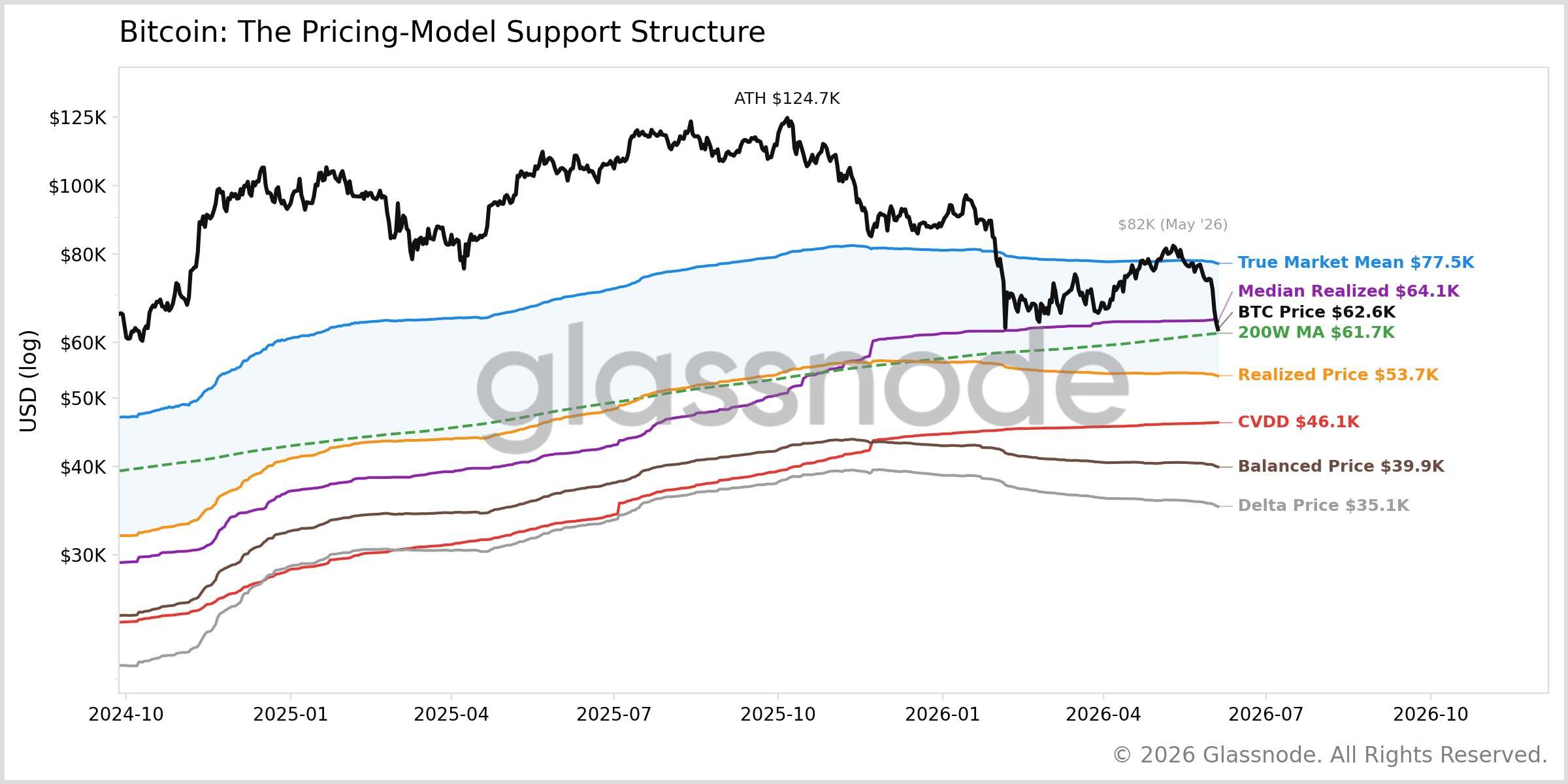
Rafael, co-founder of Glassnode, stated that Bitcoin has retraced roughly 50% from its all-time high. On-chain data shows BTC is currently trading near a significant support zone formed by the Realized Price Median ($64.1k) and the 200-week moving average ($61.7k). Historically, Bitcoin has traded below this level for only about 7% of the time.


Looking at long-term valuation models, below the 200-week moving average lie the Realized Price (~$54k), CVDD (~$46.2k), Balanced Price (~$40k), and Delta Price (~$35k) in descending order. Previous bear market bottoms have all touched this cost range before reversing, with CVDD considered the historically most accurate bottom anchor point. Based on current model projections, the $46k to $54k range constitutes a higher-probability bottom area, while the $35k to $40k range belongs to a deep capitulation zone under extreme panic scenarios, historically representing less than 3% of trading days.


However, as the Bitcoin market matures, the magnitude of cyclical drawdowns shows a narrowing trend. Previous bear market maximum drawdowns were 85%, 84%, and 77%, respectively, while this cycle has only seen a decline of about 50% from the all-time high so far. This suggests the potential for further downside exists, but a more probable bottom may lie in the $46k to $54k range. In the event of a subsequent rebound, the $75k to $79k zone will become the first significant recovery region, with greater resistance near the 50-week moving average at approximately $93k and the previous all-time high.


NYDIG Global Head of Research: AI Siphoning Significant Crypto Capital


Greg Cipolaro, Global Head of Research at NYDIG, stated in a research report that he believes the overlap between AI and crypto investors is far greater than many realize. Both attract investors seeking exposure to emerging technologies and excess returns. As AI-related stocks continue to outperform the broader market, capital flows follow, rotating out of the crypto market. Investors are also preparing for what could be the largest tech IPO cycle in years. Quantum computing, Strategy selling BTC have also intensified market concerns.


Greg Cipolaro noted in his report that several metrics are approaching levels historically coincident with major bottoms. Bitcoin's MVRV ratio has dropped to 1.2, and the percentage of supply in profit recently fell below 50%, another metric often associated with capitulation. However, the magnitude of this retracement remains relatively mild by historical standards. He pointed out that Bitcoin is down about 53% from its peak ($126k in October), significantly shallower than the 75%-90% drawdowns of past cycles. Whether the low is already in likely depends on whether institutional demand has structurally altered the cycle or merely delayed a deeper realignment.


Standard Chartered Bank's Head of Digital Assets Research: Bitcoin Bottom Is Almost Formed


Geoffrey Kendrick, Head of Digital Assets Research at Standard Chartered Bank, stated that the Bitcoin bottom is "almost certainly in," and the current price range could be the long-awaited buying opportunity for investors. An important catalyst for this decline was Strategy's sale of 32 BTC, but referencing historical experience from late 2022, Strategy is likely to soon engage in much larger-scale repurchases, potentially 10 or even 100 times the amount previously sold. If such buy-side pressure is confirmed, it could be a significant signal of a market bottom.


Strive CEO: Bitcoin Touches 200-week Moving Average (Fifth Time in History), Previous Four Times Were Perfect Buying Opportunities


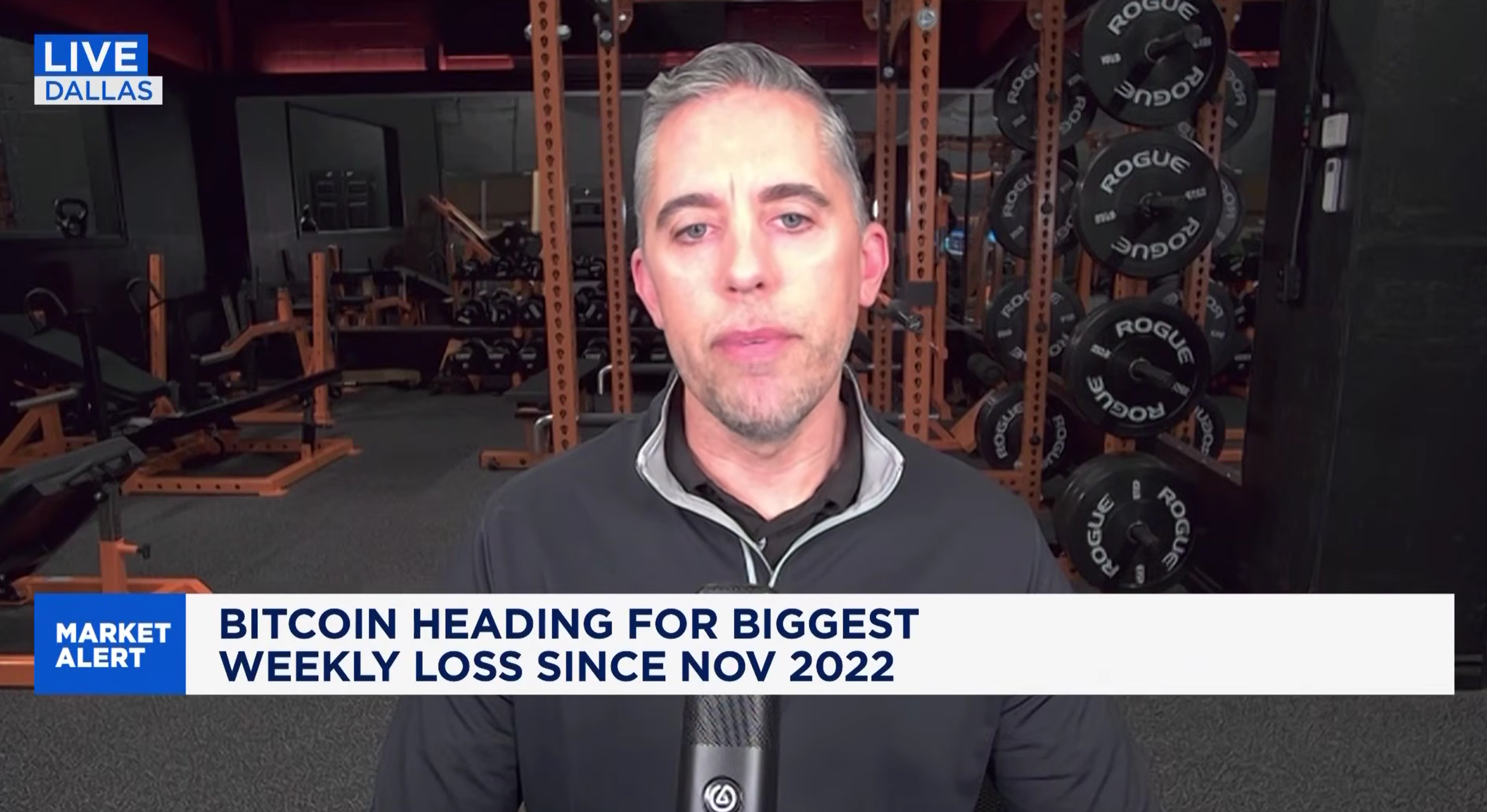
Matt Cole, CEO of asset management firm Strive, told CNBC's Squawk Box Europe that Bitcoin has touched the 200-week moving average (the fifth time in history), with the previous four times being "perfect buying opportunities." He also emphasized that Bitcoin fundamentals have "never been better" and views this touch of the 200-week MA as a historic buying opportunity.


Trader Eugene: Temporarily Left Crypto for U.S. Stocks, Won't Attempt to Catch Bitcoin's Falling Knife


Trader Eugene Ng Ah Sio posted on his personal channel that he has largely exited the cryptocurrency market since May 13 this year, shifting his main focus to stock market research. He believes that compared to the current crypto market, the stock market offers greater depth of research, cognitive challenge, and trading and investment opportunities. Based on his assessment of the industry's current state, he expects to maintain this strategy for the foreseeable future, only continuing to monitor crypto industry developments without active trading participation.


Eugene further stated that unless the market presents a highly attractive risk-reward opportunity, he has no plans to return to the crypto market for now, and such conditions have not yet emerged. He believes the trajectory of the crypto market is diminishing its appeal as a trading and investment arena, thus he will continue to focus on traditional stock markets in the near term. Discussing Strategy, Eugene believes the associated risks are just beginning to surface. He noted that even if Strategy sold more Bitcoin recently, it merely postpones the problem rather than solving it. Until the high correlation between Strategy and Bitcoin is broken, he is not bullish on long opportunities for Bitcoin. Regarding the market bottom, he admitted he cannot predict it but stated he has stopped attempting "catching a falling knife" trades.


Trader Killa: This Is a Generational Buying Opportunity


Trader Killa tweeted during Bitcoin's decline on June 6 that this is a generational buying opportunity. On June 8, he stated that BTC has entered the "final phase" and "final extension," and he has deployed 90% of his capital. Additionally, Killa mentioned that the "protective buy walls" that appeared during last weekend's crash have not been withdrawn, and he believes the likelihood of quickly hitting those support levels in the short term is low. Killa is a quantitative trader focused on BTC, having previously predicted the peak of this bull cycle in May 2025.


Analyst Darkfost: Bitcoin Has Entered Extremely Undervalued Territory


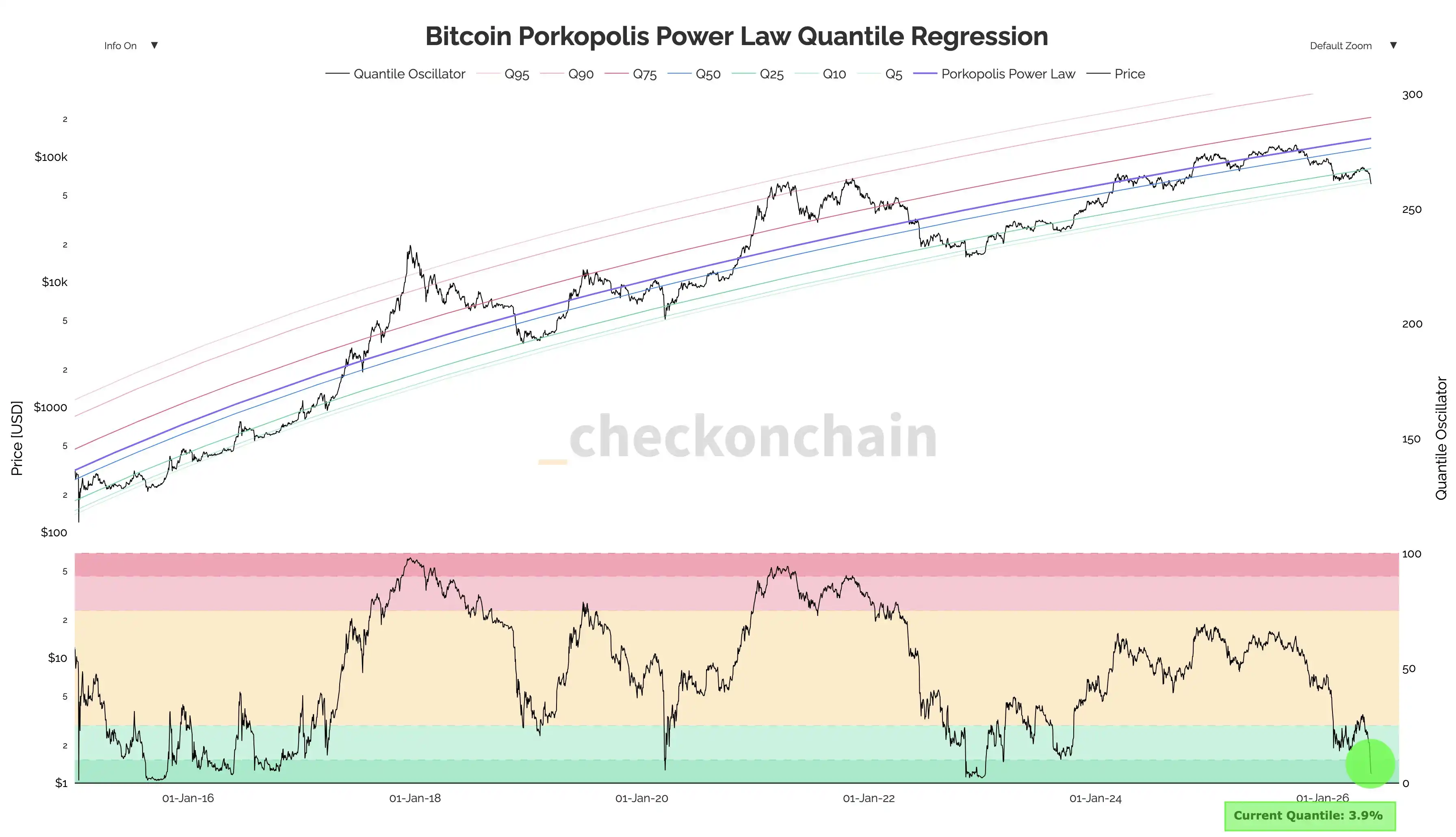
According to analyst Darkfost's data, Bitcoin has retested and broken below the 4th percentile line of the Power Law model, entering an extreme undervaluation zone. Historically, it has spent only 4% of the time at such valuation levels. Darkfost emphasized that this is a suitable period for long-term accumulation, not a short-term price prediction.


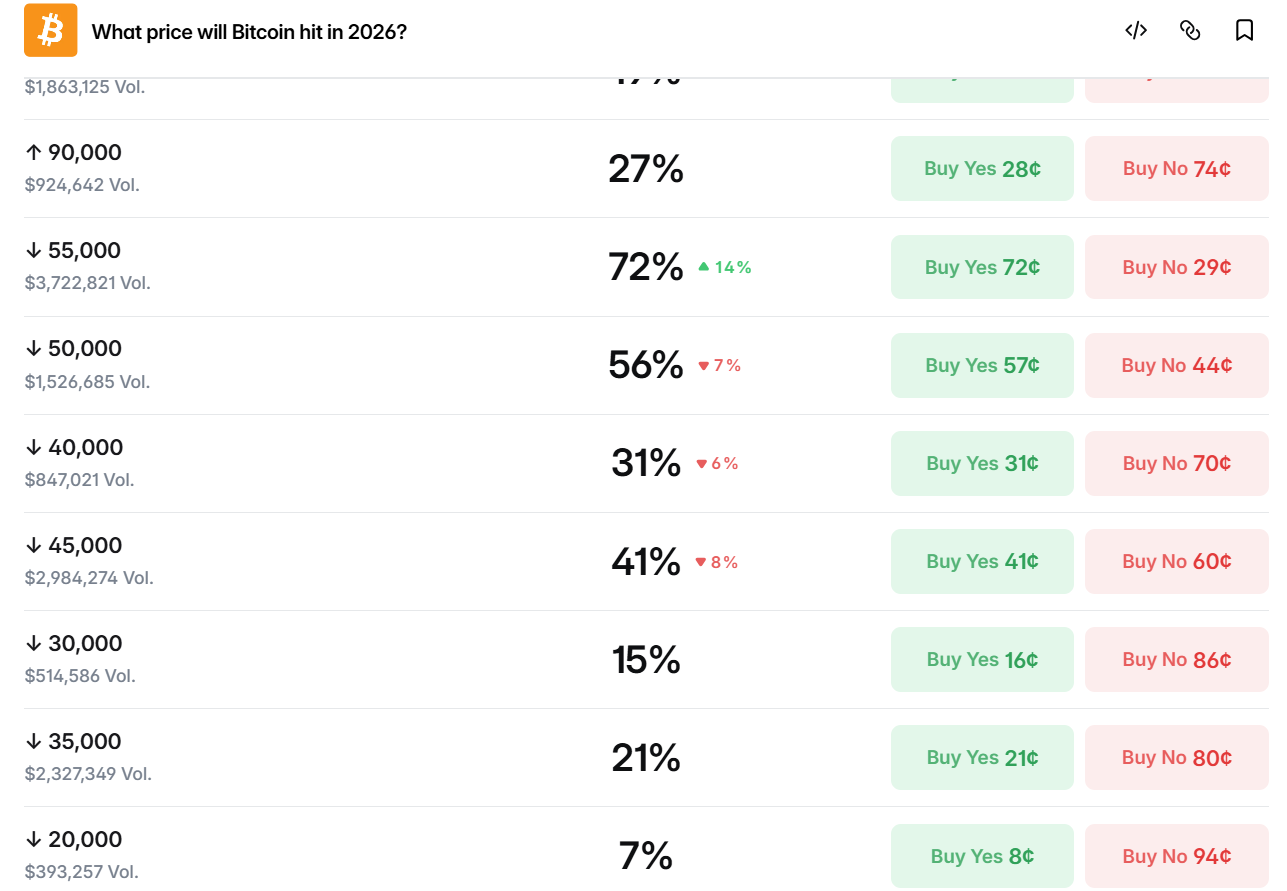
Polymarket Data: 72% Chance BTC Falls Below $55k


Latest data on Polymarket shows the probability of BTC falling below $45k is 41%, below $50k is 56%, and below $55k is 72%. The probability of falling below $40k is 31%, and below $35k is only 21%.


Most market participants currently believe the probability of BTC falling to the $35k – $40k range is not high.


Связанные с этим вопросы

QAccording to the article, what is Rafael from Glassnode's forecast for the potential bottom range of Bitcoin, and why?

ARafael forecasts a higher probability bottom range of $46,000 to $54,000 for Bitcoin. He bases this on long-term valuation models like the Realized Price (around $54,000) and the CVDD (around $46,200), which have historically been accurate bottom anchors. An extreme panic scenario could see a deeper correction to the $35,000-$40,000 range.

QWhat key factor does NYDIG's Greg Cipolaro identify as drawing capital away from the crypto market and contributing to the downturn?

AGreg Cipolaro identifies the outperformance of AI-related stocks as a key factor. He states that both AI and crypto attract investors seeking exposure to emerging tech and alpha. As AI stocks continue to outperform, capital is rotating out of the crypto market into this sector.

QWhat event does Geoffrey Kendrick from Standard Chartered cite as a major trigger for the recent Bitcoin sell-off, and what potential positive signal does he see?

AGeoffrey Kendrick cites the sale of 32,000 BTC by Mt. Gox (referred to as 'Strategy' in the article) as a major trigger for the sell-off. He sees a potential positive signal if Mt. Gox trustees initiate large-scale buybacks, which could indicate the market bottom is forming.

QHow does the trader Eugene Ng Ah Sio's current view and strategy regarding the crypto market differ from the 'buy the dip' sentiment?

ATrader Eugene Ng Ah Sio has largely exited the crypto market since mid-May, shifting his focus to the stock market. He finds more research depth and opportunity there. He does not plan to re-enter crypto unless a highly attractive risk-reward opportunity appears, which he hasn't seen, and is no longer attempting to catch a falling knife (buy the dip).

QWhat does the Polymarket prediction data, as mentioned in the article, suggest about market expectations for Bitcoin's price floor?

APolymarket data suggests most market participants do not expect a catastrophic crash to the lowest historical levels. It shows a 72% probability of BTC falling below $55,000, but only a 21% probability of it falling below $35,000. This indicates the market consensus sees a higher probability floor above the $35,000-$40,000 extreme panic zone.

Похожее

Trump in Talks with AI Companies Over Profit Sharing, A Narrative Pressure of Industrial Revolution Scale Begins

In recent AI market discussions, a new dimension beyond growth and profits has emerged: the question of how the immense wealth potentially generated by AI should be shared with the wider public. Triggered by reports of White House officials discussing "voluntary equity transfers" with top AI firms, similar to models like Alaska's Permanent Fund, the conversation focuses on public wealth funds. OpenAI's own whitepaper proposes such funds, allowing households without direct tech stock ownership to benefit from AI gains. More radical proposals, like Bernie Sanders' call for high public equity stakes and board seats, represent an extreme end of the spectrum. Currently, these are early-stage policy probes, not enacted laws. OpenAI's initiative is seen as an attempt to secure "social license" for its future expansion, mitigating risks of public backlash, stricter regulation, or anti-trust actions as AI's economic impact grows. The core market implication is the introduction of a "policy discount" to AI valuations, particularly for private model companies like OpenAI, Anthropic, and xAI. Investors must now consider not just future earnings but also what portion might be allocated to public mechanisms. The impact varies greatly based on the mechanism. A small, voluntary transfer of non-voting economic rights (e.g., 5%) acts as a quantifiable long-term cost. Government acquisition of economic rights via warrants tied to support differs from direct equity with governance power. The most disruptive scenario would be forced high-percentage public ownership affecting control and innovation incentives. Key signals to watch include whether other AI companies follow suit, if the White House formalizes proposals, related disclosures in future IPO documents, and any market price reactions. For now, this represents a shift from pricing pure AI growth to pricing its potential distribution. A manageable, voluntary economic share is akin to an insurance cost for societal acceptance, while a forced shift toward control and governance would fundamentally alter valuation logic.

marsbit4 мин. назад

Trump in Talks with AI Companies Over Profit Sharing, A Narrative Pressure of Industrial Revolution Scale Begins

marsbit4 мин. назад

From Record Highs to a Two-Week Low: Why Did AI Concept Stocks Suddenly Pull Back?

From Record Highs to Two-Week Lows: Why Did AI Stocks Suddenly Pull Back? U.S. stock indices, led by the tech-heavy Nasdaq 100, fell sharply to two-week lows. This marked a reversal from earlier in the week when AI infrastructure and semiconductor stocks had propelled major indices to record highs. Investors are rotating out of these previously high-flying tech sectors into other areas. The sell-off was driven by profit-taking and concerns that the AI rally had become overextended, exacerbated by chipmaker Broadcom's sales outlook falling short of lofty market expectations. The decline accelerated following a stronger-than-expected U.S. May nonfarm payrolls report, which showed 172,000 jobs added versus an estimated 88,000. This data sparked a jump in bond yields, with the 10-year Treasury yield rising to 4.553%, as it reinforced market speculation that the Federal Reserve's next move could be a rate hike rather than a cut. Globally, equities also declined, with European and Asian markets falling. Within the U.S. market, chip and AI-related stocks like Super Micro Computer and Arm Holdings led the losses, dropping over 7%. Cryptocurrency-linked stocks and mining shares also fell sharply amid drops in Bitcoin and commodity prices. While the overall Q1 earnings season remained solid, with 83% of S&P 500 companies beating estimates, the weakness was concentrated in tech. Excluding the tech sector, Q1 earnings growth was around 3%, the weakest in two years.

marsbit5 мин. назад

From Record Highs to a Two-Week Low: Why Did AI Concept Stocks Suddenly Pull Back?

marsbit5 мин. назад

JP Morgan Mid-Year Research Report Analysis: The AI Supercycle is Not Over, Reduce Cash Holdings + Allocate to Real Assets

JP Morgan's 2026 Mid-Year Outlook argues the AI supercycle is far from over, despite market pessimism. The report advises clients to reduce cash holdings, increase allocations to real assets as an inflation hedge, and focus on emerging markets. Key conclusions include: 1. **AI Supercycle Intact**: Hyperscalers' 2026 capex forecasts exceed $650B, with AI contributing to GDP growth. However, their financial profile is shifting toward heavy investment, compressing free cash flow. 2. **SaaS Disruption**: Traditional software companies are being negatively impacted by AI, with significant stock declines and pressure in credit markets. 3. **Persistent Inflation**: Core inflation is structurally higher post-pandemic. Holding excess cash and bonds leads to real wealth erosion. Recommendations include commodities, infrastructure, real estate, and gold. 4. **Geopolitical Shocks & Opportunities**: The Hormuz Strait blockade caused a major oil shock, but JP Morgan views the subsequent equity market pullback as a buying opportunity. "Fragmentation" is creating pockets of value, notably in resource-rich Latin America, AI-supply-chain-linked East Asia, and deeply discounted Chinese equities, where a policy shift could trigger a re-rating. 5. **Regional Views**: The firm is cautious on Europe due to high energy costs and lower innovation investment, preferring US and select EM exposures. In short, JP Morgan sees market volatility as an entry point but recommends a portfolio pivot: favor AI infrastructure, real assets, and EM, while avoiding excess cash, vulnerable software firms, and traditional 60/40 stock-bond allocations.

marsbit30 мин. назад

JP Morgan Mid-Year Research Report Analysis: The AI Supercycle is Not Over, Reduce Cash Holdings + Allocate to Real Assets

marsbit30 мин. назад

Торговля

Спот
Фьючерсы

Популярные статьи

Тест по Bitcoin Биткоина

HTX Learn: Изучите Bitcoin halving и Заработаете Токены USDT

3.1k просмотров всегоОпубликовано 2024.04.16Обновлено 2024.04.16

Тест по Bitcoin  Биткоина

Что такое $BITCOIN

ЦИФРОВОЕ ЗОЛОТО ($BITCOIN): Комплексный анализ Введение в ЦИФРОВОЕ ЗОЛОТО ($BITCOIN) ЦИФРОВОЕ ЗОЛОТО ($BITCOIN) — это проект на основе блокчейна, работающий в сети Solana, который стремится объединить характеристики традиционных драгоценных металлов с инновациями децентрализованных технологий. Хотя он носит имя Биткойн, часто называемого “цифровым золотом” из-за его восприятия как средства хранения ценности, ЦИФРОВОЕ ЗОЛОТО является отдельным токеном, предназначенным для создания уникальной экосистемы в ландшафте Web3. Его цель — позиционировать себя как жизнеспособный альтернативный цифровой актив, хотя детали его применения и функциональности все еще развиваются. Что такое ЦИФРОВОЕ ЗОЛОТО ($BITCOIN)? ЦИФРОВОЕ ЗОЛОТО ($BITCOIN) — это токен криптовалюты, специально разработанный для использования в блокчейне Solana. В отличие от Биткойна, который выполняет широко признанную роль хранения ценности, этот токен, похоже, сосредоточен на более широких приложениях и характеристиках. Примечательные аспекты включают: Инфраструктура блокчейна: Токен построен на блокчейне Solana, известном своей способностью обрабатывать высокоскоростные и недорогие транзакции. Динамика предложения: ЦИФРОВОЕ ЗОЛОТО имеет максимальное предложение, ограниченное 100 квадриллионами токенов (100P $BITCOIN), хотя детали о его обращающемся предложении в настоящее время не раскрыты. Утилита: Хотя точные функциональные возможности не описаны, есть указания на то, что токен может быть использован для различных приложений, потенциально связанных с децентрализованными приложениями (dApps) или стратегиями токенизации активов. Кто создатель ЦИФРОВОГО ЗОЛОТА ($BITCOIN)? На данный момент личность создателей и команды разработчиков, стоящих за ЦИФРОВЫМ ЗОЛОТОМ ($BITCOIN), остается неизвестной. Эта ситуация типична для многих инновационных проектов в области блокчейна, особенно тех, которые связаны с децентрализованными финансами и феноменом мем-криптовалют. Хотя такая анонимность может способствовать культуре, ориентированной на сообщество, она усиливает опасения по поводу управления и ответственности. Кто инвесторы ЦИФРОВОГО ЗОЛОТА ($BITCOIN)? Доступная информация указывает на то, что у ЦИФРОВОГО ЗОЛОТА ($BITCOIN) нет известных институциональных спонсоров или значительных венчурных капиталовложений. Проект, похоже, функционирует по модели пирингового взаимодействия, сосредоточенной на поддержке и принятии сообществом, а не на традиционных путях финансирования. Его активность и ликвидность в основном сосредоточены на децентрализованных биржах (DEX), таких как PumpSwap, а не на устоявшихся централизованных торговых платформах, что еще больше подчеркивает его подход, ориентированный на grassroots. Как работает ЦИФРОВОЕ ЗОЛОТО ($BITCOIN) Операционные механизмы ЦИФРОВОГО ЗОЛОТА ($BITCOIN) можно подробно описать на основе его дизайна блокчейна и характеристик сети: Механизм консенсуса: Используя уникальный механизм доказательства истории (PoH) Solana в сочетании с моделью доказательства доли (PoS), проект обеспечивает эффективную валидацию транзакций, что способствует высокой производительности сети. Токеномика: Хотя конкретные дефляционные механизмы не были подробно описаны, большое максимальное предложение токенов подразумевает, что оно может быть предназначено для микротранзакций или нишевых случаев использования, которые еще предстоит определить. Интероперабельность: Существует потенциал для интеграции с более широкой экосистемой Solana, включая различные платформы децентрализованных финансов (DeFi). Однако детали относительно конкретных интеграций остаются неуточненными. Хронология ключевых событий Вот хронология, которая подчеркивает значимые вехи, касающиеся ЦИФРОВОГО ЗОЛОТА ($BITCOIN): 2023: Первоначальное развертывание токена происходит в блокчейне Solana, отмеченное его адресом контракта. 2024: ЦИФРОВОЕ ЗОЛОТО приобретает видимость, когда оно становится доступным для торговли на децентрализованных биржах, таких как PumpSwap, позволяя пользователям обменивать его на SOL. 2025: Проект наблюдает спорадическую торговую активность и потенциальный интерес к инициативам, возглавляемым сообществом, хотя на данный момент не зафиксировано никаких значительных партнерств или технических достижений. Критический анализ Сильные стороны Масштабируемость: Основная инфраструктура Solana поддерживает высокие объемы транзакций, что может повысить полезность $BITCOIN в различных сценариях транзакций. Доступность: Потенциально низкая цена торговли за токен может привлечь розничных инвесторов, способствуя более широкому участию благодаря возможностям дробного владения. Риски Отсутствие прозрачности: Отсутствие публично известных спонсоров, разработчиков или процесса аудита может вызвать скептицизм относительно устойчивости и надежности проекта. Волатильность рынка: Торговая активность сильно зависит от спекулятивного поведения, что может привести к значительной волатильности цен и неопределенности для инвесторов. Заключение ЦИФРОВОЕ ЗОЛОТО ($BITCOIN) является интригующим, но неоднозначным проектом в быстро развивающейся экосистеме Solana. Хотя он пытается использовать нарратив “цифрового золота”, его отход от установленной роли Биткойна как средства хранения ценности подчеркивает необходимость более четкого различения его предполагаемой утилиты и структуры управления. Будущее принятие и усвоение, вероятно, будут зависеть от решения текущей непрозрачности и более четкого определения его операционных и экономических стратегий. Примечание: Этот отчет охватывает синтезированную информацию, доступную на октябрь 2023 года, и с тех пор могут произойти события.

99 просмотров всегоОпубликовано 2025.05.13Обновлено 2025.05.13

Что такое $BITCOIN

Fractal Bitcoin: масштабирование Биткоина с помощью рекурсивной системы

Fractal Bitcoin — масштабное Layer-1-решнение, созданное на базе кода Биткоина, позволяющего достигать бесконечного масштабирования с помощью рекурсивного подхода.

2.3k просмотров всегоОпубликовано 2025.06.30Обновлено 2025.06.30

Fractal Bitcoin: масштабирование Биткоина с помощью рекурсивной системы

Обсуждения

Добро пожаловать в Сообщество HTX. Здесь вы сможете быть в курсе последних новостей о развитии платформы и получить доступ к профессиональной аналитической информации о рынке. Мнения пользователей о цене на BTC (BTC) представлены ниже.

活动图片