Single-Day Plunge of Nearly 20%: How Long Has It Been Since You Last Saw Bitcoin at $60,000?

marsbitОпубликовано 2026-02-06Обновлено 2026-02-06

Введение

Cryptocurrency markets experienced their most severe sell-off of the year, with Bitcoin plunging nearly 20% in 24 hours to briefly touch $60,000, its lowest level in months. Ethereum fell below $2,000, dropping to as low as $1,744, while Solana and other major altcoins also saw declines exceeding 12–19%. The total market liquidation surpassed $2.66 billion, with long positions accounting for 87% of the forced closures. The sharp decline was driven by multiple factors, including concerns over potential hawkish monetary policy from the new Fed chair nominee, a strong rebound in the U.S. dollar index, and sustained outflows from institutional Bitcoin and Ethereum ETFs. Market sentiment remains fragile, with high sensitivity to macroeconomic and geopolitical news. Analysts expect continued volatility rather than a quick V-shaped recovery, citing structural weakness in altcoins, reduced retail speculation, and heightened risk aversion. Investors are advised to practice strict risk management, avoid over-leveraging, and focus on high-quality projects with strong fundamentals while maintaining a long-term perspective.

Author|jk

In the past 24 hours, the cryptocurrency market has experienced its most severe sell-off of the year, with major coins collectively plummeting over 15%, and panic continues to spread.

OKX market data shows that the BTC price fell to a low of $60,000, with a maximum 24-hour drop of 18%, currently reported at $63,150; Ethereum broke below $2,000, falling to a low of $1,744, currently reported at $1,860, with a 24-hour decline of 13.7%; Solana broke below $70, falling to a low of $67, with a 24-hour drop of 19%. All major cryptocurrencies fell by more than 12%.

Major Assets Suffer Heavy Losses

According to the latest data from CoinGecko, as of press time, Bitcoin is reported at $63,576, plummeting 13.3% in 24 hours. At this time yesterday, Bitcoin was still at $73,311. Bitcoin's market capitalization evaporated by over $160 billion, with 24-hour trading volume surging to $142.4 billion, indicating intensified panic selling in the market.

Ethereum was hit even harder, falling to $1,848, with a 24-hour decline of 14.3%. This is the first time since April 2025 that Ethereum has broken below the psychological barrier of $1,900. Ethereum's market capitalization shrank to $224 billion, with a 24-hour trading volume of $61.5 billion.

Other major cryptocurrencies were not spared either. BNB fell to $611, down 12.4%, with its market capitalization shrinking to $83.3 billion. Solana plunged 14.0% to $79, with its market capitalization falling below $45 billion. Altcoins like XRP and Cardano generally fell by more than 15%.

Record-Breaking Market Liquidation Scale

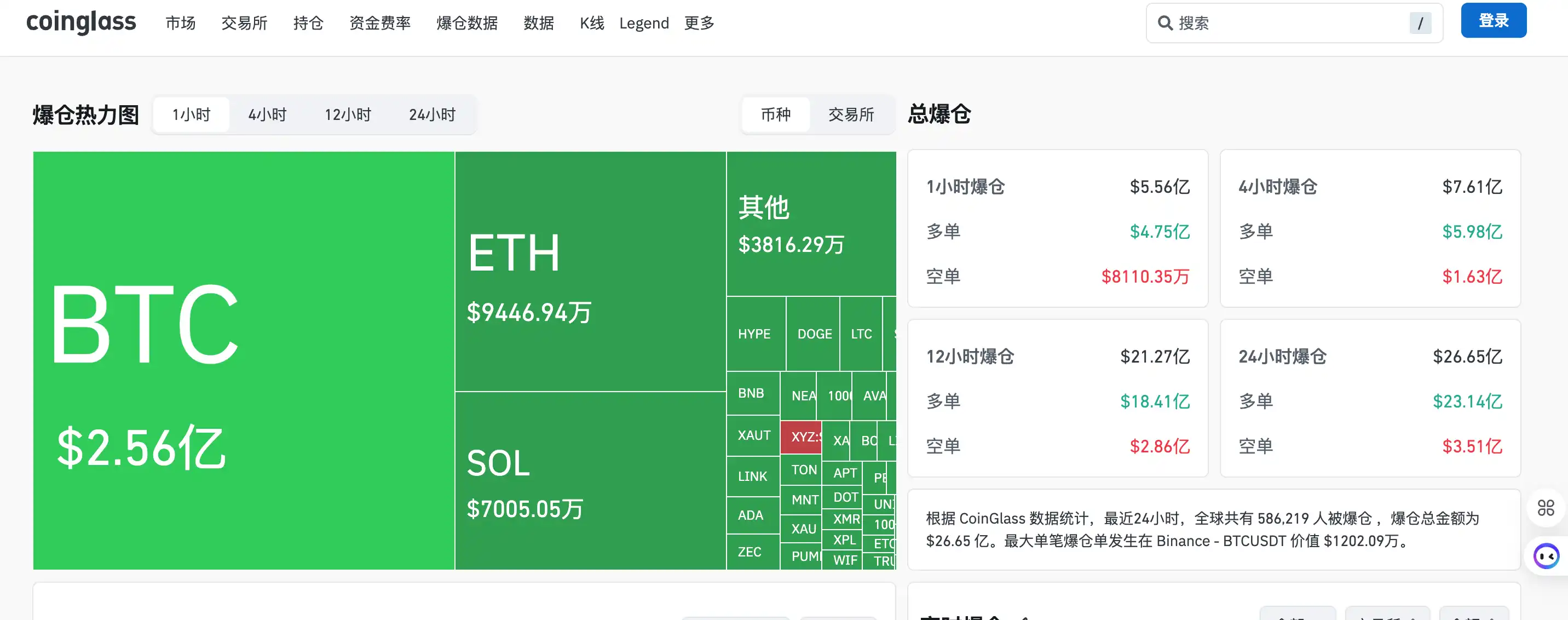
This round of sharp declines triggered massive forced liquidations. According to Coinglass data, over the past 24 hours, the total liquidation amount across the market exceeded $2.66 billion, with long positions accounting for as much as 87% of the liquidations. The single-day liquidation scale ranks 10th in history, second only to the sell-off triggered by the tariff crisis in April 2025.

Over 580,000 traders were liquidated during this crash. The chain reaction of liquidations exacerbated the downward pressure on the market, creating a vicious cycle.

Multiple Factors Combine to Trigger Panic

This crash was not caused by a single factor but rather the resonance of multiple negative factors. During the previous decline, the market was concerned about the hawkish stance of the new Fed Chair nominee, Kevin Warsh. Warsh is perceived as likely to adopt a tougher inflation control policy than Powell, meaning the high-interest-rate environment could persist for a longer time. At the same time, the US Dollar Index saw a strong rebound, which directly pressured dollar-denominated risk assets. Historical data shows a significant negative correlation between Bitcoin's price and the US Dollar Index; a stronger dollar is usually accompanied by selling in crypto assets. Continued outflows of institutional funds further intensified market pressure. According to data from The Block, US Bitcoin spot ETFs recorded a net outflow of $272 million on February 4th, and Ethereum spot ETFs also saw a withdrawal of $252 million on January 30th. The large-scale exit of institutional investors indicates a sharp decline in market risk appetite.

Future Outlook

The market generally expects continued consolidation in the short term, with a V-shaped reversal unlikely. The main reasons include structural weakness in altcoins, risk aversion among retail investors, and high sensitivity to news developments. Many altcoins have fallen more than 20%, showing structural bearishness and facing continued selling pressure from retail investors. Retail investors, having suffered significant losses, are generally risk-averse, leading to decreased speculative demand. Meanwhile, the market is extremely sensitive to geopolitical news such as trade relations and monetary policy changes.

Facing the current market environment, Odaily Planet Daily advises investors to strictly manage risks, avoid excessive leverage, and set reasonable stop-loss levels. Investors should focus on high-quality projects, choosing those with solid fundamentals and real-world application scenarios. Maintaining a long-term perspective is also crucial; historical data shows that the crypto market is cyclical and has recovered after every major crash in the past. Finally, during times of panic, be wary of emotional trading, avoid chasing rallies and selling off in panic, and rationally assess the market situation.

Связанные с этим вопросы

QWhat was the maximum 24-hour drop in Bitcoin's price mentioned in the article?

AThe maximum 24-hour drop in Bitcoin's price was 18%, falling to the $60,000 level.

QWhich major cryptocurrency fell below the $2,000 psychological barrier for the first time since April 2025?

AEthereum fell below the $1,900 psychological barrier, hitting a low of $1,744, for the first time since April 2025.

QWhat was the total amount liquidated across the market in the past 24 hours, and what percentage were long positions?

AThe total amount liquidated was over $2.66 billion, with long positions accounting for 87% of the liquidations.

QAccording to the article, what are two key factors that contributed to the market panic and sell-off?

ATwo key factors were concerns over the hawkish stance of the new Fed chair nominee, Kevin Warsh, and a strong rebound in the US Dollar Index (DXY), which negatively impacts dollar-denominated risk assets like crypto.

QWhat advice does the article give to investors in the current market environment?

AThe advice includes practicing strict risk management, avoiding excessive leverage, setting reasonable stop-losses, focusing on high-quality projects with solid fundamentals, maintaining a long-term perspective, and avoiding emotional trading.

Похожее

Stuck Polymarket: The Real Test After Riding the Traffic Boom Has Arrived

Polymarket, a leading prediction market platform, is facing significant technical challenges as its growth outpaces its current infrastructure on Polygon. Users are experiencing laggy transactions, unresponsive orders, and delayed confirmations, severely impacting the trading experience. In response, DeFi Engineering VP Josh Stevens outlined a comprehensive engineering overhaul. The plan includes reducing on-chain data delays, fixing order cancellation issues, rebuilding the central limit order book (CLOB), improving website performance, and developing a unified SDK and API. A major revelation was the ongoing "chain migration," indicating a potential move away from Polygon. The core issue is that Polymarket has evolved from a simple prediction market into a high-frequency trading platform, making Polygon's limitations—such as block space, gas fees, and block time—a ceiling for further growth. The migration is not just a simple chain switch but a fundamental rebuild of its trading system to support more complex products like perpetual contracts (Perps). This announcement has sparked competition among chains like Solana, Sui, and Algorand, all vying to host Polymarket. For Polygon, losing this key application, which contributes significantly to its gas fee revenue, would be a major setback. The real test for Polymarket is no longer attracting users but proving it can provide a stable, reliable trading environment that retains them.

Odaily星球日报13 мин. назад

Stuck Polymarket: The Real Test After Riding the Traffic Boom Has Arrived

Odaily星球日报13 мин. назад

Lowering Expectations for BTC's Next Bull Market

The author, Alex Xu, explains his decision to significantly reduce his Bitcoin holdings (from full to ~30% of his portfolio) during the current bull cycle, citing a lowered long-term outlook for BTC's price appreciation in the next cycle. He outlines six key reasons for this reduced expectation: 1. **Diminished Growth Drivers:** The narrative of exponential user adoption has largely played out with institutional ETF adoption. The next major growth phase—adoption by sovereign national reserves or central banks—seems unlikely in the near future. 2. **Personal Opportunity Cost:** More attractive investment opportunities have emerged in other assets, such as undervalued companies. 3. **Industry-Wide Contraction:** The broader crypto industry is struggling, with most Web3 business models (SocialFi, GameFi, DePIN) failing. This overall萧条 (depression) reduces the fundamental demand and consensus for Bitcoin. 4. **Strain on Major Buyer:** MicroStrategy, a major corporate buyer of BTC, faces rising financing expenses for its debt, which could slow its purchasing rate and create significant marginal pressure on the market. 5. **Increased Competition from Gold:** The emergence of "tokenized gold" has closed the functional gap (portability, divisibility) between physical gold and Bitcoin, offering a strong competitor in the non-sovereign store-of-value space. 6. **Security Budget Concerns:** The block reward halving continues to exacerbate the long-standing issue of funding Bitcoin's network security, with new fee source explorations like Ordinals and L2s largely failing. The author's decision to hold a significant (though reduced) position reflects a cautious, not bearish, outlook. He remains open to increasing his exposure if the fundamental reasons for his skepticism change or if new positive catalysts emerge.

marsbit52 мин. назад

Lowering Expectations for BTC's Next Bull Market

marsbit52 мин. назад

Can Iran 'Control' the Strait of Hormuz?

Iran has announced a comprehensive plan to assert control over the strategic Strait of Hormuz, a critical global oil shipping chokepoint. The proposed measures include requiring all vessels to obtain Iranian permission for passage, imposing fees for security, environmental protection, and navigation management—preferably paid in Iranian rials—and absolutely banning Israeli ships. Vessels from countries deemed hostile by Iran’s top security bodies may also be barred. Analysts suggest Iran’s motives are multifaceted: increasing pressure on the U.S. and Israel by leveraging control over oil transit to influence global prices and inflation; creating a new revenue stream, potentially exceeding $7.7 billion annually, to counter Western sanctions and support postwar reconstruction; and using transit permissions as bargaining chips in future negotiations, notably with the U.S. However, the plan faces significant practical and diplomatic challenges. Enforcing comprehensive interception and fee collection in the busy waterway, patrolled by international military forces, would be difficult. The U.S. has already countering with a blockade of Iranian ports and threats to intercept any ship paying fees, potentially strangling Iran’s oil exports and fee revenue. Broad international opposition, led by European and Gulf states, and legal controversies further complicate implementation. The proposal may ultimately serve more as a negotiating tactic than a feasible policy, with its execution remaining highly uncertain.

marsbit2 ч. назад

Can Iran 'Control' the Strait of Hormuz?

marsbit2 ч. назад

Торговля

Спот
Фьючерсы

Популярные статьи

Тест по Bitcoin Биткоина

HTX Learn: Изучите Bitcoin halving и Заработаете Токены USDT

3.0k просмотров всегоОпубликовано 2024.04.16Обновлено 2024.04.16

Тест по Bitcoin  Биткоина

Что такое $BITCOIN

ЦИФРОВОЕ ЗОЛОТО ($BITCOIN): Комплексный анализ Введение в ЦИФРОВОЕ ЗОЛОТО ($BITCOIN) ЦИФРОВОЕ ЗОЛОТО ($BITCOIN) — это проект на основе блокчейна, работающий в сети Solana, который стремится объединить характеристики традиционных драгоценных металлов с инновациями децентрализованных технологий. Хотя он носит имя Биткойн, часто называемого “цифровым золотом” из-за его восприятия как средства хранения ценности, ЦИФРОВОЕ ЗОЛОТО является отдельным токеном, предназначенным для создания уникальной экосистемы в ландшафте Web3. Его цель — позиционировать себя как жизнеспособный альтернативный цифровой актив, хотя детали его применения и функциональности все еще развиваются. Что такое ЦИФРОВОЕ ЗОЛОТО ($BITCOIN)? ЦИФРОВОЕ ЗОЛОТО ($BITCOIN) — это токен криптовалюты, специально разработанный для использования в блокчейне Solana. В отличие от Биткойна, который выполняет широко признанную роль хранения ценности, этот токен, похоже, сосредоточен на более широких приложениях и характеристиках. Примечательные аспекты включают: Инфраструктура блокчейна: Токен построен на блокчейне Solana, известном своей способностью обрабатывать высокоскоростные и недорогие транзакции. Динамика предложения: ЦИФРОВОЕ ЗОЛОТО имеет максимальное предложение, ограниченное 100 квадриллионами токенов (100P $BITCOIN), хотя детали о его обращающемся предложении в настоящее время не раскрыты. Утилита: Хотя точные функциональные возможности не описаны, есть указания на то, что токен может быть использован для различных приложений, потенциально связанных с децентрализованными приложениями (dApps) или стратегиями токенизации активов. Кто создатель ЦИФРОВОГО ЗОЛОТА ($BITCOIN)? На данный момент личность создателей и команды разработчиков, стоящих за ЦИФРОВЫМ ЗОЛОТОМ ($BITCOIN), остается неизвестной. Эта ситуация типична для многих инновационных проектов в области блокчейна, особенно тех, которые связаны с децентрализованными финансами и феноменом мем-криптовалют. Хотя такая анонимность может способствовать культуре, ориентированной на сообщество, она усиливает опасения по поводу управления и ответственности. Кто инвесторы ЦИФРОВОГО ЗОЛОТА ($BITCOIN)? Доступная информация указывает на то, что у ЦИФРОВОГО ЗОЛОТА ($BITCOIN) нет известных институциональных спонсоров или значительных венчурных капиталовложений. Проект, похоже, функционирует по модели пирингового взаимодействия, сосредоточенной на поддержке и принятии сообществом, а не на традиционных путях финансирования. Его активность и ликвидность в основном сосредоточены на децентрализованных биржах (DEX), таких как PumpSwap, а не на устоявшихся централизованных торговых платформах, что еще больше подчеркивает его подход, ориентированный на grassroots. Как работает ЦИФРОВОЕ ЗОЛОТО ($BITCOIN) Операционные механизмы ЦИФРОВОГО ЗОЛОТА ($BITCOIN) можно подробно описать на основе его дизайна блокчейна и характеристик сети: Механизм консенсуса: Используя уникальный механизм доказательства истории (PoH) Solana в сочетании с моделью доказательства доли (PoS), проект обеспечивает эффективную валидацию транзакций, что способствует высокой производительности сети. Токеномика: Хотя конкретные дефляционные механизмы не были подробно описаны, большое максимальное предложение токенов подразумевает, что оно может быть предназначено для микротранзакций или нишевых случаев использования, которые еще предстоит определить. Интероперабельность: Существует потенциал для интеграции с более широкой экосистемой Solana, включая различные платформы децентрализованных финансов (DeFi). Однако детали относительно конкретных интеграций остаются неуточненными. Хронология ключевых событий Вот хронология, которая подчеркивает значимые вехи, касающиеся ЦИФРОВОГО ЗОЛОТА ($BITCOIN): 2023: Первоначальное развертывание токена происходит в блокчейне Solana, отмеченное его адресом контракта. 2024: ЦИФРОВОЕ ЗОЛОТО приобретает видимость, когда оно становится доступным для торговли на децентрализованных биржах, таких как PumpSwap, позволяя пользователям обменивать его на SOL. 2025: Проект наблюдает спорадическую торговую активность и потенциальный интерес к инициативам, возглавляемым сообществом, хотя на данный момент не зафиксировано никаких значительных партнерств или технических достижений. Критический анализ Сильные стороны Масштабируемость: Основная инфраструктура Solana поддерживает высокие объемы транзакций, что может повысить полезность $BITCOIN в различных сценариях транзакций. Доступность: Потенциально низкая цена торговли за токен может привлечь розничных инвесторов, способствуя более широкому участию благодаря возможностям дробного владения. Риски Отсутствие прозрачности: Отсутствие публично известных спонсоров, разработчиков или процесса аудита может вызвать скептицизм относительно устойчивости и надежности проекта. Волатильность рынка: Торговая активность сильно зависит от спекулятивного поведения, что может привести к значительной волатильности цен и неопределенности для инвесторов. Заключение ЦИФРОВОЕ ЗОЛОТО ($BITCOIN) является интригующим, но неоднозначным проектом в быстро развивающейся экосистеме Solana. Хотя он пытается использовать нарратив “цифрового золота”, его отход от установленной роли Биткойна как средства хранения ценности подчеркивает необходимость более четкого различения его предполагаемой утилиты и структуры управления. Будущее принятие и усвоение, вероятно, будут зависеть от решения текущей непрозрачности и более четкого определения его операционных и экономических стратегий. Примечание: Этот отчет охватывает синтезированную информацию, доступную на октябрь 2023 года, и с тех пор могут произойти события.

99 просмотров всегоОпубликовано 2025.05.13Обновлено 2025.05.13

Что такое $BITCOIN

Fractal Bitcoin: масштабирование Биткоина с помощью рекурсивной системы

Fractal Bitcoin — масштабное Layer-1-решнение, созданное на базе кода Биткоина, позволяющего достигать бесконечного масштабирования с помощью рекурсивного подхода.

2.2k просмотров всегоОпубликовано 2025.06.30Обновлено 2025.06.30

Fractal Bitcoin: масштабирование Биткоина с помощью рекурсивной системы

Обсуждения

Добро пожаловать в Сообщество HTX. Здесь вы сможете быть в курсе последних новостей о развитии платформы и получить доступ к профессиональной аналитической информации о рынке. Мнения пользователей о цене на BTC (BTC) представлены ниже.

活动图片