Saylor Says Bitcoin Could Win Big If AI Destroys Traditional Moats

bitcoinistОпубликовано 2026-03-18Обновлено 2026-03-18

Введение

Michael Saylor argues that Bitcoin could become a major beneficiary if artificial intelligence undermines long-term corporate moats and compresses traditional equity valuations. This view responds to Chamath Palihapitiya’s thesis that AI could accelerate disruption, making competitive advantages temporary and forcing investors to drastically reprice stocks based on near-term cash flows rather than long-dated growth. Palihapitiya suggested that heightened disruption risk could compress market multiples, potentially leading to a significant devaluation of equity markets. Saylor contends that in such a scenario, capital would shift to assets immune to AI disruption—specifically Bitcoin, which he describes as scarce, neutral, and resilient. The debate later turned to quantum computing risks, with Palihapitiya questioning Bitcoin’s resilience, while Saylor argued that quantum threats would affect the entire digital infrastructure, not just Bitcoin. Other industry figures, including BitGo’s CEO and Helius Labs’ CEO, offered nuanced perspectives on Bitcoin’s comparative vulnerabilities and strengths in a post-quantum world. At the time of writing, Bitcoin was trading at $74,140.

Michael Saylor says Bitcoin could emerge as one of the biggest winners if artificial intelligence compresses corporate “terminal value” and forces markets to stop paying up for long-dated growth. His argument came in response to Chamath Palihapitiya’s latest thought experiment, which framed AI not simply as a productivity engine, but as a force that could undermine the basic assumptions behind modern equity valuation.

Palihapitiya’s core thesis was stark. If AI makes disruption faster, cheaper, and more relentless, investors may no longer be willing to underwrite cash flows far into the future. In that world, equities would stop being valued as long-duration assets and instead trade closer to what they generate right now.

“The entire architecture of modern capital markets rests on a single, rarely examined assumption: that competitive advantages compound over time. Moats persist. Brands endure. Network effects defend,” Palihapitiya wrote. “Strip that assumption away, and you aren’t just repricing some stocks, you would be dismantling the philosophical foundation of how capital has been allocated for a century.”

He then pushed that logic through a valuation framework built around disruption risk. Using a US 10-year yield of roughly 4.5% as a starting point and an equity risk premium of 4% to 5%, Palihapitiya argued that a stable, durable business might justify a 10x to 12x free cash flow multiple. But once AI-driven obsolescence becomes a serious annual risk, those multiples fall fast. At a 20% annual disruption probability, he estimated fair value at about 3.9x FCF. At 30%, it drops to 2.8x. Even 10% only gets to roughly 6.5x.

That matters because, in his telling, markets have done this before. He pointed to newspapers after digital advertising, retailers facing Amazon, oil majors during the energy transition, and even New York taxi medallions after Uber. In each case, the market was not denying the existence of current cash flows. It was repricing how long those cash flows could realistically last.

Palihapitiya extended that argument to the broader market. With the S&P 500 valued at around $58 trillion and corporate free cash flow near $2.8 trillion annually, he argued that repricing the index at 5x FCF would imply a market value of about $14 trillion, or a 75% drawdown. Even a less severe compression would radically change how capital gets allocated.

Bitcoin Could Surge as AI Destroys Traditional Moats

Saylor’s response was brief and reiterated his previous public stance. “If AI compresses terminal value and makes every moat temporary, capital will rotate to assets with no disruption risk,” he wrote. “Bitcoin is Digital Capital – scarce, neutral, and impervious to AI disruption. $BTC should be the primary beneficiary of this shift.”

That exchange quickly turned to a familiar fault line in Bitcoin debates: quantum risk. Palihapitiya answered that Bitcoin “would need to be quantum resistant by then,” prompting Saylor to push back. “Your AI thesis assumes the digital world is quantum-resistant. If quantum breaks cryptography, it breaks AI, cloud infrastructure, banks, and the internet—not just Bitcoin. The entire stack upgrades together.”

Palihapitiya was unconvinced. “No. A store of value has to be 100% hacking resistant. It’s an existential feature,” he wrote. “For other industries it will be important but less binary/existential.”

Others in crypto added nuance. BitGo CEO Mike Belshe said both sides were partially right, arguing that Bitcoin is likely the “low-hanging fruit” for quantum attackers even if other systems would also be affected. He added: “It’s just too easy relative to other efforts. Similarly, Bitcoin also has the easiest job to be Quantum Resistant – it’s a clean solve technically, suffering only from lack of governance and decisiveness. The banking solution(s) to Quantum will be much harder with a much longer tail of work, but at least the centralized decision making is easier.”

Helius Labs CEO Mert Mumtaz made a similar distinction from another angle: “Those systems can detect, mitigate, and fix against a quantum threat infinitely faster than bitcoin in a non-messy way. That is the cost of decentralization. An EC2 machine getting hacked (won’t happen anyway) is nowhere near the severity of your entire financial getting drained.”

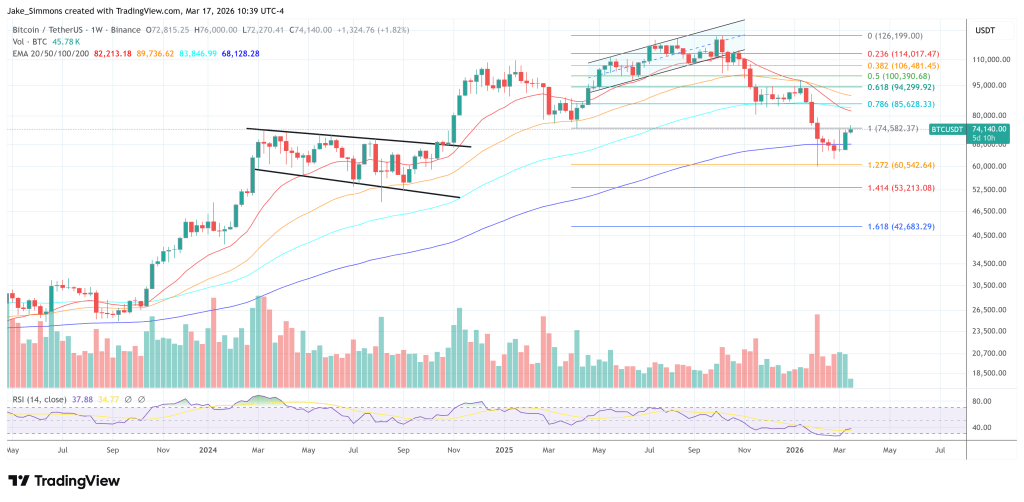
At press time, Bitcoin traded at $74,140.

Bitcoin must break above the 1.0 Fib level, 1-week chart | Source: BTCUSDT on TradingView.com

Связанные с этим вопросы

QWhat is Michael Saylor's main argument about Bitcoin in the context of AI disrupting traditional business moats?

AMichael Saylor argues that if AI compresses terminal value and makes every business moat temporary, capital will rotate to assets with no disruption risk, and Bitcoin, being scarce, neutral, and impervious to AI disruption, should be the primary beneficiary of this shift.

QAccording to Chamath Palihapitiya, how might AI impact the valuation of equities and the assumptions behind modern capital markets?

APalihapitiya argues that AI could make disruption faster, cheaper, and more relentless, causing investors to stop underwriting long-term cash flows. This would lead equities to be valued based on current cash generation rather than as long-duration assets, dismantling the assumption that competitive advantages compound over time and moats persist.

QWhat valuation multiples did Palihapitiya suggest for businesses under different annual disruption probabilities due to AI?

APalihapitiya estimated that with a 20% annual disruption probability, fair value would be about 3.9x free cash flow (FCF); at 30%, it drops to 2.8x FCF; and even at 10%, it only reaches roughly 6.5x FCF.

QHow did the debate between Saylor and Palihapitiya extend to the topic of quantum risk, and what were their respective views?

APalihapitiya raised concerns that Bitcoin would need to be quantum-resistant, implying it might be vulnerable. Saylor countered that if quantum computing breaks cryptography, it would affect AI, cloud infrastructure, banks, and the entire internet, not just Bitcoin, and the entire stack would upgrade together. Palihapitiya remained unconvinced, stating that a store of value must be 100% hacking resistant.

QWhat alternative perspectives did other crypto leaders like Mike Belshe and Mert Mumtaz offer on the quantum risk debate?

AMike Belshe said Bitcoin is likely the 'low-hanging fruit' for quantum attackers but also has the easiest technical solution to become quantum-resistant, though it suffers from governance challenges. Mert Mumtaz argued that centralized systems can detect, mitigate, and fix quantum threats faster and more cleanly than Bitcoin, highlighting the trade-off with decentralization.

Похожее

Торговля

Спот
Фьючерсы

Популярные статьи

Тест по Bitcoin Биткоина

HTX Learn: Изучите Bitcoin halving и Заработаете Токены USDT

3.0k просмотров всегоОпубликовано 2024.04.16Обновлено 2024.04.16

Тест по Bitcoin  Биткоина

Что такое $BITCOIN

ЦИФРОВОЕ ЗОЛОТО ($BITCOIN): Комплексный анализ Введение в ЦИФРОВОЕ ЗОЛОТО ($BITCOIN) ЦИФРОВОЕ ЗОЛОТО ($BITCOIN) — это проект на основе блокчейна, работающий в сети Solana, который стремится объединить характеристики традиционных драгоценных металлов с инновациями децентрализованных технологий. Хотя он носит имя Биткойн, часто называемого “цифровым золотом” из-за его восприятия как средства хранения ценности, ЦИФРОВОЕ ЗОЛОТО является отдельным токеном, предназначенным для создания уникальной экосистемы в ландшафте Web3. Его цель — позиционировать себя как жизнеспособный альтернативный цифровой актив, хотя детали его применения и функциональности все еще развиваются. Что такое ЦИФРОВОЕ ЗОЛОТО ($BITCOIN)? ЦИФРОВОЕ ЗОЛОТО ($BITCOIN) — это токен криптовалюты, специально разработанный для использования в блокчейне Solana. В отличие от Биткойна, который выполняет широко признанную роль хранения ценности, этот токен, похоже, сосредоточен на более широких приложениях и характеристиках. Примечательные аспекты включают: Инфраструктура блокчейна: Токен построен на блокчейне Solana, известном своей способностью обрабатывать высокоскоростные и недорогие транзакции. Динамика предложения: ЦИФРОВОЕ ЗОЛОТО имеет максимальное предложение, ограниченное 100 квадриллионами токенов (100P $BITCOIN), хотя детали о его обращающемся предложении в настоящее время не раскрыты. Утилита: Хотя точные функциональные возможности не описаны, есть указания на то, что токен может быть использован для различных приложений, потенциально связанных с децентрализованными приложениями (dApps) или стратегиями токенизации активов. Кто создатель ЦИФРОВОГО ЗОЛОТА ($BITCOIN)? На данный момент личность создателей и команды разработчиков, стоящих за ЦИФРОВЫМ ЗОЛОТОМ ($BITCOIN), остается неизвестной. Эта ситуация типична для многих инновационных проектов в области блокчейна, особенно тех, которые связаны с децентрализованными финансами и феноменом мем-криптовалют. Хотя такая анонимность может способствовать культуре, ориентированной на сообщество, она усиливает опасения по поводу управления и ответственности. Кто инвесторы ЦИФРОВОГО ЗОЛОТА ($BITCOIN)? Доступная информация указывает на то, что у ЦИФРОВОГО ЗОЛОТА ($BITCOIN) нет известных институциональных спонсоров или значительных венчурных капиталовложений. Проект, похоже, функционирует по модели пирингового взаимодействия, сосредоточенной на поддержке и принятии сообществом, а не на традиционных путях финансирования. Его активность и ликвидность в основном сосредоточены на децентрализованных биржах (DEX), таких как PumpSwap, а не на устоявшихся централизованных торговых платформах, что еще больше подчеркивает его подход, ориентированный на grassroots. Как работает ЦИФРОВОЕ ЗОЛОТО ($BITCOIN) Операционные механизмы ЦИФРОВОГО ЗОЛОТА ($BITCOIN) можно подробно описать на основе его дизайна блокчейна и характеристик сети: Механизм консенсуса: Используя уникальный механизм доказательства истории (PoH) Solana в сочетании с моделью доказательства доли (PoS), проект обеспечивает эффективную валидацию транзакций, что способствует высокой производительности сети. Токеномика: Хотя конкретные дефляционные механизмы не были подробно описаны, большое максимальное предложение токенов подразумевает, что оно может быть предназначено для микротранзакций или нишевых случаев использования, которые еще предстоит определить. Интероперабельность: Существует потенциал для интеграции с более широкой экосистемой Solana, включая различные платформы децентрализованных финансов (DeFi). Однако детали относительно конкретных интеграций остаются неуточненными. Хронология ключевых событий Вот хронология, которая подчеркивает значимые вехи, касающиеся ЦИФРОВОГО ЗОЛОТА ($BITCOIN): 2023: Первоначальное развертывание токена происходит в блокчейне Solana, отмеченное его адресом контракта. 2024: ЦИФРОВОЕ ЗОЛОТО приобретает видимость, когда оно становится доступным для торговли на децентрализованных биржах, таких как PumpSwap, позволяя пользователям обменивать его на SOL. 2025: Проект наблюдает спорадическую торговую активность и потенциальный интерес к инициативам, возглавляемым сообществом, хотя на данный момент не зафиксировано никаких значительных партнерств или технических достижений. Критический анализ Сильные стороны Масштабируемость: Основная инфраструктура Solana поддерживает высокие объемы транзакций, что может повысить полезность $BITCOIN в различных сценариях транзакций. Доступность: Потенциально низкая цена торговли за токен может привлечь розничных инвесторов, способствуя более широкому участию благодаря возможностям дробного владения. Риски Отсутствие прозрачности: Отсутствие публично известных спонсоров, разработчиков или процесса аудита может вызвать скептицизм относительно устойчивости и надежности проекта. Волатильность рынка: Торговая активность сильно зависит от спекулятивного поведения, что может привести к значительной волатильности цен и неопределенности для инвесторов. Заключение ЦИФРОВОЕ ЗОЛОТО ($BITCOIN) является интригующим, но неоднозначным проектом в быстро развивающейся экосистеме Solana. Хотя он пытается использовать нарратив “цифрового золота”, его отход от установленной роли Биткойна как средства хранения ценности подчеркивает необходимость более четкого различения его предполагаемой утилиты и структуры управления. Будущее принятие и усвоение, вероятно, будут зависеть от решения текущей непрозрачности и более четкого определения его операционных и экономических стратегий. Примечание: Этот отчет охватывает синтезированную информацию, доступную на октябрь 2023 года, и с тех пор могут произойти события.

99 просмотров всегоОпубликовано 2025.05.13Обновлено 2025.05.13

Что такое $BITCOIN

Fractal Bitcoin: масштабирование Биткоина с помощью рекурсивной системы

Fractal Bitcoin — масштабное Layer-1-решнение, созданное на базе кода Биткоина, позволяющего достигать бесконечного масштабирования с помощью рекурсивного подхода.

2.2k просмотров всегоОпубликовано 2025.06.30Обновлено 2025.06.30

Fractal Bitcoin: масштабирование Биткоина с помощью рекурсивной системы

Обсуждения

Добро пожаловать в Сообщество HTX. Здесь вы сможете быть в курсе последних новостей о развитии платформы и получить доступ к профессиональной аналитической информации о рынке. Мнения пользователей о цене на BTC (BTC) представлены ниже.

活动图片