Q2 2026 Bitcoin Valuation: Why $143,000 Remains Achievable?

marsbitОпубликовано 2026-04-24Обновлено 2026-04-24

Введение

In Q2 2026, Bitcoin's valuation target of $143,000 remains achievable, representing a potential 2x upside from the current $70,500 price. Despite a 27% decline since Q1, the overall macro environment remains supportive. Global M2 liquidity hit a record $13.44 trillion, though Chinese-driven liquidity (over 60% of growth) has limited access to Bitcoin markets. U.S. monetary policy, a key driver, faced delays due to Iran conflict-induced oil price spikes, pushing March CPI to 3.3% and reducing Fed rate cut expectations. However, the easing direction persists. On-chain metrics show recovery from panic zones, with key resistance at $78,000 (long-term holder cost basis). Institutional flows turned positive, with Bitcoin ETFs seeing net inflows and corporate buying accelerating. Yet, network activity reveals stagnation—active addresses fell 13.2% YoY, suggesting superficial transaction growth. The revised $143K target (down from $185.5K in Q1) applies a -10% adjustment for weak fundamentals (BTCFi ecosystem contraction) and +20% for macro support. Key catalysts include breaking $78K, sustained ETF inflows, and geopolitical stability aiding Fed policy shifts.

Macro environment remains supportive, albeit at a slower pace: Global M2 hits a new all-time high of $13.44 trillion, Bitcoin ETF flows turn net positive for the first time in 14 months. However, the oil shock triggered by the Iran conflict pushed March CPI to 3.3%, narrowing the Fed's rate cut path.

Bitcoin on-chain metrics are shifting from undervalued to early equilibrium: Key on-chain indicators have moved out of the Q1 panic zone. The current price of $70.5K is about 13% below the long-term holder average cost basis of $78K. Breaking above this level would be a key signal for a short-term trend reversal.

The $143K target price and 2x upside potential remain valid: Based on a neutral baseline of $132.5K, adjusted by -10% for fundamentals and +20% for macro factors.

This is a downward revision from the Q1 target of $185.5K, but the significant spot price correction means the actual upside potential from the current price level has actually increased.

Macro Tailwinds Persist, but Momentum Has Slowed

Since the release of the Q1 report, Bitcoin has fallen approximately 27%, with the average price hovering around $70.5K in early April.

The Iran conflict introduced a new variable, but the overall macro environment remains favorable. What changed is not the direction, but the speed.

Liquidity at record highs, yet ineffective transmission to Bitcoin

As of February 2026, global M2 continued to expand to near a record high of $13.44 trillion. Yet Bitcoin is down 27% from Q1. Liquidity and price are moving inversely.
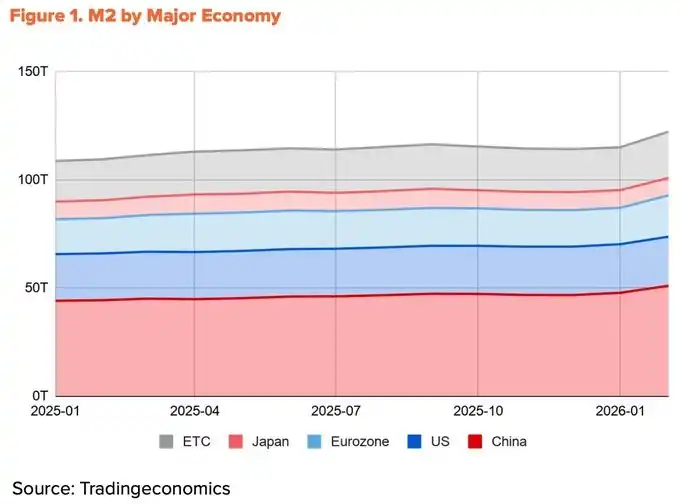
The source of this liquidity explains the divergence. Over the past year, over 60% of M2 growth from the four major economies (China, US, Eurozone, Japan) came from China, benefiting from the PBoC's RRR cuts and its formal shift to an easing stance in Q1.

The US contribution was only 10%. The problem is that channels for China-sourced liquidity to enter the Bitcoin market are limited.

Domestic crypto trading restrictions remain, and indirect channels via Hong Kong and Singapore primarily serve institutional capital. Global liquidity is at historic peaks, but the share that can actually reach the Bitcoin market is shrinking.

Iran Conflict Slows Fed Rate Cut Pace

With transmission of China-sourced liquidity blocked, USD liquidity remains the primary driver for Bitcoin. But even this part has been delayed by the Iran conflict.
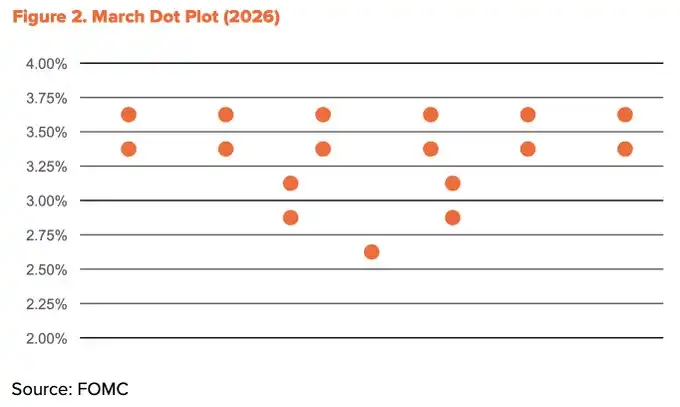
Following the US-Israel strike on Iran on February 28th, the Strait of Hormuz was blocked. Brent crude surged to $118/barrel by mid-March, and Dubai crude hit a record high of $166/barrel. This shock directly pushed inflation higher. US March CPI rose to 3.3% from 2.4% in February, a two-year high. The Fed's room for rate cuts subsequently narrowed. The March dot plot reduced 2026 rate cut expectations to just one.

Nevertheless, the direction of easing remains unchanged. By mid-April, the Strait of Hormuz partially reopened, and oil prices retreated significantly to around $90. Core CPI stabilized at 2.6%, indicating the shock hasn't broadly spread through the economy yet.

President Trump formally nominated Kevin Warsh as the next Fed Chair at the end of January, with Senate confirmation hearings ongoing. Powell's term ends May 15th, and an easing bias is highly likely to continue. The number of cuts may be reduced, but the direction remains.

Institutional flows begin to reverse
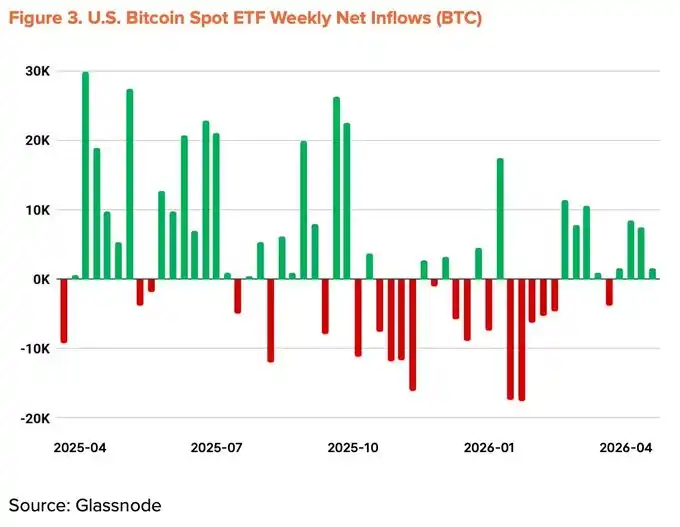
The institutional outflows that drove the Q1 decline have started to reverse. Bitcoin spot ETFs saw their worst monthly outflows since their November 2025 launch and were in net outflow for five consecutive months. However, since March, monthly net flows have turned positive. As of mid-April, year-to-date cumulative flows turned positive, with total AUM recovering to $96.5 billion.

Corporate accumulation is also accelerating. Strategy spent $2.54 billion buying 34,164 BTC in a single week (April 13-19), increasing its total holdings to 815,061 BTC. However, the number of companies participating in this trend has not increased significantly.

Macro indicator adjusted down to +20%

Structural tailwinds remain intact: liquidity expansion, policy easing bias, institutional flows back on track, and progress on the US CLARITY Act. Recent headwinds—the Iran-induced oil shock and slower Fed cuts—partly offset these positives. The Q2 macro indicator is adjusted down 5 percentage points from Q1 to +20%.

Shifting from Undervalued to Early Equilibrium

On-chain metrics have moved out of the extreme fear zone and are transitioning towards the border of undervaluation and equilibrium. Key metrics like MVRV-Z, NUPL, and aSOPR have exited the Q1 panic zone, entering an early recovery phase.

While a massive rally like those from panic zone rebounds is less probable, historical data shows that one-year average returns starting from this region consistently remain in double digits. The risk-reward ratio at this point remains in its most favorable position.

Notably, the average cost basis for Short-Term Holders (STH) is gradually declining.

This suggests speculative capital is exiting, while new buyers are accumulating at lower prices. The timing aligns with the restart of ETF net inflows and Strategy's large purchases, supporting the view that institutional investors are persistently accumulating at discounted prices, thereby pulling down the average entry cost.

A key risk level is $54K, the network's average cost basis. A break below this level would put the entire network in an unrealized loss state, forming a bottom in an extreme scenario. The strongest resistance is at $78K, coinciding with the long-term holder average cost basis.

The current price of $70.5K is about 13% below this resistance level, leaving a significant amount of recently entered short-term capital in unrealized loss. A decisive break above $78K in the short term is worth close attention.

Surface Growth, Underlying Stagnation

Bitcoin's average daily transaction count reached 564,000 in the first half of April, up 37.9% year-on-year. The surface data looks impressive, but the details tell another story.

Active addresses fell to 428,000 in the same period, down 13.2% YoY and 4.2% quarter-on-quarter. The average transaction size dropped to 1.19 BTC, down 34.1% from 1.80 BTC last quarter. Transaction count is rising, but both participants and value per transaction are falling.

This pattern reflects a small number of users repeatedly making small transfers, rather than broad economic utilization of the network. A significant portion of the transaction growth likely comes from mechanical flows like exchange deposits, unrelated to real growth.

The Q1 report maintained the fundamental indicator at 0%, based on expectations of BTCFi ecosystem expansion. Entering Q2, this thesis has clearly weakened.

According to The Block's "2026 Digital Asset Outlook," Bitcoin L2 TVL is down 74% year-to-date, and total BTCFi TVL has fallen 10%, representing only 0.46% of total Bitcoin supply (91,332 BTC). While individual protocols like Babylon and Lombard have seen growth, the overall ecosystem has contracted.

Fundamental indicator adjusted down to -10%

Surface growth has not translated into real network expansion, and the underlying data supporting the BTCFi thesis has weakened. The balance of offsetting positive and negative signals present in Q1 has been broken. The Q2 fundamental indicator is adjusted down from 0% to a baseline -10%.

Target Price $143K, Still 2x Upside Potential

Using the TVM method, the neutral baseline calculated from the early April 2026 average price is $132.5K. Applying the -10% fundamental and +20% macro adjustments yields a 12-month target price of $143K.

This figure is about 23% lower than the Q1 target of $185.5K. However, the actual upside potential has instead increased. Calculated from the average price, the upside expanded from +93% in Q1 to +103% in Q2.

The lower target price does not represent pessimism. The macro direction and on-chain structure still support a medium-to-long-term bull thesis.

Three short-term watch points:

· A decisive break above the network's mid-term equilibrium level of $78K;

· Sustained net inflows into ETFs;

· A Fed policy pivot following eased geopolitical risks.

If these three conditions materialize simultaneously, the $143K target remains achievable.

Связанные с этим вопросы

QWhat is the 12-month target price for Bitcoin as of Q2 2026, and what factors contribute to this valuation?

AThe 12-month target price for Bitcoin is $143,000. This is derived from a neutral baseline of $132,500, adjusted with a -10% for weakened fundamentals (like BTCFi ecosystem contraction) and a +20% for a supportive macro environment (including liquidity and policy trends).

QHow did the geopolitical conflict involving Iran impact the macroeconomic factors influencing Bitcoin's price?

AThe Iran conflict led to a blockade of the Strait of Hormuz, causing a spike in oil prices which pushed the March CPI to 3.3%. This narrowed the Fed's path for interest rate cuts, slowing down the primary driver of dollar liquidity for Bitcoin and delaying monetary easing.

QWhat key on-chain level is identified as the major resistance point for a short-term trend reversal, and why is it significant?

AThe major resistance level is $78,000, which represents the Long-Term Holder's average cost basis. A decisive break above this level is a key signal for a short-term trend reversal, as it would indicate that recent buyers are moving into profit and could spur further buying momentum.

QDespite a record high global M2, why has there been a divergence between liquidity and Bitcoin's price performance?

AThe divergence occurred because over 60% of the M2 growth came from China, where strict crypto trading restrictions limit the flow of that liquidity into the Bitcoin market. The US, a primary source of Bitcoin-driving dollar liquidity, contributed only 10% to the M2 growth.

QWhat is the critical risk level that could signal an extreme bottom for Bitcoin's price, according to the on-chain analysis?

AThe critical risk level is $54,000, which is the network-wide average cost basis. A break below this level would put the entire network into an unrealized loss position, potentially marking an extreme bottom in a worst-case scenario.

Похожее

Transcending Cycles, Defining the Future: BIT Hosts Global Asset Strategy Sharing Session in Hong Kong, Exploring New Paradigms of Web3 and Traditional Markets

Amid a shifting global macroeconomic landscape, BIT, a global digital asset financial services group, hosted the "Global Asset Strategy Forum" in Hong Kong on April 22, 2026, under the theme "Transcending Cycles, Defining the Future." The event brought together industry leaders from financial institutions, crypto platforms, and professional service firms to explore new paradigms in Web3 and traditional markets. Key discussions centered on cross-market investment opportunities, regulatory pathways for compliant stablecoins, and the role of precious metals like gold and silver in the digital economy. BIT Founding Partner Cynthia Wu highlighted the institutionalization of the digital asset sector, noting its evolution from early retail-driven speculation to a phase marked by clearer regulation, the approval of spot ETFs, and the rise of Real-World Assets (RWA). She emphasized RWA’s role in bridging the gap between traditional finance and digital assets. Speakers observed a structural "reversal" between Web3 and traditional markets: Web3 is becoming more rational and profit-oriented, while traditional markets, especially U.S. equities driven by AI, are attracting concentrated capital and attention. The U.S. "Goldilocks" economic environment and AI commercialization were noted as key factors supporting risk assets. In stablecoin discussions, panelists emphasized the importance of regulatory compliance, asset-backed reserves, and transparency, noting that algorithmic stablecoins remain uncertain from a regulatory perspective. For RWA, gold was discussed as a macro-sensitive asset, with its value closely tied to interest rates, dollar strength, and geopolitical factors. The forum concluded that the digital asset industry is transitioning from narrative-driven growth to structure-driven, cross-market integration, with a focus on institutional participation and trust-based financial infrastructure. Disclaimer: This summary is for informational purposes only and does not constitute investment advice.

marsbit3 ч. назад

Transcending Cycles, Defining the Future: BIT Hosts Global Asset Strategy Sharing Session in Hong Kong, Exploring New Paradigms of Web3 and Traditional Markets

marsbit3 ч. назад

Торговля

Спот
Фьючерсы

Популярные статьи

Тест по Bitcoin Биткоина

HTX Learn: Изучите Bitcoin halving и Заработаете Токены USDT

3.0k просмотров всегоОпубликовано 2024.04.16Обновлено 2024.04.16

Тест по Bitcoin  Биткоина

Что такое $BITCOIN

ЦИФРОВОЕ ЗОЛОТО ($BITCOIN): Комплексный анализ Введение в ЦИФРОВОЕ ЗОЛОТО ($BITCOIN) ЦИФРОВОЕ ЗОЛОТО ($BITCOIN) — это проект на основе блокчейна, работающий в сети Solana, который стремится объединить характеристики традиционных драгоценных металлов с инновациями децентрализованных технологий. Хотя он носит имя Биткойн, часто называемого “цифровым золотом” из-за его восприятия как средства хранения ценности, ЦИФРОВОЕ ЗОЛОТО является отдельным токеном, предназначенным для создания уникальной экосистемы в ландшафте Web3. Его цель — позиционировать себя как жизнеспособный альтернативный цифровой актив, хотя детали его применения и функциональности все еще развиваются. Что такое ЦИФРОВОЕ ЗОЛОТО ($BITCOIN)? ЦИФРОВОЕ ЗОЛОТО ($BITCOIN) — это токен криптовалюты, специально разработанный для использования в блокчейне Solana. В отличие от Биткойна, который выполняет широко признанную роль хранения ценности, этот токен, похоже, сосредоточен на более широких приложениях и характеристиках. Примечательные аспекты включают: Инфраструктура блокчейна: Токен построен на блокчейне Solana, известном своей способностью обрабатывать высокоскоростные и недорогие транзакции. Динамика предложения: ЦИФРОВОЕ ЗОЛОТО имеет максимальное предложение, ограниченное 100 квадриллионами токенов (100P $BITCOIN), хотя детали о его обращающемся предложении в настоящее время не раскрыты. Утилита: Хотя точные функциональные возможности не описаны, есть указания на то, что токен может быть использован для различных приложений, потенциально связанных с децентрализованными приложениями (dApps) или стратегиями токенизации активов. Кто создатель ЦИФРОВОГО ЗОЛОТА ($BITCOIN)? На данный момент личность создателей и команды разработчиков, стоящих за ЦИФРОВЫМ ЗОЛОТОМ ($BITCOIN), остается неизвестной. Эта ситуация типична для многих инновационных проектов в области блокчейна, особенно тех, которые связаны с децентрализованными финансами и феноменом мем-криптовалют. Хотя такая анонимность может способствовать культуре, ориентированной на сообщество, она усиливает опасения по поводу управления и ответственности. Кто инвесторы ЦИФРОВОГО ЗОЛОТА ($BITCOIN)? Доступная информация указывает на то, что у ЦИФРОВОГО ЗОЛОТА ($BITCOIN) нет известных институциональных спонсоров или значительных венчурных капиталовложений. Проект, похоже, функционирует по модели пирингового взаимодействия, сосредоточенной на поддержке и принятии сообществом, а не на традиционных путях финансирования. Его активность и ликвидность в основном сосредоточены на децентрализованных биржах (DEX), таких как PumpSwap, а не на устоявшихся централизованных торговых платформах, что еще больше подчеркивает его подход, ориентированный на grassroots. Как работает ЦИФРОВОЕ ЗОЛОТО ($BITCOIN) Операционные механизмы ЦИФРОВОГО ЗОЛОТА ($BITCOIN) можно подробно описать на основе его дизайна блокчейна и характеристик сети: Механизм консенсуса: Используя уникальный механизм доказательства истории (PoH) Solana в сочетании с моделью доказательства доли (PoS), проект обеспечивает эффективную валидацию транзакций, что способствует высокой производительности сети. Токеномика: Хотя конкретные дефляционные механизмы не были подробно описаны, большое максимальное предложение токенов подразумевает, что оно может быть предназначено для микротранзакций или нишевых случаев использования, которые еще предстоит определить. Интероперабельность: Существует потенциал для интеграции с более широкой экосистемой Solana, включая различные платформы децентрализованных финансов (DeFi). Однако детали относительно конкретных интеграций остаются неуточненными. Хронология ключевых событий Вот хронология, которая подчеркивает значимые вехи, касающиеся ЦИФРОВОГО ЗОЛОТА ($BITCOIN): 2023: Первоначальное развертывание токена происходит в блокчейне Solana, отмеченное его адресом контракта. 2024: ЦИФРОВОЕ ЗОЛОТО приобретает видимость, когда оно становится доступным для торговли на децентрализованных биржах, таких как PumpSwap, позволяя пользователям обменивать его на SOL. 2025: Проект наблюдает спорадическую торговую активность и потенциальный интерес к инициативам, возглавляемым сообществом, хотя на данный момент не зафиксировано никаких значительных партнерств или технических достижений. Критический анализ Сильные стороны Масштабируемость: Основная инфраструктура Solana поддерживает высокие объемы транзакций, что может повысить полезность $BITCOIN в различных сценариях транзакций. Доступность: Потенциально низкая цена торговли за токен может привлечь розничных инвесторов, способствуя более широкому участию благодаря возможностям дробного владения. Риски Отсутствие прозрачности: Отсутствие публично известных спонсоров, разработчиков или процесса аудита может вызвать скептицизм относительно устойчивости и надежности проекта. Волатильность рынка: Торговая активность сильно зависит от спекулятивного поведения, что может привести к значительной волатильности цен и неопределенности для инвесторов. Заключение ЦИФРОВОЕ ЗОЛОТО ($BITCOIN) является интригующим, но неоднозначным проектом в быстро развивающейся экосистеме Solana. Хотя он пытается использовать нарратив “цифрового золота”, его отход от установленной роли Биткойна как средства хранения ценности подчеркивает необходимость более четкого различения его предполагаемой утилиты и структуры управления. Будущее принятие и усвоение, вероятно, будут зависеть от решения текущей непрозрачности и более четкого определения его операционных и экономических стратегий. Примечание: Этот отчет охватывает синтезированную информацию, доступную на октябрь 2023 года, и с тех пор могут произойти события.

99 просмотров всегоОпубликовано 2025.05.13Обновлено 2025.05.13

Что такое $BITCOIN

Fractal Bitcoin: масштабирование Биткоина с помощью рекурсивной системы

Fractal Bitcoin — масштабное Layer-1-решнение, созданное на базе кода Биткоина, позволяющего достигать бесконечного масштабирования с помощью рекурсивного подхода.

2.2k просмотров всегоОпубликовано 2025.06.30Обновлено 2025.06.30

Fractal Bitcoin: масштабирование Биткоина с помощью рекурсивной системы

Обсуждения

Добро пожаловать в Сообщество HTX. Здесь вы сможете быть в курсе последних новостей о развитии платформы и получить доступ к профессиональной аналитической информации о рынке. Мнения пользователей о цене на BTC (BTC) представлены ниже.

活动图片