Bitcoin-Stock Correlation Hits Weakest Level Since 2022—Will It Last?

bitcoinistОпубликовано 2026-02-26Обновлено 2026-02-26

Введение

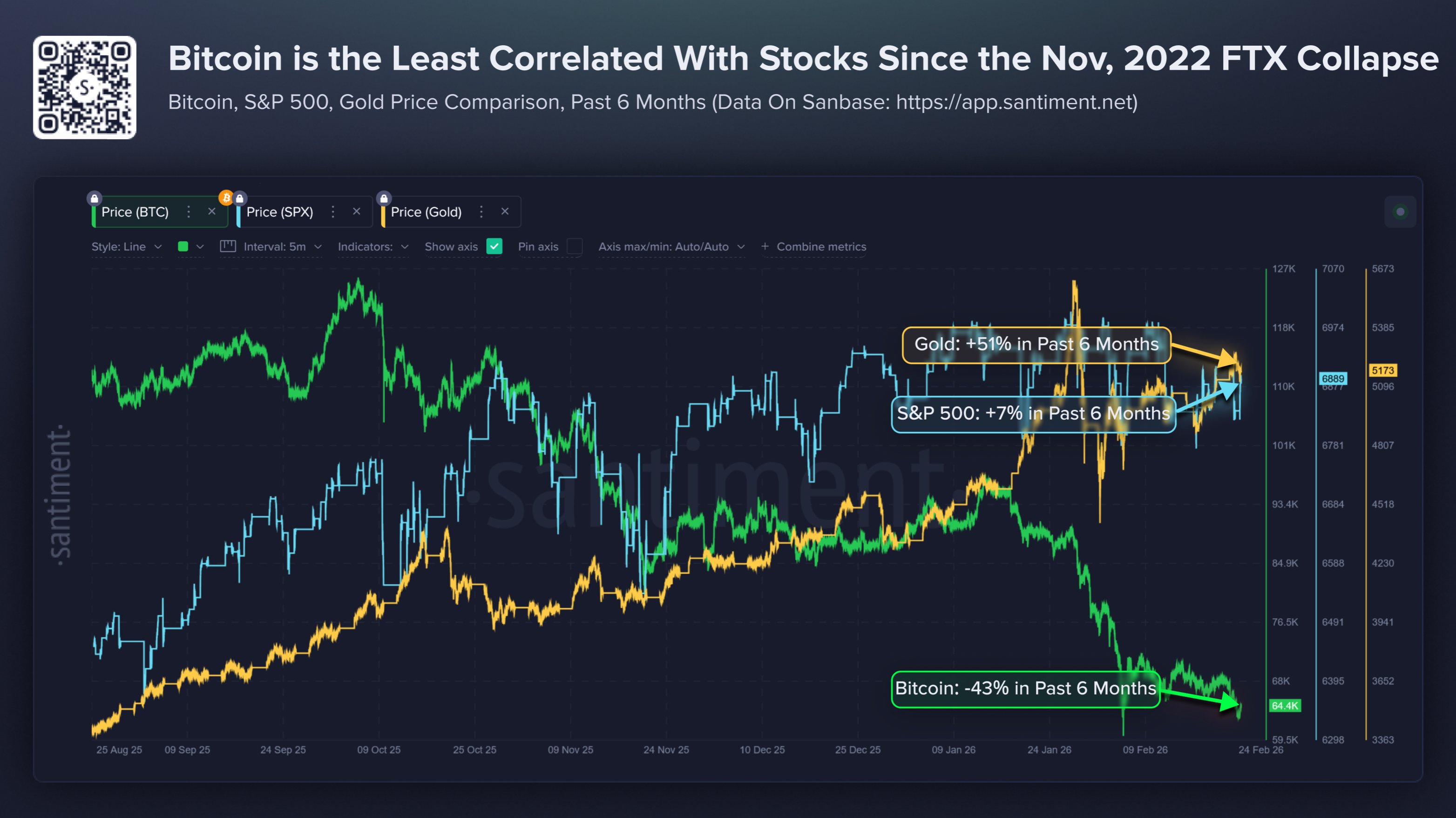
According to analytics firm Santiment, Bitcoin has reached its weakest correlation with the stock market since the FTX collapse in November 2022. While the S&P 500 has risen 7% over the past six months, Bitcoin has declined 43% in the same period, sharply underperforming traditional equities. This persistent decoupling is unusual, as historical patterns suggest such dramatic divergences typically don't last indefinitely. Furthermore, Bitcoin has also developed a negative correlation with Gold, moving in opposite directions and entering a "not digital gold" period. At the time of writing, Bitcoin is trading around $66,000.

Bitcoin has recently become the least correlated to the stock market since the FTX crash back in 2022, according to analytics firm Santiment.

Bitcoin Has Broken Away From S&P 500

In a new post on X, Santiment has discussed how Bitcoin has moved relative to the stock market recently. The number one digital asset has faced a downtrend alongside the rest of the cryptocurrency sector in the last few months that has taken its price below $70,000. Compared to six months ago, BTC is today down 43%.

Historically, the asset has generally shown some degree of correlation with the stocks. “For years, Bitcoin has often moved in the same direction as the stock market, particularly the S&P 500,” noted Santiment. Lately, however, this trend has broken. While BTC has gone down, the S&P 500 is up 7% in the past six months. Below is a chart that shows how the price trajectories of the two assets have compared.

BTC appears to have diverged from traditional markets | Source: Santiment on X

According to Santiment, this is the weakest correlation that Bitcoin has shown to the stocks since November 2022. Back then, the collapse of cryptocurrency exchange FTX induced a price crash for the asset that caused it to diverge from the S&P 500.

This previous breakaway for the cryptocurrency was different from the current one, however, as it lasted only briefly. The latest one, on the other hand, has been rather persistent. “Instead of moving alongside equities, Bitcoin has sharply underperformed while traditional markets have remained stable and gold has thrived,” said the analytics firm.

Now, will the decoupling that Bitcoin has experienced from the S&P 500 last? If the past is anything to go by, the answer may lean toward no. “Historically, when an asset that is usually correlated breaks away in this dramatic fashion, it typically does not stay disconnected forever,” explained Santiment.

The S&P 500 isn’t the only traditional asset that Bitcoin has diverged from; Gold has also charted a different path from BTC recently, despite the latter being popularly considered the former’s digital analogue.

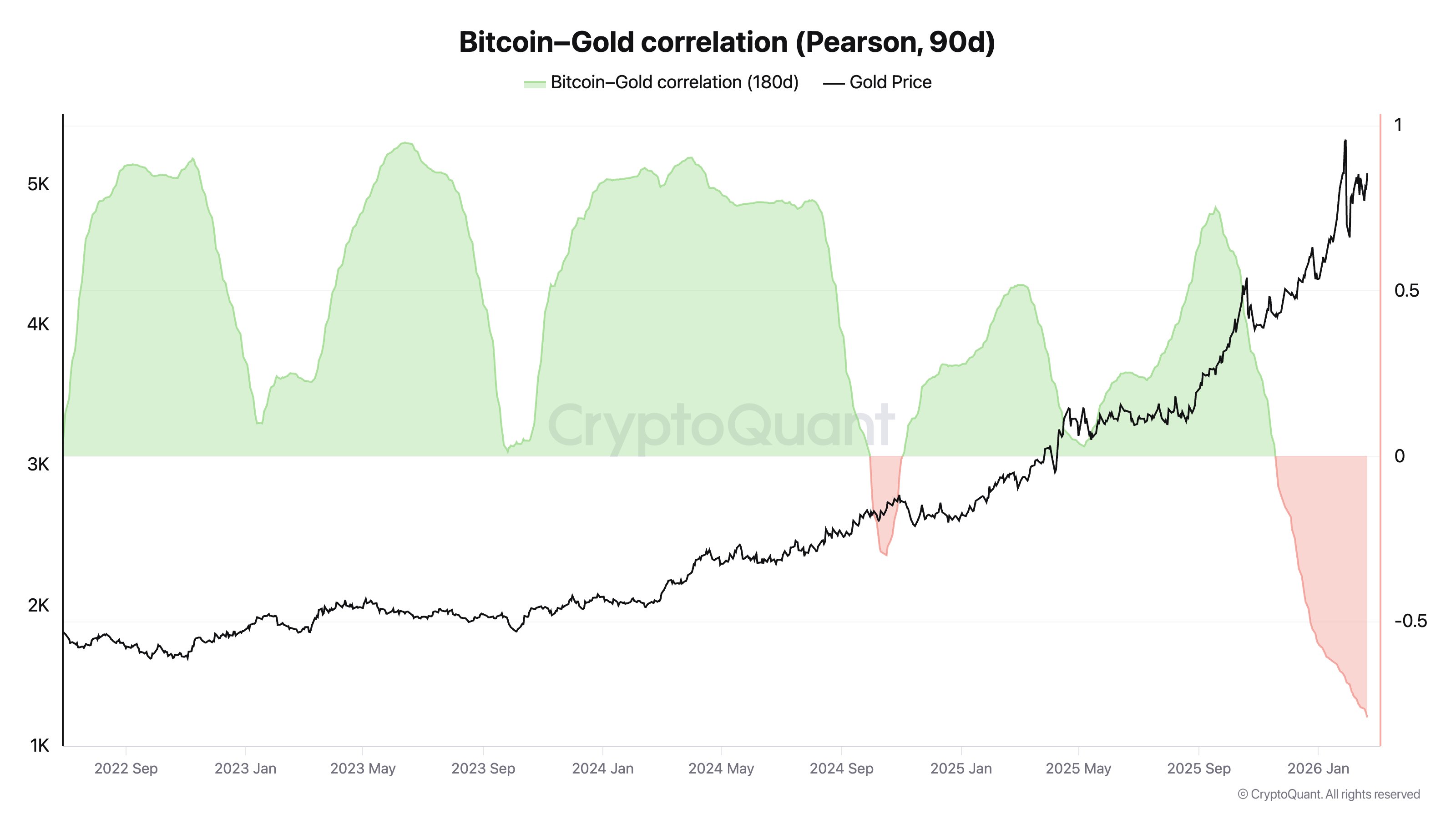
In an X post, CryptoQuant founder Ki Young Ju has shared the data of an indicator that tracks the 90-day correlation between Bitcoin and Gold.

The trend in the correlation metric between BTC and Gold over the last few years | Source: @ki_young_ju on X

As displayed in the above graph, BTC mostly observed a positive degree of correlation to Gold between 2022 and the first three quarters of 2025. Since the last quarter of 2025, however, the correlation metric has plummeted into the negative zone for the assets.

A negative correlation implies that while the two assets exhibit a relationship, it’s of the negative kind. In other words, it means the assets are moving in opposite directions. “Bitcoin is in a “not digital gold” period,” said Young Ju.

BTC Price

At the time of writing, Bitcoin is trading around $66,000, down 2% over the last week.

Looks like the price of the coin has recovered from its latest drop | Source: BTCUSDT on TradingView

Связанные с этим вопросы

QAccording to Santiment, when was the last time Bitcoin showed such a weak correlation to the stock market?

AThe last time Bitcoin showed such a weak correlation to the stock market was in November 2022, following the collapse of the FTX exchange.

QHow has the performance of the S&P 500 compared to Bitcoin's over the past six months?

AOver the past six months, the S&P 500 is up 7%, while Bitcoin is down 43%.

QWhat is the current state of the correlation between Bitcoin and Gold, according to the data from CryptoQuant?

AThe 90-day correlation between Bitcoin and Gold has plummeted into the negative zone since the last quarter of 2025, meaning the two assets are moving in opposite directions.

QWhat is the current price of Bitcoin mentioned at the end of the article?

AAt the time of writing, Bitcoin is trading around $66,000.

QHow does Santiment historically view the duration of such a decoupling between correlated assets?

ASantiment explains that historically, when a usually correlated asset breaks away in a dramatic fashion, it typically does not stay disconnected forever.

Похожее

AI "Transfer Station" Earning Millions Monthly? Five Questions Uncover the Truth of Token Arbitrage

The article "AI 'Transfer Station' Earns Millions Monthly? Five Questions Uncover the Truth of Token Arbitrage" explores the emerging business of API token transfer stations, which profit from global AI service price disparities and access barriers. These intermediaries purchase low-cost tokens from overseas AI providers (e.g., OpenAI, Claude) through grey-market methods—such as exploiting enterprise credits, bulk accounts, or subscription benefits—and resell them to Chinese users at a markup. Key drivers include the high cost of using top AI models (e.g., Claude Code costs ~$5 per million tokens), the performance gap between domestic and foreign models, and mismatches between subscription and API pricing. However, the practice carries significant risks: upstream token sources may be unstable or illegal; user data passing through intermediaries can be harvested or injected with hidden prompts; and models might be downgraded without disclosure. The market is evolving, with some operators now exporting cheaper Chinese models (e.g., Qwen3.5 at ~$0.11 per million tokens) to overseas users, leveraging price gaps. Yet, sustainability is low due to compliance crackdowns, instability, and reputational risks. Users are advised to employ detection methods (e.g., prompt adherence tests) and avoid sensitive data usage. The authors caution that while transfer stations offer short-term arbitrage, they lack long-term reliability and security compared to official APIs.

marsbit36 мин. назад

AI "Transfer Station" Earning Millions Monthly? Five Questions Uncover the Truth of Token Arbitrage

marsbit36 мин. назад

The Cost of an 11.5% Annualized Return: Will MicroStrategy's STRC Face a Moment of Reckoning?

This article analyzes the potential risks associated with MicroStrategy's (MSTR) use of structured financial products like STRC to leverage its BTC exposure. While these tools have enabled impressive returns (e.g., 11.5% annualized) and fueled significant capital inflows ($13.5B outstanding), they also create substantial annual dividend obligations (~$400M). The author argues that this structure, while effective in a bull market, could become a liability if BTC price stagnates or declines. The core risk is a potential negative feedback loop: the growing dividend burden from continued STRC issuance may eventually outweigh the benefits of increased BTC holdings. To meet these obligations, MicroStrategy might need to use new issuance proceeds for dividends instead of buying more BTC, which could disappoint equity investors. If the market capitalization (mNAV) falls below the value of its BTC holdings, the company could be forced to sell BTC instead of issuing new shares, potentially triggering a panic. The author estimates a potential inflection point in 6 months, where annual dividend costs reach $3-4B. At that stage, CEO Michael Saylor might face a difficult choice: sell BTC to meet obligations or sacrifice the credibility of the preferred shares by halting dividends. The article concludes that this financial engineering, while powerful, could ultimately "backfire" on MicroStrategy if market conditions turn.

marsbit1 ч. назад

The Cost of an 11.5% Annualized Return: Will MicroStrategy's STRC Face a Moment of Reckoning?

marsbit1 ч. назад

Торговля

Спот
Фьючерсы

Популярные статьи

Тест по Bitcoin Биткоина

HTX Learn: Изучите Bitcoin halving и Заработаете Токены USDT

3.0k просмотров всегоОпубликовано 2024.04.16Обновлено 2024.04.16

Тест по Bitcoin  Биткоина

Что такое $BITCOIN

ЦИФРОВОЕ ЗОЛОТО ($BITCOIN): Комплексный анализ Введение в ЦИФРОВОЕ ЗОЛОТО ($BITCOIN) ЦИФРОВОЕ ЗОЛОТО ($BITCOIN) — это проект на основе блокчейна, работающий в сети Solana, который стремится объединить характеристики традиционных драгоценных металлов с инновациями децентрализованных технологий. Хотя он носит имя Биткойн, часто называемого “цифровым золотом” из-за его восприятия как средства хранения ценности, ЦИФРОВОЕ ЗОЛОТО является отдельным токеном, предназначенным для создания уникальной экосистемы в ландшафте Web3. Его цель — позиционировать себя как жизнеспособный альтернативный цифровой актив, хотя детали его применения и функциональности все еще развиваются. Что такое ЦИФРОВОЕ ЗОЛОТО ($BITCOIN)? ЦИФРОВОЕ ЗОЛОТО ($BITCOIN) — это токен криптовалюты, специально разработанный для использования в блокчейне Solana. В отличие от Биткойна, который выполняет широко признанную роль хранения ценности, этот токен, похоже, сосредоточен на более широких приложениях и характеристиках. Примечательные аспекты включают: Инфраструктура блокчейна: Токен построен на блокчейне Solana, известном своей способностью обрабатывать высокоскоростные и недорогие транзакции. Динамика предложения: ЦИФРОВОЕ ЗОЛОТО имеет максимальное предложение, ограниченное 100 квадриллионами токенов (100P $BITCOIN), хотя детали о его обращающемся предложении в настоящее время не раскрыты. Утилита: Хотя точные функциональные возможности не описаны, есть указания на то, что токен может быть использован для различных приложений, потенциально связанных с децентрализованными приложениями (dApps) или стратегиями токенизации активов. Кто создатель ЦИФРОВОГО ЗОЛОТА ($BITCOIN)? На данный момент личность создателей и команды разработчиков, стоящих за ЦИФРОВЫМ ЗОЛОТОМ ($BITCOIN), остается неизвестной. Эта ситуация типична для многих инновационных проектов в области блокчейна, особенно тех, которые связаны с децентрализованными финансами и феноменом мем-криптовалют. Хотя такая анонимность может способствовать культуре, ориентированной на сообщество, она усиливает опасения по поводу управления и ответственности. Кто инвесторы ЦИФРОВОГО ЗОЛОТА ($BITCOIN)? Доступная информация указывает на то, что у ЦИФРОВОГО ЗОЛОТА ($BITCOIN) нет известных институциональных спонсоров или значительных венчурных капиталовложений. Проект, похоже, функционирует по модели пирингового взаимодействия, сосредоточенной на поддержке и принятии сообществом, а не на традиционных путях финансирования. Его активность и ликвидность в основном сосредоточены на децентрализованных биржах (DEX), таких как PumpSwap, а не на устоявшихся централизованных торговых платформах, что еще больше подчеркивает его подход, ориентированный на grassroots. Как работает ЦИФРОВОЕ ЗОЛОТО ($BITCOIN) Операционные механизмы ЦИФРОВОГО ЗОЛОТА ($BITCOIN) можно подробно описать на основе его дизайна блокчейна и характеристик сети: Механизм консенсуса: Используя уникальный механизм доказательства истории (PoH) Solana в сочетании с моделью доказательства доли (PoS), проект обеспечивает эффективную валидацию транзакций, что способствует высокой производительности сети. Токеномика: Хотя конкретные дефляционные механизмы не были подробно описаны, большое максимальное предложение токенов подразумевает, что оно может быть предназначено для микротранзакций или нишевых случаев использования, которые еще предстоит определить. Интероперабельность: Существует потенциал для интеграции с более широкой экосистемой Solana, включая различные платформы децентрализованных финансов (DeFi). Однако детали относительно конкретных интеграций остаются неуточненными. Хронология ключевых событий Вот хронология, которая подчеркивает значимые вехи, касающиеся ЦИФРОВОГО ЗОЛОТА ($BITCOIN): 2023: Первоначальное развертывание токена происходит в блокчейне Solana, отмеченное его адресом контракта. 2024: ЦИФРОВОЕ ЗОЛОТО приобретает видимость, когда оно становится доступным для торговли на децентрализованных биржах, таких как PumpSwap, позволяя пользователям обменивать его на SOL. 2025: Проект наблюдает спорадическую торговую активность и потенциальный интерес к инициативам, возглавляемым сообществом, хотя на данный момент не зафиксировано никаких значительных партнерств или технических достижений. Критический анализ Сильные стороны Масштабируемость: Основная инфраструктура Solana поддерживает высокие объемы транзакций, что может повысить полезность $BITCOIN в различных сценариях транзакций. Доступность: Потенциально низкая цена торговли за токен может привлечь розничных инвесторов, способствуя более широкому участию благодаря возможностям дробного владения. Риски Отсутствие прозрачности: Отсутствие публично известных спонсоров, разработчиков или процесса аудита может вызвать скептицизм относительно устойчивости и надежности проекта. Волатильность рынка: Торговая активность сильно зависит от спекулятивного поведения, что может привести к значительной волатильности цен и неопределенности для инвесторов. Заключение ЦИФРОВОЕ ЗОЛОТО ($BITCOIN) является интригующим, но неоднозначным проектом в быстро развивающейся экосистеме Solana. Хотя он пытается использовать нарратив “цифрового золота”, его отход от установленной роли Биткойна как средства хранения ценности подчеркивает необходимость более четкого различения его предполагаемой утилиты и структуры управления. Будущее принятие и усвоение, вероятно, будут зависеть от решения текущей непрозрачности и более четкого определения его операционных и экономических стратегий. Примечание: Этот отчет охватывает синтезированную информацию, доступную на октябрь 2023 года, и с тех пор могут произойти события.

99 просмотров всегоОпубликовано 2025.05.13Обновлено 2025.05.13

Что такое $BITCOIN

Fractal Bitcoin: масштабирование Биткоина с помощью рекурсивной системы

Fractal Bitcoin — масштабное Layer-1-решнение, созданное на базе кода Биткоина, позволяющего достигать бесконечного масштабирования с помощью рекурсивного подхода.

2.2k просмотров всегоОпубликовано 2025.06.30Обновлено 2025.06.30

Fractal Bitcoin: масштабирование Биткоина с помощью рекурсивной системы

Обсуждения

Добро пожаловать в Сообщество HTX. Здесь вы сможете быть в курсе последних новостей о развитии платформы и получить доступ к профессиональной аналитической информации о рынке. Мнения пользователей о цене на BTC (BTC) представлены ниже.

活动图片