Bitcoin Oversold Rebound Verification: Rebound is Not a Reversal | Guest Analysis

Odaily星球日报Опубликовано 2026-03-09Обновлено 2026-03-09

Введение

### Summary of Bitcoin Analysis: Rebound, Not Reversal This analysis provides a technical assessment of Bitcoin (BTC) and HYPE, concluding that Bitcoin's recent price increase is a bear market rebound within a larger corrective structure, not a trend reversal. **Key Points:** * **Core BTC View:** The rally from the February 6 low (~$60,000) is interpreted as a C-2 wave rebound within a larger C-wave correction. This rebound is seen as weak, lacking strong buying momentum and broad market participation, and is likely concluding. A subsequent C-3 wave decline is anticipated. * **Market Structure:** BTC is expected to maintain a weak range-bound consolidation. Key resistance is identified in the $72,300-$74,500 zone and $79,500-$80,600 zone. Key support levels are ~$65,000, $60,000-$62,500, and ~$57,400. * **Strategy Performance:** * A short-term bearish strategy (1x leverage) was executed, selling at ~$72,760 and buying back at ~$68,095 for a **6.41% gain**. * A medium-term short position (1x leverage), initiated near $89,000, remains open and is currently **~25.88% profitable** (as of the weekly close near $65,971). * **Technical Indicators:** Weekly and daily analyses using proprietary momentum, sentiment, and quantitative models indicate a clear and ongoing bearish trend. The recent bounce is classified as a technically weak, unsustainable rebound within this downtrend. * **HYPE Analysis:** The token HYPE is analyzed separately, with its structure su...

Core Points:

• HYPE Multi-Cycle Trend Structure Deep Deconstruction: Weekly tracking. (Details in Part 1)

• BTC Strategy Execution (Short-term) Effectiveness Verification: Bitcoin followed the established short-term strategy last week, completing one short-term short position (1x leverage), successfully achieving a return of approximately 6.41%. (Details in Table 1)

• BTC Strategy Execution (Medium-term) Effectiveness Verification: Bitcoin followed the established medium-term strategy last week, continuing to hold the short position established at $89,000 (1x leverage). As of last week's close (approx. $65,971), the profit is about 25.88%, with a maximum profit during the period of about 32.58%.

• Core View (Short-term) Verification: Bitcoin continued to maintain a weak range-bound oscillation pattern last week. The current trend is in line with expectations.

• BTC This Week's Market Trend Forecast and Medium & Short-term Trading Strategies.

The following will review the market forecast, strategy execution, and specific trading process in detail.

I. HYPE Multi-Cycle Trend Structure Analysis and Short-term Trading Review:

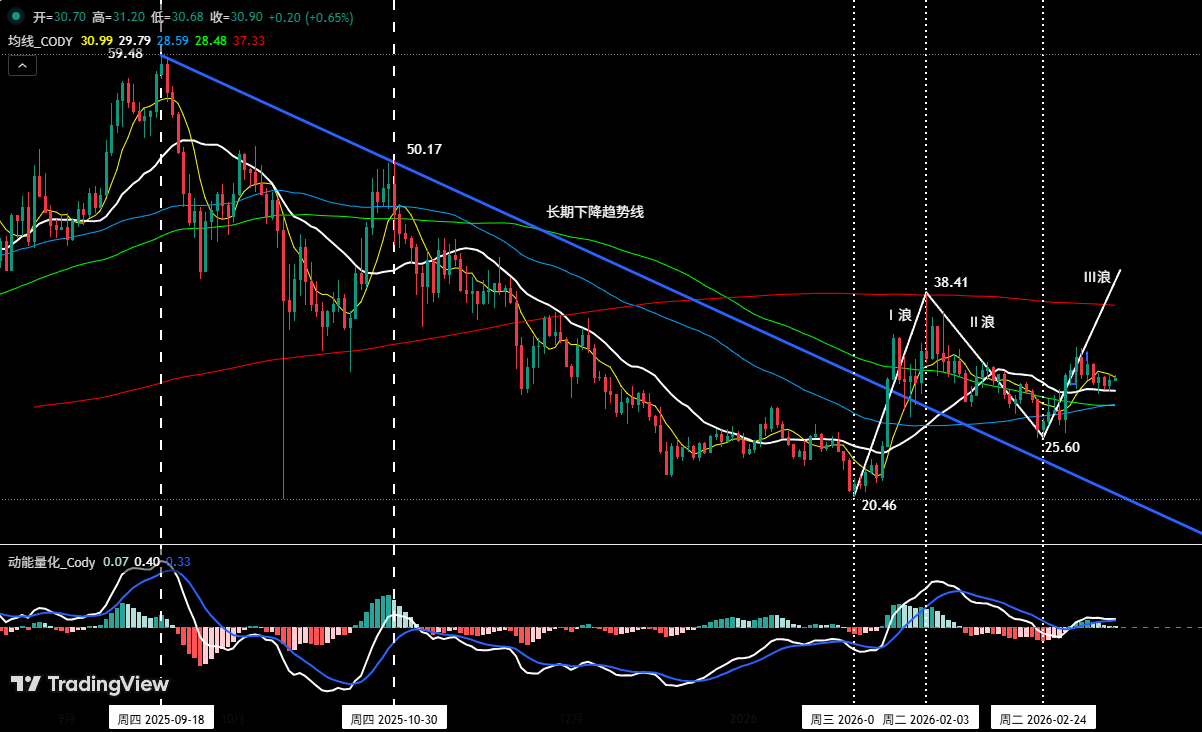
HYPE Daily K-Line Chart

Figure 1

We first highlighted the investment opportunity in HYPE in the weekly review on February 22, clearly stating the potential for a major upward (Wave III) move in the near term. In the weekly review on March 1, we reiterated: the low of $25.60 on February 24 might be the starting point of Wave III, which is currently underway.

1. Large-scale Trend Structure Analysis (See Figure 1):(Based on market evolution after January 21)

• Wave I (Impulse Wave): From the low of $20.46 on January 21 to the high of $38.41 on February 3, lasting 14 days, with a maximum gain of 87.73%.

• Wave II (Corrective Wave): From the high of $38.41 on February 3 to the low of $25.60 on February 24, lasting 20 days, with a maximum decline of 33.35%.

• Wave III (Potential Impulse Wave): From the low of $25.60 on February 24 to the present, the market is currently running, lasting 13 days so far, with a maximum gain of 31.5%.

• From the Moving Average System: The upward trend starting on February 24 has effectively broken through multiple moving average resistances. The current price is retesting key medium-term moving averages (e.g., the 21-day MA) to test the strength of support after the breakout. In terms of volume, it shows a healthy state of "increased volume on rallies, decreased volume on pullbacks," with good volume-price coordination.

• From the Momentum Quantification Model: The momentum line on the daily chart continues to operate above the zero axis, indicating the market is in a clear uptrend. The current movement is in a stage of momentum accumulation and consolidation.

2. Small-scale Structure Analysis:(Based on market movement after March 2)

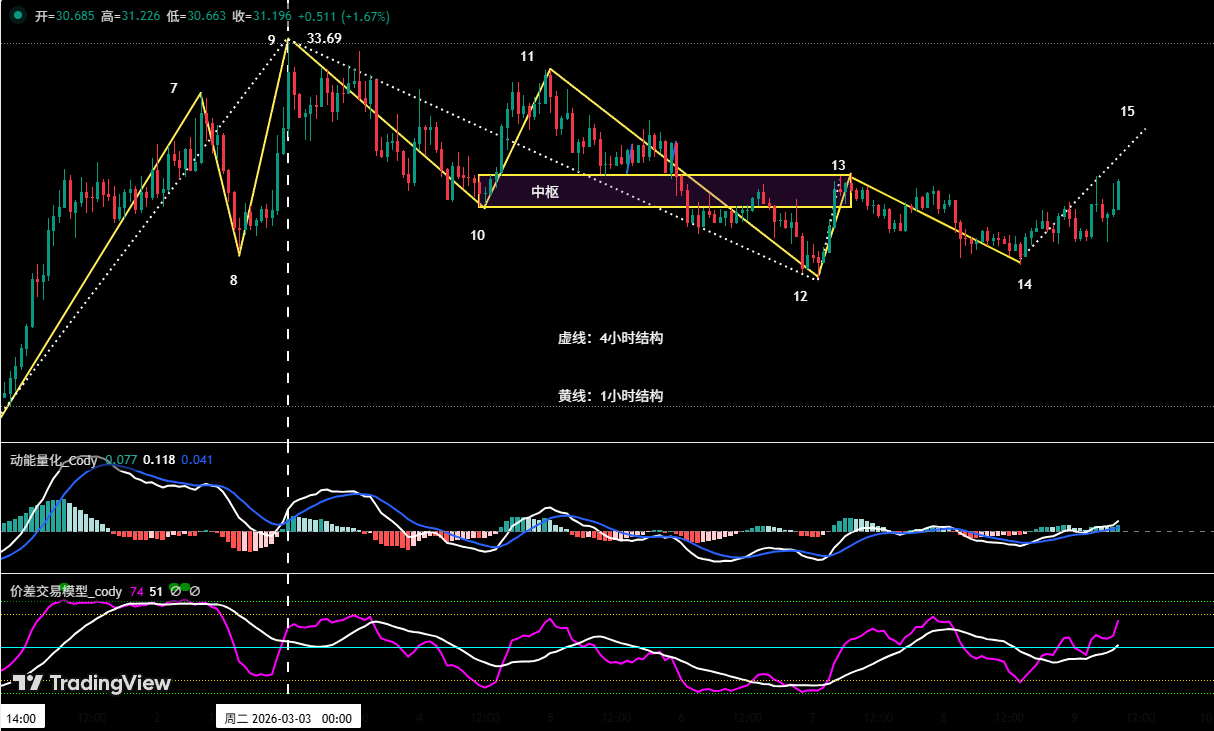
HYPE 1-hour K-Line Chart

Figure 2

As shown in (Figure 2), HYPE upward move starting from the low on February 24 entered a correction phase after touching the high of $33.69 on March 2. Below, we will start with the 1-hour chart structure to analyze the end signals and potential turning points of this correction in detail.

• Internal Structure Division:(From the high of $33.69 on March 2 to present)

It can be subdivided into a 5-segment structure: 9-10, 10-11, 11-12, 12-13, 13-14, forming a complete corrective move.

• Central Pivot (Zhongshu) Construction: In the 5-segment structure, 9-10 is the entering segment, 13-14 is the leaving segment, and 10-11, 11-12, 12-13 these 3 segments form the central pivot structure.

• Correction Turning Point Formation and Validation: As shown in (Figure 2), a divergence signal has formed between the entering segment and the leaving segment. Therefore, we believe the probability is high that this correction ended at endpoint 12. If the upward move starting from endpoint 12 first effectively stabilizes above the $31.5 resistance level, and then breaks through the local previous high of $32.75, the probability of this correction ending and a new upward wave beginning will significantly increase. (Special emphasis: Any subsequent correction in HYPE should not fall below the price of endpoint 12 (approx. $29.44). Otherwise, the above conclusion is invalid, and the correction turning point will be delayed)

3. HYPE Upside Risk Warning: Although HYPE's trend has some independence, it cannot completely detach from Bitcoin's overall environment. If Bitcoin continues to weaken and breaks below key support (e.g., around $65,000), it may increase selling pressure across the altcoin market, thereby affecting HYPE's rebound momentum.

4. HYPE Short-term Trading Review (1x Leverage):(03.02~03.08)

We anticipated that HYPE was in an upward trend on the daily chart. Last week, based on the core trading strategy of "following the trend" and combined with the analysis of the hourly correction, we did not open any new (long) positions during this period.

II. Bitcoin Last Week's Trading Strategy and Key Level Review:(03.02~03.08)

1、Short-term Strategy Review:(See Table 1)

Strictly following the trading signals from our self-built Spread Trading Model and Momentum Quantification Model, and combined with market trend forecasts, we completed one short-term (short) trade last week, with a profit of 6.41%.

1、Bitcoin Short-term Trade Details Summary:(Leverage*1x)

Table 1

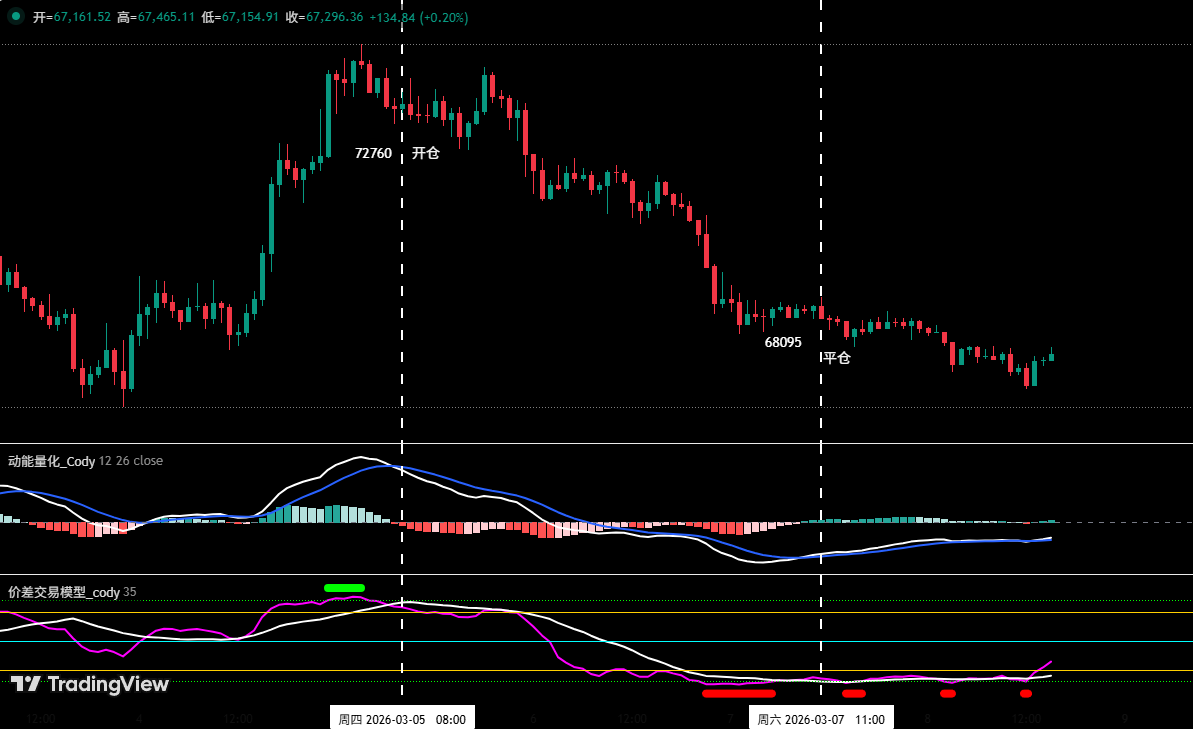
2、Short-term Trade Review:(See Figure 3)

• Entry: The price rebounded to near the important resistance level of $74,500, encountered resistance, and the Spread Trading Model triggered a top warning signal (green dot in the chart). Combined with sell signals from both models, a 30% short position was established at $72,760.

• Risk Control: Initial stop-loss for the short position was set above $75,500.

• Exit: The price fell to near $68,000, and the Spread Trading Model triggered a bottom warning signal (red dot in the chart). The position was fully closed near $68,095.

• Summary: This trade yielded a profit of 6.41%.

Bitcoin 60-minute K-Line Chart:(Momentum Quantification Model + Spread Trading Model)

Figure 3 (Short-term Trade Illustration)

2、 Medium-term Strategy Review:

Medium-term Strategy: Continue holding the 60% short position established near $89,000 (January 28). As of last week's close (closing price approx. $65,971), the profit is about 25.88%.

III. Bitcoin Technical Indicator Analysis

Combining market movements, the author conducts an in-depth analysis of various Bitcoin technical indicators from multiple models and multi-dimensional perspectives based on a self-built trading system.

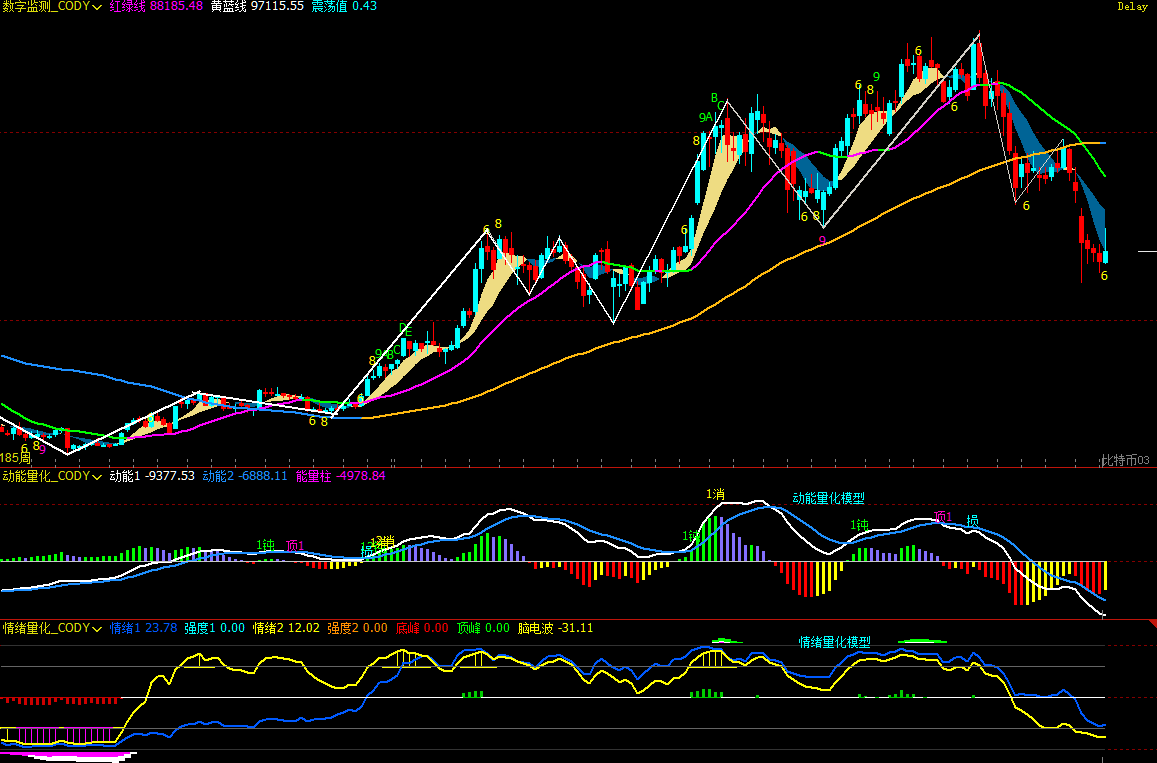
1. Analysis from the weekly chart level, as shown in (Figure 4):

Bitcoin Weekly K-Line Chart:(Momentum Quantification Model + Sentiment Quantification Model)

Figure 4

Momentum Quantification Model: Technical indicators show the momentum line declining synchronously, negative energy bars gradually shortening, with no momentum divergence signal appearing.

Sentiment Quantification Model: Blue sentiment line value 23, intensity zero; Yellow sentiment line value 11, intensity zero, peak value is 0.

Digital Monitoring Model: Moving averages show a bearish alignment. Last week closed with a small bullish candle with a long upper shadow, up 0.3%; No bottom digital monitoring signal appeared.

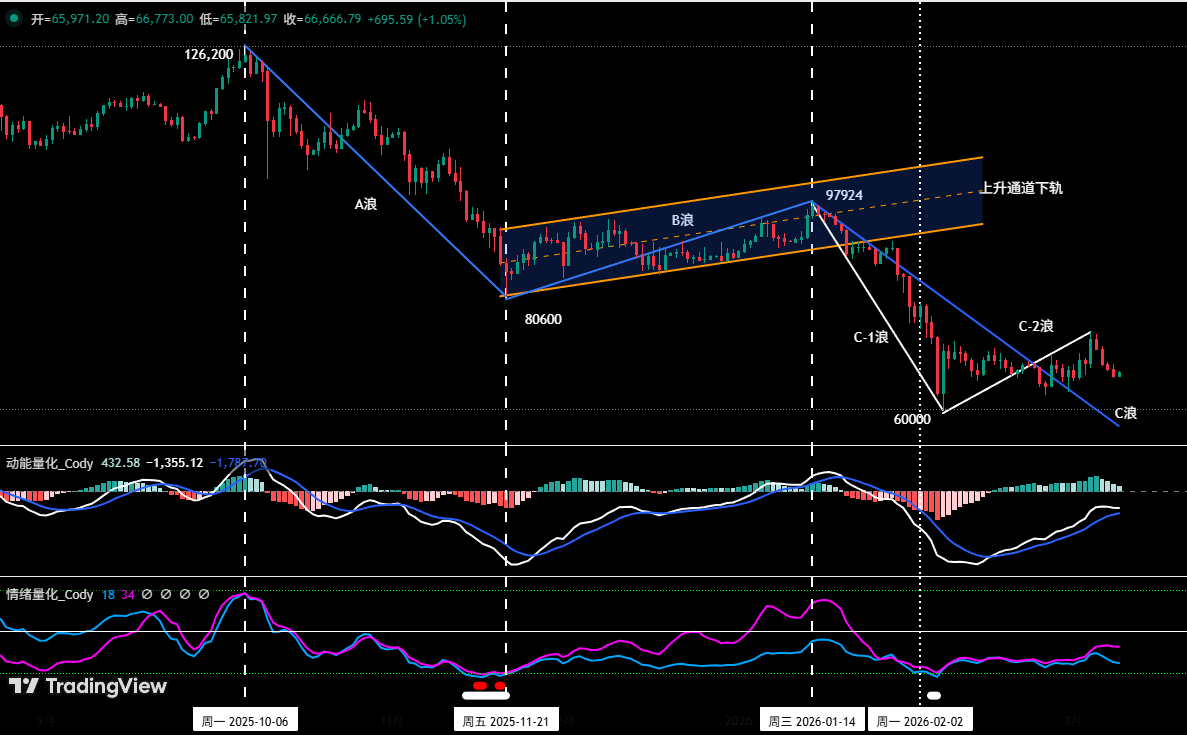
Comprehensive Analysis: Based on the data from the above three models, we believe the current Bitcoin weekly chart bearish trend is clear and continuing. Whether it's momentum divergence, extreme sentiment release intensity, or bottom signals from the digital model, none have appeared. It is currently in a falling mid-way pattern. After several weeks of sideways consolidation, the market is more likely to choose to探底 (explore lower levels) again.

2. Analysis from the daily chart level: As shown in (Figure 5)

Bitcoin Daily K-Line Chart:(Momentum Quantification Model + Sentiment Quantification Model)

Figure 5

Momentum Quantification Model: Last week's overall performance was "rising first then falling later". The momentum line is rising synchronously below the zero axis, positive energy bar changes are disordered.

Sentiment Quantification Model: At the end of last week's daily session, the blue sentiment line value was 19, intensity zero; the purple sentiment line value was 35, intensity zero, slowly exiting the oversold area.

Comprehensive Analysis: After analyzing the data from the Momentum Quantification and Sentiment Quantification models, we believe the technical structure of Bitcoin's daily bearish trend has not changed. The current行情 (market movement) is an oversold rebound, and due to disordered buying momentum, cautious market sentiment, and low capital participation, this rebound is weak with poor sustainability.

IV. This Week's Market Forecast:(03.09~03.15)

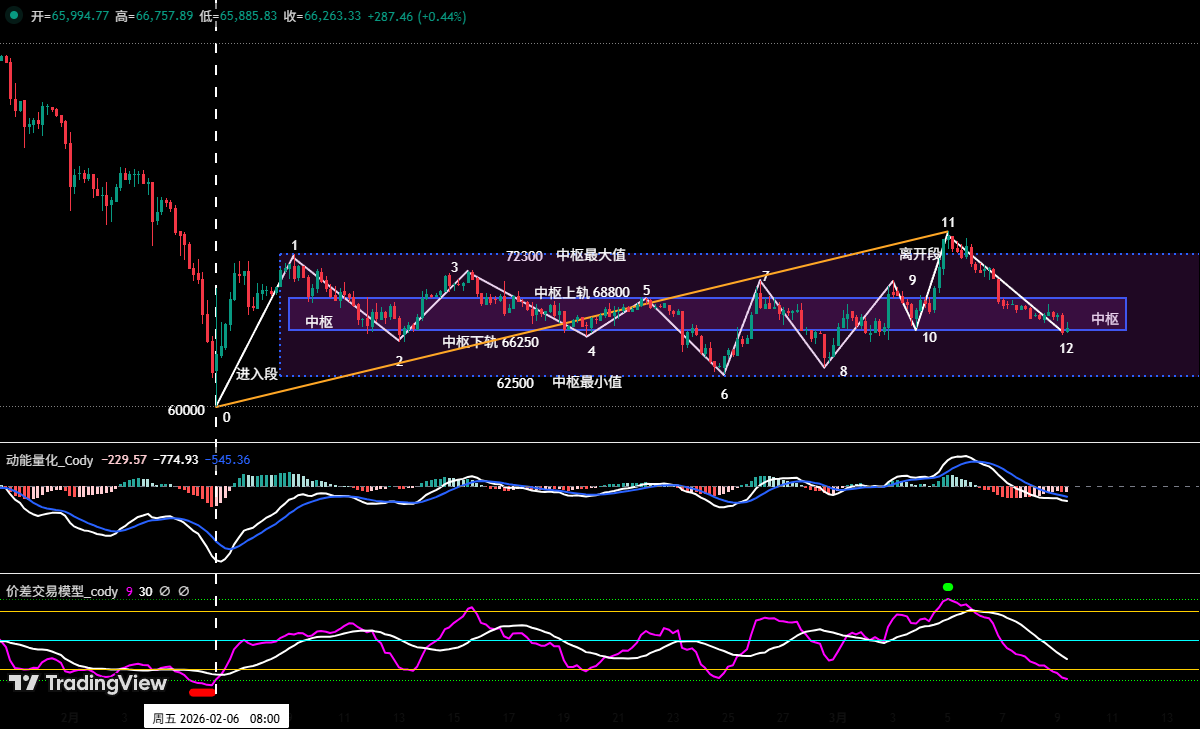
1、Bitcoin Upward Central Pivot Construction (Based on post-February 6 low):(Updated weekly)

Bitcoin 4-hour K-Line Chart

Figure 6

Using Bitcoin's 4-hour chart as the analysis周期 (cycle):

Central Pivot Construction: As seen in (Figure 6): The "Upward Central Pivot" structure is basically formed. Its highest resistance is around $72,300, and the lowest support is around $62,500; the upper轨 (rail) of the pivot is around $68,800, and the lower轨 (rail) is around $66,250.

2、 C-2 Wave Rebound End Judgment:

We maintain the previous core analysis framework: The upward move in Bitcoin starting from the low on February 6 (approx. $60,000) is, in nature, an oversold rebound within the large-scale C wave correction, specifically the C-2 wave. This is expected to be followed by a C-3 wave corrective行情 (market movement).

Bottom Warning: As seen in (Figure 6): Our self-built Spread Trading Model triggered a bottom warning signal (red dot) near Endpoint 0 on February 6, accurately capturing the start of the C-2 wave.

Top Warning: At the recently formed Endpoint 11, the Spread Quantification Model triggered a top warning signal (green dot). The successive appearance of bottom and top warning signals confirms the formation of a complete rebound wave from a model perspective, suggesting upward momentum may be exhausted.

3、This Week's Core View: Maintain the range-bound oscillation pattern. The C-2 wave oversold rebound may be nearing its end. Pay attention to the direction choice. Strategically, firmly implement the operational principle of "reduce positions (longs) on rallies, control risk".

4、Core Resistance Levels:

• First Resistance Area: $72,300-$74,500 area (Previous high volume transaction area)

• Second Resistance Area: $79,500-$80,600 area (Near the November 2025 low)

5、Core Support Levels:

• First Support Level: Around $65,000 (Previous important support area)

• Second Support Level: $60,000~$62,500 area (Near the February 6 low)

• Third Support Level: Around $57,400

V. This Week's Trading Strategy (Excluding Sudden News Impact):(03.09~03.15)

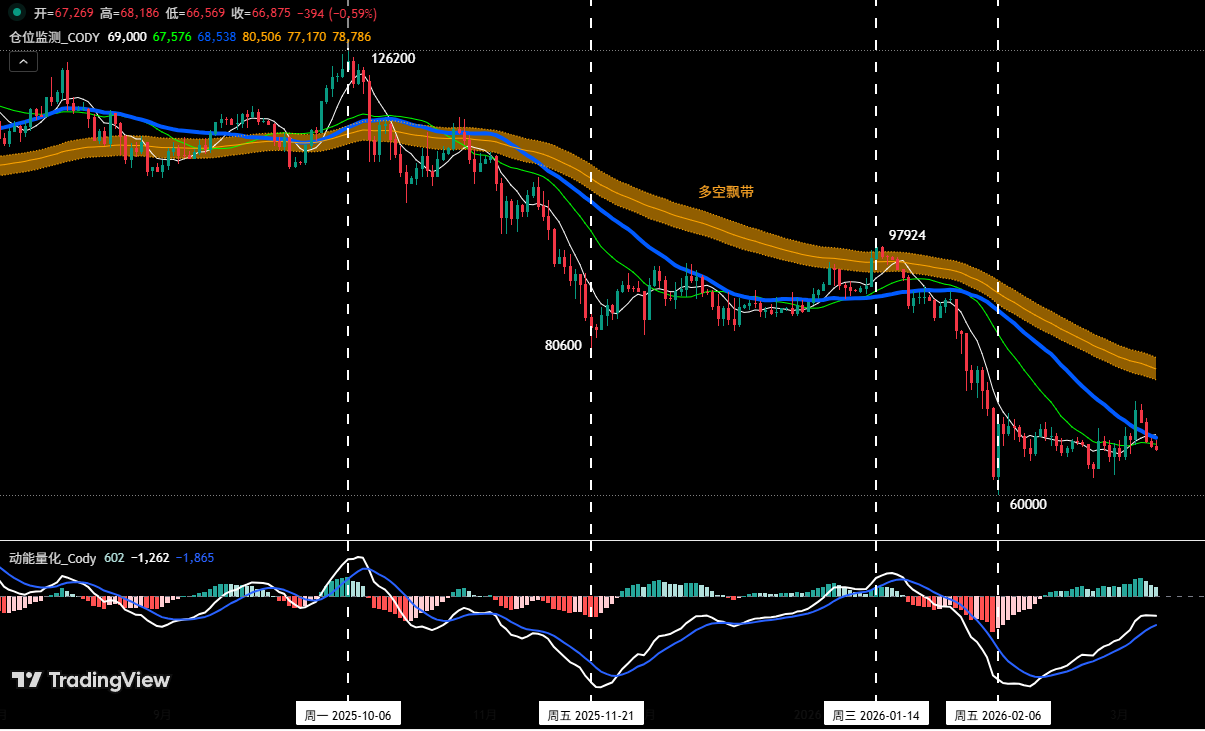
1、 Medium-term Strategy: See Figure Seven

Bitcoin Daily K-Line Chart:(Position Monitoring Model)

Figure 7

Position Monitoring Model: The current price is below the Bull-Bear Ribbon (yellow), so continue holding the 60% short position established at $89,000 (January 28).

• If the price反弹 (rebounds) and effectively breaks above $74,500, reduce the medium-term position to 40%.

• If the price反弹 (rebounds) and effectively breaks above and stabilizes above the Bull-Bear Ribbon, clear all medium-term positions.

2、 Short-term Strategy: Use 30% of the position, set stop-loss points, and look for "spread" opportunities based on support and resistance levels. (Use 30-minute/60-minute as the operation cycle).

3、 Since the medium-term market direction is bearish, to dynamically respond to complex market changes and combined with signals from our self-built trading model, we have prepared A/B two short-term operation plans:

Plan A: Sell on rallies encountering resistance.

• Entry: When the price反弹 (rebounds) to the $72,300~$74,500 area, triggers resistance signals, and combines with model top signals, establish a 30% short position.

• Risk Control: Initial stop-loss for the short position set above $75,500.

• Exit: When falling near important support levels and combined with model signals, gradually close the position to take profits.

Plan B: Follow-through breakout short.

• Entry: When the price effectively breaks below the lower轨 (rail) of the central pivot at $66,250, then retraces to this level but fails to hold above it, and combines with model top signals,顺势 (follow the trend) to establish a 30% short position.

• Risk Control: Initial stop-loss for the short position set above $67,500.

• Exit: When falling to support levels and combined with model signals, gradually close the position to take profits.

VI. Special Notes:​​

1. When opening a position: Immediately set the initial stop-loss level.

2. When profit reaches 1%: Move the stop-loss to the entry price (breakeven point) to ensure capital safety.

3. When profit reaches 2%​​: Move the stop-loss to the 1% profit level.

4. Continuous Tracking: Thereafter, for every additional 1% profit, move the stop-loss up 1%同步 (synchronously), dynamically protecting and locking in profits.

Financial markets change rapidly. All market analysis and trading strategies require dynamic adjustment. All views, analytical models, and operational strategies involved in this article are derived from personal technical analysis, intended solely for personal trading log purposes, and do not constitute any investment advice or operational basis. The market involves risks, investment requires caution. Do not make decisions based solely on this.

Связанные с этим вопросы

QWhat is the core short-term view on Bitcoin's price action as per the analysis?

AThe core short-term view is that Bitcoin continues to maintain a weak range-bound consolidation pattern. The recent price action is considered an oversold rebound, not a reversal, and is expected to be weak with poor sustainability.

QWhat was the outcome of the short-term BTC strategy executed last week?

AThe short-term strategy involved a successful short position (1x leverage) that was executed, resulting in a profit of approximately 6.41%.

QWhat is the current status and performance of the medium-term BTC short position mentioned?

AThe medium-term short position, initially opened at approximately $89,000 (1x leverage), is still being held. As of the previous week's close (~$65,971), it has a profit of about 25.88%, with a maximum profit of around 32.58% during the period.

QAccording to the multi-cycle analysis, what is the larger trend structure for Bitcoin (BTC)?

AThe analysis concludes that Bitcoin's weekly chart shows a clear and ongoing bearish trend. It is currently in a下跌中继形态 (falling relay pattern), indicating a high probability of choosing to探底 (probe the bottom) again after several weeks of sideways movement.

QWhat are the two short-term trading plans (A and B) proposed for the upcoming week?

APlan A: Sell on rallies. Open a 30% short position if the price rebounds to the $72,300-$74,500 area and meets resistance, with a stop-loss above $75,500. Plan B: Breakout short. Open a 30% short position if the price effectively breaks below the central pivot lower rail at $66,250 and then fails to hold above it on a pullback, with a stop-loss above $67,500.

Похожее

A Hair Dryer Blows Away $34,000 from Polymarket

A hairdryer was used to manipulate a temperature sensor at Paris Charles de Gaulle Airport (LFPG) on April 6 and 15, 2026, causing short-lived artificial temperature spikes. These false readings were used to exploit a prediction market on Polymarket, where users bet on Paris’s daily maximum temperature. The attacker targeted low-probability high-temperature outcomes, which settled as "Yes" based on the corrupted data, netting a total of $34,000 in profit. The attacker’s a newly created anonymous account funded just two days before the first incident. After the successful manipulations, the funds were quickly moved through mixers and decentralized exchanges to avoid tracing. French meteorological experts and authorities confirmed the anomalies were inconsistent with actual weather conditions and nearby station data, pointing to physical intervention. Legal action was initiated for "disrupting automated data processing systems," which carries severe penalties under French law. Polymarket’s market rules relied solely on a single, publicly accessible sensor and did not account for subsequent data revisions, making the system vulnerable to such physical oracle attacks. In response, Polymarket silently switched its data source to Paris-Le Bourget Airport (LFPB) without public explanation or refunding the exploited funds. The incident highlights the risks of single-point data dependencies in prediction markets and the low-cost, high-reward potential of real-world manipulation.

marsbit16 мин. назад

A Hair Dryer Blows Away $34,000 from Polymarket

marsbit16 мин. назад

MetaMask Co-founder Departs, Leaving Behind a Little Fox Packaged in an IPO Prospectus

MetaMask co-founder Dan Finlay has left Consensys after a decade, citing burnout and a desire to spend more time with family. MetaMask, launched in 2016, is one of the most recognizable crypto wallets with over 100 million installs and 30 million monthly active users. Despite its dominant position, the wallet faces growing competition from newer entrants like Phantom, which has expanded beyond Solana and reportedly generates more than double MetaMask’s annual revenue. The timing of Finlay’s departure coincides with Consensys’s plans for an IPO, advised by J.P. Morgan and Goldman Sachs. The company, last valued at $7 billion in 2022, has undergone multiple rounds of layoffs amid slowing growth and internal challenges. Employee reviews on Glassdoor point to low morale and management issues. MetaMask’s delayed expansion into chains like Solana and the long-promised but unreleased $MASK token have also drawn criticism. While the wallet remains the default option for many Ethereum dApps, its product-market fit is weakening as new users increasingly choose alternatives. Consensys appears to be prioritizing monetizing MetaMask’s strong brand recognition through a public listing while its market position is still valuable. Finlay’s quiet exit reflects both personal fatigue and broader shifts in the competitive landscape of crypto wallets.

marsbit22 мин. назад

MetaMask Co-founder Departs, Leaving Behind a Little Fox Packaged in an IPO Prospectus

marsbit22 мин. назад

In-Depth Report on the On-Chain Lending Market: When Off-Chain Credit Meets On-Chain Liquidation

The on-chain lending market has evolved from a peripheral DeFi niche into core financial infrastructure. As of early 2026, total value locked (TVL) in on-chain lending protocols has reached $64.3 billion, accounting for 53.54% of total DeFi TVL, making it the largest and most mature vertical within decentralized finance. Aave dominates the sector with approximately $32.9 billion in TVL, commanding nearly half of the market—a leadership position that is unlikely to be challenged in the foreseeable future. However, the path of on-chain lending forward is not without risk. Liquidation cascades, credit defaults, and cross-chain vulnerabilities remain systemic threats hanging over the industry. At the same time, a deeper structural transformation is underway: on-chain lending is shifting from a “leverage tool for crypto-native users” to a “compliant gateway for institutional capital”. The scale of RWA (Real World Asset) lending has surpassed $18.5 billion, with U.S. Treasuries and government securities increasingly serving as core collateral. Institutional capital inflows are reshaping both the user base and risk appetite of the sector. This report systematically analyzes the evolution of on-chain lending definitions, competitive dynamics, core risks, and future trends, providing a comprehensive industry outlook for investors and trade practitioners. Key findings suggest that the “one dominant player with several strong challengers” structure will persist in the short term, while fixed-rate lending, compliant collateral, and institutional credit underwriting will define the next phase of competition. For investors focused on DeFi infrastructure, three key opportunity tracks stand out, namely, the Aave ecosystem (Morpho, Spark), RWA lending protocols (Ondo, Maple) and fixed-rate innovation (Notional, Pendle).

HTX Learn1 ч. назад

In-Depth Report on the On-Chain Lending Market: When Off-Chain Credit Meets On-Chain Liquidation

HTX Learn1 ч. назад

Торговля

Спот
Фьючерсы

Популярные статьи

Тест по Bitcoin Биткоина

HTX Learn: Изучите Bitcoin halving и Заработаете Токены USDT

3.0k просмотров всегоОпубликовано 2024.04.16Обновлено 2024.04.16

Тест по Bitcoin  Биткоина

Что такое $BITCOIN

ЦИФРОВОЕ ЗОЛОТО ($BITCOIN): Комплексный анализ Введение в ЦИФРОВОЕ ЗОЛОТО ($BITCOIN) ЦИФРОВОЕ ЗОЛОТО ($BITCOIN) — это проект на основе блокчейна, работающий в сети Solana, который стремится объединить характеристики традиционных драгоценных металлов с инновациями децентрализованных технологий. Хотя он носит имя Биткойн, часто называемого “цифровым золотом” из-за его восприятия как средства хранения ценности, ЦИФРОВОЕ ЗОЛОТО является отдельным токеном, предназначенным для создания уникальной экосистемы в ландшафте Web3. Его цель — позиционировать себя как жизнеспособный альтернативный цифровой актив, хотя детали его применения и функциональности все еще развиваются. Что такое ЦИФРОВОЕ ЗОЛОТО ($BITCOIN)? ЦИФРОВОЕ ЗОЛОТО ($BITCOIN) — это токен криптовалюты, специально разработанный для использования в блокчейне Solana. В отличие от Биткойна, который выполняет широко признанную роль хранения ценности, этот токен, похоже, сосредоточен на более широких приложениях и характеристиках. Примечательные аспекты включают: Инфраструктура блокчейна: Токен построен на блокчейне Solana, известном своей способностью обрабатывать высокоскоростные и недорогие транзакции. Динамика предложения: ЦИФРОВОЕ ЗОЛОТО имеет максимальное предложение, ограниченное 100 квадриллионами токенов (100P $BITCOIN), хотя детали о его обращающемся предложении в настоящее время не раскрыты. Утилита: Хотя точные функциональные возможности не описаны, есть указания на то, что токен может быть использован для различных приложений, потенциально связанных с децентрализованными приложениями (dApps) или стратегиями токенизации активов. Кто создатель ЦИФРОВОГО ЗОЛОТА ($BITCOIN)? На данный момент личность создателей и команды разработчиков, стоящих за ЦИФРОВЫМ ЗОЛОТОМ ($BITCOIN), остается неизвестной. Эта ситуация типична для многих инновационных проектов в области блокчейна, особенно тех, которые связаны с децентрализованными финансами и феноменом мем-криптовалют. Хотя такая анонимность может способствовать культуре, ориентированной на сообщество, она усиливает опасения по поводу управления и ответственности. Кто инвесторы ЦИФРОВОГО ЗОЛОТА ($BITCOIN)? Доступная информация указывает на то, что у ЦИФРОВОГО ЗОЛОТА ($BITCOIN) нет известных институциональных спонсоров или значительных венчурных капиталовложений. Проект, похоже, функционирует по модели пирингового взаимодействия, сосредоточенной на поддержке и принятии сообществом, а не на традиционных путях финансирования. Его активность и ликвидность в основном сосредоточены на децентрализованных биржах (DEX), таких как PumpSwap, а не на устоявшихся централизованных торговых платформах, что еще больше подчеркивает его подход, ориентированный на grassroots. Как работает ЦИФРОВОЕ ЗОЛОТО ($BITCOIN) Операционные механизмы ЦИФРОВОГО ЗОЛОТА ($BITCOIN) можно подробно описать на основе его дизайна блокчейна и характеристик сети: Механизм консенсуса: Используя уникальный механизм доказательства истории (PoH) Solana в сочетании с моделью доказательства доли (PoS), проект обеспечивает эффективную валидацию транзакций, что способствует высокой производительности сети. Токеномика: Хотя конкретные дефляционные механизмы не были подробно описаны, большое максимальное предложение токенов подразумевает, что оно может быть предназначено для микротранзакций или нишевых случаев использования, которые еще предстоит определить. Интероперабельность: Существует потенциал для интеграции с более широкой экосистемой Solana, включая различные платформы децентрализованных финансов (DeFi). Однако детали относительно конкретных интеграций остаются неуточненными. Хронология ключевых событий Вот хронология, которая подчеркивает значимые вехи, касающиеся ЦИФРОВОГО ЗОЛОТА ($BITCOIN): 2023: Первоначальное развертывание токена происходит в блокчейне Solana, отмеченное его адресом контракта. 2024: ЦИФРОВОЕ ЗОЛОТО приобретает видимость, когда оно становится доступным для торговли на децентрализованных биржах, таких как PumpSwap, позволяя пользователям обменивать его на SOL. 2025: Проект наблюдает спорадическую торговую активность и потенциальный интерес к инициативам, возглавляемым сообществом, хотя на данный момент не зафиксировано никаких значительных партнерств или технических достижений. Критический анализ Сильные стороны Масштабируемость: Основная инфраструктура Solana поддерживает высокие объемы транзакций, что может повысить полезность $BITCOIN в различных сценариях транзакций. Доступность: Потенциально низкая цена торговли за токен может привлечь розничных инвесторов, способствуя более широкому участию благодаря возможностям дробного владения. Риски Отсутствие прозрачности: Отсутствие публично известных спонсоров, разработчиков или процесса аудита может вызвать скептицизм относительно устойчивости и надежности проекта. Волатильность рынка: Торговая активность сильно зависит от спекулятивного поведения, что может привести к значительной волатильности цен и неопределенности для инвесторов. Заключение ЦИФРОВОЕ ЗОЛОТО ($BITCOIN) является интригующим, но неоднозначным проектом в быстро развивающейся экосистеме Solana. Хотя он пытается использовать нарратив “цифрового золота”, его отход от установленной роли Биткойна как средства хранения ценности подчеркивает необходимость более четкого различения его предполагаемой утилиты и структуры управления. Будущее принятие и усвоение, вероятно, будут зависеть от решения текущей непрозрачности и более четкого определения его операционных и экономических стратегий. Примечание: Этот отчет охватывает синтезированную информацию, доступную на октябрь 2023 года, и с тех пор могут произойти события.

99 просмотров всегоОпубликовано 2025.05.13Обновлено 2025.05.13

Что такое $BITCOIN

Fractal Bitcoin: масштабирование Биткоина с помощью рекурсивной системы

Fractal Bitcoin — масштабное Layer-1-решнение, созданное на базе кода Биткоина, позволяющего достигать бесконечного масштабирования с помощью рекурсивного подхода.

2.2k просмотров всегоОпубликовано 2025.06.30Обновлено 2025.06.30

Fractal Bitcoin: масштабирование Биткоина с помощью рекурсивной системы

Обсуждения

Добро пожаловать в Сообщество HTX. Здесь вы сможете быть в курсе последних новостей о развитии платформы и получить доступ к профессиональной аналитической информации о рынке. Мнения пользователей о цене на BTC (BTC) представлены ниже.

活动图片