Bitcoin Miners Pull Back: Hashrate Drops To 3-Month Low

bitcoinistОпубликовано 2026-01-17Обновлено 2026-01-17

Введение

Bitcoin's mining hashrate has dropped to a three-month low of 998 EH/s, a significant decline from its all-time high of 1,151 EH/s recorded in October. This decline indicates that miners are decommissioning their rigs, a trend that typically occurs when mining becomes less profitable. The drop has continued despite a recent 5% price increase in Bitcoin to around $95,500, suggesting miners remain unconvinced of a sustained bullish momentum. As a result of the reduced hashrate, the average block time has slowed to 10.6 minutes. This is expected to trigger an estimated 5.6% decrease in mining difficulty during the next biweekly network adjustment to correct for the slower block production.

On-chain data shows the Bitcoin mining Hashrate has declined to its lowest level since October as miners continue to decommission farms.

7-Day Average Bitcoin Mining Hashrate Has Declined Recently

The Bitcoin “Hashrate” refers to an indicator that keeps track of the total amount of computing power that the miners as a whole have attached to the blockchain. This metric may be used as a proxy for the behavior of the network validators.

When the value of the Hashrate goes up, it means new miners are joining the chain and/or old ones are expanding their facilities. Such a trend implies BTC mining is looking attractive to these validators.

On the other hand, the indicator observing a decline suggests some of the miners have decided to disconnect their rigs from the network, potentially because they are finding the cryptocurrency to be unprofitable.

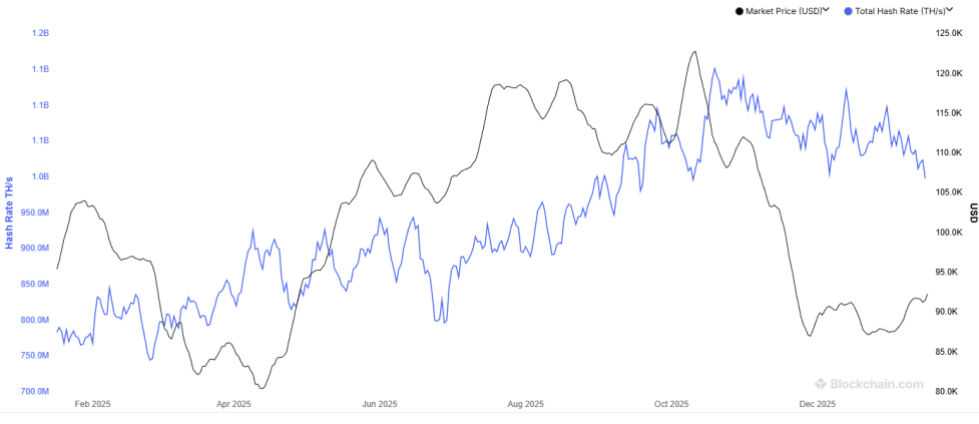
Now, here is a chart from Blockchain.com that shows the trend in the 7-day average value of the Bitcoin Hashrate over the past year:

The 7-day average value of the metric seems to have been going down in recent months | Source: Blockchain.com

As displayed in the above graph, the 7-day average Bitcoin Hashrate set a new all-time high (ATH) around 1,151 exahashes per second (EH/s) back in October. Since this record, however, the indicator’s value has gone down.

What’s behind this trend? The answer to that question could lie in the miner revenue. Miners earn their income through two means: block subsidy and transaction fees. Out of these, the former contributes the largest portion to their revenue.

Block subsidy remains fixed in terms of BTC value (outside of Halving events, during which they permanently get slashed in half), but its USD value changes alongside the cryptocurrency’s price. Thus, miner revenue is more-or-less dependent on the asset’s price action.

Back in October, Bitcoin rallied to a new ATH, so miners responded by upgrading their facilities. When the bullish price action didn’t continue, however, the cohort started pulling back. As a result, the 7-day average Hashrate has fallen to around 998 EH/s, its lowest level in more than three months.

Interestingly, the latest continuation of the decline in the indicator has come despite the fact that the cryptocurrency has made some recovery recently. This may be a possible sign that miners aren’t yet convinced by a return of bullish momentum.

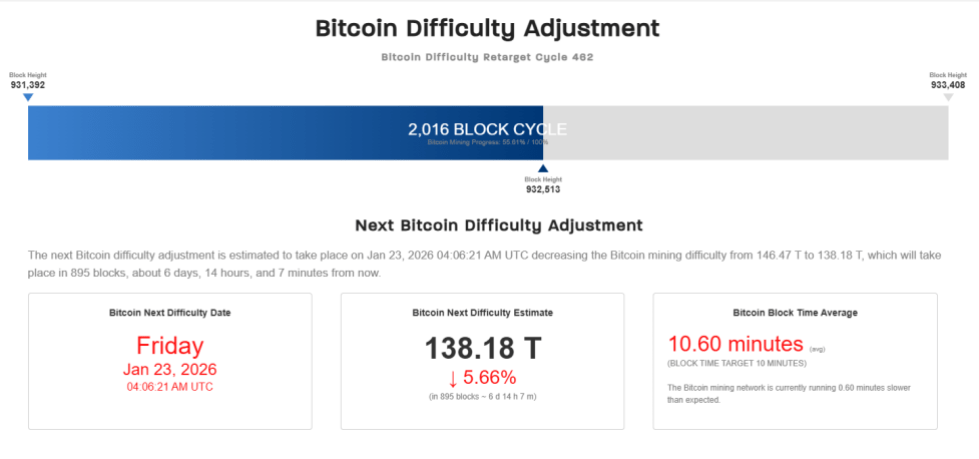
A potential consequence of the Hashrate decline may be a drop in the Bitcoin mining Difficulty during the next network adjustment. According to data from CoinWarz, miners have taken an average of 10.6 minutes per block since the last adjustment, which is notably slower than the blockchain’s target of 10 minutes.

The details related to the upcoming Difficulty adjustment | Source: CoinWarz

To correct for this, Bitcoin could be forced to decrease its Difficulty by 5.6% in the next biweekly adjustment. However, something to note is that there is still about a week to go until this event, so the network’s response could change depending on how the Hashrate behaves in the coming days.

BTC Price

At the time of writing, Bitcoin is floating around $95,500, up more than 5% over the last seven days.

Looks like the price of the coin has gone up recently | Source: BTCUSDT on TradingView

Связанные с этим вопросы

QWhat does the Bitcoin mining hashrate measure and why is it significant?

AThe Bitcoin mining hashrate measures the total amount of computing power that miners have attached to the blockchain. It is significant because it serves as a proxy for the behavior of network validators; an increase suggests mining is attractive, while a decrease may indicate profitability issues.

QWhat was the 7-day average Bitcoin hashrate's all-time high and when was it set?

AThe 7-day average Bitcoin hashrate set a new all-time high of 1,151 exahashes per second (EH/s) in October.

QWhy did the Bitcoin hashrate decline after reaching its all-time high in October?

AThe hashrate declined because Bitcoin's bullish price action did not continue after October, making mining less profitable. Miners responded by decommissioning farms and disconnecting rigs from the network.

QWhat is the potential consequence of the declining hashrate for Bitcoin's mining difficulty?

AThe potential consequence is a drop in Bitcoin's mining difficulty during the next network adjustment. Data suggests a possible decrease of 5.6% to correct for the slower average block time of 10.6 minutes, which is above the target of 10 minutes.

QDespite the recent price recovery of Bitcoin, what does the continued decline in hashrate suggest about miner sentiment?

AThe continued decline in hashrate despite Bitcoin's recent price recovery suggests that miners are not yet convinced by a return of bullish momentum and may still find mining unprofitable or are cautious about reinvesting.

Похожее

Goldman Sachs Bows Down, Bitcoin Finally Breaks Through the Gates of Wall Street

Wall Street giants, including Goldman Sachs, Morgan Stanley, Charles Schwab, and the New York Stock Exchange, have reversed their long-standing opposition to Bitcoin and are now actively embracing it. After years of dismissing Bitcoin as a scam, a bubble, or a tool for illicit activities, these institutions are launching Bitcoin ETFs, enabling spot trading, and building dedicated crypto infrastructure. Goldman Sachs, which once called Bitcoin a "fraud tool," is now offering Bitcoin ETFs. Morgan Stanley, which internally banned the term "cryptocurrency," has launched its largest-ever ETF backed by Bitcoin. Charles Schwab has opened spot crypto trading for its retail clients, integrating Bitcoin alongside traditional assets. The NYSE is building robust infrastructure to support digital assets, signaling a long-term commitment. This dramatic shift is driven not by a change in ideology but by economic necessity. As Bitcoin repeatedly survived market crashes and grew into a multi-trillion-dollar asset class, ignoring it became too costly. Wall Street’s business model relies on capturing fees, and Bitcoin’s rise represented a massive wealth transfer occurring outside their ecosystem. The fear of missing out (FOMO) and client demand forced these institutions to capitulate. The article frames this as a historic surrender to Bitcoin’s mathematical inevitability. Unlike the trust-based traditional financial system, Bitcoin operates on decentralized, transparent, and unchangeable rules. Its scarcity and resilience make it a hedge against fiat currency devaluation and systemic risk. The narrative has flipped: not holding Bitcoin is now seen as the greater risk. The author concludes that Bitcoin has not been co-opted by Wall Street; instead, it has co-opted Wall Street, marking a fundamental shift in the global financial architecture.

marsbit48 мин. назад

Goldman Sachs Bows Down, Bitcoin Finally Breaks Through the Gates of Wall Street

marsbit48 мин. назад

Торговля

Спот
Фьючерсы

Популярные статьи

Тест по Bitcoin Биткоина

HTX Learn: Изучите Bitcoin halving и Заработаете Токены USDT

3.0k просмотров всегоОпубликовано 2024.04.16Обновлено 2024.04.16

Тест по Bitcoin  Биткоина

Что такое $BITCOIN

ЦИФРОВОЕ ЗОЛОТО ($BITCOIN): Комплексный анализ Введение в ЦИФРОВОЕ ЗОЛОТО ($BITCOIN) ЦИФРОВОЕ ЗОЛОТО ($BITCOIN) — это проект на основе блокчейна, работающий в сети Solana, который стремится объединить характеристики традиционных драгоценных металлов с инновациями децентрализованных технологий. Хотя он носит имя Биткойн, часто называемого “цифровым золотом” из-за его восприятия как средства хранения ценности, ЦИФРОВОЕ ЗОЛОТО является отдельным токеном, предназначенным для создания уникальной экосистемы в ландшафте Web3. Его цель — позиционировать себя как жизнеспособный альтернативный цифровой актив, хотя детали его применения и функциональности все еще развиваются. Что такое ЦИФРОВОЕ ЗОЛОТО ($BITCOIN)? ЦИФРОВОЕ ЗОЛОТО ($BITCOIN) — это токен криптовалюты, специально разработанный для использования в блокчейне Solana. В отличие от Биткойна, который выполняет широко признанную роль хранения ценности, этот токен, похоже, сосредоточен на более широких приложениях и характеристиках. Примечательные аспекты включают: Инфраструктура блокчейна: Токен построен на блокчейне Solana, известном своей способностью обрабатывать высокоскоростные и недорогие транзакции. Динамика предложения: ЦИФРОВОЕ ЗОЛОТО имеет максимальное предложение, ограниченное 100 квадриллионами токенов (100P $BITCOIN), хотя детали о его обращающемся предложении в настоящее время не раскрыты. Утилита: Хотя точные функциональные возможности не описаны, есть указания на то, что токен может быть использован для различных приложений, потенциально связанных с децентрализованными приложениями (dApps) или стратегиями токенизации активов. Кто создатель ЦИФРОВОГО ЗОЛОТА ($BITCOIN)? На данный момент личность создателей и команды разработчиков, стоящих за ЦИФРОВЫМ ЗОЛОТОМ ($BITCOIN), остается неизвестной. Эта ситуация типична для многих инновационных проектов в области блокчейна, особенно тех, которые связаны с децентрализованными финансами и феноменом мем-криптовалют. Хотя такая анонимность может способствовать культуре, ориентированной на сообщество, она усиливает опасения по поводу управления и ответственности. Кто инвесторы ЦИФРОВОГО ЗОЛОТА ($BITCOIN)? Доступная информация указывает на то, что у ЦИФРОВОГО ЗОЛОТА ($BITCOIN) нет известных институциональных спонсоров или значительных венчурных капиталовложений. Проект, похоже, функционирует по модели пирингового взаимодействия, сосредоточенной на поддержке и принятии сообществом, а не на традиционных путях финансирования. Его активность и ликвидность в основном сосредоточены на децентрализованных биржах (DEX), таких как PumpSwap, а не на устоявшихся централизованных торговых платформах, что еще больше подчеркивает его подход, ориентированный на grassroots. Как работает ЦИФРОВОЕ ЗОЛОТО ($BITCOIN) Операционные механизмы ЦИФРОВОГО ЗОЛОТА ($BITCOIN) можно подробно описать на основе его дизайна блокчейна и характеристик сети: Механизм консенсуса: Используя уникальный механизм доказательства истории (PoH) Solana в сочетании с моделью доказательства доли (PoS), проект обеспечивает эффективную валидацию транзакций, что способствует высокой производительности сети. Токеномика: Хотя конкретные дефляционные механизмы не были подробно описаны, большое максимальное предложение токенов подразумевает, что оно может быть предназначено для микротранзакций или нишевых случаев использования, которые еще предстоит определить. Интероперабельность: Существует потенциал для интеграции с более широкой экосистемой Solana, включая различные платформы децентрализованных финансов (DeFi). Однако детали относительно конкретных интеграций остаются неуточненными. Хронология ключевых событий Вот хронология, которая подчеркивает значимые вехи, касающиеся ЦИФРОВОГО ЗОЛОТА ($BITCOIN): 2023: Первоначальное развертывание токена происходит в блокчейне Solana, отмеченное его адресом контракта. 2024: ЦИФРОВОЕ ЗОЛОТО приобретает видимость, когда оно становится доступным для торговли на децентрализованных биржах, таких как PumpSwap, позволяя пользователям обменивать его на SOL. 2025: Проект наблюдает спорадическую торговую активность и потенциальный интерес к инициативам, возглавляемым сообществом, хотя на данный момент не зафиксировано никаких значительных партнерств или технических достижений. Критический анализ Сильные стороны Масштабируемость: Основная инфраструктура Solana поддерживает высокие объемы транзакций, что может повысить полезность $BITCOIN в различных сценариях транзакций. Доступность: Потенциально низкая цена торговли за токен может привлечь розничных инвесторов, способствуя более широкому участию благодаря возможностям дробного владения. Риски Отсутствие прозрачности: Отсутствие публично известных спонсоров, разработчиков или процесса аудита может вызвать скептицизм относительно устойчивости и надежности проекта. Волатильность рынка: Торговая активность сильно зависит от спекулятивного поведения, что может привести к значительной волатильности цен и неопределенности для инвесторов. Заключение ЦИФРОВОЕ ЗОЛОТО ($BITCOIN) является интригующим, но неоднозначным проектом в быстро развивающейся экосистеме Solana. Хотя он пытается использовать нарратив “цифрового золота”, его отход от установленной роли Биткойна как средства хранения ценности подчеркивает необходимость более четкого различения его предполагаемой утилиты и структуры управления. Будущее принятие и усвоение, вероятно, будут зависеть от решения текущей непрозрачности и более четкого определения его операционных и экономических стратегий. Примечание: Этот отчет охватывает синтезированную информацию, доступную на октябрь 2023 года, и с тех пор могут произойти события.

99 просмотров всегоОпубликовано 2025.05.13Обновлено 2025.05.13

Что такое $BITCOIN

Fractal Bitcoin: масштабирование Биткоина с помощью рекурсивной системы

Fractal Bitcoin — масштабное Layer-1-решнение, созданное на базе кода Биткоина, позволяющего достигать бесконечного масштабирования с помощью рекурсивного подхода.

2.2k просмотров всегоОпубликовано 2025.06.30Обновлено 2025.06.30

Fractal Bitcoin: масштабирование Биткоина с помощью рекурсивной системы

Обсуждения

Добро пожаловать в Сообщество HTX. Здесь вы сможете быть в курсе последних новостей о развитии платформы и получить доступ к профессиональной аналитической информации о рынке. Мнения пользователей о цене на BTC (BTC) представлены ниже.

活动图片