Bitcoin: A structural shift is underway for BTC – Pressure builds under the surface

ambcryptoОпубликовано 2026-03-29Обновлено 2026-03-29

Введение

Bitcoin is experiencing a period of tight consolidation and muted volatility, with underlying pressure building as short-term holders (STHs) continue to realize losses and sell at a loss. This has resulted in deeply negative STH outflows and only 4.9% of the STH supply remaining in profit, creating significant price resistance. A major capitulation spike occurred in early February, with forced selling driving the price down sharply. However, large holders (whales) are not selling into this pressure. Balances for the 10,000–100,000 BTC and 100,000–1,000,000 BTC cohorts remain steady, indicating deliberate holding and absorption of the supply from stressed sellers. This behavior limits downside follow-through and prevents broader liquidation cascades. Concurrently, long-term holder (LTH) supply remains firm at around 14.8 million BTC, showing no signs of distribution. The monthly net position change has climbed to 353,000 BTC, marking the strongest accumulation since April 2025. Illiquid supply is also rising, indicating coins are moving into wallets with low spending intent. This redistribution of supply from weak hands to strong hands helps stabilize the price and increases the probability of a base formation rather than a further breakdown.

Current market conditions for Bitcoin [BTC] reflected tight consolidation and muted volatility, yet underlying pressure continues to build beneath the surface.

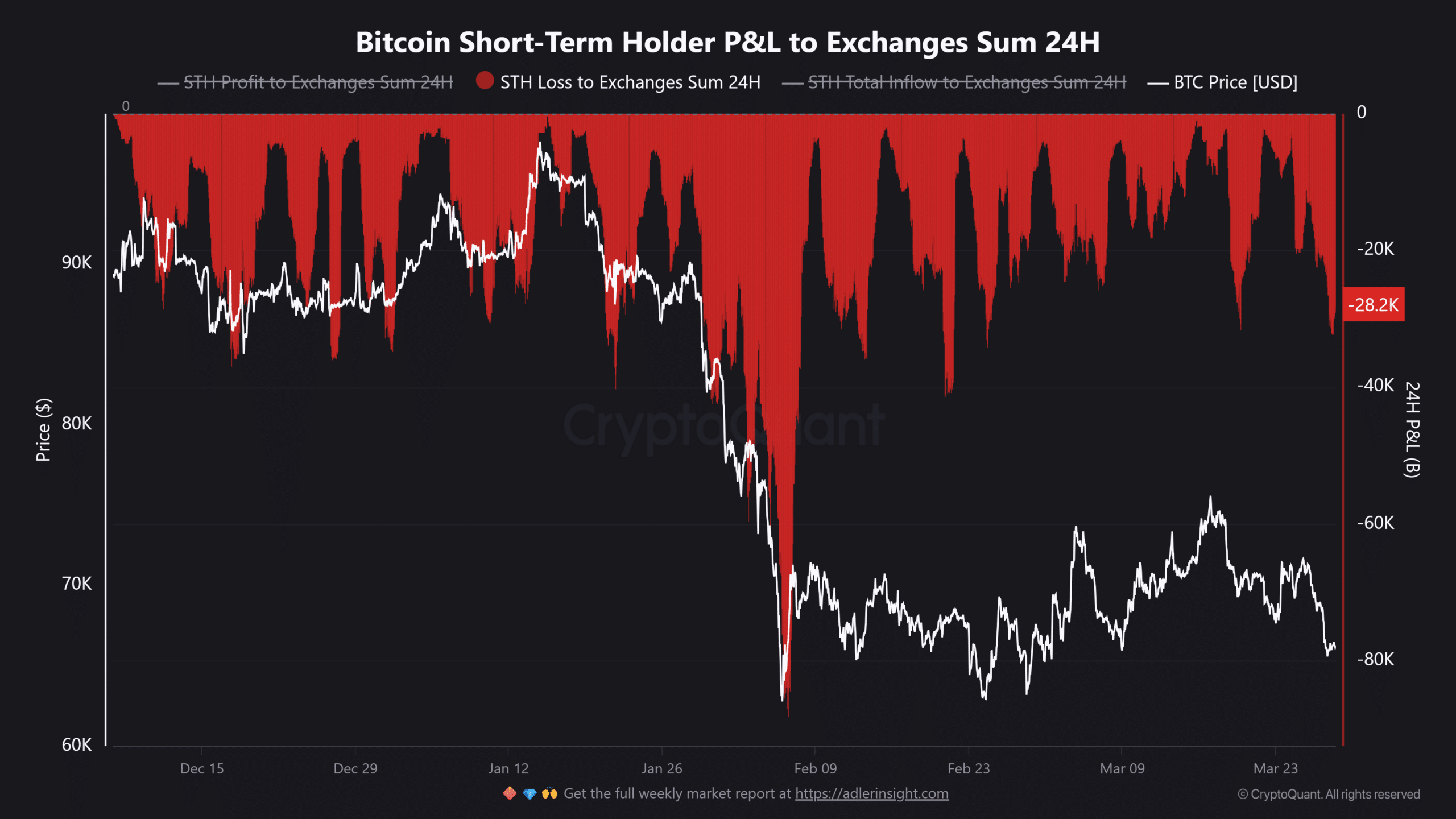
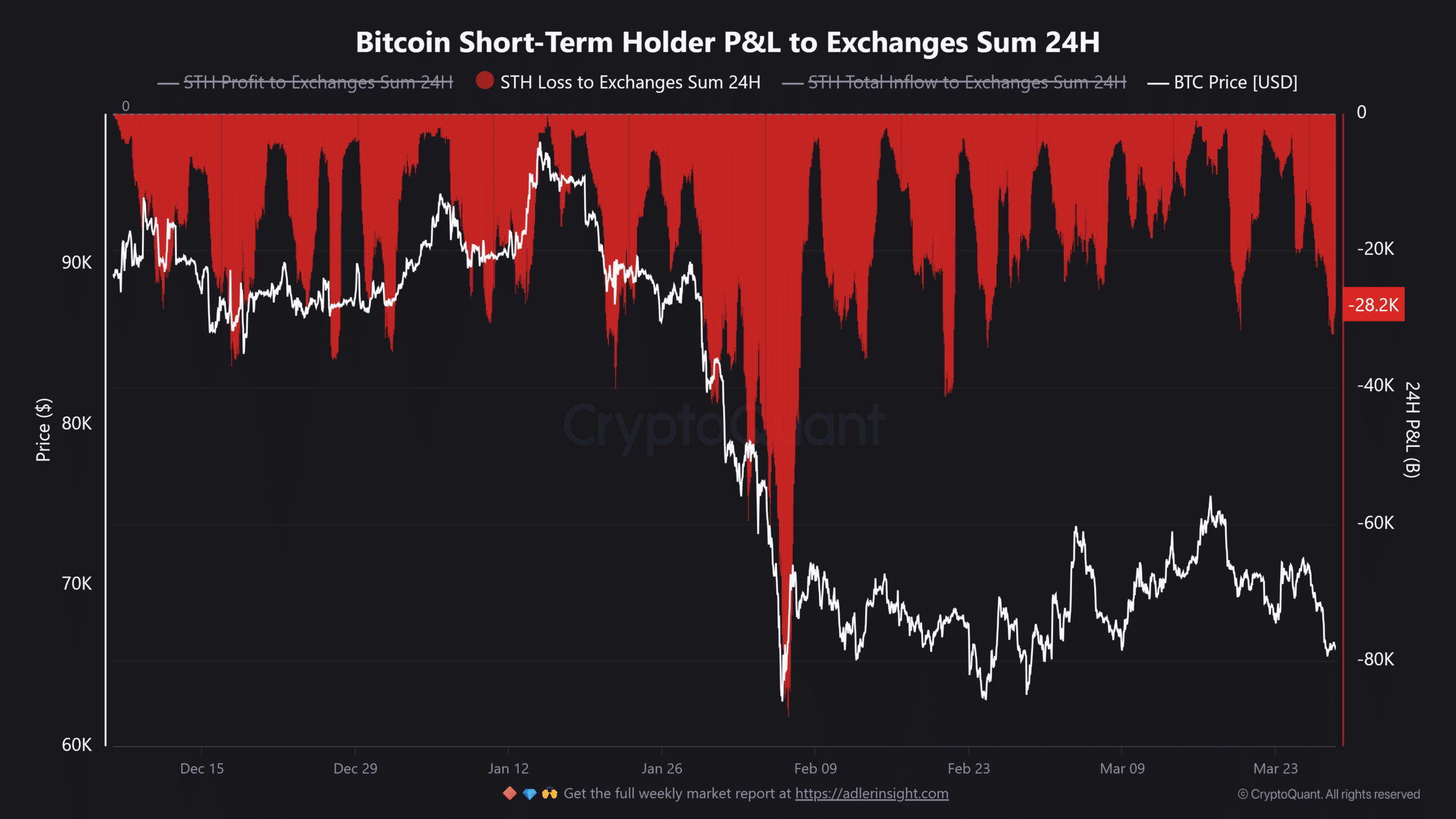
Bitcoin traded within a sideways to bearish consolidation at press time, as loss realization dominated. Short-term holder outflows remained deeply negative across sessions, implying recent buyers were selling at losses, creating heavy price resistance.

A major capitulation spike near -80,000 BTC in early February aligned with a sharp drop from around $90,000 toward $65,000, highlighting forced selling.

Although flows later eased, they still hovered near -28,200 BTC, which signaled persistent stress.

Source: CryptoQuant

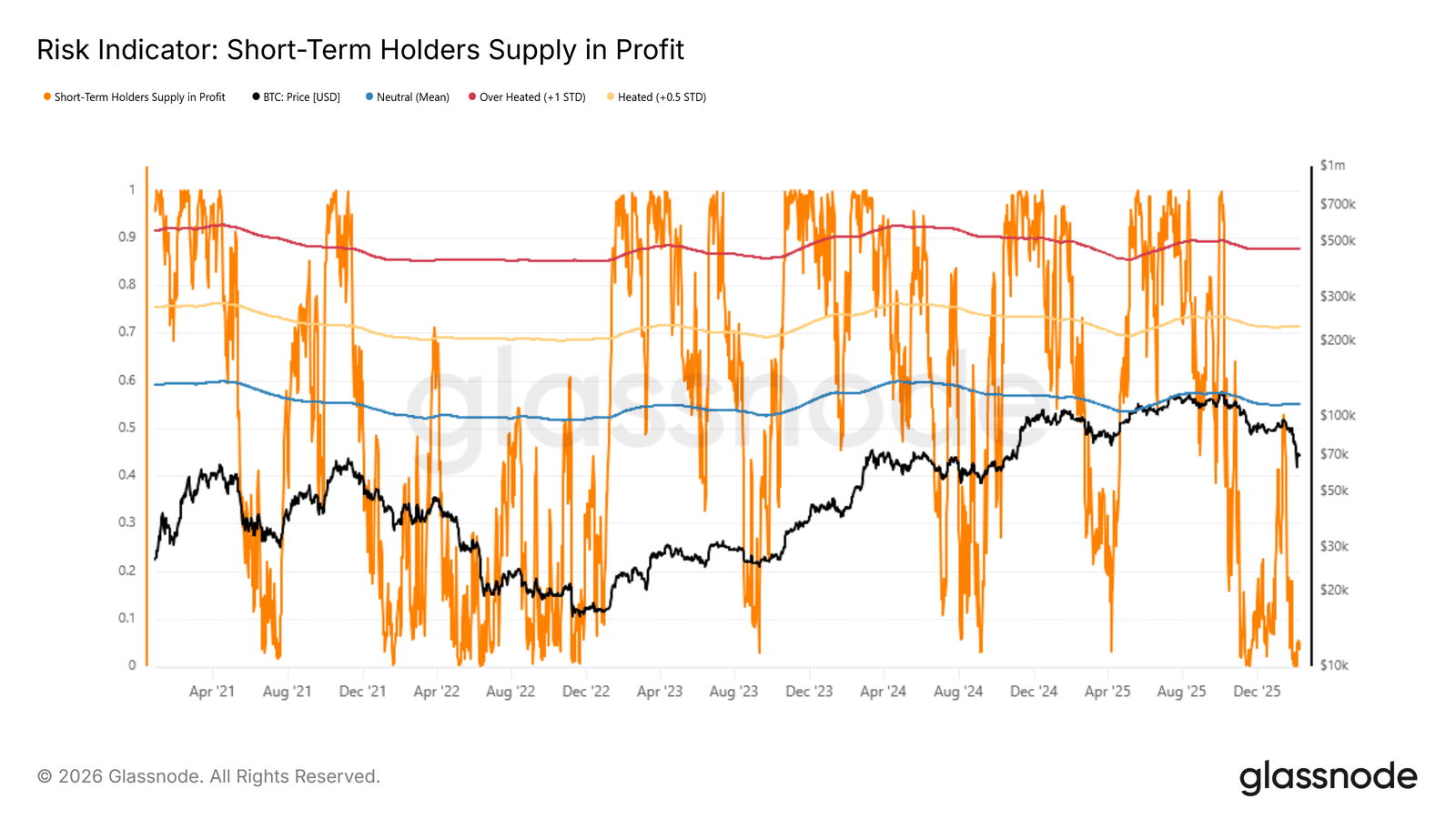
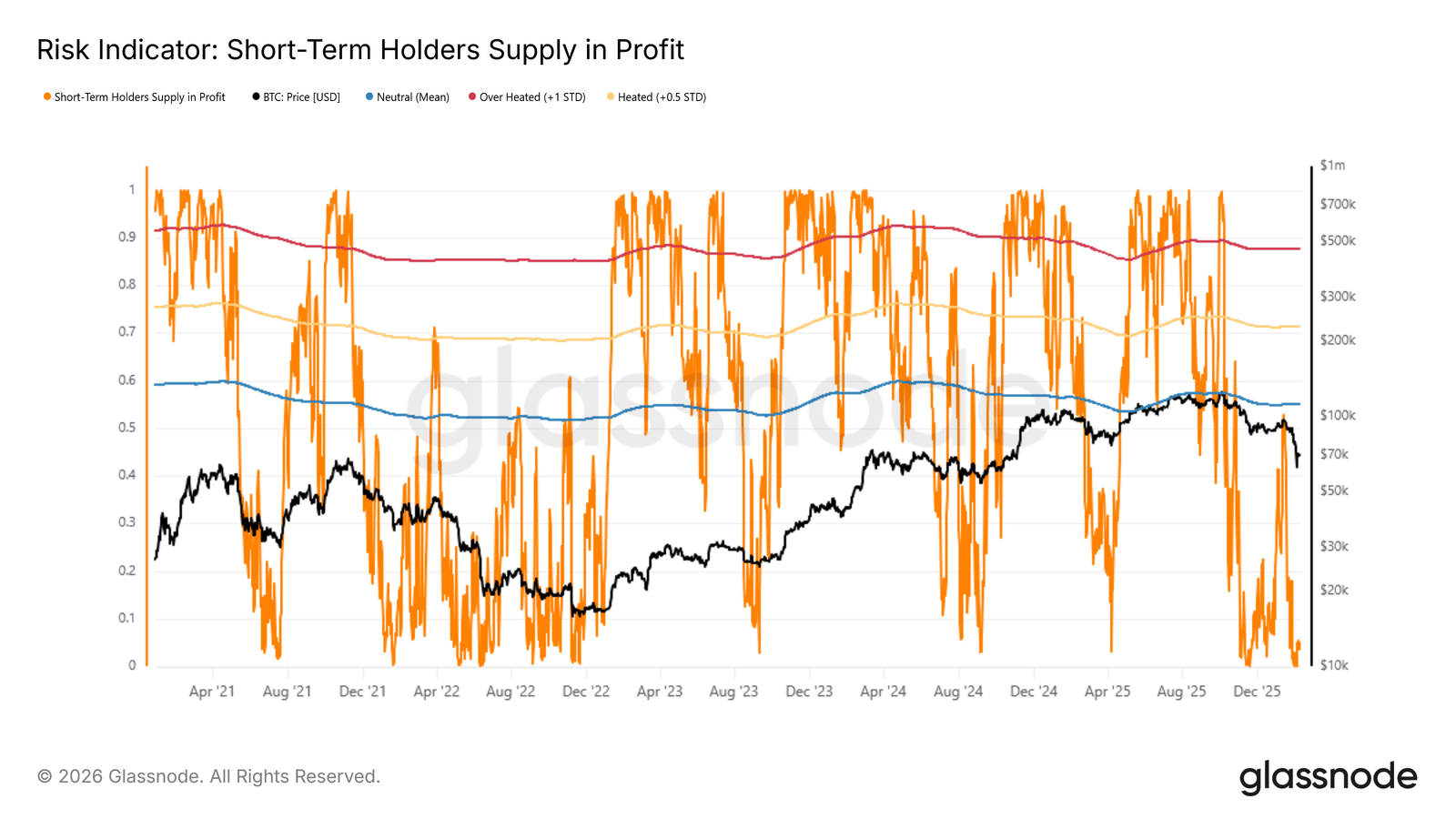
At the same time, only 4.9% of the STH supply remains in profit, while the STH-MVRV at 0.7 kept recent buyers underwater, sustaining sell pressure.

Source: Glassnode

Meanwhile, aggregate NUPL remained positive, showing long-term holders retained strong unrealized profits. As the trend holds, structure stays intact, yet ongoing STH selling continues to cap recovery and delay a breakout.

Whale stability signals absorption as weak-hand selling intensifies

As short-term holders continue to realize losses and exit positions, attention shifts toward who is absorbing this supply. Notably, large holders are not selling into this pressure, which signals restraint.

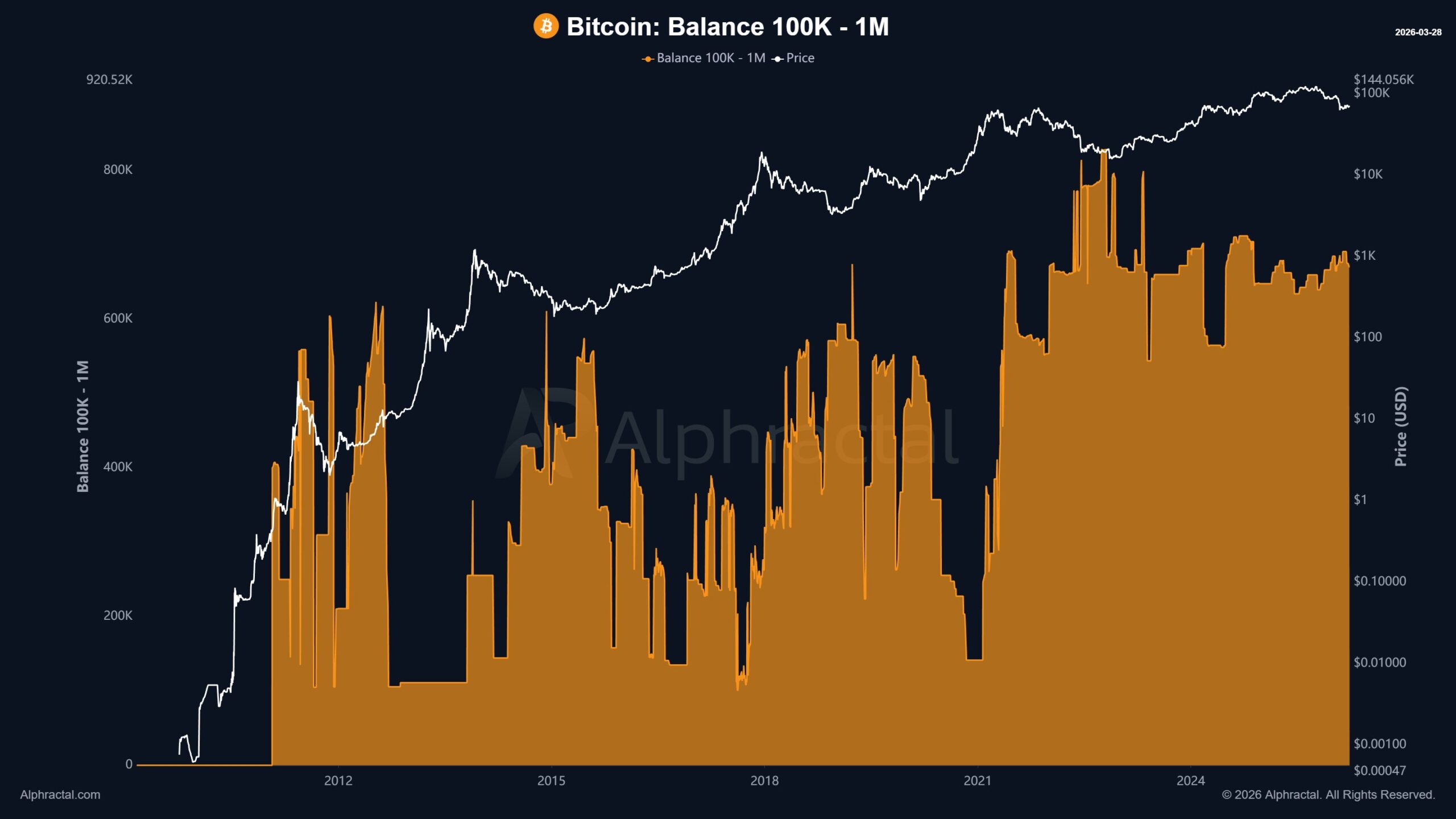
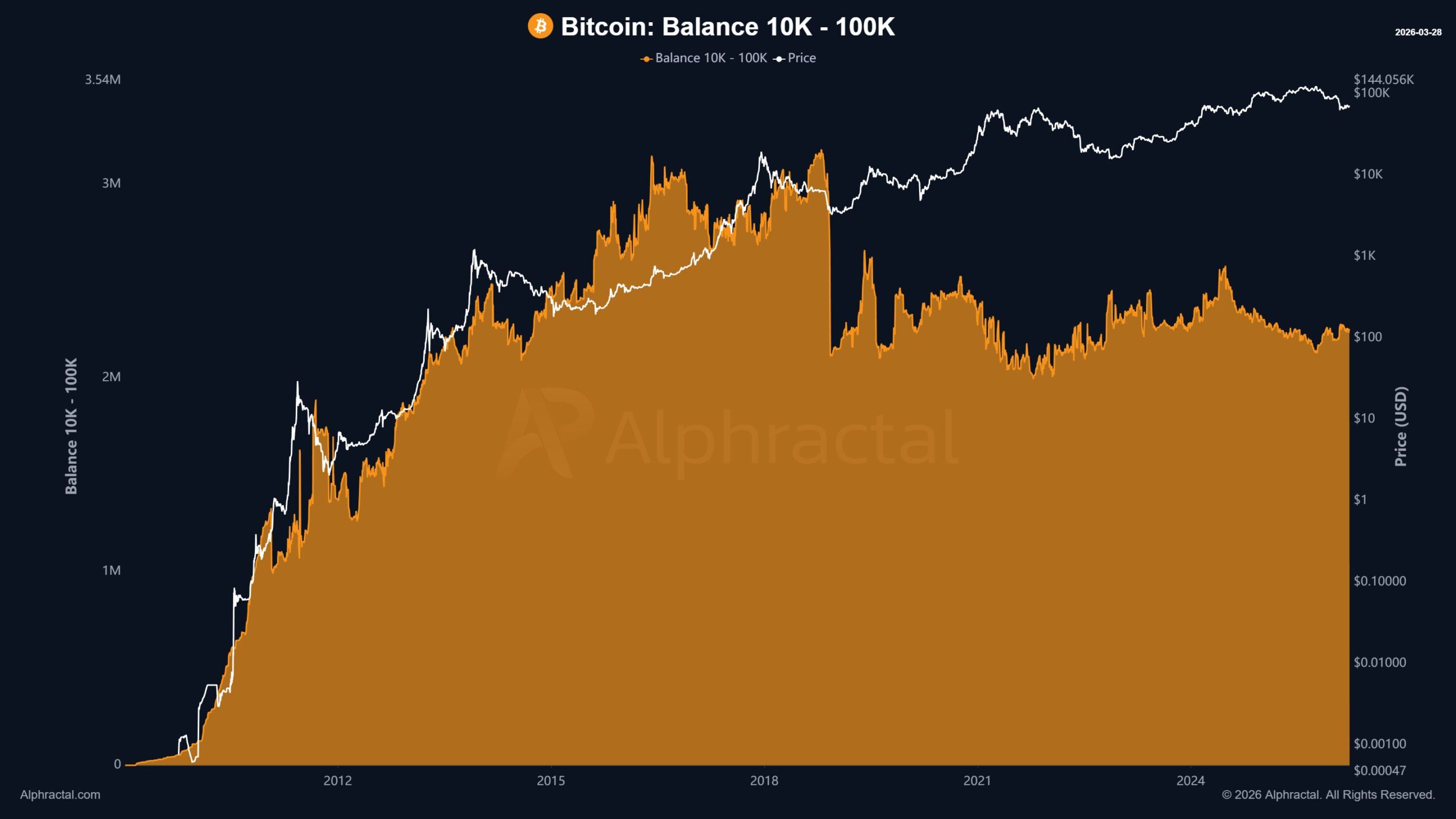
Meanwhile, balances in the 10,000 to 100,000 BTC cohort remain near 3.5 million BTC, showing little deviation. Similarly, the 100,000 to 1 million group holds around 920,000 BTC, maintaining steady exposure.

Source: Joao Wedson/X

Despite price swings from below $1,000 to above $100,000, these balances barely move, which reflects deliberate holding rather than distribution.

Source: Joao Wedson

As weaker hands capitulate, this lack of outflows suggests whales see current levels as unattractive for selling. Instead, they maintain their exposure, absorbing supply from stressed sellers without further destabilizing the price.

This behavior explains why downside follow-through remains limited. Selling exists, yet it fails to trigger broader liquidation cascades.

In effect, the market is rotating supply into stronger hands, which keeps structure intact and increases the probability of stabilization over breakdown.

Strong hands absorb as weak hands exit

As short-term holders continue to exit under pressure, the market begins to reveal where this supply is actually going. This flow is absorbing rather than triggering broader weakness, shifting the narrative toward redistribution instead of breakdown.

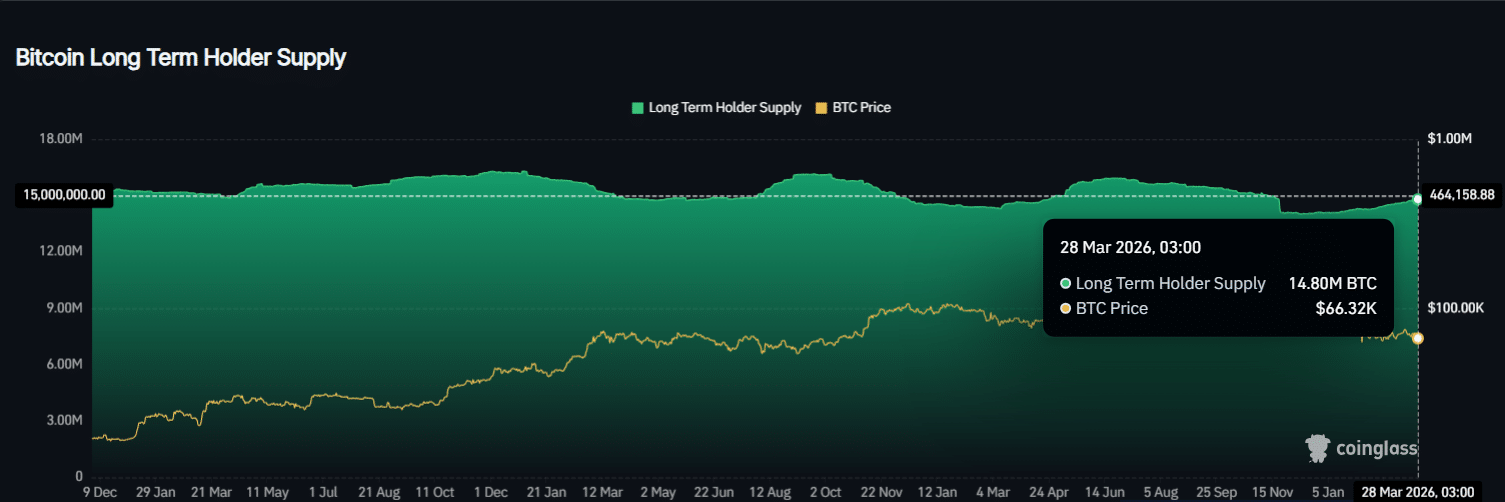
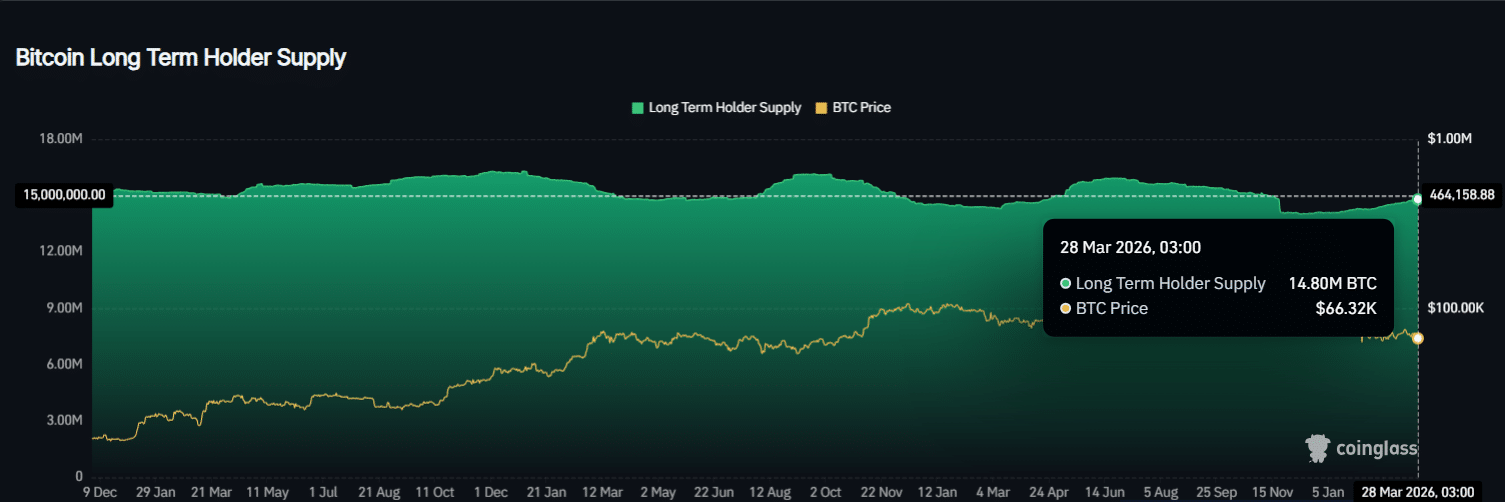
As losses expanded, Long-Term Holder Supply remained firm around 14.8 million BTC, showing no signs of distribution. At the same time, the monthly net position change climbed to 353,000 BTC, marking the strongest accumulation since April 2025.

This suggests larger participants are actively stepping in as weaker hands sell.

Source: CoinGlass

Meanwhile, illiquid supply rises by 86,000–90,000 BTC, indicating coins are moving into wallets with low spending intent. As this rotation unfolds, STH supply contracts while LTH holdings expand, which gradually reduces future sell pressure.

Demand explains why this matters. Spot Taker CVD remains neutral to positive, indicating that buyers are currently meeting sell pressure.

This interaction defines the outcome, as sustained absorption keeps the price stable, increasing the likelihood of base formation rather than further breakdown.


Final Summary

  • STH capitulation drives Bitcoin’s selling, yet whale stability and positive NUPL signal absorption, limiting BTC’s downside.
  • Bitcoin shows redistribution as LTH accumulation and rising illiquid supply stabilize price, increasing base formation probability.

Связанные с этим вопросы

QWhat is the current market condition for Bitcoin according to the article?

ABitcoin is experiencing tight consolidation and muted volatility, with underlying pressure building beneath the surface. It is in a sideways to bearish consolidation phase, dominated by loss realization from short-term holders.

QHow much Bitcoin was involved in the major capitulation spike in early February, and what was the price impact?

AThe major capitulation spike involved nearly -80,000 BTC, which aligned with a sharp price drop from around $90,000 to $65,000, highlighting forced selling.

QWhat percentage of Short-Term Holder (STH) supply remains in profit, and what does the STH-MVRV ratio indicate?

AOnly 4.9% of the STH supply remains in profit, and the STH-MVRV ratio at 0.7 indicates that recent buyers are underwater, sustaining sell pressure.

QHow are large Bitcoin holders (whales) responding to the selling pressure from short-term holders?

ALarge holders are not selling into the pressure; they are maintaining their balances steadily, absorbing supply from stressed sellers without further destabilizing the price, which limits downside follow-through.

QWhat does the increase in illiquid supply and Long-Term Holder (LTH) accumulation indicate for Bitcoin's market structure?

AThe rise in illiquid supply (86,000–90,000 BTC) and strong LTH accumulation (monthly net position change of 353,000 BTC) indicate that coins are moving into stronger hands with low spending intent, reducing future sell pressure and increasing the probability of price stabilization and base formation.

Похожее

The Battle for the AI Payment Race: Traditional Card Networks Face Off Against Coinbase

With the rise of AI agents conducting transactions, a battle for the underlying payment infrastructure is underway. Two distinct and incompatible approaches have emerged for enabling autonomous AI payments. The first approach is championed by traditional card networks Visa and Mastercard. They leverage their existing tokenized card credential systems, extending them to allow verified AI agents to make purchases within user-defined limits. Services like Mastercard's Agent Pay and Visa's Intelligent Commerce integrate with major AI platforms (e.g., OpenAI, Anthropic) and keep transactions within the established, decades-old card payment model. This system offers advantages for consumer retail, including robust fraud protection, chargeback mechanisms, and extensive merchant networks. The second approach, led by Coinbase, utilizes stablecoins on open internet protocols. Its x402 protocol reactivates the HTTP 402 status code for machine-to-machine micropayments, using USDC for settlement directly on-chain. This method eliminates the need for accounts or card fees, making it highly efficient for high-frequency, low-value, cross-border transactions between AI agents—such as paying for API calls, data streams, or computational resources—where traditional card fees and settlement times are impractical. While card networks excel in consumer-facing scenarios requiring dispute resolution, stablecoin protocols are tailored for machine economies. A key challenge for both is agent identity verification and transaction authorization. Notably, Visa and Mastercard are hedging their bets by also investing in stablecoins. Visa has rapidly grown its stablecoin settlement volume and is collaborating with Coinbase to bridge its network with the x402 protocol. Mastercard plans to acquire stablecoin platform BVNK. Their strategy is to become the fee-collecting gateway for all payment flows, regardless of the channel. Current applications reflect this division: consumer AI shopping tools (e.g., ChatGPT's checkout, Amazon's "Shop for Me") predominantly use card networks, while machine-focused services (e.g., Amazon Bedrock's core payments) adopt stablecoins via the x402 protocol. In the short term, a coexistence model is expected, with cards dominating retail and stablecoins powering machine transactions. The long-term outcome depends on whether AI-driven commerce evolves to resemble traditional retail or becomes a vast network of machine micropayments. By investing in both tracks, the incumbent card networks are positioning themselves to capture transaction fees regardless of which future prevails.

marsbit12 мин. назад

The Battle for the AI Payment Race: Traditional Card Networks Face Off Against Coinbase

marsbit12 мин. назад

Farewell to Traditional Bulls and Bears: The Market Has Entered an Era of Rotating Bubbles

Farewell to traditional bull and bear markets; we have entered an era of rolling bubbles. This article uses a meteorological analogy to explain the modern market's shift from slow-moving, long-term trends to a chain of rapid, successive speculative frenzies. The old market resembled "stratiform" weather—slow, broad cycles lasting years. Today's market is like a "mesoscale convective system," where isolated storms (bubbles in sectors like AI, GLP-1 drugs, or crypto) form in sequence. Each is triggered by the outflow of capital and sentiment from the previous one, creating a self-perpetuating chain of booms and busts. This structural change is driven by eight permanent shifts: the democratization of speculation (zero-commission trading, retail options activity), perpetual buying from defined-contribution retirement plans, the dominance of passive investing (creating price-insensitive flows), the rise of multi-strategy funds and high-frequency trading (weakening price discovery), suppressed volatility that erupts violently, an index composition now dominated by long-duration, narrative-driven tech stocks, the elimination of information delays, and a permissive fiscal/monetary backdrop. These conditions ensure that rolling bubbles are the new normal. To navigate this environment, investors should either become deep-sector experts who understand the underlying technologies and business models or become adept observers of trends and capital flows. While chaotic from within each "storm," a higher-altitude view reveals a predictable pattern of serial booms. The key is to avoid being emotionally swept up in any single narrative and to recognize the market's new, permanent structure.

marsbit47 мин. назад

Farewell to Traditional Bulls and Bears: The Market Has Entered an Era of Rotating Bubbles

marsbit47 мин. назад

Торговля

Спот
Фьючерсы

Популярные статьи

Тест по Bitcoin Биткоина

HTX Learn: Изучите Bitcoin halving и Заработаете Токены USDT

3.1k просмотров всегоОпубликовано 2024.04.16Обновлено 2024.04.16

Тест по Bitcoin  Биткоина

Что такое $BITCOIN

ЦИФРОВОЕ ЗОЛОТО ($BITCOIN): Комплексный анализ Введение в ЦИФРОВОЕ ЗОЛОТО ($BITCOIN) ЦИФРОВОЕ ЗОЛОТО ($BITCOIN) — это проект на основе блокчейна, работающий в сети Solana, который стремится объединить характеристики традиционных драгоценных металлов с инновациями децентрализованных технологий. Хотя он носит имя Биткойн, часто называемого “цифровым золотом” из-за его восприятия как средства хранения ценности, ЦИФРОВОЕ ЗОЛОТО является отдельным токеном, предназначенным для создания уникальной экосистемы в ландшафте Web3. Его цель — позиционировать себя как жизнеспособный альтернативный цифровой актив, хотя детали его применения и функциональности все еще развиваются. Что такое ЦИФРОВОЕ ЗОЛОТО ($BITCOIN)? ЦИФРОВОЕ ЗОЛОТО ($BITCOIN) — это токен криптовалюты, специально разработанный для использования в блокчейне Solana. В отличие от Биткойна, который выполняет широко признанную роль хранения ценности, этот токен, похоже, сосредоточен на более широких приложениях и характеристиках. Примечательные аспекты включают: Инфраструктура блокчейна: Токен построен на блокчейне Solana, известном своей способностью обрабатывать высокоскоростные и недорогие транзакции. Динамика предложения: ЦИФРОВОЕ ЗОЛОТО имеет максимальное предложение, ограниченное 100 квадриллионами токенов (100P $BITCOIN), хотя детали о его обращающемся предложении в настоящее время не раскрыты. Утилита: Хотя точные функциональные возможности не описаны, есть указания на то, что токен может быть использован для различных приложений, потенциально связанных с децентрализованными приложениями (dApps) или стратегиями токенизации активов. Кто создатель ЦИФРОВОГО ЗОЛОТА ($BITCOIN)? На данный момент личность создателей и команды разработчиков, стоящих за ЦИФРОВЫМ ЗОЛОТОМ ($BITCOIN), остается неизвестной. Эта ситуация типична для многих инновационных проектов в области блокчейна, особенно тех, которые связаны с децентрализованными финансами и феноменом мем-криптовалют. Хотя такая анонимность может способствовать культуре, ориентированной на сообщество, она усиливает опасения по поводу управления и ответственности. Кто инвесторы ЦИФРОВОГО ЗОЛОТА ($BITCOIN)? Доступная информация указывает на то, что у ЦИФРОВОГО ЗОЛОТА ($BITCOIN) нет известных институциональных спонсоров или значительных венчурных капиталовложений. Проект, похоже, функционирует по модели пирингового взаимодействия, сосредоточенной на поддержке и принятии сообществом, а не на традиционных путях финансирования. Его активность и ликвидность в основном сосредоточены на децентрализованных биржах (DEX), таких как PumpSwap, а не на устоявшихся централизованных торговых платформах, что еще больше подчеркивает его подход, ориентированный на grassroots. Как работает ЦИФРОВОЕ ЗОЛОТО ($BITCOIN) Операционные механизмы ЦИФРОВОГО ЗОЛОТА ($BITCOIN) можно подробно описать на основе его дизайна блокчейна и характеристик сети: Механизм консенсуса: Используя уникальный механизм доказательства истории (PoH) Solana в сочетании с моделью доказательства доли (PoS), проект обеспечивает эффективную валидацию транзакций, что способствует высокой производительности сети. Токеномика: Хотя конкретные дефляционные механизмы не были подробно описаны, большое максимальное предложение токенов подразумевает, что оно может быть предназначено для микротранзакций или нишевых случаев использования, которые еще предстоит определить. Интероперабельность: Существует потенциал для интеграции с более широкой экосистемой Solana, включая различные платформы децентрализованных финансов (DeFi). Однако детали относительно конкретных интеграций остаются неуточненными. Хронология ключевых событий Вот хронология, которая подчеркивает значимые вехи, касающиеся ЦИФРОВОГО ЗОЛОТА ($BITCOIN): 2023: Первоначальное развертывание токена происходит в блокчейне Solana, отмеченное его адресом контракта. 2024: ЦИФРОВОЕ ЗОЛОТО приобретает видимость, когда оно становится доступным для торговли на децентрализованных биржах, таких как PumpSwap, позволяя пользователям обменивать его на SOL. 2025: Проект наблюдает спорадическую торговую активность и потенциальный интерес к инициативам, возглавляемым сообществом, хотя на данный момент не зафиксировано никаких значительных партнерств или технических достижений. Критический анализ Сильные стороны Масштабируемость: Основная инфраструктура Solana поддерживает высокие объемы транзакций, что может повысить полезность $BITCOIN в различных сценариях транзакций. Доступность: Потенциально низкая цена торговли за токен может привлечь розничных инвесторов, способствуя более широкому участию благодаря возможностям дробного владения. Риски Отсутствие прозрачности: Отсутствие публично известных спонсоров, разработчиков или процесса аудита может вызвать скептицизм относительно устойчивости и надежности проекта. Волатильность рынка: Торговая активность сильно зависит от спекулятивного поведения, что может привести к значительной волатильности цен и неопределенности для инвесторов. Заключение ЦИФРОВОЕ ЗОЛОТО ($BITCOIN) является интригующим, но неоднозначным проектом в быстро развивающейся экосистеме Solana. Хотя он пытается использовать нарратив “цифрового золота”, его отход от установленной роли Биткойна как средства хранения ценности подчеркивает необходимость более четкого различения его предполагаемой утилиты и структуры управления. Будущее принятие и усвоение, вероятно, будут зависеть от решения текущей непрозрачности и более четкого определения его операционных и экономических стратегий. Примечание: Этот отчет охватывает синтезированную информацию, доступную на октябрь 2023 года, и с тех пор могут произойти события.

99 просмотров всегоОпубликовано 2025.05.13Обновлено 2025.05.13

Что такое $BITCOIN

Fractal Bitcoin: масштабирование Биткоина с помощью рекурсивной системы

Fractal Bitcoin — масштабное Layer-1-решнение, созданное на базе кода Биткоина, позволяющего достигать бесконечного масштабирования с помощью рекурсивного подхода.

2.3k просмотров всегоОпубликовано 2025.06.30Обновлено 2025.06.30

Fractal Bitcoin: масштабирование Биткоина с помощью рекурсивной системы

Обсуждения

Добро пожаловать в Сообщество HTX. Здесь вы сможете быть в курсе последних новостей о развитии платформы и получить доступ к профессиональной аналитической информации о рынке. Мнения пользователей о цене на BTC (BTC) представлены ниже.

活动图片