Strategy responds to MSCI letter, makes case for index inclusion

cointelegraphPublished on 2025-12-10Last updated on 2025-12-10

Abstract

Strategy, the largest Bitcoin treasury company, has responded to MSCI's proposed policy to exclude companies holding over 50% of their balance sheet in crypto from its indexes. The company argues the change unfairly targets crypto as an asset class, unlike REITs or oil companies, and undermines U.S. leadership in crypto. MSCI contends such firms resemble investment funds, lack uniform valuation methods, and pose systemic risks due to crypto's high volatility and leverage use. The policy, effective January, may force companies to divest crypto, creating market selling pressure. Strategy's stock has fallen over 50% in a year, underperforming Bitcoin itself.

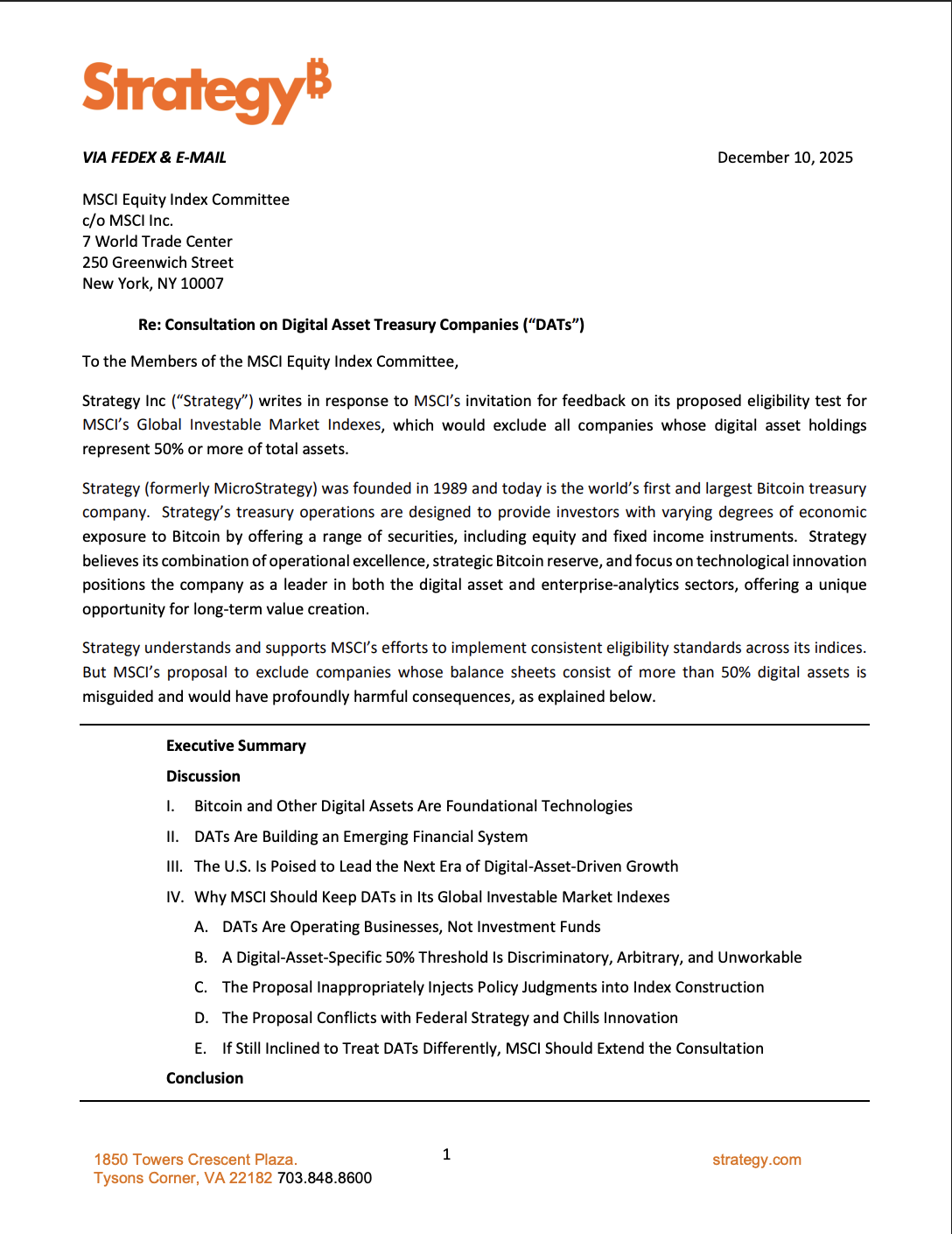
Strategy, the largest Bitcoin treasury company, submitted feedback to index company MSCI on Wednesday about the proposed policy change that would exclude digital asset treasury companies holding 50% or more in crypto on their balance sheets from stock market index inclusion.

Digital asset treasury companies are operating companies that can actively adjust their businesses, according to the letter, which cited Strategy’s Bitcoin-backed credit instruments as an example.

The proposed policy change would bias the MSCI against crypto as an asset class, instead of the index company acting as a neutral arbiter, the letter said.

The first page of Strategy’s letter to the MSCI pushes back against the proposed eligibility criteria change. Source: Strategy

The MSCI does not exclude other types of businesses that invest in a single asset class, including real estate investment trusts (REITs), oil companies and media portfolios, according to Strategy. The letter said:

“Many financial institutions primarily hold certain types of assets and then package and sell derivatives backed by those assets, like residential mortgage-backed securities.”

The letter also said implementing the change “undermines” US President Donald Trump’s goal of making the United States the global leader in crypto. However, critics argue that including crypto treasury companies in global indexes poses several risks.

Related: Strive calls on MSCI to rethink its ‘unworkable’ Bitcoin blacklist

Crypto treasury companies can create systemic risks and spillover effects

Crypto treasury companies exhibit characteristics of investment funds, rather than operating companies that produce goods and services, according to MSCI.

MSCI noted that companies capitalized on cryptocurrencies lack clear and uniform valuation methods, making proper accounting a challenging task and potentially skewing index values.

Strategy held 660,624 BTC on its balance sheet at the time of this writing. The stock has lost over 50% of its value over the last year, according to Yahoo Finance.

Bitcoin (BTC) is also 15% below its value at the beginning of 2025, when it was trading over $109,000, meaning that the underlying asset has outperformed the equity wrapper.

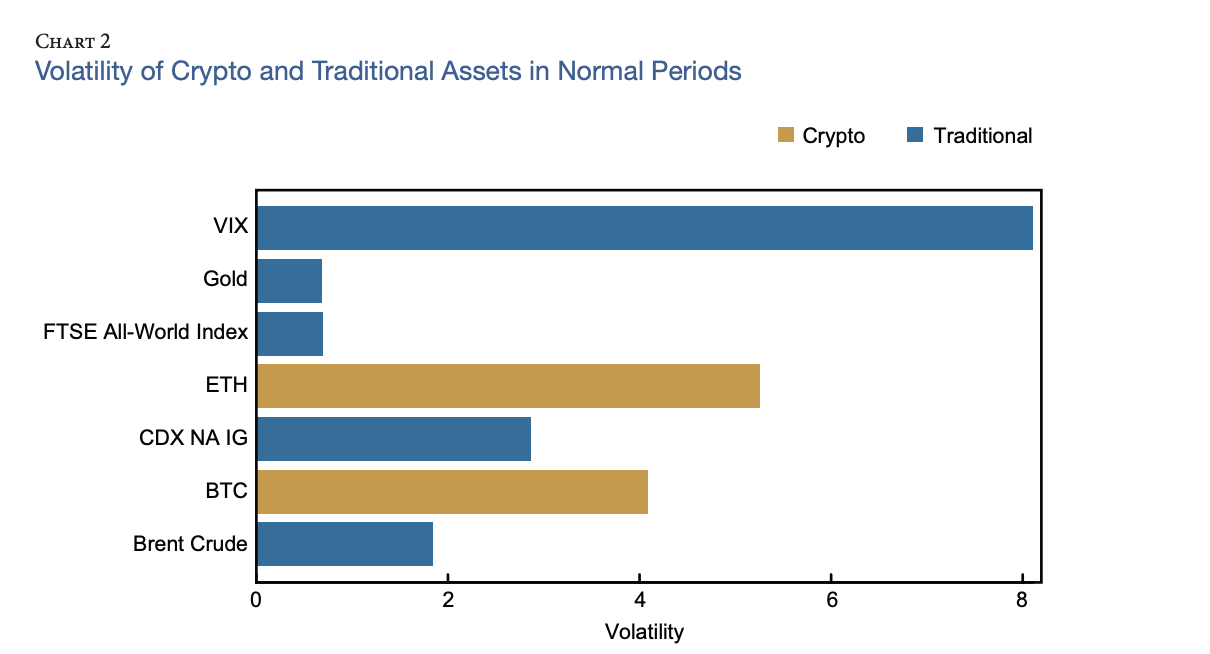
The high volatility of cryptocurrencies may heighten the volatility of the indexes tracking these companies or create correlation risks, where the index performance would mirror crypto market performance, according to a paper from the Federal Reserve.

Bitcoin and Ether volatility compared to stock indexes, oil and gold. Source: The Federal Reserve

The “common use” of leverage by crypto traders amplifies volatility and lends to crypto’s fragility as an asset class, the Federal Reserve wrote.

MSCI’s proposed policy change, set to take effect in January, could also prompt treasury companies to divest their crypto holdings to meet the new eligibility criteria for index inclusion, creating additional selling pressure for digital asset markets.

Magazine: The one thing these 6 global crypto hubs all have in common...

Related Reads

When AI Begins to Audit the World: From Claude Discovering the ZEC Vulnerability, Watching the Encryption Industry Enter the 'Recursive Security Era'

**When AI Audits the World: From Claude's Discovery of a ZEC Vulnerability, Viewing the Crypto Industry Entering a "Recursive Security Era"** This article examines a pivotal shift in the blockchain security landscape, triggered by the convergence of two events: Anthropic's research on AI's "Recursive Self-Improvement" and Claude Opus 4.8's discovery of a critical vulnerability in Zcash's code. Traditionally, crypto security has relied on human experts and automated tools for periodic audits. However, the article argues AI is transitioning from a mere tool to an active participant in understanding and analyzing complex systems. Claude's ability to identify a subtle flaw in Zcash's zero-knowledge proof system demonstrates AI's potential to dramatically lower the cost and time required for risk discovery. This goes beyond finding a single bug; it signals a change in the very mechanism of how vulnerabilities are found. The core thesis introduces the concept of "Recursive Security," drawing a parallel to Anthropic's "Recursive Self-Improvement." Just as AI can accelerate its own development through feedback loops, security systems are evolving towards a continuous cycle of analysis, risk identification, remediation, and re-analysis. Security is becoming a persistent, evolving capability integrated into a system's lifecycle, rather than a one-time pre-launch audit. This shift is particularly urgent for the crypto industry, where system complexity from Layer-2 networks, modular architectures, and ZK-proofs is growing faster than human analysis capacity. AI excels at the pattern recognition and contextual understanding needed to navigate this complexity. Importantly, the article cautions that AI augments both defenders and potential attackers, accelerating the entire threat landscape. The future competitive advantage may not lie in having zero vulnerabilities, but in having the fastest risk discovery, validation, and response capabilities. The Claude-Zcash incident is thus an early signal of an era where AI-driven, recursive security systems become essential for managing risk in an increasingly complex digital world.

marsbit1h ago

When AI Begins to Audit the World: From Claude Discovering the ZEC Vulnerability, Watching the Encryption Industry Enter the 'Recursive Security Era'

marsbit1h ago

From MSTR to STRC+: Where Is the Limit of the Strategy Universe?

From MSTR to STRC+: The Evolution and Limits of the Strategy Universe This article examines the transformation of Strategy (formerly MicroStrategy) from a simple "Bitcoin treasury" company into a complex financial engineering firm building a BTC-backed credit system. **Core Thesis:** Strategy's true significance lies not just in its massive BTC holdings (~844k BTC), but in its attempt to transform this static reserve into a multi-layered credit curve within traditional capital markets and, subsequently, into on-chain yield infrastructure. **The MSTR Flywheel:** The initial model was a reflexive loop: BTC price rises → MSTR stock rises → company raises capital (debt/equity) at a premium → buys more BTC → increases per-share BTC exposure → MSTR premium grows. This "amplified Bitcoin" equity (MSTR) thrives on bullish momentum but is vulnerable to tightening premiums and rising funding costs. **Building the Credit Curve:** Strategy's innovation is slicing its single BTC balance sheet into different risk/return profiles via specialized securities: * **MSTR:** High-volatility equity layer absorbing full BTC upside/downside. * **STRC:** Key product. A perpetual preferred stock designed as "short duration high yield credit," offering ~11.5% floating monthly dividends. It attracts fixed-income investors seeking yield without direct BTC exposure, funding Strategy's operations. * **STRD/STRK/STRF:** Other preferred/share classes with varying durations, conversion rights, and fixed dividends. **Risks of the STRC Model:** STRC's high yield is not risk-free. Its stability depends on: 1) Sufficient BTC asset coverage, 2) Strategy's continued ability to pay dividends, and 3) Market faith in the MSTR/STRC funding flywheel. Stress points include deep BTC price declines eroding the asset buffer, rising dividend costs if STRC trades below par, and a broken flywheel if MSTR's premium (mNAV) falls persistently. **On-Chain Expansion: STRC+:** Projects like **Saturn** and **Apyx** aim to package STRC's (and other DAT preferred stock) cash flows into on-chain stablecoin yield (e.g., sUSDat, apyUSD). They offer DeFi a new yield source distinct from trading fees or incentives—cash dividends from traditional securities. However, this introduces compounded risks: off-chain custody, issuer credit risk, BTC volatility, and protocol execution risk. **Conclusion: The Ultimate Boundary** Strategy's endgame is not infinite BTC accumulation. It is the market's long-term acceptance of a new credit system where BTC serves as collateral for tradable securities whose cash flows can power on-chain financial applications. Its "universe" expands if this BTC-native credit curve gains legitimacy, but contracts if these instruments are repriced purely as high-risk, yield-bearing credit assets without stablecoin mythology.

marsbit1h ago

From MSTR to STRC+: Where Is the Limit of the Strategy Universe?

marsbit1h ago

Trading

Spot
Futures

Hot Articles

How to Buy COMP

Welcome to HTX.com! We've made purchasing Compound (COMP) simple and convenient. Follow our step-by-step guide to embark on your crypto journey.Step 1: Create Your HTX AccountUse your email or phone number to sign up for a free account on HTX. Experience a hassle-free registration journey and unlock all features.Get My AccountStep 2: Go to Buy Crypto and Choose Your Payment MethodCredit/Debit Card: Use your Visa or Mastercard to buy Compound (COMP) instantly.Balance: Use funds from your HTX account balance to trade seamlessly.Third Parties: We've added popular payment methods such as Google Pay and Apple Pay to enhance convenience.P2P: Trade directly with other users on HTX.Over-the-Counter (OTC): We offer tailor-made services and competitive exchange rates for traders.Step 3: Store Your Compound (COMP)After purchasing your Compound (COMP), store it in your HTX account. Alternatively, you can send it elsewhere via blockchain transfer or use it to trade other cryptocurrencies.Step 4: Trade Compound (COMP)Easily trade Compound (COMP) on HTX's spot market. Simply access your account, select your trading pair, execute your trades, and monitor in real-time. We offer a user-friendly experience for both beginners and seasoned traders.

3.7k Total ViewsPublished 2024.03.29Updated 2026.06.02

How to Buy COMP

Discussions

Welcome to the HTX Community. Here, you can stay informed about the latest platform developments and gain access to professional market insights. Users' opinions on the price of COMP (COMP) are presented below.

活动图片