On June 15th, Li Auto detailed the specifics of its in-house developed chip, Mahe M100, during a launch event. This chip is designed for the next-generation L9 Livis. CTO Xie Yan emphasized: It's not just about creating a chip that's faster than before, but about creating a fundamentally different type of chip. This 'difference' refers to the chip architecture.
In 2026, amidst a wave of automakers developing their own chips, TOPS is the most commonly used marketing metric. The NIO Shenji NX9031, Xpeng Turing, and Huawei MDC 810 Pro all prominently feature their computational power figures. Li Auto has chosen to fundamentally alter the underlying architecture.
The Mahe M100 aims to prove that architecture is more important than raw compute numbers. But whether it's right or not still needs to be tested by the market.
01. The Divergence in Chip Development Amidst Compute Power Inflation
Developing in-house chips has become a common choice for leading domestic automakers.
The NIO Shenji NX9031 is the world's first 5nm high-performance autonomous driving chip. Its special feature is its self-developed ISP, which improves pedestrian recognition rate by 40% in low-light conditions of 1 lux at night, showing significant reinforcement at the perception layer.
Xpeng's Turing chip also demonstrates clear customization, specifically designed for Xpeng's autonomous driving large model, with plans to extend to flying cars and robots.
Huawei has taken another path, using Ascend for MDC, emphasizing complete alignment between cloud training and vehicle-side inference, "one minute of training in the cloud, one minute of following in the vehicle."
These companies' chips are variants of the von Neumann architecture: a central processing unit, with data being shuttled back and forth between computing units and memory. The more advanced the process node, the faster the data moves, but the Mahe M100 aims to change the very act of moving data itself.
02. Altering the Underlying Logic
The von Neumann architecture wasn't a problem in the era of general-purpose computing, but large model inference is a different computational paradigm. VLM inference involves large-scale matrix parallelism, not sequential instruction execution. The bottleneck is almost entirely in memory bandwidth; the overhead of data repeatedly moving in and out of memory directly consumes a significant portion of the effective computing power.
The concept of the dynamic dataflow architecture is to allow data to flow along the computational graph, eliminating the need to repeatedly store it back in memory. Li Auto claims the result is that a single Mahe M100 chip offers approximately 3 times the effective computing power of NVIDIA's Thor U, with a 40% reduction in end-to-end latency.
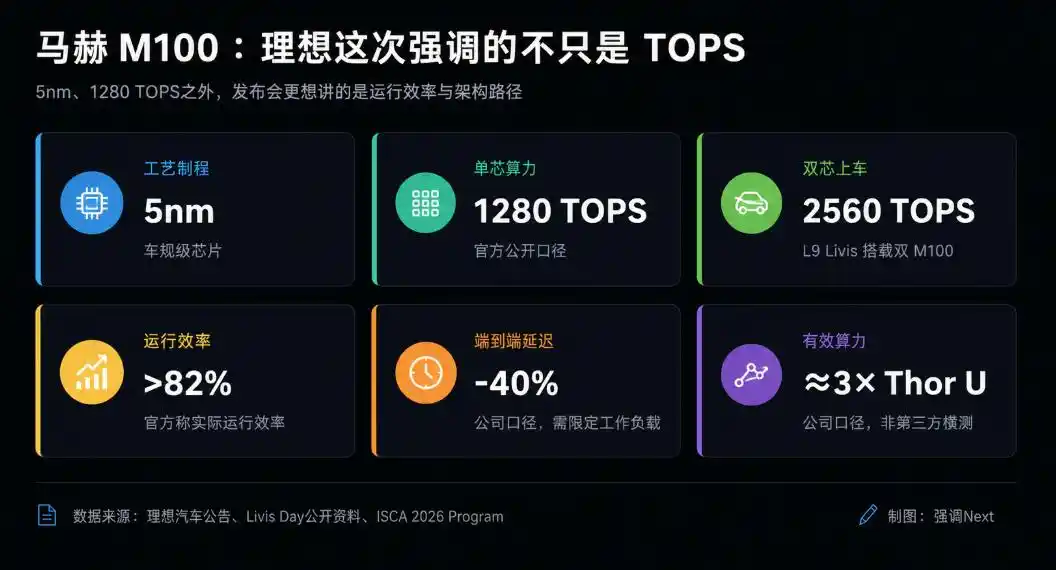
How credible is this "3 times" claim? There is one piece of external verification. The architecture paper for the Mahe M100 was accepted into the Industry Track of ISCA 2026. ISCA is a top-tier academic conference in computer architecture. Papers in the Industry Track undergo peer review, and the design details of the architecture are public. Li Auto is the first automobile manufacturer ever to be selected for this track since its establishment.
However, the 3x figure comes with its prerequisites. Effective computing power depends on the specific workload. The 3x performance achieved while running Li Auto's VLA2.1 algorithm may not hold up under a different system. The Mahe M100 is an algorithm-native chip, developed simultaneously with the model, deeply optimized for the company's own algorithms. It runs its own models best; performance on general tasks may vary.
This shares similarities with the design logic of Xpeng's Turing chip and Tesla's FSD Chip. The difference is that Tesla and Xpeng didn't make a paradigm shift at the architecture level; the Mahe M100 has made fundamental changes to the underlying logic. Whether an automaker can successfully bring a completely new architecture to reliable mass production is itself an unprecedented challenge.
With the deployment of the Mahe M100, Li Auto has achieved full-stack in-house development across chips, compilers, operating systems, AI algorithms, and domain controllers. This closed-loop system is uncommon among its peers.
NIO has its own chip but different levels of OS dependency. Xpeng develops its own chip but its compiler and OS still rely on external solutions. Huawei has a closed loop, but it is not a vehicle manufacturer. The strategic significance of Li Auto's chain lies in making it less susceptible to NVIDIA's supply chain control, keeping data within its own platform, and fully owning the optimization space for software-hardware synergy.
03. First-Mover Positioning in "Embodied AI"
The chip was only one of the stars of the launch event. Li Xiang also proposed a "Four-in-One" definition for embodied AI cars during the presentation: an electric vehicle, a professional driver, an AI computer, and a life assistant.
This marks a significant departure from Li Auto's past brand narrative.
In 2023, the L9 penetrated the 300,000 to 500,000 RMB market with its "Large Six-Seat Family SUV" positioning, followed by a generation of similarly styled models. The problem with this positioning is its low replication cost. Competitors like the AITO M9, NIO ES9, and Zeekr 9X have entered the fray. Refrigerators, screens, and large sofas have become industry standards, making it hard for any player to differentiate, leading only to price wars.
The "Embodied AI Car" shifts the competitive dimension from configurations to system capabilities. Within this framework, refrigerators and rear-seat screens are basic features. The differentiation point becomes "whose system can perceive, think, and grow." Defining a new category itself is a strategic asset; whoever articulates it first gains positioning.
Li Auto has matched this narrative with a relatively complete technological chain: the Mahe M100 computing foundation, the Mahe VLA2.1 autonomous driving large model, the Mahe Mind-Pro and Mind-Edge edge-side foundation models, and the Starlink OS for full-stack integration, with each layer having corresponding product implementations.
The launch event demonstrated features like the vehicle moving to music, a 4D racing simulator, and command-based parking – these are tangible experiences. Li Xiang also stated during the launch that autonomous driving is only the "first half" of embodied AI, with general-purpose humanoid robots being the "second half," but the specific timeline and implementation path for the second half remain unclear.
04. The Q4 Mandate
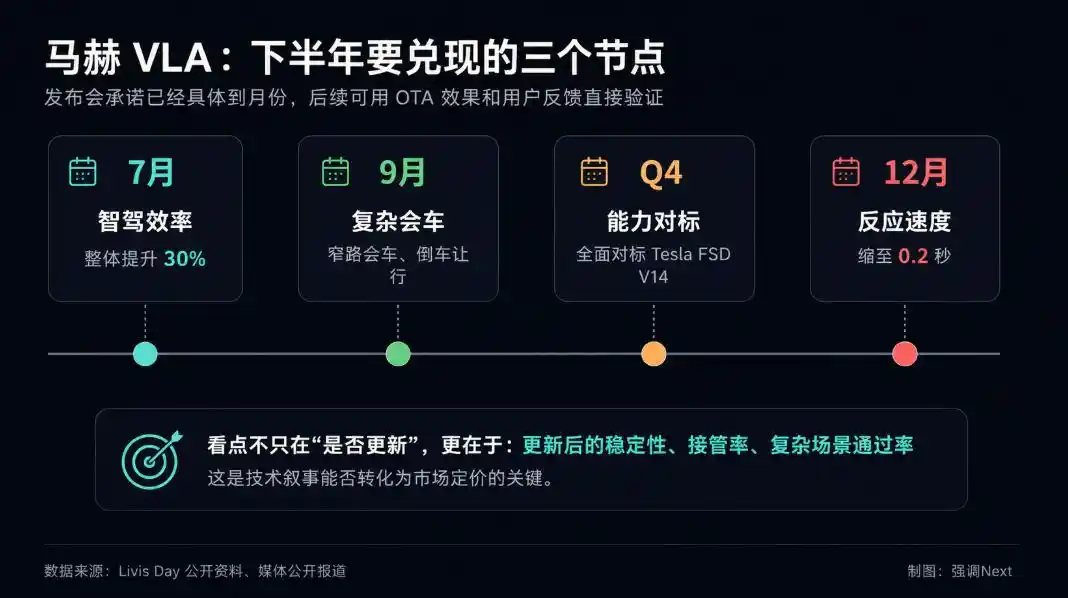
There was another crucial statement during the launch: Li Auto's autonomous driving large model, Mahe VLA, will comprehensively benchmark against Tesla's FSD V14 in Q4 of this year.
Li Xiang's consistent style is to make public commitments, using external pressure to drive internal execution. Having stated Q4 benchmarking against FSD V14, everyone will use that ruler to measure them by year-end.
In terms of technical route, Li Auto's choice is highly isomorphic to Tesla's: end-to-end + VLA large model + primarily vision-based. Huawei follows a path of lidar + multi-sensor fusion + a hybrid of rules and neural networks, offering stable short-term engineering implementation with lower compute demands. However, in the long run, if the vision-based + large model route ultimately prevails, Huawei's system may face greater switching costs. Li Auto is betting on the same technological belief as Tesla. Whether this judgment is correct will become clearer by year-end.
The OTA promises for the second half of the year are specified by month. July: a 30% improvement in autonomous driving efficiency. September: implementation of narrow-road meeting/backing-up yielding. December: vehicle response speed reduced to 0.2 seconds. Each milestone has clear technical indicators, providing data for comparison by year-end.
05. Several Data Points Beyond the Launch Event
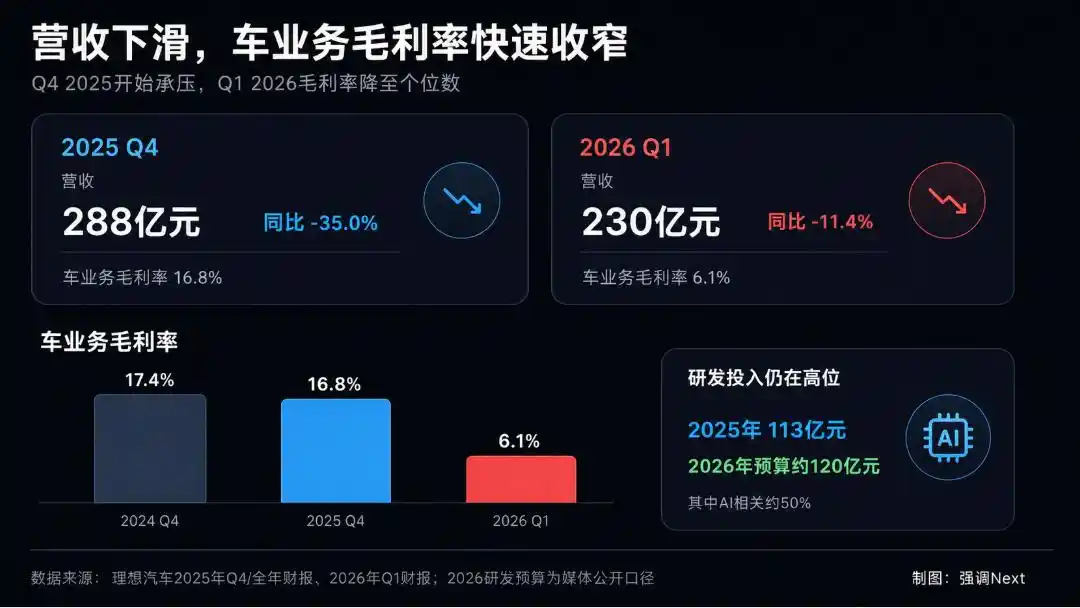
Li Auto's current financial situation is not easy. Since Q4 2025, its revenue has declined year-over-year, and automotive business gross margins have noticeably narrowed. Meanwhile, the R&D budget for 2026 remains around 12 billion RMB, with approximately 50% allocated to AI-related areas, essentially flat compared to 11.3 billion RMB and 50% in 2025. R&D investment is not decreasing, yet profitability pressure persists.
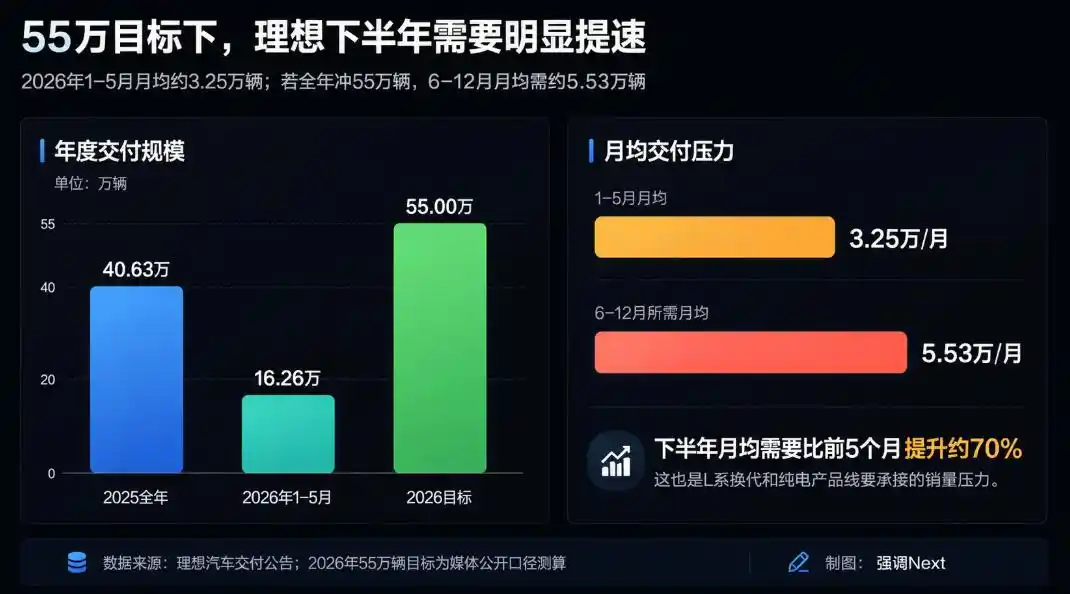
In terms of sales, Li Auto's target for 2026 is 550,000 units. Actual deliveries in 2025 were 406,000 units. May 2026 saw single-month deliveries of 33,000 units, still showing a year-over-year decline. The L9 Livis received over 10,000 non-refundable deposits within two weeks of launch, showing stable performance in the 500,000+ RMB market. However, overall delivery volume still relies on the full model changeover of the L series and the release of the pure electric product line in the second half of the year.
At the chip level, the deep binding of the Mahe M100 with its own algorithms is a design choice that brings advantages in software-hardware synergy efficiency. This also means that if future technological routes require adjustment, the switching cost would be higher than for manufacturers using third-party chip solutions. Xpeng's Turing, NIO's Shenji, and Tesla's FSD Chip face similar situations; this is an industry-wide characteristic of in-house developed, algorithm-native chips.
06. Q3 Will Reveal the Cards
The initial effects of the new L9 launch, the subsequent L8 update, and the first July OTA milestone will all be reflected in the Q3 financial report.
Xie Yan said he needed to create a completely different chip. Having the architecture paper pass peer review counts as external validation of the design concept. But the journey from design to mass production, and then to real user feedback in daily driving, is still long. The July OTA milestone is the first test; the year-end benchmarking against FSD V14 is an even more critical one.
This article is from the WeChat public account "EmphasizeNext" (ID: leo89203898), author: Yixiu, editor: Xiaobai