A Longer Iran War Could Send Bitcoin Higher, Arthur Hayes Says

bitcoinist发布于2026-03-02更新于2026-03-02

文章摘要

Arthur Hayes, co-founder of BitMEX, argues that a prolonged US military conflict with Iran could become a bullish catalyst for Bitcoin. He suggests that such a war would likely pressure the Federal Reserve to implement monetary easing—cutting interest rates and increasing liquidity—to support the economy and stabilize markets amid heightened uncertainty. Hayes cites historical precedents, including the Fed's responses to the Gulf War and the 9/11 attacks, where geopolitical shocks led to easier monetary policy. He advises waiting for clear policy signals, like a Fed rate cut, before aggressively buying Bitcoin and other cryptocurrencies. At the time of writing, Bitcoin was trading at $66,218.

Arthur Hayes argues that a deeper US conflict with Iran could ultimately become a bullish macro setup for Bitcoin, not because war is constructive for markets, but because it may push the Federal Reserve toward cheaper and more abundant money.

Why Bitcoin Could Surge

In his March 2 essay iOS Warfare, the BitMEX co-founder laid out a simple thesis: if President Donald Trump commits the US to a prolonged and expensive campaign tied to Iran, the political and fiscal strain could raise the odds of monetary easing. For Hayes, that matters more than the conflict itself. “The longer Trump engages in the extremely costly activity of Iranian nation-building,” he wrote, “the higher the likelihood the Fed lowers the price and increases the quantity of money to support Pax Americana’s latest bout of Middle Eastern adventurism.”

Hayes’ argument rests on a historical pattern rather than a direct forecast on oil, geopolitics or battlefield outcomes. He points to prior US military engagements in the Middle East and says major conflicts were followed, or accompanied, by easier monetary policy. In his reading, wars do not just damage confidence and strain public finances; they also create conditions in which the Fed has cover to cut rates, support liquidity and help stabilize asset markets.

To support that view, Hayes cites several episodes going back to 1990. After the Gulf War began, he notes, the Fed initially stayed put but signaled that worsening conditions could force a shift. From the August 21, 1990 FOMC discussion, he quotes: “The heightened uncertainties and the prospectively less satisfactory performance of the economy stemming from events in the Middle East had greatly complicated the formulation of an effective monetary policy. In the opinion of several members, events appeared likely to unfold in a direction that would require an easing of policy at some point to counter weakening tendencies in the economy that had been in train before the oil price increase.”

He also highlights the Fed’s response after the September 2001 attacks and the launch of the Global War on Terror. In an emergency meeting, then-Chair Alan Greenspan said: “It’s clear that the events of last week, at a minimum, have created a heightened degree of fear and uncertainty that is placing considerable downward pressure on asset prices, increasing the probability of an asset price deflation, with its obvious impact on the economy. Therefore, I propose a 50-basis point cut in the federal funds rate target.”

For Hayes, those episodes show that geopolitical shocks can become monetary events. His framing is blunt: when war dents confidence, threatens growth or pressures markets, the policy answer tends to be lower rates and more liquidity. That, in turn, is the backdrop he believes tends to favor Bitcoin.

Still, Hayes is not calling for an immediate risk-on trade. He says the market does not yet know how long Trump would stay committed to reshaping Iran, nor how much market or political pain the administration can absorb before changing course. Because of that, he argues the cleaner trade is to wait for confirmation from policy rather than front-run the thesis too early.

“The prudent action is to wait and see,” Hayes wrote. “The time to back up the truck and buy Bitcoin and high-quality shitcoins like HYPE is immediately after the Fed cuts rates and or prints money to support the government’s goals in Iran.”

At press time, Bitcoin traded at $66,218.
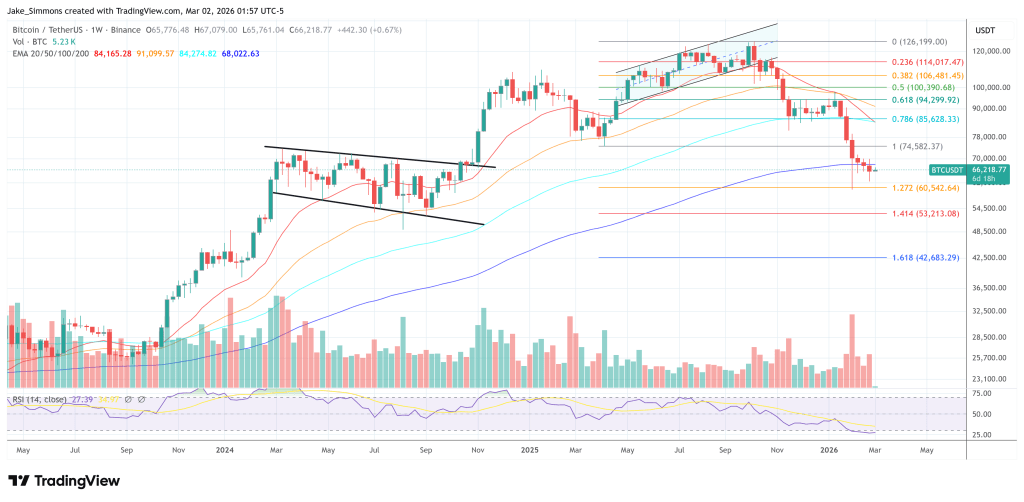
Bitcoin must reclaim the 200-week EMA, 1-week chart | Source: BTCUSDT on TradingView.com

热门币种推荐

相关问答

QAccording to Arthur Hayes, why could a prolonged US conflict with Iran become a bullish setup for Bitcoin?

ABecause it may push the Federal Reserve toward implementing cheaper and more abundant monetary policy (like cutting rates and increasing liquidity) to support the costly military campaign, which historically creates a favorable macro environment for Bitcoin.

QWhat historical pattern does Hayes cite to support his argument about war and monetary policy?

AHe points to prior U.S. military engagements in the Middle East, such as the Gulf War and the post-9/11 Global War on Terror, which were followed or accompanied by easier monetary policy from the Fed to counter economic weakening and stabilize markets.

QWhat specific Fed actions from history does Hayes reference?

AHe quotes from the August 1990 FOMC discussion about the potential need for easing due to the Gulf War and highlights then-Chair Alan Greenspan's emergency 50-basis-point rate cut following the September 2001 attacks.

QWhat is Hayes' recommended trading strategy based on his thesis?

AHe advises a prudent 'wait and see' approach, suggesting that the 'cleaner trade' is to wait for confirmation from Fed policy (like an actual rate cut or money printing) before buying Bitcoin and other cryptocurrencies.

QWhat key technical level for Bitcoin is mentioned in the article's chart caption?

AThe chart caption states that Bitcoin must reclaim the 200-week Exponential Moving Average (EMA).

你可能也喜欢

比特币八月行情:专家预计将测试价格区间,而非快速反转

比特币在八月可能继续承压,分析师预计市场将测试关键区间而非快速反转。七月比特币从多年低点反弹,但专家认为持续上涨条件尚不成熟,价格仍有跌至6万美元以下的风险。截至七月底,比特币交易于约6.35万美元,较2025年10月的历史高点下跌约50%。市场目前处于6万至6.5万美元的窄幅区间内。 分析师指出,高利率、持续通胀、强势美元以及石油价格等因素共同构成不利的宏观经济背景,压制了比特币价格。此外,美国国债等传统资产的高收益率吸引了部分资金,而加密货币ETF资金持续流出(上半年净流出54亿美元),显示机构需求疲软。 从历史数据看,八月通常是加密货币的弱势月份。专家认为市场可能正处于新周期开始前的最后阶段,建议投资者可考虑逐步积累仓位,但需警惕短期波动。 主要预测场景如下: - 基本情况(50%概率):在5.8万至6.8万美元区间震荡。 - 负面场景(30%概率):跌破5.8万美元,下探5万至5.5万美元。 - 正面场景(20%概率):突破6.7万美元,目标看向7.1万至7.5万美元。 关键支撑位在6万至6.1万美元附近,而稳定在6.7万美元上方可能打破下跌趋势。部分分析师认为,即便反弹至7万美元,也可能出现新一轮下跌,长期目标位指向约5.3万美元区域。多数观点认为,更显著的趋势性行情可能需等到今年第四季度。 投资者在八月需密切关注利率、通胀数据、ETF资金流、市场风险偏好以及主要参与者的动向,这个月可能更多是对耐心的考验,而非实现重大突破的时机。

cryptonews.ru2小时前

比特币八月行情:专家预计将测试价格区间,而非快速反转

cryptonews.ru2小时前

Coldcard硬件钱包被黑:黑客在25分钟内转走594枚比特币

硬件钱包Coldcard遭黑客攻击:25分钟内损失594枚比特币 硬件钱包长期以来被认为是存储数字货币最安全的方式,但Coinkite公司设备近期发生的事件迫使许多人重新审视这一观点。2026年7月30日,攻击者在短短25分钟内从500个地址转走了594.5枚比特币(约合4000万美元)。 问题的根源在于一个潜伏了五年的软件代码错误。Coldcard本应通过安全芯片生成真随机数来创建种子短语,但由于一个宏定义中的笔误,Coinkite的开发者早在2021年3月就意外禁用了此功能。这导致设备转而基于可预测的数据(如处理器序列号和内部系统时钟)生成密钥,使得生成的种子短语看似安全,实则因生成过程可预测而极易被破解。对于Mk2和Mk3型号,密钥搜索空间骤降至约40位,而更新的Mk4、Mk5和Q型号的最终熵值也仅为约72位,远低于所需的128位。 攻击者无需物理接触设备或进行网络钓鱼。他们仅利用了有缺陷的生成器参数,在离线状态下进行大规模枚举,生成了数百万可能的种子短语,并通过公开账本找到有余额的地址,自行签署了转账交易。 Coinkite最初声称新版本设备不受影响,但后续分析迫使公司承认所有运行受影响固件的设备均存在风险。公司负责人Rodolphe Novak已公开道歉,但排除了对受损用户进行经济补偿的可能性。 对于已创建种子短语的用户,仅更新固件无法消除风险。必须将设备更新至安全版本固件,在更新后的设备上生成全新的种子短语,并将所有资金完全转移到由此新种子短语生成的新地址。使用BIP-39标准的密码短语可降低风险,但不能替代密钥迁移。公司的其他产品如TAPSIGNER等未受此次事件影响。 此事件表明,即使是专用硬件也需要对代码进行持续独立的审计,尤其是在加密功能方面。从机器分析角度看,这与过去OpenSSL等随机数生成器缺陷长期未被发现的情况类似。开源代码理论上可通过独立审计和自动化工具加速发现此类错误,但此次漏洞潜伏五年表明理论与实践仍有差距。

cryptonews.ru2小时前

Coldcard硬件钱包被黑:黑客在25分钟内转走594枚比特币

cryptonews.ru2小时前

交易

现货

热门文章

加密市场宏观研报:《GENIUS Act》法案取得重大进展,BTC突破历史新高,后市全新展望

2025年5月22日,比特币价格正式突破11万美元大关,创下历史新高。在政策面、宏观经济、资金面与投资者结构共同作用下,一场结构性牛市浪潮正在展开。而此轮上涨背后的核心驱动,是美国《GENIUS稳定币法案》的实质性进展以及多项利好的叠加。本文将从政策端突破、宏观环境转向、链上与ETF资金结构、交易行为演化,以及重点受益赛道五大维度,全面解析此轮BTC再创新高的深层逻辑,并前瞻下半年市场的潜在趋势。

1.8k人学过发布于 2025.05.22更新于 2025.05.22

加密市场宏观研报:《GENIUS Act》法案取得重大进展,BTC突破历史新高,后市全新展望

相关讨论

欢迎来到HTX社区。在这里,您可以了解最新的平台发展动态并获得专业的市场意见。以下是用户对BTC(BTC)币价的意见。

活动图片