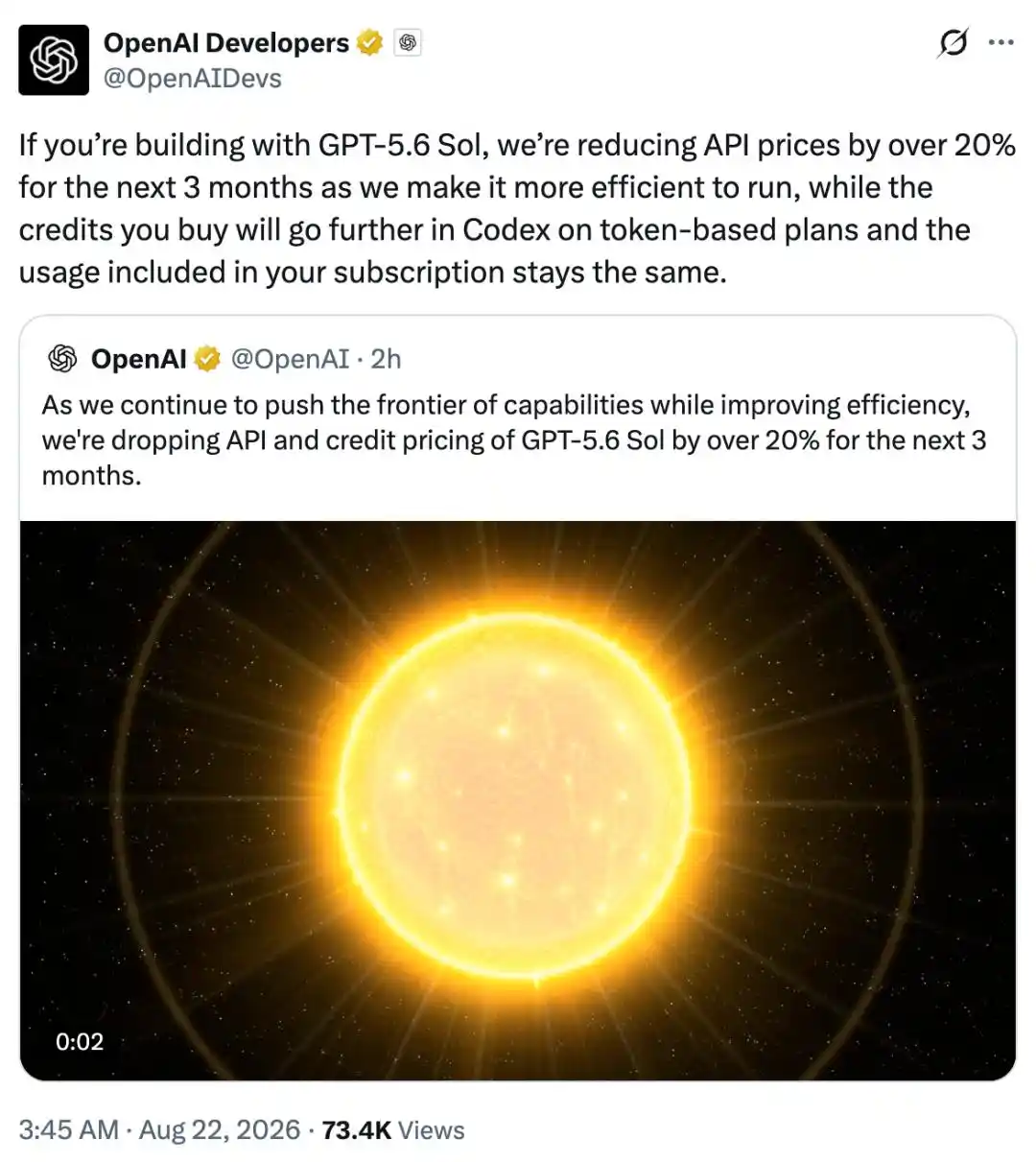
Within the next three months, both API prices and credit prices (the pay-as-you-go usage beyond the plan's included quotas) will be reduced by over 20%.
Currently, the price cuts on the API side have taken immediate effect. Eligible ChatGPT Work and Codex credits are being rolled out progressively.
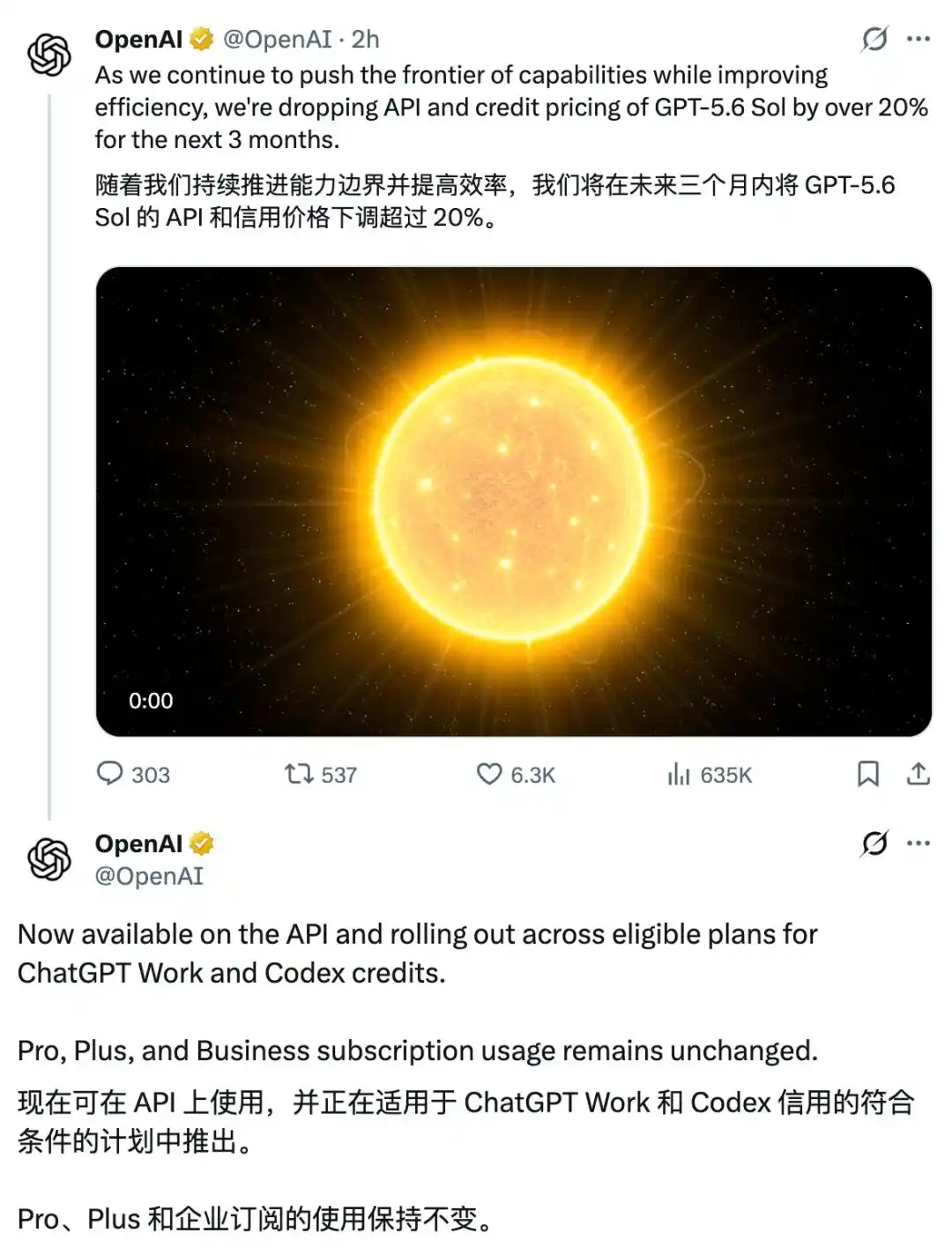
However, the prices for the Pro, Plus, and Business subscription tiers remain unchanged. The usage included in these plans has also not been increased.
The cuts are applied entirely to the token-based billing portion. This means the more API calls you make, the more you save.
How Much Can You Actually Save?
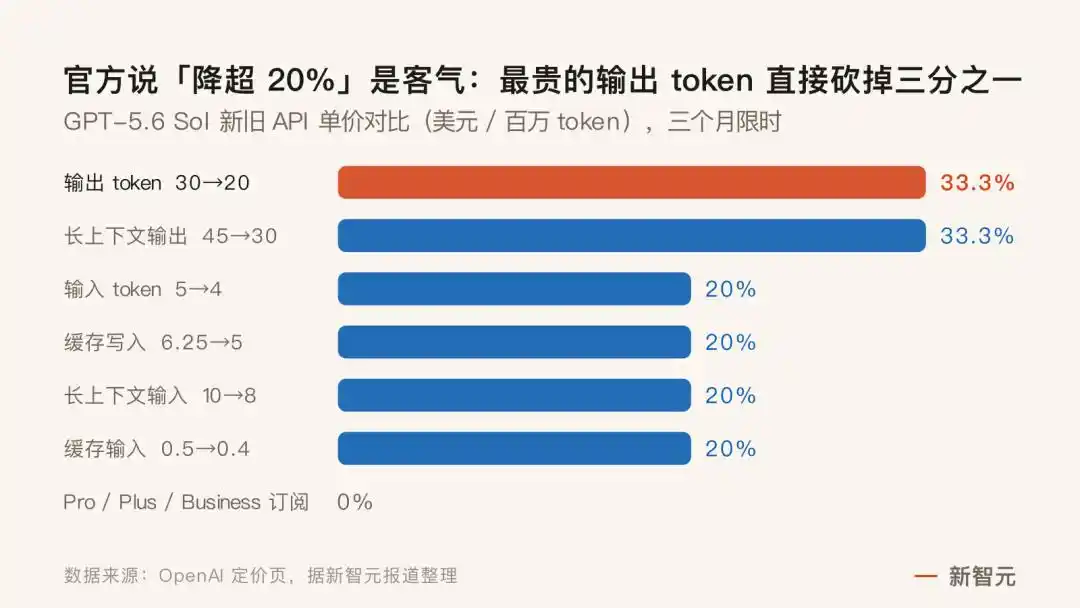
Previously, Sol's API pricing was $5 per million input tokens and $30 per million output tokens, making it the most expensive in the GPT-5.6 family.
Now, looking at the pricing page, it's $4 for input and $20 for output.
The input price dropped by 20%, which is straightforward. But the output price was slashed from $30 to $20, a full one-third reduction.
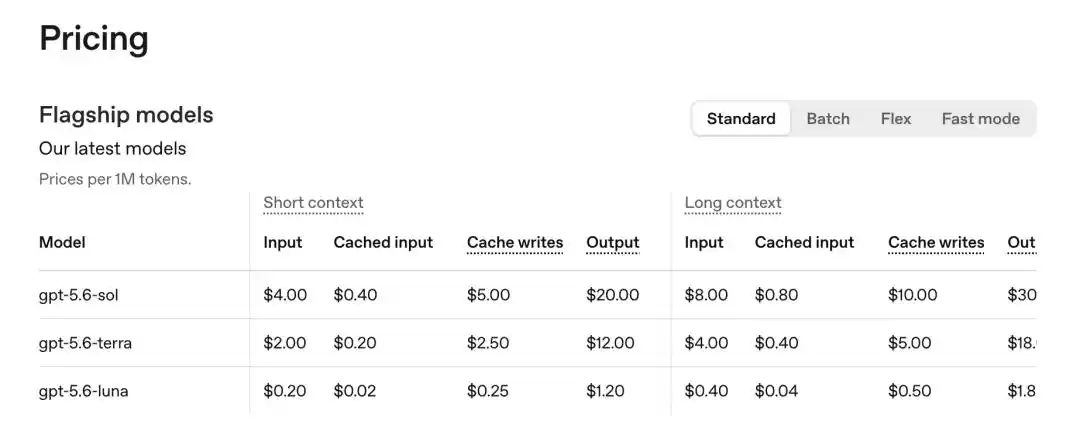
So, the official "over 20%" price cut statement is quite conservative. The truly expensive output tokens saw a 33% reduction.
Assuming a large-scale Agent consumes 100 million input tokens and 20 million output tokens per month, the cost would have been $1100. Now it's $800, a comprehensive reduction of approximately 27.3%.
How much you save specifically depends entirely on your input-to-output ratio. For input-heavy tasks like batch document processing, savings are around 20% or more. For scenarios like Codex, where code generation is intensive and output dominates, savings can exceed 30%.
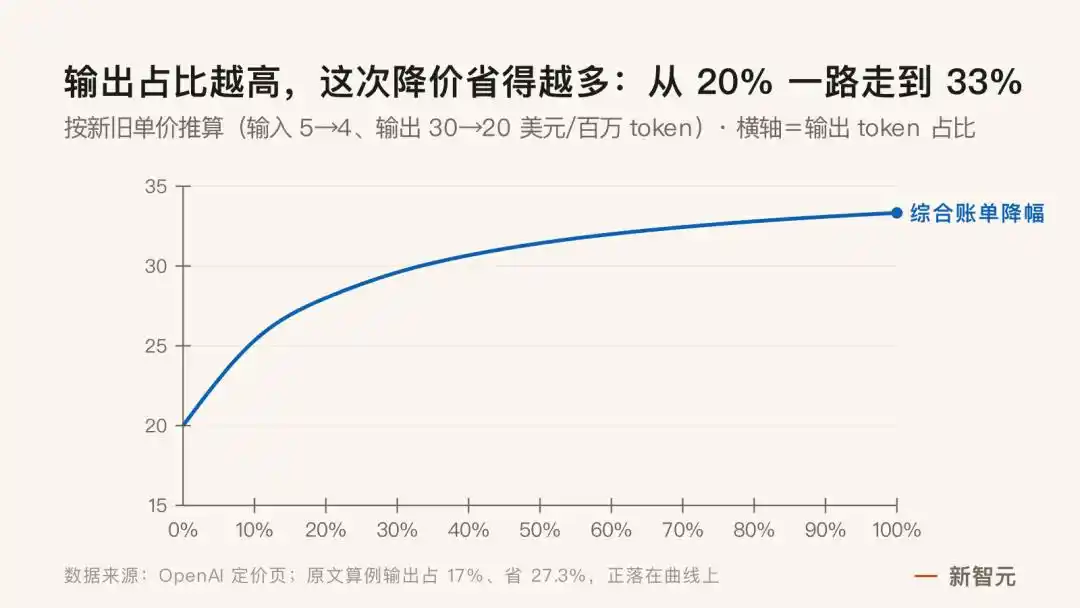
In short, the more you treat Sol as a productivity tool and push it to its limits, the more you save this time.
The cached tier has also been adjusted: cached input dropped from $0.5 to $0.4 per million tokens, and cached writes from $6.25 to $5 per million tokens. The long context window prices were similarly reduced: input from $10 to $8, output from $45 to $30 per million tokens.
OpenAI Developers subsequently posted, stating that the price reduction is possible because Sol now runs more efficiently.
The ASI Duel Finals: Price Becomes the Second Battlefield
In OpenAI's previous round of price cuts, Sol was the only model that remained unchanged.
Luna was cut by 80%, the mainstay Terra by 20%. Only the flagship Sol held its original price, merely adding a free Fast mode for acceleration.
At that time, OpenAI's strategy was clear: cheaper models drive volume, while the most expensive card maintains prestige.
This time, Sol itself is entering the fray. And at this particular moment, it doesn't seem like a coincidence.
The tech influencer Chubby's assessment is direct: This is clearly aimed at Anthropic.
Anthropic is currently facing challenges. Negative feedback on Opus 5 hasn't been fully digested, and users are complaining about the rate limits of the Fable 5 subscription plan.
OpenAI's major price cut now is an attempt to poach Anthropic's users.
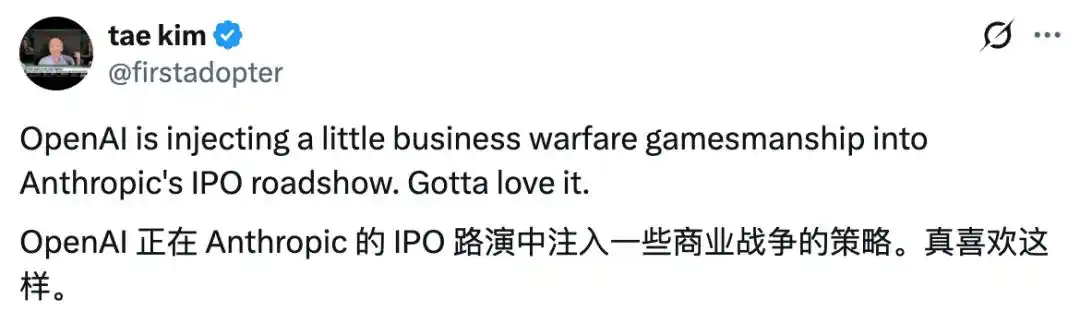
Tech journalist Tae Kim put it even more sharply: OpenAI is employing some business tactics during Anthropic's IPO roadshow.
This isn't baseless speculation.
Anthropic filed a confidential S-1 with the SEC on June 1st this year, formally initiating the IPO process. According to multiple media reports, underwriters began arranging meetings between management and potential investors from mid-July, with the roadshow window precisely covering August to September.
Target listing time: As early as October, on NASDAQ, with a valuation targeting $2 trillion.
During a roadshow, the last thing a company wants is competitors causing trouble.
After the benchmarks battle, price has become the second battlefield in the ASI duel finals.
OpenAI's willingness to slash prices drastically isn't an impulsive move either.
Their earlier aggressive investments in building their own computing power and betting on more efficient model architectures are now paying off.
Just days ago, OpenAI announced securing approximately 8 IT-GW of computing power at the PORTS-Pike complex in Pike County, Ohio, signing a 20-year lease; NVIDIA is exclusively providing the AI computing infrastructure.
Previously, OpenAI also reached a five-year agreement with Oracle worth over $300 billion, corresponding to up to 4.5GW of new capacity, and signed a 6GW GPU deployment deal with AMD.
OpenAI confirmed in April this year that it had locked in over 10GW of AI infrastructure capacity, aiming to expand to 30GW by 2030.
The more developed the infrastructure, the lower the marginal cost, and the greater the room for price reductions. This creates a positive flywheel: Model efficiency improves → Inference costs drop → Price reduction space is created → Users flock in → Revenue grows → Reinvest in infrastructure.
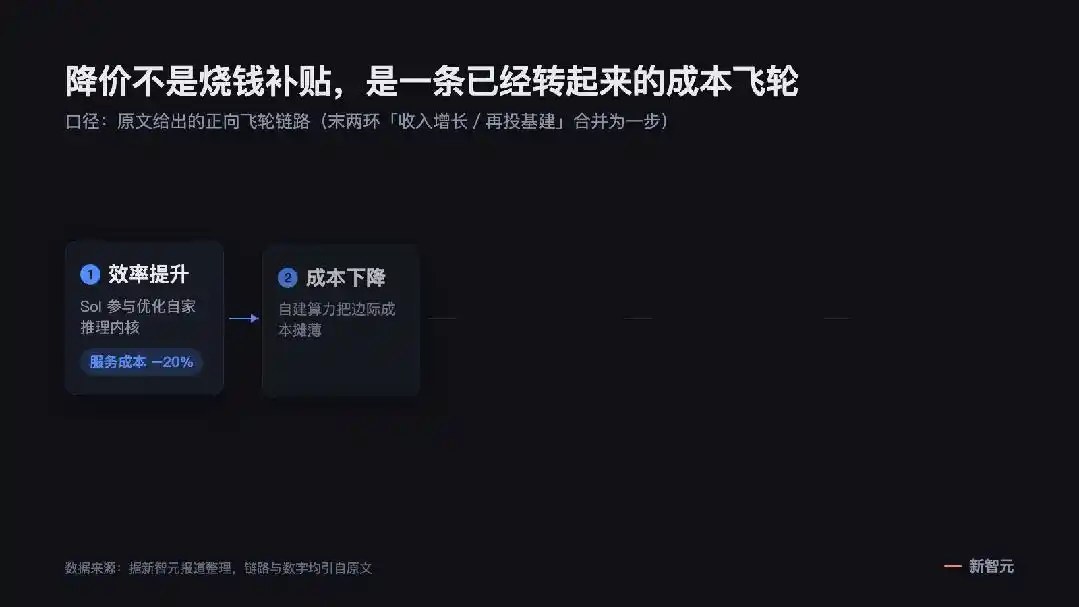
It can be said that OpenAI's flywheel is taking off. They themselves stated that GPT-5.6 Sol participated in optimizing its own production inference kernel, reducing end-to-end service costs by 20% and improving token generation efficiency by over 15%.
However, besides proactively creating pressure, this price cut also has a defensive element.
DeepSeek V4 Flash was officially released on July 31st, with pricing that seems almost free.
Even more stimulating is a mysterious model codenamed "Ox Alpha" that emerged two days ago. It boasts a 1M context window, supports text, image, and video input, and offers a week of free usage.
Now, Chinese open-source models are not only cheap but also steadily approaching the capabilities of frontier models.
Therefore, Sol's price cut is both an offensive move against Anthropic and a defensive counterattack against low-cost Chinese models.
Codex Surpasses 20 Million
Another set of numbers was announced on the same day.
Codex lead Tibo announced that Codex active users surpassed 20 million this week.
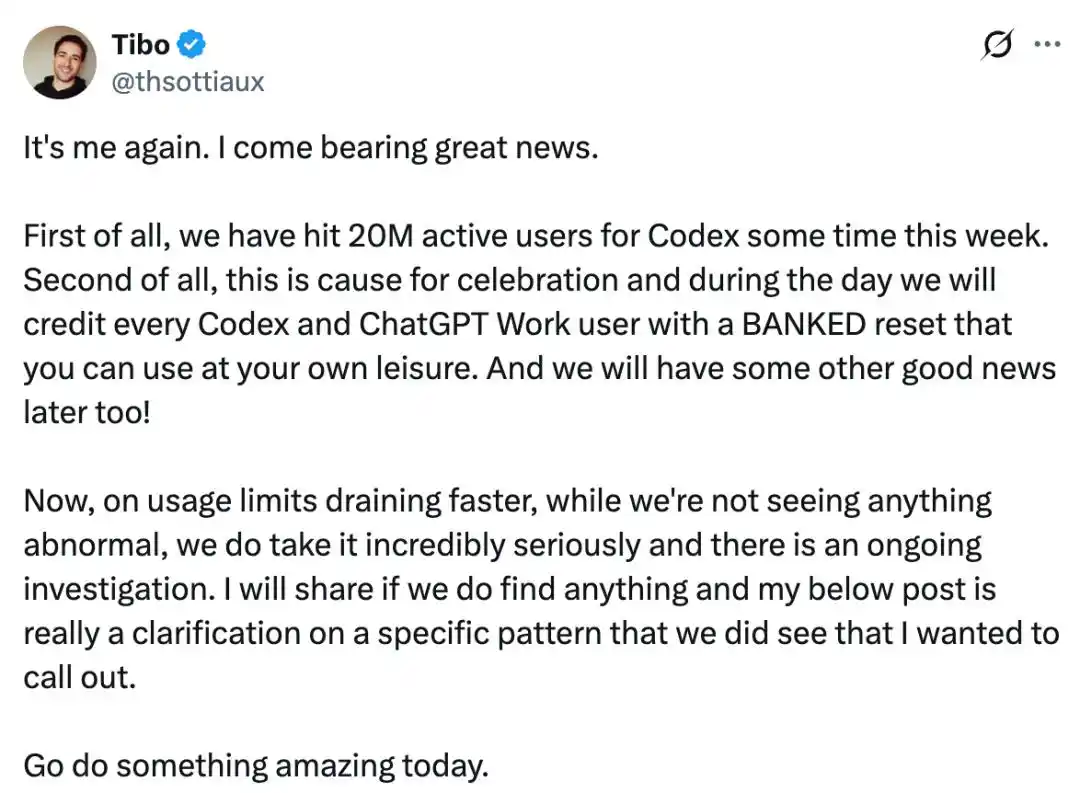
To celebrate this milestone, the team issued a one-time BANKED credit reset to all Codex and ChatGPT Work users.
However, regarding community feedback about credit consumption being too fast, Tibo said no abnormalities have been found so far, but a formal investigation has been launched, and results will be shared promptly.
He also drew a line: Officially, converting subscription accounts into API traffic via methods like sub2api for resale or multi-person sharing is not supported. Such usage patterns will be directly flagged by the risk control system.
The path of splitting a monthly subscription account to sell to a hundred people is blocked.
Using official clients, or open-source clients like Pi or OpenCode normally, is completely fine.
References:
https://x.com/OpenAI/status/2090885187634905500
https://x.com/OpenAI/status/2090885188897460249
https://x.com/kimmonismus/status/2090890956287492564
https://x.com/rohanpaul_ai/status/2090885980849050036
https://x.com/rohanpaul_ai/status/2090891370663989566
https://x.com/thsottiaux/status/2090766694897619318
This article is from the WeChat public account "新智元", author: ASI启示录, editor: Solomon