I would be ashamed if OpenAI were not the first major company managed by an AI CEO.
In October 2025, Altman made such a statement.
Nine months later, he changed his tune.
On July 28, in the podcast Invest Like the Best, Altman said people "don't really want an AI CEO" because they want to know who is actually making decisions for a company and who to hold accountable when something goes wrong.

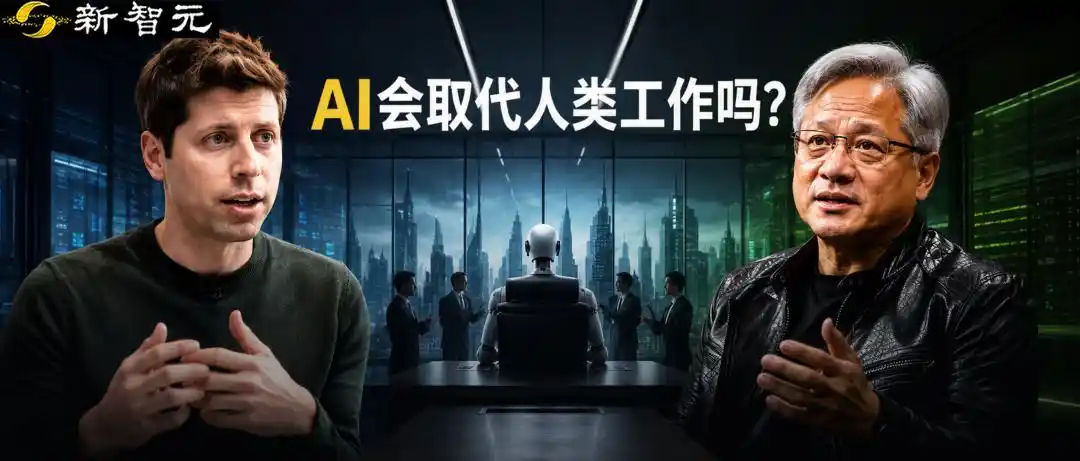
On July 28, Altman (right) guest-starred on episode 484 of the podcast Invest Like the Best, stating that people "don't really want an AI CEO."
Not only that, back in May this year, he also admitted that he had overestimated the speed at which AI would eliminate junior white-collar positions, and that kind of "job apocalypse" probably wouldn't happen.
Almost at the same time, Huang Renxun (Jensen Huang) threw out a line during a YC startup class: "The narrative of AI destroying jobs is completely backwards."

Huang Renxun at YC Startup School 2026, stating, "The narrative of AI destroying jobs is completely backwards."
One leads the world's most advanced models, the other holds the computing power.
Why did they both hit the brakes on the "unemployment apocalypse" narrative almost simultaneously?
Why Did Altman Change His Mind?
Altman says people want to know who is accountable for a company's decisions and who to go after when something goes wrong.
Therefore, people "don't really want an AI CEO."
He added that even today, most people still trust and prefer to work with real humans more. In other words, even if AI can make decisions, people might not be willing to hand the company over to it.
What prevents an AI CEO from taking the job isn't its lack of intelligence, but its inability to be truly held accountable.
AI can calculate the optimal solution in one second, but it cannot bear the consequences of a decision in court, in the boardroom, or in front of the public.
A small example from Altman's own experience illustrates this perfectly.
He once tried having an AI reply to his Slack messages and emails, signing off as "This is Sam's AI," but soon switched back to replying himself.
The reason was simple: he realized people really care about interacting with a person.
In fact, in that 2025 conversation envisioning an AI CEO, Altman had already assigned roles: real humans handle external matters, AI handles decision-making.
The difference this time is that he draws a clearer line between "AI can decide" and "humans must be accountable":
AI can make decisions, but it cannot be held responsible.
Huang Renxun: People Have Completely Reversed The Narrative About "AI Destroying Jobs"
Huang says people have reversed the narrative about "AI destroying jobs" because they've been equating "tasks" with "jobs."
He proposes this breakdown method.
A job has a purpose, and to achieve that purpose, many tasks need to be completed; AI can take over some of those tasks, but taking over tasks does not equal eliminating the entire job.
A job also involves communication, judgment, coordination, review, bearing consequences, etc. These aspects won't disappear along with the tasks replaced by AI.
He gave examples of radiologists and software engineers.
AI is increasingly taking over reading scans and writing code, yet the number of positions in these fields is actually growing.
According to Huang's figures: software engineering positions have grown by about 10% year-on-year, and radiology positions have increased by about 20% over the past few years.
Why the growth? Because there's a huge backlog.
The queues of patients in hospitals, the software waiting to be written, the piles of unprocessed demands—they were already overwhelming to begin with.
Once tasks are accelerated, companies and hospitals can instead handle more orders, expand their operations, and thus hire more people to do the remaining work that AI can't handle.
Altman also cited supporting evidence: a year ago, everyone said software engineers were doomed, but that didn't happen.
What really changed is the job itself: you almost never write code line by line anymore, yet it's still unmistakably software engineering.
The tasks have been replaced, but the job remains. However, not all jobs will remain.
Huang also acknowledged that all jobs will change, and indeed some professions will disappear entirely.
For his logic to hold, there's a hidden premise: companies must use the efficiency gains from AI to expand their business and hire more people.
If market demand remains static, or if bosses convert those gains directly into layoffs and cost-cutting, then positions will still decrease.
AI Hasn't Eliminated Junior Positions, But The Entry Step Is Being Pulled Away
The University of Maryland and LinkUp conducted a project analyzing 155 million US job postings since 2018.
The results show: as of Q4 2025, there is no evidence that AI has crushed hiring demand at the overall economic level.
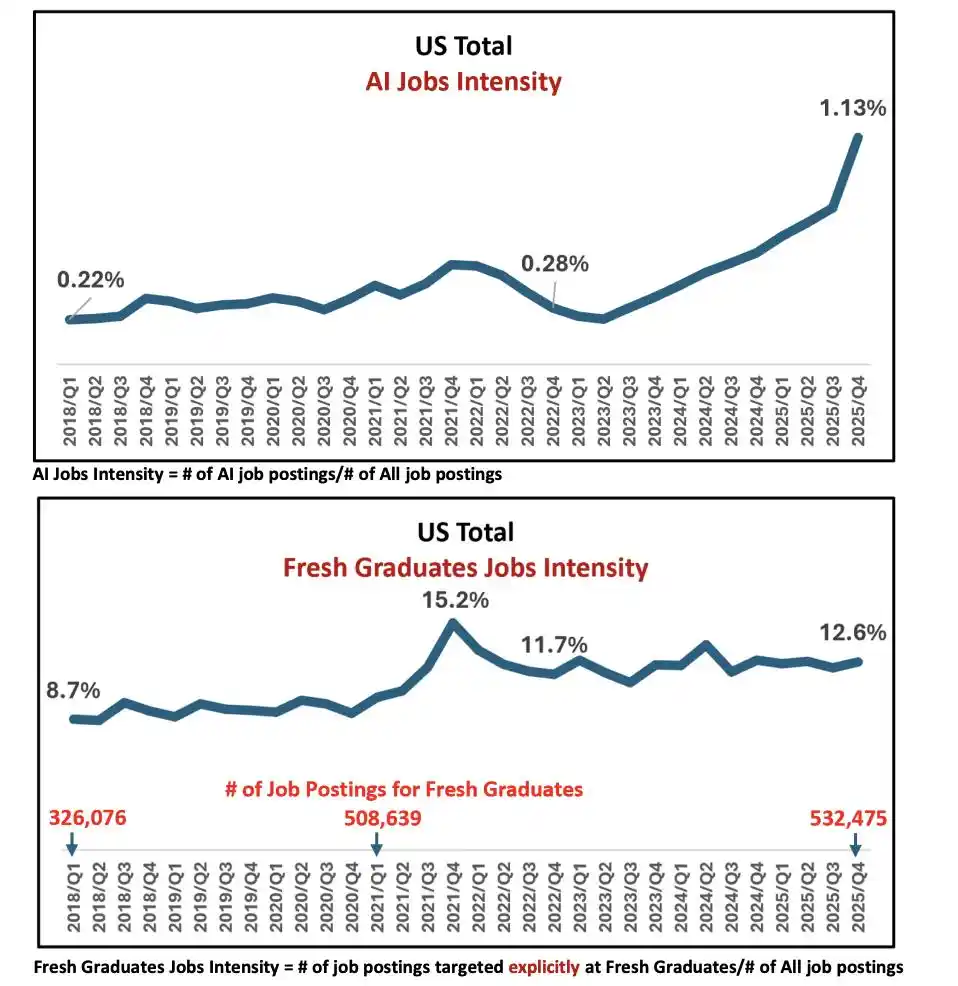
Top: US "AI Job Intensity" (AI jobs / all jobs), rising from 0.22% in Q1 2018 to 1.13% in Q4 2025; Bottom: "New Graduate Job Intensity," rebounding from 11.7% in Q4 2022 to 12.6% in Q4 2025. In Q4 2025, there were 532,000 job postings targeting new graduates.
The most counterintuitive data point is for new graduates.
The phrase "AI will eliminate junior positions first" has been repeated ad nauseam for the past two years. Yet, according to this data, the share of job postings explicitly targeting new graduates did not fall but rose, from 11.7% in Q4 2022 to 12.6% in Q4 2025.
In Q4 2025 alone, there were 532,000 such job postings, 63% higher than in Q1 2018.
Even in the math and computer occupations, which should be most vulnerable to AI "slaughter," new graduate job postings were 55% higher than in Q1 2018.
Seeing this number, the claim that "junior positions are disappearing" doesn't hold water, at least in terms of total volume.
The report also contains another counterintuitive observation:
Younger, less experienced employees are actually more likely to benefit from AI tools, because AI excels at instantly delivering vast amounts of experience to them. This makes them "cheap and effective" early adopters in the eyes of employers.
The Entry Step Is Getting Narrower
The total volume hasn't collapsed, but that doesn't mean there's no cost: there's something these nice numbers can't hide.
How did a young person grow in the past?
Often by starting with the most standardized entry-level tasks: data entry, basic coding, fundamental analysis, compiling materials, etc.
These tasks, though repetitive and tedious, were precisely how people slowly accumulated experience and judgment, honing those irreplaceable skills.
And these standardized tasks are exactly the ones AI is taking over first.
The gateway to junior positions is narrowing. For those just graduating or entering the workforce, this is the most immediate pressure they face right now.
Your Real Moat
Putting Altman's and Huang Renxun's statements together, we find:
The more capable AI becomes, the more the value of human work shifts upward, moving from "getting the work done" to "bearing responsibility, building trust, and setting goals."
Machines can replace tasks one by one, but they can't yet fill the gap of "who makes the final decision, who signs off on the results."
Instead of worrying "Will AI take my job?", perhaps ask a different question: How much of your job requires you to sign off and be responsible? How much requires your presence for others to buy in?
These parts that AI cannot replace are your real moat.
References:
https://open.spotify.com/episode/5bFBUf3X8QXaDFrve1Be5s?utm_source=chatgpt.com
https://conversationswithtyler.com/episodes/sam-altman-2/?utm_source=chatgpt.com
https://whbl.com/2026/05/26/openais-altman-says-ai-unlikely-to-lead-to-jobs-apocalypse/?utm_source=chatgpt.com https://youtu.be/I4B37S1dyQQ
Editor: Yuanyu
This article comes from the WeChat public account "AI新智元," author: ASI启示录