XRP Open Interest Falls to Lowest Level Since 2024: Market Reset Or Warning Signal?

bitcoinistОпубликовано 2026-02-04Обновлено 2026-02-04

Введение

XRP is undergoing a significant market reset as its open interest in derivatives has dropped to approximately 902 million, the lowest level since 2024, indicating a broad unwinding of leveraged positions. This decline, observed across major exchanges like Binance, reflects a market-wide de-risking trend rather than a mere shift between platforms. The reduction in leverage suggests a move away from speculative trading, potentially leading to slower but more deliberate price action. Currently, XRP is testing critical support near $1.60 after breaking below the key $1.80 level, signaling structural weakness. Trading below major moving averages, the asset shows a bearish trend with lower highs and lower lows. While the volume remains muted, indicating a controlled unwind rather than panic selling, holding the $1.55–$1.60 zone is crucial for stabilization. A breakdown could lead to a deeper retracement toward $1.30–$1.40. Analysts are watching for a rebound in open interest alongside improving price momentum as a potential early signal of a new trend.

XRP has entered a critical phase after losing the $1.80 level and sliding toward the $1.60 zone, where price is now attempting to find short-term support. The move comes amid broader weakness across the crypto market, but XRP’s structure shows an additional layer of stress that goes beyond spot price action. According to a recent report from CryptoQuant, the derivatives side of the XRP market is undergoing a sharp contraction in leverage, signaling a meaningful shift in trader behavior.

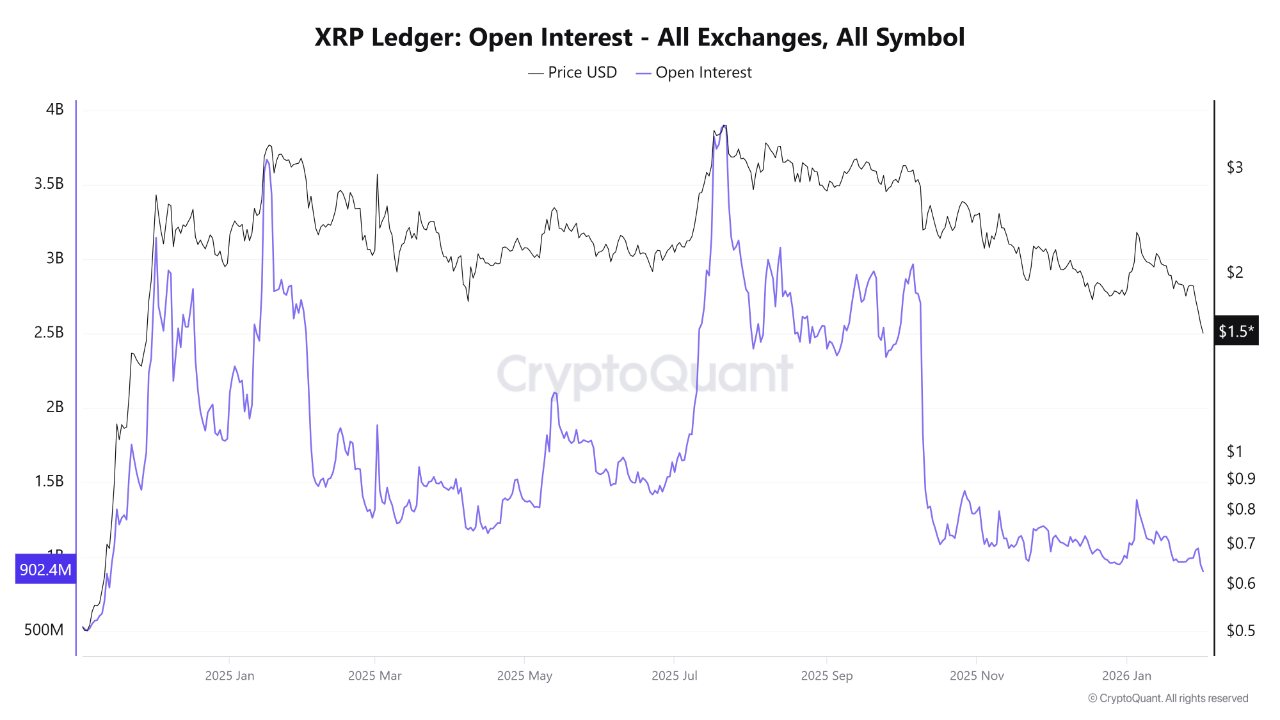
Data shows that open interest across all XRP derivatives platforms has fallen to roughly 902 million, marking its lowest level since 2024. This is a stark contrast to conditions seen during 2025, when open interest consistently hovered between 2.5 and 3.0 billion. The magnitude of this decline suggests that leverage is being actively unwound rather than merely rotating between exchanges, pointing to a broader risk-off adjustment.

XRP Ledger Open Interest | Source: CryptoQuant

Such contractions often reflect a market that is de-risking after extended volatility. With fewer leveraged positions in play, price movements tend to become slower but more deliberate, as speculative excess is flushed out. As XRP tests the $1.60 area, analysts are closely watching whether this leverage reset lays the groundwork for stabilization—or signals deeper downside still ahead.

The report adds important color by breaking down where the leverage reduction is taking place. On Binance, open interest in XRP derivatives has fallen to around 458 million. While this figure remains above the levels observed last December, it still represents a sharp contraction from the highs seen earlier in the cycle.

Crucially, this decline on Binance mirrors what is happening across other major trading venues, reinforcing the view that the market is undergoing a broad deleveraging phase rather than a simple migration of positions between exchanges.

From a structural standpoint, this matters. When open interest compresses simultaneously across platforms, it typically reflects traders actively reducing risk and closing leveraged exposure. This kind of environment often precedes periods of price consolidation, as the market digests prior volatility and searches for a new equilibrium. In past cycles, these phases have frequently led to the formation of base structures, particularly when selling pressure fades and volatility compresses.

Looking ahead, analysts note that any recovery in open interest will be critical to monitor. A rebound in leverage that coincides with improving price momentum could serve as an early signal that a new trend is developing.

For now, however, the drop in open interest to its lowest level since 2024 points to a clear market cleanup. While this reset may appear quiet on the surface, it can provide a healthier foundation for future moves—provided risk management remains front and center in the next phase of XRP’s market evolution.

XRP Price Showing Weakness

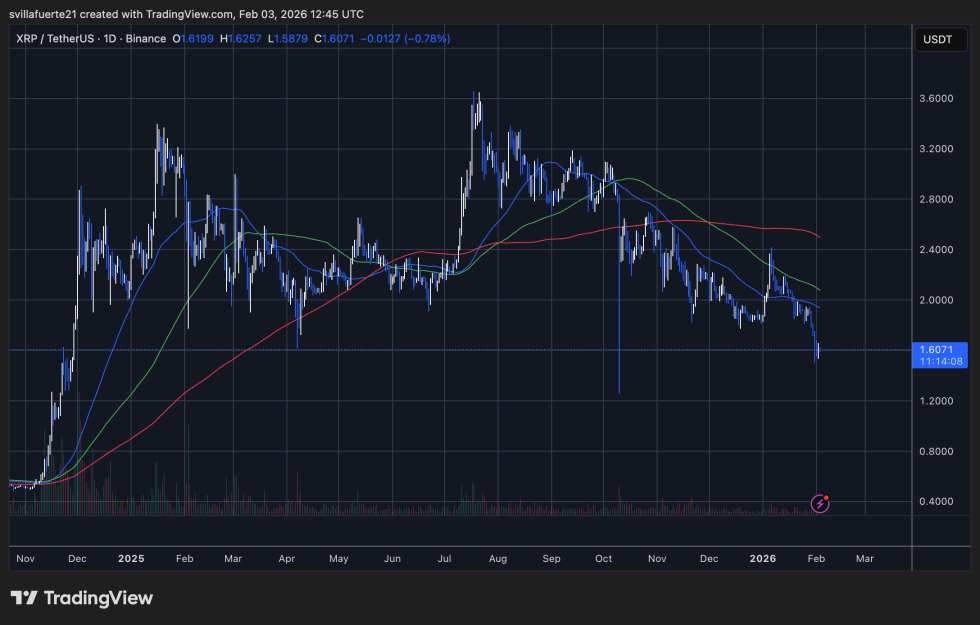
XRP price action continues to reflect structural weakness as the asset trades decisively below its key moving averages and tests the $1.60 zone for support. The chart shows a clear transition from a prior uptrend into a sustained downtrend, marked by lower highs and lower lows since the October peak near the $3.50–$3.60 region. Momentum has steadily deteriorated, with each rebound failing below the declining short- and medium-term moving averages, signaling persistent seller control.

XRP testing critical demand level | Source: XRPUSDT chart on TradingView

The loss of the $1.80 level is technically significant. This zone previously acted as a consolidation base and demand area, but the clean breakdown suggests that buyers have stepped aside rather than aggressively defending the price. XRP is now trading below the 50-day and 100-day moving averages, while the 200-day moving average above continues to slope downward, reinforcing a bearish medium-term structure.

Volume remains relatively muted compared to earlier distribution phases, which aligns with the derivatives data showing a contraction in leverage rather than panic-driven liquidation. This supports the view that the current move is more of a controlled unwind than a capitulation event.

As long as price holds the $1.55–$1.60 region, XRP may attempt to stabilize and form a base. However, a failure to hold this area would expose the market to a deeper retracement toward prior demand zones near $1.30–$1.40.

Featured image from ChatGPT, chart from TradingView.com
Связанные с этим вопросы

QWhat is the current level of XRP open interest and why is it significant?

AXRP open interest has fallen to roughly 902 million, marking its lowest level since 2024. This is significant because it represents a sharp contraction from the 2.5-3.0 billion levels seen during 2025, indicating a broad deleveraging phase and a meaningful shift in trader behavior away from speculative excess.

QAccording to the article, what does a simultaneous decline in open interest across multiple exchanges typically indicate?

AA simultaneous decline in open interest across multiple exchanges typically indicates that traders are actively reducing risk and closing leveraged exposure, rather than simply moving positions between venues. This often reflects a broad market de-risking and can precede periods of price consolidation.

QWhat key price level did XRP lose that the article describes as 'technically significant'?

AThe article describes the loss of the $1.80 level as technically significant. This zone previously acted as a consolidation base and demand area, and its clean breakdown suggests that buyers have stepped aside rather than aggressively defending the price.

QWhat potential price levels are identified as critical support and next downside targets for XRP?

AThe $1.55–$1.60 region is identified as critical short-term support. If this area fails to hold, the article states it would expose the market to a deeper retracement toward prior demand zones near $1.30–$1.40.

QHow does the article characterize the nature of the price decline based on volume and derivatives data?

AThe article characterizes the decline as a controlled unwind rather than a capitulation event. This is supported by relatively muted volume compared to earlier distribution phases and derivatives data showing a contraction in leverage instead of panic-driven liquidations.

Похожее

When AI Traffic Surpasses Humans, How Do You Prove You're Human?

As AI-generated web traffic now surpasses human activity, the internet's foundational business models—built on human attention, browsing, and advertising—face severe disruption. AI agents crawl websites at immense scale without generating ad revenue, while AI summaries divert traffic from original content sites. In response, over 2.5 million sites are blocking AI crawlers, and protections like Cloudflare's "honeypot" traps have emerged, though advanced AI can bypass these. The collapse of traditional CAPTCHAs, which assumed machines were weaker than humans, has led to a shift toward behavioral biometrics for human verification. Companies like IBM and BioCatch now analyze unique human patterns—cursor movements, typing rhythms, keystroke dynamics, and even cognitive delays like the Stroop effect—to distinguish real users from bots. These biometric signatures are difficult to fake or alter, offering a new layer of security but raising significant privacy concerns. Two competing visions for a reliable human verification system are emerging. One, exemplified by Sam Altman’s World (formerly Worldcoin), uses centralized iris scanning to generate unique credentials, though it faces bans and criticism over unauthorized data collection. The other employs cryptographic zero-knowledge proofs, allowing users to prove they are human without revealing identity or biometric data, as advocated by Vitalik Buterin. However, decentralized approaches risk exploitation through identity renting in economically unequal regions. The central dilemma is between a scalable but privacy-invasive centralized system that permanently controls users' biometric data, and a privacy-preserving cryptographic system vulnerable to real-world economic manipulation. The author expresses a preference for the cryptographic path, arguing that despite its flaws, it avoids the irreversible biometric surveillance inherent in centralized alternatives.

Foresight News7 мин. назад

When AI Traffic Surpasses Humans, How Do You Prove You're Human?

Foresight News7 мин. назад

Crypto Primary Market Investment and Financing Forward-Looking Weekly Report | Stablecoin Regulation Nears Implementation, ETF Funds Continue to Withdraw, Capital Begins Betting on Payment and Cash Flow

Crypto Market Weekly Report (Jun 1-7, 2026): Capital Shifts Focus to Payments & Cash Flow Market data indicates a significant divergence: while traditional institutional funds continue exiting via BTC and ETH ETFs (recording net outflows of $1.72B and $168M this week, respectively), stablecoin supply continues growing. This suggests capital is shifting from speculative asset allocation toward defensive positioning within on-chain liquidity, awaiting new, concrete opportunities. This trend is reflected in venture capital focus. Weekly fundraising fell 27% to $302M, with investments concentrating on infrastructure with tangible revenue potential: 1. **Stablecoin Infrastructure (28% of funding):** Projects like M0 Protocol ($35M raise) are gaining attention as regulatory clarity (e.g., the GENIUS Act) nears, shifting the focus from legitimacy to building payment and settlement networks. 2. **AI Agent Infrastructure (26%):** Investments are moving from conceptual AI Agents towards the execution and economic layers required for a functional "Agent economy." Key raises include OpenRouter ($40M) and Halliday ($20M). 3. **Real World Assets (RWA) (18%):** The search for on-chain yield and cash flow drives continued interest in RWA platforms like Ondo Finance. Security threats are evolving from smart contract exploits toward key management failures, permission control issues, and regulatory execution risks (e.g., court-ordered asset freezes). **Key Takeaways:** The investment thesis is shifting from narrative-driven bets to revenue and cash-flow-generating protocols. Future attention should be on the progression of stablecoin regulations, the commercial validation of AI Agent economies, and the performance of high-revenue protocols like derivatives platforms.

marsbit15 мин. назад

Crypto Primary Market Investment and Financing Forward-Looking Weekly Report | Stablecoin Regulation Nears Implementation, ETF Funds Continue to Withdraw, Capital Begins Betting on Payment and Cash Flow

marsbit15 мин. назад

Buy an NFT First to Get a Ticket? The Largest World Cup Ticket Slump in History

"Ticketing Woes for 2026 World Cup: NFT 'Right-to-Buy' and High Prices Dampen Sales" Despite anticipation for the 2026 FIFA World Cup, with 48 teams and 104 matches across North America, the tournament faces significant unsold tickets, with approximately 180,000 group-stage tickets still available for resale just before kick-off. This unexpected shortfall is attributed to FIFA's controversial new ticketing strategy, which includes an NFT-based "Right-to-Buy" (RTB) system and opaque, dynamic pricing. FIFA introduced RTBs as digital collectibles (NFTs) sold on its FIFA Collect platform. An RTB grants the holder only the right to purchase a ticket for a specific match later, not the ticket itself. This two-step process, criticized for selling "scarcity" first, saw RTBs priced from tens to hundreds of dollars, generating millions in revenue for FIFA. With many tickets remaining available on official channels, the value of these prepaid purchase rights is now being questioned. Compounding the issue are ticket prices, reported to be 2 to 4 times higher than the 2022 Qatar World Cup, and up to 7 times more for marquee matches. FIFA employed dynamic pricing, common in U.S. sports, but lacked transparency on seat availability and exact locations during sales, frustrating global fans facing high travel costs. This has drawn scrutiny from regulators in New York and New Jersey. FIFA's official resale platform also drew criticism for imposing high fees—roughly 10% on sellers and 17% on buyers, allowing FIFA to profit further from secondary market transactions. While FIFA President Gianni Infantino states over 6 million tickets have been sold, the situation highlights a potential disconnect between fan enthusiasm and willingness to pay under an aggressive commercial model.

marsbit22 мин. назад

Buy an NFT First to Get a Ticket? The Largest World Cup Ticket Slump in History

marsbit22 мин. назад

Торговля

Спот
Фьючерсы

Популярные статьи

Что такое XRP 2.0

XRP 2.0: Новая грань в мире криптовалют Введение в XRP 2.0 В постоянно развивающейся сфере криптовалют появляются новые проекты, стремящиеся к вниманию и внедрению. Один из таких многообещающих проектов - это XRP 2.0, новая криптовалюта, созданная для использования передовых технологий блокчейна и надежных методов шифрования. Хотя название вызывает ассоциации с XRP от Ripple, важно отметить, что XRP 2.0 функционирует независимо, сосредоточив внимание на повышении безопасности сделок, конфиденциальности и масштабируемости. Поскольку цифровая финансовая среда все больше принимает децентрализованные решения, XRP 2.0 намерена внести значимый вклад в web3 и общее расширение криптопроектов. Что такое XRP 2.0? XRP 2.0 в своей основе - это проект криптовалюты, цель которого - создать безопасную и децентрализованную экосистему цифровой валюты. Его базовая технология интегрирует сложные принципы блокчейна с современными методами шифрования. Основная цель XRP 2.0 - утвердиться как надежная и эффективная платформа, позволяющая быстро осуществлять транзакции с приоритетом на улучшенную защиту конфиденциальности для своих пользователей. Проект рекламируется как решение многих недостатков, с которыми сталкиваются существующие криптовалюты, предлагая систему, способную обрабатывать более высокий объем транзакций с улучшенной скоростью и конфиденциальностью. Эта универсальность позиционирует XRP 2.0 как значимого конкурента на рынке, переполненном различными цифровыми валютами. Кто создатель XRP 2.0? Идентичность создателя XRP 2.0 была обозначена как «Уилбур». Однако исчерпывающие данные о Уилбуре или связанном с ним проекте остаются неясными. Анонимность многих создателей криптовалют не является редким явлением в этой отрасли и часто применяется для сохранения определенной степени конфиденциальности и безопасности. Кто инвесторы XRP 2.0? <pна данный момент конкретная информация о инвестиционных фондах или организациях, поддерживающих xrp 2.0, не доступна публично. в секторе криптовалют поддержка репутабельными инвесторами может существенно повлиять на кредитоспособность и успех проекта, однако прозрачность в отношении финансовых спонсоров 2.0 еще была установлена. Как работает XRP 2.0? XRP 2.0 выделяется использованием сочетания технологий блокчейна и продвинутых алгоритмов шифрования, что обеспечивает безопасные и децентрализованные транзакции. Его инновационная структура включает уникальные функции, разработанные для повышения вовлеченности пользователей и расширения функциональности за пределами традиционных транзакций с криптовалютами. Среди этих функций XRP 2.0 интегрирует возможности с искусственным интеллектом, такие как текст в изображение и текст в речь. Эти дополнения разработаны для улучшения интерактивной работы пользователей, способствуя более широкому применению в различных секторах. Соединяя технологические достижения с дизайном, ориентированным на пользователя, XRP 2.0 стремится привлечь внимание разнообразных индивидуумов и предприятий, стремящихся интегрировать решения с криптовалютой в свои бизнес-процессы. Хронология XRP 2.0 Для понимания XRP 2.0 необходимо рассмотреть ключевые события, которые определили его путь до сих пор: 23 июля 2023 года: XRP 2.0 представлен как новый проект криптовалюты, стремящийся революционизировать возможности безопасных и децентрализованных транзакций в области блокчейна. 8 сентября 2023 года: Запуск другого проекта, XRP20, который представляет собой токен ERC-20 на блокчейне Ethereum и не имеет отношения к XRP 2.0. 13 ноября 2023 года: XRP Ledger подвергается значительному обновлению с выпуском программного обеспечения серверов rippled версии 2.0.0. Важно отметить, что это развитие не связано с проектом криптовалюты XRP 2.0. Ключевые моменты о XRP 2.0 Чтобы выделить суть XRP 2.0, возникают несколько критически важных факторов: Уникальные особенности: Включение таких функций, как основанные на ИИ текст в изображение и текст в речь, дополнительно разнообразит потенциальные приложения XRP 2.0. Технология блокчейна: Структура использует современные механизмы блокчейна и протоколы шифрования, обеспечивая безопасную и децентрализованную среду для транзакций. Масштабируемость и конфиденциальность: XRP 2.0 придает приоритет повышенным мерам защиты конфиденциальности в процессах транзакций и масштабируемости, необходимой для привлечения растущей базы пользователей. Нет связи с Ripple: Важно отметить, что, несмотря на свое название, XRP 2.0 не имеет никаких отношений или сотрудничества с XRP от Ripple, что отличает его операционные рамки и цели в экосистеме криптовалют. Заключение XRP 2.0 представляет собой амбициозное начинание в сфере криптовалют, стремясь предложить сочетание безопасности, конфиденциальности и эффективности в цифровых транзакциях. Интегрируя сложные технологии и удобные функции, проект стремится расширить горизонты того, что может достичь криптовалюта в современной цифровой экономике. Хотя анонимность его создателя и отсутствие раскрытых инвесторов могут вызвать вопросы у некоторых, акцент XRP 2.0 на передовых функциональных возможностях и децентрализации увеличивает его привлекательность на фоне все более переполненного крипто-рынка. Поскольку мир криптовалют продолжает развиваться, XRP 2.0 может еще стать ключевым игроком в расширении безопасных и масштабируемых блокчейн-решений.

198 просмотров всегоОпубликовано 2024.04.05Обновлено 2024.12.03

Что такое XRP 2.0

Неделя обучения по популярным токенам 13: запуск основной сети HIP-4 ожидается в середине 2026 года на фоне смещения фокуса рынка к масштабируемому внедрению ключевых криптоактивов, включая XRP

HIP-4 представит децентрализованные рынки прогнозов без разрешений, бинарные (исходные) контракты и опционы 0DTE.

1.3k просмотров всегоОпубликовано 2026.04.22Обновлено 2026.04.22

Неделя обучения по популярным токенам 13: запуск основной сети HIP-4 ожидается в середине 2026 года на фоне смещения фокуса рынка к масштабируемому внедрению ключевых криптоактивов, включая XRP

Обсуждения

Добро пожаловать в Сообщество HTX. Здесь вы сможете быть в курсе последних новостей о развитии платформы и получить доступ к профессиональной аналитической информации о рынке. Мнения пользователей о цене на XRP (XRP) представлены ниже.

活动图片