Trading Moment: Silver Plunges After Hitting New High, Institutions Warn of Precious Metals Correction Risk, Bitcoin Shows 'Dead Cat Bounce'?

marsbitОпубликовано 2025-12-29Обновлено 2025-12-29

Введение

Silver prices hit a record high above $84/oz before sharply retreating to around $78 amid profit-taking, dragging gold and other precious metals lower. While factors like Fed rate cut expectations and central bank buying persist, new supply concerns emerged as China plans export controls on silver from 2026. Institutions are divided: Goldman Sachs sees gold potentially surpassing $4,900, but UBS and Capital Economics warn of a correction, with silver possibly falling to $42 by end-2026. Bitcoin briefly reclaimed $90k but faces cautious sentiment, with analysts debating if it’s a "dead cat bounce" or a setup for a rally toward $112k. ETF outflows and low trading volume signal fragility, though some expect rotation from metals to crypto. Ethereum hovered near $3k, with key support at $2,775; a break could trigger a drop toward $1,800. Key data: BTC at $89,989, ETH at $3,033, fear index at 24. Over $151M liquidated in 24h. ETF flows: Bitcoin ETFs saw $782M outflows last week, Ethereum ETFs $102M. Notable events: Lighter TGE expected Dec 29, Flow hacked for $3.9M, and several tokens facing unlocks worth hundreds of millions.

Daily key data review and trend analysis, produced by PANews.

1. Market Observation

At the start of the new week, the precious metals market took center stage. Spot silver broke through $84/oz to hit a new historical high, but then faced selling pressure from profit-taking, quickly plunging and turning negative intraday, eventually fluctuating around $78. This rollercoaster ride directly impacted related financial products, with spot gold retreating from near its historical high of $4550, and platinum and palladium both falling close to or over 7%. Beyond the traditional logic of Fed rate cut expectations and continued central bank gold buying, the market began pricing in a new narrative of "commodity control," where the importance of geopolitics and supply chain security is increasingly highlighted, especially after China announced export licensing for silver effective January 1, 2026, further exacerbating expectations of tight global physical supply. However, market divergence also intensified. The Chicago Mercantile Exchange (CME) raised margins on silver futures for the second time in two weeks, sparking concerns about a historical replay of the 2011 silver crash triggered by similar measures. Institutions like Goldman Sachs remain bullish on gold continuing its strength into 2026, with a target price potentially exceeding $4900, but UBS and Capital Economics warned that precious metal prices have detached from fundamentals, accumulating correction risks, with Capital Economics even predicting silver could fall back to $42 by the end of next year. For silver, despite its strong industrial demand in sectors like solar energy, analysis suggests that prices reaching $134/oz could lead to demand destruction; while copper, as a potential substitute, poses little short-term threat as factory retrofits take at least 4 years. Institutions like Guojin Securities believe the 2026 investment theme is already visible across commodities, supply chains, and foreign exchange markets—under a structure where investment outweighs consumption,大宗商品 trading ranges are lengthening, China's manufacturing advantages are prominent, and industrial resources resonating with AI investment and global manufacturing recovery are worth watching.

Compared to the剧烈 volatility in the precious metals market, the cryptocurrency market overall was permeated with cautious and sluggish sentiment, even as Bitcoin broke through $90,000 again today. Most analysts are cautious about the outlook. For example, analyst Killa believes that although there might be short-term bounces, the broader trend is still downward seeking support below $70,000, judging that this cycle has ended. Ali Charts expressed similar views, suggesting that against a backdrop of net capital outflows reaching $4.5 billion and Bitcoin ETFs seeing nearly $1 billion in net outflows over the past two weeks, any rebound is likely a "dead cat bounce" lacking support from spot demand. A report from 10x Research also pointed out that current crypto market trading volume is 30% lower than normal, with undercurrents beneath the surface calm making the market particularly fragile. However, there are also bullish voices in the market. Analyst Astronomer, through liquidity analysis, indicated that the market has built sufficient short liquidity in the $94,000 to $95,000 region, creating conditions for a price surge towards the $112,000 target. Michaël van de Poppe expects that as funds rotate from the overheated precious metals market to the crypto market, Bitcoin could move towards $100,000 in the coming week. Analyst Plan B, by recalling the history of the 2021 bull market which experienced a correction of over 50% mid-cycle before hitting new highs, suggested the current pullback might just be a normal correction within the cycle. Samson Mow made the bold assertion that "2025 is the bear market," predicting Bitcoin might embark on a decade-long bull run. On the technical front, analysts are closely watching key levels. Ardi pointed out that whether Bitcoin can effectively break through the resistance zone between $90,000 and $94,600, and hold the support band between $80,000 and $86,300, is core to judging the future direction.

Ethereum broke through $3000 again, but market sentiment remains cautious. On-chain analyst Murphy provided a deeper analysis, suggesting the main矛盾 (contradiction) for Ethereum currently is not the overhead selling pressure from trapped positions, but the overly dispersed structure of profitable筹码 (chips/holdings) below. He noted that $2700 is one of the few levels that can form a consensus strong承接区 (support area); if lost, the price could enter a "vacuum zone" lacking effective support, with the nearest gap area below between $1800 and $2600. Nonetheless, he also observed that the whale group holding over 100,000 ETH has been adding positions near $2700, showing a posture of "long-term optimism, short-term caution." For short-term movements, technical analyst CyrilXBT described Ethereum as a "coiled spring," believing it needs to break through $3345 to release upward momentum. Michaël van de Poppe gave specific key levels: $2775 is an unbreakable support level, otherwise it could trigger a chain reaction decline; while a break above the $3000 resistance could lead to a rapid冲击 (assault) on $3650.

The market is currently most concerned about the TGE of the decentralized perpetual exchange Lighter, widely expected to occur on December 29. According to its airdrop details, the team confirmed the airdrop will account for 25% of the total supply, requiring no claim and will be sent directly to user wallets. The team also clarified that recent large token transfers were for safeguarding investor and team allocations. Meanwhile, the public chain project Flow experienced a security incident over the weekend, where an attacker exploited a vulnerability in its execution layer to transfer approximately $3.9 million, leading validators to temporarily halt operations to deploy a fix; the project team stated that user balances were unaffected and the protocol faces no solvency risk. Additionally, the ZEROBASE token ZBT saw its price briefly突破 (break through) $0.2, with a 78% gain in 24 hours.

2. Key Data (As of 13:00 HKT, December 29)

(Data sources: CoinAnk, Upbit, SoSoValue, CoinMarketCap)

  • Bitcoin: $89,989 (Year-to-date -3.25%), daily spot trading volume $31.45 billion

  • Ethereum: $3,033 (Year-to-date -9.2%), daily spot trading volume $28.28 billion

  • Fear & Greed Index: 24 (Fear)

  • Average GAS: BTC: 1.75 sat/vB, ETH: 0.02 Gwei

  • Market Dominance: BTC 59.1%, ETH 12%

  • Upbit 24-hour trading volume ranking: BTC, ZBT, XRP, ETH, 0G

  • 24-hour BTC Long/Short Ratio: 50.99% / 49.01%

  • Sector Performance: Crypto sectors generally rose, SocialFi sector up over 3%, only Layer2 sector slightly down

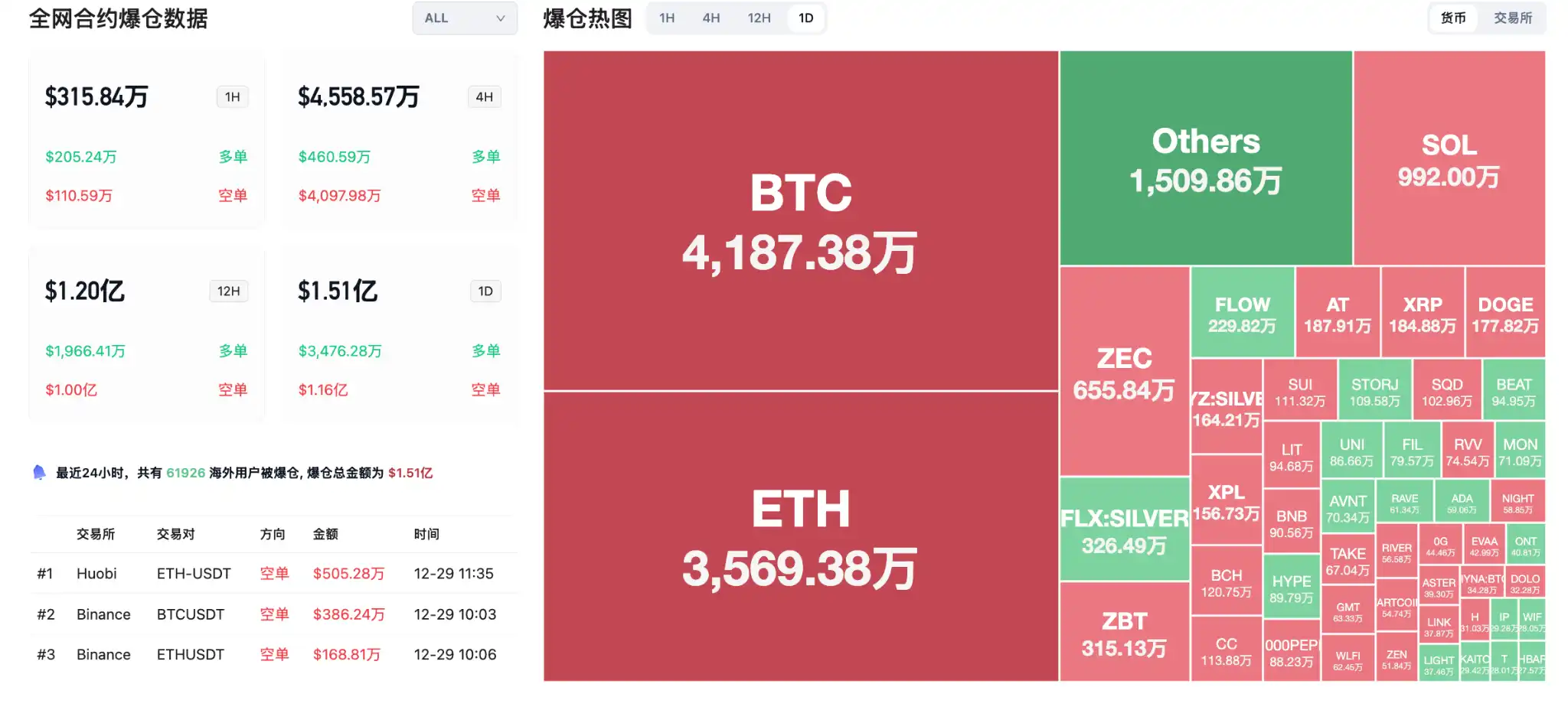
  • 24-hour Liquidation Data: 61,926 people liquidated globally, total liquidation amount $151 million,其中 (including) BTC liquidations $41.87 million, ETH liquidations $35.69 million, ZEC liquidations $6.55 million

3. ETF Flows (As of December 26)

  • Bitcoin ETFs: Net outflow of $782 million last week, BlackRock's IBIT led with net outflow of $435 million

  • Ethereum ETFs: Net outflow of $102 million last week, BlackRock's ETHA led with net outflow of $69.42 million

  • Solana ETF: Net inflow of $13.14 million last week

  • XRP ETF: Net inflow of $64 million last week

4. Today's Preview

  • "Lantian Gerui Case" fund refund registration deadline is December 29, missing it may affect fund return

  • Binance will delist EIGEN/FDUSD, ARB/FDUSD and other FDUSD margin trading pairs on December 30

  • Web3 game studio ChronoForge will shut down on December 30 due to funding shortage

  • Padre: PADRE holders will receive PUMP based on their holdings, need to submit wallet address by December 30

  • SHFE: From close on December 30, price limits for gold and silver futures contracts adjusted to 15%,同时 (simultaneously) adjusting margin ratios

  • SDIC Silver LOF: Class A定投 (fixed investment)上限 (upper limit) reduced back to 100 yuan, Class C shares will begin suspending subscriptions, effective December 29

  • 51VR, Chantecaille (Linshangtang) expected to list on HKEX on December 30

  • Hyperliquid (HYPE) will unlock approximately 9.92 million tokens at 15:30 on December 29, representing about 2.87% of circulating supply, value approx. $256 million;

  • Kamino (KMNO) will unlock approximately 229 million tokens at 20:00 on December 30, representing about 5.35% of circulating supply, value approx. $11.8 million;

  • Slash Vision Labs (SVL) will unlock approximately 234 million tokens at 08:00 on December 30, representing about 2.96% of circulating supply, value approx. $6.8 million;

  • Zora (ZORA) will unlock approximately 166 million tokens at 08:00 on December 30, representing about 4.17% of circulating supply, value approx. $6.7 million.

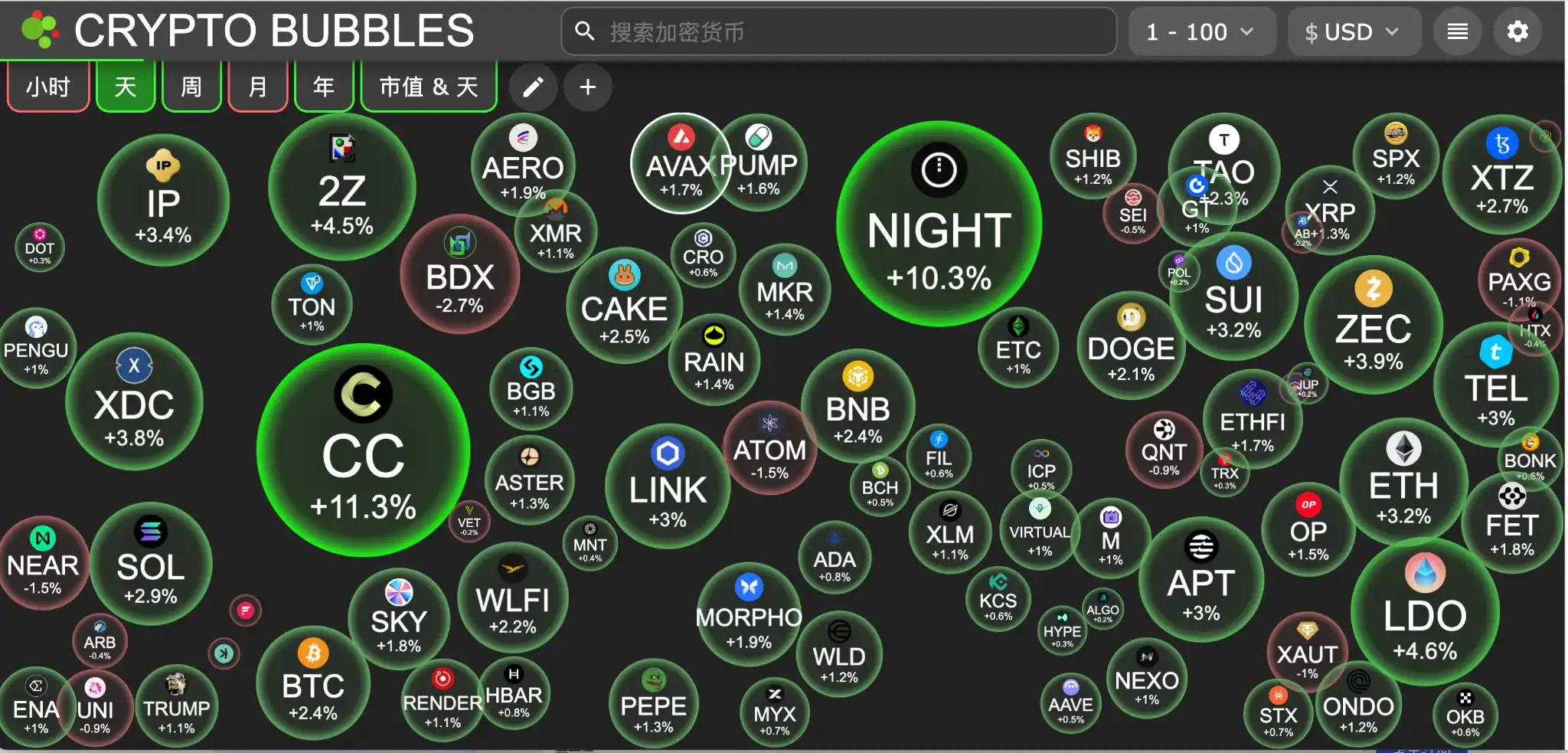
Today's Top 100 Coins by Market Cap - Maximum Gains: Canton Network up 11.3%, Midnight up 10.3%, DoubleZero up 4.7%, Lido DAO up 4.5%, Zcash up 3.9%.

5. Hot News

  • Data: HYPE, SUI, EIGEN and other tokens to see large unlocks next week,其中 (with) HYPE unlock value approx. $256 million

  • Weekly Preview | EU, UK, Hong Kong and other regions implement relevant new regulations for digital assets; Hyperliquid (HYPE) to unlock tokens worth ~$256 million

  • Suspected Trend Research purchased another 11,520 ETH, worth $34.93 million

  • Analysis: Bitcoin spot ETFs累计 (accumulated) net outflows nearly $6 billion over past nine weeks, market funding and sentiment remain under pressure

  • Hyperliquid's weekly revenue仅为 (only) $9.16 million, hitting a new low since early May

  • Solana DEX spot trading volume year-to-date exceeds $1.7 trillion, surpassing Bybit to rank second

  • A whale withdrew 2,218 ETH, 37.1 million SKY, and 4,772 AAVE from Kraken 7 hours ago

  • Spot silver breaks through $80/oz, setting a new record

  • Hyperliquid Co-founder: 1.2 million HYPE tokens will be allocated to team members on January 6 after unlock

  • Bubblemaps: Meme coin project ATLAS疑似 (suspected) insider trading, 68 wallets already hold 47% of token supply

  • Coinbase Bitcoin Premium Index has been in negative premium for two consecutive weeks, currently reported at -0.0784%

  • 100 million UNI burned from Uniswap treasury, worth $596 million

  • Flow hacked for $3.9 million loss, user deposits unaffected

Связанные с этим вопросы

QWhat happened to the price of silver after it hit a new all-time high, and what was a key factor contributing to the subsequent volatility?

AAfter hitting a new all-time high above $84/oz, the price of silver experienced a sharp pullback, falling to around $78/oz. A key factor contributing to this volatility was profit-taking by traders. Additionally, the CME raised margin requirements for silver futures for the second time in two weeks, which historically has triggered sell-offs.

QAccording to analysts cited, what is the prevailing sentiment in the cryptocurrency market despite Bitcoin's price breaking through $90,000?

AThe prevailing sentiment in the cryptocurrency market is one of caution and pessimism. Analysts like Killa and Ali Charts view any price rebounds as potential 'dead cat bounces'—temporary recoveries lacking genuine demand—due to significant capital outflows from Bitcoin ETFs and a general market downturn.

QWhat critical price level for Ethereum did on-chain analyst Murphy identify as a major support zone, and what was the concern if it were broken?

AOn-chain analyst Murphy identified $2,700 as a critical support zone for Ethereum. The concern was that if this level were broken, the price could enter a 'vacuum zone' with little support, potentially falling to a range between $1,800 and $2,600.

QWhat major event is the market anticipating for the decentralized perpetual exchange Lighter, and what is unique about its token airdrop distribution?

AThe market is anticipating the Token Generation Event (TGE) for the decentralized perpetual exchange Lighter, widely expected to occur on December 29th. A unique feature of its airdrop is that it will distribute 25% of the total token supply directly to users' wallets without requiring them to claim it.

QBased on the ETF flow data provided, what was the net flow trend for Bitcoin and Ethereum ETFs for the week ending December 26th?

AFor the week ending December 26th, both Bitcoin and Ethereum ETFs experienced net outflows. Bitcoin ETFs saw a net outflow of $782 million, while Ethereum ETFs had a net outflow of $102 million.

Похожее

The Gold Buy-on-the-Dip Guide: Watch Interest Rates, Not Just War

"Gold Buying Guide: Focus on Interest Rates, Not Just War" Four months ago, gold buyers likely didn't anticipate buying at a peak that even a war couldn't sustain. After hitting a record high of $5,596 on January 29, gold entered a bear market just 91 days later, its fastest decline since 2008. A key trigger was the Fed's hawkish shift, highlighting that monetary policy, not geopolitics, is the primary driver. The article argues that the traditional "buy gold in turmoil" script has changed. While the US-Iran conflict initially boosted prices, the sustained rally in oil prices heightened inflation fears, forcing central banks to maintain or consider tighter policy. Since gold yields no interest, higher rates increase its opportunity cost, eroding its appeal. This dynamic was evident when gold fell sharply on May 18 despite positive peace talks, as lower oil prices eased inflation and thus rate hike pressures. The recent sell-off is also part of a broader market deleveraging. Correlations between gold, Nasdaq, and Bitcoin spiked as leveraged investors sold liquid assets to cover losses, creating a synchronized downturn. Historically, gold bottoms align with policy shifts, not conflict resolutions. The 2008 and 2022 bear markets ended with shifts to extreme easing and peak inflation expectations, respectively. For potential buyers, the author suggests monitoring three signals: 1) Peak interest rate hike expectations, 2) Reopening of the Strait of Hormuz (to ease oil/inflation pressure), and 3) A return to net inflows for Gold ETFs, indicating the end of forced selling. While predicting the exact bottom is impossible, the author's personal strategy involves scaling into a position across price levels like $4000, $3700, and $3500, committing no more than 30% of the intended total allocation initially, and adding the remainder only if key signals emerge. The core conclusion: In turbulent times, watching interest rates is more crucial than watching wars.

marsbit8 мин. назад

The Gold Buy-on-the-Dip Guide: Watch Interest Rates, Not Just War

marsbit8 мин. назад

Recent On-Chain Review: No Clear Narrative Under U.S. Stock Market Pressure, Just Hype

This article analyzes the current state of the Solana meme coin and community token ecosystem, highlighting a market caught between two dominant forces: attention-based PvP and a gradual return to community-centric projects. The first part explores the "Attention PvP" dynamic, where success is driven by celebrity endorsements, viral events, and speed. Examples include $JOTCHUA, which surged after its meme creator's social media activity, and $WORLDCUP, which outperformed a similar Base chain project ($PITCH) largely due to influencer support. The recent "pump.fun GO" feature, allowing bounty tasks for token promotion, is critiqued for fostering sensationalist and often negative stunts—like people getting token tickers tattooed on their bodies for rewards—reminiscent of old internet shock content. In contrast, the article points to a resurgence of organic, community-driven tokens that survive market volatility through strong holder bases and shared ideology, not just hype. Influencer Ansem is cited, arguing that durable meme coins rely on communities willing to endure losses and promote their core message daily. Examples given are older tokens like $neet (anti-work ethos), $troll, $buttcoin, and $triplet, which have maintained relative price stability. A prime example of this community-build model is the new project $KINS, the token for the browser-based MMORPG Kintara. Its success stems not from advanced graphics but from consistently delivering updates, fostering player trust, and creating genuine engagement (e.g., in-game economies, events, property auctions). It has attracted a growing player base and even notable KOLs as participants, demonstrating that sustainable growth can come from building trust rather than orchestrating pumps. The article concludes by questioning whether the market is ultimately a game of mutual trust or mutual deception, expressing hope that such reflection might lead to a healthier ecosystem.

marsbit8 мин. назад

Recent On-Chain Review: No Clear Narrative Under U.S. Stock Market Pressure, Just Hype

marsbit8 мин. назад

On-Chain Scene on Opening Day: $20 Billion Already Staked, How Do On-Chain Contracts Know Who Wins?

On the opening day of the 2026 World Cup, over $2 billion had already been wagered on just the "tournament winner" contracts on platforms like Polymarket and Kalshi. This article explores how these blockchain-based prediction markets actually function once the games begin. It breaks down the massive volume and explains how single-game and tournament-long contracts are priced, with values moving between 1-99 cents to reflect implied probabilities. A key mechanism highlighted is "elimination zeroing," where a team's "champion yes" contract immediately settles to zero once they are mathematically eliminated. The core technical question answered is: how does a smart contract "know" who won a real-world match? The answer lies in oracles. The article details two primary paradigms: UMA's "optimistic oracle" (used by most of Polymarket), which allows a challenge period after a proposed result, and Chainlink's multi-source data aggregation (used by FIFA partners like ADI Predictstreet), which automates settlement with minimal dispute windows. Finally, the article injects a note of caution, citing research estimating that a significant portion of historical trading volume on these platforms might be "wash trading" to inflate numbers. It concludes by contrasting the legal status of these "event contracts" under CFTC rules in the U.S. versus traditional, state-regulated sports betting. As the tournament progresses, the real-time operation of this multi-billion dollar machine—its settlements, eliminations, and underlying mechanisms—becomes a story as compelling as the football itself.

marsbit23 мин. назад

On-Chain Scene on Opening Day: $20 Billion Already Staked, How Do On-Chain Contracts Know Who Wins?

marsbit23 мин. назад

Sequoia Dialogue with Jensen Huang: Computing Model Undergoes a 60-Year Transformation; You Won't Be Replaced by AI, But You Will Be Dimensionality-Reduced by 'Those Who Master AI'

NVIDIA founder and CEO Jensen Huang, in a conversation with Sequoia Capital's Konstantine Buhler, argues that we are witnessing the most significant computing shift in 60 years—from retrieval-based to generative computing. Instead of just storing and retrieving data, future systems will generate highly personalized content (text, images, video) on demand, powered by massive "AI factories." Huang envisions a global "intelligence network" that will envelop the planet, following the historical patterns of energy and communication grids. He outlines a five-layer investment framework: 1) Energy, 2) Chips/Computers, 3) Infrastructure (data centers), 4) AI Models, and 5) Applications. He predicts this ecosystem will reach a scale of $20 trillion annually. Crucially, Huang pushes back against fears of AI-driven job loss. He distinguishes between specific "tasks" (e.g., typing, analyzing images) and overall "jobs" (e.g., CEO, radiologist). While AI automates tasks, it increases efficiency and demand for the higher-value problem-solving aspects of professions, thus creating more jobs and "up-leveling" careers. The real risk, he asserts, is not being replaced by AI, but being outperformed by someone who effectively leverages it. He urges everyone to embrace AI as a tool for augmented capability and innovation.

marsbit1 ч. назад

Sequoia Dialogue with Jensen Huang: Computing Model Undergoes a 60-Year Transformation; You Won't Be Replaced by AI, But You Will Be Dimensionality-Reduced by 'Those Who Master AI'

marsbit1 ч. назад

Торговля

Спот
Фьючерсы

Популярные статьи

Тест по Bitcoin Биткоина

HTX Learn: Изучите Bitcoin halving и Заработаете Токены USDT

3.1k просмотров всегоОпубликовано 2024.04.16Обновлено 2024.04.16

Тест по Bitcoin  Биткоина

Что такое $BITCOIN

ЦИФРОВОЕ ЗОЛОТО ($BITCOIN): Комплексный анализ Введение в ЦИФРОВОЕ ЗОЛОТО ($BITCOIN) ЦИФРОВОЕ ЗОЛОТО ($BITCOIN) — это проект на основе блокчейна, работающий в сети Solana, который стремится объединить характеристики традиционных драгоценных металлов с инновациями децентрализованных технологий. Хотя он носит имя Биткойн, часто называемого “цифровым золотом” из-за его восприятия как средства хранения ценности, ЦИФРОВОЕ ЗОЛОТО является отдельным токеном, предназначенным для создания уникальной экосистемы в ландшафте Web3. Его цель — позиционировать себя как жизнеспособный альтернативный цифровой актив, хотя детали его применения и функциональности все еще развиваются. Что такое ЦИФРОВОЕ ЗОЛОТО ($BITCOIN)? ЦИФРОВОЕ ЗОЛОТО ($BITCOIN) — это токен криптовалюты, специально разработанный для использования в блокчейне Solana. В отличие от Биткойна, который выполняет широко признанную роль хранения ценности, этот токен, похоже, сосредоточен на более широких приложениях и характеристиках. Примечательные аспекты включают: Инфраструктура блокчейна: Токен построен на блокчейне Solana, известном своей способностью обрабатывать высокоскоростные и недорогие транзакции. Динамика предложения: ЦИФРОВОЕ ЗОЛОТО имеет максимальное предложение, ограниченное 100 квадриллионами токенов (100P $BITCOIN), хотя детали о его обращающемся предложении в настоящее время не раскрыты. Утилита: Хотя точные функциональные возможности не описаны, есть указания на то, что токен может быть использован для различных приложений, потенциально связанных с децентрализованными приложениями (dApps) или стратегиями токенизации активов. Кто создатель ЦИФРОВОГО ЗОЛОТА ($BITCOIN)? На данный момент личность создателей и команды разработчиков, стоящих за ЦИФРОВЫМ ЗОЛОТОМ ($BITCOIN), остается неизвестной. Эта ситуация типична для многих инновационных проектов в области блокчейна, особенно тех, которые связаны с децентрализованными финансами и феноменом мем-криптовалют. Хотя такая анонимность может способствовать культуре, ориентированной на сообщество, она усиливает опасения по поводу управления и ответственности. Кто инвесторы ЦИФРОВОГО ЗОЛОТА ($BITCOIN)? Доступная информация указывает на то, что у ЦИФРОВОГО ЗОЛОТА ($BITCOIN) нет известных институциональных спонсоров или значительных венчурных капиталовложений. Проект, похоже, функционирует по модели пирингового взаимодействия, сосредоточенной на поддержке и принятии сообществом, а не на традиционных путях финансирования. Его активность и ликвидность в основном сосредоточены на децентрализованных биржах (DEX), таких как PumpSwap, а не на устоявшихся централизованных торговых платформах, что еще больше подчеркивает его подход, ориентированный на grassroots. Как работает ЦИФРОВОЕ ЗОЛОТО ($BITCOIN) Операционные механизмы ЦИФРОВОГО ЗОЛОТА ($BITCOIN) можно подробно описать на основе его дизайна блокчейна и характеристик сети: Механизм консенсуса: Используя уникальный механизм доказательства истории (PoH) Solana в сочетании с моделью доказательства доли (PoS), проект обеспечивает эффективную валидацию транзакций, что способствует высокой производительности сети. Токеномика: Хотя конкретные дефляционные механизмы не были подробно описаны, большое максимальное предложение токенов подразумевает, что оно может быть предназначено для микротранзакций или нишевых случаев использования, которые еще предстоит определить. Интероперабельность: Существует потенциал для интеграции с более широкой экосистемой Solana, включая различные платформы децентрализованных финансов (DeFi). Однако детали относительно конкретных интеграций остаются неуточненными. Хронология ключевых событий Вот хронология, которая подчеркивает значимые вехи, касающиеся ЦИФРОВОГО ЗОЛОТА ($BITCOIN): 2023: Первоначальное развертывание токена происходит в блокчейне Solana, отмеченное его адресом контракта. 2024: ЦИФРОВОЕ ЗОЛОТО приобретает видимость, когда оно становится доступным для торговли на децентрализованных биржах, таких как PumpSwap, позволяя пользователям обменивать его на SOL. 2025: Проект наблюдает спорадическую торговую активность и потенциальный интерес к инициативам, возглавляемым сообществом, хотя на данный момент не зафиксировано никаких значительных партнерств или технических достижений. Критический анализ Сильные стороны Масштабируемость: Основная инфраструктура Solana поддерживает высокие объемы транзакций, что может повысить полезность $BITCOIN в различных сценариях транзакций. Доступность: Потенциально низкая цена торговли за токен может привлечь розничных инвесторов, способствуя более широкому участию благодаря возможностям дробного владения. Риски Отсутствие прозрачности: Отсутствие публично известных спонсоров, разработчиков или процесса аудита может вызвать скептицизм относительно устойчивости и надежности проекта. Волатильность рынка: Торговая активность сильно зависит от спекулятивного поведения, что может привести к значительной волатильности цен и неопределенности для инвесторов. Заключение ЦИФРОВОЕ ЗОЛОТО ($BITCOIN) является интригующим, но неоднозначным проектом в быстро развивающейся экосистеме Solana. Хотя он пытается использовать нарратив “цифрового золота”, его отход от установленной роли Биткойна как средства хранения ценности подчеркивает необходимость более четкого различения его предполагаемой утилиты и структуры управления. Будущее принятие и усвоение, вероятно, будут зависеть от решения текущей непрозрачности и более четкого определения его операционных и экономических стратегий. Примечание: Этот отчет охватывает синтезированную информацию, доступную на октябрь 2023 года, и с тех пор могут произойти события.

99 просмотров всегоОпубликовано 2025.05.13Обновлено 2025.05.13

Что такое $BITCOIN

Fractal Bitcoin: масштабирование Биткоина с помощью рекурсивной системы

Fractal Bitcoin — масштабное Layer-1-решнение, созданное на базе кода Биткоина, позволяющего достигать бесконечного масштабирования с помощью рекурсивного подхода.

2.3k просмотров всегоОпубликовано 2025.06.30Обновлено 2025.06.30

Fractal Bitcoin: масштабирование Биткоина с помощью рекурсивной системы

Обсуждения

Добро пожаловать в Сообщество HTX. Здесь вы сможете быть в курсе последних новостей о развитии платформы и получить доступ к профессиональной аналитической информации о рынке. Мнения пользователей о цене на BTC (BTC) представлены ниже.

活动图片