The Great Ethereum "Rate Cut" Debate: Is Now the Golden Window for Staking with the Unconventional EIP-8363?

marsbitОпубликовано 2026-08-17Обновлено 2026-08-17

Введение

Ethereon's economic policy is under review as a new proposal, EIP-8363, sparks debate over potential "interest rate cuts" for staking. The unconventional proposal suggests gradually increasing the proportion of newly issued ETH rewards that are burned as the total staked ETH ratio rises, with issuance fully offset by burns once the ratio nears 50%. This would drive the protocol-level staking APR towards 0%, though validators would still earn transaction fees and MEV. This discussion emerges as staked ETH approaches 35% of supply, with the current protocol APR at ~2.6%. The core question is whether Ethereum needs to continue paying high issuance costs for marginal gains in security once sufficient participation is achieved. EIP-8363 aims to optimize security spending, but critics warn it could disproportionately impact solo stakers and potentially increase centralization among large, resilient operators. Paradoxically, this debate coincides with the Pectra upgrade (EIP-7251), which introduces native compounding for staking rewards, significantly improving capital efficiency for long-term holders. This creates a dual narrative: the protocol is making staking more efficient while reconsidering the economic incentive to stake. For long-term ETH holders, this environment may present a "time window" rather than a fixed-rate opportunity. While future APRs are expected to trend downward, starting staking earlier maximizes the compounding effect over time. The decision to stake dep...

While the Federal Reserve remains undecided on "rate hikes or cuts," Ethereum staking, the "on-chain financial benchmark rate," has already started discussing a "rate cut."

The recently widely debated EIP-8363 proposes a rather counter-intuitive new issuance mechanism: as the proportion of ETH staked increases, gradually raise the burn ratio in validator rewards. When the network-wide staking ratio nears 50%, the burn would completely offset the issuance rewards.

In other words, when the network-wide ETH staking ratio reaches 50%, the annualized staking yield will drop to nearly 0!

Of course, this does not mean total staking returns will be strictly zero at that point, as validators could still earn other incomes like execution layer transaction fees and MEV. However, for the issuance reward, which currently constitutes the vast majority of staking returns, this would undoubtedly be like "pulling the firewood from under the cauldron."

This single stone has stirred up a thousand waves.

Consider this: as of writing, over 40 million ETH have been staked, nearing about 35% of the total supply, and the protocol-level APR has already dropped to around 2.6%. Thus, a question that once seemed distant is suddenly before Ethereum:

As more and more ETH are willing to participate in staking, does Ethereum still need to incentivize more ETH into staking through new issuance?

I. Is Ethereum Starting to Worry About "Too Much Staking"?

To understand this, we first need to review the different stages Ethereum staking has undergone.

As is well known, when the PoS mechanism first launched, its primary goal was singular: to get enough ETH willing to enter the Beacon Chain, establishing sufficient economic security for the entire network.

To achieve this, the protocol rewarded validators with new issuance, while designing a dynamic yield curve: early participants could obtain higher yields per validator; in the future, as more ETH enters staking, the yield would gradually decline.

This is why Ethereum's early staking APR was once far higher than today's, now reduced to about 2.6%. Theoretically, this mechanism itself comes with an "automatic brake."

After all, as yields get lower, some will inevitably find it no longer worthwhile, eventually allowing the entire staking market to find an equilibrium at a certain level. However, the core premise of EIP-8363 is precisely that this brake might not be strong enough.

According to the current issuance curve, even as more ETH enters staking, there remains an implied floor of about 1.5% for validators' consensus layer yield. Thus, a situation could theoretically arise where substantial funds remain willing to enter even with yields just over 1%.
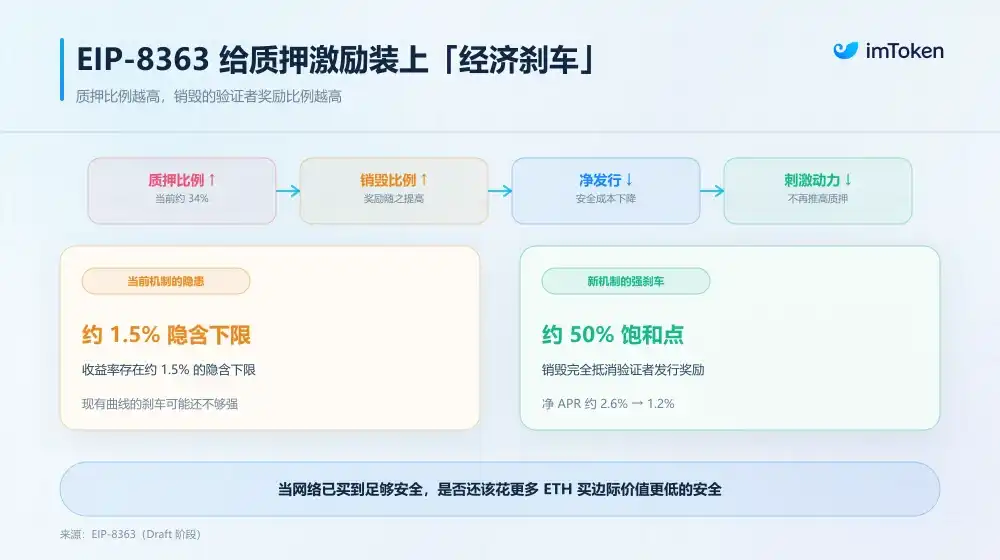
And as an increasingly larger proportion of ETH is entrusted to exchanges, custodians, LST protocols, and professional operators, the marginal contribution of additional staking to economic security diminishes, while risks like staking centralization, governance capture, and control of massive ETH by few entities may increase.

Simultaneously, staking rewards essentially come from new ETH issuance. The higher the staking ratio, the greater the issuance cost the protocol pays for network security; ETH holders not participating in staking bear the corresponding dilution.

So the problem EIP-8363 aims to address is: when the network has already bought sufficient security, is it necessary to keep spending more ETH to purchase additional security of diminishing marginal value?

Of course, its proposal is not yet a confirmed Ethereum monetary policy to be implemented, and community controversy is significant. One very realistic counter-argument is that if yields are pushed too low, the first to find it "unprofitable" and exit might precisely be the Solo Stakers who bear hardware, electricity, and operational costs.

Large institutions, due to economies of scale, MEV income, or product demands, might be better equipped to stay. The result could then be "staking ratio decreases, but those remaining become more concentrated," which clearly conflicts with the proposal's original intention of improving decentralization and anti-capture capabilities.

Community discussion continues on this point. Whether EIP-8363 will ultimately be implemented, and in what form, remains undecided.

But it at least sends a clear signal: Ethereum has begun rethinking a problem it rarely needed to consider before—is the staking reward too generous?

II. Preparing for a "Rate Cut," While Staking Just Entered the Compound Interest Era

Interestingly, while Ethereum discusses reducing long-term staking yields, the capital efficiency of staking itself just received a significant upgrade.

This is EIP-7251, brought by the Pectra upgrade (Further reading: "When 8 Million ETH Start 'Moving': Post-Pectra Era, Is Staking Facing Structural Upheaval?").

Simply put, Ethereum's native staking previously did not compound automatically; only the principal (32 ETH) earned, but interest did not automatically accrue into the principal to continue earning. EIP-7251 makes native staking truly form a compound interest loop: "principal generates ETH → rewards enter principal → more ETH then generates new ETH."

From a one- or two-year perspective, the numerical difference between compounding or not on a ~2% yield isn't dramatic.

Where it truly matters is time.

Assuming a user plans to hold ETH for three, five years, or even longer, starting staking from day one with generated ETH continuously rejoining the principal—the longer the period, the more the gap between the two can be amplified.

For ordinary users using LSTs, "compound interest" isn't a new concept; many LSD/LST products already allowed users to indirectly benefit from staking reward accumulation. But the Pectra upgrade makes auto-compounding a capability natively supported by the protocol for the first time, rather than relying on external products, undoubtedly further enhancing the capital efficiency of the entire staking infrastructure.
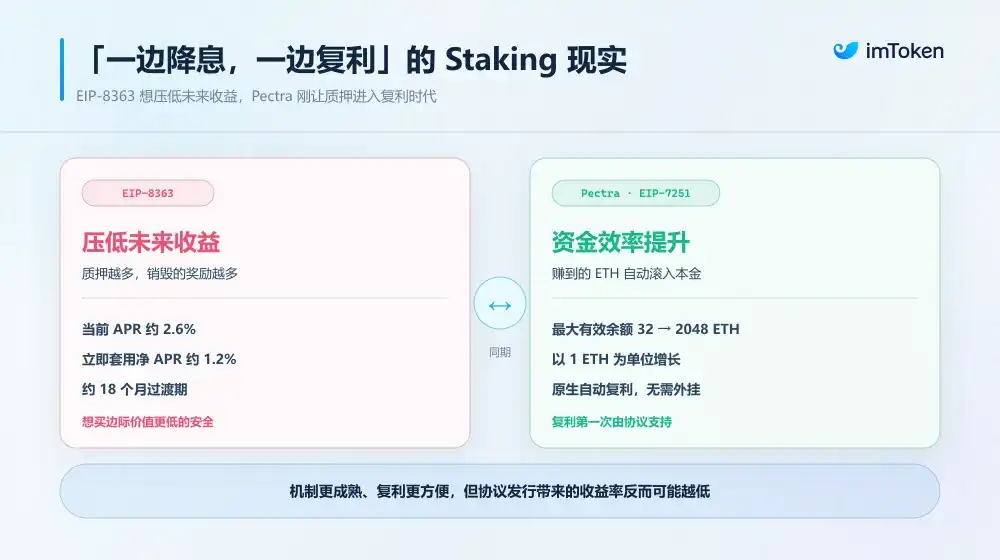
So viewing EIP-8363 and Pectra together forms a seemingly contradictory yet actually quite reasonable combination: Ethereum is striving to make "how to stake" more efficient, but that doesn't mean it still wants to use increasing ETH issuance to continuously raise the economic incentive for "why to stake."

The former addresses capital efficiency, the latter addresses how much the protocol should pay for security.

Precisely because of this, future Ethereum staking will likely see an increasingly obvious trend: mechanisms become more mature, compounding becomes more convenient, but yields derived purely from protocol issuance become lower.

This protocol-level change is also gradually transmitting to ordinary users' product experience. For instance, imToken plans to further support "auto-compounding" for native ETH staking, ensuring Pectra's new capabilities aren't limited to validators and large staking institutions but gradually enter wallet gateways directly usable by ordinary long-term holders.

III. Is Now Instead the Golden Window for Staking?

This brings us to the question ordinary ETH holders genuinely care about.

If future Staking APR may continue to decline, does it mean we should "get in quickly while yields are still high"?

We must first dispel a common misconception: staking now does not lock in today's ~2.6-3% yield.

Because Ethereum staking is not a long-term bond with a fixed coupon rate upon purchase. Even if EIP-8363 is implemented, or Ethereum modifies the issuance curve by other means in the future, validator yields will change accordingly.

Therefore, the so-called "window" is not about rushing before an Ethereum "rate cut" to grab a long-term deposit certificate at 2.6%.

The real value lies in the time cost.

Assume a user holds a sum of ETH, originally planning to hold for five years. Not staking in year one but deciding to start in year two won't make year two's yield higher, nor can they recover the missed ETH rewards from year one. More importantly, the rewards that could have been earned in year one lose the opportunity to compound over the subsequent four years.
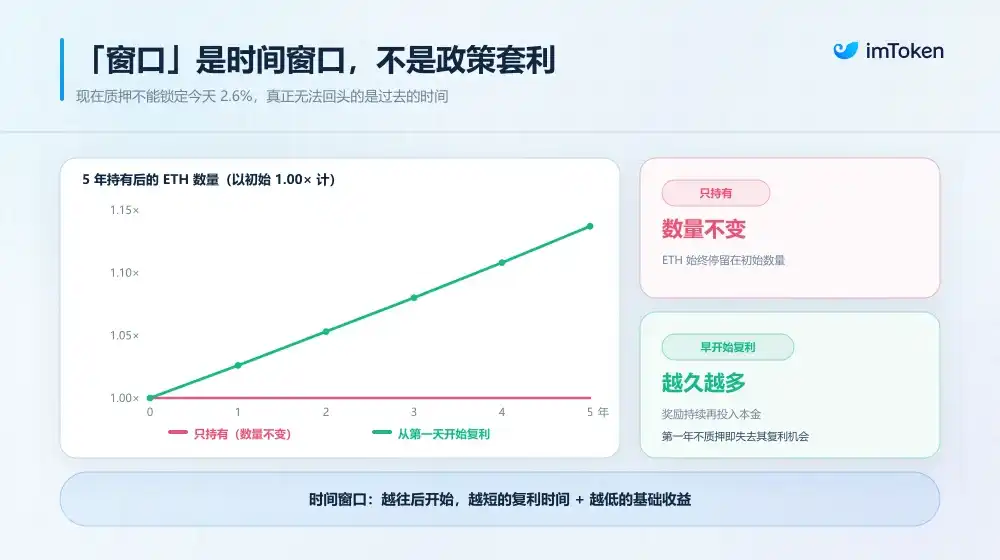
If the long-term direction for Ethereum staking is indeed a gradual increase in staking ratio and a gradual decrease in yield, this issue becomes more pronounced. Starting later means potentially enjoying not only a shorter compounding period but also a lower base yield.

This is where "now might be a window" truly holds water—in other words, it's a window of time.

Especially for users already planning to hold ETH long-term with no imminent liquidity needs, the decision-making process for staking might also need to change.

Moreover, the author personally believes EIP-8363 is a trial balloon. Regardless of future community consensus, the macro trend of Ethereum's token economics is destined to shift from extensive incentives towards more refined, more restrained issuance design.

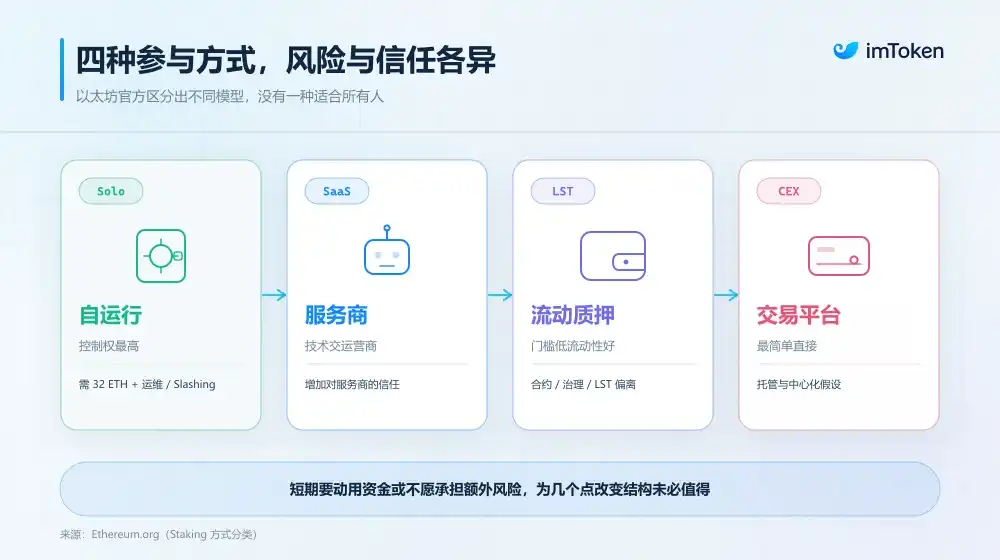
Of course, this does not mean all ETH should be staked, as any return corresponds to costs and risks:

  • Running a native validator oneself maximizes control and protocol-native rewards but requires at least 32 ETH and entails costs like node operation, offline penalties, slashing risks, and daily maintenance.
  • Staking-as-a-Service can delegate technical work to professional operators but adds trust in the service provider.
  • Liquid staking has lower capital barriers and better liquidity. For example, users can directly access services like Lido via self-custody wallets like imToken, managing their wallet while participating in ETH staking. However, it adds extra risks like smart contracts, governance, and LST price deviation.
  • Centralized exchanges are simpler but entail higher custodial and centralization assumptions.

Thus, for users who might sell ETH short-term, need frequent fund movement, or are unwilling to bear these additional risks, altering their asset structure for a few percentage points of yield may not be worthwhile.

But if the premise becomes "this ETH is intended to be held long-term anyway," then the answer might start to differ.
In Conclusion

Looking back at Ethereum staking's changes over recent years is quite interesting.

The Beacon Chain and The Merge completed the underlying transition from PoW to PoS. Shapella solved the problem of "can staked ETH be withdrawn," clearing a key obstacle for the liquid staking market's further development. By Pectra, native validators began to possess auto-compounding and higher capital efficiency.

Today's EIP-8363 discusses the question further: when enough people are already staking, how much new ETH should Ethereum actually pay for staking?

The shift from "figuring out how to get more people to stake" to "starting to worry if too much is staked" itself indicates the stage Ethereum Staking is in has changed.

Seas change into mulberry fields, progress is made step by step. This is also a question a market transitioning from early expansion to maturity must inevitably answer.

Future staking may become more convenient, more mature, increasingly resembling a standardized ETH base-layer yield infrastructure—but not necessarily more profitable. And for those truly preparing to hold ETH long-term, this might be another insight EIP-8363 offers:

When the yield itself becomes increasingly scarce, what's truly precious about compounding is time.


Трендовые криптовалюты

Связанные с этим вопросы

QWhat is the main argument of EIP-8363 regarding Ethereum staking rewards?

AThe main argument of EIP-8363 is that as the total ETH staking ratio increases, the proportion of validator rewards that are burned should gradually increase. When the network staking ratio approaches 50%, the burning would completely offset the issuance rewards, effectively reducing the protocol's APR from issuance to near 0%. This addresses whether Ethereum needs to continue paying high issuance costs for marginal gains in security once a sufficient level of staking is achieved.

QHow does the Pectra upgrade (specifically EIP-7251) improve the efficiency of Ethereum staking?

AThe Pectra upgrade introduces EIP-7251, which enables automatic compounding for native Ethereum staking for the first time. Before this, rewards did not automatically become part of the staking principal. EIP-7251 creates a cycle where 'principal generates ETH → rewards join the principal → more ETH generates new ETH,' fundamentally improving the capital efficiency of staked assets over long periods.

QAccording to the article, why might the current period be considered a 'golden window' for staking ETH?

AThe article suggests it's a 'time window,' not a rate-lock window. For users planning to hold ETH long-term, starting to stake earlier allows their rewards to benefit from compounding for a longer period. Given the potential long-term trend of decreasing staking APR (as discussed in proposals like EIP-8363), delaying participation means missing out on both earlier rewards and the subsequent compounding on those rewards, effectively facing a higher time cost.

QWhat are the potential risks or downsides of participating in Ethereum staking mentioned in the article?

AThe article mentions several risks and costs associated with different staking methods: Running a native validator requires 32 ETH and carries costs for node operation, offline penalties, slashing, and maintenance. Using Staking-as-a-Service introduces trust in the service provider. Liquid staking (e.g., via LSTs like Lido) involves smart contract, governance, and LST price deviation risks. Centralized exchange staking is simple but relies on high trust in the custodian and centralization assumptions.

QWhat broader shift in Ethereum's development stage does the discussion around EIP-8363 signify?

AThe discussion around EIP-8363 signifies a shift from an early expansion phase focused on incentivizing enough participation to secure the network ('how to get more people to stake') to a more mature phase where the protocol re-evaluates the cost-effectiveness of its security spending ('starting to worry if there is too much staking'). It reflects a move towards more refined and restrained token economics as the staking market matures.

Похожее

«Идея поймать абсолютное дно — ошибочна»: эксперты о новой фазе капитуляции биткоина

Аналитики CryptoQuant заявили, что инвесторам не стоит пытаться поймать «абсолютное дно» биткоина, называя эту идею ошибочной. По их данным, доля предложения биткоина в прибыли упала до 51,4%, что исторически соответствует фазам капитуляции и последующего накопления. Это самый низкий уровень за более чем три года. Около 48,6% монет сейчас в нереализованном убытке. Аналитики отмечают, что падение средней себестоимости держателей отражает переход монет к более сильным инвесторам, а окно для накопления может продлиться дольше ожиданий. Глава Swan Bitcoin Кори Клиппстен предположил, что биткоин может сформировать минимум в октябре 2026 года, следуя исторической цикличности, когда минимумы формировались примерно через год после пиков. После этого он прогнозирует восстановление до примерно $130 000 к халвингу 2028 года. Однако он предостерегает от чрезмерного доверия к прошлым циклам из-за ограниченного количества исторических данных.

cryptonews.ru8 мин. назад

«Идея поймать абсолютное дно — ошибочна»: эксперты о новой фазе капитуляции биткоина

cryptonews.ru8 мин. назад

Как FalconX выводит институциональное кредитование на блокчейн? Детальный разбор механизма работы FALX

Автор: @BlazingKevin_, исследователь Blockbooster FALX — это механизм формирования капитала, который преобразует кредитные портфели Prime Brokerage в активы с фиксированным доходом на блокчейне. Его ядро — это структурированный кредитный механизм, где FalconX выдает обеспеченные кредиты институциональным клиентам (хедж-фондам, маркет-мейкерам). Эти кредитные обязательства помещаются в банкротство-удаленный SPV. Затем Pareto обеспечивает инфраструктуру сейфа на блокчейне, а M11 Credit выступает в роли кредитного куратора, административного и залогового агента. Инвесторам доступ к активам предоставляется через такие платформы, как Plume, Ethereum или Solana. Доходность FALX (примерно 7.4% годовых после вычета комиссий) формируется за счет премий за риск, связанных с волатильностью залога, мгновенной ликвидностью и услугами Prime Brokerage, что отличает его от децентрализованных протоколов, таких как Aave. Инновация FALX заключается в комбинации проверенного институционального кредитного потока, юридической структуры SPV, внешнего надзора M11 и прозрачности блокчейна. Однако продукт сталкивается с вызовами, включая управление ликвидностью (31-дневный период уведомления о погашении) и новые риски, связанные с повторным залогом его токенов в DeFi-протоколах. Текущие активы под управлением (около $148 млн) существенно ниже заявленного потенциала в $1 млрд, что отражает сложность привлечения масштабного капитала на блокчейне для таких сложных кредитных продуктов.

marsbit9 мин. назад

Как FalconX выводит институциональное кредитование на блокчейн? Детальный разбор механизма работы FALX

marsbit9 мин. назад

Chainalysis подаёт в суд на США из-за контракта ICE с TRM Labs на 95 миллионов долларов

Аналитическая компания Chainalysis подала в суд на правительство США из-за решения Иммиграционной и таможенной службы (ICE) о заключении эксклюзивного контракта на 94,6 млн долларов с её конкурентом, TRM Labs. Иск был подан 27 июля в Федеральный суд по искам к правительству США. Контракт предусматривает поставку программного обеспечения и услуг поддержки для расследований Целевой группы по внутренней безопасности сроком на один год, с июля 2026 по июнь 2027 года. Chainalysis оспаривает решение ICE, называя его "произвольным, необоснованным и неразумным". Компания утверждает, что представила ICE свои возможности, однако контракт был заключён с TRM Labs без конкурентных торгов. Обе компании предоставляют государственным органам инструменты анализа блокчейна для отслеживания криптовалютных транзакций. Жалоба Chainalysis хранится под судебной печатью, поскольку содержит конфиденциальную информацию и коммерческую тайну. TRM Labs вступила в дело 28 июля. Ответы правительства и TRM ожидаются в пятницу, устные прения назначены на 2 сентября. Правительство запросило вынесение решения до 10 сентября. Детальные возражения Chainalysis и её требования не раскрываются в публичных документах. Компании TRM Labs, Chainalysis и ICE отказались от комментариев или не ответили на запросы.

cointelegraph10 мин. назад

Chainalysis подаёт в суд на США из-за контракта ICE с TRM Labs на 95 миллионов долларов

cointelegraph10 мин. назад

ИИ не умнее человека, он просто умеет проигрывать: обладатель премии Филдса объясняет десять результатов OpenAI

Искусственный интеллект, представленный внутренней моделью OpenAI Astra, демонстрирует впечатляющие успехи в решении давних математических проблем, таких как опровержение гипотезы Эрдёша о единичных расстояниях и построение не-sofic групп. Однако, как отмечают лауреаты Филдсовской премии Тимоти Гауэрс и Теренс Тао, суть достижений ИИ заключается не в превосходстве над человеческим интеллектом, а в его способности терпеть неудачи. ИИ эффективен в задачах, требующих перебора множества вариантов или построения объектов по шаблону, где его скорость и доступ к обширным данным дают преимущество. Он «не боится проигрывать» и может проверять сотни путей, недоступных человеку из-за ограниченности времени. Однако в задачах, требующих глубокой интуиции, «обрезки» неперспективных направлений поиска и понимания, какая часть доказательства является ключевой, ИИ пока отстает. Это связано с тем, что модели обучаются на «чистых» готовых результатах, лишенных информации о процессе поиска, ошибках и интуитивных прорывах. Таким образом, прорыв ИИ в математике основан на вычислительной выносливости, а не на качественно новом понимании. Настоящей границей будет преодолена тогда, когда ИИ самостоятельно создаст метод, который не просто решит одну задачу, но и откроет новое направление исследований, заставив математиков пересмотреть свой подход к целому классу проблем.

marsbit14 мин. назад

ИИ не умнее человека, он просто умеет проигрывать: обладатель премии Филдса объясняет десять результатов OpenAI

marsbit14 мин. назад

Торговля

Спот

Популярные статьи

Manyu: восходящая мем-звезда на Ethereum, готовая открыть новую эру культуры Shiba

Manyu - это мемтокен на Ethereum, который приносит децентрализованную культурную и развлекательную ценность через вирусное влияние в соцсетях и вовлечённость сообщества.

2.1k просмотров всегоОпубликовано 2025.11.27Обновлено 2025.11.27

Manyu: восходящая мем-звезда на Ethereum, готовая открыть новую эру культуры Shiba

Неделя обучения по популярным токенам 14: Glamsterdam — самое ожидаемое обновление Ethereum в 2026 году

Ordinals/Runes по-прежнему стимулируют доходы от комиссий за блоки и активность разработчиков, рассматриваются как отправная точка «нативной эмиссии активов» в сети.

1.7k просмотров всегоОпубликовано 2026.04.29Обновлено 2026.04.29

Неделя обучения по популярным токенам 14: Glamsterdam — самое ожидаемое обновление Ethereum в 2026 году

Обсуждения

Добро пожаловать в Сообщество HTX. Здесь вы сможете быть в курсе последних новостей о развитии платформы и получить доступ к профессиональной аналитической информации о рынке. Мнения пользователей о цене на ETH (ETH) представлены ниже.

活动图片