Strategy's 'Money Printer': Is STRC Bitcoin's Savior or Destroyer?

marsbitОпубликовано 2026-04-20Обновлено 2026-04-20

Введение

Bitcoin's recent price movement is being heavily influenced by Michael Saylor and his company, MicroStrategy, through a new financial instrument: STRC (Variable Rate Series A Perpetual Stretch Preferred Stock). This Nasdaq-listed perpetual preferred stock offers an 11.5% annual dividend, attracting significant capital. Crucially, funds raised from STRC are used to purchase Bitcoin, with a 3x leverage effect—for every $1 from STRC, MicroStrategy adds $2 from MSTR equity to buy $3 worth of BTC. This creates a powerful "flywheel": more STRC sales fuel massive BTC buying, supporting its price and improving MicroStrategy's credit, which in turn makes STRC more attractive to investors. However, this mechanism introduces risks. A significant "ex-dividend arbitrage" pattern has emerged, where traders buy STRC before its monthly dividend, collect the payout, and quickly sell, causing price volatility and potentially driving up Bitcoin's cost basis for MicroStrategy. In response, Saylor has proposed shifting STRC to a semi-monthly dividend to smooth out these effects. Furthermore, STRC's high yield is being integrated into DeFi protocols like Apyx Protocol and Saturn Credit, offering new on-chain yield opportunities. The central concern remains: as MicroStrategy aggressively accumulates over 3.5% of all BTC, it challenges Bitcoin's foundational principle of decentralization, creating a system where a single public company significantly influences the market.

After fluctuating for over two months, Bitcoin is finally showing signs of a breakout.

Leading the charge for Bitcoin is once again the familiar face Michael Saylor, but this time he has a new weapon: STRC.

If you scroll through Saylor's recent tweets, you'll find him promoting STRC almost daily. AI-generated, low-quality promotional videos featuring tropical resort pools and women holding cocktails send a clear signal: the man who propelled MSTR to the pinnacle of Nasdaq is applying the same marketing firepower to STRC.

Why is he doing this? Because STRC is currently almost the only tool Strategy has to convert market money into BTC buying pressure. For the past three months, the funding source for every large-scale BTC acquisition announced by Strategy has pointed to STRC.

What is STRC

STRC stands for Variable Rate Series A Perpetual Stretch Preferred Stock, a type of perpetual preferred stock issued by Strategy that listed on Nasdaq last November.

Its operating mechanism is roughly as follows:

You spend about $100 to buy one share of STRC. Strategy pays a monthly cash dividend with an annualized yield of 11.5%, which is about 96 cents per share per month. It never matures, and Strategy does not need to repay the principal.

The share price is anchored near the $100 par value by adjusting the dividend rate monthly: if it falls below $100, the dividend rate is increased to attract buying interest; if it rises above $100, the dividend rate is decreased, allowing the price to fall back towards par. The maximum adjustment to the monthly dividend rate is 25 basis points.

Strategy can only issue new shares at par value to raise funds when the STRC share price is above $100—this is the premise of the entire flywheel. The proceeds from the issuance, after deducting the dividend reserve, are mostly used to purchase BTC.

Saylor calls this product "short-duration high-yield credit" or a "Bitcoin-backed money market fund." With current US Treasury yields around 3.5%, STRC offers a yield roughly three times that of Treasuries.

The Flywheel

A common misconception about Saylor is: he is printing unlimited money to buy BTC.

He can't. Saylor cannot create money out of thin air; he must wait for the market to hand it to him. Every additional share of STRC issued requires a real marginal buyer willing to pay $100 for it.

Buyers of STRC are essentially making a credit "trade." The extra 8% yield STRC provides compared to Treasuries is compensation for "Strategy's credit risk."

However, what many STRC buyers don't know is that the funds they use to purchase STRC will be indirectly magnified threefold before flowing into BTC.

Strategy has a public financial goal: a 33% leverage ratio.

Among the company's total funding sources, perpetual preferred shares like STRC, STRF, and STRK should make up about one-third, with the remaining two-thirds coming from MSTR common stock. Saylor calls this principle "intelligent leverage." This means that for every dollar Strategy raises through STRC, to maintain the 33% leverage line, they must issue approximately $2 worth of MSTR to be invested in BTC alongside it. $1 STRC + $2 MSTR = $3 BTC buying pressure.

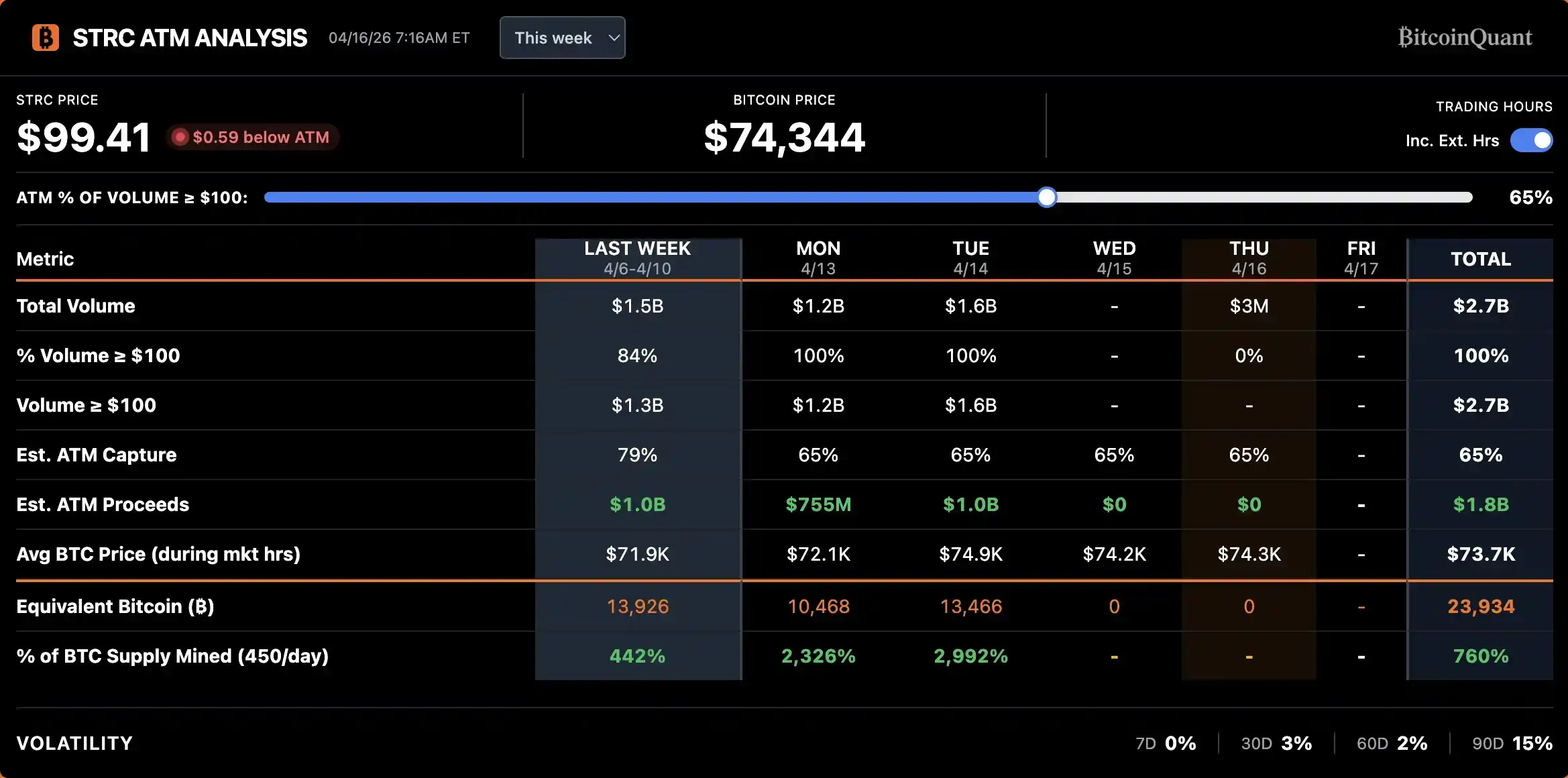
On April 14th, Strategy raised approximately $1 billion through STRC in a single day. With a 3x magnification, this corresponds to about $3 billion in BTC buying pressure, neatly matching the scale of BTC acquisitions in the first two weeks of April before the ex-dividend date.

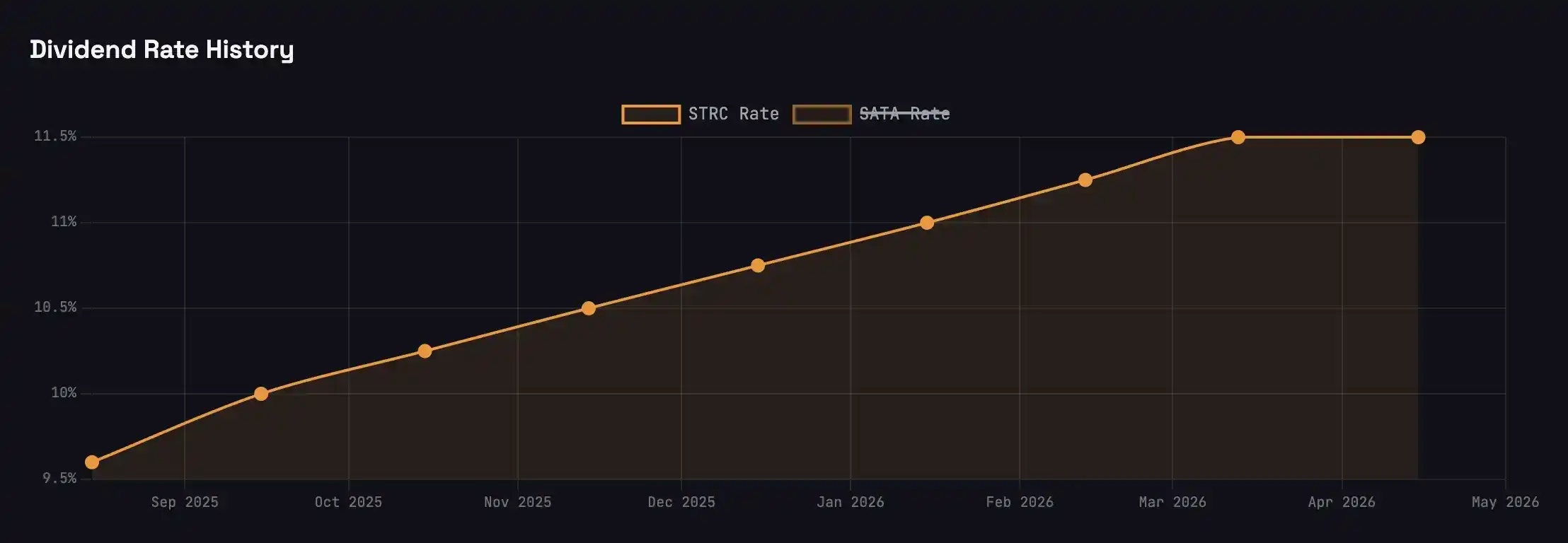
When BTC falls, the collateral shrinks, STRC's credit risk increases, and Strategy must raise the dividend rate to compensate for the new risk level. But the higher the dividend rate, the greater the cash flow pressure and the higher the probability of default. This is an unstable feedback loop. During the period last October when BTC halved from $120,000 to $60,000, the STRC dividend rate was raised from 7% all the way to 11.5% to barely pull buying interest back.

Conversely, when BTC stabilizes and rises, the collateral thickens, credit quality improves, and STRC becomes more attractive at the same dividend rate, further amplifying demand. BlackRock's Preferred and Income Securities ETF listed Strategy's preferred stock as its second-largest holding in April, with its market value increasing from about $200 million in March to $344 million, a direct endorsement of Strategy's current credit status by fixed-income institutions.

Strategy's flywheel has turned positive: More funds buy STRC → Strategy buys BTC with 3x magnification → BTC price gets support → STRC collateral base becomes more solid, credit spread compresses → STRC becomes more attractive at the same dividend rate → More funds buy STRC.

Ex-Dividend Day Arbitrage

The dividend mechanism of preferred stock is different from bonds. Bonds accrue interest daily; you earn interest for each day you hold. Preferred stocks pay out in a lump sum on a fixed date. For STRC, as long as you hold the share at the close of the day before the ex-dividend date, you receive the full 96-cent monthly dividend.

This creates an obvious arbitrage window: buy in a few days before the ex-dividend date, collect the dividend, and sell the next day. Data from the past few months shows that STRC's average decline after the ex-dividend date is about 20 cents, far less than the 96-cent dividend itself. The net profit per share from a single ex-dividend arbitrage can reach about 40 to 50 cents.

Arbitrageurs won't miss this opportunity.

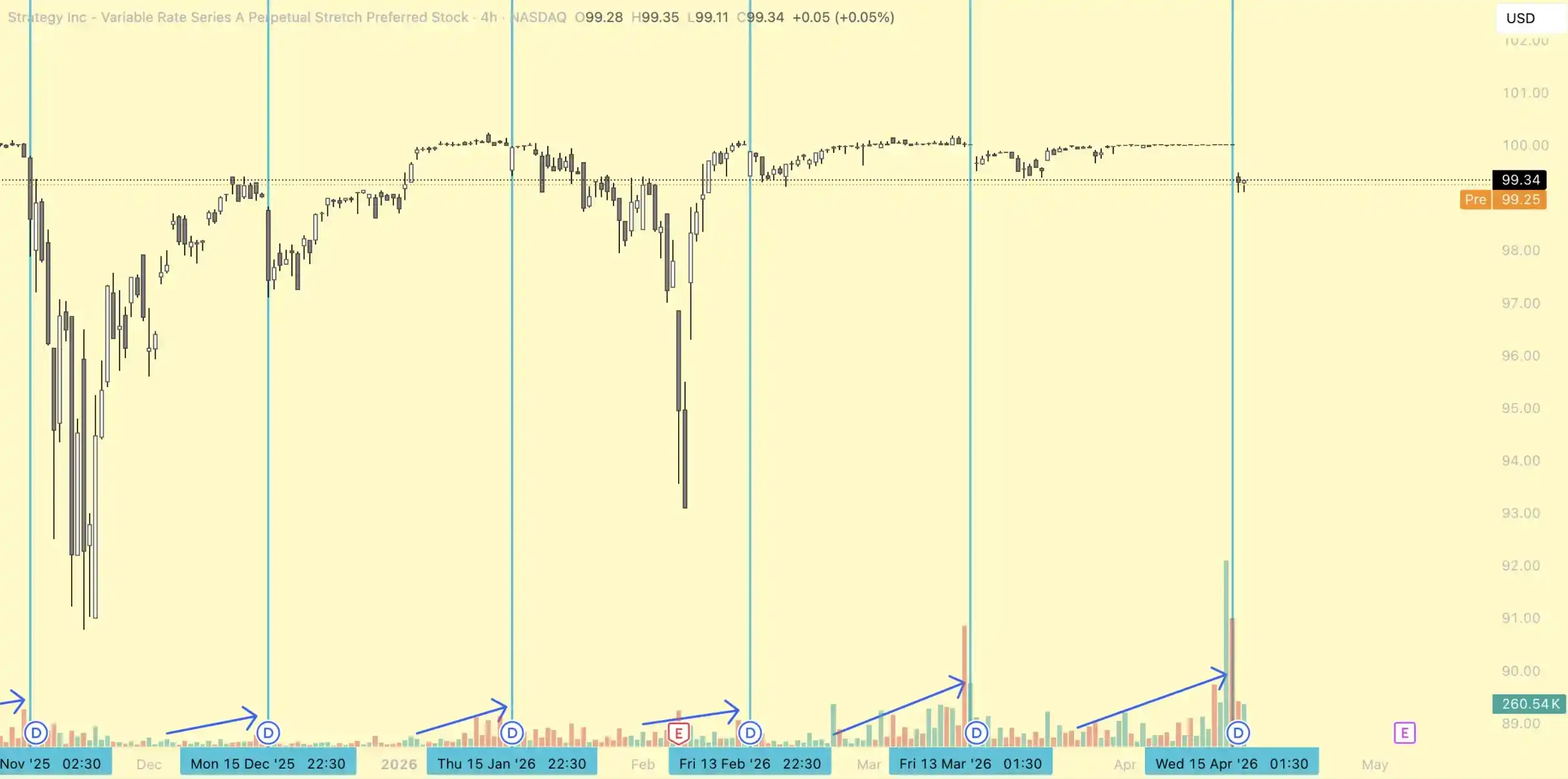
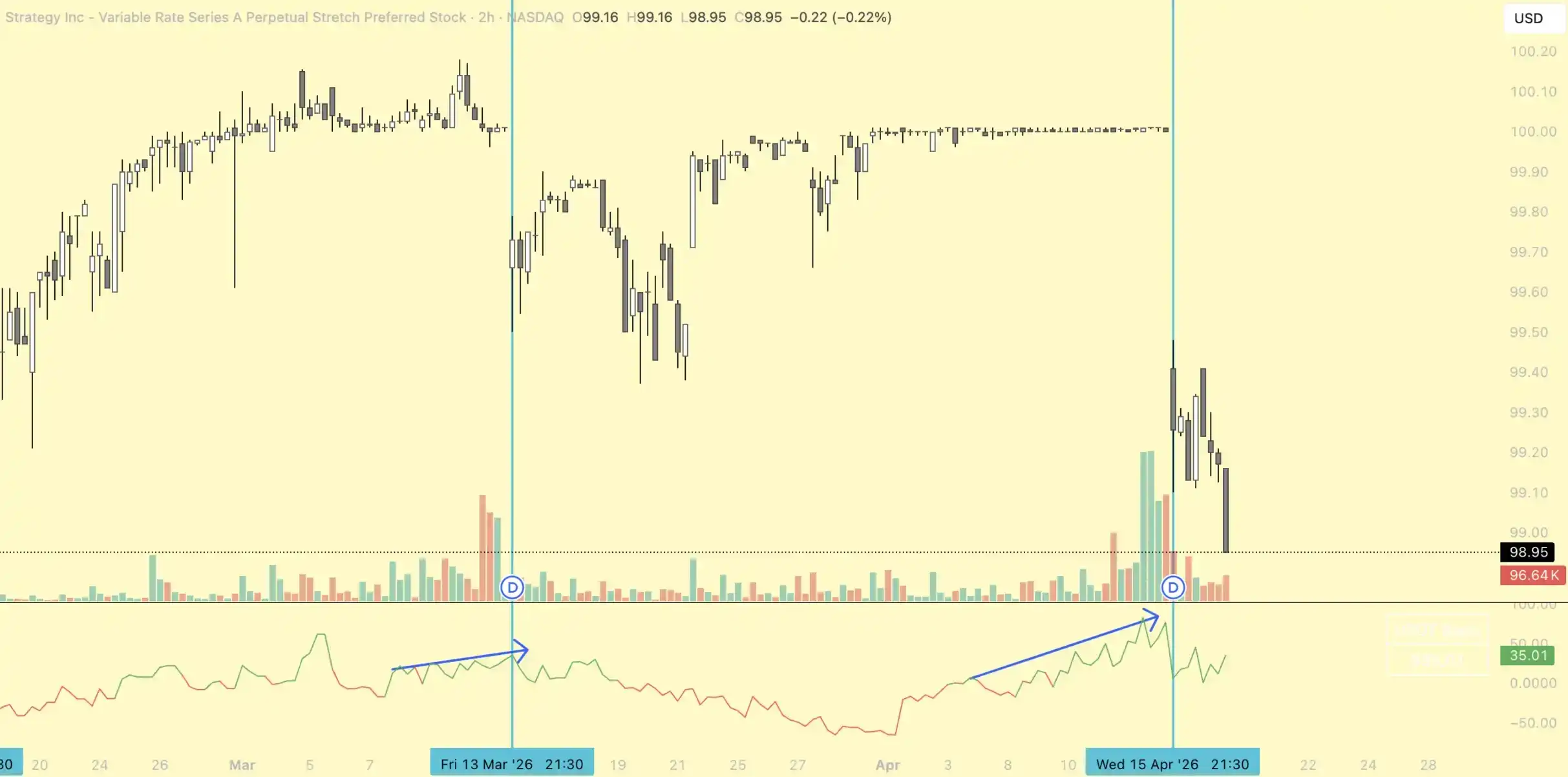
As shown in the chart, trading volume begins to climb about a week before the ex-dividend date, peaks on or the day before the ex-dividend date, and quickly subsides afterward. The surge in volume in April was significantly steeper than in March, indicating that more and more capital is participating in STRC's ex-dividend arbitrage.

However, such arbitrage behavior might not be a good thing.

For the STRC product itself, the two or three weeks after the ex-dividend date enter a "dead zone"—liquidity shrinks, bid-ask spreads widen, and the share price remains below the $100 par value for extended periods. This repeated de-anchoring erodes STRC's positioning as a "money market product," pushing it towards a form more akin to a monthly volatile bond.

For Saylor, his BTC purchases can easily be front-run by arbitrage capital. STRC issuances are concentrated in the two weeks before the ex-dividend date, meaning his BTC buying actions are also concentrated in those two weeks.

Now, traders engaging in arbitrage swarm in to buy STRC at the same time each month. They know Saylor is about to take this money to sweep the spot market for BTC, so they can buy BTC in advance and sell after Saylor pushes the price higher, thereby increasing Saylor's acquisition cost.

Significant increase in Coinbase spot premium around STRC's recent ex-dividend dates

There are two potential solutions: change the dividend frequency, for example from monthly to weekly, to spread out the arbitrage profits; or launch a more junior, more frequently paying derivative product to disperse the concentrated arbitrage trading.

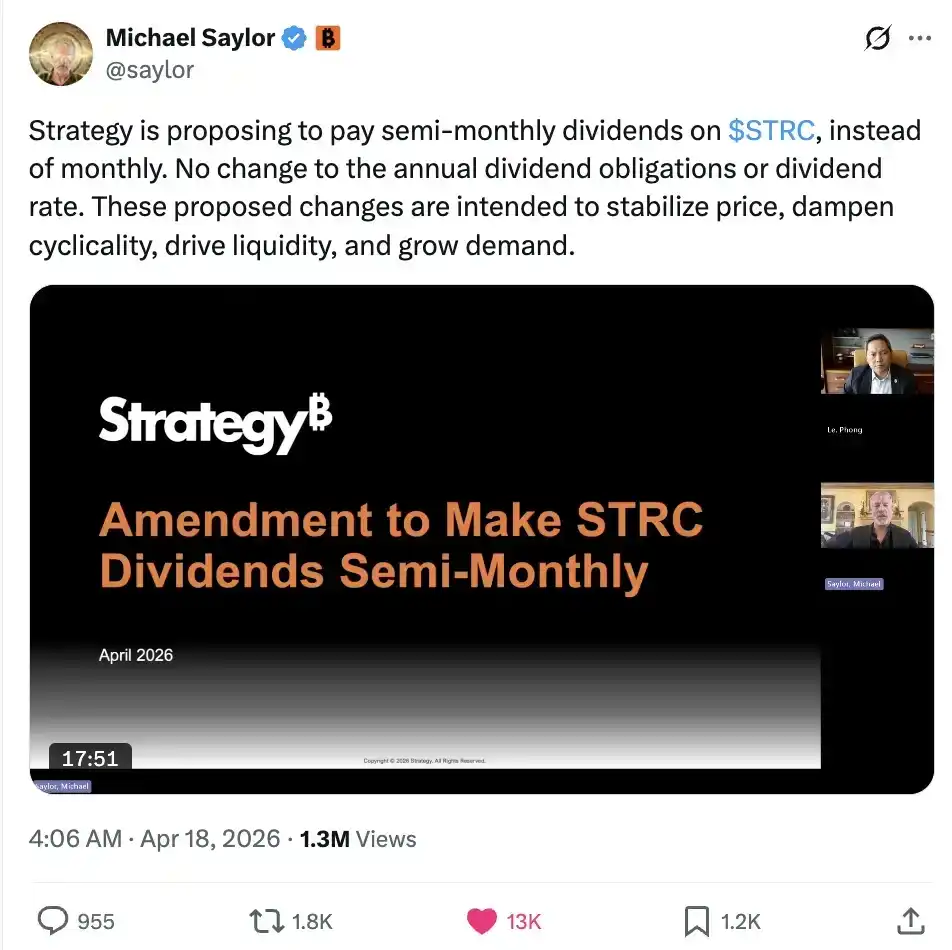
Sure enough, Saylor acted quickly, announcing on Saturday that Strategy had filed a proxy statement proposing to change STRC's dividend payment frequency from monthly to semi-monthly. The annual dividend obligation and dividend rate would remain unchanged.

If the proposal is approved, the first semi-monthly dividend will be paid on July 15th.

Bitwise advisor Jeff Park pointed out that no corporate bonds currently use a semi-monthly dividend payment mechanism in the market, and retail investors' preference for higher frequency payments has been confirmed by the success of products like weekly dividend ETFs.

On a deeper level, Jeff Park sees this as a landmark step in the infiltration of the cryptocurrency industry's "streaming payments" vision into traditional capital markets: the frequency of interest payments essentially reflects the efficiency of converting monetary potential energy into kinetic energy. The digital currency era should naturally break the artificially set time cycle restrictions.

He believes STRC sets a new benchmark for traditional enterprises and is optimistic about the future evolution from semi-monthly, to daily, and even instant payments.

A New Narrative for DeFi

The emergence of STRC has brought a breath of fresh air to the bleak DeFi market.

Stablecoin yields in DeFi have been on a downward trend over the past year. Stablecoin deposit APY on Aave is around 2%, Ethena's USDe and Sky's USDS are both below 4%, and even PTs for mainstream stablecoins on Pendle struggle to break 6%. This level of return,对应 the risk exposure of smart contracts in the AI era, has deterred many DeFi veterans due to the risk-reward ratio.

DeFi needs a credible, sufficiently large source of yield to pull money from TradFi back on-chain, and STRC刚好 provides this opportunity.

Two projects are currently attempting to package STRC's yield onto the chain:

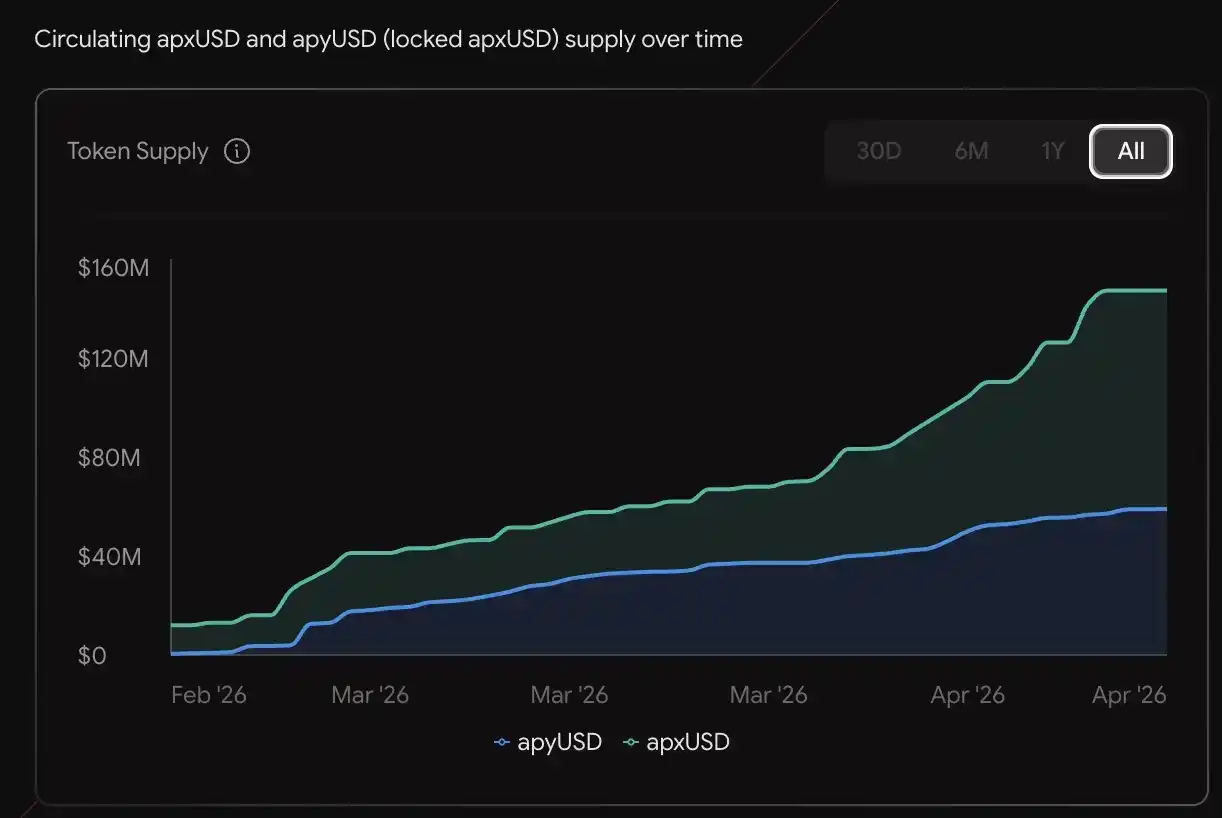
Apyx Protocol uses a dual-token model. apxUSD is the base stablecoin, over-collateralized by preferred stocks like STRC, SATA, and US Treasuries; apyUSD is the staked version, receiving the underlying dividend and interest income, currently with an APY of about 12.78%. The supply规模 has reached $130 million, and corresponding yield and leverage products are already available on Pendle and Morpho.

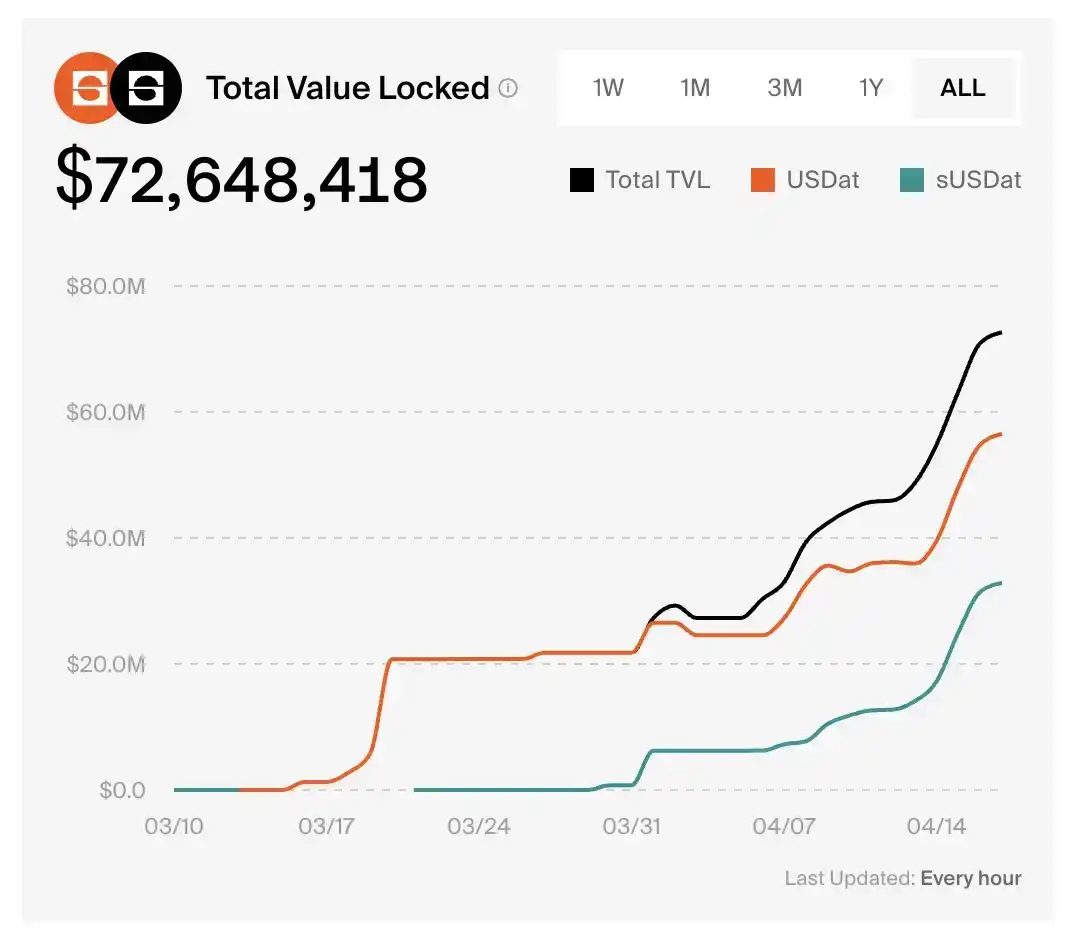
Saturn Credit's sUSDat is a staked, yield-bearing stablecoin that承接 STRC's yield. The protocol's TVL surged from zero to $72.6 million in just over a month.

According to Pendle market data, the current APY for PT-sUSDat is 9.2%.

Hoist with His Own Petard

The more successful Saylor's精心designed financial machine runs, the harder it becomes to avoid one question.

Strategy currently holds nearly 3.5% of the total BTC supply and continues to advance at a rate of billions of dollars per month.

What was BTC's original value proposition? A decentralized monetary asset that does not rely on any single entity and cannot be unilaterally manipulated by anyone.

When the perpetual preferred stock of a listed company becomes the primary marginal buyer for BTC—a decentralized, non-reliant-on-any-single-entity, cannot-be-unilaterally-manipulated monetary asset—is Bitcoin drifting away from its original form?

Связанные с этим вопросы

QWhat is STRC and how does it function as a financial instrument for MicroStrategy?

ASTRC, or Variable Rate Series A Perpetual Stretch Preferred Stock, is a type of perpetual preferred stock issued by MicroStrategy and traded on the Nasdaq. Investors pay approximately $100 per share. MicroStrategy pays a monthly cash dividend, currently at an annualized rate of 11.5%, equating to about $0.96 per share per month. The stock is perpetual, meaning it has no maturity date, and MicroStrategy is not obligated to repay the principal. The share price is anchored near its $100 face value through monthly adjustments to the dividend rate. The primary function of STRC is to raise capital, which is then used, along with capital from MSTR common stock, to purchase Bitcoin (BTC).

QHow does MicroStrategy's 'intelligent leverage' principle work in relation to STRC and Bitcoin purchases?

AMicroStrategy's 'intelligent leverage' principle aims to maintain a leverage ratio of 33%. This means that for every $1 raised through STRC and other preferred shares (which constitute about one-third of the company's funding), the company must issue approximately $2 in MSTR common stock (the other two-thirds) to maintain this target ratio. The combined $3 is then used to purchase Bitcoin. This mechanism amplifies the capital inflow into BTC, turning $1 from STRC into $3 of BTC buying pressure.

QWhat is the 'ex-dividend date arbitrage' opportunity with STRC, and what are its potential negative consequences?

AThe ex-dividend date arbitrage involves buying STRC just before its ex-dividend date to receive the full monthly dividend (approx. $0.96) and then selling the shares after. Historically, the share price drop after the ex-dividend date has been smaller than the dividend, allowing for a profit of around $0.40 to $0.50 per share. The negative consequences are twofold: 1) It creates a 'dead zone' for STRC after the ex-dividend date where liquidity dries up and the price often falls below its $100 anchor, undermining its 'money market product' image. 2) It allows arbitrageurs to front-run MicroStrategy's predictable BTC purchases, buying BTC before the company does and driving up Saylor's acquisition cost.

QHow is STRC's high yield influencing the decentralized finance (DeFi) ecosystem?

ASTRC's high yield (currently 11.5% annualized) is providing a new, significant source of yield for the DeFi ecosystem, which has been suffering from low returns on stablecoins. Protocols like Apyx Protocol and Saturn Credit are creating wrapped, tokenized versions of STRC's yield on-chain. For example, Apyx offers apyUSD with a yield of ~12.78%, and Saturn Credit offers sUSDat. These products are attracting capital back to DeFi by offering a credible, high-yield source backed by a TradFi instrument, with a combined Total Value Locked (TVL) already in the hundreds of millions of dollars.

QWhat fundamental contradiction does the article highlight regarding MicroStrategy's growing Bitcoin holdings funded by STRC?

AThe article highlights a fundamental contradiction between Bitcoin's original value proposition and MicroStrategy's dominant role as a buyer. Bitcoin was conceived as a decentralized, censorship-resistant asset that no single entity could control. However, the primary marginal demand for new BTC is now coming from a single, centralized publicly-traded company (MicroStrategy) through a specific financial instrument (STRC). This centralizes a significant portion of buying pressure and potential influence over the market with one entity, which arguably moves Bitcoin away from its original decentralized ethos.

Похожее

Anthropic's IPO Launch: Commercial Miracle or Valuation Bubble?

Anthropic has confidentially filed for an IPO, led by Morgan Stanley and Goldman Sachs, potentially going public by October. Following its latest $650 billion funding round, its pre-IPO valuation stands at $965 billion, with projections reaching up to $2 trillion at listing, which would make it the highest-valued private company ever. The article, written by Fu Sheng, addresses skepticism that this represents an AI bubble akin to the 2000 dot-com crash. It argues the current situation differs fundamentally. Unlike the internet bubble era, which relied on speculative narratives with little revenue, Anthropic's valuation is backed by unprecedented, measurable financial performance. Key data points include: * **Revenue Growth:** ARR skyrocketed from $10 billion in early 2025 to $470 billion by May 2026, targeting $100 billion by year-end—a growth curve unmatched in business history. * **Profitability:** It achieved operating profitability in Q2 2026 with an estimated $5.6 billion profit. * **Efficiency:** With ~3,000 employees and ~$470 billion ARR, its revenue per employee exceeds $10 million. Products like Claude Code, launched less than a year ago, already generate $25 billion in annualized revenue. * **Enterprise Adoption:** It boasts a strong enterprise client base, with 8 of the Fortune 10 and over 1,000 large firms spending over $1 million annually on Claude. The valuation is framed using a traditional SaaS model (e.g., a 10x Price-to-Sales multiple on $100 billion revenue). The author contends the core question for analysts has shifted from "How big could this be?" to "How much is it earning and will earn next quarter?" The discussion extends beyond Anthropic to a broader paradigm shift: the transition from a "carbon-based" to a "silicon-based" economy. Companies are increasingly prioritizing investment in compute and AI capabilities over human resources, as these directly scale productivity and competitive advantage. Anthropic's IPO is thus positioned not just as a corporate milestone, but as a price anchor for this new economic era.

链捕手2 ч. назад

Anthropic's IPO Launch: Commercial Miracle or Valuation Bubble?

链捕手2 ч. назад

Near Returns to the AI Stage: Transformation into a Public Chain Due to 'Payroll Difficulties,' Agent and Privacy Emerge as New Growth Narratives

NEAR Returns to AI Origins: From Payroll Struggles to Blockchain, Now Focusing on AI Agents and Privacy NEAR Protocol's journey began not with grand blockchain ambitions, but from a practical hurdle: its AI startup founders, including Transformer paper co-author Illia Polosukhin, couldn't efficiently pay international developers in 2017. This led them to pivot and build a high-performance, scalable blockchain. After years navigating various crypto narratives like sharding and cross-chain interoperability, NEAR is now leveraging its AI roots to re-enter the AI arena. A key driver is its "NEAR Intents" layer, which abstracts complex cross-chain transactions. Users simply state their goal (e.g., swap BTC for ETH), and a solver network finds the optimal route. This system has processed over $20B in cross-chain volume, generating significant fee revenue. A major growth area is private transactions via "Confidential Intents/Swaps," which hide trade details until settlement to protect against MEV and front-running. Remarkably, private swaps recently accounted for over 40% of NEAR's transaction volume, highlighting strong demand but also potential regulatory scrutiny. With its AI-founder pedigree, NEAR is positioning itself at the intersection of blockchain, AI agents, and privacy, aiming to become infrastructure for the emerging agent economy while navigating the challenges of its rapid adoption.

marsbit5 ч. назад

Near Returns to the AI Stage: Transformation into a Public Chain Due to 'Payroll Difficulties,' Agent and Privacy Emerge as New Growth Narratives

marsbit5 ч. назад

Торговля

Спот
Фьючерсы

Популярные статьи

Тест по Bitcoin Биткоина

HTX Learn: Изучите Bitcoin halving и Заработаете Токены USDT

3.1k просмотров всегоОпубликовано 2024.04.16Обновлено 2024.04.16

Тест по Bitcoin  Биткоина

Что такое $BITCOIN

ЦИФРОВОЕ ЗОЛОТО ($BITCOIN): Комплексный анализ Введение в ЦИФРОВОЕ ЗОЛОТО ($BITCOIN) ЦИФРОВОЕ ЗОЛОТО ($BITCOIN) — это проект на основе блокчейна, работающий в сети Solana, который стремится объединить характеристики традиционных драгоценных металлов с инновациями децентрализованных технологий. Хотя он носит имя Биткойн, часто называемого “цифровым золотом” из-за его восприятия как средства хранения ценности, ЦИФРОВОЕ ЗОЛОТО является отдельным токеном, предназначенным для создания уникальной экосистемы в ландшафте Web3. Его цель — позиционировать себя как жизнеспособный альтернативный цифровой актив, хотя детали его применения и функциональности все еще развиваются. Что такое ЦИФРОВОЕ ЗОЛОТО ($BITCOIN)? ЦИФРОВОЕ ЗОЛОТО ($BITCOIN) — это токен криптовалюты, специально разработанный для использования в блокчейне Solana. В отличие от Биткойна, который выполняет широко признанную роль хранения ценности, этот токен, похоже, сосредоточен на более широких приложениях и характеристиках. Примечательные аспекты включают: Инфраструктура блокчейна: Токен построен на блокчейне Solana, известном своей способностью обрабатывать высокоскоростные и недорогие транзакции. Динамика предложения: ЦИФРОВОЕ ЗОЛОТО имеет максимальное предложение, ограниченное 100 квадриллионами токенов (100P $BITCOIN), хотя детали о его обращающемся предложении в настоящее время не раскрыты. Утилита: Хотя точные функциональные возможности не описаны, есть указания на то, что токен может быть использован для различных приложений, потенциально связанных с децентрализованными приложениями (dApps) или стратегиями токенизации активов. Кто создатель ЦИФРОВОГО ЗОЛОТА ($BITCOIN)? На данный момент личность создателей и команды разработчиков, стоящих за ЦИФРОВЫМ ЗОЛОТОМ ($BITCOIN), остается неизвестной. Эта ситуация типична для многих инновационных проектов в области блокчейна, особенно тех, которые связаны с децентрализованными финансами и феноменом мем-криптовалют. Хотя такая анонимность может способствовать культуре, ориентированной на сообщество, она усиливает опасения по поводу управления и ответственности. Кто инвесторы ЦИФРОВОГО ЗОЛОТА ($BITCOIN)? Доступная информация указывает на то, что у ЦИФРОВОГО ЗОЛОТА ($BITCOIN) нет известных институциональных спонсоров или значительных венчурных капиталовложений. Проект, похоже, функционирует по модели пирингового взаимодействия, сосредоточенной на поддержке и принятии сообществом, а не на традиционных путях финансирования. Его активность и ликвидность в основном сосредоточены на децентрализованных биржах (DEX), таких как PumpSwap, а не на устоявшихся централизованных торговых платформах, что еще больше подчеркивает его подход, ориентированный на grassroots. Как работает ЦИФРОВОЕ ЗОЛОТО ($BITCOIN) Операционные механизмы ЦИФРОВОГО ЗОЛОТА ($BITCOIN) можно подробно описать на основе его дизайна блокчейна и характеристик сети: Механизм консенсуса: Используя уникальный механизм доказательства истории (PoH) Solana в сочетании с моделью доказательства доли (PoS), проект обеспечивает эффективную валидацию транзакций, что способствует высокой производительности сети. Токеномика: Хотя конкретные дефляционные механизмы не были подробно описаны, большое максимальное предложение токенов подразумевает, что оно может быть предназначено для микротранзакций или нишевых случаев использования, которые еще предстоит определить. Интероперабельность: Существует потенциал для интеграции с более широкой экосистемой Solana, включая различные платформы децентрализованных финансов (DeFi). Однако детали относительно конкретных интеграций остаются неуточненными. Хронология ключевых событий Вот хронология, которая подчеркивает значимые вехи, касающиеся ЦИФРОВОГО ЗОЛОТА ($BITCOIN): 2023: Первоначальное развертывание токена происходит в блокчейне Solana, отмеченное его адресом контракта. 2024: ЦИФРОВОЕ ЗОЛОТО приобретает видимость, когда оно становится доступным для торговли на децентрализованных биржах, таких как PumpSwap, позволяя пользователям обменивать его на SOL. 2025: Проект наблюдает спорадическую торговую активность и потенциальный интерес к инициативам, возглавляемым сообществом, хотя на данный момент не зафиксировано никаких значительных партнерств или технических достижений. Критический анализ Сильные стороны Масштабируемость: Основная инфраструктура Solana поддерживает высокие объемы транзакций, что может повысить полезность $BITCOIN в различных сценариях транзакций. Доступность: Потенциально низкая цена торговли за токен может привлечь розничных инвесторов, способствуя более широкому участию благодаря возможностям дробного владения. Риски Отсутствие прозрачности: Отсутствие публично известных спонсоров, разработчиков или процесса аудита может вызвать скептицизм относительно устойчивости и надежности проекта. Волатильность рынка: Торговая активность сильно зависит от спекулятивного поведения, что может привести к значительной волатильности цен и неопределенности для инвесторов. Заключение ЦИФРОВОЕ ЗОЛОТО ($BITCOIN) является интригующим, но неоднозначным проектом в быстро развивающейся экосистеме Solana. Хотя он пытается использовать нарратив “цифрового золота”, его отход от установленной роли Биткойна как средства хранения ценности подчеркивает необходимость более четкого различения его предполагаемой утилиты и структуры управления. Будущее принятие и усвоение, вероятно, будут зависеть от решения текущей непрозрачности и более четкого определения его операционных и экономических стратегий. Примечание: Этот отчет охватывает синтезированную информацию, доступную на октябрь 2023 года, и с тех пор могут произойти события.

99 просмотров всегоОпубликовано 2025.05.13Обновлено 2025.05.13

Что такое $BITCOIN

Fractal Bitcoin: масштабирование Биткоина с помощью рекурсивной системы

Fractal Bitcoin — масштабное Layer-1-решнение, созданное на базе кода Биткоина, позволяющего достигать бесконечного масштабирования с помощью рекурсивного подхода.

2.3k просмотров всегоОпубликовано 2025.06.30Обновлено 2025.06.30

Fractal Bitcoin: масштабирование Биткоина с помощью рекурсивной системы

Обсуждения

Добро пожаловать в Сообщество HTX. Здесь вы сможете быть в курсе последних новостей о развитии платформы и получить доступ к профессиональной аналитической информации о рынке. Мнения пользователей о цене на BTC (BTC) представлены ниже.

活动图片