Please Be Kind to Jack Yi

marsbitОпубликовано 2026-02-06Обновлено 2026-02-06

Введение

This article details the investment journey of Jack Yi (Yi Lihua), founder of Trend Research and Liquid Capital, a prominent figure in the Asian crypto space. In early 2025, Yi successfully bought ETH at lows around $1,800, leveraged his position, and sold near $4,700, realizing significant profits and solidifying his reputation. However, after the market downturn in October 2025, he re-entered, accumulating over 650,000 ETH with an average cost of $3,180, heavily leveraged. A sharp price drop in February 2026 pushed his position to the brink of liquidation, forcing him to sell 200,000 ETH to avoid a total loss. Despite this, he incurred a massive $763 million loss, erasing his previous gains and part of his principal. Yi admitted to misjudging the market's bottom and the risks of overconfidence post-success. He remains a vocal, transparent long-term bull on crypto, advocating for ETH reaching $10,000+ and BTC surpassing $200,000. The piece argues that despite the setback, the market needs more transparent, research-driven investors like him to attract serious capital and counter the industry's casino-like reputation.

Author: Gu Yu, ChainCatcher

With the sharp decline in BTC and ETH prices over the past few days, the position of Jack Yi (Yi Lihua), founder of Trend Research and Liquid Capital (formerly LD Capital), has drawn significant attention from crypto investors. His leveraged position of 650,000 ETH is now in a precarious state, teetering on the brink of liquidation under the current market conditions.

For this staunch ETH bull, a rare on-chain transparent trader, and a representative figure in Asia's crypto institutional circle, this situation appears particularly cruel and lamentable. After all, concepts like "transparency," "bullishness," and "research-driven" align with mainstream crypto values. To some extent, Yi Lihua's current "battle" is also a "battle for legitimacy" for the crypto industry.

So, how did this happen? Why did Yi Lihua go from successfully exiting at the top to getting trapped while buying the dip? What lessons and insights can we draw from this?

From Buying the Dip to Exiting the Top

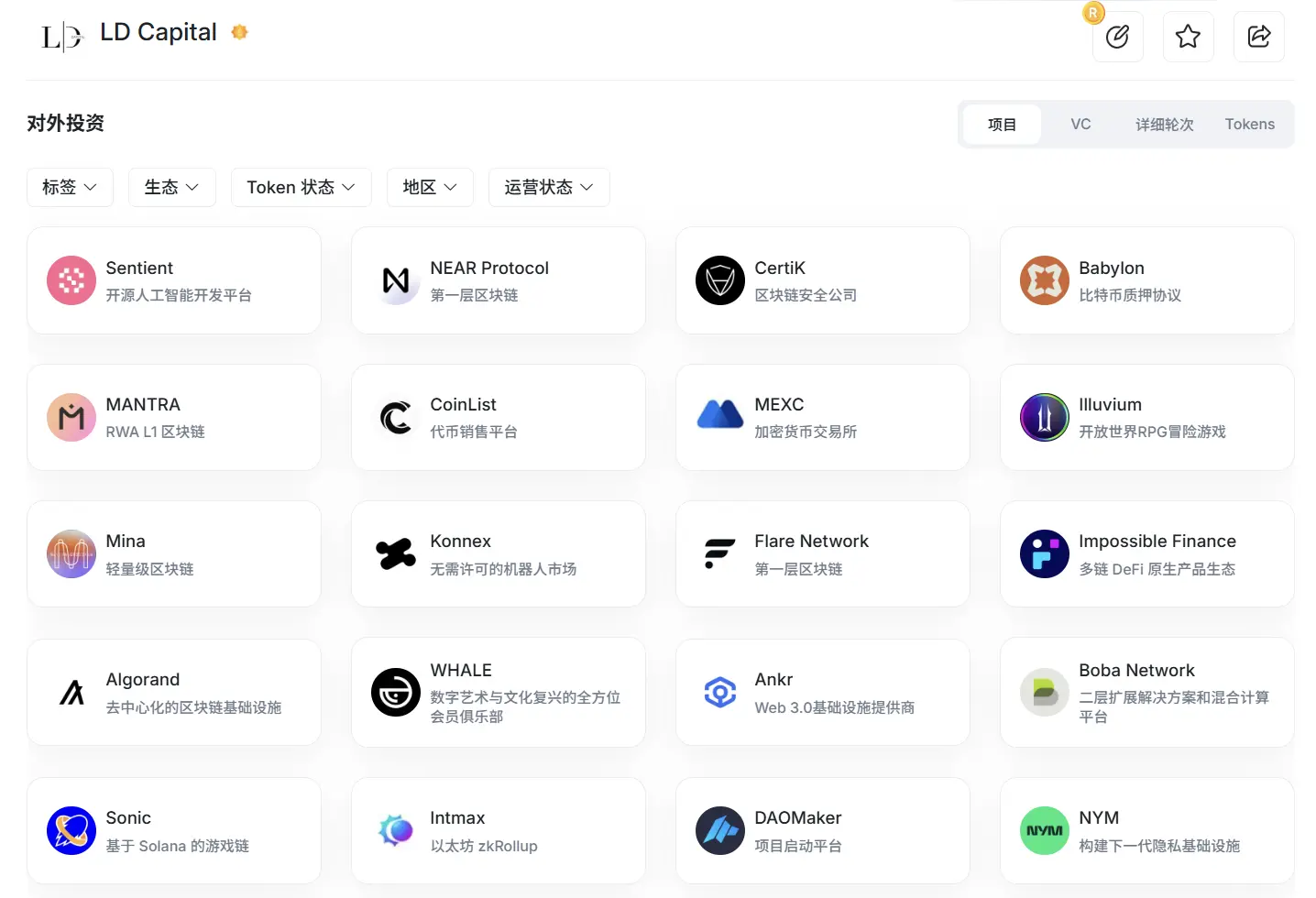
Yi Lihua is an early OG in the Chinese crypto community. Since 2015, he has invested in hundreds of blockchain projects. Early investment cases include EOS, Qtum, VeChain, etc. After 2017, through LD Capital, he invested in well-known projects like Near, CertiK, MEXC, Sentient, and others.

Some of LD Capital's investment cases Source: RootData

Since early 2025, Yi Lihua shifted his focus from the crypto primary market to the secondary market. In April 2025, the price of ETH fell to a new low since 2022, dropping to a minimum of $1,385. Yi Lihua's dip-buying began quietly at this time.

At the end of April, Trend Research publicly released a research report bullish on ETH when it rose to $1,800, stating, "Under the trend, more upside is coming for the Crypto market."

At the end of May 2025, the frequent large-scale on-chain accumulations by Trend Research were discovered and disclosed by on-chain analyst Yu Jin. Yi Lihua promptly claimed these addresses on X. By then, ETH had risen to $2,600, and Trend Research's on-chain addresses cumulatively held 133,000 ETH, with a total value of $360 million.

It should be noted, however, that Trend Research's operations were not entirely cash-based purchases. A significant portion of the funds used to buy ETH were borrowed through Aave by collateralizing the ETH purchased earlier, meaning leverage of several times was applied.

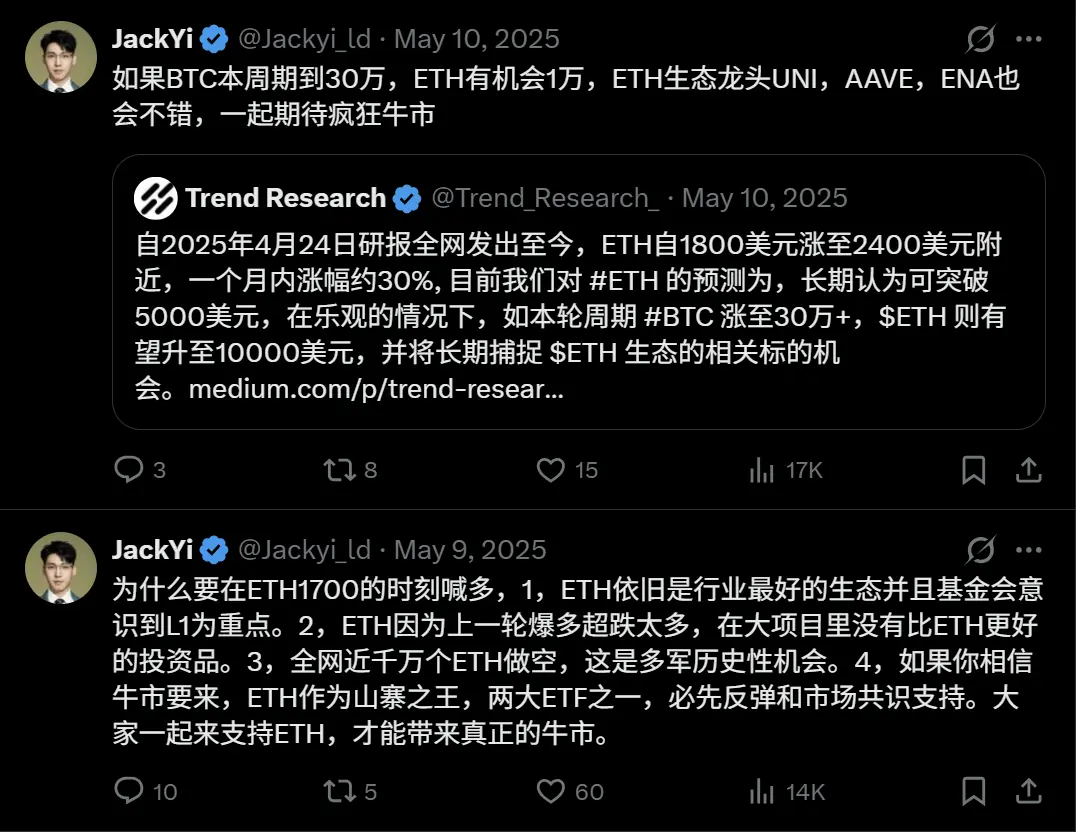
In June 2025, Trend Research published another article titled "On the Eve of the Surge: Why We Are Bullish on ETH," mentioning that the institution's underlying logic for being bullish on ETH remained: The Trump administration is committed to building a stablecoin system... and the most important infrastructure for stablecoins and on-chain finance is Ethereum. The influx of stablecoins and the continued development of RWA will bring further prosperity to DeFi, increase Ethereum's consumption and gas fee revenue, and push its market capitalization higher.

At that time, the price of ETH was around $2,800. Yi Lihua also publicly stated that he believed ETH's long-term price could break through $5,000, and optimistically, BTC could reach over $300,000 in this cycle, with ETH有望 potentially reaching $10,000. Simultaneously, Yi Lihua mentioned having purchased 100,000 ETH options.

In July 2025, Yi Lihua tweeted that the market had彻底 entered a long bull market, possibly without the traditional 4-year cycle规律. Stablecoins and blockchain represent the best opportunity for the US to globalize the dollar. Investing in crypto stocks with the left hand and earning interest on stablecoins with the right hand, the market will continuously attract new users and capital.

Thereafter, Yi Lihua几乎 added to his position every month until early October, when he began warning of market risks and quickly transferred most of his ETH holdings to the Binance exchange for sale at around $4,700,恰好 escaping the 1011 event.

Through this round of precise dip-buying (starting from around $1,800 in the first half of the year) and profit-taking at the high, Yi Lihua achieved significant doubled profits, solidifying his influence as a top trend investor in the Chinese-speaking community.

Second Position Trapped

In the market reshuffled by the 1011 event, Yi Lihua saw another opportunity to build a position. In early November, Yi Lihua tweeted again, stating that ETH was starting to rebound and that he continued to be optimistic about the subsequent行情 and the strategy of buying the dip. Subsequently, he stated that $3,000-$3,300 was the spot buying range for ETH. As ETH continued to correct, Yi Lihua, under his dip-buying strategy, stated that he was already fully invested in ETH at a price of $2,700. He then continued to add to his position through leveraged borrowing during further declines. By January of this year, his ETH holdings exceeded 650,000, with a reported average cost of $3,180.

"At the moment ETH fell to over $1,000, we saw through the主力's intention to wash out以太OG bulls and successfully bought the dip. When ETH rose to over $4,500, we saw through the market rising to a震荡 top and successfully liquidated. Trend Research has proven successful dip-buying and top-exiting performance in 2025. We will not change our investment strategy based on emotion," Yi Lihua was still cheering on the market in January.

But no one could have predicted that the market would deal this battle-hardened investor a heavy blow at this time. The price of ETH连续 broke through key levels of $2,200, $2,000, and $1,800 in early February, approaching his liquidation price.

Yi Lihua止损 sold approximately 200,000 ETH within a few days, lowering the liquidation price to around $1,600, narrowly escaping the sharp drop in the early hours of today. According to on-chain analyst Yu Jin's analysis today, Trend Research's long position this time has resulted in a loss of $763 million, not only wiping out all profits from the previous round but also losing $448 million in principal.

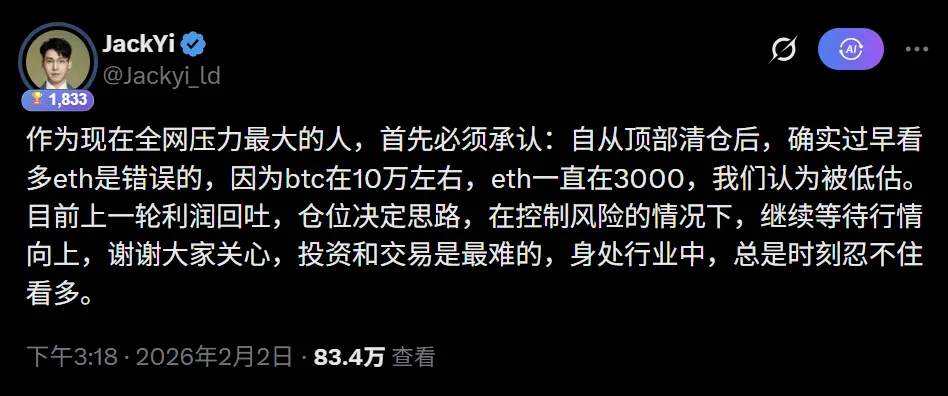
In recent days, Yi Lihua tweeted to admit his mistake, "Since liquidating at the top, it was indeed wrong to be bullish on ETH too early because when BTC was around $100,000, ETH remained at $3,000, which we considered undervalued. Currently, the profits from the previous round have been given back. Position determines perspective. While controlling risks, we continue to wait for the market to move upward. Thank you for your concern. Investment and trading are the most difficult. Being in the industry, one can't help but be bullish at all times."

"Why can't I help but be bullish? It's related to my past entrepreneurial experience. Back then, I truly couldn't find a job and started a business. After earning my first bucket of gold, I didn't dare to spend lavishly and instead invested in tech projects. Entering the crypto circle in 2015, I caught that golden age, which was a harvest from consistently being long. But later, major losses from bear market investments + couldn't endure the bear market and liquidated BTC too early, ultimately missing the big bull market after 312. We experienced two bear markets followed by bull markets, so this time, after exiting the top, we were overconfident and bought the dip too early. While controlling risks, we continue to wait."

Zhu Su, founder of Three Arrows Capital, posted on X discussing this matter, "In my experience, selling at the top is often more dangerous than selling on the way down. This is because the excitement from selling at the top leads to premature追加 buying and overconfidence. I suspect Jack Yi made a similar arrogant mistake after making nine-figure profits on October 10th."

But after going through these twists and turns, Yi Lihua still expressed his firm view on the future market, "As a bull in this round, we still看好 the performance of the new bull market: ETH reaching over $10,000, BTC exceeding $200,000. We merely made some adjustments to control risks. I know everyone is disappointed with the industry and the leaders, especially the liquidity shortage and some platform manipulation brought by the 1011 event, but I believe the long-term trend of the crypto circle remains unchanged. Now is completely the best time to buy现货. Volatility is the biggest characteristic of the crypto circle. Countless bulls in history have been shaken off by this volatility, but often followed by加倍 rebounds."

Currently, the price of ETH has rebounded to around $1,900, significantly reducing the risk for Trend Research's position. However, the impact and启示 of this event on the industry will continue to发酵.

The Market Needs More Bulls and Transparency

As one of the very few institutional representatives who choose "on-chain transparency" and publicly share all their thoughts and positional dynamics, Yi Lihua's every statement and every operation无形中 becomes a mirror for the industry: it reflects the信念 of trend investing and also magnifies the nonlinear risks of leverage; it demonstrates the power of逻辑兑现 in a bull market and also exposes the fragile balance between emotion and position during a retreat phase.

But in a market still dominated by anonymous market makers, platform manipulation, and information asymmetry, Yi Lihua's public choice is itself a rare act of courage—he uses real on-chain operations, not just talk, to verify his judgments. While this approach brings immense personal pressure and阶段性 floating losses, it also provides the most直观 textbook for countless retail investors and small institutions: how to exit at the top in a bull market, how to buy the dip in a bear market, how to manage leverage, and how to克制 emotion.

In the highly volatile and uncertain arena of the crypto market, even the most glorious success stories and profound cycle insights cannot completely exempt participants from the market's残酷 lessons—because every cycle轮回 tests participants anew, in new forms, with new intensity, and with new variables. In this cycle, the crypto market has become closely intertwined with the macro-economic environment (CPI, US stocks, gold, etc.) and geopolitical events. Any major change outside the industry has the potential to reverse the cyclical trends within the industry.

This experience once again proves that what truly determines whether an investor can weather the cycles is not the correctness of a single directional choice, but whether enough survival space is预留 for every judgment amidst持续 uncertainty, and the ability to止损 and restart promptly when mistakes occur. Respecting the market is a principle every investor must always abide by.

It is also worth noting that Trend Research, as one of the top three ETH holding entities in the market, has become a bellwether for institutional crypto investors in the Asia-Pacific region. Its successes and failures also concern the voice and status of the Asian market in the crypto industry. There is also market sentiment that the Asian market, as a major source of liquidity in the current crypto market with a relatively high proportion of retail structure and more intense情绪传导, could likely become a passive recipient of North American narratives and liquidity once transparent bulls are broken.

Fortunately, Yi Lihua and his Trend Research are still at the table. The crypto industry needs more steadfast "bulls," more "transparency," and more "Yi Lihuas."

It must be understood that Trend Research's story will be seen by more mainstream institutions and deep-pocketed organizations. The crypto industry needs more stories of achieving returns through注重 research,遵守 investment discipline, and controlling risk, not more MEME-style wealth transfers from left hand to right hand. The former can bring incremental investors, while the latter can only exacerbate the赌场化 of the crypto industry.

Связанные с этим вопросы

QWho is Jack Yi and what is his role in the cryptocurrency industry?

AJack Yi, also known as Yilihua, is the founder of Trend Research and Liquid Capital (formerly LD Capital). He is a prominent figure in the Asian crypto community, an early investor in blockchain projects like EOS and Qtum, and a well-known on-chain, transparent trader who is a staunch Ethereum bull.

QWhat was the outcome of Jack Yi's first major ETH trading strategy in 2025?

AIn his first major strategy, Jack Yi successfully bought ETH at around $1,800 in early 2025 and sold near the peak at approximately $4,700 in October, achieving significant profits and solidifying his reputation as a top trend investor. This move allowed him to avoid the major '1011 event' market crash.

QWhat caused Jack Yi's significant financial loss in his second ETH investment attempt?

AHis second attempt resulted in a reported loss of $763 million. After successfully selling at a high, he re-entered the market too early, accumulating over 650,000 ETH with leverage at an average cost of $3,180. A sharp price drop in February to near $1,800 brought his positions dangerously close to liquidation, forcing him to sell 200,000 ETH to avoid being wiped out.

QWhat lesson does the article suggest investors learn from Jack Yi's experience?

AThe article suggests that the key lesson is that what determines an investor's ability to survive market cycles is not just making the right directional bets, but also maintaining enough survival space (risk management), the ability to cut losses promptly, and the humility to restart after a mistake. It emphasizes respecting the market's unpredictability.

QWhy does the article argue that the market needs more figures like Jack Yi, despite his recent losses?

AThe article argues that the crypto market needs more transparent, research-driven, and openly bullish figures like Jack Yi because his on-chain,明牌 (ming pai - open card) approach provides valuable, real-world lessons for retail and institutional investors. It contrasts this with anonymous market manipulation and argues that such transparency can attract incremental, serious investors rather than reinforcing the industry's 'casino' image.

Похожее

Dialogue with ViaBTC CEO Yang Haipo: Is the Essence of Blockchain a Libertarian Experiment?

"ViaBTC CEO Yang Haipo: Blockchain as a Hardcore Libertarian Experiment" In a deep-dive interview, ViaBTC CEO Yang Haipo reframes the essence of blockchain, arguing it is not merely a new technology or infrastructure but a hardcore libertarian experiment. This experiment, born from the 2008 financial crisis and decades of cypherpunk ideology, tests a fundamental question: to what extent can freedom and self-organization exist without centralized trust? The discussion highlights the experiment's verified outcomes. On one hand, it has proven its core value of censorship resistance, providing critical financial lifelines for entities like WikiLeaks and individuals in hyperinflationary or sanctioned countries via tools like stablecoins. However, Yang points out a key paradox: the most successful product, USDT, is itself a centralized compromise, showing users prioritize a less-controlled pipeline over pure decentralization. On the other hand, the experiment has exposed the severe costs of this freedom—a "dark forest" without safeguards. Events like the collapses of LUNA, Celsius, and FTX, resulting in massive wealth destruction and prison sentences for founders, underscore the system's fragility and the inherent risks of an unregulated environment. Yang observes that despite decentralized protocols, human nature inevitably recreates centralized power structures, speculative frenzies, and narrative-driven cycles (from ICOs to Meme coins), where emotion and belonging often trump technological substance. Looking forward, he believes blockchain's future is significant but niche. Its real value lies in serving specific, real-world needs for financial sovereignty and bypassing traditional controls, not as a universal infrastructure replacing all centralized systems. For the average participant, Yang's crucial advice is to cultivate independent judgment. True freedom is not holding a crypto wallet, but possessing a mind resilient to groupthink and narrative hype in a high-risk, often irrational market.

marsbit10 мин. назад

Dialogue with ViaBTC CEO Yang Haipo: Is the Essence of Blockchain a Libertarian Experiment?

marsbit10 мин. назад

North Korean Hackers Loot $500 Million in a Single Month, Becoming the Top Threat to Crypto Security

North Korean hackers, particularly the notorious Lazarus Group and its subgroup TraderTraitor, have stolen over $500 million from cryptocurrency DeFi platforms in less than three weeks, bringing their total theft for the year to over $700 million. Recent major attacks on Drift Protocol and KelpDAO, resulting in losses of approximately $286 million and $290 million respectively, highlight a strategic shift: instead of targeting core smart contracts, attackers are now exploiting vulnerabilities in peripheral infrastructure. For instance, the KelpDAO attack involved compromising downstream RPC infrastructure used by LayerZero's decentralized validation network (DVN), allowing manipulation without breaching core cryptography. This sophisticated approach mirrors advanced corporate cyber-espionage. Additionally, North Korea has systematically infiltrated the global crypto workforce, with an estimated 100 operatives using fake identities to gain employment at blockchain companies, enabling long-term access to sensitive systems and facilitating large-scale thefts. According to Chainalysis, North Korean-linked hackers stole a record $2 billion in 2025, accounting for 60% of all global crypto theft that year. Their total historical crypto theft has reached $6.75 billion. Post-theft, they employ specialized money laundering methods, heavily relying on Chinese OTC brokers and cross-chain mixing services rather than standard decentralized exchanges. Security experts, while acknowledging the increased sophistication, emphasize that many attacks still exploit fundamental weaknesses like poor access controls and centralized operational risks. Strengthening private key management, limiting privileged access, and enhancing coordination among exchanges, analysts, and law enforcement immediately after an attack are critical to improving defense and fund recovery chances. The industry's challenge now extends beyond secure smart contracts to safeguarding operational security at the infrastructure level.

marsbit1 ч. назад

North Korean Hackers Loot $500 Million in a Single Month, Becoming the Top Threat to Crypto Security

marsbit1 ч. назад

Торговля

Спот
Фьючерсы

Популярные статьи

Тест по Bitcoin Биткоина

HTX Learn: Изучите Bitcoin halving и Заработаете Токены USDT

3.0k просмотров всегоОпубликовано 2024.04.16Обновлено 2024.04.16

Тест по Bitcoin  Биткоина

Что такое $BITCOIN

ЦИФРОВОЕ ЗОЛОТО ($BITCOIN): Комплексный анализ Введение в ЦИФРОВОЕ ЗОЛОТО ($BITCOIN) ЦИФРОВОЕ ЗОЛОТО ($BITCOIN) — это проект на основе блокчейна, работающий в сети Solana, который стремится объединить характеристики традиционных драгоценных металлов с инновациями децентрализованных технологий. Хотя он носит имя Биткойн, часто называемого “цифровым золотом” из-за его восприятия как средства хранения ценности, ЦИФРОВОЕ ЗОЛОТО является отдельным токеном, предназначенным для создания уникальной экосистемы в ландшафте Web3. Его цель — позиционировать себя как жизнеспособный альтернативный цифровой актив, хотя детали его применения и функциональности все еще развиваются. Что такое ЦИФРОВОЕ ЗОЛОТО ($BITCOIN)? ЦИФРОВОЕ ЗОЛОТО ($BITCOIN) — это токен криптовалюты, специально разработанный для использования в блокчейне Solana. В отличие от Биткойна, который выполняет широко признанную роль хранения ценности, этот токен, похоже, сосредоточен на более широких приложениях и характеристиках. Примечательные аспекты включают: Инфраструктура блокчейна: Токен построен на блокчейне Solana, известном своей способностью обрабатывать высокоскоростные и недорогие транзакции. Динамика предложения: ЦИФРОВОЕ ЗОЛОТО имеет максимальное предложение, ограниченное 100 квадриллионами токенов (100P $BITCOIN), хотя детали о его обращающемся предложении в настоящее время не раскрыты. Утилита: Хотя точные функциональные возможности не описаны, есть указания на то, что токен может быть использован для различных приложений, потенциально связанных с децентрализованными приложениями (dApps) или стратегиями токенизации активов. Кто создатель ЦИФРОВОГО ЗОЛОТА ($BITCOIN)? На данный момент личность создателей и команды разработчиков, стоящих за ЦИФРОВЫМ ЗОЛОТОМ ($BITCOIN), остается неизвестной. Эта ситуация типична для многих инновационных проектов в области блокчейна, особенно тех, которые связаны с децентрализованными финансами и феноменом мем-криптовалют. Хотя такая анонимность может способствовать культуре, ориентированной на сообщество, она усиливает опасения по поводу управления и ответственности. Кто инвесторы ЦИФРОВОГО ЗОЛОТА ($BITCOIN)? Доступная информация указывает на то, что у ЦИФРОВОГО ЗОЛОТА ($BITCOIN) нет известных институциональных спонсоров или значительных венчурных капиталовложений. Проект, похоже, функционирует по модели пирингового взаимодействия, сосредоточенной на поддержке и принятии сообществом, а не на традиционных путях финансирования. Его активность и ликвидность в основном сосредоточены на децентрализованных биржах (DEX), таких как PumpSwap, а не на устоявшихся централизованных торговых платформах, что еще больше подчеркивает его подход, ориентированный на grassroots. Как работает ЦИФРОВОЕ ЗОЛОТО ($BITCOIN) Операционные механизмы ЦИФРОВОГО ЗОЛОТА ($BITCOIN) можно подробно описать на основе его дизайна блокчейна и характеристик сети: Механизм консенсуса: Используя уникальный механизм доказательства истории (PoH) Solana в сочетании с моделью доказательства доли (PoS), проект обеспечивает эффективную валидацию транзакций, что способствует высокой производительности сети. Токеномика: Хотя конкретные дефляционные механизмы не были подробно описаны, большое максимальное предложение токенов подразумевает, что оно может быть предназначено для микротранзакций или нишевых случаев использования, которые еще предстоит определить. Интероперабельность: Существует потенциал для интеграции с более широкой экосистемой Solana, включая различные платформы децентрализованных финансов (DeFi). Однако детали относительно конкретных интеграций остаются неуточненными. Хронология ключевых событий Вот хронология, которая подчеркивает значимые вехи, касающиеся ЦИФРОВОГО ЗОЛОТА ($BITCOIN): 2023: Первоначальное развертывание токена происходит в блокчейне Solana, отмеченное его адресом контракта. 2024: ЦИФРОВОЕ ЗОЛОТО приобретает видимость, когда оно становится доступным для торговли на децентрализованных биржах, таких как PumpSwap, позволяя пользователям обменивать его на SOL. 2025: Проект наблюдает спорадическую торговую активность и потенциальный интерес к инициативам, возглавляемым сообществом, хотя на данный момент не зафиксировано никаких значительных партнерств или технических достижений. Критический анализ Сильные стороны Масштабируемость: Основная инфраструктура Solana поддерживает высокие объемы транзакций, что может повысить полезность $BITCOIN в различных сценариях транзакций. Доступность: Потенциально низкая цена торговли за токен может привлечь розничных инвесторов, способствуя более широкому участию благодаря возможностям дробного владения. Риски Отсутствие прозрачности: Отсутствие публично известных спонсоров, разработчиков или процесса аудита может вызвать скептицизм относительно устойчивости и надежности проекта. Волатильность рынка: Торговая активность сильно зависит от спекулятивного поведения, что может привести к значительной волатильности цен и неопределенности для инвесторов. Заключение ЦИФРОВОЕ ЗОЛОТО ($BITCOIN) является интригующим, но неоднозначным проектом в быстро развивающейся экосистеме Solana. Хотя он пытается использовать нарратив “цифрового золота”, его отход от установленной роли Биткойна как средства хранения ценности подчеркивает необходимость более четкого различения его предполагаемой утилиты и структуры управления. Будущее принятие и усвоение, вероятно, будут зависеть от решения текущей непрозрачности и более четкого определения его операционных и экономических стратегий. Примечание: Этот отчет охватывает синтезированную информацию, доступную на октябрь 2023 года, и с тех пор могут произойти события.

99 просмотров всегоОпубликовано 2025.05.13Обновлено 2025.05.13

Что такое $BITCOIN

Fractal Bitcoin: масштабирование Биткоина с помощью рекурсивной системы

Fractal Bitcoin — масштабное Layer-1-решнение, созданное на базе кода Биткоина, позволяющего достигать бесконечного масштабирования с помощью рекурсивного подхода.

2.2k просмотров всегоОпубликовано 2025.06.30Обновлено 2025.06.30

Fractal Bitcoin: масштабирование Биткоина с помощью рекурсивной системы

Обсуждения

Добро пожаловать в Сообщество HTX. Здесь вы сможете быть в курсе последних новостей о развитии платформы и получить доступ к профессиональной аналитической информации о рынке. Мнения пользователей о цене на BTC (BTC) представлены ниже.

活动图片