New Bitcoin Post-Quantum Work Undercuts ‘No One Is Building’ Claims

bitcoinistОпубликовано 2026-02-27Обновлено 2026-02-27

Введение

Bitcoin core developer Matt Corallo refutes claims that no serious work is being done on post-quantum cryptography for Bitcoin, pointing to Blockstream's new proposal, OP_SHRINCSVERIFY. This opcode enables SHRINCS, a hybrid hash-based signature scheme combining stateless and stateful elements, aiming for efficient 324-byte signatures with static backups. The topic is gaining traction, with multiple sessions on quantum risks and solutions scheduled at the OPNEXT 2026 conference, featuring speakers from institutions like BlackRock and Coinbase. While SHRINCS offers significant size advantages over NIST alternatives, it remains an open research proposal with unresolved questions. The development underscores that Bitcoin's post-quantum efforts are advancing with concrete proposals, moving beyond theoretical discussion.

Bitcoin core developer Matt Corallo used a fresh Blockstream announcement this week to push back on a familiar line in the quantum debate: that nobody serious is working on post-quantum cryptography for Bitcoin. The immediate trigger was Blockstream’s preview of OP_SHRINCSVERIFY, but the broader point was that the work did not appear out of nowhere; it sits on top of research that has already been published and debated in public.

Bitcoin’s Post-Quantum Critics Are Wrong

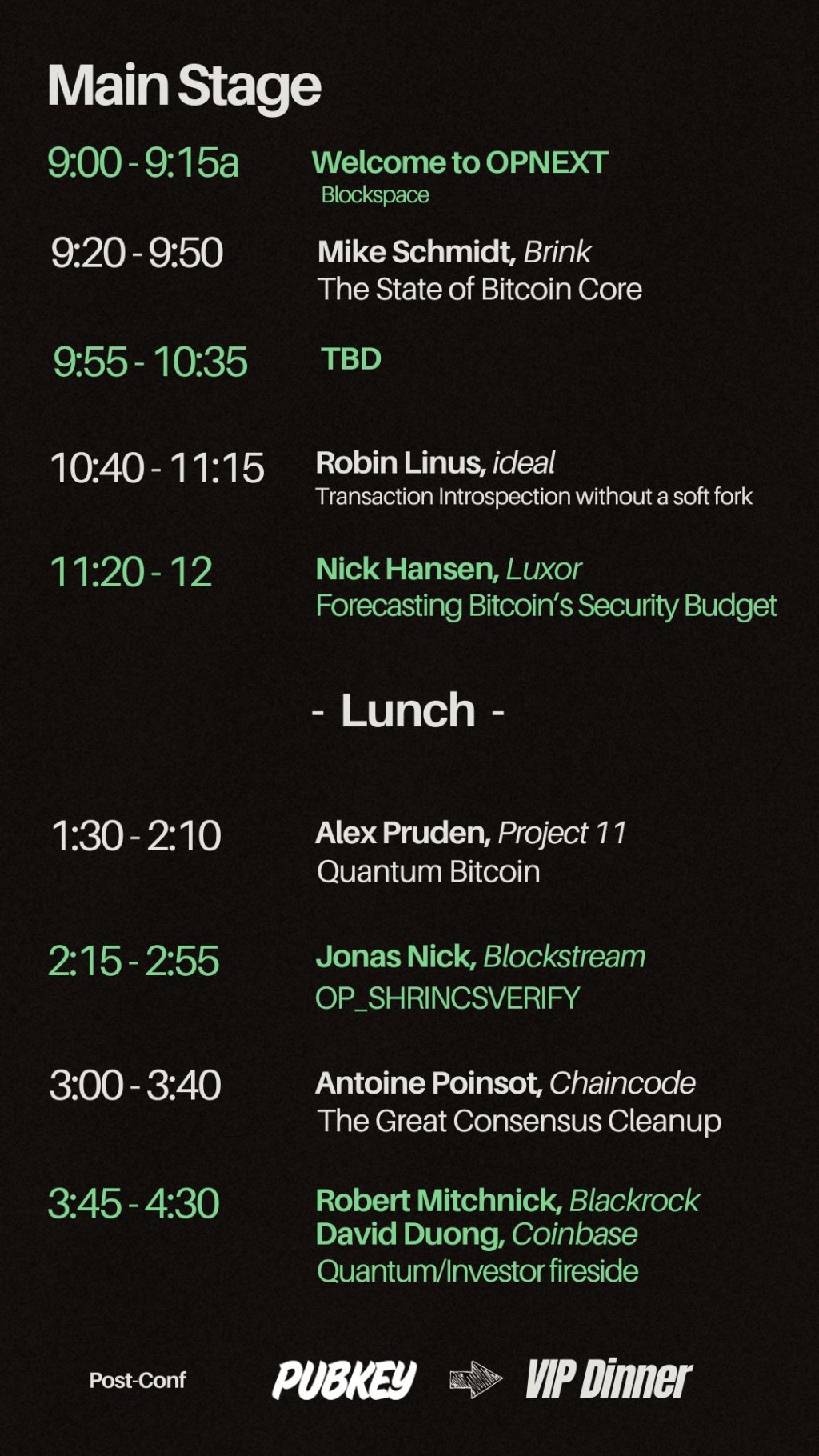
Corallo’s post was blunt: “And the Bitcoin fudsters keep trying to claim no one is working on PQC in Bitcoin...” Blockstream, in turn, framed Jonas Nick’s upcoming talk at OPNEXT 2026 (on April 16, 2026) around a specific technical artifact rather than a vague promise, saying, “He’ll be presenting on OP_SHRINCSVERIFY.” It described the proposal as “a new opcode enabling SHRINCS,” a construction aimed at 324-byte stateful post-quantum signatures with static backups.

The event lineup itself also reinforces Corallo’s point. Quantum is not a one-off mention tied only to Jonas Nick’s OP_SHRINCSVERIFY session. The main stage schedule also includes Alex Pruden of Project 11 speaking on “Quantum Bitcoin,” and later a “Quantum/Investor fireside” featuring Robert Mitchnick of BlackRock and David Duong of Coinbase.

In other words, post-quantum risk and the response to it are showing up repeatedly across both the technical and institutional sides of the program.

OPNEXT 2026 | Source: X @blockspace

The subtext was hard to miss: whatever one thinks about Bitcoin’s quantum timetable, the claim that the problem is being ignored is increasingly difficult to sustain.

What SHRINCS Actually Is

Nick laid out SHRINCS in a December post on Delving Bitcoin as a hybrid hash-based signature design that combines a stateless scheme such as SPHINCS+ with a stateful scheme based on unbalanced XMSS. The design goal is to get the efficiency benefits of stateful signing when wallet state is intact, while keeping a stateless fallback available if that state is lost or a backup has to be restored.

In Nick’s words, the scheme is “extremely efficient when only a few signatures are required” and “can be backed up with a static seed.” Bitcoin Optech later summarized the same trade-off more plainly: cheaper normal-path signing, heavier fallback signing when state integrity is in doubt.

That efficiency claim is where the proposal gets interesting for BTC. Nick wrote that the normal-path SHRINCS signature size is min(292 + q·16, s_l) + 16, where q is the number of signatures already produced through the stateful path. For q = 1, that yields the now-circulating 324-byte figure, which he said is more than 11x smaller than the smallest NIST-standardized alternative, ML-DSA, in that setting.

The earlier paper by Nick and Mikhail Kudinov made the broader case for hash-based signatures in Bitcoin, arguing that they are attractive post-quantum candidates because their security reduces to hash assumptions, while keeping public keys small and verification cost per byte within a workable range.

None of that means Bitcoin suddenly has a settled post-quantum roadmap. Nick’s Delving post explicitly invited feedback, and the December mailing-list discussion raised unresolved questions about hardware performance, signature limits, wallet design, and whether Bitcoin should standardize stateful schemes alongside stateless ones. Bitcoin Optech also covered SHRINCS as part of ongoing consensus-change discussion, not as an adopted upgrade.

That is why Corallo’s jab matters. The more precise framing is not that BTC has solved post-quantum cryptography, but that the engineering work is already underway in public view, with concrete proposals, concrete trade-offs, and increasingly concrete opcodes attached to them.

For a debate that often swings between complacency and panic, OP_SHRINCSVERIFY is evidence of something more grounded: Bitcoin’s post-quantum discussion is no longer theoretical hand-waving, even if it is still very much a research problem.

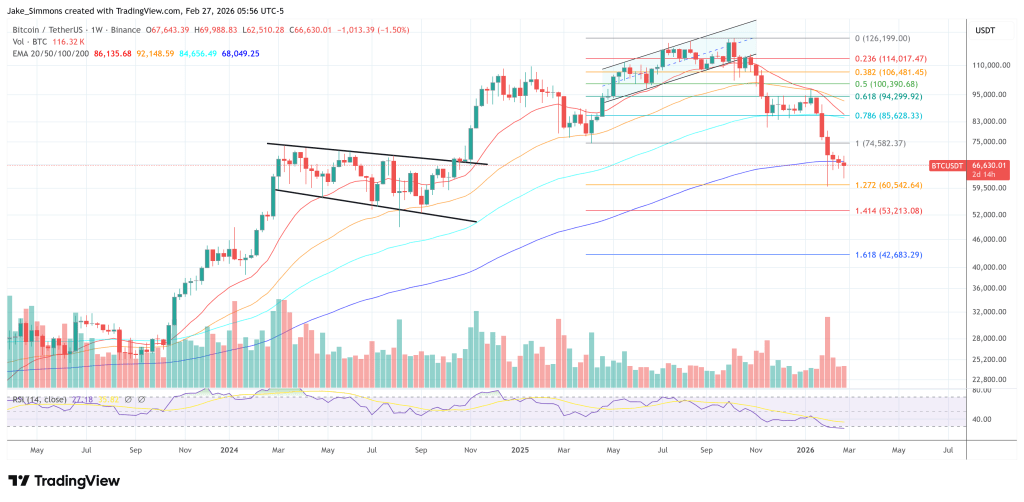
At press time, BTC traded at $66,630.

BTC must reclaim the 200-week EMA, 1-week chart | Source: BTCUSDT on TradingView.com

Связанные с этим вопросы

QWhat is the main argument that Bitcoin Core developer Matt Corallo is pushing back against in the quantum debate?

AMatt Corallo is pushing back against the claim that nobody serious is working on post-quantum cryptography for Bitcoin.

QWhat is the name of the new opcode being presented by Jonas Nick at OPNEXT 2026, and what is its purpose?

AThe new opcode is called OP_SHRINCSVERIFY. Its purpose is to enable SHRINCS, a construction for 324-byte stateful post-quantum signatures with static backups.

QAccording to the article, what are the two types of schemes that the SHRINCS signature design combines?

ASHRINCS combines a stateless scheme such as SPHINCS+ with a stateful scheme based on unbalanced XMSS.

QWhat key advantage does the SHRINCS proposal offer for normal-path signing efficiency in Bitcoin?

AThe key advantage is a significantly smaller signature size. For the first signature (q=1), it is 324 bytes, which is more than 11 times smaller than the smallest NIST-standardized alternative, ML-DSA, in that setting.

QBesides the technical presentation on OP_SHRINCSVERIFY, what other evidence does the article provide to show that post-quantum risk is being taken seriously in the Bitcoin ecosystem?

AThe article points to the OPNEXT 2026 event lineup, which includes a talk on 'Quantum Bitcoin' by Alex Pruden of Project 11 and a 'Quantum/Investor fireside' featuring Robert Mitchnick of BlackRock and David Duong of Coinbase, showing attention from both technical and institutional sides.

Похожее

Three Frameworks for Ordinary People to Achieve AI Capability Leap: Say Goodbye to the Dilemma of 'Repeating Inputs Every Day'

Summary: This article outlines three frameworks for maximizing AI efficiency, moving beyond basic prompt usage. 1. **Three-Layer Evolution**: Users progress from (1) **Prompt** (one-off instructions, reset each session), to (2) **Project** (context-aware within a specific project), to (3) **Skill** (permanent, auto-applied knowledge). Most users stagnate at the first layer, repeating the same instructions daily with no cumulative improvement. Skills transform the AI from a chat tool into a personalized work system. 2. **Transaction vs. Compound Interest Mindset**: Using prompts is a linear transaction—effort and output are 1:1, and stopping resets progress. Investing time in building Skills is compound interest; a small initial time investment pays continuous dividends, as each Skill permanently elevates the AI's baseline performance. 3. **Thin Harness, Fat Skills**: The system architecture should prioritize thick, well-defined Skills (90% of the value—containing processes, standards, and domain knowledge) and a thin "harness" (the minimal technical environment). Avoid over-engineering the toolchain while neglecting the AI's actual knowledge. Skills are permanent assets that automatically improve with model updates. The key takeaway: Identify tasks you repeat, encode them into Skills (using tools like Claude's Skill Creator), and shift focus from daily prompting to building a compounding, self-improving AI system.

marsbit33 мин. назад

Three Frameworks for Ordinary People to Achieve AI Capability Leap: Say Goodbye to the Dilemma of 'Repeating Inputs Every Day'

marsbit33 мин. назад

Торговля

Спот
Фьючерсы

Популярные статьи

Тест по Bitcoin Биткоина

HTX Learn: Изучите Bitcoin halving и Заработаете Токены USDT

3.0k просмотров всегоОпубликовано 2024.04.16Обновлено 2024.04.16

Тест по Bitcoin  Биткоина

Что такое $BITCOIN

ЦИФРОВОЕ ЗОЛОТО ($BITCOIN): Комплексный анализ Введение в ЦИФРОВОЕ ЗОЛОТО ($BITCOIN) ЦИФРОВОЕ ЗОЛОТО ($BITCOIN) — это проект на основе блокчейна, работающий в сети Solana, который стремится объединить характеристики традиционных драгоценных металлов с инновациями децентрализованных технологий. Хотя он носит имя Биткойн, часто называемого “цифровым золотом” из-за его восприятия как средства хранения ценности, ЦИФРОВОЕ ЗОЛОТО является отдельным токеном, предназначенным для создания уникальной экосистемы в ландшафте Web3. Его цель — позиционировать себя как жизнеспособный альтернативный цифровой актив, хотя детали его применения и функциональности все еще развиваются. Что такое ЦИФРОВОЕ ЗОЛОТО ($BITCOIN)? ЦИФРОВОЕ ЗОЛОТО ($BITCOIN) — это токен криптовалюты, специально разработанный для использования в блокчейне Solana. В отличие от Биткойна, который выполняет широко признанную роль хранения ценности, этот токен, похоже, сосредоточен на более широких приложениях и характеристиках. Примечательные аспекты включают: Инфраструктура блокчейна: Токен построен на блокчейне Solana, известном своей способностью обрабатывать высокоскоростные и недорогие транзакции. Динамика предложения: ЦИФРОВОЕ ЗОЛОТО имеет максимальное предложение, ограниченное 100 квадриллионами токенов (100P $BITCOIN), хотя детали о его обращающемся предложении в настоящее время не раскрыты. Утилита: Хотя точные функциональные возможности не описаны, есть указания на то, что токен может быть использован для различных приложений, потенциально связанных с децентрализованными приложениями (dApps) или стратегиями токенизации активов. Кто создатель ЦИФРОВОГО ЗОЛОТА ($BITCOIN)? На данный момент личность создателей и команды разработчиков, стоящих за ЦИФРОВЫМ ЗОЛОТОМ ($BITCOIN), остается неизвестной. Эта ситуация типична для многих инновационных проектов в области блокчейна, особенно тех, которые связаны с децентрализованными финансами и феноменом мем-криптовалют. Хотя такая анонимность может способствовать культуре, ориентированной на сообщество, она усиливает опасения по поводу управления и ответственности. Кто инвесторы ЦИФРОВОГО ЗОЛОТА ($BITCOIN)? Доступная информация указывает на то, что у ЦИФРОВОГО ЗОЛОТА ($BITCOIN) нет известных институциональных спонсоров или значительных венчурных капиталовложений. Проект, похоже, функционирует по модели пирингового взаимодействия, сосредоточенной на поддержке и принятии сообществом, а не на традиционных путях финансирования. Его активность и ликвидность в основном сосредоточены на децентрализованных биржах (DEX), таких как PumpSwap, а не на устоявшихся централизованных торговых платформах, что еще больше подчеркивает его подход, ориентированный на grassroots. Как работает ЦИФРОВОЕ ЗОЛОТО ($BITCOIN) Операционные механизмы ЦИФРОВОГО ЗОЛОТА ($BITCOIN) можно подробно описать на основе его дизайна блокчейна и характеристик сети: Механизм консенсуса: Используя уникальный механизм доказательства истории (PoH) Solana в сочетании с моделью доказательства доли (PoS), проект обеспечивает эффективную валидацию транзакций, что способствует высокой производительности сети. Токеномика: Хотя конкретные дефляционные механизмы не были подробно описаны, большое максимальное предложение токенов подразумевает, что оно может быть предназначено для микротранзакций или нишевых случаев использования, которые еще предстоит определить. Интероперабельность: Существует потенциал для интеграции с более широкой экосистемой Solana, включая различные платформы децентрализованных финансов (DeFi). Однако детали относительно конкретных интеграций остаются неуточненными. Хронология ключевых событий Вот хронология, которая подчеркивает значимые вехи, касающиеся ЦИФРОВОГО ЗОЛОТА ($BITCOIN): 2023: Первоначальное развертывание токена происходит в блокчейне Solana, отмеченное его адресом контракта. 2024: ЦИФРОВОЕ ЗОЛОТО приобретает видимость, когда оно становится доступным для торговли на децентрализованных биржах, таких как PumpSwap, позволяя пользователям обменивать его на SOL. 2025: Проект наблюдает спорадическую торговую активность и потенциальный интерес к инициативам, возглавляемым сообществом, хотя на данный момент не зафиксировано никаких значительных партнерств или технических достижений. Критический анализ Сильные стороны Масштабируемость: Основная инфраструктура Solana поддерживает высокие объемы транзакций, что может повысить полезность $BITCOIN в различных сценариях транзакций. Доступность: Потенциально низкая цена торговли за токен может привлечь розничных инвесторов, способствуя более широкому участию благодаря возможностям дробного владения. Риски Отсутствие прозрачности: Отсутствие публично известных спонсоров, разработчиков или процесса аудита может вызвать скептицизм относительно устойчивости и надежности проекта. Волатильность рынка: Торговая активность сильно зависит от спекулятивного поведения, что может привести к значительной волатильности цен и неопределенности для инвесторов. Заключение ЦИФРОВОЕ ЗОЛОТО ($BITCOIN) является интригующим, но неоднозначным проектом в быстро развивающейся экосистеме Solana. Хотя он пытается использовать нарратив “цифрового золота”, его отход от установленной роли Биткойна как средства хранения ценности подчеркивает необходимость более четкого различения его предполагаемой утилиты и структуры управления. Будущее принятие и усвоение, вероятно, будут зависеть от решения текущей непрозрачности и более четкого определения его операционных и экономических стратегий. Примечание: Этот отчет охватывает синтезированную информацию, доступную на октябрь 2023 года, и с тех пор могут произойти события.

99 просмотров всегоОпубликовано 2025.05.13Обновлено 2025.05.13

Что такое $BITCOIN

Fractal Bitcoin: масштабирование Биткоина с помощью рекурсивной системы

Fractal Bitcoin — масштабное Layer-1-решнение, созданное на базе кода Биткоина, позволяющего достигать бесконечного масштабирования с помощью рекурсивного подхода.

2.2k просмотров всегоОпубликовано 2025.06.30Обновлено 2025.06.30

Fractal Bitcoin: масштабирование Биткоина с помощью рекурсивной системы

Обсуждения

Добро пожаловать в Сообщество HTX. Здесь вы сможете быть в курсе последних новостей о развитии платформы и получить доступ к профессиональной аналитической информации о рынке. Мнения пользователей о цене на BTC (BTC) представлены ниже.

活动图片