Mining Stocks And Asian Markets Hit As Bitcoin Tumbles Under $65K

bitcoinistОпубликовано 2026-02-07Обновлено 2026-02-07

Введение

Bitcoin's decline below $65,000 has triggered a broad sell-off, affecting mining stocks and Asian markets. The cryptocurrency briefly fell near $60,000, a 15-month low, before a slight recovery. On-chain data indicates large holders (whales and sharks) have sold approximately 81,000 BTC over eight days, reducing their supply share to a nine-month low. Meanwhile, smaller investors increased their holdings. The Crypto Fear & Greed Index dropped to 9, reflecting extreme fear. Mining companies like Marathon Digital and Riot Platforms saw significant stock declines, with some hitting 52-week lows. Asian equities also fell amid a global tech sell-off and concerns over U.S. monetary policy. Analysts warn that continued volatility is likely due to macroeconomic uncertainty and large-holder selling.

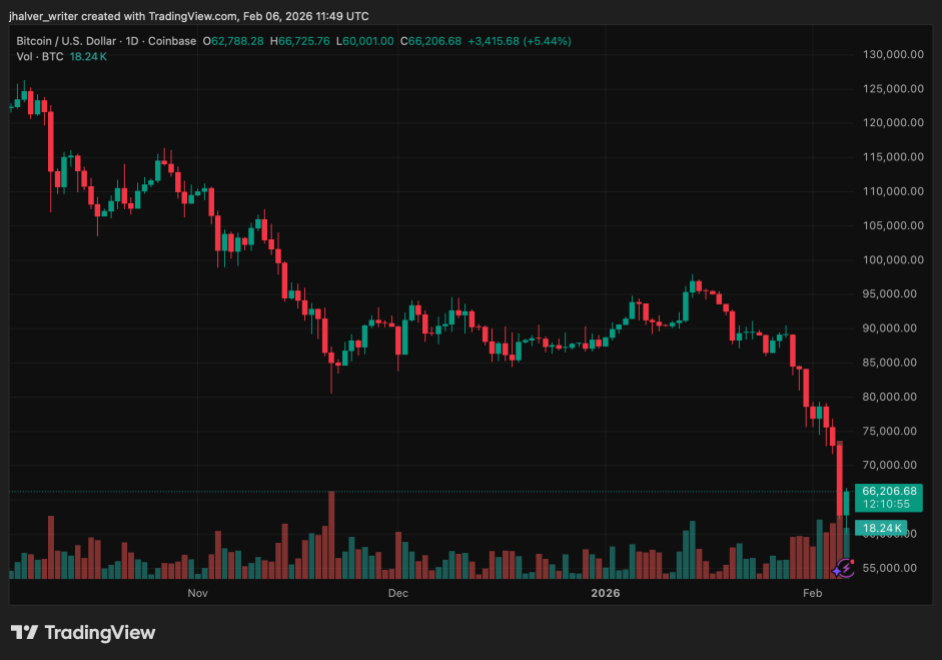
Bitcoin’s (BTC) slide below the $65,000 mark this week has rippled far beyond the crypto market, dragging down mining stocks and weighing on Asian equities already under pressure from a global tech sell-off.

The world’s largest cryptocurrency briefly dipped just above $60,000, its lowest level in about 15 months, before attempting a modest rebound. Even with that recovery, sentiment across digital assets and related equities remains fragile as investors reassess risk in an uncertain macro environment.

BTC's price trends to the downside on the daily chart. Source: BTCUSD on Tradingview

Whales Retreat As Sentiment Deteriorates

On-chain data shows a notable shift in Bitcoin ownership during the sell-off. According to Santiment, whales and sharks, controlling between 10 and 10,000 BTC, have reduced their share of Bitcoin’s circulating supply to around 68.04%, a nine-month low.

The large Bitcoin holders have sold roughly 81,000 BTC over the past eight days, coinciding with Bitcoin’s drop from near $90,000 to the mid-$60,000 range.

Similarly, smaller investors have continued to accumulate. Wallets holding less than 0.1 BTC reached a 20-month high in their share of supply, suggesting retail buyers are stepping in as prices fall.

Historically, similar patterns, large holders selling into retail demand, have been associated with prolonged bear phases. Reflecting this shift, the Crypto Fear & Greed Index fell to 9 out of 100, its lowest level since mid-2022.

Mining Stocks Slide Amid Bitcoin Weakness

The pressure on Bitcoin has translated quickly into losses for crypto-linked equities. Shares of major mining firms and Bitcoin proxies such as Marathon Digital, Riot Platforms, Hut 8, and Strategy Inc. posted double-digit declines, with several hitting new 52-week lows.

Strategy, one of the largest corporate Bitcoin holders, reported a sharply wider quarterly loss as falling prices weighed on the value of its holdings, adding to concerns about balance sheet risk if weakness persists.

Analysts note that the sell-off in miners has been largely macro-driven rather than tied to company-specific developments, reflecting their role as high-beta bets on Bitcoin’s price.

Asian Markets Feel The Spillover

Bitcoin’s drop also weighed on Asian markets, which were already tracking Wall Street’s losses, led by technology stocks. Equity benchmarks in South Korea, Hong Kong, and Australia declined, while Japan’s Nikkei managed modest gains after earlier losses.

Market players cited a broader risk-off mood linked to concerns over U.S. monetary policy, particularly following President Donald Trump’s nomination of Kevin Warsh as Federal Reserve chair, a move seen as less supportive of easy liquidity.

With Bitcoin now down roughly half from its October peak, investors remain cautious. While short-term rebounds are possible, continued selling by large holders and tightening financial conditions suggest volatility across crypto assets, mining stocks, and global markets is likely to persist.

Cover image from ChatGPT, BTCUSD chart on Tradingview

Связанные с этим вопросы

QWhat is the main reason for the decline in mining stocks and Asian markets mentioned in the article?

AThe main reason is Bitcoin's slide below $65,000, which created a risk-off mood and spilled over into related equities and Asian markets.

QAccording to on-chain data from Santiment, what change occurred in the holdings of Bitcoin whales and sharks?

AWhales and sharks (holding 10 to 10,000 BTC) reduced their share of Bitcoin's circulating supply to a nine-month low of approximately 68.04%, selling around 81,000 BTC over eight days.

QHow did smaller Bitcoin investors (retail) behave during the price drop?

ASmaller investors, specifically wallets holding less than 0.1 BTC, continued to accumulate, reaching a 20-month high in their share of the supply.

QWhat was the reading on the Crypto Fear & Greed Index, and what does it signify?

AThe Crypto Fear & Greed Index fell to 9 out of 100, its lowest level since mid-2022, signifying extreme fear in the market.

QBesides crypto, what other major factor contributed to the risk-off mood in Asian markets?

AA broader risk-off mood was linked to concerns over U.S. monetary policy, particularly following the nomination of Kevin Warsh as Federal Reserve chair, which was seen as less supportive of easy liquidity.

Похожее

The Niche Consensus Among Elites: Has College Become an Expensive Waste?

**Summary:** A growing "anti-college" movement is gaining traction among elite circles in Silicon Valley, challenging the traditional value of a four-year university degree. Proponents argue that college has become an expensive, slow, and increasingly irrelevant waste of time, especially in the fast-paced tech world where opportunities pass by quickly. The movement is led by figures like billionaire Peter Thiel, who criticizes universities for high costs, ideological indoctrination, and stifling true innovation. His "Thiel Fellowship" pays young people to drop out and pursue ventures. Companies like Palantir Technologies (co-founded by Thiel) fuel this trend with programs like the "Meritocracy Fellowship," which offers high school graduates paid internships as an alternative to immediate college enrollment, promising a practical "Palantir Degree." Key drivers include: 1. **Economics:** Skyrocketing student debt versus the allure of immediate, high-paying tech jobs or startup funding. 2. **Technology:** AI and online tools lowering barriers to self-education and product development, making formal instruction seem inefficient. 3. **Culture:** A backlash against perceived "woke" ideology and DEI policies in universities, coupled with a belief that these institutions suppress meritocracy and masculine drive. The movement is notably male-dominated. Critics, like economist David Deming, warn against overgeneralizing from dropout success stories (survivorship bias). He emphasizes that genuine autodidacts are rare, corporate training is narrowly focused, and the "college wage premium" remains high for most people. University liberal arts education, he argues, builds adaptable problem-solving skills and broad perspectives. The debate highlights a deeper crisis in education. The core model of the modern university appears increasingly mismatched with the speed of the information age. The movement signals a shift in the locus of learning from institutional "education" to personal, active "learning" powered by the internet and AI. Ultimately, this may not mean the end of university, but rather a painful evolution. The future likely holds more hybrid, personalized, and lifelong learning pathways. The central question becomes: in a world changing faster than any curriculum, how do we best learn?

marsbit14 мин. назад

The Niche Consensus Among Elites: Has College Become an Expensive Waste?

marsbit14 мин. назад

From Subsidies to Token-Based Pricing to Price Cuts: Is OpenAI Sparking a Price War? Is the Inflection Point for Token Economics Nearing?

The commercialization of generative AI is facing a critical inflection point as a potential price war looms. According to The Wall Street Journal, OpenAI is considering a significant cut to its token fees to compete with rival Anthropic, signaling a shift from a growth-at-all-costs model focused on token consumption. This move comes as both companies, reportedly losing billions on compute, prepare for IPOs, and as enterprise customers face "bill shock" from switching to usage-based token billing. Reports indicate poor ROI, with one analysis finding only 18 cents of every dollar spent on AI tokens generates user-facing value. The industry's initial phases—from flat-rate subscriptions to aggressive subsidies—have given way to a reckoning with real costs. Analysts debate the future: some predict a bifurcation between premium, high-cost models for complex tasks and cheaper alternatives for routine work, while others believe overall spending will still rise as agentic AI increases tokens per task. Notably, Chinese model DeepSeek's low-cost API is gaining traction with U.S. enterprises, adding competitive pressure. The core challenge is redefining value beyond token volume ("tokenmaxxing") toward measurable productivity ("valuemaxxing"), as the entire AI value chain, from cloud providers to chipmakers, feels the ripple effects of unsustainable pricing.

marsbit18 мин. назад

From Subsidies to Token-Based Pricing to Price Cuts: Is OpenAI Sparking a Price War? Is the Inflection Point for Token Economics Nearing?

marsbit18 мин. назад

Торговля

Спот
Фьючерсы

Популярные статьи

Тест по Bitcoin Биткоина

HTX Learn: Изучите Bitcoin halving и Заработаете Токены USDT

3.1k просмотров всегоОпубликовано 2024.04.16Обновлено 2024.04.16

Тест по Bitcoin  Биткоина

Что такое $BITCOIN

ЦИФРОВОЕ ЗОЛОТО ($BITCOIN): Комплексный анализ Введение в ЦИФРОВОЕ ЗОЛОТО ($BITCOIN) ЦИФРОВОЕ ЗОЛОТО ($BITCOIN) — это проект на основе блокчейна, работающий в сети Solana, который стремится объединить характеристики традиционных драгоценных металлов с инновациями децентрализованных технологий. Хотя он носит имя Биткойн, часто называемого “цифровым золотом” из-за его восприятия как средства хранения ценности, ЦИФРОВОЕ ЗОЛОТО является отдельным токеном, предназначенным для создания уникальной экосистемы в ландшафте Web3. Его цель — позиционировать себя как жизнеспособный альтернативный цифровой актив, хотя детали его применения и функциональности все еще развиваются. Что такое ЦИФРОВОЕ ЗОЛОТО ($BITCOIN)? ЦИФРОВОЕ ЗОЛОТО ($BITCOIN) — это токен криптовалюты, специально разработанный для использования в блокчейне Solana. В отличие от Биткойна, который выполняет широко признанную роль хранения ценности, этот токен, похоже, сосредоточен на более широких приложениях и характеристиках. Примечательные аспекты включают: Инфраструктура блокчейна: Токен построен на блокчейне Solana, известном своей способностью обрабатывать высокоскоростные и недорогие транзакции. Динамика предложения: ЦИФРОВОЕ ЗОЛОТО имеет максимальное предложение, ограниченное 100 квадриллионами токенов (100P $BITCOIN), хотя детали о его обращающемся предложении в настоящее время не раскрыты. Утилита: Хотя точные функциональные возможности не описаны, есть указания на то, что токен может быть использован для различных приложений, потенциально связанных с децентрализованными приложениями (dApps) или стратегиями токенизации активов. Кто создатель ЦИФРОВОГО ЗОЛОТА ($BITCOIN)? На данный момент личность создателей и команды разработчиков, стоящих за ЦИФРОВЫМ ЗОЛОТОМ ($BITCOIN), остается неизвестной. Эта ситуация типична для многих инновационных проектов в области блокчейна, особенно тех, которые связаны с децентрализованными финансами и феноменом мем-криптовалют. Хотя такая анонимность может способствовать культуре, ориентированной на сообщество, она усиливает опасения по поводу управления и ответственности. Кто инвесторы ЦИФРОВОГО ЗОЛОТА ($BITCOIN)? Доступная информация указывает на то, что у ЦИФРОВОГО ЗОЛОТА ($BITCOIN) нет известных институциональных спонсоров или значительных венчурных капиталовложений. Проект, похоже, функционирует по модели пирингового взаимодействия, сосредоточенной на поддержке и принятии сообществом, а не на традиционных путях финансирования. Его активность и ликвидность в основном сосредоточены на децентрализованных биржах (DEX), таких как PumpSwap, а не на устоявшихся централизованных торговых платформах, что еще больше подчеркивает его подход, ориентированный на grassroots. Как работает ЦИФРОВОЕ ЗОЛОТО ($BITCOIN) Операционные механизмы ЦИФРОВОГО ЗОЛОТА ($BITCOIN) можно подробно описать на основе его дизайна блокчейна и характеристик сети: Механизм консенсуса: Используя уникальный механизм доказательства истории (PoH) Solana в сочетании с моделью доказательства доли (PoS), проект обеспечивает эффективную валидацию транзакций, что способствует высокой производительности сети. Токеномика: Хотя конкретные дефляционные механизмы не были подробно описаны, большое максимальное предложение токенов подразумевает, что оно может быть предназначено для микротранзакций или нишевых случаев использования, которые еще предстоит определить. Интероперабельность: Существует потенциал для интеграции с более широкой экосистемой Solana, включая различные платформы децентрализованных финансов (DeFi). Однако детали относительно конкретных интеграций остаются неуточненными. Хронология ключевых событий Вот хронология, которая подчеркивает значимые вехи, касающиеся ЦИФРОВОГО ЗОЛОТА ($BITCOIN): 2023: Первоначальное развертывание токена происходит в блокчейне Solana, отмеченное его адресом контракта. 2024: ЦИФРОВОЕ ЗОЛОТО приобретает видимость, когда оно становится доступным для торговли на децентрализованных биржах, таких как PumpSwap, позволяя пользователям обменивать его на SOL. 2025: Проект наблюдает спорадическую торговую активность и потенциальный интерес к инициативам, возглавляемым сообществом, хотя на данный момент не зафиксировано никаких значительных партнерств или технических достижений. Критический анализ Сильные стороны Масштабируемость: Основная инфраструктура Solana поддерживает высокие объемы транзакций, что может повысить полезность $BITCOIN в различных сценариях транзакций. Доступность: Потенциально низкая цена торговли за токен может привлечь розничных инвесторов, способствуя более широкому участию благодаря возможностям дробного владения. Риски Отсутствие прозрачности: Отсутствие публично известных спонсоров, разработчиков или процесса аудита может вызвать скептицизм относительно устойчивости и надежности проекта. Волатильность рынка: Торговая активность сильно зависит от спекулятивного поведения, что может привести к значительной волатильности цен и неопределенности для инвесторов. Заключение ЦИФРОВОЕ ЗОЛОТО ($BITCOIN) является интригующим, но неоднозначным проектом в быстро развивающейся экосистеме Solana. Хотя он пытается использовать нарратив “цифрового золота”, его отход от установленной роли Биткойна как средства хранения ценности подчеркивает необходимость более четкого различения его предполагаемой утилиты и структуры управления. Будущее принятие и усвоение, вероятно, будут зависеть от решения текущей непрозрачности и более четкого определения его операционных и экономических стратегий. Примечание: Этот отчет охватывает синтезированную информацию, доступную на октябрь 2023 года, и с тех пор могут произойти события.

99 просмотров всегоОпубликовано 2025.05.13Обновлено 2025.05.13

Что такое $BITCOIN

Fractal Bitcoin: масштабирование Биткоина с помощью рекурсивной системы

Fractal Bitcoin — масштабное Layer-1-решнение, созданное на базе кода Биткоина, позволяющего достигать бесконечного масштабирования с помощью рекурсивного подхода.

2.3k просмотров всегоОпубликовано 2025.06.30Обновлено 2025.06.30

Fractal Bitcoin: масштабирование Биткоина с помощью рекурсивной системы

Обсуждения

Добро пожаловать в Сообщество HTX. Здесь вы сможете быть в курсе последних новостей о развитии платформы и получить доступ к профессиональной аналитической информации о рынке. Мнения пользователей о цене на BTC (BTC) представлены ниже.

活动图片