Market Expert Reveals Why Ethereum Is A Better Bet Than Solana

bitcoinistОпубликовано 2026-06-04Обновлено 2026-06-04

Введение

A market analyst argues that Ethereum (ETH) is a better long-term investment than Solana (SOL) despite recent price declines for both. While acknowledging Ethereum's weak price structure, falling network fees, and Solana's rapid growth in application fees, the analyst highlights key bullish factors for ETH. These include Ethereum's dominant share of on-chain stablecoin value (approximately $161.8 billion, or 50.7% of the total) and growing institutional interest, exemplified by BlackRock's recent filing for ERC-20 products on the Ethereum blockchain. The analyst projects that if the stablecoin market grows to $3 trillion by 2030 as forecasted, and Ethereum maintains its significant market share, over $1.5 trillion in value could be anchored to its network. This potential, coupled with the prospect of institutional asset tokenization, supports bullish long-term scenarios for Ethereum's market cap, ranging from 400% to 2,400% growth by 2029.

A crypto market expert has shared reasons why believes that despite the ongoing bearishness in the market right now, Ethereum (ETH) is still a better investment than Solana (SOL). Over the past few months, Ethereum has been in a slump, with its price falling below key support levels and underperforming the broader market. Meanwhile, Solana has seen its fair share of declines, plummeting by over 10% this past week. Despite the weakness across both assets, the analyst still picks Ethereum over Solana, citing ETH’s bullish drivers beyond price action and market trends.

Why Ethereum Is A Better Investment Than Solana

Emperor Osmo, a market analyst on X has presented a compelling case for why Ethereum remains a stronger bet than Solana despite ETH crashing more than 9.5% in the past week to trade near $1,870 at the time of writing. The analyst said he understands why many market participants and investors have turned bearish on the ETH price, pointing to weak price structure and declining network fees.

Osmo noted that Ethereum’s fee revenue has fallen sharply, while Solana continues to close the gap. According to him, Solana has generated about $3.859 billion in annual app fees compared to Ethereum’s $3.868 billion. The difference now stands at only $9 million after years of ETH maintaining a dominant lead.

The analyst also highlighted that Solana’s app fees are growing by roughly 9.5% per month, while ETH;s are declining by about 6.4%. Despite these trends, the analyst believes one key metric continues to support Ethereum’s long term bullish outlook. He revealed that the second largest cryptocurrency is currently sitting on about $161.8 billion in stablecoins, representing roughly 50.7% of all stablecoin value onchain.

Osmo also pointed to growing institutional interest in Ethereum’s ecosystem. He noted that BlackRock, the world’s largest asset manager, recently filed permissioned ERC-20 treasury products on Ethereum, picking the ETH blockchain above all others.

In addition, the analyst referenced projections from the U.S. Treasury Secretary, Scott Bessent, that the stablecoin market could eventually grow to $3 trillion by 2030. Based on those figures, Osmo argued that if Ethereum maintains its substantial stablecoin market share, more than $1.5 trillion in value could eventually be anchored to the network.

As a result, he believes that even if ETH’s current price reflects concerns around slowing fees and weak market structure, it does not represent its potential value backed by stablecoin growth and long term network retention.

Analyst Outlines Bull, Base, And Bear Case Scenarios For ETH

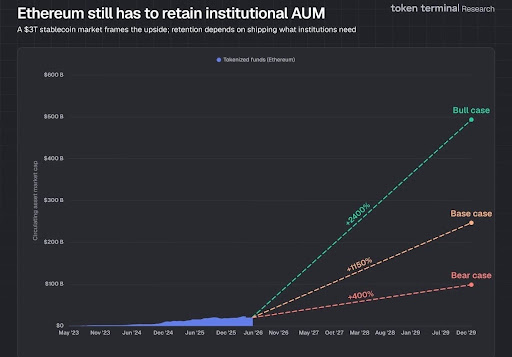
In an accompanying chart, Osmo mapped out bull, base, and bear case scenarios for Ethereum if it captures a significant slice of institutional stablecoin AUM. The analyst frames ETH’s potential upside against a projected $3 trillion stablecoin market, with retention hinging on whether the blockchain can ship what institutions need.

Source: Token Terminal

His bull case projects tokenized funds driving a 2,400% surge in ETH’s circulating asset market cap by December 2029. The base case puts that figure at 1,150%, while even the bear case holds upside at 400%.

ETH bears pull price below $2,000 | Source: ETHUSDT on Tradingview.com

Связанные с этим вопросы

QAccording to the analyst Emperor Osmo, what is the main reason Ethereum is considered a better investment than Solana despite its recent price slump?

AThe analyst believes Ethereum's long-term bullish outlook is supported by its massive stablecoin holdings, which represent about 50.7% of all onchain stablecoin value, and growing institutional interest, such as BlackRock filing ERC-20 treasury products on Ethereum.

QWhat key metric does Emperor Osmo highlight where Solana is closing the gap with Ethereum?

AEmperor Osmo highlights that Solana is closing the gap in annual app fee revenue. Currently, the difference is only $9 million, with Solana generating about $3.859 billion compared to Ethereum's $3.868 billion.

QWhat are the projected growth trends for app fees on Ethereum and Solana according to the article?

AAccording to the article, Solana's app fees are growing by roughly 9.5% per month, while Ethereum's app fees are declining by about 6.4% per month.

QWhat potential future market size for stablecoins does the analyst reference, and what implication does this have for Ethereum?

AThe analyst references a projection from U.S. Treasury Secretary Scott Bessent that the stablecoin market could grow to $3 trillion by 2030. If Ethereum maintains its substantial market share, more than $1.5 trillion in value could be anchored to its network.

QWhat are the three scenarios (bull, base, bear) outlined by the analyst for Ethereum's potential market cap growth by December 2029?

AThe analyst's scenarios for Ethereum's circulating asset market cap growth by December 2029 are: a bull case projecting a 2,400% surge, a base case projecting a 1,150% surge, and a bear case projecting a 400% surge.

Похожее

ByteDance Adopts Arm CPUs, Jensen Huang: So Sad I Didn't Buy Arm

**Summary:** At Computex 2026, Arm CEO Rene Haas announced that ByteDance and Oracle have adopted Arm's self-designed Arm AGI data center CPU. The company expects significant revenue growth from this product, projecting $20 billion in demand for the 2027/2028 fiscal years. Haas noted that restricting AI-capable CPUs from the US to China is nearly impossible due to their widespread applications. Arm's stock has surged dramatically this year, notably rising 16% after NVIDIA's Arm-based Vera CPU and RTX Spark announcements. A highlight was the informal, humorous on-stage conversation between Haas and NVIDIA CEO Jensen Huang. Huang joked about NVIDIA's failed attempt to acquire Arm and playfully lamented selling his Arm shares. Both executives showed a clear sense of camaraderie and shared regret over the missed merger. Key technical topics were discussed: 1. **AI PC Design:** Huang explained NVIDIA's RTX Spark superchip (with a 20-core Arm CPU) is designed for future AI agents that will autonomously run and use tools on PCs, blending local and cloud processing. 2. **Agent vs. OS:** Huang emphasized the operating system remains crucial, as AI agents rely on its APIs and tools to function. 3. **Growth Constraints:** He identified the shift to "useful AI" that generates profitable tokens as a primary driver for immense, almost limitless, computational demand. Haas outlined Arm's strategy across PC and data centers. For PCs, Arm collaborates with partners like NVIDIA and MediaTek, offering its compute subsystem (CSS) for custom SoCs. In data centers, its Arm AGI CPU (built on TSMC's 3nm process) has gained major partners including OpenAI, Meta, and now ByteDance and Oracle. Arm presented a multi-year roadmap for its in-house CPU line. The article concludes that while GPUs dominated the AI training race, the explosion of AI agents is shifting significant focus to CPUs for inference, state management, and tool orchestration. The industry is trending towards vertical integration, with companies like cloud providers designing chips and chip/IP firms offering full solutions, all competing to deliver more efficient computing per watt.

marsbit15 мин. назад

ByteDance Adopts Arm CPUs, Jensen Huang: So Sad I Didn't Buy Arm

marsbit15 мин. назад

New Wall Street Play: Yen Shorts Still Adding, But Japan Stocks Don't Rely on Carry Trade Unwinding

On June 3rd, USD/JPY hit 160.44, its highest level since July 2024, while the Nikkei 225 surged past 68,000 points. Contrary to popular narratives of an imminent "carry trade unwind" akin to August 2024, data reveals a more complex picture. Speculative net short positions in yen futures have actually increased, reaching -114,667 contracts by late May, suggesting traders are doubling down rather than retreating. Meanwhile, Japan's Finance Ministry conducted its largest-ever single-round FX intervention (11.73 trillion yen) in April-May but failed to hold the 160 yen line. The Nikkei's rally is not driven by carry trade dynamics. Foreign investors are aggressively buying Japanese stocks, with net purchases in 2026 running nearly 16 times higher than 2025 levels. This inflow is concentrated in AI and semiconductor-related stocks like SoftBank and Socionext, fueled by positive sector outlooks, rather than being a flight from unwinding yen shorts. Furthermore, the Nikkei has continued climbing despite the Bank of Japan's (BOJ) rate hikes to 0.75%. This disconnect exists because the current equity boom is fueled by AI-driven foreign investment, not reliant on cheap yen funding. However, this relationship remains fragile. Should the BOJ hike rates further (e.g., to 1.0%) while dollar weakness increases carry trade costs, the trajectories of the yen and Japanese stocks could reconverge, potentially triggering volatility.

marsbit20 мин. назад

New Wall Street Play: Yen Shorts Still Adding, But Japan Stocks Don't Rely on Carry Trade Unwinding

marsbit20 мин. назад

Broadcom's Q3 Guidance Misses Expectations by $12 Billion, After-Hours Trading Plummets Over 13%, AI Narrative "Cooling"?

On June 3, Broadcom released record Q2 FY26 results with revenue of $22.19B, up 48% YoY, and AI chip sales of $10.8B, up 143%. Adjusted EPS of $2.44 beat estimates. However, its Q3 AI semiconductor revenue guidance of $16B, while up over 200% YoY, fell roughly $1.2B (7%) short of analyst consensus expectations of $17.2B. This miss, coupled with slightly weaker-than-expected software revenue, triggered a severe market reaction. CEO Hock Tan maintained the FY26 AI revenue outlook of over $100B but did not raise it, disappointing investors who had priced in more robust growth. The stock plummeted over 13% in after-hours trading, erasing roughly $270B in market cap. The sell-off extended to peers like Marvell. A key concern for markets, particularly for Chinese optical module suppliers, was Tan's comment that the contribution of AI networking (e.g., Ethernet switches, optical interconnect chips) to AI revenue, currently near 40%, is expected to normalize to around 30% over time, signaling a potential peak in growth for that segment. Despite the guidance shortfall, Tan reiterated that AI demand remains "insatiable" and reaffirmed the long-term target of exceeding $100B in AI revenue by FY27. The reaction highlights the heightened sensitivity and premium valuation placed on AI-exposed stocks, where anything less than stellar guidance can prompt significant profit-taking. The broader question is whether this represents a cooling AI narrative or a correction in overstretched valuations.

marsbit20 мин. назад

Broadcom's Q3 Guidance Misses Expectations by $12 Billion, After-Hours Trading Plummets Over 13%, AI Narrative "Cooling"?

marsbit20 мин. назад

Торговля

Спот
Фьючерсы

Популярные статьи

Manyu: восходящая мем-звезда на Ethereum, готовая открыть новую эру культуры Shiba

Manyu - это мемтокен на Ethereum, который приносит децентрализованную культурную и развлекательную ценность через вирусное влияние в соцсетях и вовлечённость сообщества.

1.9k просмотров всегоОпубликовано 2025.11.27Обновлено 2025.11.27

Manyu: восходящая мем-звезда на Ethereum, готовая открыть новую эру культуры Shiba

Неделя обучения по популярным токенам 14: Glamsterdam — самое ожидаемое обновление Ethereum в 2026 году

Ordinals/Runes по-прежнему стимулируют доходы от комиссий за блоки и активность разработчиков, рассматриваются как отправная точка «нативной эмиссии активов» в сети.

1.5k просмотров всегоОпубликовано 2026.04.29Обновлено 2026.04.29

Неделя обучения по популярным токенам 14: Glamsterdam — самое ожидаемое обновление Ethereum в 2026 году

Обсуждения

Добро пожаловать в Сообщество HTX. Здесь вы сможете быть в курсе последних новостей о развитии платформы и получить доступ к профессиональной аналитической информации о рынке. Мнения пользователей о цене на ETH (ETH) представлены ниже.

活动图片