Major Catalysts To Watch Out For That Could Send Bitcoin Price To $90,000

bitcoinistОпубликовано 2026-04-05Обновлено 2026-04-05

Введение

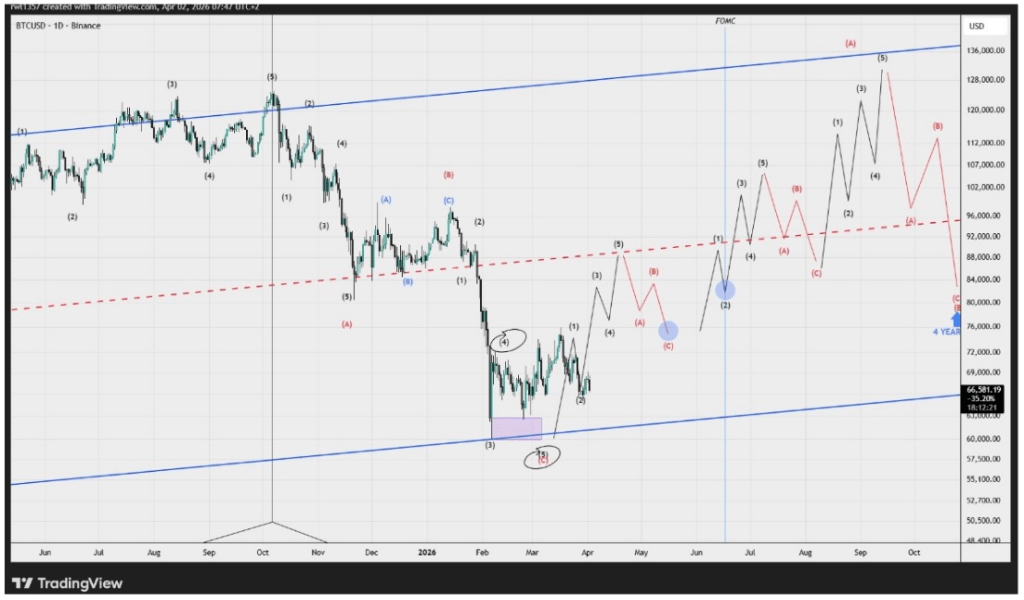
A crypto analyst, Rawl, has presented a Bitcoin price roadmap suggesting the cryptocurrency could surge to $90,000. According to his analysis, Bitcoin has completed a corrective Elliott Wave structure (Wave C) after dropping to $60,000 in February. The market has since entered a new bullish phase, with Waves 1 and 2 already formed. It is currently consolidating around $65,000 before expected upward moves in Waves 3 and 4 toward $90,000–$96,000. After reaching this level, a sideways movement is anticipated, followed by a corrective ABC wave, potentially coinciding with a change in Federal Reserve leadership. The analyst assigns an 80% probability of a new all-time high this year, with a less likely chance of a deeper pullback to $55,000 between May and June. He advises taking partial profits at $90,000 and rebuying on potential dips.

A crypto analyst has shared a new Bitcoin price roadmap, outlining where the market currently is and projecting the cryptocurrency’s next moves amid the ongoing bear market. While some experts still see more downside ahead for BTC, this analyst predicts a massive surge back above $90,000. The analyst cites several catalysts, including Bitcoin price action and the Elliot Wave structure, to support his bullish outlook.

Bitcoin Price Roadmap To $90,000

Rawl, a crypto market expert on X, has presented a new price analysis of Bitcoin, outlining in detail how the cryptocurrency can return to $90,000 and what traders should expect in the coming weeks and months. The analyst noted that, so far, Bitcoin has been following an expected plan, suggesting that the recent pullbacks, rebounds, and other price changes were normal reactions.

He said that although the market’s timeline has been the only surprise, the cryptocurrency’s structure is what truly matters. Rawl stated that, following Bitcoin’s price crash to $60,000 in February, which marked its lowest level since its 2025 all-time high, the cryptocurrency needed two more waves to complete its corrective structure.

As expected, Bitcoin went on to form Wave 4 and Wave 5 in its Elliott Wave setup, completing the full corrective Wave C chart structure. He added that BTC’s previous pullback to $63,000 counted as one wave and officially confirmed the final downward move.

Since then, Rawl noted that the market has rebounded, starting a new bullish Elliott Wave phase. In this fresh setup, the analyst stated that Bitcoin has already printed Wave 1 and Wave 2, with the market presently in a choppy range around $65,000 ahead of its next two waves to the upside.

BTCUSD now trading at $67,104. Chart: TradingView

He explained that once these waves complete, Bitcoin could rise quickly toward $90,000 to $96,000. After hitting that level, he expects it to move sideways for a few weeks before declining again as it enters a new corrective ABC wave, likely around the time a new Federal Reserve chair replaces Jerome Powell. He described this correction as a bullish move, noting that it could persist until the upcoming FOMC meeting in June.

The analyst noted that the price action following the FOMC could complete the first corrective Wave C, allowing the market to resume its uptrend. Alternatively, Bitcoin could drop one more time toward the $71,000 to $74,000 range, forming the next Wave 2 before a larger rally begins.

Rawl confidently stated that Bitcoin has an 80% chance of reaching a new all-time high this year. He noted that the remaining 20% possibility suggests that price could rise to the $116,000 to $125,000 range below its current cycle top.

Analyst Outlines Other Likely Path For Bitcoin Price

Although Rawl strongly believes in the roadmap he outlined above, he acknowledged that a less likely scenario is that Bitcoin could experience a deeper pullback between May and June, falling below $74,000 and possibly crashing to $55,000.

Because of this risk, the analyst recommends taking profits of 20-30% around the $90,000 range, then gradually buying back 10-15% of that position if Bitcoin dips to $74,000, and the rest if the price falls to $55,000 in June or by Q1 2027. Regardless of what happens to Bitcoin, the analyst still believes the cryptocurrency could hit an all-time high afterward.

Featured image from Pexels, chart from TradingView

Связанные с этим вопросы

QAccording to analyst Rawl, what is the primary technical analysis tool used to predict Bitcoin's potential surge to $90,000?

AThe primary technical analysis tool used is the Elliott Wave structure.

QWhat are the two waves that Bitcoin needed to complete after its crash to $60,000 to finalize its corrective structure?

AIt needed to complete Wave 4 and Wave 5 to finalize the corrective Wave C structure.

QAt what price level does the analyst suggest taking profits of 20-30% and what is the main reason for this recommendation?

AThe analyst suggests taking profits of 20-30% around the $90,000 range due to the risk of a deeper pullback to $55,000.

QWhat event does the analyst associate with the timing of a new corrective ABC wave for Bitcoin?

AThe analyst associates the new corrective ABC wave with the time a new Federal Reserve chair replaces Jerome Powell.

QWhat two potential price ranges does the analyst give for Bitcoin's next all-time high, and what are the associated probabilities?

AThe analyst gives an 80% probability for a new all-time high (above the previous cycle top) and a 20% probability for a high in the $116,000 to $125,000 range below the current cycle top.

Похожее

The Value Distribution of Stablecoins

**Summary: The Value Distribution of Stablecoins** The article argues that stablecoins are evolving from mere trading tools into broader channels for dollar access. It divides the stablecoin ecosystem into four layers to analyze how value is distributed: 1. **Issuance Layer:** Mints stablecoins, holds reserve assets, and captures the spread between reserve yield and user costs (e.g., Tether, Circle). This layer currently earns the largest profit margin. 2. **Infrastructure Layer:** Connects stablecoins to the traditional financial system, handling fiat on/off-ramps, banking integration, compliance (KYC/AML), and asset management (e.g., Bridge, BVNK). This is the "unglamorous" but critical work, building the essential bridges between crypto and real-world finance. 3. **Acquiring/Distribution Layer:** Integrates stablecoins into merchant systems, manages payment flows, and provides enterprise financial software (e.g., Stripe, Coinbase). They act as the access point for businesses. 4. **Application Layer:** The end-users and businesses that ultimately use stablecoins for payments, settlements, or as a store of value. They benefit from convenience but have little pricing power. The core thesis is that while the issuance layer currently dominates profits, the often-overlooked **infrastructure layer holds significant long-term potential**. The real challenge and barrier to mass adoption is not the on-chain transfer of stablecoins (which is simple), but the complex "last mile" integration into existing business workflows, banking systems, and regulatory frameworks across different countries. Companies in this layer are currently in a "land grab" phase, investing heavily to build networks, secure bank partnerships, and establish compliance pathways. While their position is currently pressured by the profitable issuers above and distribution platforms below, the article suggests that if stablecoins become a default financial rail for businesses, the infrastructure providers who have done the hard work of integration will ultimately gain strong pricing power and become entrenched, essential players.

marsbit1 ч. назад

The Value Distribution of Stablecoins

marsbit1 ч. назад

The Value Distribution of Stablecoins

The Value Distribution of Stablecoins The article argues that stablecoins are evolving from a mere trading tool into a broad "dollar channel." It analyzes the industry's value chain through four layers: 1. **Issuance Layer (e.g., Tether, Circle):** The top layer that mints stablecoins, holds reserve assets, and captures the thickest interest rate spread. 2. **Infrastructure Layer (e.g., Bridge, BVNK):** Connects stablecoins to the traditional financial system, handling critical but complex "dirty work" like fiat on/off-ramps, banking integration, compliance (KYC/AML), and cross-border settlement. 3. **Acquiring/Distribution Layer (e.g., Stripe, Coinbase):** Embeds stablecoins into merchant systems, manages payment flows, and integrates with enterprise software. 4. **Application Layer:** End-users and businesses that ultimately use stablecoins for payments, settlement, or storing value. The author posits that while the issuance layer currently captures the most profit, the most overlooked and potentially critical layer is infrastructure. The core challenge for stablecoin adoption isn't the on-chain transfer (which is simple), but bridging the gap between blockchain and the real-world financial system. This involves solving practical problems for businesses: fiat conversion, reconciliation, tax handling, and user onboarding. Infrastructure companies are currently in a difficult "land-grab" phase—building networks, securing banking relationships, and achieving compliance country-by-country. They face pressure from both the profitable issuance layer above and distribution platforms below. However, the author suggests this layer is building a crucial moat. Once stablecoins become a default business rail, the infrastructure players who have done the hard work of integration may gain significant, durable value and pricing power.

链捕手1 ч. назад

The Value Distribution of Stablecoins

链捕手1 ч. назад

How to Do Research Well: Deliberately Practice the Real Skills That Matter

No one truly teaches you how to do research. You're often given a desk, a pre-selected problem, and vague instructions to "create something new." Consequently, many people reverse-engineer the job based on visible outputs—papers, posts, announcements—learning only how to *appear* like a researcher rather than how to *become* one. True research capability is built from stacking small, trainable skills, nearly all of which can be developed through deliberate practice. **Pick Your Own Problem:** Most researchers absorb problems from advisors or trends, lacking the underlying reasoning. Choosing a problem you genuinely care about, as John Schulman advises, leads to original work. Develop "taste" like a muscle: predict experiment outcomes, guess paper results from methods, and track which findings remain important over time. **Upgrade Your Inputs:** Relying on shared reading lists (arXiv hot lists, filtered group chats) leads to unoriginal conclusions. Undervalued old literature often holds crucial insights (e.g., MoE, LSTM, backpropagation). Richard Sutton's "The Bitter Lesson" or Claude Shannon's 1952 talk on creative thinking are more predictive than lengthy modern surveys. Breadth matters as much as depth: draw from neuroscience, mechanism design, hardware knowledge, and honest statistics. Read papers directly, especially appendices and limitations sections. **Write Everything Down:** As Paul Graham noted, writing exposes flaws in seemingly mature ideas. Writing is the cheapest defense against self-deception. Following Feynman's principle, Darwin programmatically wrote down facts contradicting his theory to combat memory bias. Maintain a detailed log of hypotheses, setups, predictions, results, and updated understandings. Reviewing past logs fosters essential humility.

marsbit3 ч. назад

How to Do Research Well: Deliberately Practice the Real Skills That Matter

marsbit3 ч. назад

Торговля

Спот
Фьючерсы

Популярные статьи

Тест по Bitcoin Биткоина

HTX Learn: Изучите Bitcoin halving и Заработаете Токены USDT

3.1k просмотров всегоОпубликовано 2024.04.16Обновлено 2024.04.16

Тест по Bitcoin  Биткоина

Что такое $BITCOIN

ЦИФРОВОЕ ЗОЛОТО ($BITCOIN): Комплексный анализ Введение в ЦИФРОВОЕ ЗОЛОТО ($BITCOIN) ЦИФРОВОЕ ЗОЛОТО ($BITCOIN) — это проект на основе блокчейна, работающий в сети Solana, который стремится объединить характеристики традиционных драгоценных металлов с инновациями децентрализованных технологий. Хотя он носит имя Биткойн, часто называемого “цифровым золотом” из-за его восприятия как средства хранения ценности, ЦИФРОВОЕ ЗОЛОТО является отдельным токеном, предназначенным для создания уникальной экосистемы в ландшафте Web3. Его цель — позиционировать себя как жизнеспособный альтернативный цифровой актив, хотя детали его применения и функциональности все еще развиваются. Что такое ЦИФРОВОЕ ЗОЛОТО ($BITCOIN)? ЦИФРОВОЕ ЗОЛОТО ($BITCOIN) — это токен криптовалюты, специально разработанный для использования в блокчейне Solana. В отличие от Биткойна, который выполняет широко признанную роль хранения ценности, этот токен, похоже, сосредоточен на более широких приложениях и характеристиках. Примечательные аспекты включают: Инфраструктура блокчейна: Токен построен на блокчейне Solana, известном своей способностью обрабатывать высокоскоростные и недорогие транзакции. Динамика предложения: ЦИФРОВОЕ ЗОЛОТО имеет максимальное предложение, ограниченное 100 квадриллионами токенов (100P $BITCOIN), хотя детали о его обращающемся предложении в настоящее время не раскрыты. Утилита: Хотя точные функциональные возможности не описаны, есть указания на то, что токен может быть использован для различных приложений, потенциально связанных с децентрализованными приложениями (dApps) или стратегиями токенизации активов. Кто создатель ЦИФРОВОГО ЗОЛОТА ($BITCOIN)? На данный момент личность создателей и команды разработчиков, стоящих за ЦИФРОВЫМ ЗОЛОТОМ ($BITCOIN), остается неизвестной. Эта ситуация типична для многих инновационных проектов в области блокчейна, особенно тех, которые связаны с децентрализованными финансами и феноменом мем-криптовалют. Хотя такая анонимность может способствовать культуре, ориентированной на сообщество, она усиливает опасения по поводу управления и ответственности. Кто инвесторы ЦИФРОВОГО ЗОЛОТА ($BITCOIN)? Доступная информация указывает на то, что у ЦИФРОВОГО ЗОЛОТА ($BITCOIN) нет известных институциональных спонсоров или значительных венчурных капиталовложений. Проект, похоже, функционирует по модели пирингового взаимодействия, сосредоточенной на поддержке и принятии сообществом, а не на традиционных путях финансирования. Его активность и ликвидность в основном сосредоточены на децентрализованных биржах (DEX), таких как PumpSwap, а не на устоявшихся централизованных торговых платформах, что еще больше подчеркивает его подход, ориентированный на grassroots. Как работает ЦИФРОВОЕ ЗОЛОТО ($BITCOIN) Операционные механизмы ЦИФРОВОГО ЗОЛОТА ($BITCOIN) можно подробно описать на основе его дизайна блокчейна и характеристик сети: Механизм консенсуса: Используя уникальный механизм доказательства истории (PoH) Solana в сочетании с моделью доказательства доли (PoS), проект обеспечивает эффективную валидацию транзакций, что способствует высокой производительности сети. Токеномика: Хотя конкретные дефляционные механизмы не были подробно описаны, большое максимальное предложение токенов подразумевает, что оно может быть предназначено для микротранзакций или нишевых случаев использования, которые еще предстоит определить. Интероперабельность: Существует потенциал для интеграции с более широкой экосистемой Solana, включая различные платформы децентрализованных финансов (DeFi). Однако детали относительно конкретных интеграций остаются неуточненными. Хронология ключевых событий Вот хронология, которая подчеркивает значимые вехи, касающиеся ЦИФРОВОГО ЗОЛОТА ($BITCOIN): 2023: Первоначальное развертывание токена происходит в блокчейне Solana, отмеченное его адресом контракта. 2024: ЦИФРОВОЕ ЗОЛОТО приобретает видимость, когда оно становится доступным для торговли на децентрализованных биржах, таких как PumpSwap, позволяя пользователям обменивать его на SOL. 2025: Проект наблюдает спорадическую торговую активность и потенциальный интерес к инициативам, возглавляемым сообществом, хотя на данный момент не зафиксировано никаких значительных партнерств или технических достижений. Критический анализ Сильные стороны Масштабируемость: Основная инфраструктура Solana поддерживает высокие объемы транзакций, что может повысить полезность $BITCOIN в различных сценариях транзакций. Доступность: Потенциально низкая цена торговли за токен может привлечь розничных инвесторов, способствуя более широкому участию благодаря возможностям дробного владения. Риски Отсутствие прозрачности: Отсутствие публично известных спонсоров, разработчиков или процесса аудита может вызвать скептицизм относительно устойчивости и надежности проекта. Волатильность рынка: Торговая активность сильно зависит от спекулятивного поведения, что может привести к значительной волатильности цен и неопределенности для инвесторов. Заключение ЦИФРОВОЕ ЗОЛОТО ($BITCOIN) является интригующим, но неоднозначным проектом в быстро развивающейся экосистеме Solana. Хотя он пытается использовать нарратив “цифрового золота”, его отход от установленной роли Биткойна как средства хранения ценности подчеркивает необходимость более четкого различения его предполагаемой утилиты и структуры управления. Будущее принятие и усвоение, вероятно, будут зависеть от решения текущей непрозрачности и более четкого определения его операционных и экономических стратегий. Примечание: Этот отчет охватывает синтезированную информацию, доступную на октябрь 2023 года, и с тех пор могут произойти события.

99 просмотров всегоОпубликовано 2025.05.13Обновлено 2025.05.13

Что такое $BITCOIN

Fractal Bitcoin: масштабирование Биткоина с помощью рекурсивной системы

Fractal Bitcoin — масштабное Layer-1-решнение, созданное на базе кода Биткоина, позволяющего достигать бесконечного масштабирования с помощью рекурсивного подхода.

2.3k просмотров всегоОпубликовано 2025.06.30Обновлено 2025.06.30

Fractal Bitcoin: масштабирование Биткоина с помощью рекурсивной системы

Обсуждения

Добро пожаловать в Сообщество HTX. Здесь вы сможете быть в курсе последних новостей о развитии платформы и получить доступ к профессиональной аналитической информации о рынке. Мнения пользователей о цене на BTC (BTC) представлены ниже.

活动图片