Hyperliquid: Local Accumulation Trend Shows The Next Feasible Target For HYPE

bitcoinistОпубликовано 2026-03-17Обновлено 2026-03-17

Введение

Hyperliquid (HYPE) has reached new highs, with technical analysis indicating a potential continuation of its upward trend. A local accumulation curve formed over several weeks, allowing buyers to absorb supply and stabilize the market. Key resistance levels at $36.50 and $38.50 were breached, turning them into potential support zones. The next target is around $40, contingent on HYPE maintaining its position above these levels. A retest zone near $34–$35 could provide structural confirmation if the market holds. If $36.50 fails, a pullback to the $34–$35 support may occur. The overall trend remains bullish, driven by the earlier accumulation phase.

Hyperliquid (HYPE) has climbed to fresh highs for the first time since November, bringing the market’s focus to the next potential price target. Recent chart analysis shared by @ArdinNSC on X points to a developing continuation structure built on a local accumulation trend. With multiple upside levels already cleared, the technical framework now centers on whether the market can extend the move toward the next target.

Accumulation Curve Structure Drives Breakout Momentum

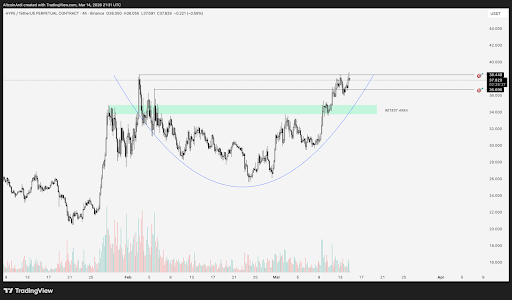
The chart posted by Ardin highlights a clear local accumulation curve that developed over several weeks. Instead of reversing sharply, Hyperliquid (HYPE) formed a rounded structure where price gradually transitioned from decline into recovery. This curved formation reflected a prolonged phase where buyers steadily absorbed supply, allowing the market to stabilize before advancing.

As the accumulation process matured, HYPE’s price began pushing into higher levels that had previously acted as resistance. The first notable level sat near $36.50. Once this barrier was cleared, the upward move accelerated toward the next target positioned around $38.50.

Both levels were taken out within a short period, confirming that the earlier consolidation phase had evolved into a stronger expansion move. The breakout also coincided with price following the upward arc of the accumulation curve, reinforcing the idea that the structure served as a base for continuation rather than a temporary rebound.

With these resistance levels now behind the market, the chart shows Hyperliquid (HYPE) trading above them, effectively transforming former barriers into areas that could now support price during any short-term pullbacks.

Hyperliquid (HYPE) Retest Zone Holds Key To $40 Target

With the initial targets already reached, attention has shifted to whether Hyperliquid (HYPE) can sustain its position above newly reclaimed levels. The chart outlines a highlighted retest zone slightly below the current price, marking an area where the market may revisit if momentum cools.

Source: X

This region sits around the mid $34 range and represents the zone where earlier resistance could now act as support. In technical market behavior, such retests often serve as confirmation that a breakout is structurally sound.

If the market maintains stability above this support area, Hyperliquid’s (HYPE) accumulation curve suggests the trend may still have room to extend higher. Under this scenario, the next feasible upside objective identified in the analysis appears near the $40 level and potentially beyond.

At the same time, the chart outlines a secondary path for Hyperliquid (HYPE) if the market weakens. Losing the $36.50 level could trigger a move back toward a support zone around $34 to $35, where the chart suggests price may return for a structural retest if $36.50 fails.

For now, the structure remains centered on whether price can hold above recently reclaimed levels. Maintaining that footing keeps Hyperliquid’s (HYPE) pathway toward a $40 target aligned with the continuation structure that emerged from the earlier accumulation trend.

Price continues toward $40 | Source: HYPEUSDT on Tradingview.com

Связанные с этим вопросы

QWhat is the main technical pattern identified in the Hyperliquid (HYPE) chart analysis by @ArdinNSC?

AThe main technical pattern identified is a local accumulation curve, a rounded structure where price gradually transitioned from decline into recovery, indicating buyers steadily absorbed supply to form a base for continuation.

QWhat were the first two key resistance levels that HYPE cleared during its recent breakout?

AThe first key resistance level cleared was near $36.50, and the next level cleared was around $38.50.

QAccording to the analysis, what is the next feasible upside price target for Hyperliquid (HYPE) if the current structure holds?

AThe next feasible upside price target is near the $40 level and potentially beyond.

QWhat is the significance of the retest zone identified in the mid $34 range?

AThe retest zone around the mid $34 range is significant because it represents an area where earlier resistance could now act as support, and holding above it would signal the breakout is structurally sound.

QWhat potential downside scenario is outlined if HYPE fails to hold the $36.50 level?

AIf HYPE fails to hold the $36.50 level, it could trigger a move back toward a support zone around $34 to $35 for a structural retest.

Похожее

Apple Also Has to Pay Rent Now

Apple Pays Rent Too: The Two-Way Flow of "Traffic Tax" and "AI Capability Rent" Between Tech Giants For over two decades, Google has paid Apple an estimated $20 billion annually to remain the default search engine on Safari, a "traffic tax" for a critical user entry point. However, in 2026, the direction of this cash flow partially reversed. Apple agreed to pay Google roughly $1 billion per year to license its Gemini AI models, as Apple's own models reportedly struggled with complex tasks. This creates a unique dynamic: Apple acts as the "landlord" in the established search ecosystem, collecting rent from Google for access. Simultaneously, in the emerging AI arena, Apple becomes the "tenant," paying Google for access to cutting-edge AI capabilities it cannot currently match internally. While Apple claims its new models are "distilled" from Gemini outputs and contain "not a drop" of Google's original code, core dependencies remain. Its knowledge base is refined using Gemini's outputs, and its most powerful cloud model runs on Google's infrastructure. Apple has structured the deal as non-exclusive, allowing it to theoretically switch AI suppliers—a hedge against over-reliance. The future hinges on whether advanced AI models become a commodity (cheap and abundant) or remain a concentrated, scarce resource (expensive and controlled by few). Apple is betting on the former, leveraging its massive device ecosystem to be a powerful, choosy customer. If the latter proves true, its bargaining power could erode. This power dynamic is extending to developers. Apple, Google, and WeChat are all pushing for apps to expose their core functions as standardized "actions" or "intents" that their respective AI assistants (Siri, Gemini, WeChat AI) can directly call. The new scarce resource is no longer just app store visibility, but "being selected by the AI." The currency of "rent" has changed from a 30% revenue share to ceding control over how users interact with an app's functions.

marsbit7 мин. назад

Apple Also Has to Pay Rent Now

marsbit7 мин. назад

Missed the SpaceX IPO? WEEX's "First Trade Protection" Lets You Experience US Stock Trading Risk-Free.

With the excitement around SpaceX's recent public listing reigniting interest in the US stock market, Chinese investors face significant challenges accessing compliant and convenient trading channels following regulatory actions against major online brokers. This article explores the available options, highlighting their risks and limitations. Traditional paths for US stock investments remain problematic. Qualified Domestic Institutional Investor (QDII) and Listed Open-Ended Fund (LOF) products, while compliant, suffer from high fees, significant purchase premiums, and a very limited selection of assets. Small, unregulated offshore brokers pose substantial risks, including potential insolvency. While secure, VIP accounts at banks in Hong Kong or Singapore require high minimum deposits (often 1-2 million RMB) and in-person visits, placing them out of reach for most retail investors. The article positions cryptocurrency exchanges, specifically their TradFi (traditional finance on-chain) offerings, as a compelling alternative. Platforms like WEEX are noted for providing access to a wide range of US stocks and ETFs, including SpaceX (SPCXON), through tokenized assets. This method offers advantages such as a single account for both crypto and traditional assets, USDT-based settlement avoiding fiat complexities, flexible leverage, and robust risk management. To attract users, WEEX is promoting a "First Trade Guarantee" campaign. Running from June 15 to July 8 (UTC+8), it features a $30,000 prize pool. Users who trade $500 worth of US stock contracts can qualify for a guarantee on their first eligible trade: 100% loss coverage up to $30 or a 20% bonus on profits up to $30. The campaign is presented as a low-risk opportunity for both crypto natives and traditional investors to experience US stock trading.

marsbit8 мин. назад

Missed the SpaceX IPO? WEEX's "First Trade Protection" Lets You Experience US Stock Trading Risk-Free.

marsbit8 мин. назад

How Difficult is Chip Making? A Division Error Costs 475 Million Dollars

How Hard Is It to Make a Chip? A Division Error Cost $475 Million Chip expert Shi Kan, a researcher at the Chinese Academy of Sciences and a popular tech creator, explains the immense challenges of chip development. Chips are foundational to modern technology, but their creation is extraordinarily difficult. The journey from sand to a functional chip involves complex design and manufacturing, but a critical bottleneck is verification—ensuring the design works flawlessly before costly production. A single, undetected bug can have catastrophic consequences, as illustrated by the infamous 1994 Intel Pentium FDIV bug. A flaw in the floating-point division unit forced a recall costing $475 million. Unlike software, chips cannot be easily patched after manufacture, making "first-time success" paramount. However, industry surveys show only 24% of chip projects achieve this; over three-quarters require at least one costly re-spin due to design flaws. Verification has thus become the dominant phase, consuming up to 70% of the design cycle. The core challenge is a "verification impossible triangle" between high performance, good debuggability, and low cost. Exhaustively verifying a modern CPU core could take 15,000 years with software simulation, or 30 years with advanced hardware emulation—timeframes utterly impractical for development. Despite being essential, verification is often seen as unglamorous "dirty work," receiving less academic attention than fields like AI. Shi and his team are tackling this by developing an agile verification research framework called ENCORE, based on FPGA technology, to improve verification efficiency and debug capability. Beyond research, Shi engages in public science communication through long-form video content, aiming to demystify chip technology, AI, and computer science. He argues for the value of pursuing "hard and long-term" endeavors, whether in the meticulous world of chip verification or in creating substantive educational content, believing such sustained effort is likely the right path forward.

marsbit18 мин. назад

How Difficult is Chip Making? A Division Error Costs 475 Million Dollars

marsbit18 мин. назад

Claude to Mandate "Face-Scan ID Verification", No ID No Service Starting July?

Anthropic, the creator of Claude AI, has sent privacy policy update emails to users, signaling a significant shift. The key change, effective July 8, is the potential requirement for consumer-level users (Free, Pro, Max plans) to verify their age or identity. This verification would be conducted through the third-party service Persona, involving uploading a government-issued photo ID and taking a live selfie for comparison. Anthropic states this data is for security purposes only, will not be used for model training, and is processed by Persona, not stored on its own servers. The update also clarifies data handling for Claude's new capabilities: when performing multi-step tasks or connecting to third-party apps, user data may flow between Anthropic and those external services. Additionally, more information may be collected from users who participate in Anthropic research. This move is seen as a major step towards establishing accountability as AI agents become more powerful and autonomous, capable of executing complex, real-world tasks. It follows previous enforcement actions, like the banning of the "Fable 5" account, and indicates a broader industry trend toward stricter user identification and safety measures. The verification is expected to apply in specific scenarios, particularly as users engage Claude in more complex agentic workflows.

链捕手30 мин. назад

Claude to Mandate "Face-Scan ID Verification", No ID No Service Starting July?

链捕手30 мин. назад

Blockchain Has Finally Started to Sail into the Mainstream After 18 Years

Blockchain Finds Its True Path After 18 Years: Becoming the Financial Backbone for AI Agents and Autonomy This analysis explores a pivotal shift in the blockchain and crypto investment landscape, driven by the dominance of AI. Major venture capital firms, including Variant, Paradigm, Haun Ventures, and YZi Labs, are moving beyond pure "crypto" investment theses. They are expanding their focus to AI, robotics, and frontier tech, signaling that blockchain is no longer seen as a standalone sector but as an underlying infrastructure layer. The core argument is that blockchain's killer application may not be user-facing apps, but rather providing the economic rails for the coming wave of AI agents, autonomous robots, and automated systems. Key capabilities like self-custody wallets, programmable stablecoins for micropayments, on-chain identity, and verifiable smart contracts are positioned as essential for a future where machines conduct economic activity. The recent $1.4 billion investment by Tether (via its venture arm) in German robotics company NEURA Robotics exemplifies this, aiming to embed Tether's wallet tools directly into robots for autonomous transactions. While many "AI + Crypto" projects remain superficial, the article concludes that true value lies where crypto is a necessary component—enabling machine-to-machine payments, agent autonomy, verifiable data provenance, and open financial settlement for the AI era. For crypto venture capital, this convergence with AI represents both an adaptation to shifting capital flows and a potential path to unlocking the large-scale, non-speculative utility the industry has long sought.

marsbit38 мин. назад

Blockchain Has Finally Started to Sail into the Mainstream After 18 Years

marsbit38 мин. назад

Торговля

Спот
Фьючерсы

Популярные статьи

Как купить HYPE

Добро пожаловать на HTX.com! Мы сделали приобретение Hyperliquid (HYPE) простым и удобным. Следуйте нашему пошаговому руководству и отправляйтесь в свое крипто-путешествие.Шаг 1: Создайте аккаунт на HTXИспользуйте свой адрес электронной почты или номер телефона, чтобы зарегистрироваться и бесплатно создать аккаунт на HTX. Пройдите удобную регистрацию и откройте для себя весь функционал.Создать аккаунтШаг 2: Перейдите в Купить криптовалюту и выберите свой способ оплатыКредитная/Дебетовая Карта: Используйте свою карту Visa или Mastercard для мгновенной покупки Hyperliquid (HYPE).Баланс: Используйте средства с баланса вашего аккаунта HTX для простой торговли.Третьи Лица: Мы добавили популярные способы оплаты, такие как Google Pay и Apple Pay, для повышения удобства.P2P: Торгуйте напрямую с другими пользователями на HTX.Внебиржевая Торговля (OTC): Мы предлагаем индивидуальные услуги и конкурентоспособные обменные курсы для трейдеров.Шаг 3: Хранение Hyperliquid (HYPE)После приобретения вами Hyperliquid (HYPE) храните их в своем аккаунте на HTX. В качестве альтернативы вы можете отправить их куда-либо с помощью перевода в блокчейне или использовать для торговли с другими криптовалютами.Шаг 4: Торговля Hyperliquid (HYPE)С легкостью торгуйте Hyperliquid (HYPE) на спотовом рынке HTX. Просто зайдите в свой аккаунт, выберите торговую пару, совершайте сделки и следите за ними в режиме реального времени. Мы предлагаем удобный интерфейс как для начинающих, так и для опытных трейдеров.

520 просмотров всегоОпубликовано 2024.12.11Обновлено 2026.06.02

Как купить HYPE

Обсуждения

Добро пожаловать в Сообщество HTX. Здесь вы сможете быть в курсе последних новостей о развитии платформы и получить доступ к профессиональной аналитической информации о рынке. Мнения пользователей о цене на HYPE (HYPE) представлены ниже.

活动图片