Has Wall Street Co-Opted Bitcoin? Bloomberg Expert Sparks Heated Debate

bitcoinistОпубликовано 2026-02-24Обновлено 2026-02-24

Введение

Bloomberg ETF analyst Eric Balchunas sparked a debate on whether Bitcoin's core value as "debasement-resistant and censorship-resistant money" remains valid despite institutional adoption and high volatility. He argued that Bitcoin’s fundamental properties haven’t changed—only the intermediaries have improved. Critics, including Oliver Renick, countered that Bitcoin’s extreme volatility makes it impractical as sound money, effectively causing repeated "debasement events." Balchunas acknowledged volatility as a sign of youth but emphasized long-term dilution resistance. The discussion highlighted a key divide: whether institutional involvement undermines Bitcoin’s original ethos or simply provides safer access.

A thread sparked by Bloomberg ETF analyst Eric Balchunas reignited one of crypto’s oldest arguments: whether Bitcoin’s core value proposition has been diluted as institutional intermediaries take center stage. What began as a reflection on crypto’s real-world utility quickly turned into a pointed dispute over whether BTC can credibly be called “debasement-resistant” while it remains wildly volatile.

Bitcoin Identity Debate Explodes on X

Balchunas weighed in after Cooper Turley, founder of Coop Records, posted that crypto feels “in the weirdest spot” since 2017 and that beyond speculation it’s “hard to see how it adds meaningful value to people’s lives.” Balchunas’ response framed Bitcoin’s novelty less as a product category and more as a monetary property set.

“Seeing this a lot. My two cents: the novel value of bitcoin is that it is user-run money that is both censorship and debasement-resistant,” Balchunas wrote. “Far as I can tell nothing has changed about that. However bc the current admin is so on board with it, the censorship part may seem less valuable, but just wait a few yrs, that could come in handy (it already does in many emerging/frontier mkt countries).. and debasement is alive and well, even dogs know that ain’t ever stopping.”

He argued that Bitcoin’s “youth” is a major driver of volatility, and that market price tends to hijack the narrative. “Price is a smoke screen that the most successful investors have learned to see through/ignore,” he added, extending the critique to traditional markets as well.

The “co-opted” question surfaced explicitly when Balchunas addressed long-time holders uneasy with BTC being increasingly accessed through Wall Street wrappers. His take: the asset didn’t change; the gatekeepers did.

“And for the OGs feeling like the establishment has co-opted their ‘outsider’ money.. all that really happened was the intermediaries got upgraded,” Balchunas wrote. “You went from paying high fees to SBF only for him to ‘lose’ your money to Larry Fink et al, who do same thing (outsourced your btc) but in a way that’s much cheaper and safer. Underlying btc hasn’t changed at all the whole time.”

Is Bitcoin Still A Debasement-Trade?

That framing didn’t satisfy critics who see Bitcoin’s volatility as fatal to the “debasement-resistant” label. Host of Chicago Future of Finance Oliver Renick pushed back sharply, arguing that a money that can swing the way Bitcoin does is effectively experiencing repeated “debasement events” by any practical standard.

“Debasement-resistant is biggest error here IMO,” Renick wrote. “If the dollar were down as much as btc can do on any given week, the world would go nuts, i.e, bitcoins volatility goes thru a debasement event like 3 times a year compared to the dollar where a 2% is a big deal. It’s rly bad money.”

Balchunas conceded the point partially on timeframe: “I think more longer term but it’s a fair point” but the exchange escalated when Renick questioned Bitcoin’s staying power. “And there it gets crushed again versus dollar and gold. Bitcoin may not make it to its 20th birthday, who knows,” he wrote.

Balchunas responded by pointing to recent performance as evidence that Bitcoin has “banked” substantial gains, citing “2023 and 2024” and “450%.” Renick’s rebuttal remained categorical: “Again , volatility intolerable of money.” Balchunas agreed Bitcoin is “too volatile rn to be widespread currency” and needs to “mature and settle down,” but rejected the conclusion that this reduces Bitcoin to censorship resistance alone.

“So that leaves you with just censorship resistance,” Renick wrote, suggesting that value might be far lower — “maybe $10k a coin” — before Balchunas returned to first principles: “It is debasement resistant, govt can’t dilute it- that’s true even if it is volatile.”

Balchunas closed by challenging the idea that shorter windows are dispositive, contrasting gold’s “20%” rise in “2023 + 2024” with Bitcoin’s “450%” move, and returning to the “young asset” thesis: it “gets ahead of itself then falls.”

The thread leaves a familiar fault line exposed. For Balchunas, institutional plumbing doesn’t change Bitcoin’s properties, and volatility is a maturity problem that can coexist with long-term dilution resistance. For critics, volatility isn’t a side effect, it’s the disqualifier, collapsing the “money” narrative and forcing a narrower censorship-resistance-only valuation debate.

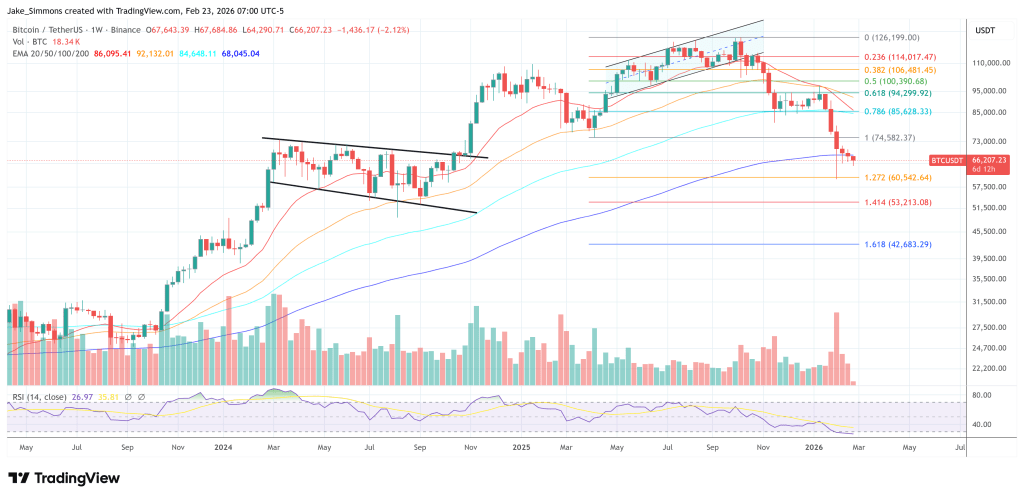
At press time, BTC traded at $66,207.

BTC must reclaim the 200-week EMA, 1-week chart | Source: BTCUSDT on TradingView.com

Связанные с этим вопросы

QWhat core Bitcoin value proposition did Eric Balchunas emphasize in the debate?

AEric Balchunas emphasized that Bitcoin's core value proposition is being user-run money that is both censorship-resistant and debasement-resistant.

QAccording to the article, what is the main criticism Oliver Renick raised against Bitcoin being 'debasement-resistant'?

AOliver Renick argued that Bitcoin's extreme volatility means it effectively experiences repeated 'debasement events,' making it intolerable as money compared to stable currencies like the US dollar.

QHow did Balchunas justify Bitcoin's volatility in the context of its long-term value?

ABalchunas attributed Bitcoin's volatility to its 'youth' as an asset class, stating it's a maturity problem that doesn't negate its long-term debasement resistance, and pointed to its substantial gains (e.g., 450% in 2023-2024) as evidence of value.

QWhat was Balchunas' perspective on institutional involvement (like Wall Street ETFs) changing Bitcoin's fundamental nature?

ABalchunas argued that institutional involvement only changed the intermediaries (e.g., from risky entities like SBF to safer, cheaper options like Larry Fink's BlackRock), but the underlying properties of Bitcoin itself remained unchanged.

QWhat key fault line in the Bitcoin debate does the article highlight between Balchunas and his critics?

AThe fault line is whether Bitcoin's volatility disqualifies it as 'debasement-resistant money' (critics' view) or whether volatility is merely a temporary maturity issue coexisting with long-term dilution resistance (Balchunas' view).

Похожее

Anthropic Starts Poaching Scientists? $27K Weekly Onsite Stipend to Fix Claude's Expert-Level Errors

Anthropic has launched a new STEM Fellow program, offering $3,800 per week for a three-month, in-person residency in San Francisco. The role targets experts from science, technology, engineering, and mathematics (STEM) fields—machine learning experience is helpful but not required. Instead, Anthropic values scientific judgment and a willingness to learn quickly. Fellows will work with Claude models and internal tools under the guidance of an Anthropic researcher. Example projects include a materials scientist identifying errors in Claude’s reasoning or a climate scientist integrating atmospheric modeling software with Claude. The goal is to have experts "tell Claude where it's wrong" and improve its scientific capabilities. This initiative is part of Anthropic’s broader strategy to strengthen its scientific ecosystem, following earlier programs like the AI Safety Fellows and AI for Science programs. The company acknowledges that current AI models, while powerful, still produce high-confidence errors and lack end-to-end research autonomy. The program aims to embed domain expertise directly into model development, turning scientists into "high-level reviewers" for AI. Anthropic CEO Dario Amodei has previously emphasized AI’s potential to accelerate scientific breakthroughs, particularly in biology and healthcare. The company believes that the next phase of AI competition will depend not on scaling parameters, but on integrating human expertise to refine model accuracy and reliability.

marsbit20 мин. назад

Anthropic Starts Poaching Scientists? $27K Weekly Onsite Stipend to Fix Claude's Expert-Level Errors

marsbit20 мин. назад

On the Eve of X Money's Launch, Musk Dismantles the Referee First

"X Money Launches After Dismantling Regulator: Musk's 9-Day Power Play" In February 2025, a team from the "Department of Government Efficiency" (DOGE), led by Elon Musk, entered the Consumer Financial Protection Bureau (CFPB) headquarters. Shortly after, the CFPB was effectively dismantled—its funding frozen, activities suspended, and nearly 90% of staff laid off. This move came just nine days after X announced a partnership with Visa and as X Money prepared to launch. The article contrasts this with the decade-long regulatory battles faced by companies like Coinbase and PayPal. Coinbase spent over $75 million in political contributions and endured a major SEC lawsuit to operate legally. PayPal complied with strict state and federal rules for its stablecoin PYUSD, including 100% reserve requirements and monthly audits. However, Musk’s approach was different. After the CFPB introduced a rule placing large digital payment apps under federal oversight, Musk tweeted "Delete CFPB." Within months, the rule was revoked by Congress. Meanwhile, DOGE operatives gained "god-tier" access to CFPB databases, potentially obtaining sensitive competitive information from rivals like Apple, Google, and PayPal. The article also highlights a "suspicious exemption clause" in the GENIUS Act, which allows private companies like X to issue stablecoins with fewer restrictions. Senator Elizabeth Warren questioned whether Musk, who was a senior presidential advisor during the Act’s drafting, influenced this clause. X Money offers a 6% APY on deposits, despite FDIC warnings that stablecoin users are not insured. As X Money launches to 600 million monthly users, the article questions the fairness of a system where Musk can bypass regulations that others spent years and millions to comply with. The dismantling of the CFPB and the alleged regulatory advantages raise concerns about the future of equitable rule-making in the U.S. financial system.

marsbit28 мин. назад

On the Eve of X Money's Launch, Musk Dismantles the Referee First

marsbit28 мин. назад

Торговля

Спот
Фьючерсы

Популярные статьи

Тест по Bitcoin Биткоина

HTX Learn: Изучите Bitcoin halving и Заработаете Токены USDT

3.0k просмотров всегоОпубликовано 2024.04.16Обновлено 2024.04.16

Тест по Bitcoin  Биткоина

Что такое $BITCOIN

ЦИФРОВОЕ ЗОЛОТО ($BITCOIN): Комплексный анализ Введение в ЦИФРОВОЕ ЗОЛОТО ($BITCOIN) ЦИФРОВОЕ ЗОЛОТО ($BITCOIN) — это проект на основе блокчейна, работающий в сети Solana, который стремится объединить характеристики традиционных драгоценных металлов с инновациями децентрализованных технологий. Хотя он носит имя Биткойн, часто называемого “цифровым золотом” из-за его восприятия как средства хранения ценности, ЦИФРОВОЕ ЗОЛОТО является отдельным токеном, предназначенным для создания уникальной экосистемы в ландшафте Web3. Его цель — позиционировать себя как жизнеспособный альтернативный цифровой актив, хотя детали его применения и функциональности все еще развиваются. Что такое ЦИФРОВОЕ ЗОЛОТО ($BITCOIN)? ЦИФРОВОЕ ЗОЛОТО ($BITCOIN) — это токен криптовалюты, специально разработанный для использования в блокчейне Solana. В отличие от Биткойна, который выполняет широко признанную роль хранения ценности, этот токен, похоже, сосредоточен на более широких приложениях и характеристиках. Примечательные аспекты включают: Инфраструктура блокчейна: Токен построен на блокчейне Solana, известном своей способностью обрабатывать высокоскоростные и недорогие транзакции. Динамика предложения: ЦИФРОВОЕ ЗОЛОТО имеет максимальное предложение, ограниченное 100 квадриллионами токенов (100P $BITCOIN), хотя детали о его обращающемся предложении в настоящее время не раскрыты. Утилита: Хотя точные функциональные возможности не описаны, есть указания на то, что токен может быть использован для различных приложений, потенциально связанных с децентрализованными приложениями (dApps) или стратегиями токенизации активов. Кто создатель ЦИФРОВОГО ЗОЛОТА ($BITCOIN)? На данный момент личность создателей и команды разработчиков, стоящих за ЦИФРОВЫМ ЗОЛОТОМ ($BITCOIN), остается неизвестной. Эта ситуация типична для многих инновационных проектов в области блокчейна, особенно тех, которые связаны с децентрализованными финансами и феноменом мем-криптовалют. Хотя такая анонимность может способствовать культуре, ориентированной на сообщество, она усиливает опасения по поводу управления и ответственности. Кто инвесторы ЦИФРОВОГО ЗОЛОТА ($BITCOIN)? Доступная информация указывает на то, что у ЦИФРОВОГО ЗОЛОТА ($BITCOIN) нет известных институциональных спонсоров или значительных венчурных капиталовложений. Проект, похоже, функционирует по модели пирингового взаимодействия, сосредоточенной на поддержке и принятии сообществом, а не на традиционных путях финансирования. Его активность и ликвидность в основном сосредоточены на децентрализованных биржах (DEX), таких как PumpSwap, а не на устоявшихся централизованных торговых платформах, что еще больше подчеркивает его подход, ориентированный на grassroots. Как работает ЦИФРОВОЕ ЗОЛОТО ($BITCOIN) Операционные механизмы ЦИФРОВОГО ЗОЛОТА ($BITCOIN) можно подробно описать на основе его дизайна блокчейна и характеристик сети: Механизм консенсуса: Используя уникальный механизм доказательства истории (PoH) Solana в сочетании с моделью доказательства доли (PoS), проект обеспечивает эффективную валидацию транзакций, что способствует высокой производительности сети. Токеномика: Хотя конкретные дефляционные механизмы не были подробно описаны, большое максимальное предложение токенов подразумевает, что оно может быть предназначено для микротранзакций или нишевых случаев использования, которые еще предстоит определить. Интероперабельность: Существует потенциал для интеграции с более широкой экосистемой Solana, включая различные платформы децентрализованных финансов (DeFi). Однако детали относительно конкретных интеграций остаются неуточненными. Хронология ключевых событий Вот хронология, которая подчеркивает значимые вехи, касающиеся ЦИФРОВОГО ЗОЛОТА ($BITCOIN): 2023: Первоначальное развертывание токена происходит в блокчейне Solana, отмеченное его адресом контракта. 2024: ЦИФРОВОЕ ЗОЛОТО приобретает видимость, когда оно становится доступным для торговли на децентрализованных биржах, таких как PumpSwap, позволяя пользователям обменивать его на SOL. 2025: Проект наблюдает спорадическую торговую активность и потенциальный интерес к инициативам, возглавляемым сообществом, хотя на данный момент не зафиксировано никаких значительных партнерств или технических достижений. Критический анализ Сильные стороны Масштабируемость: Основная инфраструктура Solana поддерживает высокие объемы транзакций, что может повысить полезность $BITCOIN в различных сценариях транзакций. Доступность: Потенциально низкая цена торговли за токен может привлечь розничных инвесторов, способствуя более широкому участию благодаря возможностям дробного владения. Риски Отсутствие прозрачности: Отсутствие публично известных спонсоров, разработчиков или процесса аудита может вызвать скептицизм относительно устойчивости и надежности проекта. Волатильность рынка: Торговая активность сильно зависит от спекулятивного поведения, что может привести к значительной волатильности цен и неопределенности для инвесторов. Заключение ЦИФРОВОЕ ЗОЛОТО ($BITCOIN) является интригующим, но неоднозначным проектом в быстро развивающейся экосистеме Solana. Хотя он пытается использовать нарратив “цифрового золота”, его отход от установленной роли Биткойна как средства хранения ценности подчеркивает необходимость более четкого различения его предполагаемой утилиты и структуры управления. Будущее принятие и усвоение, вероятно, будут зависеть от решения текущей непрозрачности и более четкого определения его операционных и экономических стратегий. Примечание: Этот отчет охватывает синтезированную информацию, доступную на октябрь 2023 года, и с тех пор могут произойти события.

99 просмотров всегоОпубликовано 2025.05.13Обновлено 2025.05.13

Что такое $BITCOIN

Fractal Bitcoin: масштабирование Биткоина с помощью рекурсивной системы

Fractal Bitcoin — масштабное Layer-1-решнение, созданное на базе кода Биткоина, позволяющего достигать бесконечного масштабирования с помощью рекурсивного подхода.

2.2k просмотров всегоОпубликовано 2025.06.30Обновлено 2025.06.30

Fractal Bitcoin: масштабирование Биткоина с помощью рекурсивной системы

Обсуждения

Добро пожаловать в Сообщество HTX. Здесь вы сможете быть в курсе последних новостей о развитии платформы и получить доступ к профессиональной аналитической информации о рынке. Мнения пользователей о цене на BTC (BTC) представлены ниже.

活动图片