From 'Hardcore' to 'Weak': Who is the Real Hardliner When Bitcoin Falls?

marsbitОпубликовано 2026-02-06Обновлено 2026-02-06

Введение

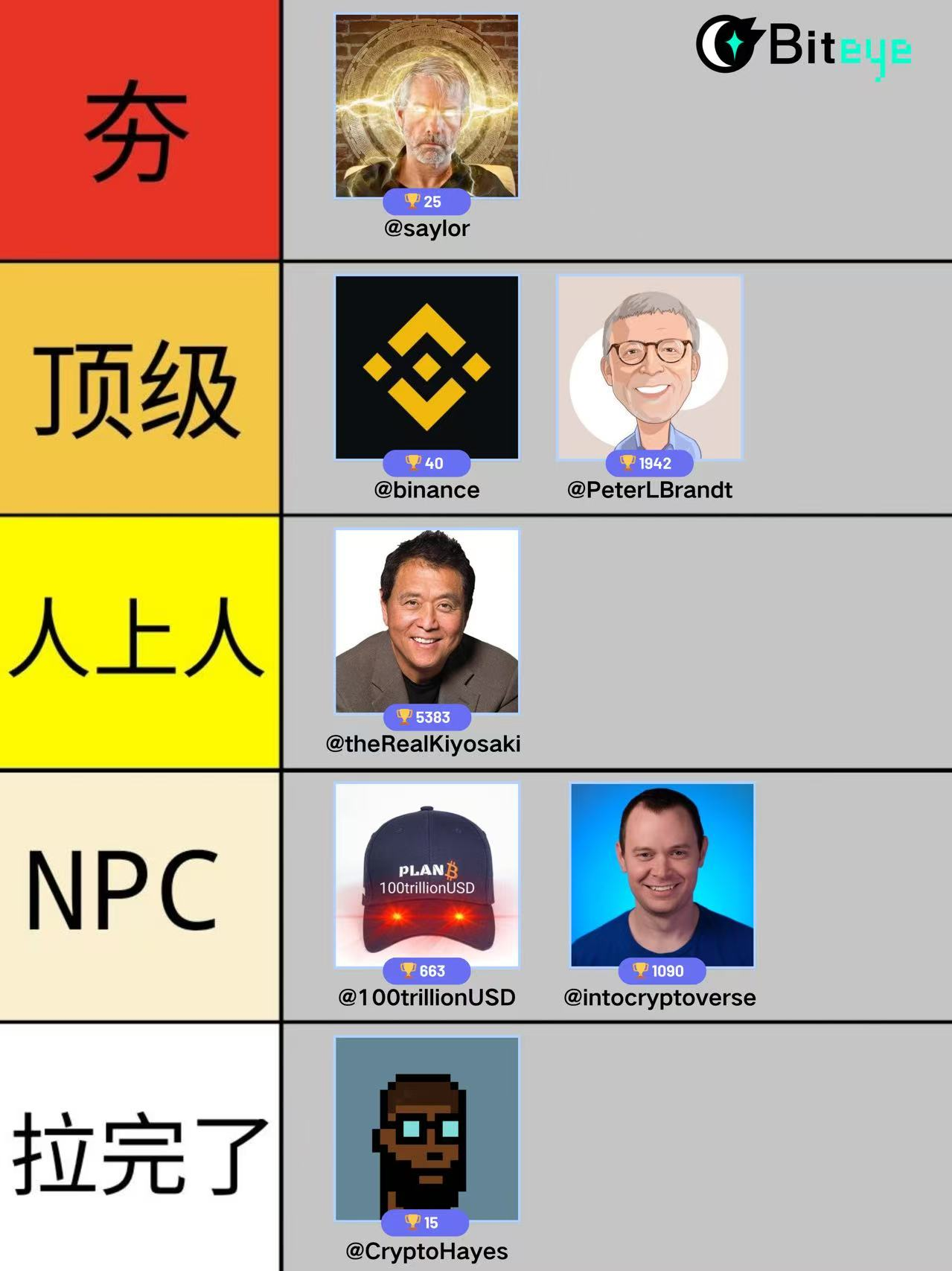
An article titled "From 'Solid' to 'Weak': Who is the Real Hardliner When Bitcoin Falls?" analyzes the behavior of prominent crypto figures and institutions during a sharp Bitcoin price decline in February 2026, when BTC dropped from its $120,000 high to briefly under $60,000. The piece rates key players based on their public statements and on-chain actions during the crash. Michael Saylor and his company MicroStrategy are hailed as the "true hardliner" for their "suicidal" buying spree, purchasing billions of dollars worth of BTC at prices between $87,974 and $91,519, despite now holding at a loss. Their rating: "Solid (walking the talk, the one true god)." Binance is praised for its "top-tier" action of converting $1 billion of its SAFU fund into Bitcoin. Veteran trader Peter Brandt is also rated "top-tier" as an "honest bear" for consistently warning of a 50% correction since the market peak and sticking to his technical analysis. Author Robert Kiyosaki is rated "theoretical" for his constant anti-fiat rhetoric but slow action, waiting for extreme prices to buy. Model-based analysts PlanB and Benjamin Cowen are heavily criticized and rated "NPC (for entertainment only)" for their failed predictions and major shifts in narrative. Former "pump king" Arthur Hayes is rated the worst ("Weak") for going silent on Bitcoin after his lofty price predictions, instead discussing macroeconomics without stating his position. The conclusion states that only two types of people are w...

Author: Biteye

Bull markets mass-produce "prophets"; bear markets are the "lie detectors".

As of February 6, 2026, Bitcoin has plummeted from last year's high of $120,000, and early this morning it even broke through the $60,000 mark, with futures briefly touching the "$50,000s". Most of those voices from six months ago shouting "eternal bull market" and "$250,000 by 2026" are now fallen silent, saying nothing.

We tracked the public statements and on-chain actions of six major KOLs and institutions during this round of sharp decline. Data doesn't lie; it brutally reveals who the true believers are and who are just fair-weather followers.

The Only "Real Hardliner": Michael Saylor's Madness and Purity

If there's only one person in the crypto circle who truly practices "walking the talk," it has to be @saylor.

At the peak in October 2025, he shilled; during the crash in January-February 2026, he bought.

When the market panicked over falling below $80,000, MicroStrategy's buying records were nothing short of a "suicidal" hardliner's declaration:

  • January 12: Invested $1.25 billion at an average price of $91,519
  • January 26: Added $264 million at an average price of $90,061
  • February 2: Bought another $75.3 million at an average price of $87,974

In just one month, he increased his holdings by tens of thousands of BTC against the trend, raising his total cost basis to around $76,000. This means that at the current price of $64,500, Saylor is sitting on massive paper losses. But he didn't wait for "bottom confirmation" like the technical analysts, nor did he worry about "recession risks" like the macro analysts.

For Saylor, a drop means only one thing: it's on sale, keep all-in.

Rating: Hardcore (Walks the talk, the one true god)

Putting Money Where Mouth Is: Binance; The Honest "Big Short": Peter Brandt

Binance @binance announced at the end of January that it would convert its $1 billion SAFU fund into Bitcoin and completed the first batch of purchases (about $100 million) on February 2. Fighting off trolls and rumors while putting real money into Bitcoin—this is the responsibility a top exchange should shoulder.

Rating: Top Tier (Protecting the market with real money)

As a bull you might not like him, but @PeterLBrandt has earned respect with his views. Back in the frenzy of October 2025, he poured cold water, warning of a "50% correction risk." Now, he's not being wise after the event; instead, he consistently reinforces his bearish view based on his logic. He might not be buying (and might even be shorting), but his loyalty to his trading system is extremely high.

Compared to those who only turn bearish after the drop, this kind of "die-hard" based on technical logic deserves respect.

Rating: Top Tier (Logically consistent, honest bear)

Theoretical "Theorist": Robert Kiyosaki

Robert Kiyosaki @theRealKiyosaki is still tirelessly promoting his "anti-fiat" philosophy. Although the logic remains, his actions are too slow.

He talks about "Rich Dad" thinking but holds cash, fantasizing about buying the bottom at extreme points like gold at $4,000 and silver at $74. In this highly volatile market, excessive waiting often means missing out or being forced to act. Full marks for theory, zero for execution.

Rating: All Talk (Valid views, too slow to act)

The Fallen "Modelists": PlanB and Benjamin Cowen

This round of decline marks another failure of "model superstition."

PlanB @100trillionUSD's S2F model has been disproven by the market once again. That confident "BTC will never fall below $100,000" promise has now become a joke. His recent tweets have started discussing a "shallow bear" and "bull market fatigue," but there's no evidence of personal buying.

Benjamin Cowen @intocryptoverse also underwent a drastic logical shift. From expecting "new highs" in Q4 last year to suddenly confirming a "bear market has arrived" in February this year, with a bearish target down to the 200-week moving average (around $58,000). This massive directional correction has left many investors following his cycle analysis unprepared.

Rating: NPC (Predictions collapsed, for entertainment only)

"Brotherhood is in the heart, but the phone is off when needed": Arthur Hayes

The former "shilling king" Arthur Hayes @CryptoHayes, after calling for a "$1 million" target, has recently fallen into a strange state.

He hasn't been buying like Saylor, nor has he been bearish like Brandt. Instead, he's been beating around the bush, talking extensively about macroeconomics, JPY exchange rates, and Fed money printing, but remaining completely silent on whether he's buying the dip himself.

Rating: Weak (Bro, say something, stop playing dead)

In Conclusion

The rating is over, and the conclusion is brutal: in this market, only two types of people are worth paying attention to.

1. Those like Saylor, who dare to publicize their wallet addresses and keep buying the dip even with billions in paper losses—the madmen.

2. Those like Brandt, who ignore emotions and strictly execute their discipline—the traders.

As for other predictions, models, and macro analyses? In the face of the $65,000 price chart, they are nothing but noise.

The current price is still below Saylor's cost basis. Do you choose to believe the KOLs who changed their tune, or the on-chain evidence of real money being put to work?
Связанные с этим вопросы

QWho is rated as the 'True Hardcore' in the article and why?

AMichael Saylor is rated as the 'True Hardcore' because he consistently bought Bitcoin during the price drop, demonstrating a 'say and do' approach by purchasing billions of dollars worth of BTC at high prices despite facing significant paper losses.

QWhat action did Binance take during the article's described market decline?

ABinance announced it would convert its $1 billion SAFU fund into Bitcoin and completed the first purchase of approximately $100 million, showing a commitment to supporting the market with real capital.

QHow does the article evaluate Peter Brandt's performance during the Bitcoin crash?

AThe article rates Peter Brandt as a 'Top-Tier Honest Bear' because he consistently maintained his bearish view based on technical logic, warning of a 50% correction risk during the market peak and sticking to his trading system without changing his stance after the drop.

QWhich two analysts were described as having their models 'shattered' by the market crash?

APlanB and Benjamin Cowen were described as having their models 'shattered.' PlanB's S2F model failed as BTC fell below $100,000, and Cowen shifted from expecting new highs to suddenly declaring a bear market, causing confusion among followers.

QWhat is the article's overall conclusion about who is worth paying attention to in the market?

AThe article concludes that only two types of people are worth attention: those like Michael Saylor, who buy aggressively despite losses, and those like Peter Brandt, who execute trades with strict discipline, ignoring market emotions.

Похожее

Not Speculation but a Necessity: The 4 Unique Values of Prediction Markets

Polymarket's recent $4 billion funding round and soaring valuation of $15 billion highlight the explosive growth of prediction markets, with trading volume reaching $25.7 billion in March 2026—a 10.6% monthly increase. This analysis argues that prediction markets serve critical non-speculative functions, positioning them as essential tools rather than mere gambling platforms. Prediction markets offer four unique values: entertainment consumption, insurance-like protection, risk hedging, and truth discovery. Firstly, they stimulate economic activity by engaging users in event-based betting, similar to the broader sports industry. Secondly, they act as a form of decentralized insurance, allowing users to hedge against specific, well-defined risks (e.g., weather events) transparently and without traditional overhead costs. Thirdly, institutions and individuals use these markets to hedge against geopolitical and commodity price risks, as demonstrated during the U.S.-Iran conflict and the launch of 24/7 commodity markets on platforms like Kalshi. Finally, prediction markets counter media bias by aggregating crowd-sourced information, often achieving 30% higher accuracy than surveys due to users' vested interests. Experts like Bitwise’s Jeff Park and SIG’s Jeff Yass emphasize the markets' role in risk transfer and financial innovation. As these platforms evolve, they are poised to become trillion-dollar markets, offering more reliable, decentralized mechanisms for information pricing and risk management.

marsbit2 ч. назад

Not Speculation but a Necessity: The 4 Unique Values of Prediction Markets

marsbit2 ч. назад

Торговля

Спот
Фьючерсы

Популярные статьи

Тест по Bitcoin Биткоина

HTX Learn: Изучите Bitcoin halving и Заработаете Токены USDT

3.0k просмотров всегоОпубликовано 2024.04.16Обновлено 2024.04.16

Тест по Bitcoin  Биткоина

Что такое $BITCOIN

ЦИФРОВОЕ ЗОЛОТО ($BITCOIN): Комплексный анализ Введение в ЦИФРОВОЕ ЗОЛОТО ($BITCOIN) ЦИФРОВОЕ ЗОЛОТО ($BITCOIN) — это проект на основе блокчейна, работающий в сети Solana, который стремится объединить характеристики традиционных драгоценных металлов с инновациями децентрализованных технологий. Хотя он носит имя Биткойн, часто называемого “цифровым золотом” из-за его восприятия как средства хранения ценности, ЦИФРОВОЕ ЗОЛОТО является отдельным токеном, предназначенным для создания уникальной экосистемы в ландшафте Web3. Его цель — позиционировать себя как жизнеспособный альтернативный цифровой актив, хотя детали его применения и функциональности все еще развиваются. Что такое ЦИФРОВОЕ ЗОЛОТО ($BITCOIN)? ЦИФРОВОЕ ЗОЛОТО ($BITCOIN) — это токен криптовалюты, специально разработанный для использования в блокчейне Solana. В отличие от Биткойна, который выполняет широко признанную роль хранения ценности, этот токен, похоже, сосредоточен на более широких приложениях и характеристиках. Примечательные аспекты включают: Инфраструктура блокчейна: Токен построен на блокчейне Solana, известном своей способностью обрабатывать высокоскоростные и недорогие транзакции. Динамика предложения: ЦИФРОВОЕ ЗОЛОТО имеет максимальное предложение, ограниченное 100 квадриллионами токенов (100P $BITCOIN), хотя детали о его обращающемся предложении в настоящее время не раскрыты. Утилита: Хотя точные функциональные возможности не описаны, есть указания на то, что токен может быть использован для различных приложений, потенциально связанных с децентрализованными приложениями (dApps) или стратегиями токенизации активов. Кто создатель ЦИФРОВОГО ЗОЛОТА ($BITCOIN)? На данный момент личность создателей и команды разработчиков, стоящих за ЦИФРОВЫМ ЗОЛОТОМ ($BITCOIN), остается неизвестной. Эта ситуация типична для многих инновационных проектов в области блокчейна, особенно тех, которые связаны с децентрализованными финансами и феноменом мем-криптовалют. Хотя такая анонимность может способствовать культуре, ориентированной на сообщество, она усиливает опасения по поводу управления и ответственности. Кто инвесторы ЦИФРОВОГО ЗОЛОТА ($BITCOIN)? Доступная информация указывает на то, что у ЦИФРОВОГО ЗОЛОТА ($BITCOIN) нет известных институциональных спонсоров или значительных венчурных капиталовложений. Проект, похоже, функционирует по модели пирингового взаимодействия, сосредоточенной на поддержке и принятии сообществом, а не на традиционных путях финансирования. Его активность и ликвидность в основном сосредоточены на децентрализованных биржах (DEX), таких как PumpSwap, а не на устоявшихся централизованных торговых платформах, что еще больше подчеркивает его подход, ориентированный на grassroots. Как работает ЦИФРОВОЕ ЗОЛОТО ($BITCOIN) Операционные механизмы ЦИФРОВОГО ЗОЛОТА ($BITCOIN) можно подробно описать на основе его дизайна блокчейна и характеристик сети: Механизм консенсуса: Используя уникальный механизм доказательства истории (PoH) Solana в сочетании с моделью доказательства доли (PoS), проект обеспечивает эффективную валидацию транзакций, что способствует высокой производительности сети. Токеномика: Хотя конкретные дефляционные механизмы не были подробно описаны, большое максимальное предложение токенов подразумевает, что оно может быть предназначено для микротранзакций или нишевых случаев использования, которые еще предстоит определить. Интероперабельность: Существует потенциал для интеграции с более широкой экосистемой Solana, включая различные платформы децентрализованных финансов (DeFi). Однако детали относительно конкретных интеграций остаются неуточненными. Хронология ключевых событий Вот хронология, которая подчеркивает значимые вехи, касающиеся ЦИФРОВОГО ЗОЛОТА ($BITCOIN): 2023: Первоначальное развертывание токена происходит в блокчейне Solana, отмеченное его адресом контракта. 2024: ЦИФРОВОЕ ЗОЛОТО приобретает видимость, когда оно становится доступным для торговли на децентрализованных биржах, таких как PumpSwap, позволяя пользователям обменивать его на SOL. 2025: Проект наблюдает спорадическую торговую активность и потенциальный интерес к инициативам, возглавляемым сообществом, хотя на данный момент не зафиксировано никаких значительных партнерств или технических достижений. Критический анализ Сильные стороны Масштабируемость: Основная инфраструктура Solana поддерживает высокие объемы транзакций, что может повысить полезность $BITCOIN в различных сценариях транзакций. Доступность: Потенциально низкая цена торговли за токен может привлечь розничных инвесторов, способствуя более широкому участию благодаря возможностям дробного владения. Риски Отсутствие прозрачности: Отсутствие публично известных спонсоров, разработчиков или процесса аудита может вызвать скептицизм относительно устойчивости и надежности проекта. Волатильность рынка: Торговая активность сильно зависит от спекулятивного поведения, что может привести к значительной волатильности цен и неопределенности для инвесторов. Заключение ЦИФРОВОЕ ЗОЛОТО ($BITCOIN) является интригующим, но неоднозначным проектом в быстро развивающейся экосистеме Solana. Хотя он пытается использовать нарратив “цифрового золота”, его отход от установленной роли Биткойна как средства хранения ценности подчеркивает необходимость более четкого различения его предполагаемой утилиты и структуры управления. Будущее принятие и усвоение, вероятно, будут зависеть от решения текущей непрозрачности и более четкого определения его операционных и экономических стратегий. Примечание: Этот отчет охватывает синтезированную информацию, доступную на октябрь 2023 года, и с тех пор могут произойти события.

99 просмотров всегоОпубликовано 2025.05.13Обновлено 2025.05.13

Что такое $BITCOIN

Fractal Bitcoin: масштабирование Биткоина с помощью рекурсивной системы

Fractal Bitcoin — масштабное Layer-1-решнение, созданное на базе кода Биткоина, позволяющего достигать бесконечного масштабирования с помощью рекурсивного подхода.

2.2k просмотров всегоОпубликовано 2025.06.30Обновлено 2025.06.30

Fractal Bitcoin: масштабирование Биткоина с помощью рекурсивной системы

Обсуждения

Добро пожаловать в Сообщество HTX. Здесь вы сможете быть в курсе последних новостей о развитии платформы и получить доступ к профессиональной аналитической информации о рынке. Мнения пользователей о цене на BTC (BTC) представлены ниже.

活动图片