From ETH to SOL: Why Will L1s Ultimately Lose to Bitcoin?

coinvoiceОпубликовано 2025-12-08Обновлено 2025-12-08

Введение

The article "From ETH to SOL: Why L1s Will Ultimately Lose to Bitcoin?" argues that Bitcoin (BTC) is increasingly dominating the "cryptomoney" narrative, leaving little room for other Layer-1 (L1) blockchains to compete for monetary premium. The core of the argument is that approximately 81% of the total crypto market cap is invested in assets viewed as money or potential money, with BTC alone accounting for 55%. While L1s like ETH, XRP, BNB, and SOL represent a significant portion of the remaining value, their valuations are not primarily driven by revenue or real economic activity. Data shows that L1 revenues have been declining annually, yet their price-to-earnings ratios have soared, suggesting their market caps are almost entirely propped up by speculation on future monetary premium, not fundamentals. The performance of L1s against BTC further supports this. Since December 2022, eight of the top ten L1s have underperformed BTC, with six lagging by over 40%. Solana (SOL) was a notable exception, outperforming BTC by 87%. However, this gain is put into perspective by its ecosystem's explosive growth: a ~3,000% increase in DeFi TVL, fees, and DEX volume. This indicates that an L1 must achieve astronomical, orders-of-magnitude growth to merely eke out a modest performance lead over BTC. The conclusion is that the trend of BTC consolidating monetary premium at the expense of L1s is irreversible. The narrative that an L1 could become "money" is losing credibility as investo...

Original Title:Can L1s Compete Against BTC as Cryptomoney?

Original Author: AvgJoesCrypto, Messari

Original Compilation: Dingdang, Odaily Planet Daily

Editor's Note: Recently, Haseeb Qureshi, a well-known partner at Dragonfly, published a lengthy article rejecting cynicism and embracing exponential thinking, unexpectedly bringing the community discussion back to the core issue: How much value do L1s really have left? The following content is excerpted from the upcoming "The Crypto Theses 2026" by @MessariCrypto, compiled by Odaily Planet Daily.

Cryptocurrency Drives the Entire Industry

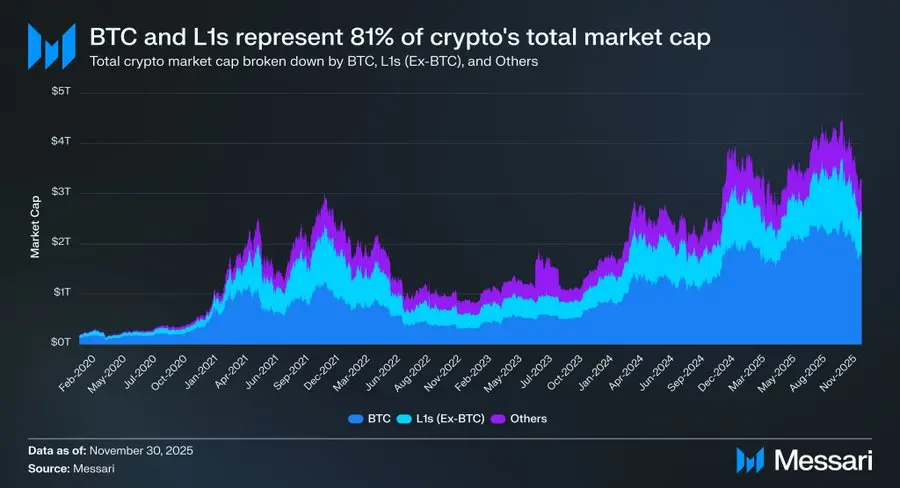
It is crucial to refocus the discussion on "cryptocurrency" itself, as most capital in the crypto industry is ultimately seeking exposure to "monetized assets." The total market capitalization of the crypto market is currently $3.26 trillion, with BTC accounting for $1.80 trillion, or 55%. Of the remaining $1.45 trillion, approximately $0.83 trillion is concentrated in various L1 public chains. This means that about $2.63 trillion, or roughly 81% of the entire market's capital, is invested in assets that the market already views as money or believes may gain a monetary premium in the future.

In this context, whether you are a trader, investor, capital manager, or developer, understanding how the market assigns or withdraws monetary premiums is essential. In the crypto industry, nothing drives valuation changes more than the market's willingness to view an asset as "money." Therefore, predicting which assets will gain monetary premiums in the future is arguably the most critical variable when building an investment portfolio.

So far, we have focused primarily on BTC, but it is also necessary to discuss those L1 assets among the remaining $0.83 trillion that "may or may not be money." As mentioned earlier, we expect BTC to continue capturing market share from gold and other non-sovereign stores of value in the coming years. But this raises a question: How much room is left for L1s? When the tide rises, will all boats (assets) rise (benefit)? Or will BTC, in its pursuit of gold, also absorb some of the monetary premium from L1 public chains?

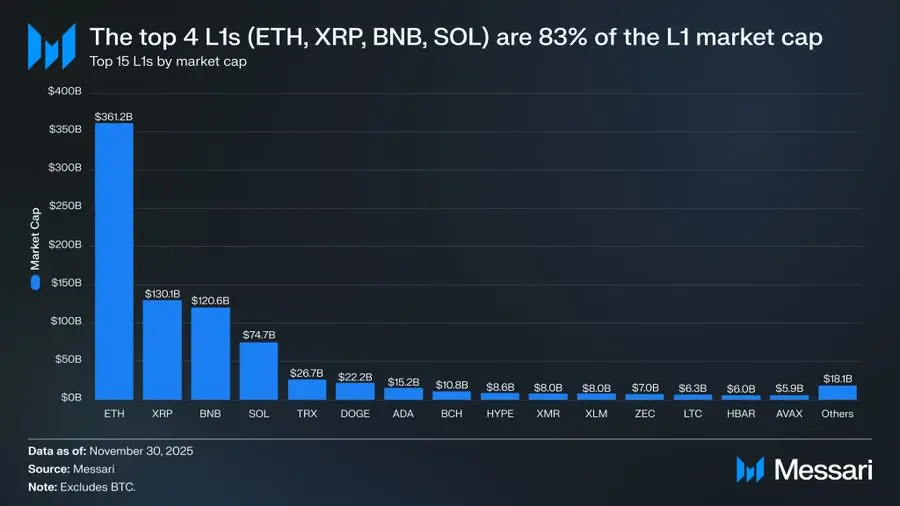
To answer these questions, we first need to look at the current valuation landscape of L1s. The top four L1s by market cap—ETH ($361.15 billion), XRP ($130.11 billion), BNB ($120.64 billion), and SOL ($74.68 billion)—have a combined market cap of $686.58 billion, accounting for 83% of the entire L1 sector. After these top four, there is a significant gap in market cap (e.g., TRX at $26.67 billion), but the tail end still holds considerable value. The total market cap of L1s outside the top 15 is still $18.06 billion, representing 2% of the total L1 market cap.

More importantly, L1 market cap is not equivalent to pure "monetary premium." There are three main valuation frameworks for L1s:

(i) Monetary Premium

(ii) Real Economic Value (REV)

(iii) Economic Security Demand

Therefore, a project's market cap is not solely determined by the market viewing it as money.

What Drives L1 Valuations Is Monetary Premium, Not Revenue

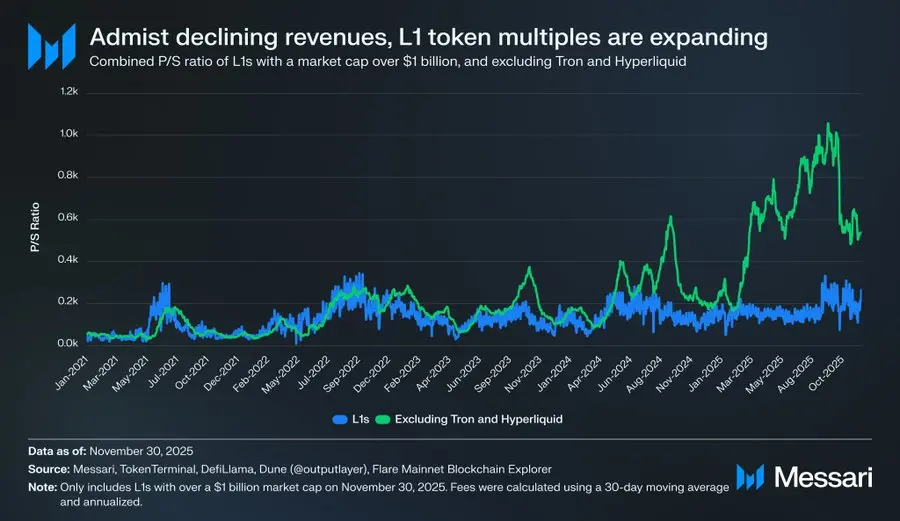
Despite the existence of multiple valuation frameworks, the market is increasingly inclined to evaluate L1s from the perspective of "monetary premium" rather than a "revenue-driven" angle. Over the past few years, the overall price-to-earnings (P/E) ratio for all L1s with a market cap exceeding $1 billion has generally remained between 150x and 200x. However, this aggregate data is misleading because it includes TRON and Hyperliquid. Over the past 30 days, TRX and HYPE contributed 70% of the revenue in this group but accounted for only 4% of the total market cap.

After removing these two outliers, the real story emerges. Despite continuously declining revenue, L1 valuations are rising. The adjusted P/E ratio shows a clear upward trend:

· November 30, 2021: 40x

· November 30, 2022: 212x

· November 30, 2023: 137x

· November 30, 2024: 205x

· November 30, 2025: 536x

If interpreted from an REV perspective, one might argue that the market is pricing in future revenue growth. However, this explanation does not hold, as revenue for the same group (still excluding TRON and Hyperliquid) has declined almost every year:

· 2021: $12.33 billion

· 2022: $4.89 billion (YoY -60%)

· 2023: $2.72 billion (YoY -44%)

· 2024: $3.55 billion (YoY +31%)

· 2025: Annualized $1.70 billion (YoY -52%)

In our view, the simplest and most straightforward explanation is: These valuations are primarily driven by monetary premium, not current or future revenue.

L1s Have Consistently Underperformed Bitcoin

If L1 valuations are primarily driven by the market's expectation of their monetary premium, the next question is: What shapes this expectation? A simple method is to compare their price performance with BTC's. If changes in monetary premium mainly reflect BTC's movements, these assets should perform similarly to BTC's "beta coefficient"; if the monetary premium comes from each L1's unique factors, their correlation with BTC should be weaker, and their performance should be more idiosyncratic.

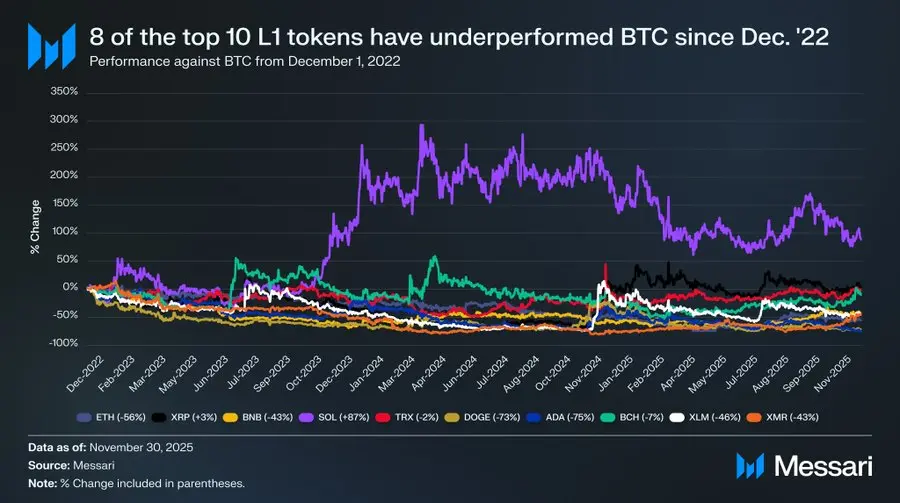
As representatives of L1s, we selected the top ten L1 tokens by market cap (excluding HYPE) and measured their performance relative to BTC since December 1, 2022. These ten assets represent about 94% of the L1 market cap, making them highly representative. During this period, eight assets underperformed BTC in absolute returns, with six lagging by more than 40%. Only two assets outperformed BTC: XRP and SOL. However, XRP's excess return was only 3%, and given its history of being driven by retail capital, we will not overinterpret this. The only asset with significant excess returns was SOL, which beat BTC by 87%.

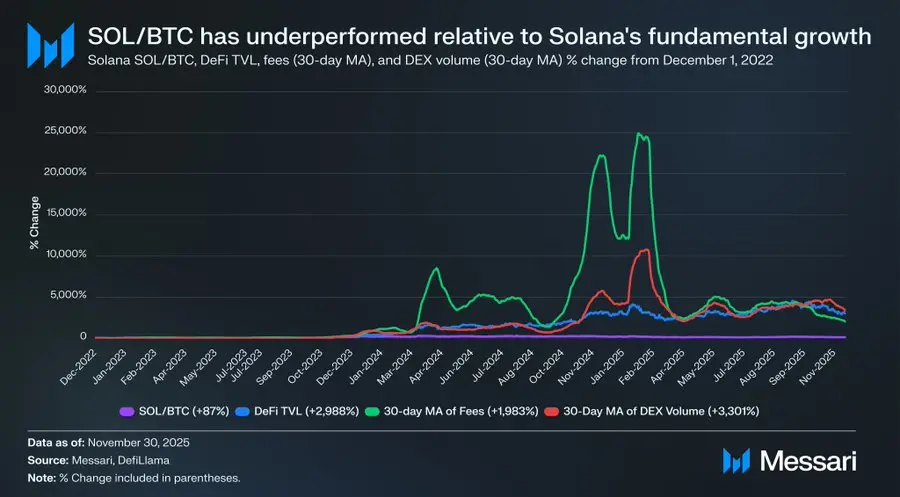
But upon closer examination, SOL's "outperformance" may not be as strong as it appears. During the same period that SOL outperformed BTC by 87%, Solana's fundamentals experienced exponential growth: DeFi TVL increased by 2,988%, fees grew by 1,983%, and DEX trading volume surged by 3,301%. By any reasonable measure, the Solana ecosystem expanded by 20 to 30 times since the end of 2022, yet SOL's price only outperformed BTC by 87%.

Please read that sentence again.

To achieve truly significant excess returns against BTC, an L1 doesn't need ecosystem growth of 200% or 300%—it needs growth of 2,000%-3,000% just to barely gain a few dozen percentage points of outperformance.

Combining the above, our judgment is: Although the market still prices L1s based on the expectation that they "may gain monetary premium in the future," confidence in these expectations is quietly waning. Meanwhile, the market's monetary premium for BTC as "cryptomoney" remains unshaken, and one could even argue that BTC's lead over various L1s is continuously widening.

Although cryptocurrency itself does not require fees or revenue to support its valuation, these metrics are crucial for L1s. Unlike BTC, the narrative for L1s depends on building an ecosystem (applications, users, throughput, economic activity, etc.) to support their token value. However, if an L1's ecosystem is showing annual declines (partly reflected in decreasing revenue and fees), it loses its only competitive advantage relative to BTC. Without real economic growth, its "cryptomoney" story becomes increasingly difficult for the market to accept.

Looking Ahead

Looking ahead, we do not believe this trend will reverse in 2026 or beyond. With few possible exceptions, we expect the L1 sector to continue losing market share, further squeezed by BTC. Since their valuations primarily rely on expectations of future monetary premium, as the market gradually concludes that BTC has the strongest claim to the "cryptomoney" narrative, L1 valuations will continue to contract. Although BTC will also face challenges in the coming years, these issues remain too distant and variable to provide effective support for the monetary premium of competing L1s.

For L1s, the bar for proving their value has been raised. Their narratives are no longer sufficiently attractive compared to BTC's, nor can they rely on market euphoria to support their valuations long-term. The era when the story of "we might become money in the future" could support trillion-dollar market caps is closing. Investors now have a decade of data proving that an L1's monetary premium can only be sustained when the ecosystem experiences extreme growth. Once growth stalls, L1s will consistently underperform BTC, and the monetary premium will dissipate.

Связанные с этим вопросы

QWhat percentage of the total crypto market capitalization is currently held by assets that the market views as or expects to become monetized assets?

AApproximately 81% of the total market capitalization, or about $2.63 trillion, is held in assets the market views as money or expects to gain a monetary premium.

QAccording to the article, what are the three main valuation frameworks for Layer-1 (L1) blockchains?

AThe three main valuation frameworks for L1s are: (i) Monetary Premium, (ii) Real Economic Value (REV), and (iii) Economic Security Demand.

QWhat trend does the article identify regarding the price-to-earnings (P/E) ratios of major L1s when excluding outliers like TRON and Hyperliquid?

AThe article identifies a clear upward trend in the adjusted P/E ratios of major L1s, rising from 40x in November 2021 to 536x in November 2025, even as their revenues have been declining.

QWhich was the only major L1 asset that significantly outperformed Bitcoin (BTC) in terms of price performance from December 2022, and by what percentage?

ASolana (SOL) was the only major L1 that significantly outperformed Bitcoin, beating it by 87%.

QWhat is the article's primary conclusion about the future trend of L1 valuations relative to Bitcoin?

AThe article concludes that the trend of L1s losing market share to Bitcoin will not reverse; it expects the L1 sector to continue being squeezed by BTC as the market increasingly sees Bitcoin as having the strongest claim to the 'cryptomoney' narrative, causing L1 valuations to contract.

Похожее

Yao Shunyu's 88 Days

Yao Shunyu, a 27-year-old AI expert with a background from Princeton and OpenAI, joined Tencent in September 2025. Within 88 days, he led a major overhaul of Tencent’s AI strategy and organization, resulting in the release of Hunyuan Hy3 preview—a MoE model with 295B total parameters and 21B active parameters, supporting up to 256K context length. The launch came after Tencent leadership, including CEO Ma Huateng and President Martin Lau, openly criticized Hunyuan's earlier underperformance—citing slow development, over-reliance on superficial benchmark optimization, and poor generalization in real-world applications. Internal adoption was low, with key business units like WeChat and gaming seeking external AI solutions. Yao reshaped Tencent’s AI approach by integrating previously siloed teams, dissolving the ten-year-old Tencent AI Lab, and establishing new units focused on AI infrastructure and data. Hy3 preview was developed using co-design principles, closely aligned with product teams to ensure practical usability from the start. It has already been integrated into core products like Yuanbao, QQ, and enterprise tools. The release signals a shift from chasing rankings to building usable, scalable AI grounded in Tencent’s ecosystem. While external partnerships (like with DeepSeek and OpenClaw) helped retain users temporarily, the focus is now on making Hunyuan a reliable internal foundation. The real test lies in sustaining this new organizational momentum amid fierce competition from Alibaba, DeepSeek, and others.

marsbit1 ч. назад

Yao Shunyu's 88 Days

marsbit1 ч. назад

Торговля

Спот
Фьючерсы

Популярные статьи

Тест по Bitcoin Биткоина

HTX Learn: Изучите Bitcoin halving и Заработаете Токены USDT

3.0k просмотров всегоОпубликовано 2024.04.16Обновлено 2024.04.16

Тест по Bitcoin  Биткоина

Что такое $BITCOIN

ЦИФРОВОЕ ЗОЛОТО ($BITCOIN): Комплексный анализ Введение в ЦИФРОВОЕ ЗОЛОТО ($BITCOIN) ЦИФРОВОЕ ЗОЛОТО ($BITCOIN) — это проект на основе блокчейна, работающий в сети Solana, который стремится объединить характеристики традиционных драгоценных металлов с инновациями децентрализованных технологий. Хотя он носит имя Биткойн, часто называемого “цифровым золотом” из-за его восприятия как средства хранения ценности, ЦИФРОВОЕ ЗОЛОТО является отдельным токеном, предназначенным для создания уникальной экосистемы в ландшафте Web3. Его цель — позиционировать себя как жизнеспособный альтернативный цифровой актив, хотя детали его применения и функциональности все еще развиваются. Что такое ЦИФРОВОЕ ЗОЛОТО ($BITCOIN)? ЦИФРОВОЕ ЗОЛОТО ($BITCOIN) — это токен криптовалюты, специально разработанный для использования в блокчейне Solana. В отличие от Биткойна, который выполняет широко признанную роль хранения ценности, этот токен, похоже, сосредоточен на более широких приложениях и характеристиках. Примечательные аспекты включают: Инфраструктура блокчейна: Токен построен на блокчейне Solana, известном своей способностью обрабатывать высокоскоростные и недорогие транзакции. Динамика предложения: ЦИФРОВОЕ ЗОЛОТО имеет максимальное предложение, ограниченное 100 квадриллионами токенов (100P $BITCOIN), хотя детали о его обращающемся предложении в настоящее время не раскрыты. Утилита: Хотя точные функциональные возможности не описаны, есть указания на то, что токен может быть использован для различных приложений, потенциально связанных с децентрализованными приложениями (dApps) или стратегиями токенизации активов. Кто создатель ЦИФРОВОГО ЗОЛОТА ($BITCOIN)? На данный момент личность создателей и команды разработчиков, стоящих за ЦИФРОВЫМ ЗОЛОТОМ ($BITCOIN), остается неизвестной. Эта ситуация типична для многих инновационных проектов в области блокчейна, особенно тех, которые связаны с децентрализованными финансами и феноменом мем-криптовалют. Хотя такая анонимность может способствовать культуре, ориентированной на сообщество, она усиливает опасения по поводу управления и ответственности. Кто инвесторы ЦИФРОВОГО ЗОЛОТА ($BITCOIN)? Доступная информация указывает на то, что у ЦИФРОВОГО ЗОЛОТА ($BITCOIN) нет известных институциональных спонсоров или значительных венчурных капиталовложений. Проект, похоже, функционирует по модели пирингового взаимодействия, сосредоточенной на поддержке и принятии сообществом, а не на традиционных путях финансирования. Его активность и ликвидность в основном сосредоточены на децентрализованных биржах (DEX), таких как PumpSwap, а не на устоявшихся централизованных торговых платформах, что еще больше подчеркивает его подход, ориентированный на grassroots. Как работает ЦИФРОВОЕ ЗОЛОТО ($BITCOIN) Операционные механизмы ЦИФРОВОГО ЗОЛОТА ($BITCOIN) можно подробно описать на основе его дизайна блокчейна и характеристик сети: Механизм консенсуса: Используя уникальный механизм доказательства истории (PoH) Solana в сочетании с моделью доказательства доли (PoS), проект обеспечивает эффективную валидацию транзакций, что способствует высокой производительности сети. Токеномика: Хотя конкретные дефляционные механизмы не были подробно описаны, большое максимальное предложение токенов подразумевает, что оно может быть предназначено для микротранзакций или нишевых случаев использования, которые еще предстоит определить. Интероперабельность: Существует потенциал для интеграции с более широкой экосистемой Solana, включая различные платформы децентрализованных финансов (DeFi). Однако детали относительно конкретных интеграций остаются неуточненными. Хронология ключевых событий Вот хронология, которая подчеркивает значимые вехи, касающиеся ЦИФРОВОГО ЗОЛОТА ($BITCOIN): 2023: Первоначальное развертывание токена происходит в блокчейне Solana, отмеченное его адресом контракта. 2024: ЦИФРОВОЕ ЗОЛОТО приобретает видимость, когда оно становится доступным для торговли на децентрализованных биржах, таких как PumpSwap, позволяя пользователям обменивать его на SOL. 2025: Проект наблюдает спорадическую торговую активность и потенциальный интерес к инициативам, возглавляемым сообществом, хотя на данный момент не зафиксировано никаких значительных партнерств или технических достижений. Критический анализ Сильные стороны Масштабируемость: Основная инфраструктура Solana поддерживает высокие объемы транзакций, что может повысить полезность $BITCOIN в различных сценариях транзакций. Доступность: Потенциально низкая цена торговли за токен может привлечь розничных инвесторов, способствуя более широкому участию благодаря возможностям дробного владения. Риски Отсутствие прозрачности: Отсутствие публично известных спонсоров, разработчиков или процесса аудита может вызвать скептицизм относительно устойчивости и надежности проекта. Волатильность рынка: Торговая активность сильно зависит от спекулятивного поведения, что может привести к значительной волатильности цен и неопределенности для инвесторов. Заключение ЦИФРОВОЕ ЗОЛОТО ($BITCOIN) является интригующим, но неоднозначным проектом в быстро развивающейся экосистеме Solana. Хотя он пытается использовать нарратив “цифрового золота”, его отход от установленной роли Биткойна как средства хранения ценности подчеркивает необходимость более четкого различения его предполагаемой утилиты и структуры управления. Будущее принятие и усвоение, вероятно, будут зависеть от решения текущей непрозрачности и более четкого определения его операционных и экономических стратегий. Примечание: Этот отчет охватывает синтезированную информацию, доступную на октябрь 2023 года, и с тех пор могут произойти события.

99 просмотров всегоОпубликовано 2025.05.13Обновлено 2025.05.13

Что такое $BITCOIN

Fractal Bitcoin: масштабирование Биткоина с помощью рекурсивной системы

Fractal Bitcoin — масштабное Layer-1-решнение, созданное на базе кода Биткоина, позволяющего достигать бесконечного масштабирования с помощью рекурсивного подхода.

2.2k просмотров всегоОпубликовано 2025.06.30Обновлено 2025.06.30

Fractal Bitcoin: масштабирование Биткоина с помощью рекурсивной системы

Обсуждения

Добро пожаловать в Сообщество HTX. Здесь вы сможете быть в курсе последних новостей о развитии платформы и получить доступ к профессиональной аналитической информации о рынке. Мнения пользователей о цене на BTC (BTC) представлены ниже.

活动图片