Ethereum Roadmap Could Advance Faster With AI, Vitalik Buterin Says

bitcoinistОпубликовано 2026-03-02Обновлено 2026-03-02

Введение

Vitalik Buterin suggests that AI could significantly accelerate Ethereum's development roadmap, citing an experiment where an AI-built client (ETH2030) was created in six days for $5,750. The prototype, covering 65 roadmap items, demonstrates potential but has limitations and bugs. Buterin emphasizes that AI should enhance both speed and security through formal verification and extensive testing. While not production-ready, the experiment highlights Ethereum's ambitious goals, including 10,000+ TPS and faster finality, and underscores that AI could help complete the roadmap faster and more securely than expected.

Ethereum’s long-range protocol roadmap may move faster than many expect as AI tools improve, according to Vitalik Buterin, who pointed to a recent experiment that used agentic coding to assemble an ambitious reference client spanning much of Ethereum’s planned 2030-era architecture.

The comment came after developer Jiayao Qi, posting as YQ via X, unveiled ETH2030, an experimental Ethereum client built to target the network’s draft “2030+” roadmap. The project weighs in at 702,000 lines of Go, covers 65 roadmap items across eight phases, passes 36,126 official Ethereum state tests, and can sync with mainnet through an integration with go-ethereum v1.17.0. Qi said the client was built in roughly six days using Claude Code at a cost of about $5,750 and 2.77 billion tokens.

AI Could Speed Up Ethereum Roadmap

Buterin called the effort “quite an impressive experiment,” while also stressing that a prototype built at that speed comes with obvious limits. “Such a thing built in two weeks without even having the EIPs has massive caveats,” he wrote. “Almost certainly lots of critical bugs, and probably in some cases ‘stub’ versions of a thing where the AI did not even try making the full version. But six months ago, even this was far outside the realm of possibility, and what matters is where the trend is going.”

That distinction mattered more to Buterin than the raw demo itself. In his view, AI is not just compressing development time. It could change how Ethereum engineers approach assurance. “Probably, the right way to use it, is to take half the gains from AI in speed, and half the gains in security,” he said. “Generate more test-cases, formally verify everything, make more multi-implementations of things.”

He tied that directly to ongoing formal verification work around Ethereum. Referring to the Lean Ethereum effort, Buterin said one collaborator had already used AI to produce a machine-verifiable proof of a complex theorem underpinning STARK security. “A core tenet of @leanethereum is to formally verify everything, and AI is greatly accelerating our ability to do that,” he wrote. “Aside from formal verification, simply being able to generate a much larger body of test cases is also important.”

ETH2030 itself was presented less as a candidate client than as a stress test for the roadmap. Qi repeatedly framed it as a rough draft, not production software, and argued that its value lies in forcing hard engineering questions into the open now rather than years from now.

The roadmap, as implemented in the project, aims at a version of Ethereum with 10,000-plus TPS on L1, finality in seconds instead of 15 minutes, solo staking for 1 ETH, stateless nodes running on a $7 Raspberry Pi, and more than 1 million TPS across L1 and L2. But the experiment also surfaced deep coupling between upgrades, from block access lists and gas repricing to PeerDAS, native rollups and fast finality.

Qi was blunt about the gaps. Pure-Go cryptographic implementations lag production code by roughly 10x to 100x, the consensus logic has not been battle-tested on a live beacon chain, and the jump from roughly 5 million gas per second today to a 1 billion gas-per-second target remains highly speculative under real-world MEV and contract dependency patterns.

Buterin did not claim AI would make those problems disappear. In fact, he cautioned against expecting a secure protocol from a single prompt. “There WILL be lots of wrestling with bugs and inconsistencies between implementations,” he wrote. “But even that wrestling can happen 5x faster and 10x more thoroughly.”

That, more than the headline numbers, is the point now in front of Ethereum researchers and client teams. If AI can speed both implementation and verification, the roadmap may not just be a distant architectural sketch. As Buterin put it, people should at least be open to the “possibility” that Ethereum’s roadmap could be completed “much faster than people expect, at a much higher standard of security than people expect.”

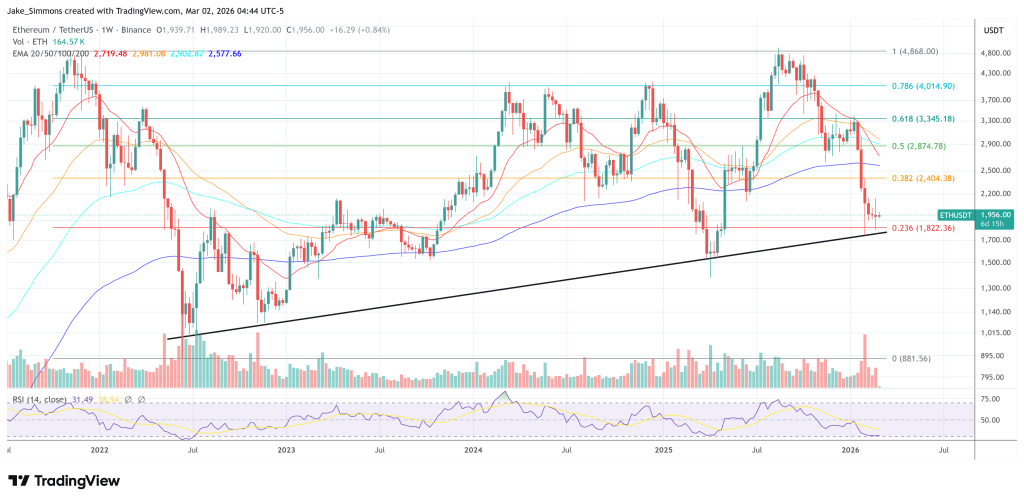
At press time, ETH traded at $1,956.

ETH remains above the black trendline, 1-week chart | Source: ETHUSDT on TradingView.com

Связанные с этим вопросы

QWhat is the ETH2030 project and how was it created?

AETH2030 is an experimental Ethereum client built to target the network's draft '2030+' roadmap. It was created by Jiayao Qi (YQ) using Claude Code in roughly six days at a cost of about $5,750 and 2.77 billion tokens. The project consists of 702,000 lines of Go code, covers 65 roadmap items across eight phases, passes 36,126 official Ethereum state tests, and can sync with mainnet.

QAccording to Vitalik Buterin, how should AI be used to advance Ethereum's development?

AButerin suggests that the right way to use AI is to take half the gains in development speed and half the gains in security. This includes generating more test cases, formally verifying everything, and creating more multi-implementations of components to enhance both development efficiency and protocol assurance.

QWhat are some of the key goals outlined in Ethereum's 2030-era roadmap as implemented in the ETH2030 project?

AThe roadmap aims for a version of Ethereum with 10,000-plus TPS on L1, finality in seconds instead of 15 minutes, solo staking for 1 ETH, stateless nodes running on a $7 Raspberry Pi, and more than 1 million TPS across L1 and L2.

QWhat limitations and caveats did both Qi and Buterin highlight about the ETH2030 experiment?

AThey highlighted that the prototype has massive caveats, including almost certainly lots of critical bugs, 'stub' versions where the AI didn't make full implementations, untested consensus logic on a live beacon chain, and cryptographic implementations that lag production code by 10x to 100x. Buterin also cautioned that a secure protocol cannot be built from a single prompt.

QHow does Buterin view the potential impact of AI on Ethereum's development timeline and security standards?

AButerin believes AI could allow Ethereum's roadmap to be completed 'much faster than people expect, at a much higher standard of security than people expect.' He emphasizes that while wrestling with bugs and inconsistencies will still occur, AI can make this process 5x faster and 10x more thorough.

Похожее

Why Is Nvidia Borrowing $20 Billion When It's Not Short of Cash?

Nvidia's recent announcement to issue at least $20 billion in senior notes, despite holding a strong cash position with over $48.6 billion in free cash flow last quarter, is not a sign of financial need. Instead, it represents a strategic move to leverage its high credit rating (recently upgraded to AA by S&P) to secure low-cost, long-term debt. This capital will support long-term AI infrastructure investments, data centers, R&D, supply chain prepayments, and strategic investments, while allowing the company to continue aggressive shareholder returns through stock buybacks and dividends. The decision reflects a mature capital management strategy: using debt to finance long-term growth assets is more efficient and less dilutive to shareholders than equity financing. It signals that Nvidia, like other tech giants (Alphabet, Meta, Amazon), is entering a new phase of heavy AI capital expenditure, shifting from a pure growth story to a story about capital allocation, credit strength, and long-term ecosystem positioning. The key question for investors is whether Nvidia can maintain its high cash flow generation and ensure that returns from these AI investments justify the cost of capital over the long term. The bond issuance amplifies its expansion capabilities but also ties its valuation more closely to the broader AI investment cycle's sustainability and profitability.

marsbit13 мин. назад

Why Is Nvidia Borrowing $20 Billion When It's Not Short of Cash?

marsbit13 мин. назад

How to Do Research Well: Deliberately Practice the Real Skills That Matter

No one truly teaches you how to do research. You're often given a desk, a pre-selected problem, and vague instructions to "create something new." Consequently, many people reverse-engineer the job based on visible outputs—papers, posts, announcements—learning only how to *appear* like a researcher rather than how to *become* one. True research capability is built from stacking small, trainable skills, nearly all of which can be developed through deliberate practice. **Pick Your Own Problem:** Most researchers absorb problems from advisors or trends, lacking the underlying reasoning. Choosing a problem you genuinely care about, as John Schulman advises, leads to original work. Develop "taste" like a muscle: predict experiment outcomes, guess paper results from methods, and track which findings remain important over time. **Upgrade Your Inputs:** Relying on shared reading lists (arXiv hot lists, filtered group chats) leads to unoriginal conclusions. Undervalued old literature often holds crucial insights (e.g., MoE, LSTM, backpropagation). Richard Sutton's "The Bitter Lesson" or Claude Shannon's 1952 talk on creative thinking are more predictive than lengthy modern surveys. Breadth matters as much as depth: draw from neuroscience, mechanism design, hardware knowledge, and honest statistics. Read papers directly, especially appendices and limitations sections. **Write Everything Down:** As Paul Graham noted, writing exposes flaws in seemingly mature ideas. Writing is the cheapest defense against self-deception. Following Feynman's principle, Darwin programmatically wrote down facts contradicting his theory to combat memory bias. Maintain a detailed log of hypotheses, setups, predictions, results, and updated understandings. Reviewing past logs fosters essential humility.

marsbit1 ч. назад

How to Do Research Well: Deliberately Practice the Real Skills That Matter

marsbit1 ч. назад

Following US Ban on Fable 5, Zhipu AI's Stock Soars 47%

On June 15th, shares of Zhipu AI surged dramatically on the Hong Kong stock market, peaking at a 47.6% gain before closing 32.82% higher. This sharp increase was directly triggered by two recent industry events. On June 12th, Anthropic announced it was suspending global access to its latest flagship models, Claude Fable 5 and Claude Mythos 5, to comply with a U.S. government export control order. The next day, Zhipu AI announced it would open access to its latest open-source flagship model, GLM-5.2, under the permissive MIT license. The Anthropic incident highlighted a critical issue beyond raw model capability: the risk of sudden, unpredictable loss of access to advanced AI models, especially for developers and enterprises deeply integrated with them. This has shifted industry and market focus toward factors like stability, sustainable access, and controllability. Zhipu's move, promoting "frontier intelligence for all," positions its openly available model as a reliable and accessible alternative. The GLM-5.2 model emphasizes "Long Horizon Task" capabilities with a 1M context window, targeting complex, multi-step coding and engineering workflows where maintaining context is crucial. Analysts note this event exposes the risk of dependency on closed-source models subject to single jurisdictional controls, potentially accelerating a shift toward domestic base models and localized deployments. The market's reaction signals a new valuation dimension in AI: providers who can offer stable, long-term, and sustainably accessible AI capabilities are gaining strategic importance.

marsbit2 ч. назад

Following US Ban on Fable 5, Zhipu AI's Stock Soars 47%

marsbit2 ч. назад

Торговля

Спот
Фьючерсы

Популярные статьи

Manyu: восходящая мем-звезда на Ethereum, готовая открыть новую эру культуры Shiba

Manyu - это мемтокен на Ethereum, который приносит децентрализованную культурную и развлекательную ценность через вирусное влияние в соцсетях и вовлечённость сообщества.

2.0k просмотров всегоОпубликовано 2025.11.27Обновлено 2025.11.27

Manyu: восходящая мем-звезда на Ethereum, готовая открыть новую эру культуры Shiba

Неделя обучения по популярным токенам 14: Glamsterdam — самое ожидаемое обновление Ethereum в 2026 году

Ordinals/Runes по-прежнему стимулируют доходы от комиссий за блоки и активность разработчиков, рассматриваются как отправная точка «нативной эмиссии активов» в сети.

1.5k просмотров всегоОпубликовано 2026.04.29Обновлено 2026.04.29

Неделя обучения по популярным токенам 14: Glamsterdam — самое ожидаемое обновление Ethereum в 2026 году

Обсуждения

Добро пожаловать в Сообщество HTX. Здесь вы сможете быть в курсе последних новостей о развитии платформы и получить доступ к профессиональной аналитической информации о рынке. Мнения пользователей о цене на ETH (ETH) представлены ниже.

活动图片