Breaking Through $500 Again: Why Is ZEC Outperforming While Bitcoin Trades Sideways?

marsbitОпубликовано 2025-12-29Обновлено 2025-12-29

Введение

Zcash (ZEC), a leading privacy-focused cryptocurrency, has surged past $500, marking a significant rally of nearly 40% from recent lows and a 13x increase since mid-2025. This growth occurred while Bitcoin remained range-bound between $80k–$90k, highlighting ZEC’s independent momentum. The rise reflects a broader market reassessment of privacy as a core monetary attribute in response to increasing financial surveillance, institutionalization of Bitcoin, and the global rollout of Central Bank Digital Currencies (CBDCs). ZEC’s value proposition lies in its robust privacy features, enabled by zero-knowledge cryptography, which offers transactional anonymity similar to physical cash—a feature Bitcoin inherently lacks due to its transparent ledger. This positions ZEC as a hedge against surveillance states and the risks of Bitcoin’s centralization, as nearly 24% of BTC supply is held by regulated custodians vulnerable to potential seizure. Key infrastructure upgrades, such as Sapling and Orchard, have drastically improved ZEC’s usability by reducing memory use and proof generation time, while the Zashi mobile wallet and NEAR Intents integration have simplified private transactions and enhanced accessibility. ZEC’s declining correlation with BTC and rising beta indicate that the market is pricing in a distinct privacy premium. Rather than competing with Bitcoin, ZEC complements it by addressing privacy needs that Bitcoin intentionally omits, solidifying its role as a specialized ...

Editor's Note: While Bitcoin repeatedly "paints the door," trading sideways in the $80,000 to $90,000 range, market attention likely remains largely focused on Bitcoin itself. However, ZEC, a representative asset in the privacy sector, has once again charted its own independent trajectory, breaking through the $500 mark again to currently trade at $518, representing a nearly 40% increase from its recent low. More ironically, ZEC was once included in Binance's voting candidate list for delisting, yet it has welcomed its own breakout moment in the latter half of 2025, with a阶段性涨幅 (stage gain) once approaching 13x.

This shift from a "peripheral asset" to being "repriced by the market" also raises a more compelling question: Is ZEC's rise merely a short-term concentrated宣泄 (vent) of sentiment and capital manipulation, or is privacy as a monetary attribute being systematically revalued? Messari attempts to explain why ZEC is being rediscovered by the market at this specific juncture, examining multiple dimensions such as monetary attributes, regulatory environment, and structural changes in Bitcoin. The following content is excerpted from @MessariCrypto's "The Crypto Theses 2026".

Among all crypto assets outside of BTC and ETH, ZEC experienced the most significant shift in "monetary attribute perception" in 2025. For a long time, ZEC existed outside the "monetary hierarchy of cryptocurrencies," seen as a niche privacy coin rather than a true monetary asset. However, as concerns about financial surveillance intensify, and Bitcoin accelerates towards institutionalization, privacy is once again being viewed by the market as a core monetary attribute, not merely a preference for a few geeks or ideological groups.

Bitcoin has proven that non-sovereign digital currencies can operate on a global scale; but it does not preserve the privacy attributes people were accustomed to with physical cash. Every transaction is broadcast to a completely transparent public ledger, traceable and analyzable by anyone using a block explorer. The irony is stark: a tool originally intended to weaken state control has inadvertently built a financial "panopticon".

Zcash combines Bitcoin's monetary policy with the privacy attributes of physical cash through zero-knowledge cryptography. In the current digital asset system, no other asset can provide the long-term, battle-tested, and deterministic privacy guarantees offered by the latest Zcash privacy pools. This makes ZEC a form of "private money" that is extremely difficult to replicate.

We believe the market is repricing ZEC relative to BTC based on this very point—viewing it as an "ideal form of private cryptocurrency" and positioning it as a hedge against the rise of the surveillance state and the institutionalization process of Bitcoin.

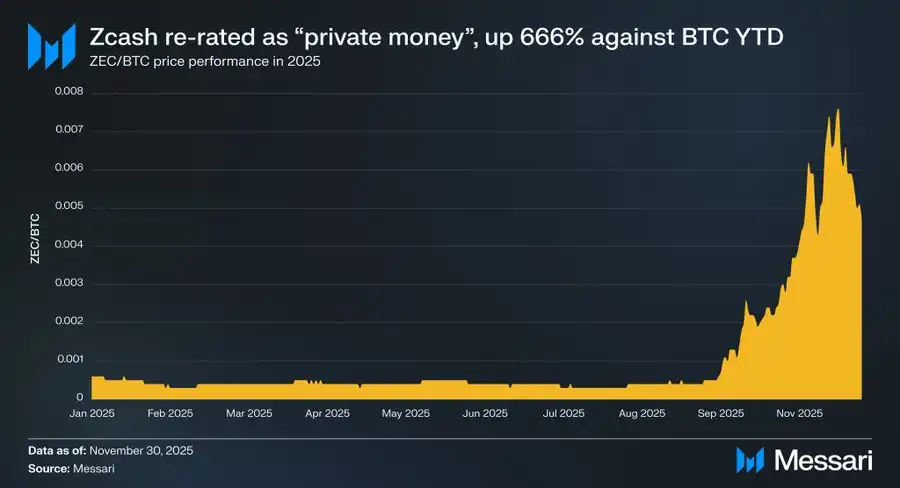
Year-to-date, ZEC has gained 666% against BTC, its market capitalization has risen to approximately $7 billion, and it briefly surpassed XMR in market cap to become the largest privacy coin. This relative strength indicates the market is viewing both ZEC and XMR as viable forms of private cryptocurrency.

Privacy on Bitcoin: A Nearly Impossible Path

It is almost impossible for Bitcoin to introduce a privacy pool architecture similar to Zcash at the protocol layer; therefore, the notion that "Bitcoin will ultimately absorb Zcash's value proposition" is unfounded.

The Bitcoin community is known for its highly conservative technical culture, prioritizing mechanism ossification to minimize attack surfaces and maintain the monetary system's integrity. Embedding privacy features at the protocol layer would require modifications to Bitcoin's core architecture, introducing potential inflation vulnerability risks that threaten its core monetary credibility. For Zcash, this risk is acceptable because privacy is its core value proposition.

Furthermore, introducing zero-knowledge cryptography at the base layer would significantly reduce blockchain scalability. To prevent double-spending, nullifiers and hashed note structures are required, leading to long-term concerns about "state bloat." Nullifiers are essentially an ever-growing list, increasing over time and potentially causing a substantial rise in the resource cost required to run nodes. If nodes are forced to store an ever-expanding set of nullifiers, Bitcoin's decentralization would be substantially weakened as the barrier to running a node increases over time.

As mentioned earlier, in the absence of a soft fork capable of supporting ZK verification (e.g., OP_CAT), no Bitcoin Layer 2 solution can achieve Zcash-level privacy while inheriting Bitcoin's security. You either introduce trusted intermediaries (like federation structures), accept long and highly interactive withdrawal delays (like the BitVM model), or outright outsource execution and security to an independent system (like sovereign Rollups).

Until this landscape changes, there is no practical path that simultaneously offers both Bitcoin's security and Zcash's privacy. This is precisely the fundamental reason why ZEC possesses unique value as a private cryptocurrency.

A Privacy Hedge Against CBDCs

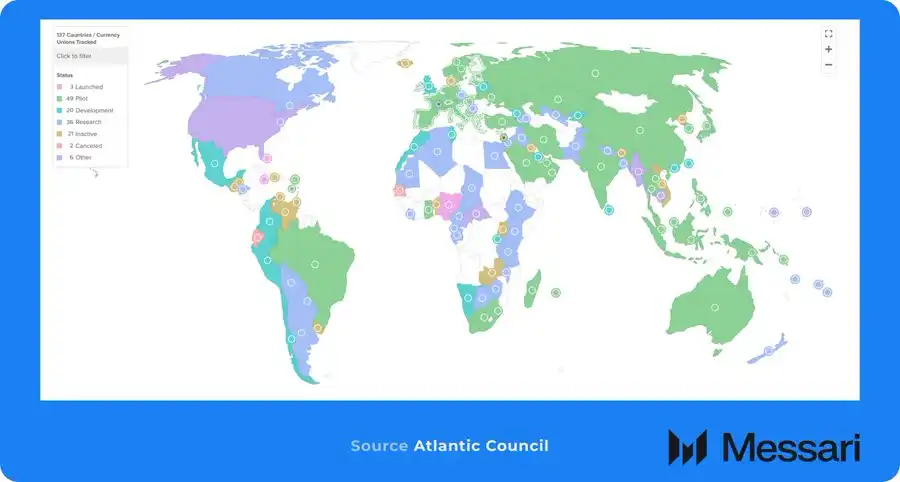
The urgency for privacy is further amplified against the backdrop of the陆续登场 (sequential rollout) of Central Bank Digital Currencies (CBDCs) worldwide. Currently, about half of the world's countries are researching or have already launched a CBDC.

The core feature of CBDCs is "programmability": the issuer can not only track every transaction but also directly control how, when, and where the funds can be used. Funds can even be programmed to be valid only at specified merchants or within specific geographical boundaries.

This is not a dystopian fantasy but a present reality:

· Nigeria (2020): During the EndSARS protests against police brutality, the Nigerian Central Bank froze the bank accounts of several protest organizers and feminist groups, forcing the movement to rely on cryptocurrencies to sustain operations.

· United States (2020–2025): Regulators and large banks implemented de-banking against a series of legal but politically unpopular industries citing "reputational risk." The issue became severe enough for the White House to order an investigation, and an OCC research report in 2025 documented systematic restrictions on the oil & gas, firearms, adult content, and crypto industries.

· Canada (2022): During the "Freedom Convoy" protests, the Canadian government invoked the Emergencies Act to freeze the bank and crypto accounts of protesters and small donors without court orders. The Royal Canadian Mounted Police even blacklisted 34 self-custodied crypto wallet addresses, requiring all regulated exchanges to cease transactions with them. This event clearly demonstrated that Western democracies are also willing to weaponize the financial system to suppress political dissent.

In an era where "money can be programmed to control you," ZEC offers a clear "exit mechanism." But Zcash's significance extends beyond escaping CBDCs; it is becoming increasingly important for protecting Bitcoin itself.

An Insurance Mechanism Against Bitcoin's "Co-option"

As emphasized by figures like Naval Ravikant and Balaji Srinivasan, Zcash is essentially an insurance policy for preserving Bitcoin's vision of financial freedom.

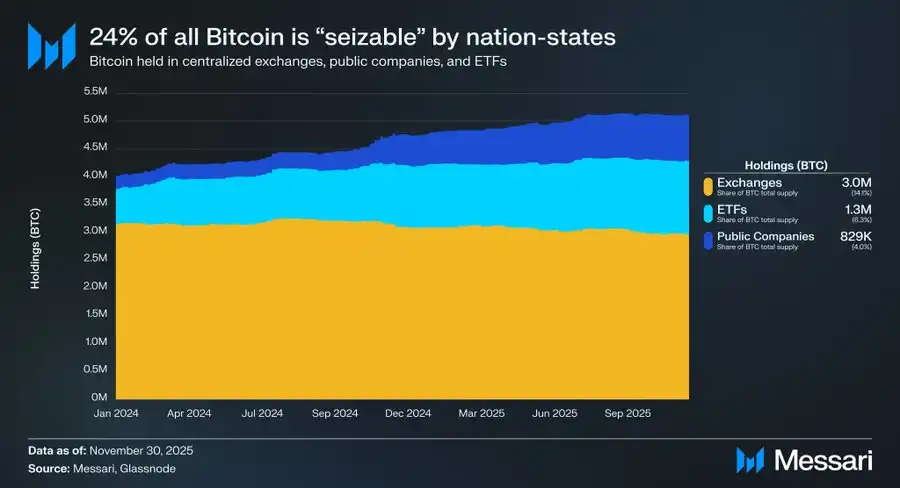
Bitcoin is rapidly concentrating towards centralized entities: centralized exchanges hold ~3 million BTC, ETFs hold ~1.3 million, and public companies hold ~829,000. Combined, approximately 5.1 million BTC (24% of total supply) is currently held by third-party custodians.

This means theoretically, nearly a quarter of the BTC supply is at risk of regulatory confiscation. This structure highly resembles the centralized conditions during the US government's gold confiscation in 1933. Back then, the US government, via Executive Order 6102,强制公民 (forced citizens) to surrender gold holdings exceeding $100, exchanging them for paper currency at a fixed price, a process accomplished through the banking system without reliance on violence.

For Bitcoin, the path is identical. Regulators don't need your private keys; they only need legal jurisdiction over the custodian. Once the government issues an enforcement order to entities like BlackRock or Coinbase, these companies, under legal obligation, can only freeze and transfer the held BTC. Without modifying a single line of code, nearly a quarter of the BTC supply could be "nationalized" overnight.

Moreover, self-custody is no longer a sufficient defense given the blockchain's high transparency. Any BTC withdrawn from a KYC exchange or brokerage account ultimately leaves a traceable "paper trail."

BTC holders can sever this custodial and regulatory link by converting to Zcash, achieving an air gap for their wealth. Once funds enter Zcash's privacy pools, their destination becomes a cryptographic "black hole" to observers. Regulators can see funds leave the Bitcoin network but cannot ascertain their final destination. Of course, the strength of this anonymity depends entirely on operational security: address reuse or acquiring assets through KYC exchanges leaves permanent associations before entering the privacy pool.

The Path to PMF Is Being Paved

The demand for private money has always existed; the problem was that Zcash was historically difficult to "get in front of users." For a long time, high memory usage, lengthy proof generation times, and complex desktop configurations made private transactions slow and daunting for average users. A series of recent infrastructure breakthroughs have systematically removed these barriers.

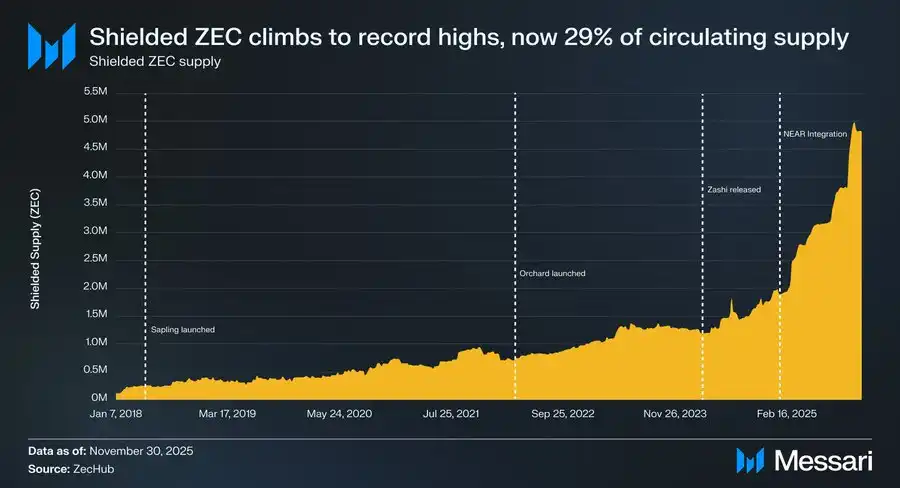
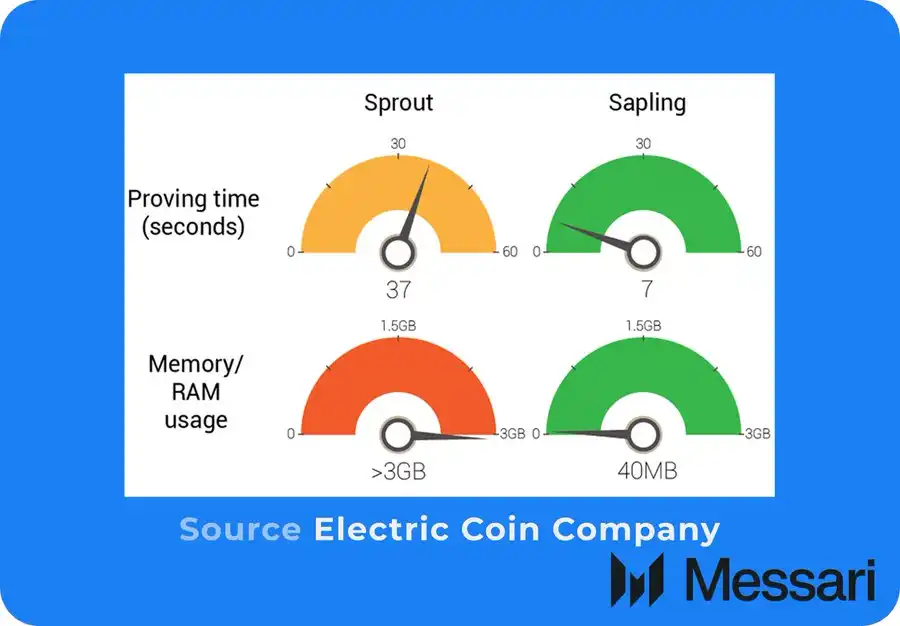
The Sapling upgrade reduced memory requirements by 97% (to ~40MB) and proof time by 81% (~7 seconds), enabling mobile private transactions.

While Sapling solved the speed issue, the trusted setup remained a concern for the privacy community. Subsequently, Orchard removed the reliance on trusted setups entirely by introducing Halo 2 and introduced Unified Addresses, integrating transparent and shielded addresses into a single entry point, significantly reducing user cognitive load.

These improvements culminated in the release of the Zashi mobile wallet in March 2024. Leveraging the abstract design of Unified Addresses, Zashi simplified the operation of private transactions to a few taps on the screen, making "privacy" the default experience.

With the UX problem solved, distribution became the final hurdle. Users still relied on centralized exchanges to deposit and withdraw ZEC to their wallets. The integration of NEAR Intents eliminated user dependence on centralized exchanges, allowing them to directly swap assets like BTC, ETH for shielded ZEC, or even use private ZEC to pay to any address on 20 different chains.

These initiatives collectively helped Zcash bypass historical friction, access global liquidity, and connect with genuine market demand.

Looking Ahead

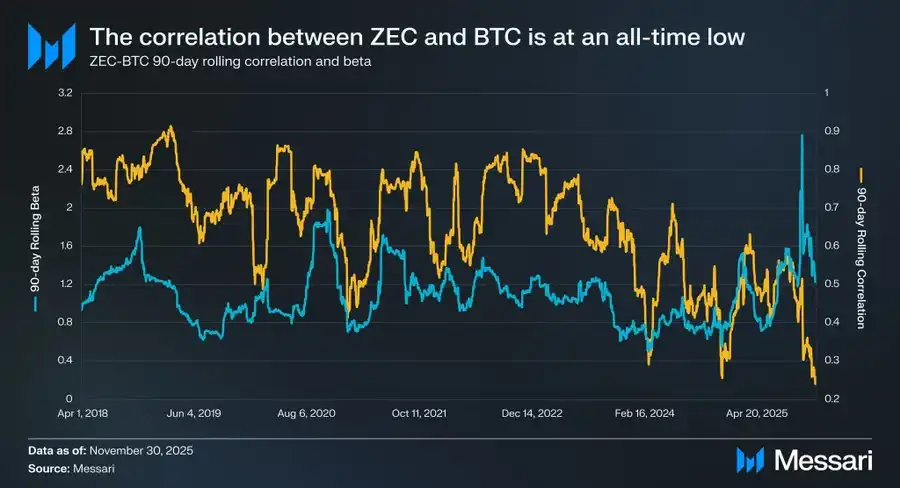
Since 2019, the rolling correlation coefficient between ZEC and BTC has持续下行 (continuously declined), dropping from 0.90 to a recent 0.24; meanwhile, ZEC's rolling Beta against BTC has risen to historical highs. This divergence indicates that the market is assigning an independent premium to Zcash's privacy attributes.

We do not believe ZEC will surpass BTC. Bitcoin, with its transparent supply and auditability, has established itself as the most reliable cryptocurrency; whereas Zcash, as a privacy coin, still inevitably bears the trade-off between privacy and auditability.

But ZEC can absolutely carve out its own niche without replacing BTC. The two are not solving the same problem but play different roles within the cryptocurrency system: BTC is a "sound cryptocurrency" optimized for transparency and security, while ZEC is a "private cryptocurrency" built for privacy and confidentiality.

In this sense, ZEC's success does not depend on defeating Bitcoin, but on complementing the attributes that Bitcoin deliberately abandoned.

Похожее

Sequoia Dialogue with Jensen Huang: Computing Model Undergoes a 60-Year Transformation; You Won't Be Replaced by AI, But You Will Be Dimensionality-Reduced by 'Those Who Master AI'

NVIDIA founder and CEO Jensen Huang, in a conversation with Sequoia Capital's Konstantine Buhler, argues that we are witnessing the most significant computing shift in 60 years—from retrieval-based to generative computing. Instead of just storing and retrieving data, future systems will generate highly personalized content (text, images, video) on demand, powered by massive "AI factories." Huang envisions a global "intelligence network" that will envelop the planet, following the historical patterns of energy and communication grids. He outlines a five-layer investment framework: 1) Energy, 2) Chips/Computers, 3) Infrastructure (data centers), 4) AI Models, and 5) Applications. He predicts this ecosystem will reach a scale of $20 trillion annually. Crucially, Huang pushes back against fears of AI-driven job loss. He distinguishes between specific "tasks" (e.g., typing, analyzing images) and overall "jobs" (e.g., CEO, radiologist). While AI automates tasks, it increases efficiency and demand for the higher-value problem-solving aspects of professions, thus creating more jobs and "up-leveling" careers. The real risk, he asserts, is not being replaced by AI, but being outperformed by someone who effectively leverages it. He urges everyone to embrace AI as a tool for augmented capability and innovation.

marsbit2 мин. назад

Sequoia Dialogue with Jensen Huang: Computing Model Undergoes a 60-Year Transformation; You Won't Be Replaced by AI, But You Will Be Dimensionality-Reduced by 'Those Who Master AI'

marsbit2 мин. назад

"I Don't Need a Better Model Anymore": A Panorama of AI Users Under a Reddit Hot Post

Titled "I Don't Need a Better Model Anymore": AI User Reactions on Reddit Anthropic recently released Claude Fable 5, its first publicly available 'Mythos'-tier model, achieving 80.3% on the SWE-Bench Pro benchmark and significantly outperforming its predecessor and competitors. However, a viral Reddit post titled "Claude Fable made me realize I don't need better models anymore" highlighted a growing user sentiment of "good enough." Top comments expressed "model fatigue," with users stating that earlier models like Opus 4.5/4.8 already sufficed for their workflows. High cost was a key concern, as Fable 5's API is nearly twice the price of Opus 4.8, with users questioning the return on investment and suggesting the field has hit a plateau. The most frequent complaint targeted Fable 5's stringent safety filters. Designed to intercept high-risk requests (e.g., cybersecurity), the system was perceived as overly conservative. Users reported frequent rejections for routine security-related tasks, leading to automatic fallbacks to the older Opus model. Paying users were particularly frustrated, feeling they paid a premium for a less usable product. Dissenting voices came from users with heavy, complex tasks. For workloads like high-energy physics simulations with thousands of code lines, Fable 5's improved long-context understanding and error detection represented a significant, worthwhile leap—described as moving from a "college player to an NBA starter." The debate underscores a divergence between benchmark performance and practical utility. For most users, current models meet their needs, making further advances relevant only for extreme use-cases. The discussion also raised concerns about a potential "Public AI Freeze," where the most powerful models (like the restricted Mythos 5) remain exclusive to enterprises and governments, while public offerings stagnate. The launch presents two report cards: one of technical excellence and another of user skepticism. Fable 5's ultimate reception may depend on Anthropic's ability to refine its safety filters and justify its cost for specialized, high-demand users.

marsbit10 мин. назад

"I Don't Need a Better Model Anymore": A Panorama of AI Users Under a Reddit Hot Post

marsbit10 мин. назад

When AI Traffic Surpasses Humans, How Do You Prove You're Human?

With AI-generated web traffic surpassing human activity, websites face a crisis as AI agents bypass ads, avoid clicks, and scrape data without generating revenue. This disrupts the ad-based internet economy, diverting traffic and reducing site visits. In response, sites are blocking AI crawlers and deploying traps like Cloudflare's "honeypot" pages. Traditional CAPTCHAs are now ineffective against advanced AI. The focus has shifted to behavioral biometrics—analyzing unique human patterns such as cursor movement, typing rhythm, and keystroke dynamics. Companies like IBM and BioCatch use this data to distinguish humans from bots, even detecting fraud through behavioral inconsistencies. Two competing approaches aim to verify human identity centrally. Sam Altman’s World (formerly Worldcoin) uses iris scanning to create unique credentials, though it faces privacy concerns and regulatory bans. Alternatively, cryptographic zero-knowledge proofs offer anonymous verification without revealing personal data, championed by Vitalik Buterin to avoid centralized surveillance. However, both systems have flaws. Centralized solutions risk biometric data misuse, while decentralized models may be exploited through identity rental markets in economically unequal regions. Despite challenges, the author favors cryptographic methods for preserving privacy over pervasive behavioral monitoring that permanently captures and controls personal biometric data.

marsbit18 мин. назад

When AI Traffic Surpasses Humans, How Do You Prove You're Human?

marsbit18 мин. назад

2026 Landscape of Decentralized AI: Why is Blockchain the Inevitable "Antidote" for AI?

**The 2026 Landscape of Decentralized AI: Why Blockchain is the "Cure" AI Cannot Ignore** Decentralized AI addresses fundamental bottlenecks of centralized AI: scarce and expensive computational resources, excessive control concentration, unverifiable model outputs, and increasing difficulty in acquiring training data due to privacy and regulation. Blockchain offers a path to make intelligence open, verifiable, and economically accessible. The technical stack comprises three layers: 1. **Applications & Services**: The main crypto use cases are "Agentic Finance" (converting natural language into on-chain actions) and "Agentic Payments" for machine-to-machine commerce. Projects like Giza, Infinity Labs, Coinvest AI, and x402 (handling 173M+ transactions) are key players. 2. **Middleware**: This coordination layer enables agents to discover, identify, and transact. Notable projects include Gokite AI (specialized L1), Virtuals (an OS for the agent economy), and especially Bittensor—a network of specialized subnets forming competitive AI micro-economies. 3. **Infrastructure**: The capital-intensive layer providing raw resources. It includes decentralized compute (Akash, Render, Aethir), verifiable inference (Venice AI, OpenGradient), distributed training (Prime Intellect, Templar AI), decentralized storage (Filecoin, Walrus), and privacy/verification layers (Nillion, Arcium, Phala Network) using technologies like ZKPs, MPC, and TEEs. The outlook for 2026-2027 indicates AI demand outpacing infrastructure, with AI agents as a primary growth engine. Computation is becoming an asset class, with on-chain markets as its financial layer. Tokenomics is emerging as a structural advantage for coordinating capital, compute, and data in decentralized AI networks. While still early—with adoption uneven and revenue often trailing token incentives—projects like Bittensor, NEAR, and Virtuals demonstrate a shift from speculative narrative to a new model for coordinating intelligence.

marsbit21 мин. назад

2026 Landscape of Decentralized AI: Why is Blockchain the Inevitable "Antidote" for AI?

marsbit21 мин. назад

a16z Crypto Partner: Cash Flow is the Moat

Cash Flow as the Moat: A Playbook for Crypto Founders Historically, the most enduring businesses have been built by positioning themselves within the "flow of funds"—facilitating the creation and transfer of value in a network and extracting a portion of it. Cryptocurrency is the first modern technology natively built for this purpose. For startups, failing to architect products and businesses to leverage these principles means missing a major opportunity. Blockchains are inherently network businesses. Each transaction settles on a shared ledger, and every new participant strengthens the underlying network for all. Well-designed network tokens amplify this by aligning users, developers, and validators around growing the network, with value flowing back to contributors in a transparent feedback loop. This model is not new; companies from railroads and Standard Oil to Google, Meta, and AWS have thrived by inserting themselves into critical flows of value (goods, attention, compute). Financial markets make it even clearer: firms like Visa and major market makers generate immense revenue not by predicting markets but by being in the path of transactions. The combination of fund flow and network effects creates one of the most durable business structures. The high margins in traditional finance (payments, custody, lending, FX) represent prime targets. Crypto founders have the opportunity to build the next version—programmable, instant, global, and natively in the flow of funds. The frontier extends beyond finance to areas like computing/GPUs, AI training data, energy, robotics, and space—markets without entrenched intermediaries, ripe for building new, efficient value rails on programmable infrastructure. Founders should ask: Are you in the flow of funds today? Does your revenue scale 10x with the value of activity on your platform? Where in your target market are profit margins highest relative to value created? The opportunity is clear: embed your startup into the new flows of value and let the network effects accumulate.

marsbit24 мин. назад

a16z Crypto Partner: Cash Flow is the Moat

marsbit24 мин. назад

Торговля

Спот
Фьючерсы

Популярные статьи

Как купить ZEC

Добро пожаловать на HTX.com! Мы сделали приобретение Zcash (ZEC) простым и удобным. Следуйте нашему пошаговому руководству и отправляйтесь в свое крипто-путешествие.Шаг 1: Создайте аккаунт на HTXИспользуйте свой адрес электронной почты или номер телефона, чтобы зарегистрироваться и бесплатно создать аккаунт на HTX. Пройдите удобную регистрацию и откройте для себя весь функционал.Создать аккаунтШаг 2: Перейдите в Купить криптовалюту и выберите свой способ оплатыКредитная/Дебетовая Карта: Используйте свою карту Visa или Mastercard для мгновенной покупки Zcash (ZEC).Баланс: Используйте средства с баланса вашего аккаунта HTX для простой торговли.Третьи Лица: Мы добавили популярные способы оплаты, такие как Google Pay и Apple Pay, для повышения удобства.P2P: Торгуйте напрямую с другими пользователями на HTX.Внебиржевая Торговля (OTC): Мы предлагаем индивидуальные услуги и конкурентоспособные обменные курсы для трейдеров.Шаг 3: Хранение Zcash (ZEC)После приобретения вами Zcash (ZEC) храните их в своем аккаунте на HTX. В качестве альтернативы вы можете отправить их куда-либо с помощью перевода в блокчейне или использовать для торговли с другими криптовалютами.Шаг 4: Торговля Zcash (ZEC)С легкостью торгуйте Zcash (ZEC) на спотовом рынке HTX. Просто зайдите в свой аккаунт, выберите торговую пару, совершайте сделки и следите за ними в режиме реального времени. Мы предлагаем удобный интерфейс как для начинающих, так и для опытных трейдеров.

641 просмотров всегоОпубликовано 2024.03.29Обновлено 2026.06.02

Как купить ZEC

Обсуждения

Добро пожаловать в Сообщество HTX. Здесь вы сможете быть в курсе последних новостей о развитии платформы и получить доступ к профессиональной аналитической информации о рынке. Мнения пользователей о цене на ZEC (ZEC) представлены ниже.

活动图片