Bitcoin Shark Accumulation Overstated: Glassnode Researcher Debunks Narrative

bitcoinistОпубликовано 2025-12-19Обновлено 2025-12-19

Введение

A senior Glassnode researcher, CryptoVizArt.₿, has debunked the narrative of significant Bitcoin "shark accumulation," arguing it reflects internal wallet reshuffling rather than organic buying. Sharks (entities holding 100-1,000 BTC) saw their supply grow by 270,000 BTC since mid-November. However, this increase coincides with a nearly equivalent 300,000 BTC decrease in the holdings of the largest entities (100,000+ BTC), which include exchanges and custodians. The data strongly suggests the shark supply growth is due to large custodial entities like Coinbase redistributing holdings across wallets—a 640,000 BTC internal transfer was noted—and not from new investors accumulating. Consequently, over 90% of the apparent accumulation is attributed to this reshuffling. Meanwhile, Bitcoin's price hovers around $87,300.

Senior researcher at on-chain analytics firm Glassnode has explained how the recent Bitcoin shark “accumulation” is not a sign of organic buying.

Bitcoin Shark-Sized Entities Have Been Growing Recently

In a new post on X, Glassnode senior researcher CryptoVizArt.₿ has talked about the recent growth in the supply attached to the Bitcoin sharks. “Sharks” are defined as the entities carrying between 100 and 1,000 BTC.

At the current exchange rate, the range of this cohort converts to $8.7 million at the lower end and $87 million at the upper one. Due to the significant size involved, sharks are considered as a investor group, although they are less influential than the whales (1,000+ BTC).

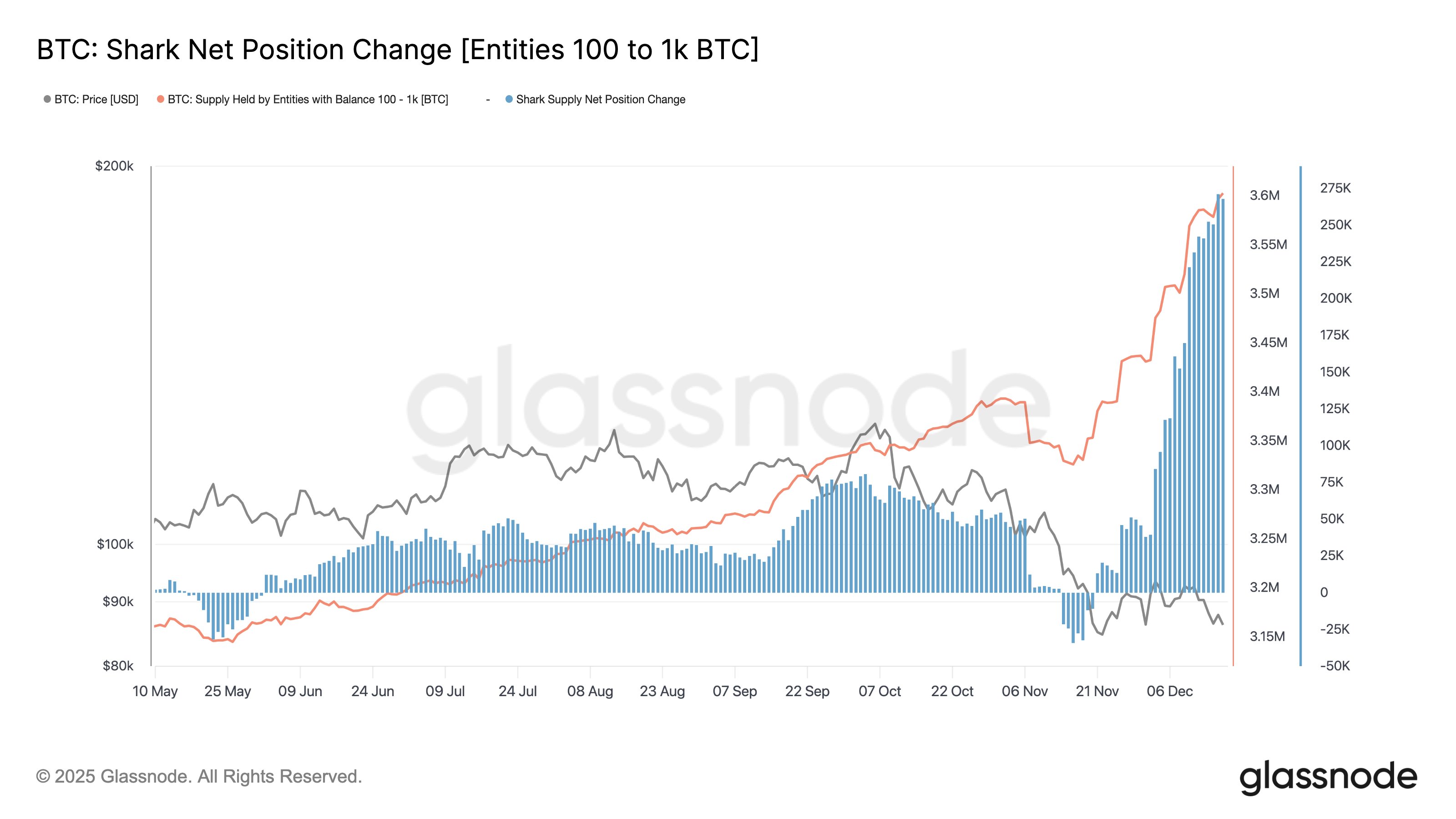
Lately, the supply of the sharks has been following a rapid upward trajectory, as the chart shared by CryptoVizArt.₿ shows.

How the supply of the sharks has changed during the last few months | Source: @CryptoVizArt on X

Since November 16th, the Bitcoin sharks have seen their combined balance change from 3.33 million BTC to 3.60 million BTC, reflecting a significant rise of 270,000 tokens. “The key question, however, is whether this reflects genuine net accumulation, or merely internal reshuffling across cohorts, a distinction only deeper on-chain analysis can resolve,” said the Glassnode researcher.

By “reshuffling,” CryptoVizArt.₿ is referring to the merging or splitting of holdings that investors sometimes take part in. For example, a whale deciding to break their balance across multiple wallets can register as a decrease in the whale supply, and an increase in the supply of whatever bracket the smaller holdings fall inside.

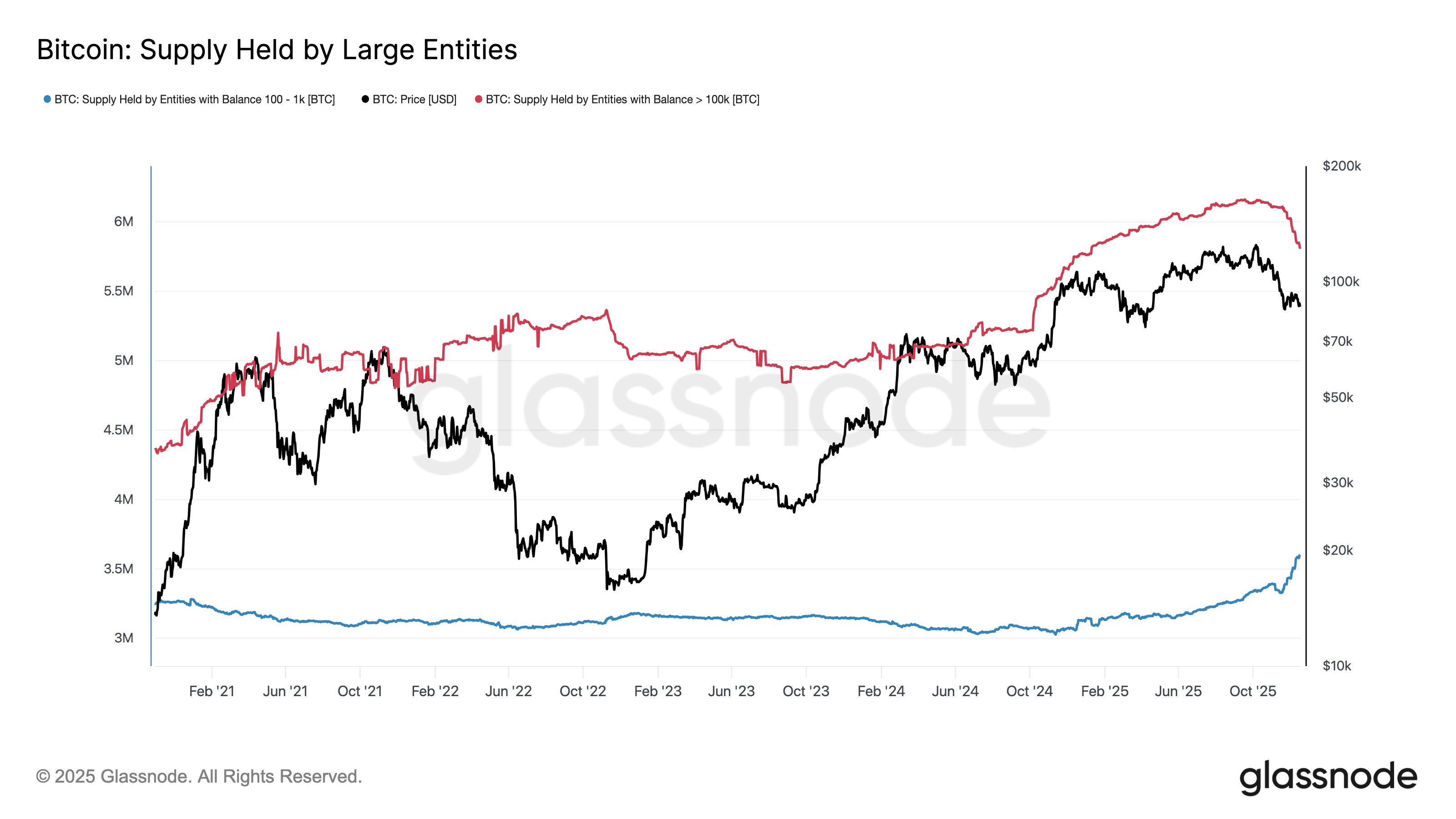
Signs point to something similar being a factor behind the recent Bitcoin shark supply increase. Below is another chart shared by the analyst, this one comparing the trend in the supply of the 100,000+ BTC entities against that of the sharks.

Looks like the two supplies have gone opposite ways in recent weeks | Source: @CryptoVizArt on X

The 100,000+ BTC cohort corresponds to the largest of entities on the blockchain, including exchanges, exchange-traded funds (ETFs), and custodial services. From the graph, it’s apparent that the holdings of this group have been declining recently.

Interestingly, the amount distributed by the cohort in this drawdown is 300,000 BTC, which is roughly equal to that accumulated by the sharks (270,000 BTC). “This pattern strongly points to wallet reshuffling, not organic accumulation,” noted CryptoVizArt.₿.

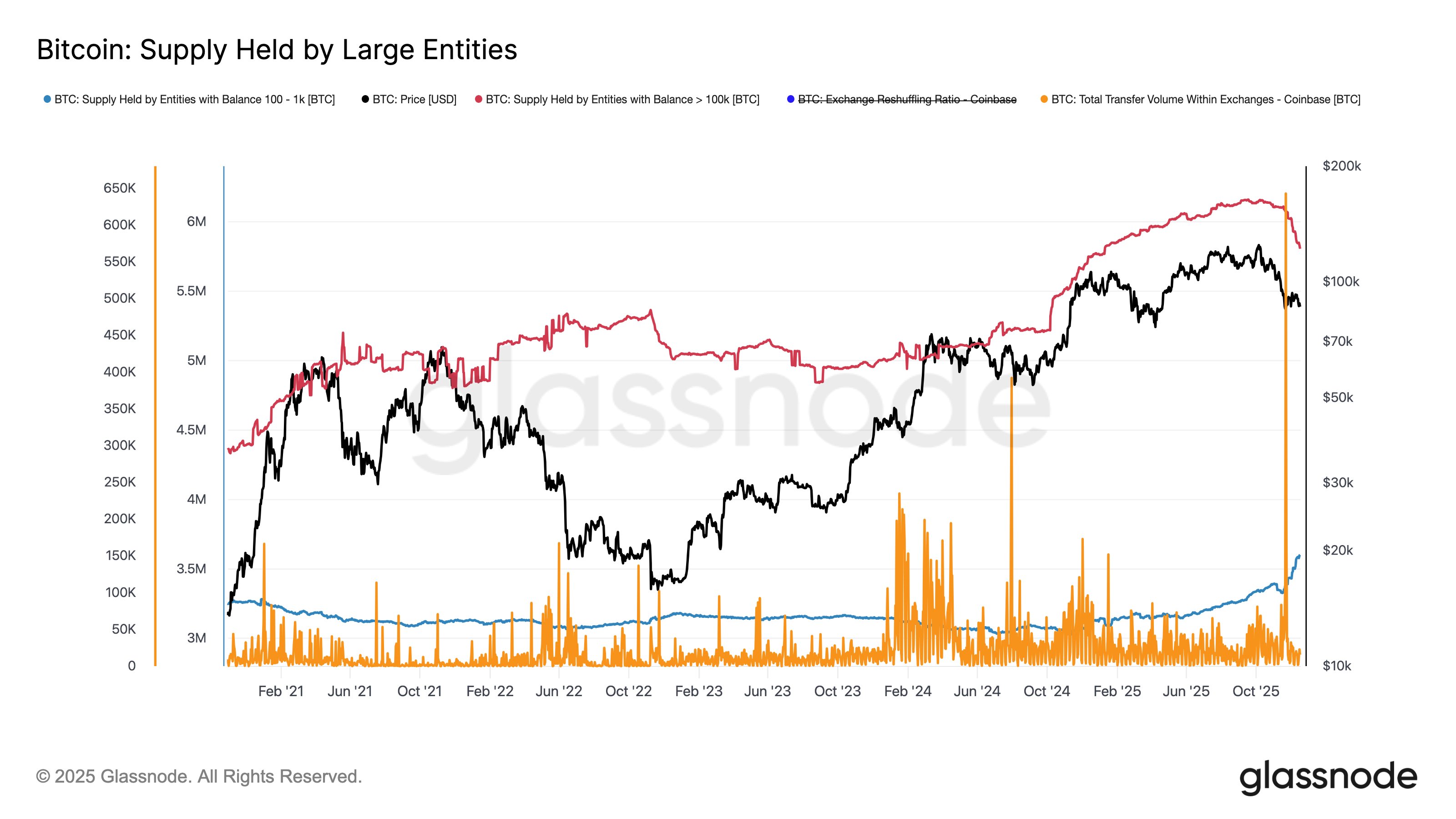
Since the 100,000+ BTC bracket also includes exchanges, reshuffling out of these platforms (that is, withdrawals) can still point toward positive accumulation. It turns out, however, that the nature of the reshuffling is truly likely to be internal, as Coinbase made internal wallet transfers amounting to a massive 640,000 BTC alongside this trend.

The trend in the total internal transfer volume of crypto exchange Coinbase | Source: @CryptoVizArt on X

Based on the data, the analyst has concluded:

The key takeaway is that >90% of the apparent “shark accumulation” is likely driven by internal reshuffling by large custodial entities, rather than net buying by new 100–1K BTC holders.

BTC Price

At the time of writing, Bitcoin is floating around $87,300, down over 3% in the last seven days.

The price of the coin seems to have gone through some volatility | Source: BTCUSDT on TradingView

Связанные с этим вопросы

QWhat is the main argument made by the Glassnode researcher regarding the recent Bitcoin shark accumulation?

AThe Glassnode researcher argues that the recent Bitcoin shark 'accumulation' is not a sign of organic buying but is instead largely driven by internal reshuffling of holdings by large custodial entities.

QHow much Bitcoin did the shark cohort (100-1,000 BTC) accumulate since November 16th, according to the article?

AThe shark cohort saw their combined balance increase by 270,000 BTC, rising from 3.33 million BTC to 3.60 million BTC.

QWhat evidence suggests that the shark supply increase was due to wallet reshuffling rather than organic accumulation?

AThe holdings of the 100,000+ BTC cohort (which includes large entities like exchanges and ETFs) declined by 300,000 BTC, an amount roughly equal to the 270,000 BTC accumulated by sharks, indicating a transfer of funds between cohorts rather than new buying.

QWhich major exchange is mentioned as having conducted significant internal wallet transfers during this period?

ACoinbase is mentioned as having made internal wallet transfers amounting to 640,000 BTC alongside this trend.

QWhat was the approximate price of Bitcoin at the time the article was written?

ABitcoin was floating around $87,300 at the time of writing, down over 3% in the last seven days.

Похожее

When AI Begins to Audit the World: From Claude Discovering the ZEC Vulnerability, Watching the Encryption Industry Enter the 'Recursive Security Era'

**When AI Audits the World: From Claude's Discovery of a ZEC Vulnerability, Viewing the Crypto Industry Entering a "Recursive Security Era"** This article examines a pivotal shift in the blockchain security landscape, triggered by the convergence of two events: Anthropic's research on AI's "Recursive Self-Improvement" and Claude Opus 4.8's discovery of a critical vulnerability in Zcash's code. Traditionally, crypto security has relied on human experts and automated tools for periodic audits. However, the article argues AI is transitioning from a mere tool to an active participant in understanding and analyzing complex systems. Claude's ability to identify a subtle flaw in Zcash's zero-knowledge proof system demonstrates AI's potential to dramatically lower the cost and time required for risk discovery. This goes beyond finding a single bug; it signals a change in the very mechanism of how vulnerabilities are found. The core thesis introduces the concept of "Recursive Security," drawing a parallel to Anthropic's "Recursive Self-Improvement." Just as AI can accelerate its own development through feedback loops, security systems are evolving towards a continuous cycle of analysis, risk identification, remediation, and re-analysis. Security is becoming a persistent, evolving capability integrated into a system's lifecycle, rather than a one-time pre-launch audit. This shift is particularly urgent for the crypto industry, where system complexity from Layer-2 networks, modular architectures, and ZK-proofs is growing faster than human analysis capacity. AI excels at the pattern recognition and contextual understanding needed to navigate this complexity. Importantly, the article cautions that AI augments both defenders and potential attackers, accelerating the entire threat landscape. The future competitive advantage may not lie in having zero vulnerabilities, but in having the fastest risk discovery, validation, and response capabilities. The Claude-Zcash incident is thus an early signal of an era where AI-driven, recursive security systems become essential for managing risk in an increasingly complex digital world.

marsbit1 ч. назад

When AI Begins to Audit the World: From Claude Discovering the ZEC Vulnerability, Watching the Encryption Industry Enter the 'Recursive Security Era'

marsbit1 ч. назад

From MSTR to STRC+: Where Is the Limit of the Strategy Universe?

From MSTR to STRC+: The Evolution and Limits of the Strategy Universe This article examines the transformation of Strategy (formerly MicroStrategy) from a simple "Bitcoin treasury" company into a complex financial engineering firm building a BTC-backed credit system. **Core Thesis:** Strategy's true significance lies not just in its massive BTC holdings (~844k BTC), but in its attempt to transform this static reserve into a multi-layered credit curve within traditional capital markets and, subsequently, into on-chain yield infrastructure. **The MSTR Flywheel:** The initial model was a reflexive loop: BTC price rises → MSTR stock rises → company raises capital (debt/equity) at a premium → buys more BTC → increases per-share BTC exposure → MSTR premium grows. This "amplified Bitcoin" equity (MSTR) thrives on bullish momentum but is vulnerable to tightening premiums and rising funding costs. **Building the Credit Curve:** Strategy's innovation is slicing its single BTC balance sheet into different risk/return profiles via specialized securities: * **MSTR:** High-volatility equity layer absorbing full BTC upside/downside. * **STRC:** Key product. A perpetual preferred stock designed as "short duration high yield credit," offering ~11.5% floating monthly dividends. It attracts fixed-income investors seeking yield without direct BTC exposure, funding Strategy's operations. * **STRD/STRK/STRF:** Other preferred/share classes with varying durations, conversion rights, and fixed dividends. **Risks of the STRC Model:** STRC's high yield is not risk-free. Its stability depends on: 1) Sufficient BTC asset coverage, 2) Strategy's continued ability to pay dividends, and 3) Market faith in the MSTR/STRC funding flywheel. Stress points include deep BTC price declines eroding the asset buffer, rising dividend costs if STRC trades below par, and a broken flywheel if MSTR's premium (mNAV) falls persistently. **On-Chain Expansion: STRC+:** Projects like **Saturn** and **Apyx** aim to package STRC's (and other DAT preferred stock) cash flows into on-chain stablecoin yield (e.g., sUSDat, apyUSD). They offer DeFi a new yield source distinct from trading fees or incentives—cash dividends from traditional securities. However, this introduces compounded risks: off-chain custody, issuer credit risk, BTC volatility, and protocol execution risk. **Conclusion: The Ultimate Boundary** Strategy's endgame is not infinite BTC accumulation. It is the market's long-term acceptance of a new credit system where BTC serves as collateral for tradable securities whose cash flows can power on-chain financial applications. Its "universe" expands if this BTC-native credit curve gains legitimacy, but contracts if these instruments are repriced purely as high-risk, yield-bearing credit assets without stablecoin mythology.

marsbit1 ч. назад

From MSTR to STRC+: Where Is the Limit of the Strategy Universe?

marsbit1 ч. назад

Торговля

Спот
Фьючерсы

Популярные статьи

Тест по Bitcoin Биткоина

HTX Learn: Изучите Bitcoin halving и Заработаете Токены USDT

3.1k просмотров всегоОпубликовано 2024.04.16Обновлено 2024.04.16

Тест по Bitcoin  Биткоина

Что такое $BITCOIN

ЦИФРОВОЕ ЗОЛОТО ($BITCOIN): Комплексный анализ Введение в ЦИФРОВОЕ ЗОЛОТО ($BITCOIN) ЦИФРОВОЕ ЗОЛОТО ($BITCOIN) — это проект на основе блокчейна, работающий в сети Solana, который стремится объединить характеристики традиционных драгоценных металлов с инновациями децентрализованных технологий. Хотя он носит имя Биткойн, часто называемого “цифровым золотом” из-за его восприятия как средства хранения ценности, ЦИФРОВОЕ ЗОЛОТО является отдельным токеном, предназначенным для создания уникальной экосистемы в ландшафте Web3. Его цель — позиционировать себя как жизнеспособный альтернативный цифровой актив, хотя детали его применения и функциональности все еще развиваются. Что такое ЦИФРОВОЕ ЗОЛОТО ($BITCOIN)? ЦИФРОВОЕ ЗОЛОТО ($BITCOIN) — это токен криптовалюты, специально разработанный для использования в блокчейне Solana. В отличие от Биткойна, который выполняет широко признанную роль хранения ценности, этот токен, похоже, сосредоточен на более широких приложениях и характеристиках. Примечательные аспекты включают: Инфраструктура блокчейна: Токен построен на блокчейне Solana, известном своей способностью обрабатывать высокоскоростные и недорогие транзакции. Динамика предложения: ЦИФРОВОЕ ЗОЛОТО имеет максимальное предложение, ограниченное 100 квадриллионами токенов (100P $BITCOIN), хотя детали о его обращающемся предложении в настоящее время не раскрыты. Утилита: Хотя точные функциональные возможности не описаны, есть указания на то, что токен может быть использован для различных приложений, потенциально связанных с децентрализованными приложениями (dApps) или стратегиями токенизации активов. Кто создатель ЦИФРОВОГО ЗОЛОТА ($BITCOIN)? На данный момент личность создателей и команды разработчиков, стоящих за ЦИФРОВЫМ ЗОЛОТОМ ($BITCOIN), остается неизвестной. Эта ситуация типична для многих инновационных проектов в области блокчейна, особенно тех, которые связаны с децентрализованными финансами и феноменом мем-криптовалют. Хотя такая анонимность может способствовать культуре, ориентированной на сообщество, она усиливает опасения по поводу управления и ответственности. Кто инвесторы ЦИФРОВОГО ЗОЛОТА ($BITCOIN)? Доступная информация указывает на то, что у ЦИФРОВОГО ЗОЛОТА ($BITCOIN) нет известных институциональных спонсоров или значительных венчурных капиталовложений. Проект, похоже, функционирует по модели пирингового взаимодействия, сосредоточенной на поддержке и принятии сообществом, а не на традиционных путях финансирования. Его активность и ликвидность в основном сосредоточены на децентрализованных биржах (DEX), таких как PumpSwap, а не на устоявшихся централизованных торговых платформах, что еще больше подчеркивает его подход, ориентированный на grassroots. Как работает ЦИФРОВОЕ ЗОЛОТО ($BITCOIN) Операционные механизмы ЦИФРОВОГО ЗОЛОТА ($BITCOIN) можно подробно описать на основе его дизайна блокчейна и характеристик сети: Механизм консенсуса: Используя уникальный механизм доказательства истории (PoH) Solana в сочетании с моделью доказательства доли (PoS), проект обеспечивает эффективную валидацию транзакций, что способствует высокой производительности сети. Токеномика: Хотя конкретные дефляционные механизмы не были подробно описаны, большое максимальное предложение токенов подразумевает, что оно может быть предназначено для микротранзакций или нишевых случаев использования, которые еще предстоит определить. Интероперабельность: Существует потенциал для интеграции с более широкой экосистемой Solana, включая различные платформы децентрализованных финансов (DeFi). Однако детали относительно конкретных интеграций остаются неуточненными. Хронология ключевых событий Вот хронология, которая подчеркивает значимые вехи, касающиеся ЦИФРОВОГО ЗОЛОТА ($BITCOIN): 2023: Первоначальное развертывание токена происходит в блокчейне Solana, отмеченное его адресом контракта. 2024: ЦИФРОВОЕ ЗОЛОТО приобретает видимость, когда оно становится доступным для торговли на децентрализованных биржах, таких как PumpSwap, позволяя пользователям обменивать его на SOL. 2025: Проект наблюдает спорадическую торговую активность и потенциальный интерес к инициативам, возглавляемым сообществом, хотя на данный момент не зафиксировано никаких значительных партнерств или технических достижений. Критический анализ Сильные стороны Масштабируемость: Основная инфраструктура Solana поддерживает высокие объемы транзакций, что может повысить полезность $BITCOIN в различных сценариях транзакций. Доступность: Потенциально низкая цена торговли за токен может привлечь розничных инвесторов, способствуя более широкому участию благодаря возможностям дробного владения. Риски Отсутствие прозрачности: Отсутствие публично известных спонсоров, разработчиков или процесса аудита может вызвать скептицизм относительно устойчивости и надежности проекта. Волатильность рынка: Торговая активность сильно зависит от спекулятивного поведения, что может привести к значительной волатильности цен и неопределенности для инвесторов. Заключение ЦИФРОВОЕ ЗОЛОТО ($BITCOIN) является интригующим, но неоднозначным проектом в быстро развивающейся экосистеме Solana. Хотя он пытается использовать нарратив “цифрового золота”, его отход от установленной роли Биткойна как средства хранения ценности подчеркивает необходимость более четкого различения его предполагаемой утилиты и структуры управления. Будущее принятие и усвоение, вероятно, будут зависеть от решения текущей непрозрачности и более четкого определения его операционных и экономических стратегий. Примечание: Этот отчет охватывает синтезированную информацию, доступную на октябрь 2023 года, и с тех пор могут произойти события.

99 просмотров всегоОпубликовано 2025.05.13Обновлено 2025.05.13

Что такое $BITCOIN

Fractal Bitcoin: масштабирование Биткоина с помощью рекурсивной системы

Fractal Bitcoin — масштабное Layer-1-решнение, созданное на базе кода Биткоина, позволяющего достигать бесконечного масштабирования с помощью рекурсивного подхода.

2.3k просмотров всегоОпубликовано 2025.06.30Обновлено 2025.06.30

Fractal Bitcoin: масштабирование Биткоина с помощью рекурсивной системы

Обсуждения

Добро пожаловать в Сообщество HTX. Здесь вы сможете быть в курсе последних новостей о развитии платформы и получить доступ к профессиональной аналитической информации о рынке. Мнения пользователей о цене на BTC (BTC) представлены ниже.

活动图片