Bitcoin Pioneer Adam Back Addresses Mention In Epstein Files

bitcoinistОпубликовано 2026-02-02Обновлено 2026-02-02

Введение

Bitcoin pioneer Adam Back addressed allegations linking him and Blockstream to Jeffrey Epstein, following the circulation of excerpts from the "Epstein files." Back stated that during Blockstream's 2014 seed funding round, they were introduced to Epstein through MIT Media Lab's former director Joi Ito, who described Epstein as a limited partner in his fund. This fund later invested a minority stake in Blockstream. However, Back emphasized that the connection was brief and indirect, with Ito's fund divesting its shares months later due to potential conflicts of interest. He asserted that Blockstream has no financial ties to Epstein or his estate. The allegations resurfaced due to emails and screenshots showing Epstein's involvement in Blockstream's early fundraising, including a tenfold increase in his investment and travel coordination involving Back. A viral social media thread attempted to connect Epstein's investment to later disputes over Bitcoin's scaling decisions, suggesting financial ties to key Bitcoin Core developers. At the time of reporting, BTC was trading at $77,750.

Bitcoin veteran Adam Back moved to shut down a fresh round of allegations after newly circulated “Epstein files” excerpts and screenshots reignited claims that Jeffrey Epstein intersected with Blockstream during the company’s earliest fundraising.

Back’s response on X framed the episode as a brief, indirect touchpoint routed through MIT Media Lab and its former director, Joi Ito, rather than a direct relationship with Epstein. “In 2014, during Blockstream’s seed-round investor roadshow, the company was introduced to then MIT Media Lab director Joi Ito. Subsequently Blockstream met with Jeffrey Epstein, who was described at the time as a limited partner in Ito’s fund,” Back wrote. “That fund later invested a minority stake in Blockstream.”

Back emphasized that the link did not persist. “A few months later, Ito’s fund divested its Blockstream shares due to a potential conflict of interest, and other concerns. Blockstream has no direct nor indirect financial connection with Jeffrey Epstein, or his estate,” he added.

Why Bitcoin OG Back Is Inside The Epstein Files

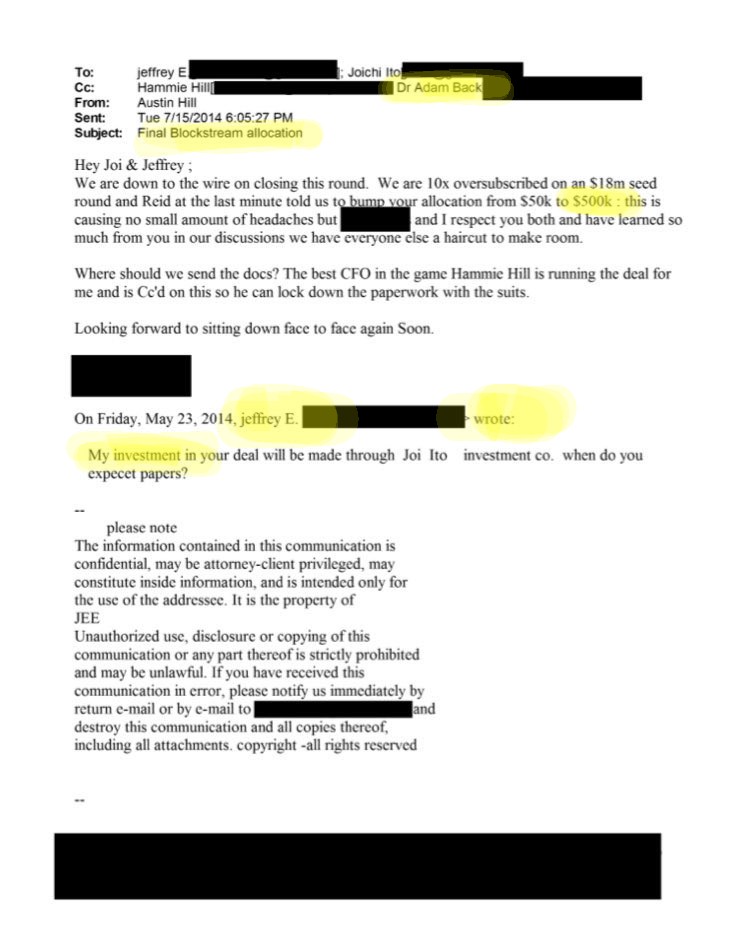
Notably, Epstein surfaced in Blockstream’s early fundraising. In a 2014 email, Blockstream co-founder Austin Hill told Epstein his seed-round allocation was being increased tenfold, from $50,000 to $500,000.

Epstein files: Blockstream | Source: X @wilkins_jo52699

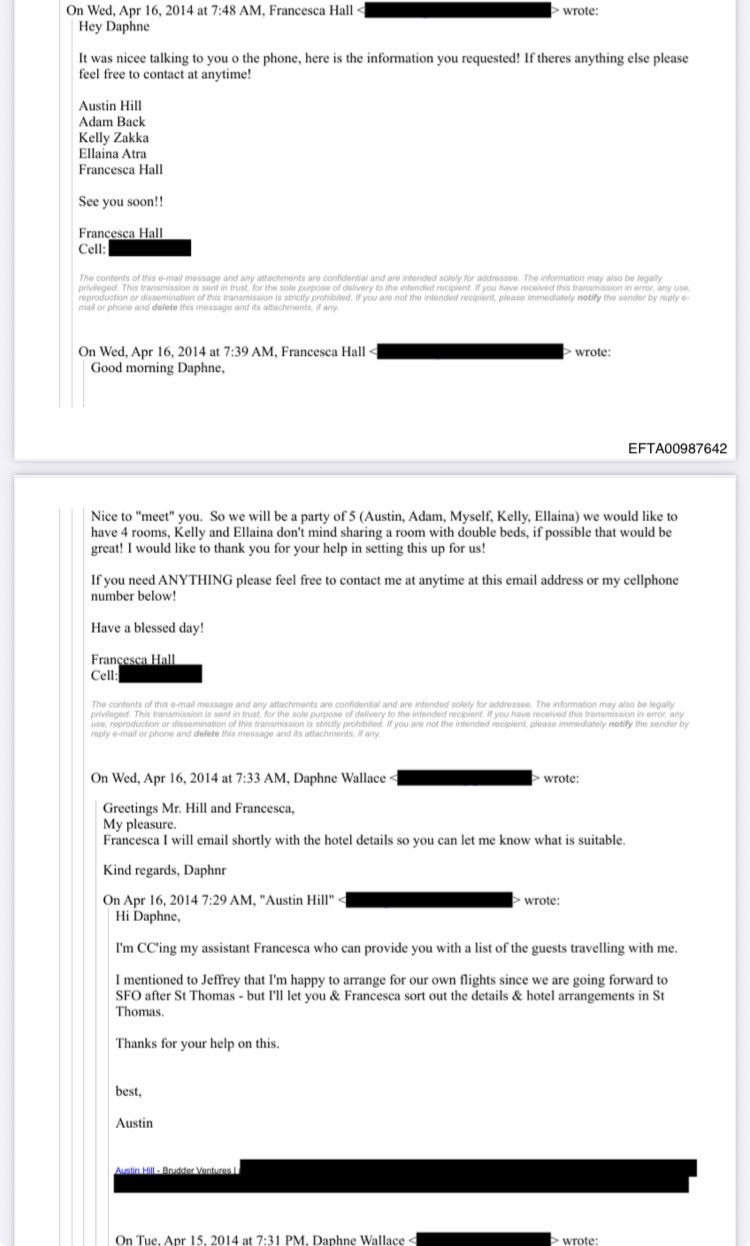
Separately, a travel-coordination email screenshot dated April 2014 includes Back’s name in a list of travelers and describes hotel-room needs for a St. Thomas trip. “Nice to ‘meet’ you. So we will be a party of 5 (Austin, Adam, Myself, Kelly, Ellaina).” The screenshot shows the message as part of a scheduling chain involving hotel arrangements, and it is one of the documents driving the current round of viral reposts.

Source: X @CatoTheElder17

Moreover, Epstein said that he “liked him” (Back).

Source: X @CatoTheElder17

A X thread posted Feb. 2, 2026 by “pigeon man” attempts to lay out what it calls an “EPSTEIN AND BITCOIN” timeline, tying early Blockstream meetings and investment claims to later disputes over Bitcoin’s scaling path.

According to that thread, Epstein “meets with Adam Back and Austin Hill” in April 2014, describing the context as a meeting with executives of a new layer-2 company, Blockstream. The thread then claims that in July 2014, Epstein invested “at least $500,001” into Blockstream with Ito, and argues this created a financial tie to a company associated with influential Bitcoin Core developers.

The same thread highlights Blockstream’s October 2014 whitepaper release and names several developers it says were co-founders or co-authors, including Gregory Maxwell, Luke Dashjr, Pieter Wuille, and Matt Corallo. It also alleges that in 2015 Epstein had “encrypted conversations” with Austin Hill and others, claiming participants avoided email because “I don’t think the NSA deserves to hear what we say.”

The thread’s framing is designed to connect the social scandal to a much older technical and governance fault line: the 2016–2017 blocksize era. It argues that “keeping the block size limit” preserved demand for layer-2 systems and later claims “Bitcoin Core developers decide small blocks are what’s best for Bitcoin,” leading to a split.

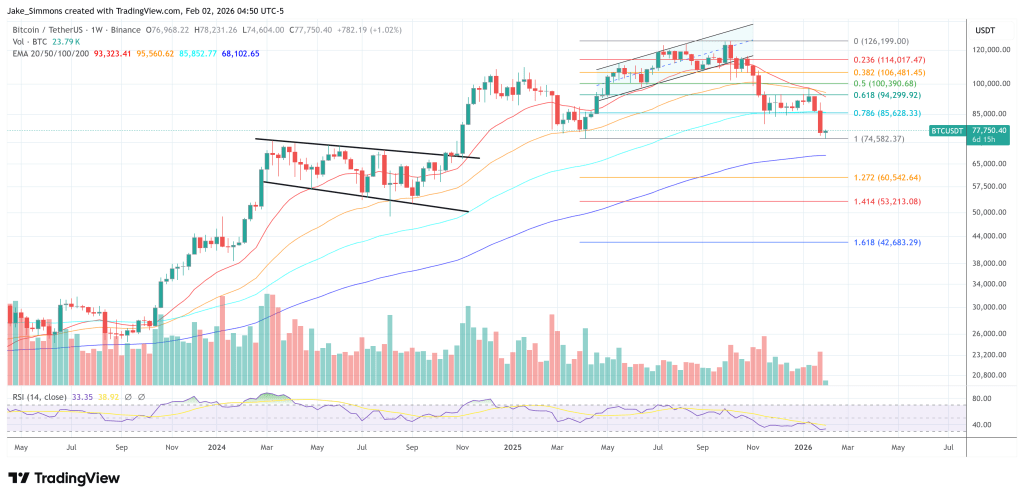
At press time, BTC traded at $77,750.

Bitcoin crash stall at the 1.0 Fib for now, 1-week chart | Source: BTCUSDT on TradingView.com

Связанные с этим вопросы

QWhat is the core allegation that Adam Back is responding to in the article?

AThe allegation is that Jeffrey Epstein had a direct financial and personal connection with Adam Back and Blockstream during the company's early fundraising, based on newly circulated excerpts from the 'Epstein files'.

QHow did Adam Back describe the nature of Blockstream's connection to Jeffrey Epstein?

AAdam Back described it as a brief, indirect touchpoint. He stated that Blockstream was introduced to Epstein through then MIT Media Lab director Joi Ito, who described Epstein as a limited partner in his fund. That fund later invested a minority stake in Blockstream, but divested its shares a few months later.

QWhat specific piece of communication from 2014 is cited as evidence of Epstein's involvement with Blockstream?

AA 2014 email from Blockstream co-founder Austin Hill to Jeffrey Epstein, in which Hill informs Epstein that his seed-round allocation was being increased from $50,000 to $500,000.

QAccording to the 'pigeon man' thread, what later Bitcoin controversy is the alleged Epstein connection tied to?

AThe thread ties the alleged Epstein connection to the 2016–2017 blocksize debate, arguing that keeping the block size limit preserved demand for layer-2 systems like Blockstream's and influenced the scaling path of Bitcoin.

QWhat was the stated reason for Joi Ito's fund divesting its Blockstream shares?

AThe fund divested its Blockstream shares due to a potential conflict of interest and other concerns, as stated by Adam Back.

Похожее

Public Version of Mythos Officially Launched: Analyzing the Advantages and Limitations of AI Smart Contract Auditing

Publicly available Mythos, Anthropic's AI model, has officially launched, demonstrating both significant potential and limitations in smart contract security auditing. The article analyzes its capabilities through real-world cases. AI excels in identifying subtle, low-level vulnerabilities through pattern recognition and large-scale code screening. A key example is detecting a storage slot collision between a custom rewards mapping and a third-party library's ReentrancyGuard, a vulnerability easily missed in manual audits. In the recent Zcash incident, AI also rapidly discovered a critical soundness bug that had remained hidden for years. However, AI currently struggles with complex, interconnected scenarios. When tested on the Curve LlamaLend sDOLA exploit, which involved manipulating prices across multiple protocols (Curve pools, lending markets) to trigger liquidations, Fable 5 failed to identify the core cross-protocol attack vector. These scenarios require a deep understanding of DeFi economic models and multi-contract interactions. In conclusion, while AI tools like Mythos significantly boost efficiency in finding standardized, syntactic vulnerabilities, they cannot yet replace expert analysis for complex, business-logic, and cross-protocol attacks. An effective audit workflow combines AI's speed for initial screening with human expertise for in-depth, holistic analysis.

marsbit2 мин. назад

Public Version of Mythos Officially Launched: Analyzing the Advantages and Limitations of AI Smart Contract Auditing

marsbit2 мин. назад

Trade.xyz's Rebase Refusal Sparks Controversy, On-Chain Pre-IPO Market Faces Major Pricing Test

The debate surrounding Trade.xyz's refusal to adjust its SPCX (SpaceX pre-IPO) perpetual contract pricing amid updated share count revelations highlights a key challenge for on-chain pre-IPO markets. While several centralized exchanges (CEXs) paused and repriced their contracts after SpaceX's filing showed a ~10% increase in total shares, Trade.xyz maintained its market-driven pricing logic, which tracks expected per-share price sentiment rather than fundamental valuation metrics like market cap. This discrepancy triggered cross-platform arbitrage and caused leveraged long positions on Trade.xyz to suffer significant losses, as the platform's HIP-3 architecture lacks a native "Rebase" mechanism to neutrally adjust all user positions following such corporate actions. The incident underscores the difficulty for decentralized perpetual exchanges (Perp DEXs) to implement Rebase—a process CEXs handle by centrally pausing markets and adjusting ledger data. On-chain, this requires complex smart contract modifications, increasing gas costs, complexity, and potential attack surfaces. While some DEXs have managed similar adjustments, Trade.xyz's current design does not natively support it, though the team is reportedly exploring solutions for future events like stock splits. Ultimately, the controversy serves as a critical case study for the nascent on-chain pre-IPO sector, raising questions about price discovery reliability, transparent rule disclosure, and the readiness of DeFi infrastructures to handle traditional corporate actions as real-world assets (RWAs) gain traction.

marsbit10 мин. назад

Trade.xyz's Rebase Refusal Sparks Controversy, On-Chain Pre-IPO Market Faces Major Pricing Test

marsbit10 мин. назад

The 'Middle Eastern Prince' Swindles a Wealthy Woman: Renting Planes and Rolls-Royces, Scamming 120 Million Over Three Years

Two brothers who posed as "Middle Eastern princes" have been sentenced in the United States to 24 and 23 years in prison, respectively, and ordered to pay over $21.2 million in restitution and back taxes. Over three years, they fraudulently obtained approximately $21 million, primarily by promoting fictitious investment projects, including a non-existent cryptocurrency mining operation in a former General Electric industrial park in East Cleveland. The brothers, aged 42 and 33, created elaborate personas: one claimed to be a wealthy royal family heir and the city's "International Economic Advisor," while the other posed as a hedge fund manager with expertise from watching the TV show *Billions*. They bolstered their image by renting luxury cars and private jets and cultivating a relationship with a local mayor's chief of staff, who provided official-looking documents and government event access. A significant portion of the victims' funds, about $18 million, came from a single Chinese investor, a woman from Sichuan with experience in Bitcoin mining. The brothers also defrauded several women, including one former girlfriend. Their scheme unraveled when the primary investor discovered her $6 million worth of mining equipment had been sold off. The case highlights a trend of impostors using fabricated "Middle Eastern royal" identities to target wealthy individuals. Similar incidents include a "Dubai prince" who recently promoted a $500 million family office in Hong Kong and a Colombian man who impersonated a Saudi prince for decades in the US before being caught and sentenced in 2019.

marsbit25 мин. назад

The 'Middle Eastern Prince' Swindles a Wealthy Woman: Renting Planes and Rolls-Royces, Scamming 120 Million Over Three Years

marsbit25 мин. назад

a16z Partner: Being in the Flow of Capital Is the True Moat

A16z Partner: Standing in the Cash Flow is the True Moat Historically, many of the strongest companies built their moats by positioning themselves within "cash flows"—facilitating value creation and transfer in a network and taking a cut. The more value flows, the larger they grow. Crypto is the first modern technology natively built for this. With open ledgers, programmable settlement, and stablecoins enabling internet-speed global value transfer, it allows startups to inherit network effects from day one. Well-designed tokens align users, developers, and the protocol towards network growth, distributing value to contributors. This model isn't new (e.g., railroads, Visa, Google, AWS) but Crypto democratizes it. It lets entrepreneurs target areas with high inefficiency and profit extraction—like traditional finance's payments, custody, FX, and settlement—to compress costs, increase speed, and redistribute value by standing in the new flow. The opportunity extends beyond finance to emerging markets like GPU/compute, AI training data, energy, and space, where new, programmable infrastructure can be built without legacy constraints. Key questions for founders: Are you already in the cash flow? Does your revenue scale 10x with network activity? Where is profit extraction highest relative to value created in your market? The strategy is clear: compress the old cost structure, position yourself in the new value stream, and let the network compound.

marsbit52 мин. назад

a16z Partner: Being in the Flow of Capital Is the True Moat

marsbit52 мин. назад

Торговля

Спот
Фьючерсы

Популярные статьи

Тест по Bitcoin Биткоина

HTX Learn: Изучите Bitcoin halving и Заработаете Токены USDT

3.1k просмотров всегоОпубликовано 2024.04.16Обновлено 2024.04.16

Тест по Bitcoin  Биткоина

Что такое $BITCOIN

ЦИФРОВОЕ ЗОЛОТО ($BITCOIN): Комплексный анализ Введение в ЦИФРОВОЕ ЗОЛОТО ($BITCOIN) ЦИФРОВОЕ ЗОЛОТО ($BITCOIN) — это проект на основе блокчейна, работающий в сети Solana, который стремится объединить характеристики традиционных драгоценных металлов с инновациями децентрализованных технологий. Хотя он носит имя Биткойн, часто называемого “цифровым золотом” из-за его восприятия как средства хранения ценности, ЦИФРОВОЕ ЗОЛОТО является отдельным токеном, предназначенным для создания уникальной экосистемы в ландшафте Web3. Его цель — позиционировать себя как жизнеспособный альтернативный цифровой актив, хотя детали его применения и функциональности все еще развиваются. Что такое ЦИФРОВОЕ ЗОЛОТО ($BITCOIN)? ЦИФРОВОЕ ЗОЛОТО ($BITCOIN) — это токен криптовалюты, специально разработанный для использования в блокчейне Solana. В отличие от Биткойна, который выполняет широко признанную роль хранения ценности, этот токен, похоже, сосредоточен на более широких приложениях и характеристиках. Примечательные аспекты включают: Инфраструктура блокчейна: Токен построен на блокчейне Solana, известном своей способностью обрабатывать высокоскоростные и недорогие транзакции. Динамика предложения: ЦИФРОВОЕ ЗОЛОТО имеет максимальное предложение, ограниченное 100 квадриллионами токенов (100P $BITCOIN), хотя детали о его обращающемся предложении в настоящее время не раскрыты. Утилита: Хотя точные функциональные возможности не описаны, есть указания на то, что токен может быть использован для различных приложений, потенциально связанных с децентрализованными приложениями (dApps) или стратегиями токенизации активов. Кто создатель ЦИФРОВОГО ЗОЛОТА ($BITCOIN)? На данный момент личность создателей и команды разработчиков, стоящих за ЦИФРОВЫМ ЗОЛОТОМ ($BITCOIN), остается неизвестной. Эта ситуация типична для многих инновационных проектов в области блокчейна, особенно тех, которые связаны с децентрализованными финансами и феноменом мем-криптовалют. Хотя такая анонимность может способствовать культуре, ориентированной на сообщество, она усиливает опасения по поводу управления и ответственности. Кто инвесторы ЦИФРОВОГО ЗОЛОТА ($BITCOIN)? Доступная информация указывает на то, что у ЦИФРОВОГО ЗОЛОТА ($BITCOIN) нет известных институциональных спонсоров или значительных венчурных капиталовложений. Проект, похоже, функционирует по модели пирингового взаимодействия, сосредоточенной на поддержке и принятии сообществом, а не на традиционных путях финансирования. Его активность и ликвидность в основном сосредоточены на децентрализованных биржах (DEX), таких как PumpSwap, а не на устоявшихся централизованных торговых платформах, что еще больше подчеркивает его подход, ориентированный на grassroots. Как работает ЦИФРОВОЕ ЗОЛОТО ($BITCOIN) Операционные механизмы ЦИФРОВОГО ЗОЛОТА ($BITCOIN) можно подробно описать на основе его дизайна блокчейна и характеристик сети: Механизм консенсуса: Используя уникальный механизм доказательства истории (PoH) Solana в сочетании с моделью доказательства доли (PoS), проект обеспечивает эффективную валидацию транзакций, что способствует высокой производительности сети. Токеномика: Хотя конкретные дефляционные механизмы не были подробно описаны, большое максимальное предложение токенов подразумевает, что оно может быть предназначено для микротранзакций или нишевых случаев использования, которые еще предстоит определить. Интероперабельность: Существует потенциал для интеграции с более широкой экосистемой Solana, включая различные платформы децентрализованных финансов (DeFi). Однако детали относительно конкретных интеграций остаются неуточненными. Хронология ключевых событий Вот хронология, которая подчеркивает значимые вехи, касающиеся ЦИФРОВОГО ЗОЛОТА ($BITCOIN): 2023: Первоначальное развертывание токена происходит в блокчейне Solana, отмеченное его адресом контракта. 2024: ЦИФРОВОЕ ЗОЛОТО приобретает видимость, когда оно становится доступным для торговли на децентрализованных биржах, таких как PumpSwap, позволяя пользователям обменивать его на SOL. 2025: Проект наблюдает спорадическую торговую активность и потенциальный интерес к инициативам, возглавляемым сообществом, хотя на данный момент не зафиксировано никаких значительных партнерств или технических достижений. Критический анализ Сильные стороны Масштабируемость: Основная инфраструктура Solana поддерживает высокие объемы транзакций, что может повысить полезность $BITCOIN в различных сценариях транзакций. Доступность: Потенциально низкая цена торговли за токен может привлечь розничных инвесторов, способствуя более широкому участию благодаря возможностям дробного владения. Риски Отсутствие прозрачности: Отсутствие публично известных спонсоров, разработчиков или процесса аудита может вызвать скептицизм относительно устойчивости и надежности проекта. Волатильность рынка: Торговая активность сильно зависит от спекулятивного поведения, что может привести к значительной волатильности цен и неопределенности для инвесторов. Заключение ЦИФРОВОЕ ЗОЛОТО ($BITCOIN) является интригующим, но неоднозначным проектом в быстро развивающейся экосистеме Solana. Хотя он пытается использовать нарратив “цифрового золота”, его отход от установленной роли Биткойна как средства хранения ценности подчеркивает необходимость более четкого различения его предполагаемой утилиты и структуры управления. Будущее принятие и усвоение, вероятно, будут зависеть от решения текущей непрозрачности и более четкого определения его операционных и экономических стратегий. Примечание: Этот отчет охватывает синтезированную информацию, доступную на октябрь 2023 года, и с тех пор могут произойти события.

99 просмотров всегоОпубликовано 2025.05.13Обновлено 2025.05.13

Что такое $BITCOIN

Fractal Bitcoin: масштабирование Биткоина с помощью рекурсивной системы

Fractal Bitcoin — масштабное Layer-1-решнение, созданное на базе кода Биткоина, позволяющего достигать бесконечного масштабирования с помощью рекурсивного подхода.

2.3k просмотров всегоОпубликовано 2025.06.30Обновлено 2025.06.30

Fractal Bitcoin: масштабирование Биткоина с помощью рекурсивной системы

Обсуждения

Добро пожаловать в Сообщество HTX. Здесь вы сможете быть в курсе последних новостей о развитии платформы и получить доступ к профессиональной аналитической информации о рынке. Мнения пользователей о цене на BTC (BTC) представлены ниже.

活动图片