Bitcoin Miners Are Abandoning 'Mining' for 'Cloud'

深潮Опубликовано 2025-12-16Обновлено 2025-12-16

Введение

Facing a survival crisis due to declining Bitcoin prices and rising operational costs, Bitcoin miners are increasingly pivoting to AI data center leasing as a sustainable alternative. The core business model of Bitcoin mining has become economically unviable, with the average cost to mine one Bitcoin reaching approximately $74,600—exceeding its current market price of around $91,000, resulting in significant per-unit losses. Miners are leveraging their existing infrastructure—including high-performance GPUs, pre-approved large-scale power capacity, and advanced cooling systems—to meet the explosive demand from tech giants for readily available AI data center space. This shift not only provides a stable revenue stream but also reduces reliance on volatile crypto markets. Companies like Core Scientific have successfully transitioned, now operating about 200 MW of data center capacity with plans to expand further. Beyond data center leasing, some miners are exploring broader digital asset technology (DAT) business models. This industry-wide evolution signals a move toward greater resilience and maturity, as weaker pure-play miners exit and leading firms diversify into integrated service providers.

Written by: Tiger Research

Compiled by: AididiaoJP, Foresight News

As Bitcoin prices continue to decline, many miners are facing a survival crisis. In the face of increasingly fierce core mining competition, how can these companies save themselves? Leasing data centers for artificial intelligence (AI) has become a highly regarded path.

Core Conclusions

  • Bitcoin mining revenue is unstable, while costs continue to rise, making the core business model unsustainable.

  • Mining companies are beginning to leverage their existing sites and infrastructure to rent out data center space to large tech companies.

  • This transformation alleviates恶性竞争 and helps improve the health and stability of the entire industry.

I. Core Operational Risks Faced by Mining Companies

The business model of Bitcoin mining companies is relatively单一, which constitutes its fundamental脆弱点. Their revenue is almost entirely tied to the highly volatile price of Bitcoin, full of unpredictability; while on the cost side, including increasing mining difficulty, rising electricity prices, and hardware迭代, it shows a rigid upward trend.

When the币价 falls, the problem is particularly acute: revenue plummets, costs remain high, creating a "squeeze from both ends" dilemma. In addition, regulatory risks loom large, such as the proposal in New York State to increase the mining consumption tax. Although it has limited impact on mining companies currently concentrated in宽松 areas like Texas, it预示着 the possibility of broader compliance pressures in the future.

All this forces mining companies to ponder a fundamental question: can the single mining business model survive in the long term?

II. Cost Inversion: The Increasingly Fragile Profit Structure

According to data from CoinShares, the average cost to mine one Bitcoin has now risen to approximately $74,600. If costs such as equipment depreciation are included, the total production cost is close to $130,000 per Bitcoin.
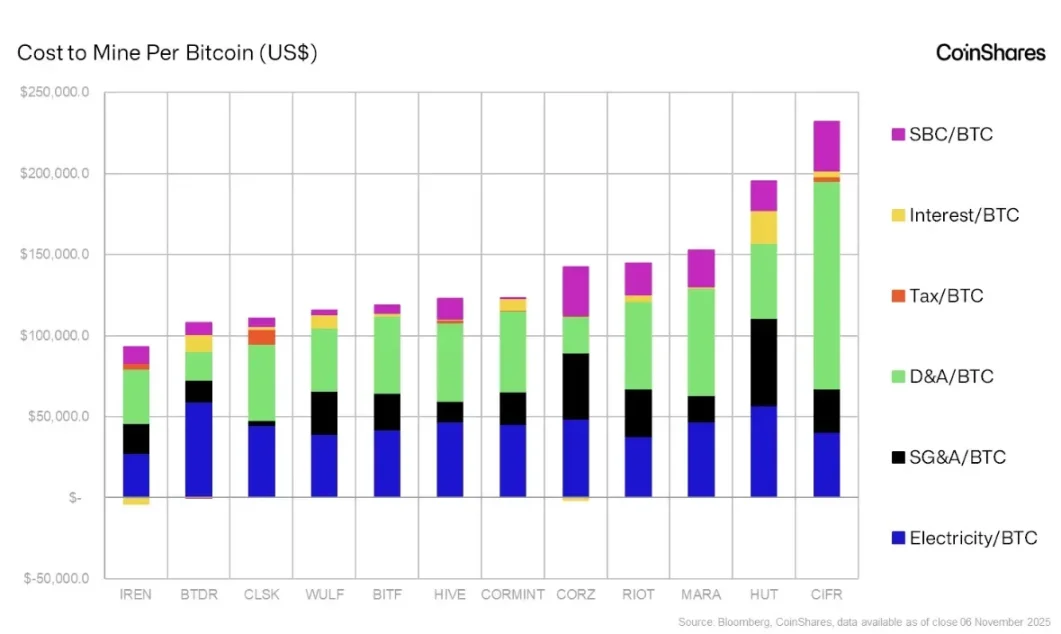
However, the current price of Bitcoin is around $91,000. This means that for every Bitcoin produced, mining companies face a paper loss of approximately $46,000. The increasing mining difficulty and tightening energy policies further worsen the cost structure, leading to an increasingly fragile overall profitability foundation for the industry.

III. The Path to Transformation: Why AI Data Centers?

The白热化 AI race has催生 an explosive demand for data centers from tech giants. Building data centers from scratch is time-consuming, and market opportunities are fleeting, so leasing existing, quickly adaptable facilities becomes the preferred option.
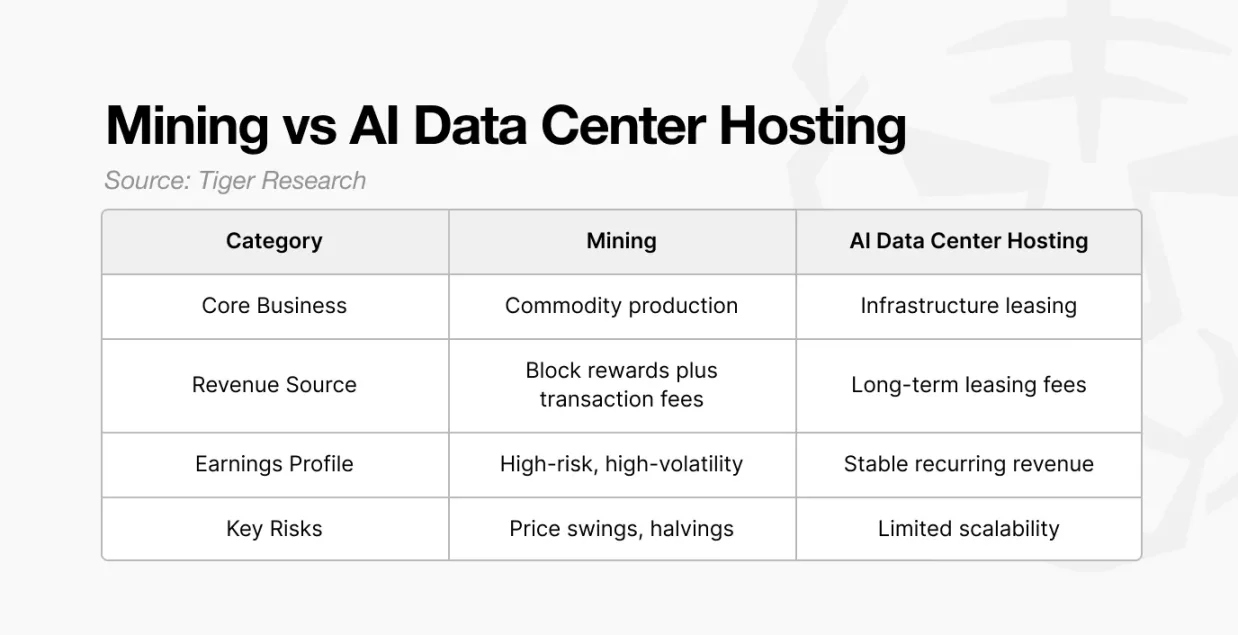
The existing assets of mining companies恰好 match this demand:

  • Computing Hardware: Possess大量 high-performance GPUs (such as NVIDIA chips) that can be repurposed for AI computing.

  • Power Resources: Already approved grid access at the数百兆瓦 level is a scarce resource in today's energy market.

  • Cooling Capacity: Experience in operating high-power mining machines积累, which can be directly applied to managing AI servers like H100/H200.
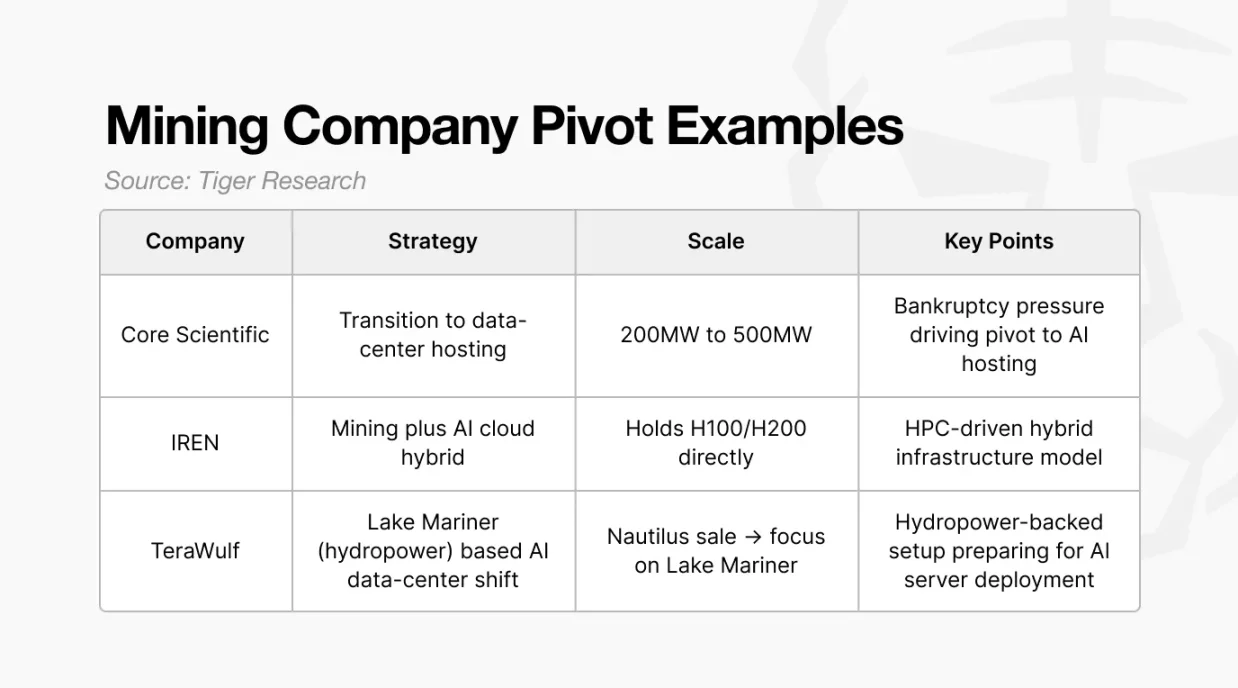
A typical case is Core Scientific, which was once濒临破产. By transforming into AI data center leasing, it now operates approximately 200 megawatts of capacity and plans to expand to 500 megawatts, successfully turning a profit. Companies like IREN and TeraWulf are also exploring similar paths of business diversification. This is not just about pursuing growth, but a necessity for survival.

IV. Diversified Evolution: More Than Just Data Centers

Transitioning to AI data center leasing is the mainstream trend, but it is not the only way out. This is essentially a rational choice for mining companies to reallocate capital to more efficient areas. Stable data center revenue can provide mining companies with a cash flow buffer, allowing them to more从容 strategically hold Bitcoin assets and avoid forced sales during market downturns.

Meanwhile, some mining companies, such as Bitmine and Cathedra Bitcoin, are exploring expansion into broader Digital Asset Technology (DAT) business models. These diversification attempts collectively point to a trend:纯挖矿 players with weak competitiveness are being淘汰 or转型, while leading companies are evolving into comprehensive service providers. The entire cryptocurrency mining industry is moving towards a new, more mature, and more resilient stage.


Связанные с этим вопросы

QWhat are the main reasons Bitcoin miners are facing a survival crisis?

ABitcoin miners face a survival crisis due to unstable mining income tied to volatile Bitcoin prices, while their operating costs, including rising electricity prices, increasing mining difficulty, and hardware upgrades, continue to climb. This creates a 'squeeze from both ends' that makes their core business model unsustainable.

QWhat is the average cost to mine one Bitcoin, and how does it compare to the current price?

AAccording to CoinShares, the average cost to mine one Bitcoin has risen to approximately $74,600. When including costs like equipment depreciation, the total production cost is close to $130,000 per Bitcoin. With the current Bitcoin price around $91,000, miners are facing a significant deficit for each coin they produce.

QWhy are AI data centers an attractive pivot for Bitcoin mining companies?

AAI data centers are an attractive pivot because there is explosive demand from tech giants for computing power, and building new data centers from scratch is time-consuming. Mining companies already possess the necessary assets: high-performance GPUs that can be repurposed for AI computation, pre-approved access to massive electrical grids (a scarce resource), and expertise in cooling high-power equipment, which is directly applicable to managing AI servers.

QCan you name a specific mining firm that has successfully transitioned to AI data center leasing?

AA prime example is Core Scientific. After nearly facing bankruptcy, the company successfully transitioned to AI data center leasing. It currently operates approximately 200 megawatts of capacity, with ambitions to expand to 500 megawatts, and has returned to profitability.

QBeyond AI data centers, what other diversification strategies are some mining companies exploring?

ABeyond AI data centers, some mining companies like Bitmine and Cathedra Bitcoin are exploring a broader shift towards Digital Asset Technology (DAT) business models. This overall trend towards diversification signifies the industry's evolution from pure-play mining to more mature, resilient, and comprehensive service providers.

Похожее

The Other Side of the Stock Market Rally: Energy Restructuring, Bitcoin Squeeze, and Market Mismatch

The article examines the complex and seemingly contradictory signals in global markets, where rising equities, falling oil prices, and cooling inflation expectations coexist with unresolved structural tensions. In digital assets, a major corporate strategy added nearly $1 billion in Bitcoin, increasing its holdings significantly, while Bitcoin's price action is seen as less important than the persistent negative funding rates, indicating a crowded short position that could lead to a sharp upward repricing. The global oil trade is rapidly rewiring, with the U.S. Gulf Coast becoming a key supplier to Europe and Asia amid Middle East disruptions. However, the article warns that such supply shocks can lead to permanent demand destruction as consumers and governments adapt. U.S. equities rose on optimism over potential geopolitical de-escalation and softer PPI data, led by tech stocks like NVIDIA. Meanwhile, the U.S. Federal Reserve maintains a wait-and-see stance on rates. Geopolitically, U.S.-Iran negotiations are ongoing alongside a maritime blockade, which has disrupted energy infrastructure and supply chains. Finally, the push for supply chain reshoring, particularly in critical minerals and defense, is accelerating but faces significant execution challenges related to permitting, financing, and labor, moving the issue from cost to one of strategic necessity.

marsbit16 мин. назад

The Other Side of the Stock Market Rally: Energy Restructuring, Bitcoin Squeeze, and Market Mismatch

marsbit16 мин. назад

US Stocks Hit Record Highs: Why Isn't the Market Afraid of the Flames of War?

U.S. stocks hit a record high on April 15, with the S&P 500 closing at 7,022.95, just 77 days after its previous peak. This rebound occurred in only 11 trading days—far faster than recoveries following past crises like the COVID-19 pandemic (103 days) or the 2011 debt crisis (106 days). The market's rapid recovery is attributed to "ceasefire expectations" rather than deteriorating economic fundamentals. During the sell-off triggered by the U.S.-Israel military action against Iran in late February, the S&P 500 fell nearly 10%. However, the market rallied twice on ceasefire rumors—first on March 24 and again on April 8—even before any permanent peace deal was signed. Notably, the VIX fear index fell below pre-war levels, indicating that the market had repriced the conflict from an uncertainty to a calculable risk. Major financial institutions like JPMorgan reported record trading revenues of $11.6 billion in Q1 2026, largely driven by volatility in commodities and emerging markets. Hedge funds turned net long for the first time since late 2025, while margin debt hit a record $1.28 trillion. This reflects a financial system that commercializes volatility, treating geopolitical shocks as tradable opportunities rather than systemic threats. However, the current optimism relies on assumptions of a sustained ceasefire and stable oil prices, leaving the market vulnerable if these conditions change.

marsbit56 мин. назад

US Stocks Hit Record Highs: Why Isn't the Market Afraid of the Flames of War?

marsbit56 мин. назад

Is the Rebound an Illusion? The Bond Market Has Already Given the Answer

Is the stock market's rapid rebound to pre-war levels a sign of recovery or a misleading rally driven by momentum rather than fundamentals? While the S&P 500 has fully recovered its losses from the U.S.-Iran conflict and nears all-time highs, bond and oil markets tell a different story. Key data reveals contradictions: 10-year Treasury yields have risen 30 basis points, signaling persistent inflation concerns and constrained Fed policy space. WTI crude is up 37%, indicating that geopolitical risks are not priced to resolve soon. The 2-year Treasury yield, a sensitive gauge of rate expectations, has increased nearly 40 bps, challenging the narrative of imminent Fed rate cuts. The equity market appears to be pricing in a "perfect scenario": subdued oil impact on consumption, Fed rate cuts despite hot inflation, stable corporate margins, and near-term conflict resolution. However, bonds and oil reflect a reality of sticky inflation, limited Fed flexibility, and ongoing geopolitical tension. This divergence suggests the rally may be momentum-driven rather than fundamentally justified. If upcoming CPI data exceeds expectations (e.g., above 3.5%), the 2026 rate-cut narrative could collapse. Investors chasing the rally are betting on an ideal outcome—swift conflict resolution, controlled inflation, Fed easing, and resilient earnings—while ignoring signals from more cautious asset classes. The gap will likely close either through a fundamental improvement validating stocks or a market correction aligning with bond and oil realities.

marsbit1 ч. назад

Is the Rebound an Illusion? The Bond Market Has Already Given the Answer

marsbit1 ч. назад

Торговля

Спот
Фьючерсы

Популярные статьи

Тест по Bitcoin Биткоина

HTX Learn: Изучите Bitcoin halving и Заработаете Токены USDT

2.9k просмотров всегоОпубликовано 2024.04.16Обновлено 2024.04.16

Тест по Bitcoin  Биткоина

Что такое $BITCOIN

ЦИФРОВОЕ ЗОЛОТО ($BITCOIN): Комплексный анализ Введение в ЦИФРОВОЕ ЗОЛОТО ($BITCOIN) ЦИФРОВОЕ ЗОЛОТО ($BITCOIN) — это проект на основе блокчейна, работающий в сети Solana, который стремится объединить характеристики традиционных драгоценных металлов с инновациями децентрализованных технологий. Хотя он носит имя Биткойн, часто называемого “цифровым золотом” из-за его восприятия как средства хранения ценности, ЦИФРОВОЕ ЗОЛОТО является отдельным токеном, предназначенным для создания уникальной экосистемы в ландшафте Web3. Его цель — позиционировать себя как жизнеспособный альтернативный цифровой актив, хотя детали его применения и функциональности все еще развиваются. Что такое ЦИФРОВОЕ ЗОЛОТО ($BITCOIN)? ЦИФРОВОЕ ЗОЛОТО ($BITCOIN) — это токен криптовалюты, специально разработанный для использования в блокчейне Solana. В отличие от Биткойна, который выполняет широко признанную роль хранения ценности, этот токен, похоже, сосредоточен на более широких приложениях и характеристиках. Примечательные аспекты включают: Инфраструктура блокчейна: Токен построен на блокчейне Solana, известном своей способностью обрабатывать высокоскоростные и недорогие транзакции. Динамика предложения: ЦИФРОВОЕ ЗОЛОТО имеет максимальное предложение, ограниченное 100 квадриллионами токенов (100P $BITCOIN), хотя детали о его обращающемся предложении в настоящее время не раскрыты. Утилита: Хотя точные функциональные возможности не описаны, есть указания на то, что токен может быть использован для различных приложений, потенциально связанных с децентрализованными приложениями (dApps) или стратегиями токенизации активов. Кто создатель ЦИФРОВОГО ЗОЛОТА ($BITCOIN)? На данный момент личность создателей и команды разработчиков, стоящих за ЦИФРОВЫМ ЗОЛОТОМ ($BITCOIN), остается неизвестной. Эта ситуация типична для многих инновационных проектов в области блокчейна, особенно тех, которые связаны с децентрализованными финансами и феноменом мем-криптовалют. Хотя такая анонимность может способствовать культуре, ориентированной на сообщество, она усиливает опасения по поводу управления и ответственности. Кто инвесторы ЦИФРОВОГО ЗОЛОТА ($BITCOIN)? Доступная информация указывает на то, что у ЦИФРОВОГО ЗОЛОТА ($BITCOIN) нет известных институциональных спонсоров или значительных венчурных капиталовложений. Проект, похоже, функционирует по модели пирингового взаимодействия, сосредоточенной на поддержке и принятии сообществом, а не на традиционных путях финансирования. Его активность и ликвидность в основном сосредоточены на децентрализованных биржах (DEX), таких как PumpSwap, а не на устоявшихся централизованных торговых платформах, что еще больше подчеркивает его подход, ориентированный на grassroots. Как работает ЦИФРОВОЕ ЗОЛОТО ($BITCOIN) Операционные механизмы ЦИФРОВОГО ЗОЛОТА ($BITCOIN) можно подробно описать на основе его дизайна блокчейна и характеристик сети: Механизм консенсуса: Используя уникальный механизм доказательства истории (PoH) Solana в сочетании с моделью доказательства доли (PoS), проект обеспечивает эффективную валидацию транзакций, что способствует высокой производительности сети. Токеномика: Хотя конкретные дефляционные механизмы не были подробно описаны, большое максимальное предложение токенов подразумевает, что оно может быть предназначено для микротранзакций или нишевых случаев использования, которые еще предстоит определить. Интероперабельность: Существует потенциал для интеграции с более широкой экосистемой Solana, включая различные платформы децентрализованных финансов (DeFi). Однако детали относительно конкретных интеграций остаются неуточненными. Хронология ключевых событий Вот хронология, которая подчеркивает значимые вехи, касающиеся ЦИФРОВОГО ЗОЛОТА ($BITCOIN): 2023: Первоначальное развертывание токена происходит в блокчейне Solana, отмеченное его адресом контракта. 2024: ЦИФРОВОЕ ЗОЛОТО приобретает видимость, когда оно становится доступным для торговли на децентрализованных биржах, таких как PumpSwap, позволяя пользователям обменивать его на SOL. 2025: Проект наблюдает спорадическую торговую активность и потенциальный интерес к инициативам, возглавляемым сообществом, хотя на данный момент не зафиксировано никаких значительных партнерств или технических достижений. Критический анализ Сильные стороны Масштабируемость: Основная инфраструктура Solana поддерживает высокие объемы транзакций, что может повысить полезность $BITCOIN в различных сценариях транзакций. Доступность: Потенциально низкая цена торговли за токен может привлечь розничных инвесторов, способствуя более широкому участию благодаря возможностям дробного владения. Риски Отсутствие прозрачности: Отсутствие публично известных спонсоров, разработчиков или процесса аудита может вызвать скептицизм относительно устойчивости и надежности проекта. Волатильность рынка: Торговая активность сильно зависит от спекулятивного поведения, что может привести к значительной волатильности цен и неопределенности для инвесторов. Заключение ЦИФРОВОЕ ЗОЛОТО ($BITCOIN) является интригующим, но неоднозначным проектом в быстро развивающейся экосистеме Solana. Хотя он пытается использовать нарратив “цифрового золота”, его отход от установленной роли Биткойна как средства хранения ценности подчеркивает необходимость более четкого различения его предполагаемой утилиты и структуры управления. Будущее принятие и усвоение, вероятно, будут зависеть от решения текущей непрозрачности и более четкого определения его операционных и экономических стратегий. Примечание: Этот отчет охватывает синтезированную информацию, доступную на октябрь 2023 года, и с тех пор могут произойти события.

99 просмотров всегоОпубликовано 2025.05.13Обновлено 2025.05.13

Что такое $BITCOIN

Fractal Bitcoin: масштабирование Биткоина с помощью рекурсивной системы

Fractal Bitcoin — масштабное Layer-1-решнение, созданное на базе кода Биткоина, позволяющего достигать бесконечного масштабирования с помощью рекурсивного подхода.

2.2k просмотров всегоОпубликовано 2025.06.30Обновлено 2025.06.30

Fractal Bitcoin: масштабирование Биткоина с помощью рекурсивной системы

Обсуждения

Добро пожаловать в Сообщество HTX. Здесь вы сможете быть в курсе последних новостей о развитии платформы и получить доступ к профессиональной аналитической информации о рынке. Мнения пользователей о цене на BTC (BTC) представлены ниже.

活动图片