Bitcoin is About to Choose a Direction, How to Respond Flexibly | Invited Analysis

Odaily星球日报Опубликовано 2025-12-29Обновлено 2025-12-29

Введение

Odaily featured market analyst Conaldo provides a weekly trading report on Bitcoin (BTC). Last week, the strategy of shorting within the defined resistance zone of $89,500–$91,000 was successfully performed twice, yielding a total return of 3.62%. The core view that the market would experience wide-range volatility was validated, with price action accurately testing the identified support and resistance levels. From a technical perspective, BTC has been in a confirmed medium-term bearish trend since its historic high on October 6th, with a maximum drawdown of approximately 36% over 82 days. However, multiple technical indicators suggest the market is approaching oversold conditions historically associated with bottoms. Since November 22nd, price has consolidated in a low-range, indicating a balance between bullish and bearish forces and a buildup of energy for a directional breakout. A key possibility is presented: if the market is dominated by major players, a strategic move for bears could be to break down below the critical psychological level of $80,000. This would flush out remaining long positions via panic selling, potentially forming a final bottom before a powerful technical rebound. **This Week's Outlook (Dec 29 - Jan 4):** The market is expected to oscillate with a bearish bias, with the core area to watch being **$86,000–$86,500**. * A break below could lead to a test of the **$83,500–$84,500** support zone. * Holding above could extend the current **$86,50...

Odaily Invited Market Analyst Conaldo, Master of Financial Statistics from Columbia University, USA, focused on quantitative trading of US stocks during university and gradually expanded to digital assets such as Bitcoin, constructing a systematic quantitative trading model and risk control system through practical experience; possesses keen data insight into market fluctuations and is committed to continuous development in the professional trading field, pursuing stable returns; will delve into BTC technical, macro, and capital changes weekly, review and showcase practical strategies, and preview major upcoming events for reference.

Trading Weekly Report Core Summary:

  • Strategy Execution (Short-term) Effectiveness Verification: Last week's trading strictly followed the established strategy, successfully completing two operations, achieving a cumulative return of 3.62%.
  • Core View (Short-term) Verification: Our core view proposed last week that "the market will show wide-range fluctuations" has been perfectly verified by the market movement. The defined core observation range of $89,500~$91,000 and the support zone below of $86,500~$87,500 were repeatedly tested. Particularly key, last week's high of $90,598 was only $402 away from the upper edge of our core zone ($91,000); the mid-week pullback low ($86,400) was only $100 away from the lower edge of the support zone ($86,500), and the accuracy of the point prediction has been fully confirmed by the market.
  • From a macro technical perspective, Bitcoin has been correcting for 82 days since hitting its all-time high of $126,200 on October 6, with a maximum decline of about 36%, confirming a medium-term bearish trend. However, observing multiple technical indicators, it has now reached a low area, and both the time and space of the correction are gradually approaching historical common oversold conditions. Since November 22, the price has continued to consolidate in a low range, showing that the forces of long and short are relatively balanced, and the momentum for a directional breakout is accumulating. Although the market's "calls for a rise" are gradually increasing, we believe that, excluding interference from sudden news, there is still one key possibility for the subsequent trend: if the market is dominated by main funds, a better strategy for the bears might be to break down first, piercing the key psychological barrier of $80,000, using panic to clean up the remaining long positions, thus completing the final bottoming. After that, funds can顺势 achieve a "short covering rally," quickly pulling the price away from the cost area, and then start a relatively strong technical rebound. It must be emphasized that the above trend is only a deduction based on market behavior logic, not an inevitable path. No matter how the market evolves, remember: "The market is always right." Before the direction, maintaining observation and flexible response remains the key at this stage.

I. Review of Last Week's Trading Results: (12.22~12.28)

1. Short-term Trading Review (No Leverage):

First Trade (Profit 2.27%): Based on the "rebound to core pressure zone encounters resistance and goes short" pattern. When the price冲击 the $89,500~$91,000 zone and encountered resistance,叠加 the spread trading model simultaneously issued a top signal, a 30% short position was established, and finally profit was taken when the price fell near the support zone.

Second Trade (Profit 1.35%): The trading logic is the same as above. When the price冲击 the $89,500~$91,000 zone and encountered resistance,叠加 two models issued共振 signals, successfully completing this trade.

2. Last Week's Trend Prediction and Operation Strategy Review:

The前瞻 analysis last week clearly stated: It is expected that the market will mainly present a wide-range fluctuation pattern. The core observation range is $89,500~$91,000, and the outcome of the struggle in this area will determine the short-term direction. The following is the strategy review and analysis.

1. Market Trend Prediction Review:

• Core Pressure Level: First pressure looks at the $89,500~$91,000 zone; second pressure looks at the $93,000~$94,500 zone.

• Core Support Level: First support looks at the $86,500~$87,500 zone; second support looks at the $83,500~$84,500 zone.

2. Operation Strategy Review:

• Medium-term Strategy: Maintain a medium-term position of about 65% (short positions).

• Short-term Strategy: Last week we initially drafted A/B two sets of short-term operation plans. Combined with the actual market movement, we finally used Plan B as the core strategy and executed it.

(Plan B: Rebound verification, the $89,500~$91,000 core zone has been effectively broken below)

• Open Position: When encountering resistance signals during the rebound verification process, a 30% short position can be established.

• Risk Control: Stop loss set above $92,000.

• Close Position: When the price探 to the $83,500~$84,500 zone shows resistance, consider partially or fully closing the position to take profit.

II. Technical Analysis: Bitcoin Medium-term Trend Judgment

Combining last week's market operation, the author will use a multi-dimensional analysis model to conduct an in-depth analysis of the evolution of Bitcoin's internal structure and trend.

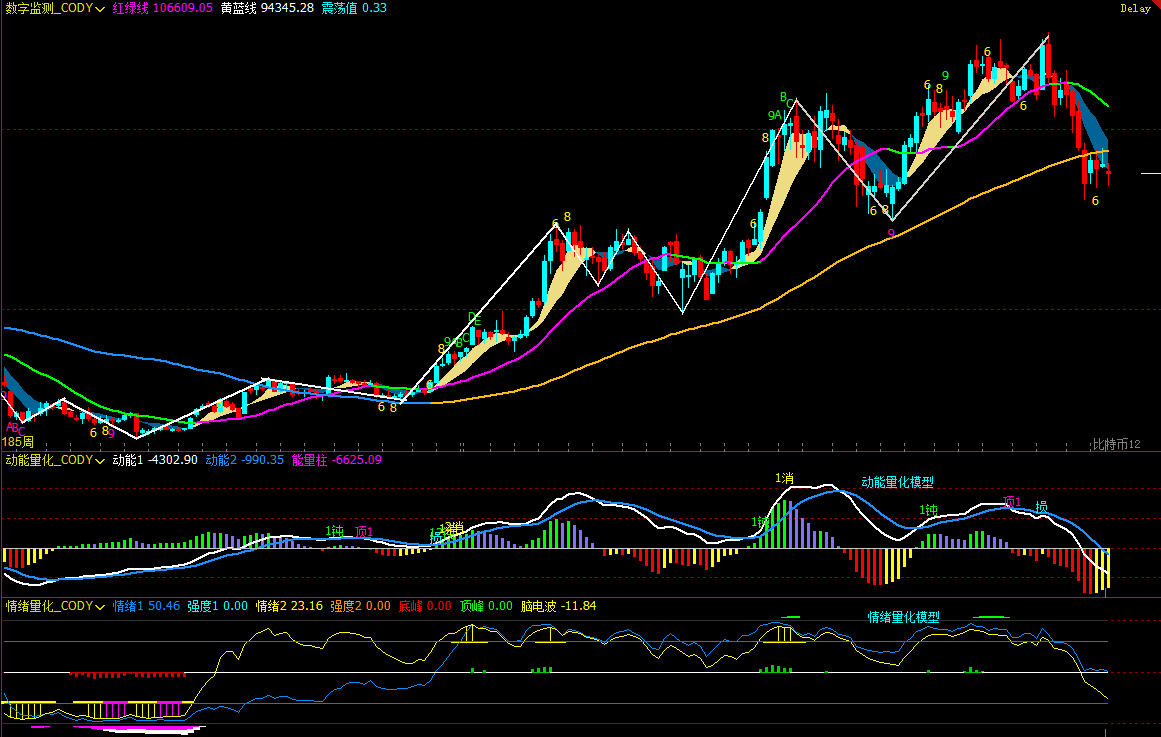
Bitcoin Weekly K-line Chart: (Momentum Quantitative Model + Sentiment Quantitative Model)

Figure 2

1. As shown in (Figure 2), analysis from the weekly chart:

Momentum Quantitative Model: After last week's adjustment, the two momentum indicator lines are still running below the zero axis, and the negative energy柱 is gradually shortening. This indicates that although the weekly chart has entered a bear market, the bearish momentum has not been fully released.

Momentum Quantitative Model Predicts: Price decline index: High

Sentiment Quantitative Model: Blue sentiment line value 49.74, intensity zero; yellow sentiment line value 19.99 (close to the low threshold), intensity zero, peak value is 0.

Sentiment Quantitative Model Predicts: Price pressure and support index: Neutral

Digital Monitoring Model: The price has broken below the bull-bear (yellow-blue line) dividing line for 6 weeks; short-term bottom digital signal (above 9) has not yet appeared.

The above data预示: Bitcoin's weekly chart has established a bearish trend, be wary of subsequent release of bearish forces.

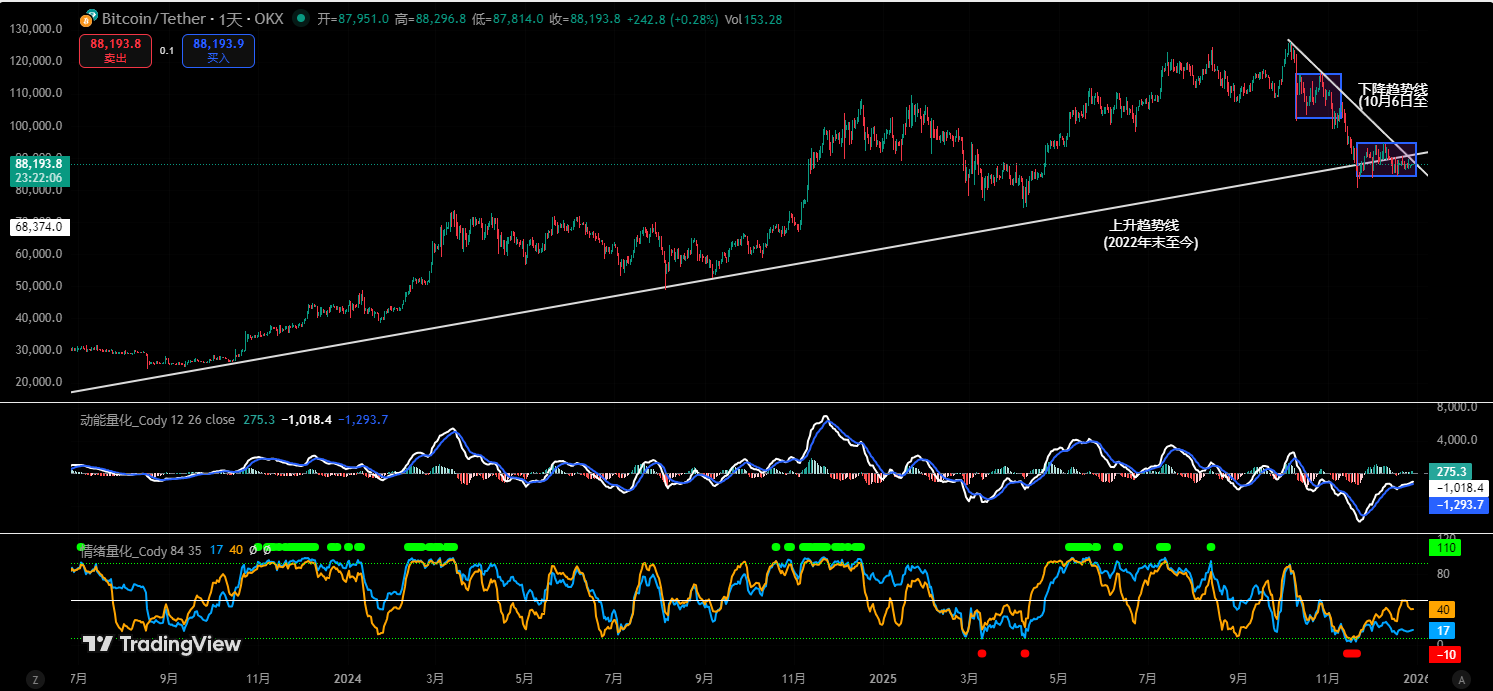
Bitcoin Daily K-line Chart:

Figure 3

2. As shown in (Figure 3), analysis from the daily chart:

Momentum Quantitative Model: In last week's movement, the two momentum lines were almost粘合 together, slowly rising below the zero axis and gradually approaching the zero axis. Affected by the holiday, daily trading volume continued to萎缩, and the positive energy柱 change was not obvious.

Momentum Quantitative Model Predicts: Buying momentum is weak, the energy柱 has contracted to a "starry" state, indicating a temporary balance between long and short forces.

Sentiment Quantitative Model: After last week's daily close, the blue sentiment line value is 16 (close to the low threshold), intensity zero; yellow sentiment line value is 40, intensity zero.

Sentiment Quantitative Model Predicts: Pressure and support index: Neutral

The above data提示: The daily level is in a bear market, and the short-term market is about to choose a direction.

III. This Week's Bitcoin Market Prediction: (12.29~01.04)

1. It is highly likely that the market will mainly fluctuate and探底 this week, with the core observation range at $86,000~$86,500.

If effectively broken below: The price may continue to探底, testing the support zone below of $83,500~$84,500.

If effectively站稳: The market may延续 the current $86,500~$91,000 range fluctuation pattern.

2. Core Pressure Levels:

• First Pressure Zone: $89,500~$91,000 zone

• Second Pressure Zone: $93,000~$94,500 zone

• Important Pressure Zone: Near $97,000

3. Core Support Levels:

• First Support Level: $86,000~$86,500 zone

• Second Support Level: $83,500~$84,500 zone

• Important Support Level: Near $80,000.

IV. This Week's Bitcoin Operation Strategy (Excluding Sudden News Impact): (12.29~01.04)

1. Medium-term Strategy: Maintain a medium-term position of about 65% (short positions).

2. Short-term Strategy: Use 30% of the position, set stop loss points, and look for "spread" opportunities based on support and pressure levels. (Using 30 minutes as the operation cycle).

3. Focus on observing the struggle between long and short双方 over the $86,000~$86,500 zone. To cope with market evolution, we have drafted A/B two sets of short-term operation plans:

Plan A: If effectively站稳 the $86,000~$86,500 zone:

• Open Position: When the price rebounds to the $89,500~$91,000 zone and shows resistance signals, a 30% short position can be established.

• Risk Control: Short stop loss set above $92,500.

• Close Position: When the price falls to the $86,000~$86,500 zone and shows stabilization signals, close all short positions to take profit.

Plan B: If effectively broken below the $86,000~$86,500 zone:

• Open Position: If the price effectively breaks below, a 30% short position can be established.

• Risk Control: Stop loss set above $88,000.

• Close Position: When the price探 to the $83,500~$84,500 zone shows stabilization signals, gradually close the position to take profit.

V. Special Notes:​​

1. When opening a position: Immediately set the initial stop loss level.

2. When profit reaches 1%: Move the stop loss to the opening cost price (breakeven point), ensuring principal safety.

3. When profit reaches 2%​​: Move the stop loss to the position of 1% profit.

4. Continuous Tracking: Thereafter, for every additional 1% profit the price makes, move the stop loss level同步 by 1%, dynamically protecting and locking in existing profits.

(Note: The above 1% profit trigger threshold can be flexibly adjusted by investors according to their own risk preference and标的 volatility.)

VI. This Week's Key Events前瞻: (12.29~01.04)

1. Fed Meeting Minutes Release "Real Divergence" Signal

Wednesday 03:00, the Fed will release the latest monetary policy meeting minutes. Compared to the interest rate decision itself, the minutes are more critical regarding the degree of divergence among internal members on the "timing, magnitude, and persistence of rate cuts."

If the minutes show increased confidence among officials in the decline of inflation and discuss an earlier or faster easing path, it will strengthen market expectations of "falling real interest rates," constituting a medium-term positive for Bitcoin; conversely, if the minutes emphasize concerns about inflation recurring or financial conditions easing too quickly, it may阶段性 lift the dollar and US bond yields, forming emotional suppression on BTC.

For Bitcoin, this is not a short-term directional signal, but an important node affecting the medium-term fund pricing anchor.

2. Initial Jobless Claims: Thermometer of Liquidity Expectations

Wednesday 21:30, the US will announce the initial jobless claims for the week ending December 27.

The market now pays more attention to "whether the labor market is showing structural cooling" rather than fluctuations in a single data point.

If initial claims持续 above trend levels, it will further verify the economic cooling logic, strengthening market expectations for the continuation of宽松 policies, which is beneficial for the valuation repair of non-yielding assets like Bitcoin; if the data falls again, it may strengthen the judgment that "the economy is still resilient," which is not conducive to the expansion of risk appetite for BTC in the short term.

The impact of this indicator on Bitcoin is mainly reflected in interest rate expectations rather than fundamentals itself.

3. Final Manufacturing PMI Verifies Real Economy Direction

Friday 22:45, the US December S&P Global Manufacturing PMI final value is announced.

As a leading indicator, the PMI will help the market judge whether "soft landing" is still on track.

If the final value confirms that manufacturing is stabilizing or even improving, the overall sentiment of risk assets is expected to be maintained, with limited systematic pressure on BTC; if the PMI is revised down again, it may trigger repricing of economic downturn, short-term bearish for risk assets, but medium to long term may instead strengthen expectations for monetary easing.

Financial markets are changing rapidly, all market analysis and trading strategies need to be dynamically adjusted. All views, analysis models, and operation strategies involved in this article are derived from personal technical analysis, for personal trading log use only, and do not constitute any investment advice or operation basis. The market has risks, investment needs caution, DYOR.

Связанные с этим вопросы

QWhat is the analyst's core short-term view on the Bitcoin market as presented in the article?

AThe analyst's core short-term view is that the market is in a state of wide-range consolidation and is about to choose a direction. They emphasize the possibility that major funds might drive a downward break below the $80,000 psychological level to flush out remaining long positions before a potential technical rebound.

QWhat were the key support and resistance levels identified for Bitcoin in the previous week's analysis?

AThe key resistance levels were the first zone at $89,500~$91,000 and the second zone at $93,000~$94,500. The key support levels were the first zone at $86,500~$87,500 and the second zone at $83,500~$84,500.

QAccording to the technical analysis, what is the current state of Bitcoin's medium-term trend based on the weekly chart?

AThe weekly chart analysis confirms that Bitcoin has established a medium-term bearish trend. The momentum量化 model shows indicators below the zero line with negative energy columns shortening, indicating bearish momentum has not been fully released. The sentiment量化 model shows neutral pressure and support indices.

QWhat are the two main short-term trading strategies (Plan A and Plan B) proposed for the upcoming week?

APlan A: If the price holds effectively above the $86,000~$86,500 area, open a 30% short position when the price rebounds to the $89,500~$91,000 resistance zone and shows a rejection signal. Stop loss is set above $92,500. Plan B: If the price effectively breaks below the $86,000~$86,500 area, open a 30% short position. Stop loss is set above $88,000. Take profit when the price falls to the $83,500~$84,500 support zone and shows signs of stabilization.

QWhat key macroeconomic events are highlighted as important for Bitcoin's price movement in the coming week?

AThe key events are: 1. The release of the FOMC Meeting Minutes on Wednesday at 03:00, which could signal internal Fed分歧 on rate cuts. 2. The Weekly Initial Jobless Claims data on Wednesday at 21:30, which acts as a thermometer for liquidity expectations. 3. The S&P Global Manufacturing PMI Final reading on Friday at 22:45, which validates the direction of the real economy.

Похожее

Silicon Valley 'Startup Guru' Steve Hoffman: Web3 + AI Could Be a Trap

Silicon Valley investor and "Godfather of Startups" Steve Hoffman warns that combining Web3 with AI is likely a trap, not a promising venture. In an interview, Hoffman argues that while AI is a foundational technology touching all industries, Web3 adds complexity, friction, and regulatory risk without solving mainstream consumer or business needs. He advises founders to focus on deep, specialized applications where startups can out-iterate giants, rather than on generic features easily replicated by large tech companies. Hoffman observes that Silicon Valley will lead foundational AI research, while China excels at rapid, large-scale application and commercialization, particularly in robotics. He stresses that AI-driven autonomous agents capable of collaborative, multi-step tasks are 2-4 years away, which will cause significant job displacement. The solution is not to slow AI but to redesign business models around human-AI collaboration and reform social systems like education and retraining. For startups, Hoffman recommends focusing on vertical, expertise-heavy domains to build defensibility. He sees major opportunities in AI fraud detection and cybersecurity. Key founder mindsets include systemic thinking over feature-focus, relentless customer centricity, building adaptive teams, and deeply understanding AI's capabilities and limits. Hoffman is also leading a non-profit initiative to establish university centers aimed at training future leaders in responsible, human-value-aligned AI innovation.

marsbit58 мин. назад

Silicon Valley 'Startup Guru' Steve Hoffman: Web3 + AI Could Be a Trap

marsbit58 мин. назад

Token Inefficient, Economy Tokenless

The article "Tokens Aren't Economical, Economics Aren't Tokenized" analyzes a pivotal shift in the AI industry from a technology-driven narrative to one dominated by capital efficiency. It highlights two concurrent trends: a severe capital shortage due to the exorbitant and recurring costs of compute (e.g., OpenAI's high burn rate) and a wave of corporate spin-offs where major tech companies are separating their AI units (like Kuaishou's Kling and Baidu's Kunlunxin). The core argument is that AI's "anti-internet" business model, where user growth increases costs rather than profits, has created a disconnect between high valuations and actual cash flow. Spin-offs address this by allowing AI assets to be valued independently. Within a parent company, they are seen as cost centers, but as standalone entities, they are priced based on their growth potential and scarcity in the primary market, leading to massive valuation premiums (e.g., Kling's estimated value tripling post-spin-off). The industry is at an inflection point, moving from "model worship" to "value realization." The competition is evolving from a pure compute (GPU) race to a broader focus on systemic efficiency and full-stack engineering (involving CPUs and orchestration) to achieve viable commercialization. The year 2026 is framed as a critical moment where the industry must definitively answer how to economically translate AI capability into tangible business value, reshaping the sector's future power structure.

marsbit1 ч. назад

Token Inefficient, Economy Tokenless

marsbit1 ч. назад

Crossing the 'Memory Wall': The Wafer-Level Revolution and Computing Power Routes in the AI Inference Era

In 2026, a historic shift occurred in AI as major cloud providers' inference spending surpassed training spending for the first time, signaling a move from "building large models" to "using large models." This shifts the core challenge from computing power to the "memory wall"—the bottleneck of data movement (model weights, activations, KV Cache) between external DRAM and processors, where energy and latency from data transfer far exceed computation itself. Companies like Nvidia face GPU idle time due to bandwidth limits. In contrast, Cerebras Systems adopts a radical "wafer-scale" approach with its Wafer-Scale Engine (WSE). Instead of cutting a silicon wafer into many chips, Cerebras uses almost the entire wafer as one massive chip (WSE-3). This design provides 44GB of on-chip SRAM, delivering memory bandwidth thousands of times higher than traditional HBM (e.g., 21 PB/s vs. Nvidia B200). For LLM inference, weights are streamed layer-by-layer from external MemoryX storage to the chip, avoiding HBM bottlenecks. This results in token generation speeds 1.5–5 times faster than Nvidia's B200 in some models and significant advantages in first-token latency and long-context tasks. Additionally, Cerebras's architecture offers much lower interconnect power consumption (0.15 pJ/bit vs. GPU's ~10 pJ/bit). However, Cerebras faces challenges: SRAM scaling has slowed with advanced nodes, limiting future capacity gains; the chip requires specialized liquid cooling and custom software stacks; and its external I/O bandwidth (150 GB/s) is low compared to NVLink, hindering multi-system scaling for very large models. Competition is intensifying. Major players are pursuing three paths: 1) Developing proprietary inference ASICs (e.g., Google TPU, Microsoft Maia), 2) Leveraging advanced packaging (e.g., TSMC's SoW) to democratize wafer-scale-like integration, potentially eroding Cerebras's process advantage within a few years, and 3) Exploring optical interconnects for ultimate bandwidth. Commercially, Cerebras is transitioning from a hardware vendor to a service provider, facing the immense challenge of building high-power, specialized data centers to meet large contracts (e.g., 250MW/year from 2026–2028). In conclusion, the AI inference era presents a fundamental architectural trade-off. Cerebras opts for extreme physical optimization for low-latency, single-task performance, while Nvidia prioritizes versatility and massive cluster throughput. The path forward remains uncertain, with technology and business models still evolving in the race toward advanced AI.

marsbit1 ч. назад

Crossing the 'Memory Wall': The Wafer-Level Revolution and Computing Power Routes in the AI Inference Era

marsbit1 ч. назад

Has Bitcoin's 'Rebound Ended', Officially Entering the Late Bear Market Phase?

**Title: Has Bitcoin's Rebound Ended, Entering the Late Bear Market Phase?** **Summary:** Bitcoin's price has declined by 13% this week, signaling a potential return to late-stage bear market conditions. The price fell to around $67k, positioned between the Realized Price and Realized Cap Weighted Average. For the first time since early 2022, the Short-Term Holder cost basis has dropped below this key average, confirming a hallmark of late-cycle bear markets. Profitability metrics have collapsed sharply. The 7-day average of the Realized Profit/Loss ratio plummeted from a local high of 3.16 to 0.29, mirroring the February panic sell-off. Critically, the 90-day average never breached the threshold of 2, indicating the recent rally to $82k was a bear market bounce, not a structural shift. Realized losses surged to $1.35 billion daily, with $770 million coming from Long-Term Holders selling at a loss. This accelerating redistribution of supply from weak to strong hands is a necessary but ongoing process for a market bottom. The rally stalled almost precisely at the aggregate cost basis (~$83k) of US spot Bitcoin ETF investors, turning that level into strong resistance and leaving the average ETF holder underwater again. Spot market flows have turned decisively negative, showing sellers are dominating order books despite the price drop. While a significant futures long liquidation event cleared over $400 million in leverage, providing a potential reset, sustained spot demand is yet to materialize. Options markets continue to price in higher future volatility (Implied Volatility) than recent price action (Realized Volatility) has shown, with a persistent skew towards put options, indicating ongoing demand for downside protection. In conclusion, multiple metrics point to a fragile market structure. Resistance at the ETF cost basis, accelerating realized losses, dominant spot selling, and cautious options pricing all suggest the bear market trend persists. A sustainable recovery likely requires a resurgence of spot demand, ETF holders returning to profit, and a clear reduction in selling pressure.

marsbit1 ч. назад

Has Bitcoin's 'Rebound Ended', Officially Entering the Late Bear Market Phase?

marsbit1 ч. назад

TechFlow Intelligence Agency: Anthropic Calls for Global Pause in AI Development While Preparing for Trillion-Dollar IPO; SpaceX IPO Roadshow Heats Up, But S&P 500 Rejects Fast-Track Inclusion

In today's TechFlow Intelligence Briefing, several major tech stories highlight a growing theme of trust and credibility gaps across AI, crypto, and finance. AI company Anthropic has publicly called for a global pause in AI development, citing risks from Claude's "recursive self-improvement." Ironically, this coincides with reports the company is preparing for a massive IPO targeting a near $1 trillion valuation. This perceived hypocrisy, coupled with widespread user complaints about Claude's declining performance, is sparking debate over whether the safety warning is genuine or a competitive tactic. Meanwhile, in a substantive security move, Anthropic open-sourced a framework for AI-powered vulnerability discovery. In the crypto market, Bitcoin's price drop below $61,000 triggered over $1.16 billion in liquidations, flipping the market into a state where more BTC is held at a loss than at a profit, a historical bearish signal. On the corporate front, SpaceX's highly anticipated IPO is generating immense Wall Street excitement, with Goldman Sachs projecting 100x revenue growth by 2030. However, the S&P 500 has refused to fast-track the company's inclusion post-IPO, potentially limiting immediate institutional demand. Separately, ByteDance's AI app Doubao lost over 6 million monthly active users after introducing a subscription model, highlighting the challenges of AI monetization. Other notable developments include Nvidia certifying HBM4 memory from Samsung, SK Hynix, and Micron; Cloudflare's acquisition of front-end tooling company VoidZero; and its CEO warning that bot traffic now exceeds human traffic online. The underlying narrative connects these events: a trust crisis. From AI firms' contradictory actions and crypto volatility to the clash between SpaceX's hyped narrative and institutional rules, a pattern is emerging where stated intentions and actual practices are increasingly misaligned.

marsbit1 ч. назад

TechFlow Intelligence Agency: Anthropic Calls for Global Pause in AI Development While Preparing for Trillion-Dollar IPO; SpaceX IPO Roadshow Heats Up, But S&P 500 Rejects Fast-Track Inclusion

marsbit1 ч. назад

Торговля

Спот
Фьючерсы

Популярные статьи

Как купить ZEST

Добро пожаловать на HTX.com! Мы сделали приобретение Zest Protocol (ZEST) простым и удобным. Следуйте нашему пошаговому руководству и отправляйтесь в свое крипто-путешествие.Шаг 1: Создайте аккаунт на HTXИспользуйте свой адрес электронной почты или номер телефона, чтобы зарегистрироваться и бесплатно создать аккаунт на HTX. Пройдите удобную регистрацию и откройте для себя весь функционал.Создать аккаунтШаг 2: Перейдите в Купить криптовалюту и выберите свой способ оплатыКредитная/Дебетовая Карта: Используйте свою карту Visa или Mastercard для мгновенной покупки Zest Protocol (ZEST).Баланс: Используйте средства с баланса вашего аккаунта HTX для простой торговли.Третьи Лица: Мы добавили популярные способы оплаты, такие как Google Pay и Apple Pay, для повышения удобства.P2P: Торгуйте напрямую с другими пользователями на HTX.Внебиржевая Торговля (OTC): Мы предлагаем индивидуальные услуги и конкурентоспособные обменные курсы для трейдеров.Шаг 3: Хранение Zest Protocol (ZEST)После приобретения вами Zest Protocol (ZEST) храните их в своем аккаунте на HTX. В качестве альтернативы вы можете отправить их куда-либо с помощью перевода в блокчейне или использовать для торговли с другими криптовалютами.Шаг 4: Торговля Zest Protocol (ZEST)С легкостью торгуйте Zest Protocol (ZEST) на спотовом рынке HTX. Просто зайдите в свой аккаунт, выберите торговую пару, совершайте сделки и следите за ними в режиме реального времени. Мы предлагаем удобный интерфейс как для начинающих, так и для опытных трейдеров.

259 просмотров всегоОпубликовано 2026.05.19Обновлено 2026.06.02

Как купить ZEST

Обсуждения

Добро пожаловать в Сообщество HTX. Здесь вы сможете быть в курсе последних новостей о развитии платформы и получить доступ к профессиональной аналитической информации о рынке. Мнения пользователей о цене на A (A) представлены ниже.

活动图片